v
ABSTRACT
vi
ABSTRAK
vii
TABLE OF CONTENTS
CHAPTER CONTENT PAGE NO.
DECLARATION ii
DEDICATION v
ACKNOWLEDGEMENT iv
ABSTRACT (ENGLISH) v
ABSTRACT (MALAY) vi
TABLE OF CONTENTS vii
LIST OF TABLES xii
LIST OF FIGURES xiii
LIST OF SYMBOLS xx
LIST OF APPENDICIES LIST OF SYMBOLS
xxi xiv
1 INTRODUCTION 1
1.2 Problem Background 4
1.3 Problem Statement 5
1.4 Research Aim 6
1.5 Objectives 6
1.6 Project Scope 6
1.7 Thesis Organization 7
2 LITERATURE REVIEW 8
viii
2.2 Digital Watermarking 9
2.3 Fundamental of digital watermarking 2.3.1 Embedding of watermark in content
2.3.2 Subsequent reading of watermark by
d device/software
2.3.3 Back-end database for determining 2.3.4 Actions triggered upon reading of Watermark 10 11 11 11 12 2.4 Basic Watermarking Techniques
2.4.1 Visible watermarking 2.4.2 Invisible watermarking
12 12 14 2.5 Requirement of a good watermark
i. Robustness
ii. Quality of the image
iii. Payload capacity of the image iv. Reliability of the watermark
15 15 16 16 16 2.6 Watermark Attacks i. Simple attacks
ii. Detection-disabling attacks iii. Ambiguity attacks
iv. Removal attacks 17 17 17 17 17
2.7 Wavelet Transform 18
2.8 Signal Space 19 2.9 Continuous Wavelet Transform (CWT) 20 2.10 Discrete Wavelet Transform (DWT) 22 2.11 Multiresolution Analysis (MRA)
2.11.1 Scaling function 2.11.2 Wavelet function 2.11.3 Analysis and synthesis
24 24 25 26 2.12 Two Dimensional Discrete Wavelet
transform
28
2.13 Watermarking and Wavelets 30
ix
3 RESEARCH METHODOLOGY 34
3.1 Introduction 34
3.2 Research Structure 35
3.3 Decompose and segmentation image 37 3.4 The Embedding Algorithm
3.4.1 The Wavelet Decomposition 3.4.2 Embedding images in the wavelet
3.4.3 Wavelet reconstruction 38 38 40 41 3.5 Watermarking Detection and Extraction 44 3.6 Peak Signal to Noise Ratio (PSNR) 44
3.7 Correlations 45
4 RESULT AND DISCUSSION 46
4.1 Introduction 46
4.2 Transparency 47
4.3 Robustness 4.3.1 Filtering
4.3.1.1 Median filter 4.3.1.2 High pass filter 4.3.1.3 Sharpen filter
4.3.2 Adding noise 4.3.2.1 Gaussian Noise 4.3.2.2 Salt and peppers Noise
4.3.2.3 Spackle Noise 4.3.3 Geometric attack 4.3.3.1 Rotation
4.3.3.2 Cropping
4.3.3.3 Jpeg compression 4.3.4 Removal attack
4.3.5 Contrast enhancement and Brightness adjust.
4.3.6 Motion effect
48 49 49 50 52 54 54 56 57 59 59 61 62 64 66 69
x
4.5 Conclusion 72
5 CONCLUSION 74
5.1 Introduction 74
5.2 Conclusion 75
5.3 Future Work 76
1
CHAPTER 1
INTRODUCTION
1.1 Introduction
An increased care has been paid recently on the multimedia services leading to fast and noticeable growth in this vital sort of computerized services. This growth is moving along with special techniques prepared to support the security fields like copyright protection, fingerprinting and authentication.
2 The purpose behind digital watermarking is to embed the information and data in the host digital media (image, video and audio) with the purpose of copyright protection, access control, broadcast monitoring etc. Embedding the information in images is made possible through making slight changes unrecognized by naked eye [1].The changes imposed in the images are controlled by computer program to be recoverable.
According to [35] there are three significant differences between digital watermarking and other technology:
i. Unlike encryption, watermark is imperceptible so that the image will not be detracting from the aesthetic sense.
ii. The watermarks and the works they embedded in are inseparable. Even if the works were displayed or converted into other file formats
iii. The watermarks will have exactly the same transformation experience as the works that means you can get the information of transformation by looking at the watermarks.
Watermarking system is regarded as a reliable way in which many efforts have been exerted in order to get the researches fully acquainted with it. However, the requirements of this system are significant issue to discuss [2]:
i. Readability: The mobility of the information in the watermark system ought to be pretty rapid, statistically organized, with a sufficient amount of data to define the ownership and sound copyright.
ii. Security: watermark data are allowable just for the permitted users.
iii. Imperceptibility: The embedding process should not introduce any perceptible artifacts into original image and not degrade the perceive quality of image
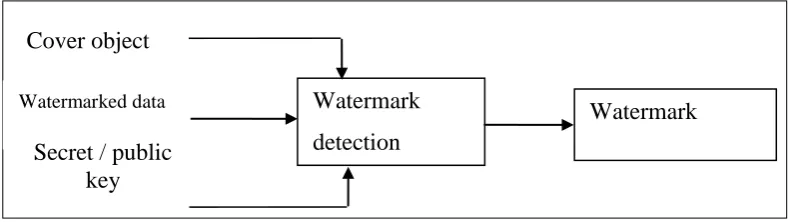
3 The watermarking system is provided with at least one key, or a number of keys to meet the requirement of the security. In another hand, the function of the key is to support the security for preventing the unauthorized users to modify on or fooling around with the secured image [3]. The General Framework for watermarking is shown in Figure 1.1 and 1.2. Any watermarking scheme consists of three parts. The watermark, embedding (insertion algorithm), and detection with comparator (extraction). Embedding as a process contains watermark as inputs, cover object and the secret or the public key. Numbers, text and images are the main types used as watermark. The outcome of the process is watermarked data Figure 1.1.
Figure 1.1: Digital watermarking Embedding
The inputs used for extracting are watermarked data, original data and secret or public key. The recovers watermark is the outcome of the process.
Figure 1.2: Digital watermarking extracting Watermark
detection Cover object
Watermarked data
Secret / public key
Watermark Digital
watermark Cover object
Secret / public key
4 Robustness and transparency are the parameters in which the watermarking tries to adjust. The technique of watermarking insists to find a location for watermark to insert and to get the robustness of the watermark improved [4].
There are many issues contributes to make the algorithm robustness significant. The Algorithm robustness must play a role of a robust watermark to withstand all the attacking attempts including common signal processing distortions which an image encounters during transmission and malicious removing attacks [5].
1.2 Problem Background
There is remarkable number of unprotected images in internet at the time being; consequently this makes these images vulnerable to illegal use and informal downloading. The negativity of the illegal use to these data is usually associated with economic losses to original owner [6]. The problem in digital watermarking is that there are two requirements of transparency and robustness which must be satisfied but they almost always conflict with each other.
5 Robustness is another important issue in watermarking, the embedding process should not introduce any perceptible artifacts into original image and not degrade the perceive quality of image. Robustness refers to ability to recover the watermark after performing various signals processing attacks on watermarked image. The degree of watermarking robustness differs from one signal processing to another [9]. The attack implement by applying for example, filters, adding noise, geometric distortions and removal. in addition to evaluating similarity between original and recovered watermark after applying attacks.
1.3 Problem Statement
Internet and network topologies are being utilized extensively nowadays. As a result for these affect digital contents become widely available and every one can access it then use it for personal or commercials purposes. Many users abused these contents by piracy and forgery, these problems generated the need to authenticity of digital contents.
The digital watermarking technology proposed as a solution to deal with this kind of problems.The problem is how to embed a watermark in an image to how to improve the robustness of the watermark.
6
1.4 Research Aim
The aim of this work is to construct a digital image watermarking using wavelet transform. The proposed watermark technique offers a property of robustness whereby it is strong enough to confront the malicious attacks. The other point behind using watermark technique is to create no evidence on watermarking the image, in another words; the watermarked image is unable to be differentiated by naked eye.
1.5 Objectives
This project intends to achieve the following objectives:
i. To develop a digital watermarking by using wavelet method ii. To achieve a transparency image watermarking
iii. To achieve the robustness of image watermarking by applying filters, adding noise, geometric, removal, Contrast enhancement, Brightness and motion attacks.
1.6 Project Scope
7 i. The project focus on 1024*1024 RGB images of the host image and gray scale UTM logo image size (256*256) BMP format as a watermark. The format of the host image is (JPG), also (BMP).
ii. The program is built on windows environment using MATLAB language 2008a.
1.7 Thesis Organization
The report is divided into 5 chapters:
i. Chapter 1 describes the introduction and background of the study, the project objectives, scope.
ii. Chapter 2 gives literature reviews on the existing watermarking technique, and brief description of wavelet transform.
iii. Chapter 3 describes the project methodology.
iv. Chapter 4 discusses the result of the project methodology