DECLARATION OF THESIS / UNDERGRADUATE PROJECT PAPER AND COPYRIGHT
Author’s full name :
Date of birth :
Title :
MOHD NAZER BIN APAU
THE ANALYSIS AND DEVELOPMENT OF SECURE 27th FEBRUARY 1976
SOFTWARE ASSESSMENT MODEL (SSAM)
CASE STUDY: ONE OF THE MAJOR FINANCIAL INSTITUTION
Academic Session :
I declare that this thesis is classified as:
I acknowledged that Universiti Teknologi Malaysia reserves the right as follows:
1. The thesis is the property of Universiti Teknologi Malaysia.
2. The Library of Universiti Teknologi Malaysia has the right to make copies for the purpose of research only.
3. The Library has the right to make copies of the thesis for academic exchange.
Certified by:
SIGNATURE SIGNATURE OF SUPERVISOR
(NEW IC NO. /PASSPORT NO.) NAME OF SUPERVISOR
Date : Date :
760227-04-5193
2007/2008
RABIAH AHMAD
OPEN ACCESS I agree that my thesis to be published as online open access
(full text)
RESTRICTED (Contains restricted information as specified by the
organization where research was done)*
CONFIDENTIAL (Contains confidential information under the Official Secret
Act 1972)*
√
NOTES : * If the thesis is CONFIDENTAL or RESTRICTED, please attach with the letter from
Perpustakaan Sultanah Zanariah UTM, Skudai
Johor.
Sir,
CLASSIFICATION OF THESIS AS RESTRICTED - THE ANALYSIS AND DEVELOPMENT OF SECURE SOFTWARE ASSESSMENT MODEL (SSAM) CASE STUDY: ONE OF THE MAJOR FINANCIAL INSTITUTIONS BY MOHD
NAZER BIN APAU
Please be informed that the above mentioned thesis entitled “The Analysis and Development of Secure Software Assessment Model (SSAM) Case Study: One of the Major Financial Institutions” be classified as RESTRICTED for a period of three (3) years from the date of this letter. The reasons for this classification are:-
(i) Thesis contains some confidential information regarding the case study organization’s process flow and standard operating procedure, and
(ii) The contents display some information about the bank’s participated vendors
Thank you.
Sincerely yours,
………..
Dr. Rabiah Ahmad
“I hereby declare that I have read this thesis and in my opinion this thesis is sufficient in terms of scope and quality for the
award of the degree of Master of Information Security”
ASSESSMENT MODEL (SSAM)
CASE STUDY: ONE OF THE MAJOR FINANCIAL INSTITUTIONS
MOHD NAZER BIN APAU
A project report submitted in fulfillment of the requirements for the award of the degree of Master of Computer Science (Information Security)
Faculty of Computer Science and Information Systems University Teknologi Malaysia
I declare that this thesis entitled “The Analysis and Development of Secure Software
Assessment Model (SSAM) Case Study: One of the Major Financial Institutions
(Malaysia)” is the result of my own research except as cited in the references. The thesis has not been accepted for any degree and is not concurrently submitted in candidature of any other degree.
To my wife Izam Zuliana Yahya, and children Zarif Aiman , and Nur Zara Safiah
ACKNOWLEDGEMENT
IN THE NAME OF ALLAH, MOST GRACIOUS, MOST COMPASSIONATE
Thank you to Allah for giving me the blessing for health, strength and earnestness to accomplish and fulfill my final project report. I take this opportunity to convey my utmost gratitude and appreciation to my supervisor, Dr. Rabiah Ahmad and Pn. Salmah Awang who gives me the full support and all guidance, advice and commitment upon my effort to complete this report.
ABSTRACT
ABSTRAK
TABLE OF CONTENTS
CHAPTER TITLE PAGE
DECLARATION ii
DEDICATION iii
ACKNOWLEDGEMENTS iv
ABSTRACT v
ABSTRAK vi
TABLE OF CONTENTS vii
LIST OF TABLES x
LIST OF FIGURES xi
LIST OF ABBREVIATIONS xii
LIST OF APPENDICES xiii
1 INTRODUCTION
1.1 Overview 1
1.2 Background of Selected Study Organization 1 1.3 The Background of Problem 4 1.3.1 Lack of Compliances to IS Security Policy 5
1.3.2 Staff Constraint 6
1.3.3 Cost 6
1.4 The Objective 7
1.5 Scope 8
1.6 Project Importance 10
1.7 Project Plan 11
2.1 Introduction 13
2.2 Techniques and Approach 14
2.3 Common Criteria 16
2.4 Architecture Trade-off Analysis Method 18
2.5 Qualitative Selection 20
2.6 SDLC Phase 0: Evaluation 26
2.6.1 Introduction 26
2.6.2 Initiations and Endorsement 27
2.6.3 Source for Solution 28
2.6.4 Assessment and Selection 29
2.6.4.1 Functional and Technical Review 29
2.6.4.2 Cost Implication Review 31
2.6.4.3 Overall Assessment 31
2.6.4.4 Recommendation 32
2.7 Commercial of the Shelf (COTS) Evaluation 3
2.7.1 Plan the evaluation 34
2.7.2 Design the evaluation instrument 34 2.7.3 Apply the evaluation instrument 34
2.8 Summary 35
3 PROJECT METHODOLOGY
3.1 Introduction 36
3.2 Operational Framework 36
3.2.1 Data Collection and Analysis 37
3.2.2 Pilot Study 38
3.2.3 Evaluate the Result 38
3.2.4 Develop Prototype 38
4.1 Introduction 40 4.2 Secure Software Assessment 40
4.3 Mapping on Activity between
SDLC Phase 0 and COTS Model 43 4.4 Generic Secure Software Assessment model 45 4.5 IT Security Baseline Requirement 46
4.5.1 Physical Security 47
4.5.2 Network Security 47
4.5.3 Application Security 48 4.5.4 Database Security 48
4.5.5 System Security 49
4.5.6 ID Security 49
4.5.7 Operational Management 49
4.5.8 Logical Security 50
4.5.9 Policies 50
4.6 Summary 51
5 RESULT AND DISCUSSION
5.1 The Result of SSAM Implementation 52 5.2 The Result of Pilot Project Implementation 53
5.3 Summary 58
6 CONCLUSION
6.1 Conclusion 59
6.2 Summary of Contribution 61
TABLE NO TITLE PAGE
1.1 SDLC Phases 2
1.2 IS Security Policies 9
2.3 Scoring Table 21
2.4 Vendor Self-Evaluation scale 23
2.5 Risk Factor 24
2.6 Vendor Self-Evaluation Score scale 24 2.7 SDLC Phase 0: Fix Scoring for Functional and
Technical 29
4.8 COTS and SDLC Phase 0 42
4.9 IT Security Baseline Requirement
Section 44
5.10 Project 1 for Vendor A 52
5.11 Project 1 for Vendor B 53
5.12 Project 2 for Vendor A 54
5.13 Project 2 for Vendor B 54
FIGURE NO TITLE PAGE
1.1 Project Life Cycle 3
1.2 Project Activities 11
2.3 Security Software Assessment
and SDLC Phase 0 26
3.4 Operational Framework 35
4.5 COTS and SDLC Phase 0 42
4.6 Secure Software Assessment Model 44
GITSC – Group IT Steering Committee LTM – Logical Technology Model
ORM – Operational Risk Management PTM – Physical Technology Model RD – Requirement Definition
WO – Work Order
COTS – Commercial of the Shelf RFI – Request for Information RFP – Request for Proposal
Org. – Organization
R&R – Roles and responsibilities ITSEC – IT Security
BAFO – Best and Final Offer
LIST OF APPENDIXES
APPENDIXES TITLE PAGE
A IT Security Baseline Requirements 64 B IT Security Baseline Compliance Table 103 C IT Security Baseline Prototype Scoring
INTRODUCTION
1.1 Overview
This chapter begins with the background of the selected case study organization. In section 1.2 it briefly explains on the current process in dealing with a software development and a project life cycle. One of the focus areas is software evaluation. Section 1.3 highlights the difficulty face by the organization if the proposed Secure Software Assessment Model (SSAM) is not in place. Chapter 1 emphasizes on the objective of having SSAM with explaining on the scope and the importance of SSAM.
1.2 Background of the Selected Study Organization
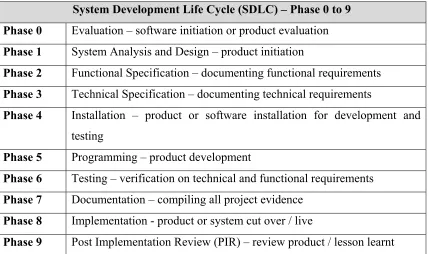
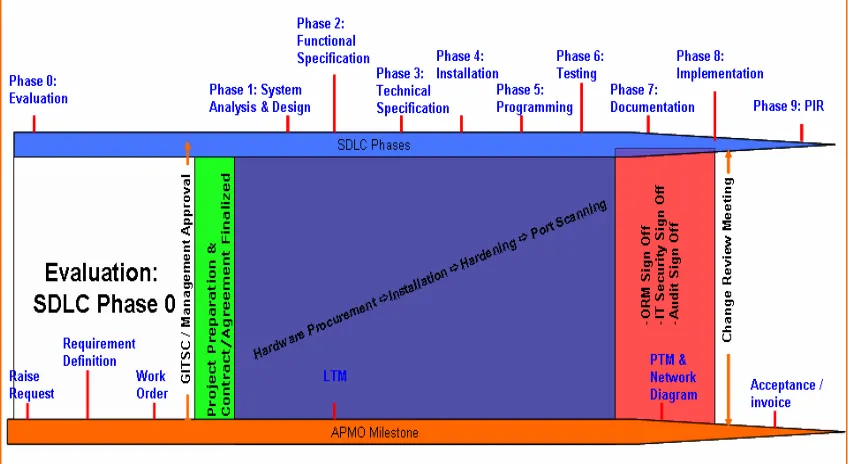
It is a known fact that each IT project implementation involves a new software deployment. Staff within the organization is expected to comply with the System Development Life Cycle (SDLC) framework where it consists of Phase 0 until Phase 9 as illustrated in Table 1.1 below. The organization’s Project Life Cycle (PLC) framework has two main processes which are SDLC and Account Project Management Office (APMO). SDLC is used to govern the software development life cycle while APMO is governing the infrastructure related matters. This is consisting of network operation setup, server preparation, server hardening and the port scanning activities. Figure 1.1 representing the organization high level process of SDLC and APMO.
System Development Life Cycle (SDLC) – Phase 0 to 9 Phase 0 Evaluation – software initiation or product evaluation
Phase 1 System Analysis and Design – product initiation
Phase 2 Functional Specification – documenting functional requirements
Phase 3 Technical Specification – documenting technical requirements
Phase 4 Installation – product or software installation for development and testing
Phase 5 Programming – product development
Phase 6 Testing – verification on technical and functional requirements
Phase 7 Documentation – compiling all project evidence
Phase 8 Implementation - product or system cut over / live
Phase 9 Post Implementation Review (PIR) – review product / lesson learnt
Figure 1.1: Project Life Cycle
Annually, the Information System (IS) sector is mandated with at least 400 projects for implementation. These projects are required to support and align the business objective. The directive is critical due to aggressive competition among the Financial Institution (FI) Sector. Each FI desire to come up with own product within the reasonable time frame. Lapse in ‘time to market’ of the product will dampen the business objective and possibly losing opportunity to the other FI. Even though, the volume of a project is filtered every year whereby only a high Return on Investment (ROI) project is implemented, yet the volume is still far ahead with a comparison to the available manpower. In this case, we are specifically referring to the staff responsible in guaranteeing that the IS Security Policy is followed and being addressed accordingly.
Occasionally, the projects implemented and systems installed are not able to fully comply with the IS Security Policy and Requirements. Prior to project implementation, evaluation committee was formed in order to evaluate the suitable solution. The solution selected must be able to fulfill the business requirements. Even though the selection of vendors is going trough a very detail and structured process, there are still possibilities that the system is not able to fully comply with the IS Security Policy once the software is installed. This is due to the fact that the committee members is not normally put a priority to other requirement such as security requirement as compared to their business or functional requirement. During the evaluation process, verification is done through a paper based. This is where the proposal submitted is reviewed by the evaluation team. The evaluation committee’s decision will be based upon the proposal in which the information is weight from the document and then analyze for further assessment. If it involves such a high investment, the committee may ask participated vendors to prepare a test environment where a “near-production-setup” can be shown to the committee.
IS Staff is expected to support the organization business objective by successfully implementing a new software and technology. The technology is an enabler to the organization goals and objectives. Every year, the number of projects waiting to be implemented is very high. IS Security personnel are playing a vital role in order to ensure the software installed is in compliance to the organization IS Security Policy and Standard. A realistic number of people are required to handle tremendous number of projects implemented in the organization. However, the existing manpower is not sufficient and may not able to work efficiently and effectively to support the current needs. Security requirements is the responsibility of everyone in the organization and it is not the responsibility of IS Security personnel alone.
1.3.3 Cost
There is potentially a high possibility to incur additional cost in getting the vendors to comply with IS Security Policy. During the project implementation, it is the responsibilities of the Project Manager to ensure the software installed is comply with the IS Security Policy. Unfortunately, there are cases whereby during evaluation it was noted as comply but it is not able to comply with it when comes for actual implementation. This misunderstanding does happen and could cause the organization to incur with more effort and money to get the system comply with the stipulated policy.
the self-assessment from the vendors’ responses. However, as mentioned earlier in this chapter, the outcome of the end product by using the assessment model may not guarantee 100% compliance to the security policy, but it can anticipate for the organization on the software assurance compliance level prior to the deployment.
1.4 The Objective
The selected organization for the case study has established a software evaluation process and known as SDLC Phase 0. During this phase, it requires the project evaluation team to produce a documented requirement or Request for Proposal (RFP). The RFP then submitted to the potential vendors or the solution providers. This paper is going to discuss on the above process in more detail in Chapter 2. Even though IS Security personnel is expected to get involve in all evaluation projects, it is extremely difficult to manage the project effectively and efficiently in term of monitoring the security compliances. Hence, this study is formulated to:-
a. Understand the areas of a secure software assessment, particularly areas related to the selected case study organization behavior;
b. Develop appropriate Secure Software Assessment Model (SSAM) which consists of IS Security Requirement Baseline as a simple tools;
c. Integrate the Secure Software Assessment Model (SSAM) to the existing SDLC Phase 0 (Evaluation phase) in the organization; and
d. The success in this integration will result to a prototype of Secure Software Assessment Model.
it is impossible to ascertain a 100% non-vulnerabilities product, but to a certain degree, assurance is a likely method to reduce the known threats and vulnerabilities in any IT Products. Software Security Assurance is the process of ensuring that software is designed to operate at a level of security that is consistent with the potential harm that could result from the loss, inaccuracy, alteration, unavailability, or misuse of the data and resources that it uses, controls, and protects. (Wikipedia, 2007 Wikipedia. Retrieved October 2007, from http://en.wikipedia.org/wiki/Software_Security_Assurance). By having SSAM, the organization is hoping to achieve the following:-
a. Provide a better snapshot on the level of IS Security Policy Compliance on the intended software installation or intended project implementation;
b. Sufficient and efficient in monitoring project evaluation; and
c. Reduce the risk of extra cost incurred, due to additional scope or add-on in order to comply with IS Security Policy;
1.5 Scope
1. The project scope is only covers to the organization head office located in Kuala Lumpur, Malaysia. It is important to note that the organization has about 22,000 employees and more than 500 branches nationwide. However, the scope of this study is mainly covering a software acquisition by the IS Sector.
2. The main custodian of the process would be the IS Security Department. However, the baseline requirement will be the responsibility of each evaluation project team to update in accordance to their current needs and situation.
on the organization’s IS Security Policy and the development of Information Security Baseline Requirements. The selected policy available are as below:-
Information Security Policy
1. IS Security Policy 2. Policy on General Systems Security and Controls on ID and Password
3. Security Policy for Overseas Branches
4. Local Administrator Policy
5. Notebook Policy 6. Desktop Policy 7. Anti Virus Policy 8. Internet Usage Policy 9. Firewall Policy 10. Email Usage Policy 11. Enterprise Security Network
Architecture Policy
12. Wireless Communication Policy
13. Database Policy 14. Remote Access Policy 15. VPN Policy 16. PKI Guideline
17. Encryption Policy 18. Backup Policy
Table 1.2: IS Security Policies
A) can always be updated with a proper versioning control in place.
1.6 Project Importance
The proposed SSAM is expected to establish visibility and manageability of software installed within the organization. The benefits would be:-
1. Detection of a problem to the current infrastructure, design, policy, and setup. 2. Risk clarification and prioritization on the mitigation process can be done in
order to support business objectives; and
1.7 Project Plan
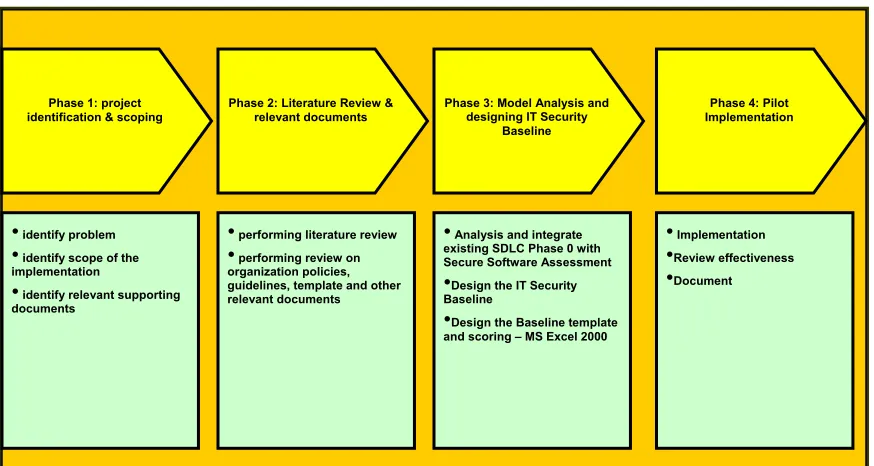
In order to achieve the desired result, figure 1.2 below conceptually lay out major activities to be performed for project completion. The key activities are divided into 4 phases as below:-
Phase 1: Project Identification and scoping
Phase 2: Literature Review and relevant documents
Phase 3: Model Analysis and designing the IT Security Baseline Phase 4: Pilot Implementation
Phase 1: Phase 2: Liter re Review &
relevant documents Phase 3: Modedesigning IT Security nalysis and Implementation Phase 4 Pilot : project
identification & scoping atu l A
Baseline
• identify problem e
• performing literature review • Analysis and integrate • Implementation ss
• identify scope of th plementation im
• identify relevant supp
• performing review on ganization policies, or
guidelines, template and relevant documents
•Review effectivene
•Document existing SDLC Phase 0 wi
Secure Software Assessment
•Design the IT Security seline
th
other
orting Ba
•Design the Baseline templat documents
e and scoring – MS Excel 2000
.
REFERENCES
Alan W. Brown and Kurt C. Wallnau (1996). A Framework for Systematic Evaluation of Software Technologies. 5-40. Software Engineering Institute, CMU, 19996
Ann Brown (2005). IS Evaluation in Practice. 169-178. The Electronic Journal Information Systems Volume 8 Issue 3.
David Carney (1998). Evaluation of COTS Product: Some Thoughts on the Process. 1-7. SEI Interactive 9/98.
Dieter Gollman (2006). Computer Security. 170-184. (2nd Edition) John Wiley and Sons Ltd.
Federic Copignneaux and Sylvain Martin (1998). Software Security Evaluation Based on a Top down Mc Call like Approach. 414-418. French Ministry of Defense.
Ha Lin, Ahh Lai and Rebecca Ulrich (2006). COTS Software Selection Process. 8, 12-14,18. Sandia National Laboratories.
John Kelsey (2005). Voting System Testing and Evaluation. 1-16. NIST, Computer Security Division.
John Rushby (1995). Formal Methods and their Role in the Certification of Critical Systems. 9-38. FAA Digital Systems Validation Handbook.
CMU/SEI-2006-TN-026
R. Kazman, Mark Klein and Paul Clements (2000). ATAM: Method for Architecture Evaluation 3-15. SEI: CMU.
Ray C. Williams, George J. Pandelious and Sandra G. Behrens (1999). Software Risk Evaluation (SRE) Method Description. 33-59, 73-81. Software Engineering Institute, CMU, 1999.
Syntegra (2006). Common Criteria. Common Criteria Project Sponsoring Organization, May 1998