
Oleg Mazonka, Nektarios Georgios Tsoutsos,
and Michail Maniatakos, Member, IEEE
Abstract
The rapid expansion and increased popularity of cloud computing comes with no shortage of privacy concerns about outsourcing computation to semi-trusted parties. Leveraging the power of encryption, in this paper we introduce Cryptoleq: an abstract machine based on the concept of One Instruction Set Computer, capable of performing general-purpose computation on encrypted programs. The program operands are protected using the Paillier partially homomorphic cryptosystem, which supports addition on the encrypted domain. Full homomorphism over addition and multiplication, which is necessary for enabling general-purpose computation, is achieved by inventing a heuristically obfuscated software re-encryption module written using Cryptoleq instructions and blended into the executing program. Cryptoleq is heterogeneous, allowing mixing encrypted and unencrypted instruction operands in the same program memory space. Programming with Cryptoleq is facilitated using an enhanced assembly language that allows development of any advanced algorithm on encrypted datasets. In our evaluation, we compare Cryptoleq’s performance against a popular fully homomorphic encryption library, and demonstrate correctness using a typical Private Information Retrieval problem.
Index Terms
Abstract Machine, Compiler, Encrypted Computation, Obfuscation, One Instruction Set Computer, Heterogeneous Computer, Homomorphic Encryption, Paillier.
Copyright c2016 IEEE. Personal use of this material is permitted. However, permission to use this material for any other purposes must be obtained from the IEEE by sending a request to [email protected].
O. Mazonka and M. Maniatakos are with the Department of Electrical and Computer Engineering, New York University Abu Dhabi, UAE (e-mail: [email protected]; [email protected]).
N. G. Tsoutsos is with the Department of Computer Science and Engineering, New York University, New York (e-mail: [email protected]).
I. INTRODUCTION
Contemporary computing paradigms, such as cloud and pervasive computing, have become increasingly
popular as they allow outsourcing computation to a typically more powerful or dedicated set of machines.
From Bitcoin mining [1] and Mersenne primes search [2], to commercial cloud services offered by
major industry companies, outsourced computation requires code execution in a remote machine. One
fundamental concern with such paradigms, however, is the privacy of the outsourced data [3]. In addition
to the legitimate third party that performs the outsourced computation, additional concerns arise in light
of side channel attacks [4] or even hardware Trojans [5]–[7].
Fortunately, cryptographic primitives such as homomorphic encryption can be leveraged to address
those privacy concerns, and eventually return control of the data back to the legitimate information
owner [8], [9]. As soon as fully homomorphic encryption (FHE) became theoretically possible [10]–[13],
the academic interest in FHE applications has increased accordingly. From secure cloud computation
[14] and verifiable computation [15], to multiparty computation [16] and message authenticators [17]. In
addition, partial homomorphic encryption (PHE) has recently been leveraged for verifiable computation
[18].
Despite the wide range of applications that can benefit from FHE schemes, their efficiency has been
a concern, and their practicality has been questioned [19], [20]. More practical implementations of
FHE, such as [21], have already been instantiated in the HElib software library, but fully homomorphic
operations could still have overheads in the order of seconds [22]. In addition, HElib only recently has
evolved to support bootstrapping and rencryption [23], and applications that use this library to implement
generic/interactive computer programs that process homomorphic data are yet to be seen.
On the other hand, PHE schemes are more practical than their FHE counterparts, and what the former
lack in range of supported operations, they gain in efficiency. Indeed, PHE schemes typically require
straightforward operations on ciphertexts, such as modular multiplication, which can be implemented
very efficiently (e.g. [24]–[27]). Our observation is that PHE could be sufficient for practical applications
of outsourced computation, where the applicable threat model can afford obfuscation as an adequate
mitigation control to protect the privacy of processed data. Of course, PHE is less powerful than
FHE in terms of computational completeness, and end-to-end encryption is traded for performance in
computations. This tradeoff will allow us to design and implement a new programming language capable
of processing homomorphically encrypted data with practical computational cost.
Problem formulation: This work addresses the problem of protecting the privacy of sensitive data,
Fig. 1. Cryptoleq abstraction layers.
In addition, this work combines privacy preservation with a practicality requirement, which, so far, is
difficult to achieve through FHE schemes. Likewise, this work also addresses the usability problem of
theoretical approaches, which prevents them from seeing wide deployment and being used in everyday
applications.
Our contribution: In this work we propose Cryptoleq, a new programming language based on a
single instruction computer architecture, which processes homomorphic data natively. Cryptoleq defines
a universal computer for processing encrypted and unencrypted data together within the same program
memory space. Data encryptions are generated using Paillier PHE, and only homomorphic addition is
natively supported. Universal computation, however, requires support for both addition and multiplication,
and in this work, we simulate multiplication with heuristically obfuscated re-encryption implemented
using Cryptoleq instructions. Notably, we devised a PHE operating model with a single instruction that
supports both encryption and decryptionwithin itself; this effectively enables unifying re-encryption with
the executing program. Overall, we claim the following:
• Design and implementation of Cryptoleq, which expands single instruction computing with native
support for homomorphic data using a novel bit layout representation. Cryptoleq supports programs
written without privacy protections, as well as protected execution using encrypted data under full
encryption or heuristic obfuscation modes, depending on the need to multiply encrypted values.
• A practical framework for Cryptoleqwith extended assembly language, compiler, and emulator for
executing Cryptoleq programs on different platforms (e.g. x86, ARM).
Roadmap: The paper is organized on a bottom-up traversal of Cryptoleq abstraction layers (fig. 1).
Following a preliminaries discussion on homomorphic encryption and single instruction architectures
(sec-tion II), the Cryptoleq abstract machine is presented in sec(sec-tion III. Multiplica(sec-tion on encrypted operands
is then presented in section IV, while section V discusses the Cryptoleq Enhanced Assembly Language
(CEAL) that accelerates program development in Cryptoleq. In section VI, we evaluate the correctness
against a popular FHE library [23], while related work and conclusions appear in sections VIII and IX.
II. PRELIMINARIES
A. Homomorphic Encryption
Homomorphic encryption allows the application of mathematical operations directly on encrypted data
so that the results after decryption would correspond to applying matching operations on unencrypted
data. This can be expressed as:
v=f(u) ⇐⇒ Enc(v) =g(Enc(u)) (1)
wherevanduare some vectors in the unencrypted domain, Enc(·)is the encryption operation over each vector element, and f andg are related functions. For example, if Enc(z) =az then Enc(x)·Enc(y) = Enc(x+y)so the homomorphism is between addition in unencrypted data and multiplication in encrypted.
In this caseu is a vector of two elements,vis a scalar,f is scalar addition, andgis scalar multiplication. Having one homomorphic mathematical operation is not sufficient for universal computation, as not all
functions can be expressed through that operation. On the other hand, when we have both addition and
multiplication, there exists a zero element that is both an additive identity and multiplicative absorbing
element, and this allows evaluating any function. Indeed, addition and multiplication on a binary ring
would define a Turing complete pair of logic gates [28], and such pair is sufficient to construct a
universal machine. A homomorphic encryption scheme supporting only one operation is called partially
homomorphic, while a scheme supporting two orthogonal operations is called fully homomorphic.
In this work, we employ the Paillier additive PHE scheme that uses a modulus N as its security
parameter [29]. This modulus is defined as the product of two primes, and message m is encrypted as
rNgm modN2. In Paillier, g is an encryption base parameter, whiler is randomly selected to provide
semantic security to the probabilistic scheme [30].
B. One Instruction Set Computer
One instruction set computer (OISC) is a computer architecture which supports only one instruction
and is able to perform universal computation [31]. It operates on memory organized as a sequence of
memory cells, while processor instructions and data reside in unified memory space, following the
von-Neumann model. There exist three OISC categories [32]: (i) Transport Triggered Architecture Machines,
(ii) Bit Manipulation Machines, and (iii) Arithmetic Based Machines.
Since OISC has only one instruction, it is an attractive choice for homomorphic computations for several
possible opcodes for the given arguments and homomorphically combine their results. Furthermore, since
OISC architectures typically apply a simple mathematical operation over their arguments, this operation
can be directly ported to the encrypted domain by identifying its homomorphic counterpart. Thus, due
to their simplicity, OISC architectures are naturally compatible with homomorphic encryption relations
(eq. 1) and can be extended to support processing of encrypted arguments.
One popular Turing-complete OISC is Subleq, which stands for subtract and branch if less than or
equal to zero [33]. Its abstract machine is easily implemented both in hardware and emulating software, as
it is sufficiently simple and computationally efficient compared to other OISC variants. In this work, we
leverage some Subleq principles for constructing our computational model, as presented in the following
section.
III. CRYPTOLEQABSTRACTMACHINE
A. Description of the Model
The Cryptoleq abstract machine is a processor model operating on a sequence of memory cells. Each
memory cell has an address and a value, while any cell value may also be used as a memory address. The
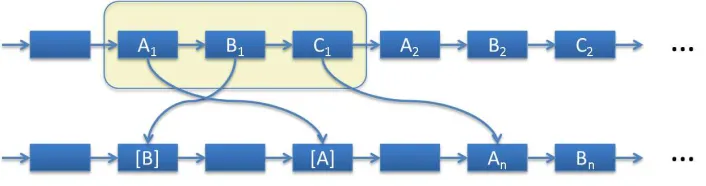
processor has an instruction pointer IP and executes instructions read from memory. Each such instruction
consists of three operands, named A, B andC.
Let [·]denote a dereference operation so that [X] represents a memory cell with address X, as well as its value. The three instruction operands are fetched from memory as follows:
A= [IP]; B = [IP+ 1]; C= [IP+ 2]. (2)
As soon asAandB are fetched, referenced memory cells[A]and[B]are accessed using the values of
AandB as addresses (fig. 2). Then, the instruction modifies[B]and IP values according to the following
two steps:
[B] =O1([A],[B])
IP=
C, if O2([B])≤0
IP+ 3, otherwise
(3)
where O1 and O2 are operations that will be explicitly defined in the following paragraphs (eq. 5). O1
Fig. 2. Instruction and data organization in Cryptoleq.
As soon as the first step of eq. 3 is executed (i.e. operation O1), the result is stored back to the
memory cell pointed byB. Next, operation O2 is performed on the updated value of [B]and the result
is compared with zero. We further define a “Less or equal to zero” compound Boolean operation, named
Leq, over a cell value argument:
Leq(x)def= (O2(x)≤0). (4)
If Leq([B])test is True, then value C is assigned to IP. This is effectively a control flow branch to the
address of the cell where C points to. On the other hand, if Leq([B]) is False, the IP is updated with
the address of the cell immediately after C (i.e. if IP was pointing to A, then it is increased by 3) and
the execution sequence is repeated for the next instruction. Additional details regarding the increment of
IP and address sequence organization are presented in section III-B.
O operations: In Cryptoleq, operations O1 andO2 are defined as follows:
O1(x, y) =x−1·ymodN2, O2(x) =
x−1 N
. (5)
Throughout this paper we use exponent (−1) for reciprocal1 in the corresponding modulus; to avoid ambiguity we also use (·)−ξ1, where placeholder subscript ξ explicitly defines the modulus for the reciprocal. The floor brackets notationb·c refers to the integer part of the fraction in the equation above.
Operations O1,2 have been judiciously selected in order to:
1) support computation on encrypted operands, compatible with the chosen encryption scheme (as it
will become evident in section III-B), and
2) support computation on unencrypted operands, compatible with existing Turing-complete single
instruction languages (further discussed in section III-D)
1
x=rNgm mod N2 (6)
where g is a generator in Z∗N2. We select g= 1 +N k with a random kcoprime to N. Our selection of
g is less general than the original Paillier encryption definition [29], where g can be any number from
Z∗N2 with its order being nonzero and multiple of N. This selection of g is equally secure to [29] and
sufficient for our scheme, with the order of g beingN, and the rest of encryption and decryption being
the same up to notation. In our encryption scheme,r serves as the probabilistic part of encryption, while
m is the plaintext value to be protected. Based on our selection of g, eq. 6 becomes:
x=Enc(m)≡rN(1 +N km) mod N2. (7)
Heremcan be written inside the brackets because modulusN2reduces all higher powers ofN. Moreover,
decryption requires knowledge of kas defined above, and φ that is the value of Euler’s totient function
ofN:
m=Dec(x) = x
φ(kφ)−N1 −1
N mod N,
r= (xg−m)Nφ−1 mod N.
(8)
Eqs. (7) and (8) provide a clear method to encrypt and decrypt numbers comprising the data and executable
code of a program, while operations O1,2 in eq. 5, along with the abstract machine description, define a
method to evaluate a program.
Operation O1 (eq. 5) is homomorphic to subtraction of m’s with recombination of random parts, as
follows:
x−1y= (rx−1ry)Ngmy−mx mod N2. (9)
Thus, multiplication ofy by the invertedxcorresponds to subtraction of their unencrypted values. Having
the subtraction operation also brings the addition functionality to the programming paradigm, considering
x+y =x−(0−y).
TS-notation: Our observation about the aforementioned encryption scheme is that the encrypted value
x is also bijective to a unique pair of values t ands:
with t= [0, N−1], s= [0, N−2], and (s+ 1)being coprime toN. If eq. 10 reconstructsx fromtand s, the converse is:
t=
x−1 N
and s= ((x−1)modN). (11)
To distinguish these two equivalent representations, in this work we name X value the left-hand side of
eq. 10 and TS value the correspondingt ands pair.
The view of an encrypted value x (X value) as t and s (TS value) has additional benefits: First, as
elaborated in section III-C, a simple definition of negative values for O2 is possible. Examining O2 in
eq. 5 andtin eq. 11, we observe that comparingtwith zero is equivalent to Leq(·)comparison in eq. 4. In addition, TS-values are useful when s is zero, since subtraction of t values demonstrates the same
homomorphic property as the encryptedm in eq. 9:
x−1y= (1−N tx)(1 +N ty) =
= 1 +N(ty−tx) mod N2.
(12)
Leveraging this property, the Cryptoleq processor can execute instructions using TS values and generate
the same result as if the instructions were executed on a backwards compatible Subleq processor.
Moreover, a TS pair with s6= 0 can still be used in addition and subtraction because a special “unit” for each particular s can be defined. Let U = 1 +N u be a unit that increases t values by 1. Then,
combining this definition with eq. 10 and operation O1 (eq. 5), we can solve for u:
U−1·(1 +N t+s) = 1 +N(t+ 1) +s modN2,
u= (1 +s)−1 mod N.
(13)
Using this definition,U can be used as a unit to predictably change the t part of any encrypted value.
Since memory cell addresses in Cryptoleq are of the same type as cell values, arranging these cells in
a sequence without introducing the notion ofU, is problematic: when an operand is treated as an address,
naive homomorphic addition or subtraction of a constant does not correspond to an equal increment or
decrement in the address value. Introducing the U unit is essential for defining the notion of sequence
in encrypted values and use them as memory addresses. Hence, address arithmetic in eqs. (2) and (3)
becomes a simple modular multiplication with a power of U; moreover, if TS values are used, address
arithmetic is expressed as a direct increment or decrement of the tpart.
C. Range of values
The Leq operation in eq. 4 is required to make a decision on what values within the range (0, N) are
considered less than zero. Thus, to introduce the concept of “negative” numbers, we break the values in
Fig. 3. Schematic display of Cryptoleq valid number range.
• positiveis a number whose most significant bit position is less than the most significant bit position
ofN, and
• negative is a number whose most significant bit is at the same bit position as the most significant
bit ofN.
This grouping is natural, as it is similar to the commonly accepted bit representation of numbers in
conventional computers. Since N is not a power of 2, the range of negative numbers is actually smaller
than the range of positive numbers. To ensure symmetry between positives and negatives, as expected
in computer arithmetic, we further restrict the range of valid positive numbers. Therefore, we define a
“valid” positive number as a number that:
1) has a corresponding negative counterpart, congruent to modulus N, and
2) does not become a negative number when doubled.
Since 2blog2Nc limits the range of positive numbers, N −2blog2Nc defines the range of negative
numbers. A natural parameter governed by the above definition of valid positive numbers can be expressed
as the largest power 2β with:
β =jlog2(N −2blog2Nc)
k
(14)
so that any number greater than zero and less that 2β is a valid positive number in Cryptoleq programs.
Hence, the whole range of integers in a program is divided into the following four classes shown in
fig. 3: (i) zero, (ii) valid positive numbers<2β, (iii) valid negative numbers, and (iv) other numbers with
undefined behavior if used in the program arithmetic.
Theβparameter introduced in eq. 14 defines numbers available to the arithmetic of Cryptoleq programs
and provides a strong guarantee that each positive number has a corresponding negative, so that the Leq
test (eq. 4) is defined correctly. Furthermore, β is required by the multiplication algorithm presented in
section IV-C. It is worthwhile to note that someN moduli may correspond to a relatively smallβ value,
which may not be sufficient to accommodate the required range of numbers in a program; selecting such
Bit representation of numbers in Cryptoleq is somewhat different from conventional representations.
Programs can use a value either encrypted (as eq. 7), or unencrypted, as a TS value with t = m and
s= 0. We name this latter caseopen representation:
x=Open(m) = 1 +N m. (15)
Typical bitwise operations over this bit representation of numbers are not naturally supported and require
emulation within the program using multiplication and division.
Using our definitions for operations O1,2, the notion of negative numbers, and the ability to organize
memory with sequential addresses, we can fully define our Cryptoleq abstract machine. Cryptoleq is able
to obliviously execute code independent of whether values are constructed using encryption (eq. 7) or
the open representation (eq. 15). This is beneficial since:
• it provides backward compatibility to other single instruction architectures, and
• both encrypted and unencrypted operands can be mixed within the same program to allow
hetero-geneous execution.
D. Mixed-mode execution
A Cryptoleq program can operate on open values (eq. 15), as well as encrypted ones (eq. 7). For the
former case, program instructions effectively perform homomorphic subtraction (eq. 12) of the t parts
(recall that open values have s= 0 by definition), and compare the t value directly with zero, as this
is equivalent to Leq(·) comparison (eq. 4) since O2(x) (eq. 5) and t (eq. 11) yield the same value for
the same x. Hence, the effective operation that instructions perform on open values is the same as if
plaintext values were processed, and if operationsO1,2 in eq. 5 were redefined as:
O1Subleq(x, y) =y−x and OSubleq2 (x) =x. (16)
Indeed, if the set of eqs. (2) to (5) formally defines the Cryptoleq abstract machine, then redefining O1,2
as in eq. 16 would be sufficient to define a Subleq abstract machine instead. Therefore, we can apply
eq. 15 on all instructions and data of a Subleq program and run it natively using Cryptoleq.
In practice, encrypted Cryptoleq programs can use open values in several cases (e.g. for iteration or
array indexing). Coexisting open and encrypted values in a program does not affect correctness since their
interrelated usage is limited: while an encrypted value can be multiplied by an open value to produce an
encrypted result, they cannot be added together or converted from one to the other. Indeed, a property of
secure encryption schemes is that encrypted values exist in their own domain and cannot be manipulated
to leak data. To actually break the barrier between the encrypted and unencrypted domains, mixing open
Fig. 4. Memory organization and inverted values.
Cryptoleq instructions always treat open and encrypted values the same, as they are indistinguishable
to the processor. In addition, modular multiplication of two open or two encrypted values is always
homomorphic to adding the corresponding plaintexts. Nevertheless, Leq(·) comparisons (eq. 4) are expected to be performed only on open values, as applying this comparison on encrypted values with an
unknown random partr would yield an unpredictable result. In some cases, the Leq comparison can be
applied to encrypted values as well, but only if the compiler or the programmer can track modifications
of the random part in encrypted values. In the latter case, it is possible to discriminate between expected
encryptions.
Mixed-mode provides the flexibility to prioritize the variables to be kept private, given specified
performance constraints, experimentally demonstrated in section VI.
E. Implementation remarks
Memory organization: Since the Cryptoleq abstract machine represents memory addresses using
en-crypted values, any potential implementation with standard memory modules would require a translation
from these encrypted value to natural memory indices. In this work, we propose three different memory
organization approaches:
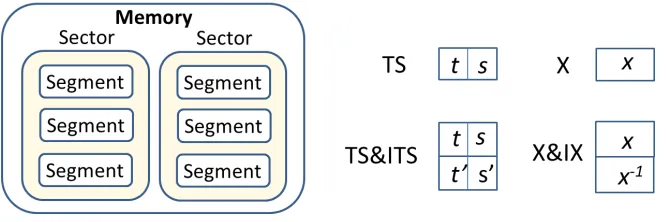
1) In the first approach, the memory is organized as a collection of sectors (fig. 4). Each sector is a
collection of continuous segments (i.e. sequences of memory cells) and all cell addresses within
one sector share the same s value, while all cell addresses within one segment have sequential t
values. Incrementing a t value by a unit (eq. 13) returns the next cell address.
2) In the second approach, we employ the x values as addresses. Since the size of x is much larger
compared to physical addresses, a “hash map” is used for translation.
3) The third memory organization also uses x values of addresses but implements a self-balancing
corresponding to an x value.
The first memory organization type is a natural selection when implementing the memory in hardware,
while the second and third types are good matches for software emulations of Cryptoleq that leverage
standard libraries (e.g. C++ STL).
Operand representation in memory:A second implementation decision is related to the representation
of Cryptoleq operands in memory, as TS or X values. The first memory organization type discussed above
(i.e. use of sectors) is by design compatible with TS storage, since access to a memory location is direct.
The second and the third organization types (i.e. use of hash map and binary search tree respectively)
are generally faster when the X representation is used, since x values are used directly for address
mapping. A benefit of the X representation is its convenience for multiplying operands (eq. 5), while
Leq comparisons (eq. 4) can be implemented using comparisons with precomputed values as:
Leq(x) = (x <1 +N)∨(x > N ·2blog2Nc). (17)
On the other hand, the TS representation requires temporary transformation to X before multiplying
operands, but it is more convenient for Leq comparisons. An extensive comparison of the various options
appears in section VI-B1.
Avoiding modular inversion: Another important optimization is avoiding the modular inversions
re-quired in eq. 5, since such inversions incur high performance overheads. In this work, we propose to
precompute and store the inverted values alongside the non-inverted ones. Then, a runtime inversion
can be implemented by swapping the stored pair. In this case, the Cryptoleq processor must update both
values in the pair when[B]is updated, so an additional modular multiplication is necessary: for example,
if one stored pair is {x, x−1} and another is {y, y−1}, operation O1 in eq. 5 should be applied twice
to create an updated pair {x−1·y, x·y−1}. The benefit of this optimization is the evasion of expensive modular inversions, but this is traded with the aforementioned additional multiplication and doubling of
required memory. This inverted representation can be used with both TS and X notations; thus, there are
four distinct operand representation configurations (as presented in fig. 4): (i) TS, (ii) X, (iii) TS with
inverted TS (i.e. TS&ITS), and (iv) X with inverted X (i.e. X&IX). Note that t0 and s0 for inverted TS
are not the modular inverses of t ands, but are computed using eq. 11 on x−1.
Selecting β: Eq. 14 essentially defines the maximum ranges for valid positive and negative numbers in
the program’s arithmetic. Nevertheless, if β is always set to maximum using this equation, increasing
the size ofN (i.e. the security parameter) would actually reduce efficiency, since the maximum possible
β increases as well. In practice, Cryptoleq allows programmers to fix β to a value smaller than the one
Based on the previous discussion, our Cryptoleq abstract machine supports programs that
homo-morphically add or subtract values and can perform conditional jump based on non-encrypted values
(these are the same basic operations as a typical OISC architecture [31]). An important concept that
has not been introduced yet, however, is support for multiplication2 and comparison within programs. Other arithmetic OISC implementations address this problem at the software level, using multiplication
algorithms expressed in native instructions. The same can be done in Cryptoleq. Multiplication algorithms,
however, are optimally implemented using conditional jumps and in Cryptoleq this is available only
for non-encrypted values (i.e. only such values can support multiplication). This limitation exists since
conditional jumps over encrypted values could immediately leak side channel information about those
values. Since multiplication (along with addition) is necessary for universal computation, one of our
contributions is designing a special software function G that is used to implement a multiplication
algorithm for encrypted values without conditional jumps, as well as to support encrypted comparisons.
IV. MULTIPLICATION OVERENCRYPTEDVALUES
A. Notation
Before introducing our algorithm for multiplication of encrypted values, as well as defining the
corresponding software modules, we provide a brief description of our notation. For the remaining of
this section, we employ special notation for binary and unary operations applied on ciphertexts, to avoid
uncertainty compared to standard arithmetic operations applied on plaintexts (such as regular addition,
subtraction, negation and multiplication). Therefore, we define the following signs on any ciphertexts x
andy (defined as in eq. 7):
1) Plus sign with hat (x+ˆ y): Is a binary operator that denotes modular multiplication of ciphertexts
x and y:
x+ˆ y≡Enc(Dec(x) +Dec(y)) =x·ymodN2.
2) Minus sign with hat (x−ˆ y): Is a binary operator that denotes modular multiplication of ciphertext x with the modular multiplicative inverse of another ciphertext y:
2
x−ˆ y≡Enc(Dec(x)−Dec(y)) =x·y−1modN2.
Likewise, the unary minus operator (−ˆy) is equivalent to Enc(0) ˆ−y.
3) Star sign(x ? y): Is a binary operator that denotes execution of alg. 1 on ciphertexts x andy:
x ? y≡Enc(Dec(x)·Dec(y)) modN2.
In addition to the aforementioned operators, we also define the tilde accent (e·)over a given plaintext m, to denote encryption of this message with a new Paillier randomization parameter, as in eq. 7:
e
m ≡ Enc(m). Furthermore, as already defined in eq. 15, for a given ciphertext x, the bar accent x denotes the open value corresponding to that ciphertext.
B. FunctionG
Function G is a software module that performs heuristically obfuscated decryption and re-encryption.
Our goal is to define the simplest mathematical function which is sufficient for designing any other
complex algorithm in Cryptoleq, such as encrypted multiplication or comparison.
Definition:Letx andy be encrypted values based on eq. 7, and lety0 =rN·ymodN2 be defined as a re-encryptedy with a new randomization parameterr. Following the notation in section IV-A, we define
function Gis as follows:
G(x, y) =
e
0, if Leq(x)
y0, otherwise.
(18)
Function G takes two encrypted arguments as inputs and returns the second argument modified with
new randomization when the unencrypted value of the first argument is positive; otherwise, it returns an
encryption of zero. In both cases, a different randomization parameter is used each time.
Our observation is that function G can be expressed using Cryptoleq instructions. Moreover, since
Cryptoleq’sO1 operation is multiplication (eq. 5), exponentiation is also easy to implement as a
combi-nation of squaring and multiplication operations based on the bit expansion of the exponent. In Cryptoleq,
if an encrypted value is raised to exponent φ(kφ)−N1, it actually decrypts into an open representation (as
in eq. 15):
xφ(kφ)−N1 = (rN(1 +N km))φ(kφ)
−1
N =
= (1 +N km)φ(kφ)−N1 =
= 1 +N kφ(kφ)−N1m= 1 +N m mod N2.
(19)
Note that rN φ = 1 modN2. Cryptoleq programs do not have to retain a copy of φ(kφ)−1
N , as its
obfuscated bit expansion is sufficient to define the sequence of multiplications in calculating the result of
As it appears in the next section IV-C function Gis adequate to implement a multiplication algorithm
on encrypted values. Moreover, appendix A illustrates an example of how functionGis being calculated.
C. Multiplication Algorithm
The multiplication algorithm3is a software library procedure that produces an encrypted product given two encrypted factors. The requirements for this algorithm are: (i) it should be based only on addition
and subtraction, (ii) it uses functionG, and (iii) it cannot use any conditional jumps on encrypted values.
The non-branching constraint ensures that the algorithm iterations are always deterministic and do not
depend on any argument values. Moreover, section III-C defines the ranges of valid positive and negative
values for Cryptoleq programs so that the β parameter can be used to determine the algorithm iterations
without any risk of overflowing positive values. Another observation is that it is sufficient to construct a
multiplication algorithm for positive values only, since multiplying arbitrary values reduces to multiplying
positives using alg. 1:
x ? y= (z1? z3) ˆ−(z2? z3)
z1 = (G(x,e1)? G(y,e1)) ˆ+ (G( ˆ−x,e1)? G( ˆ−y,e1))
z2 = (G(x,e1)? G( ˆ−y,e1)) ˆ+ (G( ˆ−x,e1)? G(y,e1))
z3 =|x|?|y|
(20)
using the following formula for absolute values:
|x|=G(x, x) ˆ+G( ˆ−x,−ˆx). (21)
Eq. 20 expresses the multiplication of two arbitrary numbersxandy, based on the multiplication of their
absolute values as well as multiplications of function Goutputs (either e0 ore1 in this case). In addition,
eq. 20 uses negations, which are defined as the modular additive inverses of the given values.
Our proposed non-branching multiplication procedure is presented in alg. 1. The algorithm is the
homomorphic equivalent of “shift & add” multiplication, and uses function G to add the value of the
3
Algorithm 1 Multiplication (?): top level
1: procedure MULTIPLY(x, y) 2: sum←e0
3: for(β+ 1) timesdo . β is a global parameter
4: z←Div2(x) . Div2 to be defined in alg. 2
5: bit←x−ˆ (z+ˆ z)
6: sum←sum+ˆ G(bit, y)
7: y←y+ˆ y
8: x←z
9: end for 10: returnsum
11: end procedure
Algorithm 2 Division by 2
1: procedure DIV2(x)
2: sum←e0 3: p2←2fβ 4: forβ timesdo
5: p2 ←Half2(p2) . Half2 to be defined in alg. 3
6: y←sum+ˆ p2 7: y←(y+ˆ y) ˆ−x
8: sum←sum+ˆ G(e1 ˆ−y, p2) 9: end for
10: returnsum
11: end procedure
multiplicand to an accumulator, if the least significant bit (LSB) of the multiplier is not zero, before left
shifting the multiplicand and right shifting the multiplier. Homomorphic isolation of the LSB entails 3
steps: invoking alg. 2 that performs the homomorphic equivalent of integer division by 2 (i.e., a right
shift); adding the quotient to itself (i.e., a left shift); and subtracting from the multiplier. Alg. 2 is also
expressed as a non-branching algorithm and uses the Half2() auxiliary procedure (alg. 3). The input to
Half2()can only be a power of2and the procedure divides its input by2, using functionGand absolute
5: y←(p2 +ˆ p2) ˆ−x
6: y←G(|y|,e1) . |·|- eq. 21
7: y←G(e1 ˆ−y, p2) 8: sum←sum+ˆ y
9: p2 ←p2 +ˆ p2 10: end for
11: returnsum
12: end procedure
current implementation, reducing the number of calls to functionG fromO(β3) toO(β2). A numerical
example on the execution of alg. 1 is presented in appendix B.
V. CRYPTOLEQ ENHANCEDASSEMBLYLANGUAGE
A. Overview
Cryptoleq is complemented by a developed piece of software named Cryptoleq Enhanced Assembly
Language (CEAL). It is designed to aid in writing extended programs. Specifically, since the algorithms
enabling universal computation on encrypted data have to be written in Cryptoleq, their complexity
requires more expressive language than mere sequence of Cryptoleq instructions. CEAL allows writing
symbolic notation avoiding explicit memory address manipulation. A CEAL compiler automates several
procedures required for proper program execution, including, but not limited to, memory arrangement,
address resolution, expression evaluation and macro definition substitution. It can also generate function
G, as discussed in section IV-B. This section discusses the fundamental differences of CEAL compared
to typical compilers4.
CEAL provides syntax for supporting encrypted values, either directly hardcoding them in a program
or generating them during compilation time. The compiler can also generate random encrypted values
4
to be stored in memory or values to be used as memory addresses. So the program data can be easily
initialized with encrypted values, as well as assigned to randomly selected memory addresses.
B. Arrays
Similar to other high level programming languages, CEAL can allocate memory arrays and access
memory cells by either indexes or pointers. This is supported by Cryptoleq instructions via self-modifying
code. In order to access memory indirectly – via a pointer – for reading or writing, an instruction is
used to write the address into the corresponding operand of the target instruction. The CEAL compiler
allocates the required amount of memory, initializes it and assigns the memory addresses. An array can
be placed in a continuous block of memory with all elements sharing the s part of their addresses.
CEAL syntax provides three options for placing an array: (i) in the default block of memory withs= 0,
(ii) starting from an explicitly defined address, or (iii) at a random position. In the last two cases, the
addresses of the array elements are indistinguishable from encrypted values. Array element access is
facilitated using pointer arithmetic, and more specifically modification of t part: the program uses the
unit value, as discussed in eq. 13, to navigate through the array elements.
C. Library, Multiplication and Function G
Macros are introduced into CEAL to simplify repetition of instruction sequences, to make a local
scope for names, and to build more complex constructions, such as functions. CEAL defines functions
as special constructs built by small macros passing the execution to specific points in the program –
function entries – while copying the return address in advance, so when the function finishes execution
the control flow is passed back to the calling point. These macros also prepare the arguments and return
values.
In order to reuse useful general macros, a library written in CEAL can be attached to a program
by an include directive. This is similar, for example, to C include directive and C standard library
linking. The CEAL library implements several macros and algorithms, most notably multiplication of
encrypted and unencrypted values, function G, and equal operation on encrypted values. Specifically,
the developed CEAL library defines two multiplication algorithms as functions: one for encrypted and
one for unencrypted values. The reason the algorithms are different is that multiplication of unencrypted
values can use conditional jump, hence can be implemented in a more optimal way. On the contrary,
encrypted multiplication in Cryptoleq is implemented by code written in CEAL implementing the three
as well as squaring and multiplying (for bits1). Using the provided bit expansion, the compiler generates
a list of macro calls to either the squaring macro, or the squaring and multiplying one, mapping each
such call to the corresponding bit in the bit expansion (starting from the least significant one, without
generating any branching code). This list of macros is used at runtime to compute the decryption of the
first ciphertext argument of function G. The compiler completes the implementation of function G, by
referencing library code to perform the following steps: (i) generate new encryptions e0 (using previous
random encryptions of zero as randomness seed); (ii) depending on the result of a Leq test (eq. 4) on the
decryption of the first ciphertext argument, the code returns either a newly computede0, or a re-encryption
of the second ciphertext argument ase0 ˆ+y.
At runtime, the aforementioned list of macro calls accepts a ciphertext x as input, and computes the
decryption of x (as in eq. 19). The decryption result (x) is calculated with the assistance of a memory
cell acting as an accumulator A, initialized to plaintext value 1 (for each decryption). If the next macro
call in the list corresponds to squaring (i.e., there was a bit0 in the expansion ofφ(kφ)−N1), the memory
cell containingxis updated with the square ofx. Otherwise, if the next macro call in the list corresponds
to multiplying and squaring (i.e., there was a bit 1in the expansion of φ(kφ)−N1),A is updated with the
product of x with A, beforex is updated with the square of x. After all macros in the list are executed,
the correct decryption result is computed. Finally, the executed code generates newe0 values, and based
on Leq(x), it either returns ae0, or a re-encryption of the second ciphertext argument y.
D. Equal function
In addition to the four basic operations already discussed (i.e. addition, subtraction, multiplication
and division), Cryptoleq programs require additional arithmetic operations over encrypted values. A
prominent example is equivalence of two encrypted values that is homomorphic to equality of their
plaintexts. Therefore, we define the equivalence comparison operation as follows:
Equal(x, y) =
e
1, if Dec(x) =Dec(y)
e0, otherwise.
(22)
Algorithm 4 Private Information Retrieval
1: procedure PIR(input)
2: arraytable[6][2]
3: sum←e0
4: fori= 0 to 5 do 5: key←table[i][0]
6: val←table[i][1]
7: sum←sum+ (val ?ˆ Equal(key, input))
8: end for . Equal returnse0 ore1 (eq. 22)
9: returnsum
10: end procedure
This function can be easily expressed via function G:
Equal(x, y) =e1 ˆ−(G(x−ˆ y,e1) ˆ−G(y−ˆ x,e1)). (23)
From a theoretical standpoint addition and multiplication operations are sufficient for Turing
complete-ness. Hence, equality checks in the encrypted domain can be implemented using an bitwise OR operation
over all bit encryptions of the difference of two numbers. In this work, the introduction of the Equal
function is actually a practicality feature and not a theoretical requirement. It should be emphasized
that the result of the Equal function is an encrypted value, hence no information about the compared
plaintexts is actually leaked. Cryptoleq programs are not allowed to branch based on encrypted values,
so the result of the Equal function cannot be used for control flow decisions.
VI. PERFORMANCEEVALUATION
In this section, we assess Cryptoleq’s performance with respect to various memory organization options,
encrypted operand representations, as well as different security and β parameter sizes, via a classic
PIR case study. In addition to demonstrating correct functionality of our framework, the PIR case study
allows us to report statistics over different operation modes, identify the most efficient configurations, and
highlight the advantages of heterogeneous computation by obliviously mixing encrypted and unencrypted
data. Moreover, we report Cryptoleq’s raw performance figures for encrypted addition, subtraction and
Hash 3208 3201 61.9 16.3 Red-Black tree 3222 3195 61.8 15.1
A. PIR Case Study
Private Information Retrieval (PIR) is a classic example of applications which require private
com-putation. In the simplest scenario, the user maintains an encrypted database on an untrusted server. At
some point, the user desires to retrieve some data from the database, without revealing any information
about the inquiry itself, data stored in the database or the result of the inquiry.
As a simple example, the database can be visualized as a table of key-value pair entries, e.g. {1:6, 2:7, 3:8, 4:9, 5:0, 6:1}. An inquiry to the database is a particular key and the expected output is the corresponding value. So, in this example, when the key 3 is requested the output returned to the user
should be 8. As mentioned before, both the key input and the return result are encrypted. Therefore,
PIR entails a brute-force search through all encrypted entries, secretly comparing database keys with the
encrypted input, eventually returning the encrypted value when the keys match.
A straightforward algorithm of the PIR example appears in alg. 4. The flow of the algorithm ensures
that (i) no data are ever decrypted; and (ii) there is no branching based on sensitive data. This algorithm
is implemented in CEAL in a similar fashion: the program iterates through the entries of the table,
accumulating the result of the multiplication of the value of each entry and the Boolean result of the
equal function between the encrypted key and the encrypted input. Alg. 4 is ported to CEAL using 24
lines of code, and when compiled it occupies approximately 30000 memory cells.
B. Cryptoleq Performance Analysis
1) Memory options: Section III-E describes the various options for memory organization and operand
representation. Table I shows the execution time of the PIR example running with 32-bit N for various
configurations. The times are shown in seconds. The table columns define the memory cell type: TS, X,
TS & inverted TS (TS&ITS), and X & inverted X (X&IX). For the last two configurations, as mentioned
Fig. 5. Calculation time (in seconds) and Instruction count (in105
units) vsN bit size.
original values. The rows of table I correspond to the selected memory type: Sector type, Hash map, or
Red-Black tree.
The results show that Hash and Red-Black tree with inverted X memory outperform all other
con-figurations. Therefore, for the rest of the results, we select Red-Black tree and X&IX as the baseline
configuration. It should be emphasized that the poor performance of Sectors is expected, as Cryptoleq
performance is evaluated in emulation mode. Sectors are expected to outperform the complex Hash and
RB-trees when implemented in real hardware.
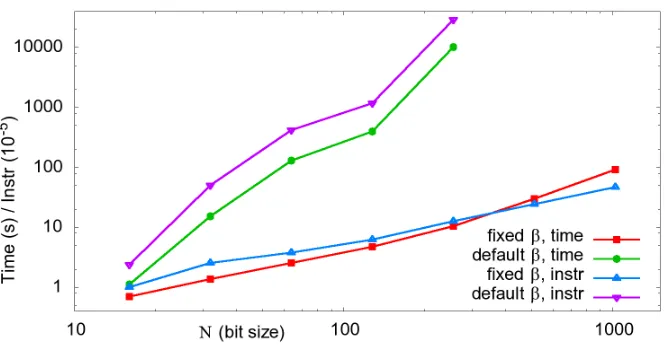
2) Size of N: The next set of results investigates the effect of the security parameter size to the
performance of Cryptoleq. Runtime (in seconds) and number of instructions (in 105 units) are jointly
presented in fig. 5, for security parameter N ranging from 16 to 1024 bits. Since the data type range,
defined by β (section III-E), affects the number of instructions executed, we perform two sets of
experiments: default β, calculated to be exactly N bit size minus 3, and a restrictedβ = 8.
With regards to unlimitedβ, we can quickly observe that the instruction and time overhead is prohibitive
even for small sizes of N. Fortunately, as data type values over 64-bit do not natively exist in modern
computer architectures and have to be emulated through big number libraries, the infeasibility of using
unlimited β does not affect the practicality of Cryptoleq.
Indeed, the fixed β results of fig. 5 showcase that whenβ is restricted to 8 bits, the performance and
instruction overhead remain in the feasible range. An interesting observation is the difference in the rate
of the increase of execution time to the number of instructions. Specifically, the runtime performance
16 1746 16696340 32 6546 64671092 64 25362 266779700
each doubling of the size of N. This is attributed to the fact that operand sizes more than 64 bits
require extensive use of big number libraries, affecting runtime performance given the same number of
instructions.
3) β performance: The multiplication algorithm (section IV-C) encompasses two enclosed loops
proportional to β; therefore, for each doubling of β, multiplication should take roughly 4 times longer.
In this subsection we explore the performance implications of various β commonly used as native data
type sizes, namely 8, 16, 32 and 64 bits. All experiments have been executed for security parameter size
N = 1024, which is the minimum standard, not yet broken size. Table II presents the number of calls
to function G, as well as the total number of instructions, for differentβ.
The quadratic dependency toβ, along with some expected overhead, can be extracted from the results.
Since N is the same for all four cases, the running time is exactly proportional to the total number of
instructions. The results corroborate that data type sizes typically used in programming languages (8-64
bits) can be practically used in Cryptoleq for acceptable, with regards to their security, key sizes.
4) Mixed-mode simulation: The results presented in the previous subsections combined the overhead
of all stages required for the execution of the PIR example, including compilation time and loading time.
As expected, compilation and loading times are proportional to the size of the program. Table III breaks
down the execution time to the individual stage overheads, and presents several statistics for different
implementations of the PIR algorithm:
• Secure: The originally implemented PIR algorithm.
• Mixed 1: Key values of the databases are now open (i.e. function Equal compares two open values
and outputs encrypted 1 or 0).
• Mixed 2: Open key values (Mixed 1), and removal of the secure multiplication (line 7) when
key is not equal to input.
TABLE III
STATISTICS FOR DIFFERENT OPERATION MODES.
Secure Mixed 1 Mixed 2 Open Compilation, s 26.5 8.8 8.8 5.1 Loading, s 28.6 21.5 21.5 8.8 Execution, s 35.8 34.1 8.8 0.4 Time total, s 91.0 64.5 39.2 14.3
G calls 498 486 81 0
Open mult 0 0 0 6
Secure equal 6 0 0 0
Secure mult 6 6 1 0
Instr open 95847 13014 2499 1803 Instr secure 3053659 2990930 8981 0 Instr mixed 1535106 1499425 5173 0 Instr total 4688612 4503369 16653 1803
For the following experiments, security parameter size N is 1024 bits andβ is fixed at 8 bits.
While the total execution time of the Secure mode is 91 seconds, only 35.8 seconds is the
run-ning time. Compilation time incurs significant overhead as the compiler is generating the encrypted
representation of the operands and program constants. When a smaller number of encrypted values is
used, compilation times decreases proportionally, as shown by the compilation overheads of Mixed 1,
Mixed 2 and Open. Similarly, loading time is also considerable for the Secure mode, due to the
selected baseline configuration for memory cell representation: X&IX mode requires calculation of the
inversion of encrypted memory cells during loading time. The overhead of the loading process remains
significant for Mixed 1 and Mixed 2, due to the oblivious way the processor is treating open and
encrypted values (modular inversions for open values are also computed).
The difference in the execution times of the various versions of the PIR algorithm can be explained
by the individual statistics shown in table III. Open instructions are classified as instructions where
both A and B operands use open representation (i.e. their s part is zero), secure instructions have both
operands encrypted while mixed instructions include one operand from each category. As expected, in the
Securemode, both secure multiplication and equal functions were called 6 times since the PIR database
contains 6 entries. Furthermore, when the security requirements are reduced (modes Mixed 1 and
Mixed 2), number of function G calls and secure instructions decreases, allowing faster computation.
Fig. 6. Experimental comparison on the addition, subtraction and multiplication overheads between Cryptoleq and HElib [23]. The results demonstrate that Cryptoleq additions and subtractions are 4 and 5 orders of magnitude faster than amortized HElib additions and subtractions respectively (over 500 operations). This large performance difference is expected, since Cryptoleq does not require expensive re-encryption operations periodically. Likewise, Cryptoleq’s multiplication (alg. 1) is about twice as fast compared to HElib’s amortized multiplication (over 9 operations).
security requirements can be fine-tuned and prioritized according to performance implications, all within
the same abstract machine supporting seamless manipulation of encrypted and unencrypted operands.
C. Comparison to HElib
In this section, we compare the raw performance of Cryptoleq’s addition, subtraction and multiplication
against HElib FHE software library [23]. A major difference between Cryptoleq and HElib is the use
of re-encryption operation; in the former, re-encryption (using function G) is needed to support each
multiplication of ciphertexts, while in the latter it is needed to enable bootstrapping and refresh the noise
of ciphertexts after a finite number of operations [22]. Notably, Cryptoleq does not require re-encryption
for additions or subtractions, while HElib requires it after a small number of multiplications or a larger
number of additions/subtractions. For the latter, this is necessary since multiplications accumulate a large
amount of ciphertext noise, while additions/subtractions accumulate only little noise. In all cases, HElib’s
encryption parameters control the noise tolerance of each ciphertext.
Our experimental comparisons between Cryptoleq and HElib are presented in fig. 6. We evaluated
both libraries on an Intel i7-3770 processor with 4GB memory, running GMP 6.1.0 and NTL 9.6.4 on
Ubuntu 14.04. For our experiments, we configured a Cryptoleq security parameter size N of 1024 bits
and a HElib security level of 76 bits (as in [22]), which offers approximately the same key strength
additions/subtractions, before a re-encryption operation was necessary; hence our experimental results for
HElib report the amortized cost of additions, subtractions and multiplications, incorporating the cost of
re-encryption over a fixed number of operations.
Contrary to Cryptoleq where there is no noise accumulation, HElib ciphertexts require re-encryption
depending on the size/levels of the arithmetic “circuit” computing each particular ciphertext, as well as
the existing noise of other ciphertexts used as arguments in the aforementioned “circuit”. To compensate
for this case by case cost, our experiments calculate an average case overhead, where a single operation
is applied on ciphertexts with comparable noise levels. As reported in fig. 6, Cryptoleq’s subtractions
and additions are 5 and 4 orders of magnitude faster than HElib’s addition and subtraction respectively.6 Similarly, in fig. 6 it is shown that encrypted multiplication is twice as fast in Cryptoleq, as it is in HElib.
An important remark on comparing Cryptoleq to HElib is that the former provides a comprehensive
framework for general purpose computation, rather than a mathematical library to evaluate arithmetic
circuits. Indeed, since HElib is designed to evaluate polynomials, it first requires converting arbitrary
programs into circuits featuring negations, additions and multiplications. In HElib, these conversions do
not generally scale for larger input sizes (i.e., deeper circuits should be defined), and programmers should
ensure bootstrapping operations are performed on each ciphertext, before noise levels reach maximum
thresholds. Conversely, the CEAL compiler handles different input sizes automatically, without having
to generate new Cryptoleq instruction sequences (i.e., the same instructions can support arbitrary data
sizes).
VII. CRYPTOLEQSECURITYCONSIDERATIONS
A. Design Objectives & Protection Strategy
A major objective for the development and design of the Cryptoleq framework is native support for data
privacy when computation is outsourced to semi-trusted parties. Our strategy to address this requirement
is to protect memory confidentiality using two methods: (i)probabilistic encryption, and (ii) obfuscated
decryption and re-encryption, depending on the type of mathematical operations required by the program.
Thus, the following alternative protection modes are supported:
1) Encryption mode, where all memory locations are protected through Paillier PHE encryption,
proven asymptotically secure as the security parameter increases. This mode is applicable when
6
comparison operations, obfuscated decryption and re-encryption is performed on the fly. Prominent
examples in this mode are sorting and searching algorithms or Z-transforms on discrete-time signals.
For mixed-mode execution and backward compatibility, Cryptoleq also supports an unencrypted mode,
where memory contents are stored in plaintext format.
B. Additional Discussion on Obfuscation Mode
As a general protection mechanism, obfuscation can be leveraged for creating public-key cryptosystems
from secret-key ones, as well as for converting public-key cryptosystems to homomorphic ones [36]. For
the former, one could allow public encryption but private decryption, by obfuscating the encryption
function corresponding to the secret key. Similarly, for the latter, full homomorphism can be added by
creating an obfuscated algorithm that decrypts, applies a function on plaintexts, and re-encrypts the result
using the cryptosystem’s key-pair.
An important negative result from [36], however, is that strong obfuscator programs (called Virtual
Black Boxes) do not generally exist, as there are inherently unobfuscatable functions. It is possible,
however, to construct weaker obfuscator programs, based on the notion of indistinguishability obfuscation
(iO). The latter notion mandates that the obfuscations of two programs that compute the same function
and have the same size, must be computationally indistinguishable [36]. Even though this notion does not
ensure that all information is hidden within the program, it was shown that indistinguishability obfuscators
correspond to the “best-possible” obfuscators for a particular program [37]. The first construction for
general purpose iO was proposed in 2013, leveraging FHE, cryptographic multilinear maps and matrix
branching program for computation [38]; the key idea was to use a coreiO obfuscator to protect a small
fully homomorphic decryption program, to bootstrap the fully homomorphic evaluation of a much larger
generic program.
One limitation of cryptographic multilinear maps, however, is that their security is still investigated
by the academic community, and several attacks [39]–[42], as well as mitigations [39], [43], [44]
have been reported recently. Moreover, new type of attack (called zeroizing) that was not previously
considered in security arguments and has yet to be demonstrated, has recently been deemed possible
[39]–[41]. Considering that the discovery of secure (“clean”) multilinear maps is still an open problem
based on multilinear maps may be limited for now. In addition, the use of FHE as part ofiO, effectively
limits the practicality of such obfuscators. Indeed, recent performance evaluation ofiOfor a simple 16-bit
point function showed prohibitive overheads (e.g., over 9 hours for obfuscation and at least 3 hours for
evaluation, requiring more than 31GBs of program size [46], or a cluster of more than 20 computers
[47]), while a 2-bit multiplication circuit could be obfuscated in 1027 years and evaluated in 108 years
[48].
Evidently, the current state of the art with respect to cryptographic obfuscation does not allow practical
implementations. Alternatively, obfuscation can also be approached heuristically, based on high
perfor-mance on evaluation metrics, such as potency and resilience, at a reasonable cost. Indeed, it is possible
to attain a realistic threat model where heuristic approaches that rely on obscurity are sufficient for most
privacy-aware applications in a white-box setting. In this work, we focus on a heuristic approach for
obfuscation, and function Gis designed under those assumptions.
C. Security Model & Limitations
Following the description of our heterogeneous framework, we can further define our assumed security
model. Both in case of encryption and obfuscation modes, all memory values within Cryptoleq programs
are protected using a secure probabilistic PHE scheme. Thus, due to the security guarantees of that
scheme, it is not generally possible to leak any plaintext information, either by examining ciphertexts in
memory or by manipulating them usingO1,2 operations (eq. 5). Moreover, in our case we do not consider
active adversaries [49], as data confidentiality is the asset to be protected, and allowing malleability is a
requirement for data manipulation.
Instead of attacking the encryption scheme, a powerful adversary may attempt to analyze side-channel
information of the Cryptoleq execution itself, such as IP trace patterns, memory access events or
ob-fuscated decryptions, and extrapolate information about the protected values or the type of the running
algorithm. Nevertheless, we remark that execution traces may depend only on unprotected data, since Leq
comparisons (eq. 4) and branch decisions are not defined over ciphertexts, yielding unpredictable results.
Naturally, the security guarantees of the underlying encryption scheme are not continuously applicable
when functionGis invoked to perform obfuscated decryption and re-encryption7. Indeed, our code-based obfuscation can provide heuristic guarantees (compared to a provably secure cryptosystem), and thus our
threat model is considering rational, semi-honest adversaries that are unable to deobfuscate function G
routines or extract obfuscated bit-expansions of decryption key material stored inside the executable.
7
argument locations of the obfuscated function G and reuse this code until after decryption happens;
nevertheless, when the blinding coefficient s is used, adversaries can only retrieve random multiples
of the actual plaintexts. Since the resilience of the underlying obfuscation is critical, Cryptoleq can
leverage self-modifying code, on-the-fly code generation, and oblivious mixing of encrypted computation
with unencrypted, to increase obfuscation protections. Specifically for the blinding coefficient s,
self-modifying code allows runtime re-randomization of the bit expansion of s·φ(kφ)−N1 with new random s, without affecting correctness.
As the previous discussion shows, there exist cases where deobfuscation could be a concern for the
security of the system, as we employ code-based heuristic obfuscation methods when provably secure
encryption cannot be applied. Still, in the rational, semi-honest adversarial model, where cryptanalysis
or deobfuscation threats combined with memory snooping are not applicable, the heuristic guarantees of
code-based obfuscation are sufficient for practical applications. Moreover, if the protected program does
not use any multiplication or comparison operations, no obfuscated decryption routines are included in
the executable and memory contents are protected with provably secure encryption.
An important remark is that, since our re-encryption approach in functionGgenerates new probabilistic
ciphertexts on every invocation, no plaintext information about the inputs of function G is leaked to
its outputs. Similarly, operations O1,2 (eq. 5) do not leak plaintext information either, as previously
mentioned. Hence, if there existed an attack algorithmAdv that could predict plaintext information with
probability better than a random guess, only by observing homomorphic operations and newly generated
ciphertexts, then Adv would also break a semantically secure PHE scheme.
VIII. RELATEDWORK
In the area of encrypted computation both theoretical and practical approaches have been proposed in
the past. The authors of [50] have designed Ascend, which is a secure processor that employs Oblivious
RAM to obfuscate memory accesses to encrypted external memory. Specifically, in Ascend, a block
cipher accelerator decrypts all oblivious RAM read operations before instructions and data move into
the processor caches, while data evicted from these caches are re-encrypted before oblivious memory
storage. The processor contains a shared block cipher key and the chip itself is considered tamper-proof.
executed software similar to Trusted Platform Modules (tamper-evident execution), and provides privacy
protection for off-chip memory using non-malleable symmetric encryption (tamper-resistant execution).
The Aegis chip contains a permanent private key that is necessary to decrypt other symmetric keys used
to protect data and instructions within program binaries.
A theoretical approach on encrypted computation, leveraging FHE, is presented in [52], where the
authors discuss an encrypted processing unit that supports static programs and provide proof of its
cor-rectness. Similarly, the authors of [14] use FHE circuits for outsourcing execution to the cloud, and further
discuss the requirement of selective decryptions in order to detect termination of FHE encrypted programs
(called thetermination problem). In [53], the authors demonstrate general function evaluation and
zero-knowledge protocols focusing on universally composable security, while [15] leverages homomorphic
hashing for verifiable computation delegation.
Encrypted computation using secure containers has emerged as a protection strategy for commodity
processors as well. In [54], the authors present new architectural features that allow the creation of
encrypted enclaves, to provide privacy and integrity protection from potentially malicious processes
running on the same system with elevated privileges. In this case, a memory encryption engine protects all
traffic between the processor and the system main memory. In the same direction, the hardware enforced
isolation discussed in [55] provides integrity protection even in case the operating system kernel is under
attack, using a cryptographic coprocessor provisioned with secret keys during fabrication.
IX. CONCLUSIONS
In this paper, we have presented a new computational model based on the concept of single instruction
architecture, able to execute programs whose instruction operands have been encrypted using Paillier PHE
scheme. Universal computation is achieved by introducing a software function, which adds multiplication
to the abstract machine’s native addition and subtraction operations. This function is expressed using
the only available instruction. We have also developed an enhanced assembly language to facilitate
the development of complex programs, in addition to a compiler and an emulator. We evaluated this
framework and our experimental results show that Cryptoleq incurs practical overhead when used with
typical range of valid numbers.
Cryptoleq allows for several future improvements with regards to performance and security. The former
can be improved through the introduction of high-radix representations (e.g. Montgomery), and advanced
runtime techniques (such as automatic detection of open values to replace homomorphic multiplication
The executable files for the CEAL compiler and emulator, as well as sample Cryptoleq programs can
be found at [34].
APPENDIXA
FUNCTIONGCALCULATIONEXAMPLE
To illustrate the functionGoperation, we select a small security parameterN =p·q = 3·5 = 15,β = 2 and a random parameterk= 2. Then, a message m1 = 3 can be encrypted asx= 415·(1 + 15·2·3) =
109 mod 152, using eq. 7 and a random r1 = 4. Similarly, a message m2 = 1 can be encrypted as
y = 215 ·(1 + 15·2 ·1) = 158 mod 152 using a random r2 = 2. For N = 15, we have Euler’s
φ= (p−1)·(q−1) = 2·4 = 8 and(kφ)−N1 = (2·8)−151 = 1; hence,φ(kφ)−N1 equals 8·1 = 8 or10002
in binary representation.
Computing the value G(x, y) entails raising ciphertext x= 109to power 10002 (as in eq. 19), before
reducing to mod 152 at each step. As discussed in section V-C, the latter can be performed using
squaring and multiplying over the bits of exponent 10002. Initializing our accumulator A to 1, we have
x ← 1092 = 181 for the LSB of 10002, x ← 1812 = 136 for the second bit, x ← 1362 = 46 for the
third bit, and A ← A·46 = 46 for the non-zero MSB (squaring x for the MSB is unnecessary, as A already holds the open value x= 46). Using eq. 15, we can confirm that(46−1)/15 = 3 =m1.
Subsequently, we use eq. 17 to compute Leq(46) = F alse, since 46 > (1 + 15) and 46 < (15·
2blog215c = 120). After selecting a new random r = 7, function G generates e0 = 715 = 118. Finally,
function G returns a re-encryption of argument y= 158, as e0 ˆ+y = 118·158 = 194. We confirm that
ciphertext 194 is another encryption of m2 = 1, since 1948 = 16 = 1 + (15·1) (using eq. 19) is the
open value for plaintext 1. Note that all steps are mod152.
Alternatively, choosing m1 = 13 as our plaintext, we get x = 415·(1 + 15·2·13) = 184 (using a
random r1 = 4). Then, raising 184 to 10002 as before, would return x = 196 = 1 + (15·13) (i.e., the
open value for 13). In this case Leq(196) =T rue, since 196>(15·2blog215c= 120) (eq. 17). Finally,
using a random r = 8, function G generates and returns e0 = 815 = 107. As before, all steps are mod

![Fig. 6. Experimental comparison on the addition, subtraction and multiplication overheads between Cryptoleq and HElib [23].The results demonstrate that Cryptoleq additions and subtractions are 4 and 5 orders of magnitude faster than amortized HElibaddition](https://thumb-us.123doks.com/thumbv2/123dok_us/7918146.1314746/25.612.162.422.75.265/experimental-comparison-subtraction-multiplication-cryptoleq-demonstrate-subtractions-helibaddition.webp)
