DOI:10.26717/BJSTR.2018.07.001501
Matheus Vinicius Abadia Ventura. Biomed J Sci & Tech Res
Review Article
Open Access
Introduction
Brazil presents the greatest biological diversity in the
world, possessing a rich flora arousing the interests of scientific
communities for study and conservation of these resources [1]. Thus, ethnobotanica is the rescue of this traditional knowledge,
related to the use of this flora as a resource [2,3], since man has
not lost the close relationship with plants and nature, bringing him
individual benefits [4]. The medicinal plants comprise plant species with medicinal property, which in some way is used for specific
purposes of cure or prevention [5,6] From surveying in certain communities it is possible to ascertain the vegetation resources
and their benefit in several factors, which are transferred from
generation to generation [7]. The objective of this article was to carry out a bibliographic review, adopting documentary research as a criterion based on articles published in renowned national and international journals specialized in ethnobotanical aspects of medicinal plants reported in the state of Goiás.
Methodology
An ethnobotanical bibliographical survey was carried out on reputed pulicated articles that cataloged the species in two important cities in the state of Goiás. The ethnobotanical survey of medicinal plants were carried out through documentary research in the following locations described in Table 1. The informational survey in the city of Ipameri - GO conducted by [8] was conducted in
the period from August 2008 to June 2009 where 200 people were
interviewed. In the city of Goianésia, the survey period was made
from May to June 2013 by [9], where 50 people were interviewed.
Table 1: Locations used in ethnobotanical surveys. City / State Sources Author Location
Ipameri – Goiás Zucchi et al. (2013) Latitude: 17º 43’ 19” S Longitude: 48º 09’ 35” W
Goianésia – Goiás Silva & Faria (2014) Latitude: 15º 19’ 03” S Longitude: 49º 07’ 03” W
Results and Discussion
[8] observed in the city of Ipameri, in Goiás, where 200
families were interviewed, 75 of whom stated that they did not
use medicinal plants, and the other 125 reported doing so (54% female and 46% female male), representing 62.5%, and Silva & Faria (2014), observed that in Goianésia - Goiás, 48 of the 50 people interviewed (41 females and 9 males) use plants for medicinal purposes ( 96%). According to [10,11] there is a predominance of
women with greater use due to greater presence during the day at home in the performance of domestic activities, which was not
demonstrated in the work of [8,12], which despite being greater than half, did not present a significant superiority [13] observed that 70% of the interviewees were female.
In both, the surveys cited the species used by the interviewees
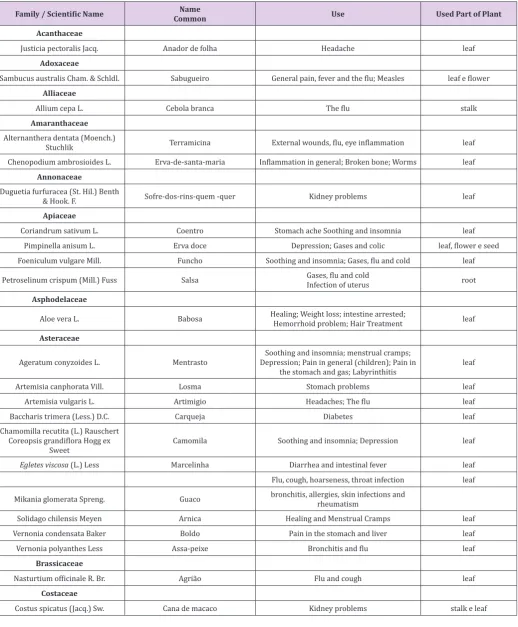
for medicinal purposes, totaled 61 species in 23 families as shown in Table 2, and the popular names, the medicinal use
and the part of the plant used were also described. In the city of Ipameri - Goiás, in the survey of [8], the species that have stood out because they are the most used are quebra-pedra (Phyllanthus
Ethnobotanical Survey of Medicinal Plants in the
Cities of Goianésia And Ipameri, in Goiás, Brazil
Matheus Vinicius Abadia Ventura*
1, Estevam Matheus Costa
2and Marcio Moacir Bessa
2 1Goiano Federal Institute, Brazil2Paulista State University, Brazil
Received: : July 19, 2018; Published: July 30, 2018
*Corresponding author: Matheus Vinicius Abadia Ventura, Goiano Federal Institute, Rio Verde – GO, Brazil
Abstract
Medicinal plants include plant species with medicinal properties, which in some cases are used for specific purposes of healing or prevention. Thus, ethnobotanica is the rescue of this traditional knowledge, related to the use of this flora as a resource. The objective of this article was to
carry out a bibliographic review, adopting documentary research as a criterion based on articles published in renowned national and international journals specializing in the ethnobotanical aspects of medicinal plants reported in the state of Goiás. Most interviewees responded to use plants for for medicinal purposes, with women being the majority. In addition, leaves are the most used parts for different diseases. The use of medicinal
plants is a widely used practice among residents of the cities (Goianésia and Ipameri, Goiás). In general, the species indicated by the inhabitants
niruri L.), camomila (Chamomilla recutita (L.) Rauschert.), hortel ã-rasteira (Mentha x villosa L.), poejo (Mentha pulegium L.), funcho
(Foeniculum vulgareMill.), babosa (Aloe veraL.) malva (Althaea
officinalis L.), guaco (Mikania glomerata Spreng.), mentrasto
(Ageratum conyzoides L.), alfavacão (Ocimum gratissimum L.),
losna (Artemisia canphorata Vill.), bálsamo (Eysenhardtia platycarpa Mich.), carqueja (Baccharis trimera (Less.) DC.),
boldo-sete-dores (Plectranthus barbatus Andrews.), and capim-cidreira
(Cymbopogon citratus (DC.) Stapf.)
Table 2: Plants used for medicinal purposes identified in the cities of Goianésia - GO and Ipameri - GO.
Family / Scientific Name CommonName Use Used Part of Plant
Acanthaceae
Justicia pectoralis Jacq. Anador de folha Headache leaf
Adoxaceae
Sambucus australis Cham. & Schldl. Sabugueiro General pain, fever and the flu; Measles leaf e flower
Alliaceae
Allium cepa L. Cebola branca The flu stalk
Amaranthaceae
Alternanthera dentata (Moench.)
Stuchlik Terramicina External wounds, flu, eye inflammation leaf Chenopodium ambrosioides L. Erva-de-santa-maria Inflammation in general; Broken bone; Worms leaf
Annonaceae
Duguetia furfuracea (St. Hil.) Benth
& Hook. F. Sofre-dos-rins-quem -quer Kidney problems leaf Apiaceae
Coriandrum sativum L. Coentro Stomach ache Soothing and insomnia leaf Pimpinella anisum L. Erva doce Depression; Gases and colic leaf, flower e seed
Foeniculum vulgare Mill. Funcho Soothing and insomnia; Gases, flu and cold leaf
Petroselinum crispum (Mill.) Fuss Salsa Gases, flu and coldInfection of uterus root
Asphodelaceae
Aloe vera L. Babosa Healing; Weight loss; intestine arrested; Hemorrhoid problem; Hair Treatment leaf
Asteraceae
Ageratum conyzoides L. Mentrasto Depression; Pain in general (children); Pain in Soothing and insomnia; menstrual cramps;
the stomach and gas; Labyrinthitis leaf
Artemisia canphorata Vill. Losma Stomach problems leaf
Artemisia vulgaris L. Artimigio Headaches; The flu leaf
Baccharis trimera (Less.) D.C. Carqueja Diabetes leaf
Chamomilla recutita (L.) Rauschert Coreopsis grandiflora Hogg ex
Sweet Camomila Soothing and insomnia; Depression leaf
Egletes viscosa (L.) Less Marcelinha Diarrhea and intestinal fever leaf Flu, cough, hoarseness, throat infection leaf
Mikania glomerata Spreng. Guaco bronchitis, allergies, skin infections and rheumatism
Solidago chilensis Meyen Arnica Healing and Menstrual Cramps leaf Vernonia condensata Baker Boldo Pain in the stomach and liver leaf Vernonia polyanthes Less Assa-peixe Bronchitis and flu leaf
Brassicaceae
Nasturtium officinale R. Br. Agrião Flu and cough leaf
Costaceae
Crassulaceae
Cotyledon orbiculata L. Bálsamo Stomach pain and gastritis leaf Kalanchoe brasiliensis Cambess Folha santa Flu and cold leaf
Fabaceae
Myroxylon peruiferum L. f. Bálsamo Stomach pain and gastritis leaf Stryphnodendron adstringens
(Mart.) Coville Barbatimão Stomach ache; Uterus and vaginal infection stalk e leaf
Andira inermis (W. Wright) Kunth
ex DC. Quina Anemia stalk
Pterodon emarginatus Vogel Sucupira Sore throat leaf
Lamiaceae
Lavandula angustifolia Mill. Alfazema
Anxiety and restlessness, blood pressure, fever, scarring of thrush, heartbeat, migraine pain, relaxation, improve sleep quality, stress
and depression
flower
Melissa officinalis L. Erva-cidreira Soothing; Flu and cold leaf e root
Mentha arvensis L. Vique Flu Soothing and insomnia; leaf
Mentha pulegium L. Poejo Stomach ache; Flu and cold
Mentha viridis L. Alevante The flu; Calming and insomnia leaf
Mentha x villosa Huds Hortelãzinho Flu, cold, fever and bronchitis; Indigestion; Worms leaf
Ocimum gratissimum L. Alfavacão Soothing; urine infection; Gases; flu, cold, hoarseness and bronchitis leaf
Ocimum tenuiflorum L. Manjericão Flu leaf
Plectranthus amboinicus (Lour.)
Spreng. Hortelã-da-folha-gorda Flu and cold; Problems in the stomach and vomiting leaf Plectranthus barbatus Andrews. Boldo-sete-dores Headache leaf
Rosmarinus officinalis L. Alecrim Flu, shortness of breath, sinusitis; Heart problems; Calming and insomnia leaf
Salvia officinalis L Sálvia Relief of canker sores, bronchitis, dandruff, phlegm, gingivitis, rheumatism, vomiting,
cough, diarrhea, diabetes, indigestion leaf Lauraceae
Cinnamomum canphora Turra Cânfora Muscle or skin problems leaf
Cinnamomum zeylanicum Breyn Canela Soothing leaf
Persea americana Mill. Abacate Kidney problems leaf
Punica granatum L. Romã Throat and urine infection leaf e fruit Malvaceae
Gossypium hirsutum L. Algodão Infection in the uterus and vagina; Associated Infection and inflammation in general;
Issues leaf e root
Malva parviflora L. Malva Flu, cold, gastritis, skin sores leaf e flower
Waltheria indica L. Douradinha Kidney problems leaf
Phyllanthaceae
Phyllanthus niruri L. Quebra-pedra Kidney problems root
Phytolaccaceae
Petiveria alliacea L. Guiné Sinusitis leaf
Plantaginaceae
Plantago major L. Tanchagem Infection (inflammation) in general leaf Poaceae
Rubiaceae
Morinda citrifolia L. Noni Diabetes fruit
Rutaceae
Citrus limon L. Limão | Conjunctivitis;The flu Fruit
Ruta graveolens L. Arruda menstrual cramps; Flu, cold and sinusitis
Verbenaceae
Lippia alba (Mill.) N.E. Br. Erva cidreira Soothing; Flu and cold leaf
Vochysiaceae
Qualea parviflora Mart. Pau terra Toothache (when the baby’s teeth are born) root
Zingiberaceae
Curcuma longa L. Açafrão inflammatory diseases, gastrointestinal Arthritis, osteoarthritis and other
problems, fever, treat colds root
Zingiber officinale Roscoe Gengibre The flu leaf e root
[9] in Goianésia - Goiás, reported that the five medicinal
species most used by the residents were hortelã da folha gorda (Plectranthus amboinicus (Lour.) Spreng.), alecrim (Rosmarinus officinalis L.), hortelãzinho (Mentha x villosa Huds), boldo (Vernonia condensata Baker) and capim cidreira (Cymbopogon citratus (DC)
Stapf.), Among the 61 species mentioned within the 23 families,
the family that includes the largest number of species is Lamiaceae
(12 species) and Asteraceae (11 species). Souza & Felfili (2006)
observed in their work in the city of Alto Paraiso in Goiás, that the
predominant families were Fabaceae (12 species) and Asteraceae (14 species). It is necessary to reinforce that the work of [8] (8 species) and Lamiaceae (10 species) were the predominant species. With this, we observe the diversity of species within the
state of Goiás. Of the 61 species described and raised, the most frequently used plant parts were leafy leaves, as described (Table
3). The leaves were also the most cited among those interviewed in the works of [4,14]. Of the 61 species raised, the use of medicinal
plants, according to the interviewees, has the purpose, mostly to
cure pain and flu. The same result was also found for [11,14], where most of the interviewees cited species to cure influenza, fever and
pain.
Table 3: Parts of the plant most used in production for medicinal purposes.
Parts of the Plant Number of Species
Sheets 50 (72,46%)
Fruits 3 (4,34%)
Flower 4 (5,80%)
Stalk 4 (5,80%)
Root 7 (10,14%)
Seeds 1 (1,46%)
Total 69 (100%)
Conclusion
The use of medicinal plants is a widely used practice among city dwellers (Goianésia and Ipameri, Goiás), although not all the
inhabitants cultivate the plants, they did not abandon the practice of using them, acquiring them when necessary, by means of relatives
and neighbors. In general, the species indicated by the inhabitants in the ethnobotanical survey demonstrated the potential for the pharmaceutical use, since they demonstrate some compounds that are recognized as important, in addition, the use is independent of the sex and extends to diverse age groups and socioeconomic, representing an alternative to the consumer market. But anatomical and pharmacological studies of these plants are suggested to give greater reliability.
References
1. Souza CDD, Felfili JM (2006) The utilization of medicinal plants in the
region of Alto Paraíso of Goiás, GO, Brazil. Acta Botanica Brasilica20(1): 135-142.
2. Amorozo MCM (1996) Abordagem etnobotânica na pesquisa de plantas
medicinais. Plantas medicinais: arte e ciência - um guia de estudo interdisciplinar. São Paulo: Ed UNESP.
3. Begossi A (1998) Etnobotânica em comunidades caiçaras. Etnobotânica: bases para a conservação. Rio de Janeiro: EDUR.
4. Souza MD, Fernandes RR, Pasa MC (2010) Estudo etnobotânico de plantas medicinais na comunidade São Gonçalo Beira Rio, Cuiabá,
MT. Biodiversidade 9(1): 91-100.
5. Amorozo MCM, Gély AL (1988) Uso de plantas medicinais por caboclos
do baixo Amazonas, Barcarena, PA, Brasil. Boletim do Museu Paraense Emílio Goeldi, Série Botânica 4(1): 1-4.
6. Silva JS, de Carvalho JNF, Teixeira WS, Franco ÍO, Ribeiro DD (2010b) 088-Importância do uso de plantas medicinais em comunidades rurais
no sudoeste de Goiás. Cadernos de Agroecologia 5(1).
7. Silva CG, Marinho MGV, Lucena MFA, Costa JGM (2015) Ethnobotanical
survey of medicinal plants in the caatinga area in the community of sitio nazaré, milagres, ceará, Brazil. Revista Brasileira de Plantas
Medicinais 17(1): 133-142.
8. Zucchi MR, Oliveira Júnior VF, Gussoni MA, Silva MB, Silva FC, et al.
(2013) Ethnobotanical survey of medicinal plants in Ipameri City-Goiás State. Revista Brasileira de Plantas Medicinais 15(2): 273-279.
9. Silva RD, Faria MT (2014) Caracterização e etnobotânica e histoquímica de plantas medicinais utilizadas pelos moradores do Bairro Carrilho,
Goianésia (GO). Enciclopédia Biosfera, Centro Científico
Conhecer-Goiânia 10(19): 2807-2829.
10. Ricardo LGPS (2011) Estudos etnobotânicos e prospecção fitoquímica
das plantas medicinais utilizadas na comunidade do Horto, Juazeiro do
Norte (CE). (Dissertação de mestrado - Centro de Saúde e Tecnologia
11. Badke MR, Budó MDLD, Silva FMD, Ressel LB (2011) Medicinal plants: the knowledge sustained by daily life practice. Escola Anna Nery 15(1): 132-139.
12. Silva MABD, Melo LVL, Ribeiro RV, Souza JPMD, Lima JCS, et al. (2010a)
Ethnobotanical survey of plants used as anti-hyperlipidemic and anorexigenic by the population of Nova Xavantina-MT, Brazil. Revista
Brasileira de Farmacognosia 20(4): 549-562.
13. Cruz EAL, Silva JWS, Garcia WM, Ferraz-Neto É, Silva Nunes JR, et al. (2011) Perfil e Utilização de Plantas Medicinais em quintais da comunidade de Salobra Grande distrito de Porto Estrela-MT. Uniciências 15(1): 53-66. 14. Lima RA, Magalhães SA, dos Santos MRA (2011) Levantamento
etnobotânico de plantas medicinais utilizadas na cidade de Vilhena,
Rondônia / Ethnobotanical survey of medicinal plants used in the city of
Vilhena, Rondônia. Revista Pesquisa & Criação 10(2): 165-179.
Submission Link: https://biomedres.us/submit-manuscript.php
Assets of Publishing with us
• Global archiving of articles• Immediate, unrestricted online access • Rigorous Peer Review Process • Authors Retain Copyrights • Unique DOI for all articles
https://biomedres.us/ This work is licensed under Creative
Commons Attribution 4.0 License
ISSN: 2574-1241
DOI: 10.26717/BJSTR.2018.07.001500