
Proof of Proximity of Knowledge
Serge Vaudenay
EPFL
CH-1015 Lausanne, Switzerland http://lasec.epfl.ch
Abstract. Public-key distance bounding schemes are needed to defeat relay attacks in payment systems. So far, only two such schemes exist, but fail to fully protect against malicious provers. In this paper, we solve this problem. We provide a full formalism to define the proof of proximity of knowledge (PoPoK). Protocols should succeed if and only if a prover holding a secret is within the proximity of the verifier. Like proofs of knowledge, these protocols must satisfy completeness, soundness (protection for the honest verifier), and security (protection for the honest prover). We construct ProProx, the very first fully secure PoPoK.
1 Introduction
Following the chess grandmaster problem, a dummy chess player can challenge two grandmasters in parallel (without letting them know) if they take different colors. This works by letting the dummy player relay the move of a grandmaster on one chess board to the other chess board against the other grandmaster andvice versa. In real life,relay attackscan be a serious threat against applications such as NFC-based payment: for small payments, there is typically no action required on the creditcard or smartphone (beyond approaching to the terminal) such as typing a PIN code. So, a man-in-the-middle adversary could just relay communications between the payment device of the victim and the terminal to make payments on the behalf of the holder. The limit of the speed of communication was proposed to solve this problem [4]. Brands and Chaum [12] introduced the notion ofdistance-bounding protocol to prove that aproveris close enough to averifier. This relies on information being local and unable to travel faster than the speed of light. So, an RFID reader can identify when participants are close enough because the round-trip communication time in challenge/response rounds have been small enough. Although challenging from an engineering viewpoint, it is actually feasible to implement these protocols, as shown in [25,26,27]. Actually, some commercial NFC cards by NXP1are already supposed to implement “proximity checks against relay attacks” by “a precise time measurement of challenge-response pairs”, although no public analysis is available so far.
The literature considers several threat models.
– Relay attack: an adversary relay messages between a far-away honest prover and a verifier, trying to make the verifier accept. This is extended by Mafia fraud[16] where the adversary can also modify messages. This is further extended byMan-in-the-Middle attack [6,8] where the attack follows a learning phase where the prover could be close-by. In Impersonation fraud [2], the prover is absent and the adversary tries to impersonate the prover to the verifier.
– Distance fraud[12]: a far-away malicious prover tries to pass the protocol.
the notion ofsoundness [28]: whenever the verifier accepts, there must be an extractor who can reconstruct the secret of the prover based on the view of all close-by participants, even after many iterations. An hybrid model between distance fraud and terrorist fraud is the one of Distance hijacking[15]: A far-away prover takes advantage of some honest, active provers to make the verifier accept.
One of the first model to capture these notions was proposed by Avoineet al.[1]. However, is was not formal enough. Then, two parallel models were developed: the BMV model by Boureanuet al.[6,8] and the DFKO model by D¨urholzet al.[17]. There exist many (symmetric) distance-bounding pro-tocols but so far only the SKI protocol [5,6,7] (based on the BMV model), the Fischlin-Onete proto-col [19] (based on the DFKO model), and DB1 and DB2 [9,10] (combining both protoproto-cols in the BMV model) provide an all-encompassing proven security, i.e., they protect against man-in-the-middle, dis-tance fraud, and collusion fraud with a formal proof of security. (See [5, Section 2].)
As discussed herein, resistance to malicious provers (i.e., distance fraud, distance hijacking, ter-rorist fraud, collusion fraud, and non-soundness) is important, specially for non-repudiation. This is needed for contactless payment applications: If a customer can deny a payment by proving he was somewhere else, there is a liability issue. Making the scheme such that this type of fraud is impossible would certainly be an asset. It would strengthen trust and acceptance of this technology. So, there is a need for distance-bounding protocols protecting against all the above types of fraud.
Public-key distance bounding. In interactive proofs, the prover does not share a secret key with the verifier. The verifier only knows a public key. However, so far, only the following distance-bounding protocols are in the public key model: the Brands-Chaum protocol [12] (Fig. 4), the Bussard-Bagga protocol [13], and the Hermans-Peeters-Onete (HPO) protocol [23] (Fig. 5).2The Bussard-Bagga pro-tocol was broken by Bay et al. [3] and none of the others protect against terrorist fraud. Additionally, the protocol VSSDB was presented at the BalkanCryptSec’14 conference by Gambset al.. It is based on the random oracle model, but the security proofs are still questionable, as discussed in Appendix C. So, the problem of making a fully secure public-key distance-bounding protocol is still open.
Sometimes, secret key protocols are sufficient for practical applications. Indeed, to unlock a car or to open a door in a building with an RFID token, it may be reasonable (especially if symmetric distance-bounding protocols are more efficient) to assume that the RFID token shares his secret with the car or the door. However, when considering wireless payment systems, it is unreasonable to assume that the secret of the prover can be shared with all verifiers. When paying with an NFC credit card at the grocery shop, the cashier may sometimes be offline with the bank and not willing to stop business. To protect against relay attacks, we need the cashier to run a distance-bounding protocol from the public key of the payer only. So, there is a need for public-key distance bounding.
Contribution. In clear, our contributions in this paper are as follows.
– We take the “Fundamental Lemma” in its version of [9,10] and provide a detailed proof of it in the BMV model. (The previous version of this lemma was proven in [6].)
– We adapt the framework of [9,10] in the BMV model to provide a full formalization of public-key distance-bounding. We specify our new primitive: theproof of proximity of knowledge (PoPoK). It is based on a prover holding a secretxauthenticating to a verifier knowing his public keyy. Under honest execution, the verifier should accept if the prover is at a distance up to a boundB. Under adversarial environment, he should only accept if we can extractxfrom the view of all participants within a distance lower thanB.
– We change the definition of soundness from [9,10] and [28] to make it more natural and closer to the one of interactive proofs. So, our model is pretty natural and nicely connects recent work on distance bounding (such as the BMV model [6,8]) and interactive proofs.
– Observing that none of the existing protocol is provably sound, we construct ProProx, the very first secure and sound PoPoK. It is based on the quadratic residuosity problem, using the Goldwasser-Micali encryption [21,22] as a perfectly binding commitment and the Fiat-Shamir protocol [18].
– We provide a technique to prove security and soundness. Essentially, we construct an extrac-tor based on the “Fundamental Lemma” and prove that the protocol is zero-knowledge. Then, the extractor is used with malicious provers to show that the protocol is sound and the extractor with non-concurrent honest provers is transformed into a key recovery algorithm by using zero-knowledge.
– By closely looking at our security proofs, we provide some concrete parameters to provide con-crete security and soundness. Our best parameters require the encryption of 80 bits, the ZK proof that 80 residues are quadratic, and 80 rounds of fast challenge/response exchanges. This provides an 80-bit equivalent offline security and an online security which guaranties that the probability of success of online attacks is between 2−11 and 2−22. We further conjecture that 80 rounds is optimal for protocols with a single-session extractor.
Organization. In Section 2 we provide a full formal model for public-key distance bounding, mostly based on the BMV model, and define the PoPoK. We relate this to the state of the art and to the notion of interactive proofs. Some case studies illustrating the difficulty of constructing a PoPoK are put in Section 3. In Section 4 we propose ProProx, the very first fully secure PoPoK, and analyze it. In addition to man-in-the-middle and collusion frauds, we specifically cover distance frauds. We also discuss on concrete parameters and implementation.
2 Model and Definitions
We refine the security definitions and other tools from the BMV model [6,8,28]. Throughout this paper, we use the asymptotic complexity approach for security. Constructions depend on some security parameterλwhich is omitted for more readability. Aconstantdoes not depend onλ, while parameters defining cryptographic constructions do. Algorithms will often run in probabilistic polynomial-time (PPT) in terms of λ. A real function f(λ) is negligible if for any d, we have f(λ) =
O
(λ−d), asλ→+∞. In this case we denote f(λ) =negl(λ). We also use the following notation:
Tail(n,τ,ρ) =
n
∑
i=τ
(n
i
)
ρi(1−ρ)n−i
2.1 Computational, Communication, and Adversarial Models
In our settings, participants are interactive Turing machines running PPT algorithms.
We follow the BMV communication model and adversarial model [6,8]: we assume that partici-pants have alocationwhich is an element of a metric space
S
, with a distance functiond. If a partici-pantπ1at a locationloc1executes a special commandsend(π2,m)at timetto send a messagemto a participantπ2at locationloc2, the messagemis received byπ2at timet+d(loc1,loc2). Furthermore, any malicious participantπ3at some locationloc3could see this messagemat timet+d(loc1,loc3). We assume no authentication:π2does not know if the message comes fromπ1.delivered toπ2ift+d(loc1,loc2)≥t′+d(loc3,loc2). This condition is a consequence of the informa-tion traveling with a speed limit: whenever a malicious participantπ3corrupts aπ1→π2channel,π2 will only receive the messages until his corruption signal emitted fromπ3reachesπ2.
Note that once theπ1→π2 channel is corrupted,π3 can still see the messagemsent byπ1and decide to send anym′toπ2, either depending onmif he waits to receivem, or not. The crux is that eitherm′is independent ofm, or it is delivered at a different time, depending on the locations.
The BMV model is only used to prove the following lemma which is taken from [9,10].
Lemma 1 (Fundamental Lemma). Assume a multiparty protocol execution with a distinguished
participant
V
, the setFarof all participants within a distance toV
larger than B, and the setCloseof all other participants. At some time t in the execution,
V
broadcasts a message c and waits for a response r. We letAcc denote the event that r was received byV
no later than time t+2B. For each participant U , we denote byViewU his partial view just before time t+d(V
,U), the time whenU could see c. We say that a message from U is independent3 (from c) if it is sent before time t+
d(
V
,U): if it is the result of applying the algorithm U on ViewU, or on an earlier partial view.There exists an algorithm Algo such that if Acc occurs and r was sent by some U ∈Close, then r=Algo(ViewClose,c,Other), whereViewCloseis the list of allViewC, C∈Close, andOtheris the list
of all messages from any F∈Farwhich are independent from c (i.e., sent before time t+d(
V
,F)), that at least one member C∈Closecould see (either because he was the recipient, or because he is malicious), and not already in anyViewC(i.e., sent after time t+d(V
,C)−d(C,F)). Furthermore, ifAccoccurs and r was sent by some U∈Far, then r is independent from c.
In clear:rcannot depend on messages from a far awayUwhich has been sent afterUreceivedc. We provide here a detailed proof of this lemma in the BMV model.
Proof. The case where r comes fromU ∈Far is easy: if r is computed at timet′, we must have t′≤t+2B−d(
V
,U). Sinced(V
,U)>B, we havet′<t+d(V
,U), soris independent formc.For the other case, we letAlgosimulate each participantC∈Closebetween timet+d(
V
,C)(to continue afterViewC) and timet+2B−d(V
,C) (after which it is too late to send a message toV
).The simulation of all participants is done in parallel, chronologically. The output of Algois the first messagerfor
V
to arrive toV
.We show by induction that the simulation cannot block: whenAlgomust simulate the computation of a message by someC∈Closeat timet′≤t+2B−d(
V
,C), the input toCare messagesmwhich are either part of the input to Algoor which have been computed byAlgobefore. To prove this, we distinguish three cases. First, if mcomes from a participant inFar, due to the distance constraint, it must be independent fromc, so be part ofOtherwhich is input toAlgo. In the second case,mcomes fromV
. Since it is assumed thatV
does not send messages afterc beforer is received,mis either part of ViewC or the messagec itself, so part of the inputs ofAlgo in both cases. In the third case,mcomes fromC′∈Close. It is either computable fromViewC′ or computed byC′ after ViewC′ was
closed but early enough to arrive atCat timet′, so between timet+d(
V
,C′)andt′−d(C,C′). Since t′≤t+2B−d(V
,C), we havet′−d(C,C′)≤t+2B−d(V
,C)−d(C,C′)≤t+2B−d(V
,C′), so this message must have been computed in the simulation byAlgo.Finally, we observe thatAlgoreturns r. Indeed, the messager to
V
must be among those which are computed by the simulation, due to the distance constraints. ⊓⊔ Participants can move, in a way which can depend on their view, but not faster than communi-cation. I.e., the location at timet+1 can only be at a distance up to 1 to the location at timet. For 3We stress that this notion of independence isnotrelated to statistical independence. Our notion of independence meanssimplicity, we assume that far-away participants (as defined in Def. 3) remain far away during the entire execution.
We sometimes consider that when an honest participant receives a message from another honest participant, it may be subject to noise. As for malicious participants, we could assume that they use a better equipment which eliminates noise. Also: whenever the honest-to-honest communication is not time-sensitive, we may also assume that they use error correction means so that the communication is noiseless. Protocols shall thus make clear which messages may be subject to noise.
2.2 PoPoK: Proofs of Proximity of Knowledge
Definition 2 (Proof of proximity of knowledge).A proof of proximity of knowledge (PoPoK) is a tuple (
K
,Kgen,P,V,B), consisting of: a key spaceK
depending on a security parameter λ, with elements of polynomially-bounded size in terms ofλ; a PPT algorithmKgen; a two-party PPT proto-col(P(x),V(y)), where P(x)is theproving algorithmand V(y)is theverifying algorithm; a distance bound B. The algorithmKgen maps the secret x∈K
to a public key y.4 y is given as input to all participants. At the end of the protocol, V(y)sends a final messageOutV. He accepts (OutV =1) orrejects (OutV =0).
The protocol must be such that when running P(x)and V(y)at locations within a distance up to B, in a noiseless environment, the verifier always accepts. This property is calledcompleteness.
If the protocol specifies a list of time-critical challenge/response exchanges, we say that it is com-plete with noise probability pnoise if, in an environment in which all challenge/response rounds are
independently corrupted with probability pnoise and other exchanges are not subject to noise, the
probability that the verifier accepts is1−negl(λ).
The last part of this definition applies to protocols which identify well the challenge/response rounds. We implicitly assume that(x,y)keys of honest provers are correctly registered usingKgen. In practice, if we want to have B=10m, assuming that an adversary can do computation in negligible time, the timer for receiving a responserto a challengecin Lemma 1 should be limited to 67ns. So, an honest prover at a zero distance must respond within less than 67ns. This clearly excludes any cryptographic computation. This even excludes waiting for receiving several bits in a sequence since the typical time between two bits is of 1µs in wireless technologies. To be realistic, a PoPoK can only consider boolean (or very small) challenges and responses when it comes to use Lemma 1.
2.3 Cryptographic Properties of PoPoK in a Multiparty Setting
We adopt the multiparty setting from [9,10] and only adapt it to accommodate public-key distance bounding.
As it is discussed in Example 7, we don’t assume that instances reliably know their locations. We consider a setting with participants which are called eitherprovers,verifiers, orother actors. We assume only one verifier
V
, without loss of generality. Indeed, we can take other verifiers asother actors. Similarly, we assume that provers correspond to the same identity so share the same secretx, without loss of generality. (Provers with other secrets are considered asother actors.) Other actors are malicious without loss of generality. The difference between malicious provers and malicious actors is in the input: malicious provers receivexwhile malicious actors only receivey.4This is without loss of generality: an algorithmGen(ρ) = (K
p,Ks)making a public keyKpand a secret keyKsusing
We assume that participants run their algorithm only once. Since different participants may corre-spond to the same identity at different time and locations, multiple executions are modeled by multiple participants. Since honest provers correspond to the same person at different time and locations, we assume that honest provers never run concurrently. A malicious prover may however clone himself at different locations and run algorithms concurrently.
Definition 3 (Experiment).Anexperimentexpfor a PoPoK(
K
,Kgen,P,V,B)is defined by several participantswho are averifierV
,proversfrom an ordered setP, and otheractorsfrom a setA. Par-ticipants which are within a distance of at most B toV
are calledclose-byparticipants. Participants which are within a distance larger than B toV
are calledfar-awayparticipants. We say that the prover isalways far-awayif all participants inPare far away.We adopt astaticadversarial model: either the prover is honest and all participants inPrun the P(x)algorithm, or the prover is malicious, and they could run any PPT algorithm.
If the prover is honest, the participants in P are assumed to be non-concurrent: at each time, there is only one participant ofPwhich is activated. When the active participant terminates, another participant ofPis activated, following a sequence. This sequence is defined by the ordering ofP.
At the beginning of the experiment, for malicious provers,(x,y) is set arbitrarily. If the provers are honest, x∈
K
is randomly selected and y=Kgen(x) is computed. Then, x is given as input to participants inP, while y is given as input to all participants.V
runs V(y). All participants are then activated and run concurrently. (If the prover is honest, only the first prover fromPis activated with the other participants, other provers being activated sequentially.) The experiment terminates whenV
produces its final outputOutV.We want to protect the honest prover against abuse. For that, we formalize security as follows:
Definition 4 (Security of PoPoK). A PoPoK(
K
,Kgen,P,V,B) issecure if for any experimentexpwhere the prover is honest and always far-away from
V
, we havePr[OutV =1] =negl(λ).This definition clearly captures relay attacks, Mafia fraud [16], and man-in-the-middle attacks in gen-eral. Some models (like in [6,8]) distinguish a learning phase (with provers which could be close-by) and an attack phase (with far-away provers). This could also be described in the above framework: we just simulate both phases in two different locations and time of the experiment and make the adversary of the (simulated) learning phase sends what he has learnt to the adversary of the (simulated) attack phase. (The target
V
would be the one from the attack phase. So, provers would still be all far away.) With our model, we also cover more general cases in which provers are being attacked in parallel at other locations. Our definition is thus much simpler, more natural, and more general than [6,8].We now formalize the protection for the honest verifier. Intuitively, we want that if the proof is accepted, it must be because the information about the secretxis in the close-by neighborhood.
Definition 5 (Soundness of PoPoK).A PoPoK(
K
,Kgen,P,V,B)issoundif there exists a negligible function pSound(λ)such that for any experimentexpin whichV
accepts with probabilityPr[Succ]≥pSound(λ), there exists an algorithm
E
calledextractor, with the following property.exp defines anCompared to the soundness of interactive proofs, our notion uses a straightline extractor: we ex-tract the secret from close-by participants without rewinding them. This makes the treatment of mul-tiparty settings much easier. As we will see, our extractor essentially uses Lemma 1. Interestingly, the extractor is also used to prove security: if the protocol is zero-knowledge, the oracle extractor can (in honest prover cases) be transformed into a stand-alone extractor which contradict some one-way assumption in the key generation.
Clearly, our definition nicely connects the infamous terrorist-fraud resistance to the soundness of interactive proofs. To compare with the literature, we could see that terrorist frauds in our model make the secret leak instead of only making man-in-the-middle attack feasible as in the notion of collusion fraud proposed in [6,8], and on which the SKI protocol is based, or only making impersonation attack feasible as in [9,10]. Our soundness is thus stronger.
Our notion and the one of [9,10] are close to soundness as defined in [28], except that we no longer require 1/Pr[Succ]to be polynomial. Also, compared to [9,10], we no longer need the condition on the success of the experiment to extract and we call an oracle
O
many times instead of usingmviews. Just like other notions of TF-resistance, soundness is incomparable withSimTF-security [17] orGameTF-security [19] in the DFKO model. ButSimTF-security has a single symmetric instance [19]
which is not competitive (see [9,10,28]) andGameTFhas no instance (the MSK instance from [19] is broken in [28]).5
What is captured by the notion of soundness? In distance bounding, the regular distance fraud is the case where the verifier accepts, with a malicious prover, and all participants far-away. Our soundness definition implies in such a case an extractor based on the transcript only. So, our soundness and secu-rity definitions protect against distance fraud by warning that any attack would leak. If the malicious prover does not care about leaking, this line of defense does not work and we have to treat distance fraud specifically. For this reason, we specifically define resistance to distance fraud in Def. 6 below.
Similarly, distance hijacking is a more general case allowing some honest close-by participants but not the prover holdingx. We could say that a malicious prover hijacking the distance is bound to leak his secret due to our soundness definition. Indeed, the distance hijacking scenario is less general than the case of terrorist fraud where some adversaries may be close to the verifier.
Why do we care about soundness? In practice, it is not quite clear which application reallyneeds soundness. Indeed, the original motivation of distance-bounding was to protect against relay attacks, or more generally to man-in-the-middle attacks, where the prover is assumed to be honest. These are all covered by security following Def. 4. When we additionally want to protect against malicious provers, one may think that distance fraud resistance it is enough and not care about soundness.
History shows that more bizarre attack scenarios happen, such as distance hijacking and collusion fraud. As we have seen, our notion of soundness is strong enough to capture all these threat models. Finally, protection against malicious provers in general (what soundness captures) is really needed for applications requiring non-repudiation such as payment. A malicious prover who succeeds to make a payment by an unknown attack can deny having made the payment with an alibi for having been unable to do it honestly (e.g., by proving he could not be close to
V
at this time). Soundness could offer more confidence in that this situation could not happen. It could be an asset.We mention that there are other techniques to protect against malicious provers, including making sure that provers are honest by relying on tamper resistance. But tamper resistant devices are always subject to side-channel attacks, so this may not be so easy to achieve. Also, we think that soundness nicely bridges to the theory of interactive proofs of knowledge where soundness is defined similarly.
There is however a risk in trying to make distance bounding sound. Like in [23], some authors argue that soundness weakens protocols. This is actually the case of [19] (as shown in [28]). Also, sometimes, poorly analyzed protocols aimed to be sound can be badly broken, likeDBPK-Log [13] (as shown in [3]) or MSK [19] (see [28]). This requires soundness to be taken with a special care and to make correct full security proofs.
Definition 6 (Distance-fraud security). A PoPoK (
K
,Kgen,P,V,B) resists to distance fraud if for any experimentexpwhere all participants are far away fromV
, we have thatPr[OutV =1] =negl(λ).3 Case Studies
We briefly discussed some natural examples which come to mind and which illustrate that making a protocol which is both secure and sound is not trivial.
Example 7. Imagine a protocol in which the prover signs his location (with a challenge), then the verifier checks if this location is close enough. Obviously, this protocol is not sound since a malicious prover could claim to be anywhere. It may not be secure eitherin practice, since an adversary could make the honest prover believe that he is somewhere else. He could just relay GPS, WiFi, or cellular network signals. So, we rather consider protocols not assuming they reliably know their location.
Example 8. We consider a very simple protocol in which a verifier sends a random bitstring as a challenge and the prover must return at once a valid signature of it. This protocol suffers from many problems. First of all, it may not be sound, except if we could make the signature somehow extractable (i.e., we could extract the secret from the view of any signing algorithm). Second, sending a bitstring as a challenge must be done “at once” as we cannot afford loosing time by sending bits sequentially. This requires to send all bits in parallel. Finally, the signature operation would take too much time on any commercial device to make the protocol work with aBlow enough. Indeed, the crucial problem in making a PoPoK scheme is to remove all computation from the time-critical challenge-response exchange and to split it into boolean challenge-response rounds.
Example 9. We recall the Brands-Chaum protocol [12] on Fig. 4. It is based on a commitment scheme and a signature scheme. The Brands-Chaum protocol is not sound if the signature resists to chosen-message attacks: a far-away malicious prover can let a close-by actor run the protocol then sign the transcript for him.
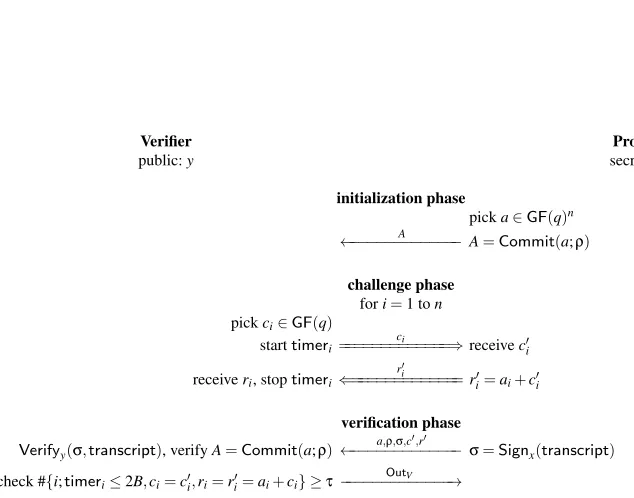
Example 10. We recall the Hermans-Peeters-Onete protocol [23] on Fig. 5. It is based on the one-more discrete logarithm problem and the decisional Diffie-Hellman problem over elliptic curves. We can easily see that it is not sound. Indeed, the adversary can just relay messages between the prover and the verifier and run the challenge phase after being given the vectorsa′0anda′1. These vectors do not leak any sensitive information.
4 ProProx: a PoPoK Scheme
4.1 Building Blocks
Perfectly binding bit commitment. Depending on the security parameterλ, we use a (multiplicative) group structure with two Abelian groupsLandGand an elementθsuch thatGis generated byLandθ,
θ̸∈L, andLis the set of all squares ofG. We further assume that it is easy to do group operations and comparisons inGand to sample elements inGuniformly.6Finally, we assume it is computationally hard to distinguish elements fromLand fromG.
We defineCom(b;ρ) =θbρ2for a bitband a randomρ∈G, like in the Goldwasser-Micali cryp-tosystem [21,22]. So,Comis computationally hiding as defined by Def. 19. We will not require any secret key to extractb, although thereexistsa functionCom−1 such thatCom−1(Com(b;ρ)) =bfor allb∈ {0,1}andρ∈G. We will rather use the homomorphic properties of the commitment and prove the correct commitment in a zero-knowledge way. Def. 19 in appendix formally definesCom.
For instance, we can take a Blum integerN, i.e.,N=PQfor two distinct primesPandQwhich are congruent to 3 modulo 4. We set L to the set of quadratic residues modulo N andθ a residue moduloNsuch that(θP)=
(
θ
Q
)
=−1. E.g.,θ=−1. The algorithmComis givenNandθ. We sample r∈Gbyr=θbρ2modN, forb∈Z2andρ∈Z∗N. DistinguishingGfromLis the quadratic residuosity
problem, which is supposed to be hard. In this case,Nis assumed to come from a Common Reference String (CRS).
A zero-knowledge proof for z being a square. We use the Fiat-Shamir protocol [18]. Namely, we show thatzis a commitment to zero with a witnessζ(i.e.,z=ζ2) with the protocol from Fig. 3, based on a perfectly hiding trapdoor commitment. Concretely, we use Def. 20 and Def. 21 in appendix with an
N P
languageL. This is the set of all squares. Ifz=ζ2, we say thatzis a member ofLwith witnessζ. The protocol of Fig. 3 in appendix is 12-sound and zero-knowledge. It must be run k times in parallel to achieve a soundness levelκ=2−k. We denote it byZKPκ(z:ζ).By using parallel composition, we extend the protocol to prove thatz1, . . . ,zk are some
commit-ments to zero with witnessζ1, . . . ,ζk respectively, and denote it byZKPκ(z1, . . . ,zk:ζ1, . . . ,ζk). I.e., it succeeds with probability up toκif there existsisuch thatzi̸∈L.
(Perfectly binding) deterministic commitment. Given a hash functionH making coins forCom, we define a deterministic commitment byComH(x) = (Com(x1;H(x,1)), . . . ,Com(xs;H(x,s))) forx∈ Zs2. We assume thatComH is a one-way function. Def. 22 in appendix formally definesComH.
WhenHis a random oracle, we can easily show thatComH satisfies Def. 22. In other cases, we
must assume thatComcomposed withH is one-way. Constructions without using a random oracle are left to future work.
4.2 The ProProx Protocol
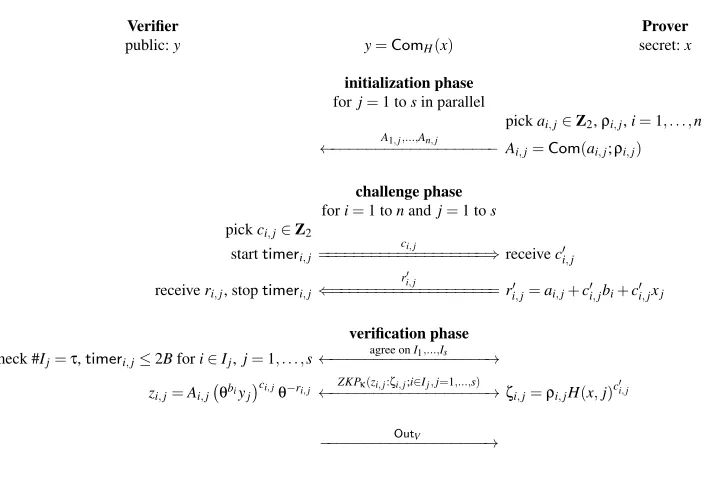
We define the ProProx protocol, as depicted on Fig. 1. We considers(the size of the secret),n (the number of rounds per iteration),τ(the minimal number of correct rounds per iteration for acceptance) as functions in terms of the security parameterλ. We assume sandnare asymptotically linear. We also use a vector b∈Zs2. We consider the vector b as fixed in the protocol. For now on, b is not important. It will only appear in Lemma 17 to treat distance fraud. There, we will only requirebto have a Hamming weight of⌊n2⌋.
Verifier Prover
public:y y=ComH(x) secret:x
initialization phase
forj=1 tosin parallel
pickai,j∈Z2,ρi,j,i=1, . . . ,n A1,j,...,An,j
←−−−−−−−−−−−−−−−−−−−Ai,j=Com(ai,j;ρi,j)
challenge phase
fori=1 tonandj=1 tos
pickci,j∈Z2
starttimeri,j
ci,j
===================⇒receivec′i,j
receiveri,j, stoptimeri,j
r′i,j
⇐===================ri′,j=ai,j+c′i,jbi+c′i,jxj
verification phase
check #Ij=τ,timeri,j≤2Bfori∈Ij,j=1, . . . ,s
agree onI1,...,Is ←−−−−−−−−−−−−−−−−−−→
zi,j=Ai,j(θbiyj)
ci,jθ−ri,j ←−−−−−−−−−−−−−−−−−−→ZKPκ(zi,j:ζi,j;i∈Ij,j=1,...,s) ζi,j=ρi,jH(x,j)c′i,j
OutV
−−−−−−−−−−−−−−−−−−−→
Fig. 1.ProProx: a Sound and Secure PoPoK.
The prover holds a secretx∈Zs2 and the public key isy=ComH(x). We iterates times and in
parallel a protocol which we call an iteration and which corresponds to an index j. First, the prover selectsnbitsa1,j, . . . ,an,j∈Z2and commits to them using some fresh coinsρ1,j, . . . ,ρn,j, respectively.
So,Ai,j=Com(ai,j;ρi,j),i=1, . . . ,n. TheAi,j’s are sent to the verifier.
In the challenge phase, we haventime-critical rounds (in each iteration). These rounds may be subject to noise. Fori=1, . . . ,n, the verifier picks a challengeci,j ∈Z2 at random and sends it to the prover. The prover receivesc′i,j (which may be different, due to noise). He computes his response r′i,j=ai,j+c′i,jbi+c′i,jxj and sends it back to the verifier at once. The verifier receivesri,j. The verifier
measures the elapsed timetimeri,j taken to receiveri,j after ci,j was sent. Below, pnoise is the
prob-ability that some noise corrupts a challenge/response round. We assume that the noise corrupts each round independently.
The c′i,j 7→r′i,j function maps one bit to one bit. Its table could be precomputed to save time. Furthermore, thesec′i,j7→ri′,jrounds could be run by analog circuits to avoid communication delays.
In the verification phase, the prover and the verifier determine a setIj ofτround indices which
they believe are correct. The way this agreement is done is not important (as long as the prover does not leak). Then, the verifier checks whetherIjhas cardinalityτand the corresponding timers are small
enough. If this fails, the verifier rejects. As a concrete instance forIj agreement, we suggest that the
prover sends (through the lazy noiseless channel) thec′i,jandr′i,jto the verifier. The verifier then takes the firstτ rounds for whichci,j =c′i,j, ri,j =r′i,j, and timeri,j ≤2B to define Ij and sendsIj to the
prover. If there are not enough correct rounds, the protocol aborts.
Next, the prover and the verifier run the interactive proofZKPκ to show that the responsesri,j’s
are consistent with theAi,j’s andyj’s. Namely, for all jandi∈Ij, they compute
zi,j=Ai,j
(
θbiy j
)ci,j
θ−ri,j , ζi
,j=ρi,jH(x,j)c
′
SinceAi,j=θai,jρ2i,jandyj=θxjH(x,j)2, it is easy to verify thatri,j=ai,j+ci,jbi+ci,jxjis equivalent
to the existence ofζi,jsuch thatzi,j=ζ2i,j. That is,zi,j∈L. If this fails, the protocol aborts. When the
protocol aborts, the verifier sendsOutV =0. Otherwise, he sendsOutV =1.
4.3 Analysis
Theorem 12. Letε>0be a constant. We assume that n is linear inλand that nτ <1−pnoise−εor
that pnoise=0. Under the assumption thatComis a homomorphic bit commitment [Def. 19] and that
ZKPκ is complete [Def. 20], the ProProx protocol is a PoPoK when the challenge/response rounds are subject to a noise level of pnoise[Def. 2].
We further assume thatτ≥n−(12−2ε)⌈n2⌉. Under the assumption thatComis a perfectly binding, computationally hiding, and homomorphic bit commitment [Def. 19], thatComHis one-way [Def. 22],
and thatZKPκis aκ-sound [Def. 20] computationally zero-knowledge [Def. 21] proof of membership
forκ=negl(λ), the ProProx protocol is a sound [Def. 5] and secure [Def. 4] PoPoK.
Proof. Completeness forpnoise=0 is trivial. Proving completeness whennτ<1−pnoise−εis
straight-forward: we have less thanτnoiseless rounds with probability 1−Tail(n,τ,1−pnoise)<e−2ε
2n
due to the Chernoff-Hoeffding bound (see Appendix A), which is negligible. Then, the completeness failure is bounded by
pComp=1−Tail(n,τ,1−pnoise)s (1)
which is also negligible. We prove in Lemma 14 that ProProx is sound and we prove in Lemma 16
that ProProx is secure. ⊓⊔
We state an important result which will be used to prove soundness and security. Indeed, we construct an extractor using a single session of the experiment. Any time the experiment makes
V
accept, the extractor gives an output which is close to the secret, except with some probability that we can bound.
Lemma 13 (Extractor). Under the assumption that Com is a perfectly binding homomorphic bit
commitment, and thatZKPκ is aκ-sound proof of membership, for any experiment, there is a PPT algorithmExtractwhich takes the views of all close-by participants and the transcript of the protocol seen by
V
and which aborts ifV
rejects, otherwise produces a vector x′ ∈ {0,1}s. For any w, theprobability that
V
accepts and the Hamming distance between x and x′ is at least w is bounded byTail(⌈n2⌉,τ− ⌊2n⌋,12)w+κ.
Proof. We assume that we have an experiment making
V
accept with probability p. We definepB=Tail(⌈n2⌉,τ− ⌊n2⌋,12).
We take the viewpoint of
V
. Since we have a perfectly binding commitment, the valueyjuniquelydefinesxj=Com−1(yj), and the value ofAi,juniquely definesai,j=Com−1(Ai,j). (We stress that we
need not compute these values, we just mathematically define them given the view of the verifier.) The purpose of the proof is to show that we can extract a good approximation ofx, except with some negligible cases.
Letp=Pr[
V
accepts]. LetSbe the event that for all jand alli∈Ij, we haveri,j=ai,j+ci,jbi+ci,jxj(where the values are those seen by
V
).In the case where the statement proven by ZKPκ is true, for all j and i∈Ij, zi,j is clearly a
commitment to zero. Due to the homomorphic property ofCom, we know thatzi,jis the commitment
toai,j+ci,jbi+ci,jxj−ri,j. So, we deduce thatSoccurs. By using theκ-soundness ofZKPκ(Def. 20),
Thanks to Lemma 1, whenri,jcomes from a close-by participant, we can write
ri,j=Algo(Viewi,j,ci,j,Otheri,j)
with Viewi,j the partial view (before being able to see ci,j) of close-by participants and messages
Otheri,j independent (in the sense of Lemma 1) fromci,jcoming to these participants from far-away.
Note that bothViewi,jandOtheri,j can be computed from the final views of the close-by participants.
So, thanks to Lemma 1, we can compute in this case bothresp(0) =Algo(Viewi,j,0,Otheri,j) and
resp(1) =Algo(Viewi,j,1,Otheri,j) without rewinding (i.e., from the final view only). So, we can
compute the guessξi,j=resp(1)−resp(0)−biforxj.
Note that if the answerri,j comes to
V
from far-away, we can still apply Lemma 1 and deducethat the answer is the same forci,j=0 andci,j=1:resp(0) =resp(1). Although we may be unable
to compute the responses, we can still computeξi,j =−bi. In all cases, we can always compute the
vectorsξj= (ξ1,j, . . . ,ξn,j).
The extractor is takingAlgoto computeξjand to deducex′j=majority(ξj).
Given c, if ai,j+cbi+cxj =resp(c), we say that the answer to ci,j =c is correct. Let Rj =
(R1,j, . . . ,Rn,j)whereRi,jis the number of challenge valuesc∈ {0,1}for which the answer is correct
forci,j=c. IfRi,j =2, i.e. if we have two correct answers forci,j=0 and forci,j=1, then we have ξi,j=xj. IfRi,j =1, we haveξi,j̸=xj. Let
R
be the set of allR= (R1, . . . ,Rn)∈ {0,1,2}nsuch thatthe number ofi’s withRi =2 is at least ⌊n2⌋+1. For Rj∈
R
, we have a majority ofi’s for which ξi,j=xj. So, we havex′j=xj.We let R= (R1, . . . ,Rs) be a random variable defining theRj vectors. Since
V
is selecting thechallenges at random, onceRi,j is determined, we can compute the probability that the answer toci,j
is correct: ifRi,j=2 then this probability is 1. Otherwise, it is at most 12. IfW is the random variable
giving the number of jsuch thatRj̸∈
R
, we have Pr[S|W=w]≤pwB. So, Pr[W=w,S]≤pwBPr[W=w]and then Pr[W≥w,S]≤pwB. Finally, by splitting with theSand¬Sevents, we have
Pr[W≥w,A accepts]≤Pr[¬S,
A
accepts] +Pr[W≥w,S]≤µ+pwBWe note that each index jsuch that x′j̸=xj must corresponds toRj ̸∈
R
. So, having thatA
acceptsand the extractor gives at leastwerrors occurs with probability bounded byµ+pwB. ⊓⊔
Lemma 14 (Soundness).We assume that n is linear in λ and that τ≥n−(21−2ε)⌈n2⌉ for some constantεand some parameter⌈n2⌉. Under the assumption thatComis a perfectly binding homomor-phic bit commitment, and thatZKPκis aκ-sound proof of membership forκ=negl(λ), the ProProx protocol is a sound proof of proximity.
Proof. We define pB=Tail(⌈n2⌉,τ− ⌊n2⌋,12). We assumep≥pSoundwhere
pSound=2(pwB+κ) (2)
forw>0 constant. Actually, to use (2) with concrete parameters,wis chosen as the maximal value such that we want to protect against an adversary who can afford an exhaustive search ofsw steps. Sinceτ−n+⌈n2⌉
⌈n
2⌉ ≥
1
2+2ε, we havepB≤e−8ε
2n
due to the Chernoff-Hoeffding bound (see Appendix A), which is negligible. So,pSoundis negligible.
in the extracted pairs is bounded by pwB+κ
p ≤
1
2. When there are less errors, we can correct them by exhaustive search in time
O
(sw)(which is polynomial). If this fails (i.e., if it gives no preimage ofy by ComH), as some extracted pairs may have too many errors, we can just iterate. With a constantnumber of iterations, we finally extractx. The overall expected complexity isPoly(λ)/p. ⊓⊔ Our technique to prove security relies on Lemma 13 and zero-knowledge. We state this latter property.
Lemma 15 (Zero-knowledge).Under the assumption thatComis a computationally hiding bit com-mitment and thatZKPκis a computationally zero-knowledge proof of membership, The ProProx pro-tocol is zero-knowledge following Def. 21.
Proof. We have to prove that, given two participants P(x) andV∗(y,aux), there exists a simulator S(y,aux)such thatV∗(y,aux)↔P(x)produces a view ofV∗(y,aux)which is computationally indis-tinguishable from the output ofS(y,aux). We will actually construct a sequence of simulations. We define an interactiveV′(y,aux) to replaceV∗(y,aux), and some interactiveP′(x) andP′′ to replace P(x).
We denote ¯z the vector of allzi,j for j=1, . . . ,s andi∈Ij, and ¯ζthe vector of allζi,j. We split
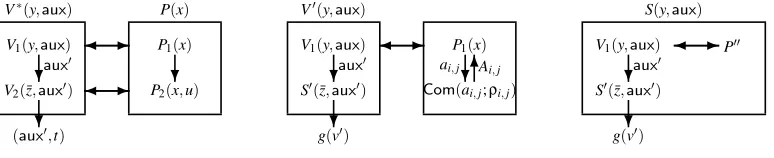
V∗(y,aux) into two protocolsV1(y,aux) andV2(¯z,aux′), whereV1 mimicsV∗ until theZKPκ(z¯: ¯ζ) protocol must start. Actually,V2executes onlyZKPκ(z¯: ¯ζ)whereaux′is the final view ofV1(y,aux). The final view ofV2(z¯,aux′) is of formv= (z¯,aux′,t). We writeg(v) = (aux′,t), which is the final view ofV∗(y,aux). Similarly, we splitP(x)intoP1(x)andP2(x,u)where(x,u)is the view ofP1(x). Clearly, running eitherV∗(y,aux)↔P(x) and taking the final view ofV∗, or V1(y,aux) ↔P1(x), V2(¯z,aux′)↔P2(x,u), then takingg(v)is the same. This simulation is illustrated on the left-hand side of Fig. 2.
V∗(y,aux)
V1(y,aux)
?aux′
V2(z¯,aux′)
?
(aux′,t)
P(x)
P1(x)
?
P2(x,u)
V′(y,aux)
V1(y,aux)
?aux′
S′(z¯,aux′)
?
g(v′)
P1(x)
?6
ai,j Ai,j Com(ai,j;ρi,j)
S(y,aux)
V1(y,aux)
?aux′
S′(z¯,aux′)
?
g(v′)
P′′
Fig. 2.Applying a ZK Reduction.
First,V′(y,aux) runs a simulation ofV1(y,aux) interacting withP1(x). Then,V′(y,aux) runs the simulatorS′(z¯,aux′) of the ZKPκ(z¯: ¯ζ) protocol associated to the verifierV2(¯z,aux′). Let v′ be the output ofS′(¯z,aux′). Finally,V′(y,aux) produces g(v′) as an output. This simulation is illustrated on the middle of Fig. 2. Due to the zero-knowledge property ofZKPκ(¯z: ¯ζ), v′ is computationally indistinguishable from the final view ofV2(¯z,aux′). So, the final view ofV′(y,aux) inV′(y,aux)↔ P1(x)and the final view ofV∗(y,aux)inV∗(y,aux)↔P(x)are indistinguishable.
Note thatP1(x) makes no longer extra use of the coinsρi’s (as P2(x,u) does inZKPκ). So, the commitment can be outsourced to a challenger playing the real-or-random hiding game forCom. We modifyP1(x)into an algorithmP′(x)who setsAi,j to the commitment to some random bit instead of
ai,j. Thanks to the hiding property ofCom, the output ofV′(y,aux)↔P1(x)and ofV′(y,aux)↔P′(x)
are indistinguishable.
view ofV∗inV∗(y,aux)↔P(x)and the output ofV′(y,aux)↔P′′are indistinguishable. This defines a simulatorS(y,aux), as illustrated on the right-hand-side of Fig. 2.
Overall, the advantage to distinguish is bounded by
pZK=pZKP+ns.pCom (3)
wherepZKPis the advantage to distinguish the ZK simulation from real in theZKPprotocol andpCom
is the bound on the hiding property ofCom. ⊓⊔
Lemma 16 (Security).We assume that s is linear and thatτ≥n−(12−2ε)⌈n2⌉for some constant
ε. Under the assumption thatComis a perfectly binding, and computationally hiding homomorphic bit commitment, thatComHis one-way, and thatZKPκis aκ-sound computationally zero-knowledge
proof of membership forκ=negl(λ), the ProProx protocol is secure following Def. 4.
Proof. We consider an experimentexpwith an honest always far-away prover. Letpbe the probability that
V
accepts. We want to show that p=negl(λ).We define pB=Tail(⌈n2⌉,τ− ⌊n2⌋,12) andw>0 constant. We use the extractor of Lemma 13 to
extract the vectorx′ when
V
accepts, with at leastwerrors toxwith probability bounded bypwB+κ. Then, by aO
(sw)-time exhaustive search on the errors, we correctx′and check if we obtain a preimage ofComH. This givesxin polynomial time and a probability of success of at leastp−pwB−κ, by playingwith some non-concurrent instances ofP(x). For each of the non-concurrent instances ofP(x), we use the zero-knowledge property ofP(x) to construct an algorithm invertingComH with probability of
success of at leastp−pwB−κ−r.pZK, whereris the number ofP(x)instances in one experiment. By
assumption onComH, this must be bounded by some negligible pCom. So, we have p≤pSec with
pSec=pwB+κ+r·pZK+pCom (4)
Sinceτ−n+⌈
n
2⌉
⌈n
2⌉ ≥
1
2+2ε, we havepB≤e− 8ε2n
due to the Chernoff-Hoeffding bound (see Appendix A), which is negligible. The valuesκ, pZK, and pComare also negligible, whiler is polynomial andwis
constant. So,pSecis negligible. ⊓⊔
Note that a malicious prover can run a distance fraud in each round wherebi=xj, asri,jno longer
depends onci,j. Forx=0 (as allowed in the malicious prover model) andb=0, this can be done in all
rounds, so we can have a distance fraud. There is no contradiction with soundness: an observer seeing the verifier accepts can deduce thatxjis likely to be zero, for all j. So, the malicious prover leaks.
To have distance fraud resistance, we adopt the following trick taken from DB2 [9,10]: we select a vectorbwith Hamming weight⌊n2⌋so that half of the rounds will really useci,j. Actually,bhas a
maximal distance to the repetition code.
Lemma 17 (DF-Resistance). We assume that n is linear and that τ ≥n−(21−2ε)⌊n2⌋ for some constantεand that the vector b has a Hamming weight of⌊n2⌋. Under the assumption thatComis a perfectly binding bit commitment and thatZKPκis aκ-sound computationally zero-knowledge proof of membership forκ=negl(λ), the ProProx protocol resists to distance fraud following Def. 6.
Proof. Due to the perfectly binding property, the view of
V
uniquely definesxj andai,j. Thanks toLemma 1,ri,j is independent (in the sense of Lemma 1) fromci,j. So, forbi̸=xj(which happens for
half of the rounds), we have that Pr[ri,j=ai,j+ci,jbi+ci,jxj] =12. So, the probability that the statement
inZKPκholds is bounded byTail(⌊n2⌋,τ−⌈n2⌉,12)swhich is negligible forτ−n+⌊
n
2⌋
⌊n
2⌋ ≥
1
with probability bounded byκ+Tail(⌊n2⌋,τ− ⌈n2⌉,12)s. Finally, the attack succeeds with probability bounded by
pDF=κ+Tail
(⌊n 2 ⌋ ,τ− ⌈n 2 ⌉ ,1 2 )s (5)
which is also negligible. ⊓⊔
We could also treat distance hijacking [15] specifically. As we can see in our protocol, the prover responds using his own randomai,j which are hidden in the commitment. So, is an honest prover with
another identity interact with
V
during the challenge phase, his response would match the one thatV
expect from his view, and the soundness ofZKPwould make the protocol fail. The full formalization is left to future work.
4.4 A Variant for Noiseless Communications
The protocol could be simplified in noiseless environment. For this, we would take n=τ. There is clearly no need to agree onIjwhich is always the full setIj={1, . . . ,n}. The protocol is much simpler.
4.5 Concrete Parameters
To see if the proven bounds Eq. (2), Eq. (4), and Eq. (5) may tight or not, we look at the best known attacks. They correspond to the following probabilities of success:
pDF=Tail
(⌊n 2 ⌋ ,τ− ⌈n 2 ⌉ ,1 2 )s
, pSec=Tail
(
n,τ,1
2
)s
, pSound=Tail
(⌈n 2 ⌉ ,τ− ⌊n 2 ⌋ ,1 2 )s
The DF attack with success probability pDF consists of guessingci in half of the rounds for which
bi̸=xj. So, the proven bound Eq. (5) is pretty tight.
The MF attack with success probability pSec follows the post-ask strategy: the adversary first
guesses the answers to all challenges then play with the prover with the same challenges. Clearly, there is a gap between pSec and the proven bound of Eq. (4).
The TF attack with success probability pTF consists of giving a table of allc′i,j 7→r′i,j which is
corrupted in half of the rounds in each iteration, so that it gives no information aboutxj. There is also
a gap with the proven bound Eq. (2).
So, it may be the case that either the bounds Eq. (4) and Eq. (2) can be improved, or that there exist better attacks. To select the parameters, we could either use theprovenbounds or the equations based on the best known attacks that we call theempiricalbounds.
As concrete parameters, we could suggests=80 bits as the size of the secret and a modulusN of 2 048 bits. Then, we look fornandτwhich minimize the total number of roundsnwhile keeping pComp≈1−2−7and different objectives: we propose several vectors of parameters to reach the online
security of eitherσ=2−20(high) orσ=2−10(low), withprovenbounds orempiricalbound, and with eitherpnoise=1% or the noiseless variant (pnoise=0) from Section 4.4. In the computation of Eq. (2)
and Eq. (4), we tookκ=σ4 andwsuch that the exhaustive search is not more for a randoms-bit string, i.e.,sw≤2s. So, we tookw=⌊sloglog 2s⌋.
security bounds pnoise ns s n w τ pComp pDF pSec pSound
high proven 1% 1 360 80 17 12 14 1−2−9 2−22 2−22 2−21 high empirical 1% 720 80 9 – 7 1−2−7 2−43 2−278 2−80 low proven 1% 720 80 9 12 7 1−2−7 2−12 2−11 2−10 low empirical 1% 720 80 9 – 7 1−2−7 2−43 2−278 2−80 high proven 0 240 80 3 12 3 1 2−22 2−22 2−21 high empirical 0 160 80 2 – 2 1 2−80 2−160 2−80 low proven 0 160 80 2 12 2 1 2−12 2−11 2−10 low empirical 0 160 80 2 – 2 1 2−80 2−160 2−80 low proven 0 80 80 1 12 1 1 (2−22)∗ 2−12 2−11 high empirical 0 80 80 1 – 1 1 (2−22)∗ 2−80 2−80
Clearly, there is a big gap between proven and empirical parameters in the high security values. In the noiseless variant, the round complexity looks large but acceptable. ProProx may be hard to implement on NFC credit cards, but, at least all vectors in the noiseless variant and all vectors with the empirical bounds are feasible for implementation on an NFC smartphone for payment applications.
In theory, we cannot consider n as a constant since the bounds in Eq. (2) and Eq. (4) are not negligible in this case. However, it makes sense to consider very lownin practice if we estimate the exact security.
As we can see,nis very low in the noiseless variant. Typically,n=2. We cannot haven=1 due to thepDFbound: withn=1,bhas a single bit and forxj=bfor all j, the distance fraud is possible.
However, we could tweak the protocol to obtain DF-resistance forn=1: we could havebselected by the verifier for each iteration at random. I.e.,V selects a random vectorb∈Zs2and sends it toP during the initialization. Then,P uses ri,j =ai,j+ci,j(bj+xj) as a response function. Clearly, our
results about security and soundness do not depend on the selection ofb, so they remain valid with this variant. With this variant, we could prove pDF=κ+ (34)s≈2−22 by standard techniques. This
selection is indicated under parenthesis in the table as it requires a change in the protocol and does not use Eq. (5).
As we can see, the noiseless case withn=1 ands=80 offers pretty reasonable parameters. We can prove thelowsecurity level and we can even hope that it provides ahighone, due to the remaining gap betweenprovenandempiricalbounds. An interesting open question is to wonder if we could have protocols with less thansrounds. In our construction, we build an extractor using a single session of the protocol by
V
. We conjecture and in such case, to extract ans-bit secret, we need to getsbits in the challenge phase. So our protocol could be optimal among those with a single-session extractor.5 Conclusion
We proposed ProProx, the very first PoPoK addressing soundness. It is provably secure. Conceptually, we believe it could integrate well in an infrastructure for contactless payments. A remaining challenge is to construct a more efficient PoPoK. Another open question would be to have a tight security proof for ProProx.
References
1. G. Avoine, M. Bing¨ol, S. Kardas, C. Lauradoux, B. Martin. A Framework for Analyzing RFID Distance Bounding Protocols.Journal of Computer Security, vol. 19(2), pp. 289–317, 2011.
3. A. Bay, I. Boureanu, A. Mitrokotsa, I. Spulber, S. Vaudenay. The Bussard-Bagga and Other Distance-Bounding Proto-cols under Attacks. InINSCRYPT’12, Beijing, China, Lecture Notes in Computer Science 7763, pp. 371–391, Springer-Verlag, 2012.
4. T. Beth, Y. Desmedt. Identification Tokens or: Solving The Chess Grandmaster Problem. InAdvances in Cryptology CRYPTO’90, Santa Barbara, California, U.S.A., Lecture Notes in Computer Science 537, pp. 169–176, Springer-Verlag, 1991.
5. I. Boureanu, A. Mitrokotsa, S. Vaudenay. Secure & Lightweight Distance-Bounding. InLightweight Cryptography for Security and Privacy LightSec’13, Gebze, Turkey, Lecture Notes in Computer Science 8162, pp. 97–113, Springer-Verlag, 2013.
6. I. Boureanu, A. Mitrokotsa, S. Vaudenay. Practical & Provably Secure Distance-Bounding. To appear in the Journal of Computer Security. Available as Eprint technical report, 2013. http://eprint.iacr.org/2013/465.pdf
7. I. Boureanu, A. Mitrokotsa, S. Vaudenay. Towards Secure Distance Bounding. InFast Software Encryption’13, Singa-pore, Lecture Notes in Computer Science 8424, pp. 55–67, Springer-Verlag, 2013.
8. I. Boureanu, A. Mitrokotsa, S. Vaudenay. Practical & Provably Secure Distance-Bounding. To appear in the proceedings of ISC’13.
9. I. Boureanu, S. Vaudenay. Optimal Proximity Proofs. Eprint technical report, 2014. http://eprint.iacr.org/2014/693.pdf 10. I. Boureanu, S. Vaudenay. Optimal Proximity Proofs. To appear in the Proceedings of Inscrypt’14.
11. I. Boureanu, S. Vaudenay. Challenges in Distance-Bounding. To appear in the IEEE Security & Privacy Magazine, 2015.
12. S. Brands, D. Chaum. Distance-Bounding Protocols (Extended Abstract). InAdvances in Cryptology EUROCRYPT’93, Lofthus, Norway, Lecture Notes in Computer Science 765, pp. 344–359, Springer-Verlag, 1994.
13. L. Bussard, W. Bagga. Distance-Bounding Proof of Knowledge to Avoid Real-Time Attacks. InIFIP TC11 Interna-tional Conference on Information Security SEC’05, Chiba, Japan, pp. 223–238, Springer, 2005.
14. H. Chernoff. A Measure of Asymptotic Efficiency for Tests of a Hypothesis Based on the sum of Observations.Annals of Mathematical Statistics, vol. 23 (4), pp. 493-507, 1952.
15. C.J. F. Cremers, K.B. Rasmussen, B. Schmidt, S. ˇCapkun. Distance Hijacking Attacks on Distance Bounding Protocols. InIEEE Symposium on Security and Privacy S&P’12, San Francisco, California, USA, pp. 113–127, IEEE Computer Society, 2012.
16. Y. Desmedt. Major Security Problems with the “Unforgeable” (Feige-)Fiat-Shamir Proofs of Identity and How to Overcome Them. InCongress on Computer and Communication Security and Protection Securicom’88, Paris, France, pp. 147–159, SEDEP Paris France, 1988.
17. U. D¨urholz, M. Fischlin, M. Kasper, C. Onete. A Formal Approach to Distance-Bounding RFID Protocols. In Informa-tion Security ISC’11, Xi’an, China, Lecture Notes in Computer Science 7001, pp. 47–62, Springer-Verlag, 2011. 18. A. Fiat, A. Shamir. How to Prove Yourself: Practical Solutions to Identification and Signature Problems. InAdvances
in Cryptology CRYPTO’86, Santa Barbara, California, U.S.A., Lecture Notes in Computer Science 263, pp. 186–194, Springer-Verlag, 1987.
19. M. Fischlin, C. Onete. Terrorism in Distance Bounding: Modelling Terrorist-Fraud Resistance. InApplied Cryptog-raphy and Network Security ACNS’13, Banff AB, Canada, Lecture Notes in Computer Science 7954, pp. 414–431, Springer-Verlag, 2013.
20. S. Gambs, C. Onete, J.-M. Robert. Prover Anonymous and Deniable Distance-Bounding Authentication. InACM Sym-posium on Information, Computer and Communications Security (ASIACCS’14), Kyoto, Japan, pp. 501–506, ACM Press, 2014.
21. S. Goldwasser, S. Micali. Probabilistic Encryption and How to Play Mental Poker Keeping Secret All Partial Infor-mation. InProceedings of the 14th ACM Symposium on Theory of Computing, San Fransisco, California, U.S.A., pp. 365–377, ACM Press, 1982.
22. S. Goldwasser, S. Micali. Probabilistic Encryption.Journal of Computer and System Sciences, vol. 28, pp. 270–299, 1984.
23. J. Hermans, R. Peeters, C. Onete. Efficient, Secure, Private Distance Bounding without Key Updates. InACM Confer-ence on Security and Privacy in Wireless and Mobile Networks WISEC’13, Budapest, Hungary, pp. 195–206, ACM, 2013.
24. W. Hoeffding. Probability Inequalities for Sums of Bounded Random Variables.Journal of the American Statistical Association, vol. 58, pp. 13–30, 1963.
25. A. Ranganathan, N.O. Tippenhauer, B ˇSkori´c, D. Singel´ee, S. ˇCapkun. Design and Implementation of a Terrorist Fraud Resilient Distance Bounding System. InComputer Security - ESORICS’12, Pisa, Italy, Lecture Notes in Computer Science 7459, pp. 415–432, Springer-Verlag, 2012.
27. K.B. Rasmussen, S. ˇCapkun. Realization of RF Distance Bounding. InUSENIX Security Symposium (USENIX’10), Washington, DC, USA, pp. 389–402, USENIX, 2010.
28. S. Vaudenay. On Modeling Terrorist Frauds. InProvable Security ProvSec’13, Melaka, Malaysia, Lecture Notes in Computer Science 8209, pp. 1–20, Springer-Verlag, 2013.
29. S. Vaudenay. Private and Secure Public-Key Distance Bounding: Application to NFC Payment. To appear in the pro-ceedings of Financial Cryptography’15.
A Useful Bounds
We recall here some useful bound on the tail of the binomial distribution.
Lemma 18 (Chernoff-Hoeffding bound [14,24]). For any ε,n,τ,q such that τn <q−ε, we have
Tail(n,τ,q)>1−e−2ε2n. For τn>q+ε, we haveTail(n,τ,q)<e−2ε2n.
B Definitions
Definition 19 (Bit commitment).A bit commitment consists of a PPT algorithmComtaking as in-putλ, a bit b∈Z2, and some randomρ∈G. It computesCom(b;ρ)∈G. We define the following properties:
– homomorphic: for all b,b′∈Z2andρ,ρ′∈G,Com(b;ρ)Com(b′;ρ′) =Com(b+b′;ρρ′);
– perfectly binding: for all b,b′∈Z2andρ,ρ′∈G,Com(b;ρ) =Com(b′;ρ′)implies b=b′;
– computationally hiding: forρrandom, the distributions ofCom(0;ρ)andCom(1;ρ)are compu-tationally indistinguishable.
Definition 20 (Sound proof of membership).An interactive proof for a language L is a pair of protocols(P(ζ),V(z))of PPT algorithms such that
– completeness: for any z∈L with witnessζ,Pr[OutV =1 :P(ζ)↔V(z)] =1;
– κ-soundness: for any z̸∈L and any algorithm P∗thenPr[OutV =1 :P∗↔V(z)]≤κ.
Definition 21 (Zero-knowledge protocol). A protocol (P(ζ),V(z)) for a language L is computa-tionally zero-knowledge for P(ζ) if for any PPT interactive machine V∗(z,aux) there exists a PPT algorithm S(z,aux) and a negligibleε such that for any PPT distinguisher, any(z:ζ)∈L, and any
aux, the advantage for distinguishing the final view of V∗(z,aux)in P(ζ)↔V∗(z,aux)and the output of S(z,aux)is bounded byε.
Definition 22 (One-way function).We consider a function Com taking as inputλ and a message x∈Zs2 which is computable in deterministic polynomial time. The function is one-way if for any algorithm receivingCom(x), for x∈Zs2random, the probability that it outputs x is negligible.
C VSSDB
At BalkanCryptSec’14, Gambset al.presented VSSDB, a new protocol based on the random oracle model.7The protocol also needs a PKI for the verifier, so that he can use a secret decryption keyskv
and publish a public encryption keypkV. It also uses a homomorphic bit-commitment scheme. The presented protocol offers no tolerance to noise and is not sound, but it offers resistance to terrorist fraud as modeled by theGameTFnotion [19] in the DFKO model.
![Fig. 5. The Hermans-Peeters-Onete Protocol [23].](https://thumb-us.123doks.com/thumbv2/123dok_us/7908239.1313136/20.612.116.440.101.346/fig-the-hermans-peeters-onete-protocol.webp)
