Optimization of Self-Adaptive High
Anti-Radiation EDFA for Space OCS: A Review
Varinder Singh1, Lovkesh2, Harmandeep Singh3, Baldeep Singh4
PG Students [ECE], Dept. of ECE, Punjabi University, Patiala, Punjab, India1,3,4
Assistant Professor, Dept. of ECE, Punjabi University, Patiala, Punjab, India2
ABSTRACT: In the earliest days of the telecommunication, there was a need to increase the transmission of more data and with the faster rate. Earlier single line wires were used in the telecommunication. But these gave way to the coaxial cables which enabled various channels to transmit over the same cable. But these systems had limited bandwidth and then optical systems investigated. So for the transmission of more than gigabits of data, fiber optic communication is widely used. This paper will review the use of fiber optic in Space communication systems. Apart from this, the present study will focus on the use of EDFA in space optical communication.
KEYWORDS: EDFA, Self-Adaptive, Space communication system
I. INTRODUCTION 1.1.Optical Communication
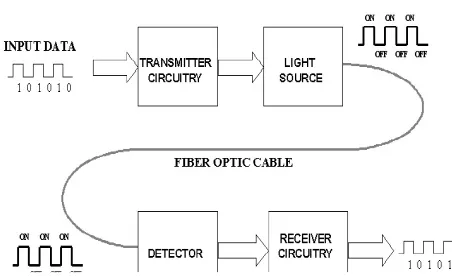
Apart from the transmission based on the copper wire where entirely transmission depends on the electrical signals instead of the light signal passing through the copper cable, fiber optics transmission includes the transmission of the signals as a light signal from one end to the another end. Moreover, the fiber optic communication network has a transmitter and receiver circuitry, light source and the detector devices like shown in figure 1. [1]
In the optical fiber communication system, an input signal is applied in the form of electrical signal and is directly given to transmitter circuitry. This circuitry converts the electrical signal into the light signal with the help of light source. The light source can be LED whose amplitude, phase and frequency remain stable and must be free from fluctuations so that we can achieve efficient transmission of the signal. Then the light beam coming from a source is passed through fiber optic cable to the receiving circuitry where the information is converted back to the electrical signal by a photo detector. [1]
As the optical fiber communication transmits the data over the longer distance by which the signals can be attenuated.But this is not limited by the attenuation of a cable, but also by the distortion of light signal along with the cable. So to overcome those effects and to transmit the signals over longer distances efficiently, repeaters and amplifiers are used in this communication. [2]
For the above purpose, Opto-electric repeaters can be used. These repeatersconvert an optical signal into the electrical signal where it can be ensured that signal will not be distorted and then it is converted back into optical form.
Figure 1: Optical Fiber Communication system
1.2. Use of Optical Communication in Space
There are some space applications which requires a significant amount of data to be transmitted. We can take the example like there is transmission between the different Earth-orbiting satellites, which was firstly demonstrated by the European Space Agency (ESA) in 2001. But now it’s possible to transmit more than ten megabits per second over so many thousands of kilometers, by using medium laser average power in the order of few watts. [3]
We can also exchange the data between more remote spacecraft and the station on or near to Earth. Such as, planetary probes can generate lots of image data, and one of the greatest challenges is to transmit bulk of data back to the Earth. Recently, radio links are operating like in X-band or Ka band were the only one available technology. Now, optical data links considered particularly for downlink process, whereas the desired data volumes are so much larger than for the process of uplink, and with this optical communication now greatly expand its transmission capacity to the hundreds of kbit or even many megabits per second. [4]
Thus the spacecraft has a pulsed laser source and an optical telescope of the moderate size which is targeting the receiver. Later on, it can be the large ground-based telescope or the transceiver in Earth orbit.The basic advantage of the optical technology on the radio links is that it has the much shorter wavelength which allows for more directional transmitting and receiving of information, which results in low power requirements with high data rates. Technically, antenna gain will be much higher. Whileoptical links are highly sensitive to the weather conditions. [5]
1.3. EDFA
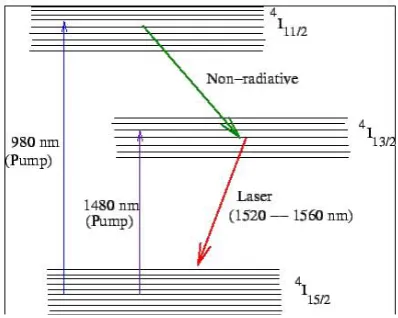
EDFA means erbium doped fiber amplifier, is an optical repeater device which is used to boost up the intensity of the optical signals and then carried through the fiber optic communications system.The optical fiber is doped with rare earth element Er3+ with this glass fiber will absorb light at the single frequency and then emit light at other frequency. The external semiconductor laser will couple the light into the fiber at the infrared wavelengths of 980 or 1480 nanometers. Furthermore, this action will excite the Er3+ atoms. Additionally, optical signals which are at the wavelengths between 1530 and 1620 nanometres then enter fiber and stimulate excited Er3+ atoms to emit the photons at the of the same wavelength as an incoming signal. With this action, it will amplify a weak optical signal to high power optical signal and effect a boost in signal strength. [6]
Figure 2: EDFA
But the EDFA removes this step from the complete process: as all steps of its operation will be the actions of photons, because of this, there’s no conversion of the optical signals to the electronic signals. The energy levels of erbium doped system are shown in figure 3. It may be noted that energy levels from the three groups of energy levels which are marked with their spectroscopic notations. To make it simple, we will model the three groups of energy levels by the three sharp levels of the energy denoted by and then representing respectively upper, metastable and ground states. [7]
Figure 3: Energy Level Diagram
1.4. Benefits of EDFA
Larger bandwidth: Optical communication system provides high bandwidth with high data rate.
Low transmission: Low transmission can be obtained in optical communication systems because of the use of optical amplifiers of Ultra low loss fibers and erbium-doped silica fibers. Less possibility of signal loss as compared to copper wire. [12]
Free from EMI and RFI:Optical fibers are free from radio frequency interference (RFI) and electromagnetic interference (EMI) as they are dielectric waveguides. [13]
Light in weight and size:Opticalfibers are very light in weight (10 µm - 50 µm).
Signal security: Optical fiber provides total signal security as the signal transmitted through the fiber does not radiate.
Flexibility: Optical fibers can be easily twisted or bent without any damage.
1.5. Applications of EDFA
a) In Roadmap of the optical communications
b) As Self-Adaptive High Anti-Radiation EDFA for the Space Optical Communication Systems c) EDFA based all optical relaying in FSO
d) Fiber coupling efficiency for the free-space optical communication via atmospheric turbulence [10] e) 1.28 terabit/s WDM transmission system for the FSO communications.
f) Link budget calculations and amplified system BER. g) Estimation of bit error rate.
h) ROF (Radio Over Fiber) systems. i) Fiber backup.
j) Service acceleration.
1.6. Self-Adaptive and Anti Radiations in Space Optical Communication Systems
Due to the effects of the space radiation, the performance of anti-radiations of erbium-doped fiber amplifier(EDFA) will worsen in space optical communication system which also includes amplification of the sub-system. The EDFA does not work in the optical state that is designed on the ground. The basic characteristics of the radiations of EDFA are conducted to solve this type of problem. With the decrease in the dose of radiations, the gain of EDFA and optimal length of EDFA can be decreased. A system is developed named as a self-adaptive system to eliminate this type of effect which makes an improvement in the gain i.e. up to 7Db when the radiations go up to 5000Gy. [1]This system is very beneficial in space optical communication system. It also helps in reducing the noise figure of EDFA in the space of anti-radiation environment. [4]
The anti-radiations can affect the performance of the EDFA in various ways by decreasing the EDFs optimal length and reducing the output power of the signal. Due to which the efficiency of the pumpis also reduced under the anti-radiation environment. For increasing the anti-radiation tolerance in EDFA, self -adaptive system is developed which adapt the anti-radiation environment in space optical communication system. It improves the anti-radiation tolerance in the EDFA by avoiding the complexity. The self-adaptive system can benefit the space optical communication system and improves the performance of the anti-radiation tolerance. [6]
II.LITERATURE REVIEW
O. Berné, M. Caussanel, and O. Gilard (2004) discussed the model to predict the EDFA gain and show the effects of radiation on EDFA in Space Radiation Environment by irradiating with a total dose of 3kgy and 60Co-rays. The core erbium concentration was evaluated and observed to be 150 ppm. The experiment of this research used 24 m of this fiber and configured the pump for single-stage EDFA. The experimental method used the input signal of 1.2 mW and pump power at 240 mW. The results of this experiment show that during the irradiation, they achieved 1310-nm absorption and measured the gain to overcome the damage on the fiber. They concluded that on achieving the 1310 nm absorption, they predict the 10% accuracy in degradation which is caused by radiation on EDFA [1].
P. B. Harboeand J. R. Souza (2004) presented the feasibility of the FSO systems in the Brazil region. On the concept of power balance, a numeric model is developed for calculating the space optical link losses. And data is collected from many airports to determine the FSO system availability. The results of the investigation show that the condition of atmosphere determines the FSO systems availability. FSO system offers quality, speed, reliability at the low cost of optical communication in clear sky conditions. It is concluded that from the proper analysis of scintillation effect improves the numeric model [2].
K. V. Zotov, et al. (2008) presented the use of radiant-resistance erbium-doped fiber for the application of spacecraft. This research analyzed the EDFA coated with hermetic with molecular hydrogen for Radiation-induced absorption. It is observed that the hermetic coating and H-loading are used to prevent diffusion of H-gas from the network fiberglass, and it also allows the service time prolongation of Erbium-doped fibers more than five times in the space communication. This study also observed that the erbium-doped fibers which are coated with H-loaded provide prolongation of EDFA’s service time and the solution to the problem of the radiation resistance [4].
Ma, et al. (2009) proposed a high power EYDFA (erbium-ytterbium co-doped fiber amplifier) radiated to the 50 krad at the rate of 40 rad/s. The research measured some important parameters to investigate the effects of radiation on EYDFA in space optical communication system. The results explored that the dose of 50 kradis enough to low-dose radiation and good for low-dose inter-satellite communication systems. [5]
J. Thomas, et al. (2012) demonstrated the radiation-resistance erbium-doped-nanoparticles optical fiber performance that is used in the space application which is based on the reduction of an Aluminum co-doping atom. Due to this reason, many fibers with different aluminum and erbium configuration is developed and then tested in the configuration of the optical amplifier. This resulted in high radiation resistance pure silica optical fiber of Erbium-doped that exhibit less quenching level. In the experiment, radiation-resistance performance is compared with 5 EDFAs which have different chemical compositions that measure the noise factor, optical gain, wavelength of signal and pump under 60Co gamma radiations. From the experiment, it is concluded that the inhomogeneous broadening fiber must enhance to target the low noise applications and multi-channel [6].
E. Bayaki, S. Michalopoulos, and R. Schober (2012) proposed multi-hop and dual-hop EDFA-based all optical relaying in free-space optical systems. For the analysis, they developed AF relays including electrical amplification which estimated the performance of actual system accurately. The results show that EDFA-based all optical relaying are simpler to implement, gives better performance and they are faster in comparison to electrical relaying. The high performance and simplicity of EDFA-based optical relaying make FSO systems which are attractive for their applications in wireless backhaul and terrestrial communication in the communication system of mobile. They are also beneficial for another type of fading like K-fading or Gamma fading. The proposed system all-optical relays equipped with EDFA observed that performance increases with the number of relays increases [7].
Erick de A. Barboza, C. J. A. Bastos-Filho, Joaquim F. Martins-Filho, U. C. de Moura and Juliano R. F. de Oliveira (2013) described the method to adjust amplifiers in the cascade which is based on machine learning approach whose objective is to increase the level of each amplifier to get the output and input level of power to minimize the noise figure and increase the flatness in the transmission systems.The iterative method was used to perform backward and feed forward adjustments errors which are based on the local information. The results show that the performance of input and output power is very essential in the scenario network [8].
J. Sakaguchi, et al. (2013), proposed19-SDM transmission system with low-crosstalk 19-core fiber and a prototype 19-core EDFA. The research developed 19-core MCF Transmission System with the help of EDFA which share the core pumping coupling in Free-Space Optics that light into cores due to which SDM is transparent. It consists of 19-core EDFA prototype and 19-19-core fiber low-crosstalk. The result shows that by performing the experiment using PDM-QPSK signals, the long-haul transmission goes to 900 km in the system feasibility. And new core arrangement improved the crosstalk over 30km is -42 dB, and reduction in the cost using the core pumping scheme [9].
Yan, W.,Hongzuo, L., & Ziqiang, H. (2013) analyzed the effects of EDFA performance in space radiation environment. The paper proposed various the approaches improve the performance of EDFA against radiation. Those approaches include pre-radiation and hydrogen loading active anti-radiation technique, fading center anti-radiation technique, and fiber manufacturing technology of anti-radiation technique. The experimental results found that the proposed approaches can obtain the radiation decay up to 0.8 dB/km for 1550 nm EDF.
values. It is also concluded that the radiations of space influence BER performance. The increase in temperature maximizes the effect of radiation on BER which means that EDFA could no work in high temperature. Hence, it essential to choose the suitable lasers and receivers which adapt to a specific dose of radiation [11].
R. N. Mahalati, D Askarov and J. M. Kahn (2014) studied adaptive methods to balance Mode-Dependent gain (MDG) in multimode EDFA (MM-EDFAs). One method used a spatial light modulator (SLM) and the second method used SLM with MM-EDFA proposed two adaptive methods in multi-mode erbium-doped fiber amplifier to level the gain of mode dependent. In the first method, a spatial light modulator is used which also include pump beam amplifier which controls the power pump. The second method is used to control signals of model powers with the help of SLM. Then compare the performance of the two methods which are applied to MM-EDFA that support modes of the signal. The proposed methods obtained 2.6-dB loss of mode-averaged gain. From the result, it is concluded that both the methods were performed for frequency independent equalization MDG which are highly effective in the high frequency [12].
M. Li, et al. (2015) investigated about space optical communication system by using self-adaptive erbium-doped fiber amplifier (EDFA) to enhance the EDFA radiation tolerance. They observed that due to the effect of the space radiation, the performance of erbium-doped fiber optics is degraded. The results show that EDFA will not work in the optimal state which is designed on the ground because on increasing the EDFA and its optimal length, decrease the output of signal power. To overcome these effects, they established a self-adaptive system which improves the gain by 7db when radiations dose is 5000Gy which benefits the design of space optical communication system by adjusting the power pump. The results proved that with the adjustment of pump power and length of EDFA, gain improvement could be achieved up to 7 dB. The research concluded that the proposed work could practically advantage the space optical communication system [13].
M. P. Chang,Chia-Lo Lee, Ben Wu, and P. R. Prucnal (2015) demonstrated the experiment of anoptical system which uses the optical amplifier semiconductor used in radio frequency signals to perform the analog, adaptive self-interference cancellation and phase matching. The delay and weight are controlled by input-output power and SOA bias current in which the latency of device is 200ns. The results show that system achieved 38 Db interference cancellation in-band over 60 MHz which decreased self-interference using the algorithm Nelder-Mead Simplex [14].
P. V. Trinh, N. T. Dang, and A.T. Pham (2015) analyzed the performance of optical amplify and forward relaying free space optical systems over the channels of Gamma-Gamma by using erbium doped fiber amplifier that combines over atmospheric turbulence with optical hard-limiter. To remove the noise to limit the system performance, OL is used which enables to relaying the FSO systems. From the numeric results, it is concluded that the proposed systems are superior to the conventional. The results of the experiment show that when the number of relays increased, the system which is proposed prevent accumulator noise and with the use of fewer relays, improved communication distance can be achieved [15].
W. Zhu, Li. Qian, A. S. Helmy (2015) presented the implementation and design of an advanced photonics lab experiment with three function devices by slide modifications of setup using Erbium-doped fiber. Experiments are performed on three devices i.e. a fiber laser, a multi-wavelength optical amplifier, and a broadband light source. These experiments result to determine the basic principles of EDFA and laser [16].
V. Trinh, T. Dang,and T. Pham(2015) proposed all optical relaying FSO systems to improve distance coverage of optical FSO systems and the performance of bit-error rate using EDFA. OAF technique is combined with Optical hard limiter using EDFA which prevent the accumulator noise and decreases the performance of the system which depends on relays. The results show that the proposed system is superior to the conventional [17].
A. Ladaci, et al., (2017)proposed simulation tool in rare earth doped fiber amplifier to optimize the performance of the space missions. A state of art model which is based on rate equation is used to describe the system. The main radiation effects on the radiation-inducedAttenuation can be seen using the technique particle swarm optimization. The experimental result shows deleterious radiation effects on the performance of amplifier which can be mitigated from the adequate strategies. [19]
M. Pfennigbauerand W. R. Leeb analysed about Erbium doped fiber amplifiers that areused in optical satellite communication. For implementing the optical free-space transmission system, they designed and tested booster amplifier of 1-watt power with breadboard that is consist of NRZ/RZ transmitter and direct detection receiver preamplifier. The receiver determines optimal optimum bandwidth by using simulation tool. The results of this research show that the parameters which were found, maximize the sensitivity of the receiver. According to the results, best sensitivity is obtained at 3 Db [20].
S. Singhand H. Kaur discussed the various effects of erbium-doped fiber amplifier such as power booster, pre-amplifier using 8 channel WDM which is based on the configuration of the optical pre-amplifier under the effect of NRZ-OOK. The results show a high-quality factor of wavelength 1500 nm by using Modulator, and they also show the good results for the configuration of the amplifier. It is concluded from the result that 50 Gbps of data is achieved from the 23 dBm of input of laser power which covers the distance of 7000 km having quality factor 28.086. It is also concluded that in order to cover large satellite distance and send the data of higher bit rate, optical amplification is very effective [21].
M. A. Khalighi, M. Uysal presented the survey on Space Optical Communication theory perception. The study investigated on OWC links of outdoor terrestrial that are operated in the infrared band which is referred as free space optical used between two fixed points for higher rate communication. The study concluded from the results that the FSO links are better than radio frequency in respect of higher data rates, high optical bandwidth which is used in Metropolitan area network and local area network which helps in backhaul wireless cellular network, fiber back-up, disaster recovery, wireless do surveillance, high definition medical image or video transmission [22].
III.FINDINGS
The section presents the findings of different techniques or methods used in previous researches to demonstrate the use of EDFA in Space communication systems. In 2014, Mi Li, et al., studied the ground-to-satellite communication system with EDFA and observed the BER performance influenced by space radiation, EDFA’s gain decreased by 2 Db.Mi Li, et al., also studied the EDFA characteristics under radiation to develop a self-adaptive system and obtained gain improvement of 7 Db.Similarly, R. N. Mahalati, D Askarov and J. M. Kahn in 2014, proposed adaptive methods to balance Mode-Dependent gain (MDG) in multimode EDFA (MM-EDFAs) and achieved 2.6-dB loss of mode-averaged gain. One method used a spatial light modulator (SLM) and the second method usedSLM with MM-EDFA.
The gain improvement could also help to reduce the deterioration of noise figure in EFA in radiation environment in space. In 2016, J. R. Lopez-Arreguin proposed a model to calculate noise figure growth of EDFA in the ionized environment and obtained the least degradation on noise figure up to 0.02 dB at low dose rates. S. Singh and H. Kaur
demonstrated the effect of optical amplifier configurations on simplex and 8 channel WDM inter-satellite free space optical communication system using NRZ-OOK and shown that 23 dBm input laser power, 50 Gbps of data rate can be achieved.
From our findings, we observed that the various parameters of EDFA influence the performance of EDFA. Such parameters are pump power, signal wavelength, signal power, the length of EDFA, etc. In order to enhance the radiation tolerance of an EDFA, a self-adaptive system can be designed which would adapt to the radiation in space.
IV.CONCLUSION
REFERENCES
1. O. Berné, M. Caussanel, and O. Gilard. “A Model for the Prediction of EDFA Gain in a Space Radiation Environment.” IEEE Photonics Technology Letters, Volume- 16, Issue No.- 10, October 2004.
2. P. B. Harboe and J. R. Souza. “Free Space Optical Communication Systems: A Feasibility Study for Deployment in Brazil.” Journal of Microwaves and Optoelectronics, Vol. 3, N.o 4, April 2004.
3. M. Abtahi, P. Lemieux,W.Mathlouthi, and L. A. Rusch. “Suppression of Turbulence-Induced Scintillation in Free-Space Optical Communication Systems Using Saturated Optical Amplifiers.” Journal of Lightwave Technology, Volume-24, Issue No.- 12, December 2006. 4. K. V. Zotov, M. E. Likhachev, A. L. Tomashuk, M. M. Bubnov, M. V. Yashkov, A. N. Guryanov, and S. N. Klyamkin. “Radiation-Resistant
Erbium-Doped Fiber for Spacecraft Applications.” IEEE Transactions on Nuclear Science, Volume- 55, Issue No. 4, August 2008.
5. Ma, J., Li, M., Tan, L., Zhou, Y., Yu, S., & Ran, Q. (2009). Experimental investigation of radiation effect on erbium-ytterbium co-doped fiber amplifier for space optical communication in alow-dose radiation environment. Optics Express, 17(18), 15571. doi:10.1364/oe.17.015571 6. J. Thomas, M. Myara, L. Troussellier, Ekaterina Burov,A. Pastouret,D. Boivin,G. Melin, O. Gilard,M. Sotom,and P. Signoret. “Radiation
-resistant erbium-doped-nanoparticles optical fiber for space applications.” Optics Express, Volume-20, Issue No.- 3, 30 January 2012. 7. E. Bayaki, S. Michalopoulos, and R. Schober. “EDFA-Based All-Optical Relaying in Free-Space Optical Systems.” IEEE Transactions on
Communications, Volume- 60, Issue No. 12, December 2012.
8. Erick de A. Barboza, C. J. A. Bastos-Filho, Joaquim F. Martins-Filho, U. C. de Moura and Juliano R. F. de Oliveira. “Self-Adaptive Erbium-Doped Fiber Amplifiers Using Machine Learning.” 2013.
9. Sakaguchi, J., Klaus, W., Puttnam, B. J., Mendinueta, J. M., Awaji, Y., Wada, N., Jensen, R. V. (2013). 19-core MCF transmission system using EDFA with shared core pumping coupled via free-space optics. Optics Express, 22(1), 90.
10. Yan, W., Hongzuo, L., & Ziqiang, H. (2013). Research of Anti-Radiation Technology for the EDFA Systems in Space Environment. Laser & Optoelectronics Progress, 50(7), 070601. doi:10.3788/lop50.070601
11. Mi Li, W. Jiao, Y. Song, X. Zhang, S. Dong, and Y. Poo. “Investigation of the EDFA effect on the BER performance in space uplink optical communication under the Atmospheric Turbulence.” Optical Express, Volume-22, Issue- 21, 20 October 2014.
12. R.N.Mahalati, D Askarov, and J. M. Kahn. “Adaptive Modal Gain Equalization Techniques in Multi-Mode Erbium-Doped Fiber Amplifiers.” Journal of Lightwave Technology, Volume- 32, Issue NO. 11, June 1, 2014.
13. Mi Li, Wenxiang Jiao, Yuejiang Song, Xuping Zhang, & Lingqian Chang. (2015). Self-Adaptive High Anti-Radiation EDFA for Space Optical Communication Systems. Journal of Lightwave Technology, 33(21), 4513-4516.
14. M. P. Chang,Chia-Lo Lee, Ben Wu, and P. R. Prucnal. “Adaptive Optical Self-Interference Cancellation Using a Semiconductor Optical Amplifier.” IEEE Photonics Technology Letters, Volume- 27, Issue No. 9, May 1, 2015.
15. P. V. Trinh, N. T. Dang, and A.T. Pham. “All-Optical AF Relaying FSO Systems using EDFA combined with OHL over Gamma-Gamma Channels.”Optical Networks and Systems Symposium, 2015.
16. Zhu, W., Qian, L., & Helmy, A. S. (2015). Implementation of three functional devices using erbium-doped fibers: an advanced photonics lab.
Tenth International Topical Meeting on Education and Training in Optics and Photonics. doi:10.1117/12.2207348
17. Trinh, P. V., Dang, N. T., & Pham, A. T. (2015). All-Optical Relaying FSO Systems Using EDFA Combined With Optical Hard-Limiter Over Atmospheric Turbulence Channels. Journal of Lightwave Technology, 33(19), 4132-4144. doi:10.1109/jlt.2015.2466432
18. J. R. Lopez-Arreguin, A. Rissons, Y. E. Avellaneda, S. L. Destrez, F. Destic, A. Fernandez, and O. Gilard. “Theoretical study of the space radiation effects in an EDFA for a small satellite mission.” International Symposium on Reliability of Optoelectronics for Systems, 2016. 19. Ladaci, A., Girard, S., Mescia, L., Robin, T., Laurent, A., Cadier, B., Boukenter, A. (2017). Optimized radiation-hardened erbium doped fiber
amplifiers for long space missions. Journal of Applied Physics, 121(16), 163104. doi:10.1063/1.4981532 20. M. Pfennigbauer and W. R. Leeb. “Optical satellite communications with Erbium-dopedfiber amplifiers.”
21. S. Singh, and H. Kaur. “Effect of EDFA based Various Optical Amplifier Configurations on Is OWC System.” Department of Electronics and Communication Engineering.