A Study on Power efficient Techniques in various
layers of Protocol stack in MANETs
Supriya Mahajan , Bhupinder Kaur , Vaibhav Pandey
Department of Computer Science & Engineering, PTU (Main Campus) Kapurthala, India
Abstract
-
Last decade has witnessed wide growth of Mobilead-hoc networks (MANETs). MANETs work well as a temporary fallback mechanism if normally-available infrastructure mode gear (access points or routers) stops functioning. Due to this, ad-hoc networks have gained wide popularity. However, Energy is a limiting factor in the successful deployment of ad hoc networks since nodes are expected to have little potential for recharging their batteries. . In this paper, we will review various techniques used for achieving energy efficiency. Protocol stack plays important role in functioning of any protocol. So, an attempt has been made to correlate various layers with power, to get better understanding by our future researchers in order to achieve efficient and effective power optimization.
Keyword - MANETs, Energy-efficient, Power, Protocol-Stack
I. INTRODUCTION
Mobile ad-hoc networks do not require any fixed router. Every node is equipped with various networking functions viz. control, routing, monitoring, mobility management etc. No single authority is in charge of controlling and managing the entire network. In other words, node acts as both end systems and routers, as well. Due to this reason, MANETs are widely accepted but also same is reason which has made MANETs, most concerning area of research. Since, each node administer its routing functionality independently and that too when it is operated on battery power. This makes it even more challenging to explore new ways to maintain its maximum lifetime [1] without affecting its core functionality.
Communication in ad hoc networks necessarily drains the batteries of the participating nodes, which results in the failure of nodes due to lack of energy. Since the goal of an ad hoc network is to support some desired communication, energy conservation techniques must consider the impact of specific node failures for effective communication in the network. At a high level, achieving the desired communication can be associated with a definition of network lifetime. Various definitions of network lifetime include: 1) The time when the first node failure occurs 2) The fraction of nodes with non-zero energy as a function of time 3) The time it takes the aggregate delivery rate to drop below a threshold, or 4) The time to a partition in the network. In the context of any of these definitions, it may also be useful to consider node priority in the definition of lifetime. For example, the network lifetime could be defined as the time the first high priority node fails. In
general, one static definition of lifetime does not fit all networks.
The rest of the paper is structured as follows. Section II presents related work. Section III focuses on defining Energy efficiency while Section IV addresses metrics on which energy consumption happens. Association of various Layers of protocol stack is discussed in section V and finally Section VI Concludes the paper.
II. RELATED WORK
Mobile Ad Hoc networks have few challenges like Limited wireless transmission range, hidden terminal and exposed terminal problems, broadcast nature of the wireless medium, stimulated change of route, packet losses due to transmission errors and mobility, Battery constraints and security problem [2] [3]. Moreover, power affects various operations in the network including the throughput of the network. Power control also affects the conflict for the medium and the number of hops in turn it will affect the delay time. Since, transmission power also influences the important metric of energy consumptions. Thus, the energy efficient protocol is must to increase the lifetime of node as well as the lifetime of network [1] [4]. So the designed Ad Hoc routing protocol must meet all these challenges to give the average performance in every case. Routing in ad-hoc networks has some distinct characteristics such as, Mobility of the nodes which may cause frequent route failures, Energy of node which depends on the limited power supply battery, and Wireless channels required variable bandwidth compare to wired network. The very solution for the above requirements is energy efficient routing protocols [5]. In the protocols the energy efficiency can be achieved by using efficient metric for selection of route such as cost, node energy, and battery level. Energy efficiency is not intended only on the less power consumption, but it also focuses on increasing the life time of node where network maintains certain performance level. Various energy effective protocols have been introduced to deal with it [9]. Recently it is reported in the literature that energy efficiency can be made at all layer of the network protocol stack. Various study recommended different techniques for handling the energy issue.
III. DEFINATION OF ENERGY EFFICIENCEY
acceptable performance under specific scenarios. The energy efficiency of a node is defined as the ratio of the amount of data delivered by the node to the
total energy expended. Greater energy efficiency implies
that a greater number of packets can be transmitted by the node with a given amount of energy reserve. Reasons for energy management in ad hoc networks are listed below: A.Difficulty in replacing the batteries: Sometimes it
becomes very difficult to replace or recharge the batteries. In situations like battlefields, this is almost impossible. Thus, energy conservation is essential in such scenarios.
B. Optimal transmission power: The transmission power selected determines the reachability of the nodes. Consumption of battery charge increases with an increase in the transmission power. Optimal value for the transmission power decreases the interference among nodes, which will increase the number of simultaneous transmissions.
C.Limited energy reserve: The main reason for the development of ad hoc wireless networks is to provide a communication infrastructure in environments where the setting up of a fixed infrastructure is impossible. Ad hoc networks have very limited energy resources. Advancement in battery technologies has been negligible as compared to the recent advances that have taken place in the field of mobile computing and communication. Increasing gap between the power consumption requirements and power availability adds to the importance of energy management.
D.Channel utilization: A reduction in the transmission power increases frequency reuse, resulting in better channel reuse. Power control is important for CDMA-based systems in which the available bandwidth is shared among all the users. Hence, power control is essential to maintain the required signal to interference ratio (SIR) at the receiver and to increase the channel reusability.
E. Lack of central coordination: The lack of a central coordinator, such as base station in cellular networks, inculcates multi-hop routing and necessitates that some of the intermediate nodes act as relay nodes. If proportion of relay traffic is large, it may lead to a faster depletion of the power source for that node. But, if no relay traffic is allowed through a node, which may lead to partitioning of the network. Thus, unlike other networks, relay traffic plays an important role in ad hoc wireless networks.
F. Constraints on the battery source: Batteries tend to increase the size and weight of a mobile node. While reducing the size of the battery results in less capacity which decreases the active lifespan of the node. Thus, in addition to reducing the size of the battery, energy management techniques are also necessary to utilize the battery capacity in the best possible way.
Energy conservation [7] can be achieved in one of two ways: Saving energy during active communication & saving energy during idle times in the communication. The first targets the techniques used to support communication in an ad hoc network and is typically achieved through the
use of energy-efficient MAC and routing protocols. The second focus over reducing the energy consumed when the node is idle and not participating in communication by placing the node in a low-power state.
IV. ENERGY CONSUMPTION AND POWER AWARE
METRICES
The types of energy consumption that have been identified are:
A. Transmitting: Energy consumed while sending of a packet.
B. Receiving: Energy consumed while receiving of a packet.
C. Sensing: Energy consumed while sensing reception of packet.
D. Idling: Energy consumed in idle mode.
Energy is consumed while in sleep mode which occurs when the wireless interface of the Mobile node is turned off. It should be noted that the largest source of energy consumption is the energy consumed during sending a packet.
This is followed by the energy consumption during receiving a packet. Although there is a fact that while in idle mode the node does not actually handle data communication operations, but it was found that the wireless interface consumes a considerable amount of energy nevertheless. This amount corresponds to the amount that is consumed in the receive operation. Energy in idle mode is a wasted energy that should be eliminated or reduced through energy-efficient schemes. Energy efficiency metrics are needed to both devise and evaluate energy conservation schemes. These include:
1) Minimize Energy consumed/packet:
This is one of the more obvious metrics. The Goal is to minimize the total energy, which is, consumed for each packet. To conserve energy, we want to minimize the amount of energy consumed by all packets traversing from the source node to the destination node. That is, we need to know the total amount of energy the packets consumed when it travels from each and every node on the route to the next node. This metric has a drawback also and that is the nodes will tend to have widely differing energy consumption profiles resulting in early death for some nodes.
2) Maximize Time to Network Partition:
The basic criterion for this metric is that one can find a minimal set of nodes, given a network topology, whereby the removal of it will cause the network to partition. A routing procedure must therefore distribute the work among nodes to maximize the life of the network. However, optimizing this metric is extremely difficult as finding the nodes that will partition the network is non-trivial and the “load balancing” problem is known to be an NP-complete problem.
3) Minimize Variance in node power levels:
network can be shared among the nodes with each node relaying about equal number of packets. Thus, each node spends about the same amount of power in transmission.
4) Minimize Cost/Packet:
The idea for this metric is such that paths selected do not contain nodes with depleted energy reserves. Or it can be said that this metric is a measurement of the amount of power or the level of battery capacity remaining in a node and that those nodes with a low value of this metric are not chosen for a route. This metric is defined as the total cost of sending one packet over the nodes, which in turn can be used to calculate the remaining power
5) Minimize Maximum Node Cost:
The idea for this metric is to find the minimum value from a list of costs of routing a packet through a node. The costs themselves are maximized value of the costs of routing a packet at a specific time.
V.ASSOCIATION OF VARIOUS LAYERS WITH POWER
Efficient power utilization can be achieved when one gets deeper insight of its relation with different layers of protocol stack. Most of the energy efficiency of ad-hoc network is performed at mobile node keeping routing as sole for their objective. This efficiency is mostly performed at network layer, being guardian of routing kept with this layer. In actual, this efficiency can be achieved at each layer of protocol stack. This section discusses the various power management techniques used for reducing the power consumed in each layer of network. These techniques exist from the Physical layer all the way down to the Application layer of a traditional networking protocol stack.
A. Physical Layer and Wireless Device:
At the physical layer, transmission power can be adjusted. By using excessive transmission power, there can be increase in the interference to other hosts and it may cause an increase in transmission power by other hosts. Thus, physical layer functions should include transmitting data at the minimum power level to maintain links, and also adapt to changes in transmission environment. Variable clock CPUs, Proper hardware design, CPU voltage scaling, flash memory techniques can also be used to further reduce the power consumed at the physical layer. A technique known as Remote Access Switch (RAS) can be used to wake up a
receiver only when it has data destined for it. Low power radio circuit is run to detect a certain type of activity on the channel. Only when any activity is detected does the circuit wake up the rest of the system for reception of a packet.
Fig.1.Protocol Stack for Network Model
B. Data Link Layer:
At the data link layer, energy conservation can be achieved by using effective retransmission request schemes and sleep mode operation. Due to the presence of mobility and co-channel interference in ad hoc networks, transmission errors can occur frequently, leading to frequent retransmission requests. Since retransmissions increase power consumption and cause higher interference to other users, new efficient retransmission request scheme must be needed for ad hoc networks. There are two basic retransmission schemes:
1) Sense the channel, if it is bad then do not retransmit the
data. This scheme reduces unnecessarily power wastage at the expense of transmission delay.
2) Increase the retransmission power. It reduces the
possibility of transmission errors but increases the signal-to-interference ratio (SIR) of the network. A node transmitting packets to its downstream nodes will be overheard by all neighboring nodes. Therefore, all neighboring nodes will consume power even though the packet transmission was not directed to them. So, to reduce power consumption a node’s transceiver should be powered off when not in use.
In short note, whenever possible avoid unneccessary retransmission , avoid collision in channel access , put receive in standby mode ,use or allocate contiguos slots for transmission and reception, turn radio off(sleep) when not transmitting or receiving for effective savings of power.
C. Network Layer:
The network layer is concerned with getting packets from the source all the way to the destination. . The packets may require to make many hops at the intermediate routers while reaching the destination. This is the lowest layer that deals with end to end transmission. In order to achieve its goals, the network later must know about the topology of the communication network. It must also take care to choose routes to avoid overloading of some of the communication lines while leaving others idle. For maximizing the lifetime of mobile hosts, routing algorithms must select the best path (from the view point of power constraints) as part of route stability. Thus, the routes that require lower level of power transmission are preferred, but this can affect end-to-end throughput.
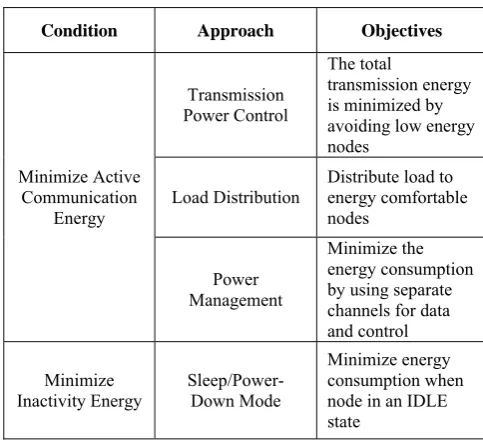
1) Classification of Routing Techniques used at Network Layer: Transmission power control, load distribution
and Power Management [Table.1] are the approaches to minimize the energy on active communication and sleep/power-down approach is used to minimize energy during inactivity [10].The protocols are designed based on the energy related metrics like energy consumed per packet to provide the minimum power path which is used to minimize the overall energy consumption for delivering packet. The next metric is inconsistency in node power levels which is a simple indication of energy balance and in turn it can be used to extend network lifetime. Lesser the rate of consumption of power i.e. draining rate, greater will be Lifetime of network.
TCP/IP Model MANET Protocol Stack
Application
Transport Network
Data Link Physical
Application
Transport Net- Ad-hoc work Routing
Table I: Classification of Energy-Efficient Routing Techniques
Condition Approach Objectives
Minimize Active Communication
Energy
Transmission Power Control
The total
transmission energy is minimized by avoiding low energy nodes
Load Distribution Distribute load to energy comfortable nodes
Power Management
Minimize the energy consumption by using separate channels for data and control
Minimize Inactivity Energy
Sleep/Power- Down Mode
Minimize energy consumption when node in an IDLE state
Transmission Power Control: The routing protocols available under the technique transmission power optimization stores additional information at each node other than that acquired during operation such as link costs of all edges , costs of all nodes and data generation rate at all nodes . With the help of the information available the routing protocol select the max-min path among a number of best min-power paths and few protocols regulate the transmission power just enough to reach the next hop node in the given routing path.
Load Distribution: The objective of the load distribution approach is to balance the energy usage of all nodes by selecting a route with nodes which are not used frequently instead of the shortest route. This is because, shorter path are frequently used leading to unpredicted depletion of those particular nodes leading to network partition. The result of this approach may involve more nodes in a route but packets are routed only through energy comfortable intermediary nodes. Routing protocols based on this approach are not necessarily offer the lowest energy route, but they prevent certain nodes from being overloaded, and thus guarantee for longer network lifetime.
Power Management: The Power Management Based Protocols are focused to achieve the energy efficiency goal by using two separate channels, one for control and another for data. RTS/CTS signals are transmitted through the control channel while data are transmitted over data channel. The power aware multi-access protocol (PAMAS) protocol , in which the nodes sends a RTS message over the control channel when it ready to transmit and waits for CTS, if the CTS message not receives within a precise time then node enters to a power off state. In the receiving end, node transmits a busy tone over the control channel to its neighbors when its data channel is busy. Control channel is used to determine when and how long the node will remain in power off state. After turning to active state, a node can transmit data over the data channel. Conversely, if CTS is
received once, then node transmits the data packet over the data channel.
Sleep/Power-Down Mode: Contrasting the previous techniques discussed, sleep/power-down mode approach focuses on inactive time of communication. In MANET when all the nodes in a sleep mode packets cannot be delivered to a destination node. To overcome this problem, choose a special node named as master which can manage
the communication on behalf of its neighboring slave nodes. At this moment, the slave nodes may be in sleep mode for saving battery energy. Each slave node once in a while wakes up and communicates with the master node to detect if any data it has to receive or not. If no packed for the slave it may back to previous mode to save energy. In multi hop MANET, more than one master node can identified to handle the entire MANET. Nodes except master nodes can save energy by setting their power hardware into low state.
2) Power-efficient routing protocols: There are many
power efficient routing protocols ([8] and [9]). Two of them are described here.
Minimum Battery Cost Routing (MBCR): Total transmission power concerns the lifetime of mobile hosts, so it is considered as an important metric. Although this metric can reduce the total power consumption of the overall network, it doesn’t reflect directly on the lifetime of each host. If minimum total transmission power routes are through a specific host, battery of this host will be exhausted quickly and this host will die of battery exhaustion soon. Therefore, the remaining battery capacity of each host is a more accurate metric to describe the lifetime of each host.
Min-Max Battery Cost Routing (MMBCR): This algorithm is used to take care of the overuse of specific node and make sure that no node will be overused. Battery cost Rj for route j is redefined as
Rj = max i ϵ route-j fi(cti)
Similarly, the desired route i can be obtained from the Equation:
Ri = min { Rj | j ϵ A}
Since this metric always tries to avoid the route with nodes having the least battery capacity among all nodes in all possible routes, battery of each host will be used more fairly than in previous schemes. Since there is no guarantee that minimum total transmission power paths will be selected under all circumstances, it can consume more power to transmit user traffic from a source to a destination, which actually reduces the lifetime of all nodes.
In short note, consider route relaying load, consider battery life in route selection,reduce frequency of sending control messages,optimize size of control headers, use efficient route reconfiguration techiniques for effective power savings at network layer.
D. Transport Layer:
Transport Layer techniques manage the mobile host’s communication device by suspension of the device during idle period in communication. The problems with suspending communication devices are as follow:
guess about when other host might be sending data for it.
This isolation can result in buffer overflow, both at mobile host and other sending host.
To address this problem, during the suspension period data can be queued up both at the mobile host as well as at the sending hosts.
1) Communication Model for Power management:
In this model, the mobile host is communicating with rest of the world through the base station. Wireless communication devices operate in two modes currently, transmit mode and receive mode.
Transmit mode is for transmitting the data and the receive mode is the default mod for receiving data as well as for listening to channel. Also, significant amount of power is consumed by node in listening to channel. Certain areas to look at software level power conservation are as follow: Reducing data transmission time.
An Intelligent data transfer protocol can be used to reduce the effect of nosy connection which causes power expensive retransmission of lost messages. Switching of the communication device during idle
periods.
By providing power control at the transport layer (or above), one may provide power management interfaces to the application, allowing the application to better control the communication, enabling adaptive power management driven by the needs of the application. Mobile host that is running multiple applications cannot base its power strategy on the expected communication patterns of a single application. In this situation, the power management protocol must take hints about sleep/wake up durations for all executing applications.
2) Communication Based Power Management:
A typical mobile host leaves its wireless Ethernet card in receive mode during the time it is not being used. This is more possible technique to extend battery lifetime by suspending the wireless Ethernet card during idle periods in communication. In this technique mobile host acts as a master and tells the base station about the data transmission. When the mobile host wakes up, it sends query to the base station to check if the base station has any data to send. Due to the suspension of communication device, an additional delay in data communication will be experienced by mobile host in data transmission since data on both the sending and receiving sides may be held up during suspension. The mobile host can monitor its own outgoing communication patterns to insure that, despite these suspension times, communication continues smoothly without buffer overflow. On the other hand, the base station has no means to restart communication if it notices that it is running out of buffer space. In order to efficiently use this power management technique, this communication layer must monitor the communication patterns of the mobile host and match the suspend/resume cycle to these patterns.
In short note, avoid repeated retransmission, handle packet loss in a localised manner and use power-efficient error control schemes for savings at transport layer.
E. Application Layer:
At the application layer a number of different techniques can be used to reduce the power consumed by a wireless device. A technique called as load partitioning allows an
application to have all of its power intensive computation performed at its base station rather than locally. The wireless device simply sends the request for the computation to be performed and then waits for the result. Other technique uses proxiesin order to inform an
application to changes in battery power. Application uses this information to limit their functionality and only provide their most essential features. This technique can be used to suppress certain "unwanted" visual effects that accompany a process. While these techniques may be adapted to work with any application that wishes to support them,
number of techniques also exists for specific classes of applications.
Some applications are so common that it is worth exploring techniques that specifically deal with reducing the power consumed while running them. Two of the most common applications include database operations and video processing. For database systems, techniques are explored that are able to reduce the power consumed during data retrieval, data indexing, as well as querying operations. In all three cases, the energy is conserved by reducing the number of transmissions needed to perform these operations. For video processing application, the energy can be conserved using compression techniques to reduce the number of bits transmitted over the wireless medium. Since performing compression itself may consume a lot of power, however, other techniques that allow the video quality to become slightly degraded have been explored in order to reduce the power even further.
In short note, adopt an adaptive mobile quality of service (QoS) framework, move power-intensive computation from mobile host to the base station, use proxies for mobile client. Proxies can be designed to make application adapt to poweror bandwidth constraints. Proxies can intelligently cache frequently used infrmation, supress video transmission and allow audio, and employ a variety of method to conserve power.
VI. CONCLUSION
In this paper, review of energy efficiency techniques has been performed. Also, a brief linkage of power consumption relation to various layers of protocol stacks has been studied. There are many protocols, which concentrated on this very issue. But, it is clear that there is still room for new approaches that can tackle this extremely complex problem of balancing energy conservation with communication quality in dynamic ad hoc networks.
REFERENCES
[1] Reina1 D. and Johnson2 P., “Optimization of network lifetime
through energy-efficient broadcast scheme using dynamic random walk”, 15th International Power Electronics and Motion Control Conference, EPE-PEMC 2012, ECCE Europe, Novi Sad, Serbia , pp.1-5.
[2] Misra S., Woungang I. and Misra S.C., “Guide to Wireless Ad Hoc Networks”, Springer science, 2009.
IEEE 802.11-based multihop ad hoc Networks”, International Conference on Mobile Ad hoc and Sensor Systems Conference, IEEE Nov 2005.
[5] Li Q. and Rus D. “Online Power-aware Routing in Wireless Ad-hoc Networks”, Proceedings of International Conf. on Mobile Computing and Networking (MobiCom’2001) 2001.
[6] Shiva P. and Saini J.P., “A review of Energy Efficient Routing Protocols for Mobile Ad Hoc Wireless Networks” International Journal of Computer Information Systems, Volume 1, No. 4, 2010,pp.36-46
[7] Goldsmith A.J. and Wicker S.B., “Design challenges for energy-constrained ad hoc wireless networks.” IEEE Wireless Communications 2002; 9(4): 8–27.
[8] Hieng T., Tan C. E. and Lau S. P., “Alternate Link Maximum Energy Level Ad-hoc Distance Vector Scheme for Energy Efficient Ad-hoc Networks Routing,” International Conference on Computer and Communication Engineering (ICCsCE 2010), 11-13 may 2010,Kuala Lumpur, Malaysia
[9] Preethi S. and Ramachandran B., “Energy Efficient Routing Protocols for Mobile AdHoc Networks”, IEEE 2011, pp.136-141. [10] Suganya S. and Palaniammal S., “A Detailed Study on Energy