Cancer Management and Research
Dovepress
O R i g i n a l R e s e a R C h open access to scientific and medical research
Open Access Full Text Article
Behavior change techniques for increasing physical
activity in cancer survivors: a systematic review
and meta-analysis of randomized controlled trials
emily Finne1,*
Melanie glausch2,*
anne-Kathrin exner1
Odile sauzet1,3
Friederike stölzel2
nadja seidel2
1school of Public health, Bielefeld
University, Bielefeld, germany;
2University Cancer Center, University
hospital Carl gustav Carus, Dresden University of Technology, Dresden, germany; 3Center for statistics
(Zest), Bielefeld University, Bielefeld, germany
*These authors contributed equally to the paper
Purpose: The purpose of this systematic review and meta-analysis is to investigate how
physi-cal activity (PA) can be effectively promoted in cancer survivors. The effect of PA-promoting interventions in general, behavior change techniques (BCTs), and further variables as modera-tors in particular are evaluated.
Methods:This study included randomized controlled trials of lifestyle interventions aiming at
an increase in PA that can be carried out independently at home, published by December 2016, for adults diagnosed with cancer after completion of the main treatment. Primary outcomes were subjective and objective measures of PA prior to and immediately after the intervention. Meta-analysis and meta-regression were used to estimate effect sizes (ES) in terms of standardized mean differences, variation between ES in terms of heterogeneity indices (I2), and moderator
effects in terms of regression coefficients.
Results: This study included 30 studies containing 45 ES with an overall significant small
posi-tive effect size of 0.28 (95% confidence interval=0.18–0.37) on PA, and I2=54.29%. The BCTs
Prompts, Reduce prompts, Graded tasks, Non-specific reward, and Social reward were signifi-cantly related to larger effects, while Information about health consequences and Information about emotional consequences, as well as Social comparison were related to smaller ES. The number of BCTs per intervention did not predict PA effects. Interventions based on the Theory of Planned Behavior were associated with smaller ES, and interventions with a home-based setting component were associated with larger ES. Neither the duration of the intervention nor the methodological quality explained differences in ES.
Conclusion: Certain BCTs were associated with an increase of PA in cancer survivors.
Inter-ventions relying on BCTs congruent with (social) learning theory such as using prompts and rewards could be especially successful in this target group. However, large parts of between-study heterogeneity in ES remained unexplained. Further primary studies should directly compare specific BCTs and their combinations.
Keywords:exercise, lifestyle, intervention methods, behavior change, moderator effects, tumor
Background
About 14.1 million new cancer cases and 8.2 million cancer-related deaths were recorded worldwide in 2012.1 A person is defined as a cancer survivor from the moment
of cancer diagnosis throughout life.2 Early detection, improved diagnostics, and
treat-ment have resulted in increased survival rates,3,4 leading to almost 32.6 million cancer
survivors worldwide with a diagnosis in the previous 5 years.1 Numerous disease- or
treatment-related adverse effects, such as secondary cancers, fatigue, or depression, can decrease the length and quality of life.5
Correspondence: emily Finne school of Public health, Bielefeld University, Universitätsstrasse 25, Bielefeld, 33615, germany Tel +49 521 106 3882 Fax +49 521 106 6433
Email [email protected]
Journal name: Cancer Management and Research Article Designation: Original Research Year: 2018
Volume: 10
Running head verso: Finne et al
Running head recto: Increasing physical activity in cancer survivors: a meta-analysis DOI: http://dx.doi.org/10.2147/CMAR.S170064
Cancer Management and Research downloaded from https://www.dovepress.com/ by 118.70.13.36 on 20-Aug-2020
For personal use only.
Dovepress Finne et al
In the last two decades it has been demonstrated that physical activity (PA) plays an important role not only in can-cer prevention but also during and after cancan-cer treatment.6,7
PA increases physical functioning among cancer survivors and provides physiological and psychological benefits.8–11 It
is recommended that cancer survivors should become or stay physically active as soon as possible after diagnosis. They should engage in at least 150 minutes per week of moderately intense or 75 minutes per week of vigorous intense aerobic PA and should perform muscle-strengthening activities at least twice per week.12 Despite this evidence, cancer survivors
show low levels of PA13–15 and a decline during cancer
treat-ment without returning to PA levels prior to diagnosis.16,17
Changing behavior from a mainly sedentary to a physi-cally active lifestyle poses a challenge to most people but particularly to those with chronic diseases such as cancer.18,19
PA that is easily performed at home (for example aerobics, walking, biking) is more convenient and accessible for patients and can play an important role in developing an active lifestyle.20
Various interventions have been developed in recent years, aiming at promoting PA in cancer survivors.21–24 Although
reviews show beneficial effects in terms of PA increases23,25,26
and exercise tolerance,24 substantial variance in effect sizes
indicates a moderating effect of intervention characteristics such as study design, theoretical foundation, and content.
Regarding study design as a moderator, a recent meta-analysis on PA promoting interventions in different target groups found a strong methodological quality to be related to smaller intervention effects.27 This finding suggests that, by
including methodologically weak studies with larger effects in previous meta-analyses, overall effects may potentially have been overestimated.
Theories most commonly used as a basis of behavior change interventions are the Transtheoretical Model (TTM), Social Cognitive Theory (SCT), Health Belief Model, and Theory of Planned Behavior (TPB).28 It is expected that
interventions are more effective when built on a theoretical foundation.29 However, studies show ambiguous results.30,31
Examining intervention content as a potential moderator is challenging, since behavior change interventions are usu-ally built out of multiple components. To facilitate consistent classification of intervention content by researchers and clinicians, Michie et al32 developed a taxonomy of behavior
change techniques (BCTs) by employing a systematic expert consensus approach.32 A BCT is defined as “an observable,
replicable and irreducible component of an intervention designed to alter or redirect causal processes that regulate
behavior”.33 The taxonomy of Michie et al33 (BCTT v1)
consists of standardized definitions of 93 different BCTs. No consistent matching of BCT definitions from BCTT v1 with theories or theory-based determinants of PA behavior is avail-able yet. Studies that analyzed effective BCTs in interventions to increase PA30,31,34–38 showed equivocal results. Regarding
cancer survivors, so far neither the amount of PA nor BCTs were compared between more or less successful trials.24
The purpose of the present review and meta-analysis is to summarize the efficacy of interventions that aim at increasing overall PA that can be carried out independently at home in cancer survivors after completion of main cancer treatment and, particularly, to analyze which BCTs are most effective in this target group. Additional intervention features such as intervention duration, number of applied BCTs, and theoreti-cal foundation as well as patient characteristics are analyzed as possible moderators of treatment effects.
Methods
To ensure correct proceedings along the Preferred Report-ing Items for Systematic Reviews and Meta-Analyses (PRISMA), a PRISMA checklist was created and PRISMA review guidelines were followed (Figure S1).39 Every study
and intervention feature was extracted by two reviewers independently and ambiguity in this process was resolved by consulting with a third reviewer. Since only published results were analyzed and no individual data gathered, no ethical approval was obtained.
search strategy
The electronic database MEDLINE was searched for articles from the earliest possible year to December 2016. The search strategy included medical subheadings and text word terms in different combinations, for example: neoplasms, cancer survivor, exercise, PA, physical fitness, muscle strength, health promotion, health education, behavior therapy, and randomized controlled trial (RCT). The complete search strategy is shown in Figure S2. Additionally, reference lists of retrieved articles and published reviews and meta-analyses on PA interventions in cancer survivors were screened.
study inclusion criteria
For eligibility, studies had to meet the following conditions:
1. Type of study: RCT. Exclusion: RCT-pilot study subse-quently evaluated in a main study.
2. Type of participants: Adult patients (18 years of age or older) diagnosed with cancer. Exclusion: Current active
Cancer Management and Research downloaded from https://www.dovepress.com/ by 118.70.13.36 on 20-Aug-2020
Dovepress increasing physical activity in cancer survivors: a meta-analysis
treatment (except hormonal treatment) or end-of-life-care patients.
3. Type of intervention: Lifestyle intervention aiming at an increase in PA behavior including exercise intervention and multicomponent program focusing on PA and further lifestyle factors; interventions that aim at increasing PA that can be easily carried out independently at home. Exclusion: Interventions aiming at PA that requires pro-fessional guidance, specific equipment or facilities (eg, fitness machines).
4. Type of control group: Usual care or wait-list control group.
5. Type of outcome measure: PA (self-reported or objectively measured) prior to and immediately after the interven-tion. PA is defined as any bodily movement produced by skeletal muscles resulting in energy expenditure.
Follow-up measurements were not taken into account, since these were reported only for a subset of interventions and were of varying duration. Only full-text articles written in English and German were included. To identify studies meeting the inclusion criteria, titles and/or abstracts of studies retrieved with the search strategy were screened. The full texts of these studies were retrieved and assessed for eligibility.
Data extraction
Extracted information of study details included author, year, research question, the country where the study was carried out, recruitment source, inclusion and exclusion criteria, study design, and description of the control group (CG) vs intervention group (IG). Regarding participant character-istics, cancer type, age, gender, and time since diagnosis or treatment were extracted. Furthermore, the following intervention details were recorded: name, frequency and total duration of the intervention, setting, type of delivery, theoretical basis, and BCTs used. Regarding PA outcome, the method of measuring PA, the number of participants randomly assigned and assessed, as well as the PA level were extracted.
Coding of methodological quality
Methodological quality was assessed according to the Effec-tive Public Health Practice Project Quality Assessment Tool for Quantitative Studies (EPHPP-Tool).40 The tool consists
of questions to help with assessing the quality concerning the six criteria selection bias, study design, confounders, blinding, data collection methods, as well as withdrawals and dropouts, which are combined to a global rating of meth-odological quality. Additionally, intervention integrity and
statistical analyses (including intention-to-treat approach) are evaluated.
Coding of behavior change techniques
The BCT taxonomy v132 was used to identify and code the
BCTs reported in each IG. The most comprehensive pub-lished description of the intervention content (eg, from study protocols) was used. Coding was carried out by MG and EF independently after completing the BCT taxonomy v1 Online Training41 using the given BCT definitions and coding rules.
BCTs were coded as present or absent, and only the BCTs exclusively applied in the IG were extracted. After coding the first interventions, definitions and coding rules were discussed and additional coding rules established to inter-pret ambiguities. To quantify intercoder agreement, Cohen’s kappa42 was calculated for BCTs and studies (Table S1) based
on the semi-final coding after this discussion. Prevalence-adjusted bias-Prevalence-adjusted kappa (PABAK)42 values are
addition-ally reported. These are kappa values adjusted for a potential bias by the overall proportion of “yes”-responses as well as by differences in this proportion between the coders. Remaining disagreements in coding were then solved by discussion and consulting with a third reviewer (AE).
Data synthesis (analysis and
meta-regression)
Since the majority of studies reported means and standard deviations (SD or equivalents) as outcome and only a few studies reported change scores, Hedge’s g was computed as an effect size from the PA scores immediately after the inter-vention. Since only RCTs were included, possible baseline differences between groups should be random. For calculat-ing SDs from other measures, formulae from the Cochrane Handbook were used.43
Effectsizes and variances were calculated within the package “metafor”44 for the Software R45 and, where effect
sizes had to be calculated from F-values, P-values or propor-tions, these calculations were performed with the package “compute.es”,46 using conversion formulas from Cooper
et al.47 If required, SDs of PA outcomes following the
inter-vention were estimated by regressing the log SDs on the log means following the Cochrane Handbook.43
Available objective and self-reported measures were included, since both measure slightly different aspects of PA behavior and are only moderately correlated.48,49 Within-study
dependencies of effect sizes were accounted for.
For studies that provided multiple self-report measures, only one effect size regarding these measures was included.
Cancer Management and Research downloaded from https://www.dovepress.com/ by 118.70.13.36 on 20-Aug-2020
Dovepress Finne et al
Scores of total moderate to vigorous physical activity were prioritized over scores solely including low-intensity activi-ties or those limited to only moderate or vigorous intensity activities. Overall PA was preferred over measures of sport or exercise, and measures related to total volume (ie, com-bining intensity, frequency, and duration) were favored over the duration of PA. Validated self-report instruments were given priority. One study did not report any measure of PA volume or frequency, but instead gave a “relative treatment effect” and the corresponding SD for both groups.50 This
study was included in the meta-analysis, since this outcome measure seemed directly related to overall PA, and sensitiv-ity analysis excluding this study did not change our results meaningfully.
For studies which included different treatment conditions compared to the same CG, dependencies between effect sizes were also taken into account in the models.
Within-study covariances were estimated following Gle-ser and Olkin51 and Pustejovsky52 for multiple outcomes,
mul-tiple treatment conditions, or both. In cases without a reported correlation, the estimation of covariances was based on a correlation between self-reported and objective outcomes of
r=0.51, as reported for cancer survivors.49 Significance tests
and CIs were based on robust estimation methods to adjust for a potentially misspecified variance–covariance matrix, since all but one covariance could only be estimated.
First, a multivariate mixed effects meta-analysis (a random effects meta-analysis that allows for effect sizes of different outcomes to be correlated within a study) with the function “rma.mv” within the “metafor” package was con-ducted to estimate the overall effect size and between-study heterogeneity for self-reported and objective PA outcomes using the restricted maximum likelihood estimation method. Heterogeneity due to differences between the true effects was estimated by calculating a variant of I2 for multivariate
meta-analysis based on a multivariate generalization of H2,
as suggested by Jackson et al.53 Publication bias was
exam-ined by visual inspection of the funnel plot and testing the association of study sampling variances with effect sizes within the multivariate mixed model (similar to Egger’s regression test).
To determine effects of individual BCTs, separate meta-regression models were then calculated with each BCT (coded as absent or present) as moderator. Only BCTs that were coded as being present for at least five comparisons were included. Additional models with fur-ther intervention characteristics as moderators followed the same approach.
Results
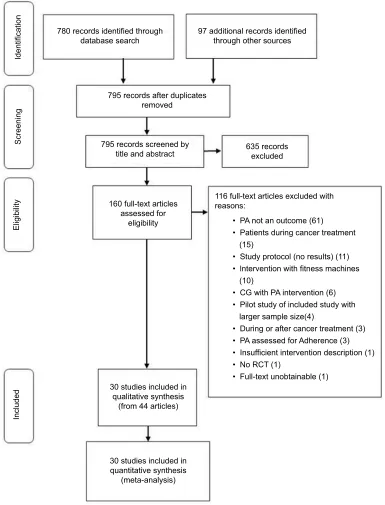
From a database search and reference checking of recent systematic reviews, 795 records were identified (Figure 1). After screening, 44 articles reporting on 30 trials met the inclusion criteria.54–96 Of these articles, all 30 trials provided
sufficient data for inclusion into the meta-analysis.
Description of included trials
Three of the 30 RCTs included compared more than one IG to an untreated CG, resulting in the investigation of a total of 34 comparisons for self-reported PA outcomes and 11 comparisons for objectively measured PA outcomes. All studies were published between 2006 and 2016.
In total, 4,507 cancer survivors were included (M=150, range=22–641) with a mean age of 57.1 years (median (Md)=56.7, SD=7.71, range=33.6–73.1), and an overall percentage of females of M=74.14% (Md=90.93, SD=35.25, range=0%–100%). Most samples were survivors of breast cancer (k=13 trials) or mixed types of cancer (k=11). The majority of trials were from the US (k=19) and mostly used standard care as control comparison (k=21, eight wait-list control, and one not stated).
The duration of interventions ranged from one-time rec-ommendation (zero months) to 12 months (M=4.26, Md=3, SD=2.87), and treatment took place at home (k=16), at dif-ferent treatment facilities (k=4) or both combined (k=10). Study characteristics are depicted in Table 1.
Methodological quality
Results of the methodological quality assessment are pre-sented in Figure 2 (for details see also Table S2). Overall, nine of the 30 studies were rated as methodologically strong, 16 as moderate, and five as weak. Regarding patient selection bias, many of the studies were rated weak (k=18), while the remaining were rated moderate. Confounders were controlled for in most of the studies (k=26). For blinding, only two of the studies were ranked strong. In the remaining studies, the blinding process was either not explained, the outcome asses-sors were aware of the exposure status of the participant, or the participants were aware of the research question. Reliable and valid outcome measures were used in most of the studies (k=26). Regarding drop-outs, 21 studies had a rate of less than 20%, and were, therefore, rated as strong. Nine studies had 60%–79% drop-outs, and one study did not report on drop-outs. Half of the studies (k=15) reported a sample-size calculation. Many of the studies had small sample sizes, suggesting difficulties in providing adequate statistical power to detect between-group differences, even if they were
pres-Cancer Management and Research downloaded from https://www.dovepress.com/ by 118.70.13.36 on 20-Aug-2020
Dovepress increasing physical activity in cancer survivors: a meta-analysis
ent. Intention-to-treat analyses were used in 20 studies. The remaining studies used either per-protocol analysis (k=7) or analyses were not explained (k=3).
Regarding intervention integrity (ie, the degree to which an intervention is implemented as intended), three studies reported that more than 80% of participants of the IG received
the intervention, in two studies 60%–79% of participants received the intervention, while the remaining 25 studies did not communicate the information. Four studies measured the consistency of the intervention (ie, if all individuals receive the same intervention). Unfortunately, 26 studies did not report on the consistency of the intervention.
780 records identified through database search
Identification
Screening
Eligibilit
y
Included
795 records after duplicates removed
795 records screened by title and abstract
160 full-text articles assessed for
eligibility
30 studies included in quantitative synthesis
(meta-analysis) 30 studies included in
qualitative synthesis (from 44 articles)
116 full-text articles excluded with reasons:
• PA not an outcome (61)
• Patients during cancer treatment
(15)
• Study protocol (no results) (11)
• lntervention with fitness machines
(10)
• CG with PA intervention (6)
• Pilot study of included study with
larger sample size(4)
• During or after cancer treatment (3) • PA assessed for Adherence (3)
• Insufficient intervention description (1)
• No RCT (1)
• Full-text unobtainable (1)
635 records excluded 97 additional records identified
through other sources
Figure 1 PRISMA flow chart of literature search for PA interventions in cancer survivors.
Abbreviations: Cg, Control group; Pa, physical activity; PRisMa, Preferred Reporting items for systematic Reviews and Meta-analyses; RCT, randomized controlled trial.
Cancer Management and Research downloaded from https://www.dovepress.com/ by 118.70.13.36 on 20-Aug-2020
Dovepress Finne et al
Table 1
Characteristics of participants and P
a
interventions
Reference
Cancer type
Sample size (n)
Con- trol group
Age (mean years)
Gender (women) Time since diagnosis (mean
years) Intervention Theory b Components Setting
Duration (weeks) Types of PA Intervention provided by
Bantum et al, 2014
54 Diverse 352 W l 51.0 82.1% 1.8
six sessions, web- based educational material
h ome-based 6 MVP a
Trained peer facilitators
—
Basen- engquist et al, 2006
55 Breast 60 sC 55.1 100% 3.2 21 g roup sessions,
educational material Facility- based 24 MVP a — sCT, TTM
Bennett et al, 2007
56
Breast, others
56 sC 57.8 89.3% 3.5 a
Four counseling sessions (three phone sessions)
h
ome-based
24
Moderate intensity exercise specialist
M
i
Bloom et al, 2008
57 Breast 404 W l — 100% — Three workshops Facility- based 12
stretching, walking, others Medical oncologist, others social support
Carmack Taylor et al, 2004, 2006
58,59 Prostate 134 sC 69.2 0% — 21 g roup sessions,
educational material Facility- based
24
Moderate intensity
g
roup
facilitator
sCT, TTM
Culos-Reed et al, 2010
60 Prostate 100 W l 67.4 0% — 16 g roup sessions,
tailored exercise program
Combined
16
Walking, light resistance training exercise specialist
ToPB
Demark- Wahnefried et al, 2003 and 2007; Ottenbacher et al, 2012
61–63
Breast, prostate
543
sC
57.0
56.4%
—
Tailored educational material (two workbooks), eight newsletters
h ome-based 40 MVP a
Mail-based material
sCT, TTM
h
atchett
et al, 2013
64 Breast 85 W l — 100% —
eight emails, access to e-counselor
h ome-based 12 MVP a
exercise specialist
sCT
h
ébert et al,
2012 65 Prostate 54 W l 70.4 0% —
One individual session, 13 group sessions, progress phone calls
Combined 24 MVP a — — ibf elt et al, 2011; h øyb
ye et al,
2008
66,68
Breast, prostate, colorectal
507
sC
61.0
35.3%
1.2
Retreat with lectures, patient group work, training, access to counselor Facility- based
1
—
Medical doctor, others
— (Continued
)
Cancer Management and Research downloaded from https://www.dovepress.com/ by 118.70.13.36 on 20-Aug-2020
Dovepress increasing physical activity in cancer survivors: a meta-analysis
Table 1
(
Continued
)
Reference
Cancer type
Sample size (n)
Con- trol group
Age (mean years)
Gender (women) Time since diagnosis (mean
years)
Intervention
Theory
b
Components
Setting
Duration (weeks) Types of PA Intervention provided by
irwin et al, 2008
67
Breast
75
sC
55.8
100%
3.5
Three supervised group training sessions and two home- based training sessions per week, educational material
Combined
24
Walking, others Medical doctor, others
—
James et al, 2011 and 2015
69,70
Diverse
133
W
l
57.2
77.4%
3.5
six group sessions, home-based training program, educational material
Combined
8
Resistance training, MVP
a
exercise specialist, others
sCT
Kim et al, 2011
71
Breast
45
—
45.6
100%
1.1
12 Tailored phone sessions, educational material
h
ome-based
12
Moderate intensity
n
urses
TTM
lahart et al, 2016
72
Breast
80
sC
53.6
100%
0.7
One individual session, three phone sessions, educational material
h
ome-based
24
MVP
a
Researcher
M
i
ligibel et al, 2012
73
Breast, colorectal
121
sC
54.3
92.6%
—
Ten
phone
sessions,
educational material
h
ome-based
16
Moderate intensity Behavioral counselor
sCT
livingston et al, 2011 and 2015
74,75
Prostate
147
sC
65.6
0%
0.5
a
One individual session, 24 supervised training sessions, unsupervised training
Combined
12
MVP
a
,
resistance training, others exercise specialist
sCT
Matthews et al, 2007
76
Breast
36
sC
54.1
100%
0.8
One counseling visit, five phone sessions
h
ome-based
12
Walking
h
ealth
counselor
sCT (Continued
)
Cancer Management and Research downloaded from https://www.dovepress.com/ by 118.70.13.36 on 20-Aug-2020
Dovepress Finne et al
Table 1
(
Continued
)
Reference
Cancer type
Sample size (n)
Con- trol group
Age (mean years)
Gender (women) Time since diagnosis (mean
years)
Intervention
Theory
b
Components
Setting
Duration (weeks) Types of PA Intervention provided by
Morey et al., 2009; Demark- Wahnefried et al, 2012; snyder et al, 2009
77–79
Breast, prostate, colorectal
641
W
l
73.1
54.5%
—
Tailored educational material (workbook), newsletters, 15 phone sessions, eight automated phone prompts
h
ome-based
48
Resistance training, mvpa
h
ealth
counselor
sCT, TTM
Park et al, 2015
80
Breast, colorectal
162
sC
51.8
87.2%
1.9
exercise recommendation or exercise recommendation plus educational material, and pedometer
c
h
ome-based
4
Moderate intensity exercise specialist
—
Pinto et al, 2005 and 2008
81,82
Breast
86
sC (
+
phone calls)
53.1
100%
1.8
One individual session, 15 phone sessions, mailed educational material, and feedback
Combined
12
Moderate intensity (eg, biking)
Researcher
sCT, TTM
Pinto et al, 2013
83
Breast
192
sC (
+
phone calls)
60.0
100%
3.0
One individual session, 11 phone sessions, mailed educational material, and feedback
Combined
12
Moderate intensity aerobic (eg, biking)
Researcher
sCT, TTM
Pinto et al, 2013
84
Colorectal
46
sC (
+
phone calls)
57.6
56.5%
3.0
One individual session, 15 phone sessions, mailed educational material, and feedback
h
ome-based
12
Moderate intensity aerobic (eg, biking)
Researcher
sCT, TTM
Rabin et al, 2016
85
Diverse
35
W
l
33.6
82.9%
2.5
One individual session, 15 phone sessions, access to monitored online peer forum
h
ome-based
12
Moderate intensity aerobic
Researcher
sCT, TTM (Continued
)
Cancer Management and Research downloaded from https://www.dovepress.com/ by 118.70.13.36 on 20-Aug-2020
Dovepress increasing physical activity in cancer survivors: a meta-analysis
Table 1
(
Continued
)
Reference
Cancer type
Sample size (n)
Con- trol group
Age (mean years)
Gender (women) Time since diagnosis (mean
years)
Intervention
Theory
b
Components
Setting
Duration (weeks) Types of PA Intervention provided by
Rau et al, 2009
50
Diverse
118
sC (
+
phone calls)
56.4
38.5%
—
Three phone sessions
h
ome-based
24
MVP
a
—
TTM, M
i
Reif et al, 2010 and 2013
86,87
Breast, others
261
sC
57.7
71.7%
—
eight group sessions, educational material
Combined
24
—
n
urse, others
self- management
Rogers et al, 2012 and 2015
88,89
Breast
222
sC
54.4
100%
4.5
six discussion group sessions, 12 supervised exercise sessions, home-based training, three counseling sessions
Combined
12
Moderate- intensity (eg, walking) exercise specialist, others
sCT
sheppard et al, 2016
90
Breast
31
sC
54.7
100%
1.7
a
six group sessions with supervised training and education, 12 phone sessions Facility- based
12
Moderate intensity (walking) exercise specialist, others
TPB,
sCT,
M
i
short et al, 2012, 2013, and 2015
91–93
Breast
330
sC
55.0
100%
3.4
a
Three tailored newsletters or targeted P
a
guidebook
c
h
ome-based
12
Moderate intensity (aerobic, resistance training)
Mail-based
sCT, TPB
c
Vallance et al, 2007 and 2008
94,95
Breast
377
sC
58.0
100%
3.3
Pa recommendation plus P
a
guidebook
or plus pedometer and step calendar or plus both
c
h
ome-based
12
MVP
a
Print-based
TPB
von gruenigen et al, 2012
96
Uterine
75
sC
58.0
100%
1.8
16 group sessions, three counseling visits, Pa
guidebook,
newsletters, phone sessions, emails
Combined
48
Moderate intensity (eg, walking) Physician, others
sCT
Notes:
aTime since treatment. bTheory mentioned as basis of intervention. cFor several intervention groups.
Abbreviations:
M
i, Motivational
interviewing; MVP
a
, moderate
to
vigorous
physical activity; P
a
, physical activity;
sC, standard
care;
sCT,
social Cognitive Theory;
TPB, Theory
of Planned
Behavior;
TTM, Transtheoretical
Model
of
Behavior Change;
W
l, wait-list control group; —, not reported.
Cancer Management and Research downloaded from https://www.dovepress.com/ by 118.70.13.36 on 20-Aug-2020
Dovepress Finne et al
Behavior change technique coding
Overall, 41 of the 93 BCTs were coded at least once in the semi-final and 37 in the final coding. For the individual BCTs, based on the semi-final coding, Cohen’s kappa ranged from 0.30 (BCT Reduce prompts) to 1.0, with the exception of four BCTs that were coded only once or twice by one reviewer but not the other, resulting in κ=0. Including these values, mean κ was 0.76 and reflects substantial agreement.97 PABAK
values ranged from 0.65–1.0 (M=0.93) for the different BCTs. Regarding the different trials, Cohen’s κ ranged from 0.67–1.0 (M=0.91) and PABAK from 0.74–1.0 (M=0.94) (see
Table S1). Overall, a substantial agreement could be reached. The included interventions used an average of 10.44 BCTs (Md=11, SD=4.44), ranging from 1–17. The BCTs most commonly used were Goal setting (behavior) and Social support (unspecified) (in k=27 IGs), followed by Problem solving and Self-monitoring of behavior (k=26), Instructions on how to perform the behavior (k=24), Behavioral practice/ rehearsal (k=23), and Adding objects to the environment (k=21, often related to the use of pedometers).
Overall meta-analysis
The meta-analysis included k=45 effect sizes (34 for self-reported, 11 for objective PA outcomes) within 30 trials. All trials used self-reported PA as an outcome and eight trials (effect sizes from 10 IGs) additionally used objectively mea-sured PA. Raw means and SDs for the PA outcomes imme-diately after the intervention were extracted for 33 effects. The SD had to be estimated in eight studies (10 comparisons overall). For the prediction of SDs from log means the values R2=0.946 for the IG and R2=0.918 for the CG were detected.
The estimated SDs were controlled for plausibility. In two cases the effect size was estimated based on available data,
comparing group proportions by converting effect sizes to the standardized mean difference.
The funnel plot (Figure S3) and regression of effect size on sampling variance (β=3.65, t(df = 28)=2.273, P=0.031) indicated a significant asymmetry in the distribution of standard errors related to observed study outcomes mainly caused by small studies with particularly large effect sizes. The estimated pooled effect size may, therefore, be slightly overestimated. However, with a fail-safe N (number of unpublished studies with nonsignificant findings that would have to exist for the overall effect to become insignificant) of 1,859 for a probability of error of alpha=5%, an overall positive effect seems likely.
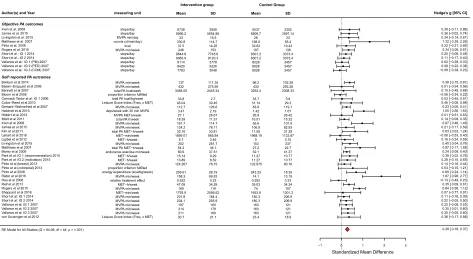
The model resulted in an overall estimated effect size in terms of standardized mean difference of g=0.276 (95% CI=0.183–0.369 based on robust variance estimation), indicating a significant effect in favor of the IG (P<0.001; Figure 3). There was significant heterogeneity of effect sizes (Q(df=44)=94.081, P<0.001), with τ2=0.048 (95%
CI=0.013–0.132) for subjective outcomes and τ2=0.007 (95%
CI=0.000–0.097) for objective outcomes, respectively. About 54.29% of the total variation in effect sizes was estimated to be caused by heterogeneity of true effects (I2). On average,
effect sizes for self-reported PA were higher than for objec-tive outcomes (g=0.316 as compared to 0.182, F(1,28)=4.642,
P=0.040).
Meta-regression of Pa outcomes on
behavior change techniques and other
potential moderators
Results of multivariate mixed effects models on BCTs
number of BCTs
Figure 4 shows predicted and observed effect sizes of the included studies in relation to the number of BCTs used in the analyzed interventions. Effect sizes did not increase meaningfully with the number of BCTs per intervention (estimated increase per additional BCT, β=0.005, 95% CI=–0.007–0.017, P=0.408).
Moderator effects of specific BCTs
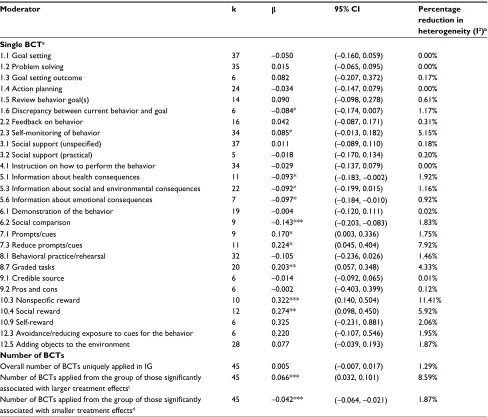
Of the final 37 BCTs exclusively applied in an IG, 27 were coded as being present for at least five effect sizes and were, therefore, analyzed as possible moderators in the meta-regression models for self-reported and objectively measured PA outcomes (see Table 2). The BCTs Prompts/cues, Reduce prompts/cues, Graded tasks, Nonspecific reward, and Social reward were significantly related to larger effect sizes, while
Selection bias Study design Confounders Blinding Data collection methods
Global rating
0% 20% 40%
Strong Moderate Weak
60% 80% 100%
Withdrawals and drop-outs
Figure 2 Quality assessment results presented as percentages across all included
studies (k=30).
Cancer Management and Research downloaded from https://www.dovepress.com/ by 118.70.13.36 on 20-Aug-2020
Dovepress increasing physical activity in cancer survivors: a meta-analysis
Information about health consequences and Information about emotional consequences as well as Social comparison were used in interventions with smaller treatment effects (P<0.05). The largest differences in effect sizes associated with the use of specific BCTs were comparable in size to the magnitude of the overall effect. With a borderline significant
trend, the potential moderator Self-monitoring of behavior was associated with larger effect sizes and the moderators Discrepancy between current behavior and goal and Infor-mation about social and environmental consequences with smaller effect sizes (P<0.10).
None of these individually tested BCTs reduced the unexplained heterogeneity in effects to a nonsignificant level. Overall, the amount of heterogeneity explained by the men-tioned BCTs was higher for objective than for self-reported outcomes, although the heterogeneity estimates were rather imprecise due to the small number of effect sizes for objec-tive outcomes.
Of the seven mentioned BCTs coded most often (see “BCT coding” above), only Self-monitoring of behavior had a trend to significance while the other six BCTs were clearly not significant.
Further study characteristics analyzed as potential moderators
intervention features
Theories that were mentioned as the foundation of inter-ventions were analyzed as further potential moderators concerning an increase in PA (see Table 3). Some interven-tions referred to more than one theory so that frequently mentioned theories were coded binary as absent or present
−1 0 1 2 3
Standardized Mean Difference Irwin et al. 2008
James et al. 2015 Livingston et al. 2015 Matthews et al. 2007 Pinto et al. 2008 Rogers et al. 2015 Short et al.: IG 1 2014 Short et al.: IG 2 2014 Vallance et al.: IG 1 (PM) 2007 Vallance et al.: IG 2 (PED) 2007 Vallance et al.: IG 3 (COM) 2007
Bantum et al 2014 Basen−Engquist et al 2006 Bennett et al 2007 Bloom et al 2008 Carmack Taylor et al: IG 1 2006 Culos−Reed et al 2010 Demark−Wahnefried et al 2007 Hatchett et al 2013 Hébért et al 2012 Ibfelt et al 2011 Irwin et al 2008 James et al 2015 Kim et al 2011 Lahart et al 2016 Ligibel et al 2012 Livingston et al 2015 Matthews et al 2007 Morey et al 2009
Park et al: IG 1 (recommendation) 2015 Park et al: IG 2 (motivation) 2015 Pinto et al (breast) 2013 Pinto et al (colorectal) 2013 Pinto et al 2008 Rabin et al 2016 Rau et al 2008 Reif et al 2013 Rogers et al 2015 Sheppard et al 2016 Short et al: IG 1 2014 Short et al: IG 2 2014 Vallance et al: IG 1 2007 Vallance et al: IG 2 2007 Vallance et al: IG 3 2007 von Gruenigen et al 2012
steps/day steps/day MVPA min/day counts (ct/min/day) kcal MVPA min/week steps/day steps/day steps/day steps/day steps/day MVPA min/week MVPA min/week total PA kcal/week proportion criterion fulfilled
total PA kcal/kg/week Leisure Score Index (Freq. x MET)
MVPA min/week days/week with 30 min MVPA
MVPA METs/week total PA h/week MVPA min/week MVPA min/week total PA MET−h/week
MET−min/week MET−h/week MVPA min/week total PA MET−h/week endurance exercise min/week
MET−h/week MET−h/week MVPA min/week proportion criterion fulfilled energy expenditure (kcal/kg/week)
MVPA min/week relative treatment effect
MET−h/week MVPA min/week MET−min/week MVPA min/week MVPA min/week MVPA min/week MVPA min/week MVPA min/week Leisure Score Index (Freq. x MET)
6738 8566.2 33 330.8 37.5 246 9644.8 9083.9 8114 8420 7783 137 432 3484.05 33.8 45.04 112.7 3.47 27.1 18.39 161.7 124.2 32.16 1899.01 5.7 252 54.2 60.9 15.14 13.89 124.267 259.61 158.3 0.522 47.09 169 1793.8 201.8 234.1 197 214 211 30.7 2958 5654.89 16.5 114.7 14.25 153 7745.6 8120.3 3778 5226 3048 111.35 275.59 2445.34 2.7 30.45 126.6 2.19 26.67 11.31 114.7 78.11 33.81 985.84 3.46 261.7 34.1 37.51 9.29 8.52 78.15 28.19 99.83 0.22 34.29 119 2599.52 184.4 255.9 160 178 169 21.1 5537 6809.7 26 198.5 33.62 197 8301.2 8301.2 8028 8028 8028 96.2 430 3252.4 33.7 31.14 83.8 1.42 26.9 16.51 55.6 106.9 11.09 1968.19 5 153 27.2 52.1 11.27 11.27 102.975 243.23 14.1 0.552 35.03 74 1653.8 180.3 180.3 163 163 163 23.4 3352 3597.14 23 55.4 19.43 138 3373.4 3373.4 3457 3457 3457 102.28 293.28 2308.33 3.8 29.3 119.1 1.67 26.42 15.22 101.9 82.93 31.29 1133.87 5.15 237 22.7 41.27 10.77 10.77 80.16 18.39 13.19 0.23 34.24 107 1301.2 206.9 206.9 121 121 121 18.9
0.38 [−0.11, 0.86] 0.36 [−0.02, 0.74] 0.34 [−0.14, 0.81] 1.32 [ 0.39, 2.26] 0.22 [−0.21, 0.66] 0.34 [ 0.06, 0.61] 0.20 [−0.08, 0.48] 0.11 [−0.17, 0.40] 0.02 [−0.28, 0.33] 0.08 [−0.22, 0.38] −0.08 [−0.38, 0.23]
0.38 [ 0.15, 0.61] 0.01 [−0.54, 0.56] 0.10 [−0.49, 0.68] −0.06 [−0.34, 0.22] 0.03 [−0.45, 0.51] 0.46 [−0.06, 0.98] 0.23 [ 0.06, 0.41] 1.05 [ 0.56, 1.53] 0.01 [−0.51, 0.53] 0.14 [−0.08, 0.35] 0.97 [ 0.46, 1.48] 0.21 [−0.17, 0.59] 0.63 [ 0.03, 1.24] −0.06 [−0.53, 0.40] 0.16 [−0.24, 0.55] 0.40 [ 0.04, 0.76] 0.87 [ 0.17, 1.58] 0.24 [ 0.08, 0.40] 0.39 [ 0.02, 0.76] 0.28 [−0.10, 0.65] 0.14 [−0.16, 0.44] 0.53 [−0.15, 1.21] 0.69 [ 0.24, 1.14] 1.87 [ 0.98, 2.77] −0.13 [−0.49, 0.23] 0.35 [ 0.09, 0.61] 0.84 [ 0.56, 1.12] 0.07 [−0.77, 0.91] 0.11 [−0.16, 0.39] 0.22 [−0.05, 0.50] 0.22 [−0.08, 0.53] 0.30 [ 0.01, 0.60] 0.30 [−0.00, 0.60] 0.36 [−0.17, 0.88]
0.28 [ 0.18, 0.37] RE Model for All Studies (Q = 94.08, df = 44, p = <.001)
Intervention group Control Group measuring unit Mean SD Mean SD
Author(s) and Year Hedge's g [95% CI]
Objective PA outcomes
Self−reported PA outcomes
Figure 3 Forest plot of included studies.
Abbreviations: CI, confidence interval; COM, combination of PM and PED; IG, intervention group; MET, metabolic equivalent; MVPA, moderate to vigorous physical
activity; Pa, physical activity; PeD, step pedometer; PM, print materials; Re model, random-effects model.
Standardized mean dif
ference (Hedge’
s g)
Number of BCTs 0
1.5
1.0
0.5
0.0
5 10 15 20
Figure 4 Prediction of effect sizes by number of BCTs.
Notes: solid line: predicted effect size of mixed-effects model; dashed lines: 95%
confidence bounds; dotted line: reference line for null effect; bubbles: individual
study effect sizes with size relative to inverse variance weight; red: subjective Pa outcome; black: objective Pa outcome.
Abbreviations: BCTs, Behavior Change Techniques; Pa, physical activity.
Cancer Management and Research downloaded from https://www.dovepress.com/ by 118.70.13.36 on 20-Aug-2020
Dovepress Finne et al
Table 2 Results of simple meta-regression analyses with BCTs and further study characteristics as predictors of 45 effect sizes from
physical activity interventions
Moderator k b 95% CI Percentage
reduction in heterogeneity (I2)b Single BCTa
1.1 goal setting 37 –0.050 (–0.160, 0.059) 0.00%
1.2 Problem solving 35 0.015 (–0.065, 0.095) 0.00%
1.3 goal setting outcome 6 0.082 (–0.207, 0.372) 0.17%
1.4 action planning 24 –0.034 (–0.147, 0.079) 0.00%
1.5 Review behavior goal(s) 14 0.090 (–0.098, 0.278) 0.61%
1.6 Discrepancy between current behavior and goal 6 –0.084# (–0.174, 0.007) 1.17%
2.2 Feedback on behavior 16 0.042 (–0.087, 0.171) 0.31%
2.3 self-monitoring of behavior 34 0.085# (–0.013, 0.182) 5.15%
3.1 Social support (unspecified) 37 0.011 (–0.089, 0.110) 0.18%
3.2 social support (practical) 5 –0.018 (–0.170, 0.134) 0.20%
4.1 instruction on how to perform the behavior 34 –0.029 (–0.137, 0.079) 0.00%
5.1 information about health consequences 11 –0.093* (-0.183, –0.002) 1.92%
5.3 information about social and environmental consequences 22 –0.092# (–0.199, 0.015) 1.16%
5.6 information about emotional consequences 7 –0.097* (-0.184, –0.010) 0.92%
6.1 Demonstration of the behavior 19 –0.004 (–0.120, 0.111) 0.02%
6.2 social comparison 9 –0.143*** (-0.203, –0.083) 1.83%
7.1 Prompts/cues 9 0.170* (0.003, 0.336) 1.75%
7.3 Reduce prompts/cues 11 0.224* (0.045, 0.404) 7.92%
8.1 Behavioral practice/rehearsal 32 –0.105 (–0.236, 0.026) 1.46%
8.7 graded tasks 20 0.203** (0.057, 0.348) 4.33%
9.1 Credible source 6 –0.014 (–0.092, 0.065) 0.01%
9.2 Pros and cons 6 –0.002 (–0.403, 0.399) 0.12%
10.3 Nonspecific reward 10 0.322*** (0.140, 0.504) 11.41%
10.4 social reward 12 0.274** (0.098, 0.450) 5.92%
10.9 self-reward 6 0.325 (–0.231, 0.881) 2.06%
12.3 avoidance/reducing exposure to cues for the behavior 6 0.220 (–0.107, 0.546) 1.95%
12.5 adding objects to the environment 28 0.077 (–0.039, 0.193) 1.87%
Number of BCTs
Overall number of BCTs uniquely applied in ig 45 0.005 (–0.007, 0.017) 1.29%
Number of BCTs applied from the group of those significantly associated with larger treatment effectsc
45 0.066*** (0.032, 0.101) 8.59%
Number of BCTs applied from the group of those significantly associated with smaller treatment effectsd
45 –0.042*** (-0.064, –0.021) 1.87%
Notes: aOnly results for BCTs involved in k≥5 effects sizes (or used in ≥5 igs) are reported; bcompared to the model without moderator; cBCTs 7.1, 7.3, 8.7, 10.3, 10.4;
dBCTs 5.3, 5.6, 6.2. #P≤0.10, *P≤0.05, **P≤0.01, ***P≤0.001 (based on robust estimation). k, number of interventions where a specific BCT was present; b, estimated
meta-regression coefficient for the comparison of effect size with BCT present vs absent; I2, percentage of residual heterogeneity, test for residual heterogeneity was significant
(P<0.001) for all BCTs.
Abbreviations: BCT, Behavior Change Technique; CI, confidence interval; IG, intervention group.
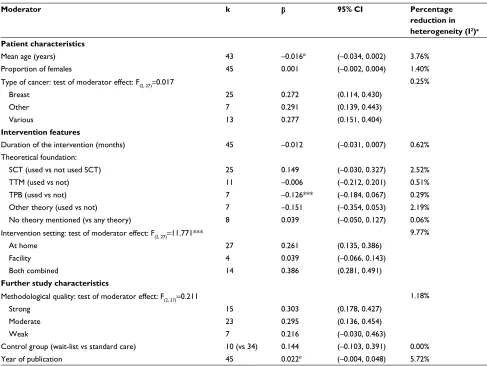
for each study. The most frequently used theories were Social Cognitive Theory (SCT, in 25 IGs), the Transtheoretical Model (TTM, in 11), and Theory of Planned Behavior (TPB, in 7), whereas seven interventions used other theories and for eight interventions no theoretical foundation was men-tioned. Interventions based on the SCT reported slightly but not significantly larger effect sizes. No difference was found for interventions based on the TTM. Interventions based on the TPB revealed significantly smaller effects (P<0.001). No significant moderating effects were found for interventions
that did not mention a theoretical foundation or those that were based on other theories when compared to the remain-ing interventions.
Effect sizes varied with the setting of the intervention (P<0.001). Interventions that included a home-based train-ing component seemed more effective than those that only took place at facilities like clinics or gyms, and those that combined both settings showed the largest effect sizes.
The duration of the intervention did not explain dif-ferences in effects sizes. However, effect sizes for longer
Cancer Management and Research downloaded from https://www.dovepress.com/ by 118.70.13.36 on 20-Aug-2020
Dovepress increasing physical activity in cancer survivors: a meta-analysis
interventions had a tendency to be smaller (mean effect size=0.30 for duration <3 months, 0.36 for 3 months, and 0.19 for >3 months; F(2, 27)=1.452, P=0.252).
study characteristics
Methodological quality had no significant effect on effect size (see Table 3). Particularly, studies with lower quality did not result in larger effect sizes. Studies published more cur-rently reported slightly larger effect sizes with an estimated increase per year of β=0.022 (P<0.10). Effects for trials with a wait-list CG did not differ meaningfully from those with a standard care comparison.
Patient characteristics
Effect sizes had a tendency to be smaller in studies with older participants, with an estimated decrease in effect size of β=0.016 per year of mean age of the study population
<
vors with different types of cancer, neither did the proportion of females vs males have a significant effect on outcomes.
Discussion
Within this meta-analysis, treatment effects from 30 RCTs on interventions for cancer survivors following acute treat-ment and aiming at an increase in PA which can be carried out independently at home were analyzed. The results show an overall significant positive effect (Hedge’s g=0.28; 95% CI=0.18–0.37) after the end of treatment, which is in line with the magnitude of effect sizes of other meta-analyses for PA interventions in cancer patients and survivors.23,26,98
There-fore, the effect is of small magnitude in terms of established rules and typical for studies in this field.
Behavior change techniques
Our results show that some specific BCTs were associated
Table 3 Moderating effects of study and patient characteristics
Moderator k b 95% CI Percentage
reduction in heterogeneity (I2)a Patient characteristics
Mean age (years) 43 –0.016# (–0.034, 0.002) 3.76%
Proportion of females 45 0.001 (–0.002, 0.004) 1.40%
Type of cancer: test of moderator effect: F(2, 27)=0.017 0.25%
Breast 25 0.272 (0.114, 0.430)
Other 7 0.291 (0.139, 0.443)
Various 13 0.277 (0.151, 0.404)
Intervention features
Duration of the intervention (months) 45 –0.012 (–0.031, 0.007) 0.62%
Theoretical foundation:
sCT (used vs not used sCT) 25 0.149 (–0.030, 0.327) 2.52%
TTM (used vs not) 11 –0.006 (–0.212, 0.201) 0.51%
TPB (used vs not) 7 –0.126*** (–0.184, 0.067) 0.29%
Other theory (used vs not) 7 –0.151 (–0.354, 0.053) 2.19%
no theory mentioned (vs any theory) 8 0.039 (–0.050, 0.127) 0.06%
intervention setting: test of moderator effect: F(2, 27)=11.771*** 9.77%
at home 27 0.261 (0.135, 0.386)
Facility 4 0.039 (–0.066, 0.143)
Both combined 14 0.386 (0.281, 0.491)
Further study characteristics
Methodological quality: test of moderator effect: F(2, 27)=0.211 1.18%
strong 15 0.303 (0.178, 0.427)
Moderate 23 0.295 (0.136, 0.454)
Weak 7 0.216 (–0.030, 0.463)
Control group (wait-list vs standard care) 10 (vs 34) 0.144 (–0.103, 0.391) 0.00%
Year of publication 45 0.022# (–0.004, 0.048) 5.72%
Notes: aCompared to the model without moderator. #P≤0.10, ***P≤0.001 (based on robust estimation). k, number of interventions where a specific BCT was present; β,
moderator effect: coefficient from meta-regression model; confidence intervals (CIs) based on robust estimation, I2, percentage of residual (unaccounted for) heterogeneity;
test for residual heterogeneity was significant (P<0.001) for all moderators.
Abbreviations: CI, confidence interval; SCT, Social Cognitive Theory; TPB, Theory of Planned Behavior; TTM, Transtheoretical Model.
Cancer Management and Research downloaded from https://www.dovepress.com/ by 118.70.13.36 on 20-Aug-2020
Dovepress Finne et al
prompts or cues to perform PA behavior (eg, adding a pedometer to a workbook as a behavioral cue) or employ-ing intermittent telephone calls as prompts79 and gradually
decreasing such prompts (or the frequency/intensity of interventions) over time were significantly associated with larger PA increases. The same was true for setting graded tasks that increase in difficulty (eg, increasing the frequency and/or duration of exercise sessions from week to week was a common strategy or progressing to more demanding exer-cises) and for delivering different kinds of rewards for effort or progress toward PA behavior (eg, immediate reinforce-ment via positive automated messaging for participants who attained their personal exercise goal,99 praise for achievement
of goals, or progress toward goal61). In general, interventions
using a larger number of these specific BCTs showed larger PA increases.
In contrast, BCTs including information about the conse-quences of PA behavior in terms of health benefits or positive emotional effects were used in less successful interventions. Likewise, social comparison, ie, to draw attention to the performance of others compared to the patient her/himself, or emphasizing discrepancies between PA goals and actual behavior was associated with smaller intervention effects in our analysis. Combinations of more than two of these BCTs were associated with smaller PA increases.
In contrast, the overall number of BCTs used in an inter-vention had no significant impact on the achieved PA increase immediately after the intervention compared to standard care or wait-list controls in our study. This result is in line with meta-regressions that included BCTs to increase PA behavior in adults with obesity37 or diabetes.36 In contrast, Samdal et
al100 found more BCTs associated with larger intervention
effects in overweight or obese adults.
Overall, results on the effectiveness of specific BCTs for increasing PA do not show a consistent pattern, and our analysis is only partly consistent with previous research. Rewards were associated with greater success, in line with other studies on healthy adults of the general population as well as older adults.34,35 However, a negative effect was found
for Graded tasks in one study,34 while others found a positive
effect of graded tasks only on long-term but not on immediate success.100 On the other hand, BCTs similar to Social
com-parison, which was associated with lower effect sizes in our study, showed a positive PA effect in healthy adults,34 but a
negative effect in a meta-analysis on older adults.35 In terms
of Information on consequences of the behavior, we obtained a negative association with effect size, whereas others found no effect.36,100 One meta-analysis showed a positive effect.34
None of the compared studies30,34–37,100,101 endorse the positive
effects we found in relation to Prompts and cues.
Several authors came to the conclusion that a combina-tion of BCTs fostering self-regulacombina-tion, ie, Self-monitoring, Goal setting, Feedback on performance, and Reviewing goals are especially promising in increasing PA in different populations.31,34,38 Of these only Self-monitoring showed a
marginally significant effect in our study, while no effects were found for other self-regulatory BCTs. One reason could be that cancer survivors as a specific target group react dif-ferentially to certain BCTs than other groups. This conclusion is backed by the results of French et al,35 who found these
techniques were not successful in older adults in contrast to younger populations. A similar mechanism could apply to Social comparison.35 Social comparison might be more
important for younger people than for cancer survivors or the elderly, and, thus, might not be as effective when applied as BCT in these target groups.
In addition to potential target group effects,102 reasons
for the differences observed may lie in different taxonomies used for coding of BCTs (ie, CALO-RE taxonomy vs BCTT v1) or in the challenge of adequate translation of intervention methods into practical application,103,104 as well as the varying
numbers of included studies.
In our analysis, the most frequently used BCTs, includ-ing some of the self-regulatory techniques mentioned above, were not associated with a more successful PA increase. In other reviews and meta-analyses on different target groups, these or similarly defined BCTs were shown to be associated with larger PA effects (ie, Instructions on how to perform behavior,34 Problemsolving,30,35 Goalsetting,31,100 Behavioral
practice31).
One possible explanation for this finding may be that some of these BCTs were used in too many interventions to enable meaningful comparisons in our analysis. Further studies should specifically test intervention effects of such frequently employed BCTs in different target groups alone and in combination with other techniques.103
Further moderators
Overall, results on the use of specific theories in PA inter-ventions are equivocal. Most studies did not find differences between specific theories reported as the basis of PA interven-tions101,105 or the use of theory in general.27,30,106
Interventions that were described as based on the TPB showed lower effect sizes. Husebø et al,107 on the other hand,
reported that constructs of the TPB (ie, intention, perceived behavioral control) were weakly but significantly associated
Cancer Management and Research downloaded from https://www.dovepress.com/ by 118.70.13.36 on 20-Aug-2020
Dovepress increasing physical activity in cancer survivors: a meta-analysis
with better exercise adherence in eight studies with cancer patients and survivors. The most frequently stated theory in our analysis was SCT and interventions based on SCT reported slightly but not significantly larger effect sizes. While some of the identified BCTs directly match SCT con-structs (like Setting graded tasks to increase self-efficacy), other techniques fitting into the SCT framework (like Role modeling) were not associated with better success.
While the authors of the present study could not identify a cluster of BCTs that completely matches one specific theory of behavior change, BCTs that proved advantageous in our study seem mostly congruent with principles of (social) learning theory, ie, rewards, including sense of achievement and situational cues which are faded out gradually and may promote habit building. In contrast, those BCTs relying on knowledge and rational decision making (ie, setting goals, providing information, problem solving) seemed less suc-cessful in increasing PA in cancer survivors. The latter is consistent with smaller effect sizes for TPB-based interven-tions which often rely on information and rationality.
However, in many cases it remains unclear how exactly theory is implemented in interventions. An explicit methodol-ogy for linking BCTs to theories is currently being developed and will help to clarify relations between BCTs, mechanisms of action, and other variables such as modes of delivery, popu-lations, settings, and types of behavior.33 Further research
should establish whether the results of the present study can be replicated for cancer survivors compared to other groups, since this would have theoretical implications for planning interventions for this target group.
In terms of intervention duration, we did not find a meaningful effect on PA increase. A study by Bernard et al27
even reports a shorter duration of theory-based interventions designed to promote PA, ie, less than 14 weeks, to be associ-ated with larger treatment effects in different target groups. Although not significant, our results point in the same direc-tion with the lowest effect sizes for those intervendirec-tions longer than 3 months. These findings underline that duration alone may not be the best measure of overall intervention intensity and that, in fact, more complex or longer interventions do not necessarily lead to greater success.
Methodological quality of included studies was also not associated with the magnitude of intervention effects indicat-ing that the results are not contorted by differences in study quality. In contrast, two recent studies27,100 reported significant
moderator effects suggesting overestimation of the efficacy of PA interventions due to methodological weaknesses. Both of these studies employed the Cochrane tool for assessing risk
of bias,108 while the present study used the EPHPP-Tool.40 As
Armijo-Olivo et al109 demonstrated, ratings using the
EPHPP-Tool may differ from those resulting from the Cochrane tool. This may explain the diverging results. However, it was also found that the EPHPP tool seems superior in terms of interrater reliability.109
strengths and limitations
This is the first study that systematically analyzed the asso-ciations of BCTs with PA increases in cancer survivors after treatment employing a current BCT taxonomy, where two coders evaluated studies independently, arriving at good interrater reliabilities. Furthermore, self-reported as well as objectively measured PA outcomes were included while adjusting the analysis for intratrial correlations.
Some limitations must also be taken into account. As our search was limited to MEDLINE, missing studies may lead to publication bias. However, we also accounted for reference lists of other current reviews and meta-analyses.23,98
Although the overall methodological quality of trials was not related to effect sizes, only a subset implemented an intention-to-treat analysis or reported on intervention integ-rity. As these criteria are not included in the overall quality rating, they may have biased the results.
Our meta-analysis is limited to outcomes measured directly after completion of interventions. Effects of specific BCTs might differ between immediate and long-term out-comes, as recently shown by Samdal et al.100 Further research
on long-term effects is, therefore, desirable.
Eight trials added an objectively measured PA outcome to a self-report measure. Since these trials contained more effect size information than those relying only on self-report measures, this may have influenced our results. However, including all available information by using a multivariate model and adjusting for dependencies between outcomes seemed more appropriate than including only information on self-reported measures. The overall effect size was similar to other studies on cancer survivors. Due to the limited amount of data on objective outcomes, it was not suitable to distin-guish the results of meta-regression models by subjective vs objective outcome.
Peters et al103 described limitations of analyzing
effec-tiveness of BCTs by meta-analytical techniques. Within the included studies, BCTs may not have been transferred to intervention strategies effectively or may not have been adapted to target groups and contexts adequately. A prerequi-site for finding an effect of BCTs in a meta-regression is the exclusive use of a BCT in the IG, but not in the CG. Since
Cancer Management and Research downloaded from https://www.dovepress.com/ by 118.70.13.36 on 20-Aug-2020
Dovepress Finne et al
most of the included interventions only provided a very short description of the “standard care,” it was impossible to code and, therefore, detect BCTs for the CG accurately.
Effects of different BCTs may have confounded each other or may have been confounded by other study charac-teristics such as the overall number of BCTs applied in an intervention. Due to a large number of analyzed potential moderators compared to the limited number of included stud-ies, calculation of more complex models allowing analyses of confounding effects were not possible.
Since some BCTs were often used in combination in the same studies (see Table S3) we adjusted for within-study dependencies of effect sizes and show “dose-response” relations for the use of those BCTs associated with effect sizes, but we cannot rule out that trial characteristics other than these BCTs were responsible for differences in PA effects. Furthermore, many BCTs were tested as moderators in separate models without adjustment for multiple testing.
Furthermore, some BCTs were used in very many or very few interventions, reducing the power of tests for moderator effects of these BCTs. A nonsignificant effect may not be interpreted as a proof of lack of effectiveness. The results are, therefore, exploratory and do not allow definite or causal conclusions.
We found some BCT definitions and coding rules not being clearly outlined and, therefore, added more specific coding rules, attaining good intercoder reliabilities after-wards. Others report similar issues.100 Cradock et al36 also
developed extensive additional coding rules, which we included in our discussion process.
Notwithstanding these limitations, meta-analyzing the effectiveness of BCTs for increasing PA in cancer survivors and comparing the results to other target groups can be seen as one constituent of further developing theory-based interven-tions aimed at health behavior change in this target group.103
Conclusions
A growing body of evidence shows the positive effects of PA in cancer survivors. Thus, identifying the relevant characteris-tics of interventions is of great importance. The present meta-analysis shows significant effects for interventions aiming at an increase in PA that can be carried out independently by cancer survivors. The magnitude of PA increase seems neither to depend on the duration of the intervention nor on the num-ber of BCTs used, but certain techniques were associated with significantly larger or smaller PA-increasing effects. Inter-ventions relying on BCTs congruent with (social) learning
theory, such as using prompts and rewards and setting graded tasks, could be especially successful in this target group. However, large parts of between-study heterogeneity in effect sizes remained unexplained by single moderator variables. Other factors than those studied here may impact on the suc-cess of PA interventions in cancer survivors, or synergistic effects of moderators may exist that can only be revealed in more complex analyses which require larger meta-studies. To strengthen validity, the results should be replicated and in addition be complemented by the analysis of long-term effects and direct comparisons to other target groups. Further primary studies should directly test and compare specific BCTs and their combinations. Coding instruments should be more precise with an extension of definitions and anchor examples for different interventions goals.
Acknowledgments
This research was partially supported by Stiftung Hoch-schulmedizin Dresden and by Deutsche Krebshilfe (German Cancer Aid) in the Program for the “Development of Inter-disciplinary Oncology Centers of Excellence in Germany”, reference number: 107,759. We acknowledge support by the German Research Foundation and the Open Access Publica-tion Funds of the Sächsische Landesbibliothek – Staats- und Universitätsbibliothek Dresden/Technische Universität Dresden. FS and NS contributed equally to this paper.
Disclosure
The authors report no conflicts of interest in this work.
References
1. Stewart BW, Wild CP. World Cancer Report 2014. online ed. Lyon: International Agency for Research on Cancer/World Health Organiza-tion; 2014.
2. Centers for Disease Control and Prevention. Cancer survivors—United States, 2007. MMWR Morb Mortal Wkly Rep. 2011;60(9):269–272. 3. Siegel RL, Miller KD, Jemal A. Cancer statistics, 2017. CA: A Cancer
Journal for Clinicians. 2017;67(1):7–30.
4. Cancer Research UK. Cancer survival statistics. Available from: http:// www.cancerresearchuk.org/health-professional/cancer-statistics/ survival. Accessed September 15, 2017.
5. Hewitt M, Greenfield S, Stovall E. editors. From Cancer Patient to Cancer Survivor: Lost in Transition. Washington, DC: National Academy Press; 2006.
6. Schmitz KH, Courneya KS, Matthews C, et al. American College of Sports Medicine roundtable on exercise guidelines for cancer survi-vors. Med Sci Sports Exerc. 2010;42(7):1409–1426.
7. World Cancer Research Fund InternationalAmerican Institute for Can-cer Research. Food, Nutrition, Physical Activity, and the Prevention of Cancer: A Global Perspective. 1. publ. Washington, DC: AICR; 2007. 8. Speck RM, Gross CR, Hormes JM, et al. Changes in the Body Image and Relationship Scale following a one-year strength training trial for breast cancer survivors with or at risk for lymphedema. Breast Cancer Res Treat. 2010;121(2):421–430.
Cancer Management and Research downloaded from https://www.dovepress.com/ by 118.70.13.36 on 20-Aug-2020