ISSN 1350-6722
GLOBALISATION AND INSECURITY
by
John McClaren and Andrew Newman
Discussion Paper 02-06
DEPARTMENT OF ECONOMICS
UNIVERSITY COLLEGE LONDON
Globalization and Insecurity
John McLaren and Andrew Newman
University of Virginia and University College, London
July, 2002
1
Abstract.
1We construct a simple model of the e¤ect of increased interna-tional openness on risk bearing in an environment in which the only risk-sharing institutions are self-enforcing agreements. We show how increased openness can weaken long-term relationships, and hence risk sharing, by increasing the e¤ectiveness of the market, much as some critics of globalization have argued. However, the harm thereby done is tempered by the fact that in order to have such a negative indirect e¤ect, openness must have a direct e¤ect thatreduces risk. It is shown that on balance, globalization reduces risk and raises welfare for those in small countries, but increases risk and reduces welfare for those in large countries.
2
Introduction.
When trade economists study the e¤ect of economic openness on the welfare of workers and on income distribution, the focus usually rests on how trade changes the average wage paid to various categories of worker. For example, much work has tested for “Stolper-Samuelson” e¤ects, under which a rich country on opening up to trade would see an increase in the wages paid to higher-skilled workers and a fall in the wages to unskilled workers (see Slaughter (1998) for
1Preliminary and incomplete. The authors are grateful to seminar participants at Harvard,
a survey). However, when non-economists argue that globalization has large social costs, they often argue something more subtle: That increased openness adds to increased risk or insecurity for individual workers, by breaking down existing relationships.2
This paper explores that possibility. We construct a simple model of risk-bearing in an environment in which complete contracts are unavailable for in-formational reasons. In this envrironment, the only way for an agent to share risk is to develop a long-run relationship with another agent in which the two promise to help each other out when one is su¤ering from bad luck. This ar-rangement is enforceable only through the threat that if one reneges, he or she will lose the bene…t of the trust on which the relationship was founded, and will need to su¤er the whims of the market and search for a new partner. However, the process of globalization makes the market work better, and by breaking down barriers makes it easier to …nd a new partner. This makes the loss of one’s current relationship less frightening, and thus weakens risk-sharing. Thus, in a well-de…ned sense, globalization does indeed weaken domestic institutions for risk bearing, and this is an indirect cost of the process that needs to be reckoned.
However, it also is a cost that will not arise unless globalization provides a direct bene…t in risk reduction. The analysis shows how ambiguous the welfare e¤ects are once these two e¤ects are taken into account. A key conclusion in the basic model is that (within the parameter region of interest) globalization does make life riskier on balance for large countries, but it has the opposite e¤ect in small countries.
The model is highly abstract but is intended to serve as a metaphor for important real-world risk sharing institutions, most notably long-term implicit employment contracts. A number of researchers have argued that long-term relationships in labor markets have been eroded in recent years, and debated the possible reasons (see Farber 1997). Bertrand (1998) provides evidence of weakening long-term relationships in US …rms that have been hit by tough im-port competition. In those …rms, the wage paid to workers is more responsive to ‡uctuations in labor demand than in …rms less a¤ected by imports. A jour-nalistic account of a broad erosion of the importance of long-term relationships in Japan in the face of international competition is found in Kristof (1997).
In order to address these questions, we have borrowed ideas from various strands of theory. The theory of implicit contracts was considerably advanced by MacLeod and Malcomson (1989), and is the focus of Thomas and Worrall (1988) and Baker et. al. (1994). Coate and Ravallion (1993) study risk-sharing arrangements through long-run relationships. The idea that a rise in the
e¢-2Copious citations of this view can be found in the popular press. For example, Nicholas
ciency of the market can harm cooperation in long-term relationships appears in some form in MacLeod and Malcomson (1989), Baker et. al. (1997), and especially in Ramey and Watson (2001), and is a focus of Kranton (1996), from which this paper derives some inspiration.3
However, none of the ideas in this literature appears to have made its way into the trade literature. Further, although changes in risk institutions have powerful implications for income distribution (as has been emphasized in papers such as Banerjee and Newman (1991)), there appears to have been no attempt to assess the possibility that some of the changes in income distribution that have interested empirical researchers may be due to globalization through that channel. For example, it has been noted by labor economists that in recent years “inequality [has] increased greatlywithin narrowly de…ned demographic and skill groups” (Katz and Murphy, 1992, p. 35; italics added), as well as between groups. This within-group e¤ect can occur quite naturally through globalization in the types of model proposed here, but is very di¢cult to produce through Stolper-Samuelson e¤ects or through skill-biased technical change (see Acemoglu (1998), for example). Thus, the e¤ects identi…ed here may be a useful complement to other explanations emphasized in the literature on income inequality.
A provocative monograph that does argue for connections between globaliza-tion and risk is Rodrik (1997). An example of such a connecglobaliza-tion is the increased elasticity of demand for labor in a globalized economy. In a closed economy, a negative productivity shock in sectoriwould drive down the marginal product of labor there, tending to depress i-workers’ wages; but it would also drive up the price ofioutput, raising the marginalvalue product of labor and providing a cushion for those wages. However, if the country becomes part of a large world market in which it has no in‡uence over prices, that cushion disappears. The Rodrik analysis has done much to put the issue of globalization and risk onto the agenda, but we argue that it omits an important element: private domestic institutions for sharing risk (in particular between employers and employees). A focus of this paper, therefore, is to consider imperfect risk institutions and ask how they respond to the globalized environment. In this respect, the cur-rent paper is similar in spirit to Dixit’s (1989) criticism of earlier writing on trade and insurance; that literature had mostly assumed away risk markets by …at, while Dixit showed that allowing for imperfect risk markets instead could dramatically change the conclusions.4
We now present the model that we use to study these ideas.
3In addition, Spagnolo (2001) explores the related idea that improvements in …nancial
markets can hinder bilateral cooperation.
4Additional examples can be cited. Newbery and Stiglitz (1981, ch. 23) study an example
3
A Pure Exchange Model.
Consider an economy with two countries, A and B, in which there is a continuum of agents of measureXAandXBrespectively. Each agent in each period receives an endowment of a non-storable, homogeneous consumption good. Each period, the quantity the agent receives is"H with probability¼and"L with probability
(1¡¼), where"H> "Land¼2(0;1)are constants. Time is discrete, measured
in periods indexed from t = 0to 1. Each agent has a strictly concave von-Neumann-Morgenstern utility function ¹ and a common discount factor ¯ 2
(0;1).
Clearly, there are gains from risk sharing and one would expect to see mutual insurance contracts if they are feasible. However, contracting is limited by two factors. First, the endowment an agent receives in a given period is observable only by that agent and another agent who is in the same location. At most two agents can be in the same location at one time, so this compromises the en-forceability of risk-sharing contracts. Second, agents can communicate and thus agree on risk-sharing arrangements only if they are in the same location, and they can …nd themselves at the same location only through a process of random search. This preventsex ante contracts involving more than two participants.
The search mechanism is of a simple Diamond (1982)-type. In any period, ifxagents are searching for partners, thenminfeÁx2; xgof them …nd partners, where eÁis a constant that summarizes the e¤ectiveness of the search process. Thus, if the number of searchers is below1=eÁ, the probability of …nding a match for any one searcher is equal toeÁx. In all of the subsequent discussion, we will constrain parameters so that the number of searchers is below1=eÁ.5
When two agents get together to form an agreement on risk sharing, they understand that since they cannot write binding contracts, they must agree on a scheme that will be subgame-perfect. Thus, as in Malcomson and Macleod (1984) or Thomas and Worrall (1988), the partners agree to an optimal subgame-perfect equilibrium at the moment they meet (we will follow the literature in calling these ‘self-enforcing agreements’). This agreement will typically use the ‘grim’ punishment of exclusion from the relationship as an enforcement mecha-nism; in practice, this means that if ever a partner reneges on the agreement, the other partner will from that point never trust him/her again, and both partners will need to search for a new partner to attain risk sharing again. (Of course, this is not renegotiation-proof; an extension to renegotiation-proofness is part of ongoing work.)
5This is a very simple example of a search technology with a ‘market-thickness’ property.
We also assume that for any existing partnership, in each period, there is a …xed probability, (1¡½), that the partnership will be dissolved for exogenous reasons (the letter ‘½’ stands of the probability that the partners will be able toremain together). One might think of this as the case in which one partner must move for personal reasons, for example. This is helpful to our argument because it avoids the situation in which all agents wind up in relationships in the steady state; as will become apparent, this would eliminate any scope for discussing the role of globalization.
The sequence of events within each period is as follows. (i) Agents within a relationship learn whether they are to be separated exogenously or not. (ii) Agents without a partner search, and learn whether or not they will identify a new potential (and currently unmatched) partner in this period. (iii) Then negotiations occur between the two new potential partners over the new part-nership. (iv) This period’s endowment for each agent is revealed. Within a partnership, this is immediately common knowledge. (v) Each partner chooses to surrender a fractionµ2[0;1]of her output to her partner (this is the form that risk-sharing takes). (vi) Consumption occurs; in each period this is equal to the agent’s output plus net transfers received from the agent’s partner.
4
Risk-sharing agreements.
In each period, within the partnership betweeni andj, there are four possible endowment outcomes: Both partners have large endowments; both have small endowments; i has a large endowment andj has a small one; and vice versa. Clearly, risk sharing requires action only in the latter two, and clearly the rel-evant action will be for the partner with the large endowment to give some up it up to the partner with the smaller endowment. Thus, the agreement can be characterised by the fraction, µ, of the large endowment transferred to the agent with the small endowment. (It is straightforward to verify that there is no generality to be gained by allowing for payments in both directions.)
Consider a pair of agents negotiating a new relationship. If the incentive compatibility constraint implied by the subgame perfect requirement did not bind, then they would agree to optimal bilateral insurance, with µ = µopt ´
("H¡"L)=2"H. This is the value ofµat which consumption of the two partners is
equalized. The case of interest, however, will be the case in which the incentive compatibility constraint does bind, so that insurance falls short of the …rst-best. That constraint is:
¹("H)¡¹((1¡µ)"H)·¯[VC(µ)¡VS], (1)
where VC is the payo¤ from being in the risk-sharing relationship (the ‘C’
stands for ‘cooperation’) andVS is the payo¤ from being without a relationship
(the ‘S’ stands for ‘search’). Note thatVC depends on the value ofµ chosen
within the relationship in question, while VS does not, but rather depends
to the well-endowed partner from reneging on the risk-sharing promise (or the ‘temptation to cheat’), and the right-hand side is the cost in ostracism of doing so (or the ‘punishment’).
The value of being in the current relationship, then, follows:
VC=½(¹c+¯VC) + (1¡½)Vs, where
¹C(µ)´¼2¹("H) + (1¡¼)2¹("L) + (1¡¼)¼[¹((1¡µ)"H) +¹(µ"H+"L)]
is the per-period expected utility of an agent in a relationship with sharing parameterµ. The last two terms denote, respectively, theex post utility of a high-endowment partner whose partner has a low endowment, and vice versa. This enables us to write the incentive compatibility constraint as:
¹("H)¡¹((1¡µ)"H)· ¯½
1¡¯½(¹
C(µ)¡(1¡¯)VS). (2)
Note that by the concavity of¹, the temptation to cheat, measured on the left hand side, is a strictly convex function of the risk sharing parameterµchosen by the partners, and that the punishment, as measured on the right hand side, is a strictly concave function ofµ. The latter attains a maximum atµ=µopt.
5
Steady state calculations.
We focus on steady states, which simpli…es the analysis in two important ways. First, analysis of equilibrium requires us to keep track of the number of people searching for partners, because this determines how easy it is for anyone out of a relationship to …nd a new one. Second, it is necessary to compute payo¤s to any agent in a relationship as well as any agent out of one. Either of these would be an order of magnitude more di¢cult outside of a steady state.
First, we analyse the number of agents searching. Denote the fraction of the total population searching (as of stage (ii) of the within-period chronology) by ¾S (where ¾ stands for ‘share’ and S stands for ‘search’), and denote the
population of the economy in question by X, where X = XA or XB without globalization andX=XA+XBwith globalization. Denote the productXÁeby
Á. Then the fraction of searching agents who …nd partners in any one period is equal to¾SXeÁ=¾SÁ, and so the fraction of agents without partners who
remain without partners at the end of the period is equal to 1¡ ¾SÁ. The
fraction of agents who will be searching in the search stage of the next period is equal to these unsuccessful searchers plus those who are in relationships at the end of this period, but who exogenously lose them at the beginning of the next period. Thus, the steady state fraction of the population without partners satis…es the following equation:
¾S = (1¡½) +½¾S(1¡Á¾S). (3) The right-hand side of this equation is quadratic in¾S, with one zero
satis-fying¾S <0and another zero satisfying¾S >1=Á >0. Between those zeroes,
the right hand side is positive. Further, plugging in¾S = 1, the right-hand side
takes a value strictly below1. Thus, (3) has one negative root and one positive root less than one; the latter is the unique steady state value of ¾S. This is
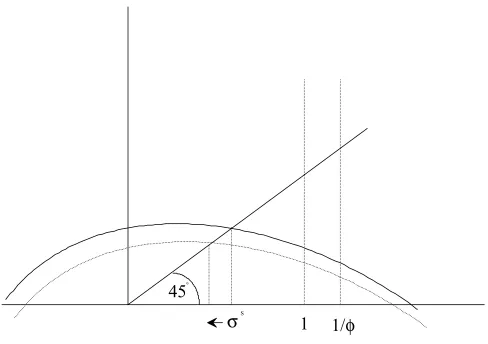
depicted in Figure 1, where the parabola indicates the right-hand side expres-sion. Further, since an increase inÁshifts the parabola down everywhere,¾S
is a decreasing function ofÁ. Finally, (3) can be written:
¾SÁ=1¡½ ½
1¡¾S
¾S , (4)
so that an increase inÁ, which decreases ¾S, must clearly increaseÁ¾S. This
can be summarized thus:
Proposition 1 For any value ofÁ, there is a unique steady state value of¾S.
It is decreasing inÁ, with an elasticity less than one in absolute value.
Thus, we can write¾S(Á). Essentially, an improvement in search technology
makes it easier to …nd a partner and escape the state of autarchy, reducing the number of searchers in the long run. The …nding on the elasticity will be important later.
Second, we analyze the value of being in a relationship and being without one. First, de…ne:
¹S ´¼¹("H) + (1¡¼)¹("L),
the per-period expected utility of an agent without a partner.
Consider an agent in a relationship with sharing parameter µ, who also understands that in any future relationship with di¤erent partners the sharing parameter would be the same. In any given period, this agent will lose the relationship with probability (1¡½). If this occurs, that agent will become a searcher, and receive the same payo¤ as any other searcher. With probability
½, the agent will remain in the relationship. Thus, in a steady state, such an agent’s payo¤ will follow:
VC= (1¡½)VS+½(¹C(µ) +¯VC).
An agent who is searching, on the other hand, will succesfully obtain a relationship if he or she …nds another agent who is not currently in a relationship. This occurs with probabilityÁ¾S, implying that such an agent’s payo¤ must
follow:
VS =Á¾S(Á)(¹C+¯VC) + (1¡Á¾S(Á))(¹S+¯VS).
Proposition 2 For given parameters and a given value of µ, the steady-state values VS and VC are uniquely de…ned by their two laws of motion. Thus,
holding other parameters constant, we can write VS(µ;Á) and VC(µ;Á). For µ2(0; µopt], these are both increasing inµ, and VC(µ;Á)> VS(µ;Á). Further,
taking into account the e¤ect of a change inÁ on the steady-state value of¾S,
bothVS(µ;Á)andVC(µ;Á)are increasing inÁ forµ2(0; µopt].
Proof. The solution is:
VS(µ;Á) = Á¾
S(Á)¹C(µ) + (1¡¯½)(1¡Á¾S(Á))¹S
(1¡¯)(1¡¯½(1¡Á¾S(Á))) ; (5) VC(µ;Á) = (Á¾S(Á) +½(1¡¯)(1¡Á¾S(Á)))¹C(µ) + (1¡½)(1¡Á¾S(Á))¹S
(1¡¯)(1¡¯½(1¡Á¾S(Á))) .
(6)
It is seen readily that(1¡¯)VS(µ;Á) and (1¡¯)VC(µ;Á)are both weighted
averages of¹C(µ)and¹S. The weight on¹C(µ)in the expression forVCexceeds
the corresponding weight in the expression for VS, and since ¹C(µ) strictly
exceeds¹S(µ)in the rangeµ 2(0; µopt), we must have VC(µ;Á)> VS(µ;Á)in
that range as well. Further, since ¹C(µ) is strictly increasing in that range,
both VS(µ;Á) and VC(µ;Á) are as well. Finally, since by Proposition 1 an
increase inÁwill increase the steady-state value ofÁ¾S(Á), an increase inÁwill
increase the weight on¹C(µ)in both expressions, which in the indicated range
must increase their values.
6
Constructing an equilibrium.
Recall the incentive-compatibility constraint (2). If we consider a representa-tive pair of agents negotiating a new relationship, and if both members un-derstand that in any future relationship with other agents they would face a risk-sharing parameter equal toµ, then they will choose a risk-sharing parame-tereµfor themselves that is the highest value not exceedingµopt such thatT(eµ)
is no greater thanP(eµ; µ;Á)(or will chooseµ= 0if no such value exists), where
T(eµ) = ¹("H)¡¹((1¡eµ)"H) is the temptation of the well-endowed partner
to cheat, and P(eµ; µ;Á) = 1¡¯½¯½(¹
C(eµ)¡(1¡¯)VS(µ;Á)) is the punishment
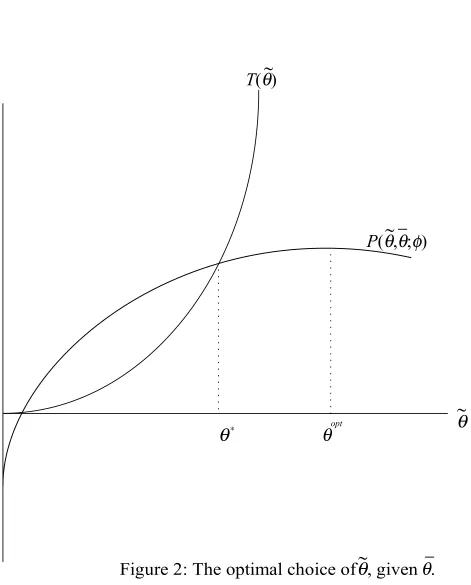
for doing so. Denote this optimal decision by eµ(µ; Á). The problem is illus-trated in Figure 2. An equilibrium, then, will be a value ofµ2[0;1]such that eµ(µ; Á) = µ. This is illustrated in Figure 3. Note that by Proposition 2, an increase inµ causes the punishment curve P of Figure 2 to shift down, and so theeµ curve in Figure 3 must be downward sloping.
equilibrium with any cooperation under any circumstances. To avoid this, we assume:
P(eµ;0; 0)¡T(eµ)¸0for someeµ2(0; µopt]. (7) This assures that there could be some cooperation between two agents on a desert island who could never have a chance to …nd another partner. It is a necessary condition for any cooperation at all. Since
P(0;0; 0) =T(0) = 0
and sinceP is concave ineµ andT is convex ineµ, the desert island condition is equivalent to
P1(0;0; 0)> T0(0).
This can easily be checked for speci…c functional forms. For example, if¹(¢) = log(¢), then the condition is that"H="L >1 + (1¡¯½)=(¯½¼(1¡¼)).
SinceP(eµ; µ;Á)is continuous inµ, and since by Proposition 2 it is decreasing inµ, we know thateµ(µ; Á) decreases continuously asµ rises until the P curve in Figure 2 becomes tangent to the T curve, after which the value of eµ drops discontinously to zero. This is illustrated in Figure 3, for the case in which this discontinuity occurs to the right of the 45-degree line and so there is an equilibrium.
Note that the discontinuity in the curve in Figure 3 will occur at a value ofµ
andeµfor which thePcurve and theT curve of Figure 2 will be tangent, so that the derivatives of both functions with respect toeµ will be equal. Computing these derivatives, setting them equal, and solving foreµyields the critical value,
µcrit, at which this occurs. The convexity of T and the concavity of P with respect toeµensure that this tangency condition de…nes a unique value ofµcrit. For example, in thelog-utility case, the critical value is given by:
eµ=µcrit=("
H="L¡1)A¡1
("H="L)(1 + 2A),
whereA= (1¡¯½¯½)¼(1¡¼). Note that, regardless of functional form,µ
critdoes
not depend onÁ.
An equilibrium will exist if theeµcurve of Figure 3 crosses the 45-degree line, which will be true if and only if P(µcrit; µcrit;Á)¡T(µcrit) ¸0. Noting that
7
The equilibrium, before and after
globaliza-tion.
We can now turn to the normative analysis of globalization. In the event thatÁ < Ácrit, globalization strictly lowersµ and¾S. Thus, globalization has
weakened all agents’ ability to protect themselves against risk, in the sense that the one available risk-sharing institution – the long-run bilateral relationship – has been weakend.
However, it is immediate that the e¤ect of all of this on overall risk is am-biguous. The reason is that the mechanism through which the partnerships have been weakened, namely the increased ease of …nding a new partner when one is without one, consitutes aprima faciereduction in risk. The globalization has a direct risk-reducing e¤ect, together with an indirect risk-enhancing e¤ect, and the net e¤ect of these two is unclear.
This can be made clearer using Lorenz curves, because changes in risk in this economy are isomorphic to changes the degree of horizontal inequality. To see why, …rst consider the realized sum of payo¤s of all agents in, for example, country A, which is given by:
Z 1
j=0
1
X
t=0
¯¹(cj;t)dj, (8)
whereci;tdenotes the consumption of workerj2[0;1]in periodt. Since we are focussing on steady states, and since the aggregate behaviour of the economy at each date will be identical due to the fact that the endowments are iid and and there is a continuum of aggents, this expression is equal to:
1 (1¡¯)
Z 1
j=0
¹(cj;0)dj
= 1
(1¡¯)(¾
S(Á)¹S+ (1¡¾S(Á))¹C(µ¤
))
´ W(µ¤
; Á)=(1¡¯), (9) whereµ¤
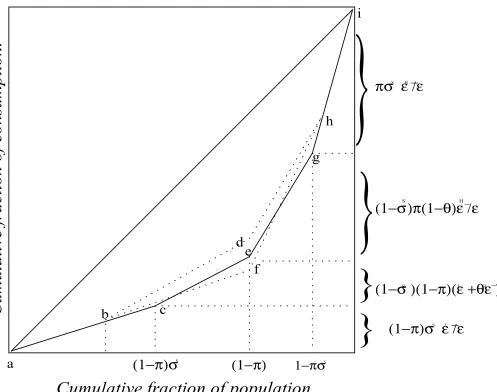
is the equilibrium level ofµ. Thus, all that we need to know about the lifetime risk faced by agents in the economy together is revealed by a one-period snapshot of the population. Further, since the average endowment, and hence the average consumption, is una¤ected by globalization, the Lorenz curve in any one period tells us all that we need to know about that. The Lorenz curve for this economy is depicted in Figure 4.
an unambiguous reduction in inequality and vice versa, while for any pair of economies whose Lorenz curves cross, the two cannot be ranked unambiguously by inequality (see Atkinson (1971) for a classic analysis).
The Lorenz curve for this economy without globalization is represented as the piecewise linear curveacegi. There are four distinct groups in the population, as distinguished by their level of consumption: There are agents without partners, some of whom have large endowments and some of whom have small; and there are agents with partners, some of whom have large endowments and some of whom have small. For example, the fraction who are not in relationships and who have small endowments are the poorest group; they number¾G(1¡¼), and
the consumption level of each is simply the endowment,"L. Thus, their share
of total consumption is equal to ¾G(1¡¼)"L=", where " is the economy-wide
average endowment. This is pointc in the …gure.
Note that the slope of ac is the ratio of the typical unpartnered, low-endowment agent’s consumption to the economywide average consumption, and that this is una¤ected by globalization. A parallel argument holds for the slope ofgi. On the other hand, globalization certainly will lower the fraction¾S of
the population without partners. Therefore, with globalization, point c will slide leftward along the rayac, to a point likeb; and pointg will slide rightward along the raygi, to a point like h. If the share parameter µ for risk-sharing agreements were to be unchanged by globalization, then the new Lorenz curve would beabdhi6, which is everywhere above the old curve, indicating lower in-equality and risk. This is the direct e¤ect of globalization: By making it easier to …nd a partner, it lowers the inherent riskiness of economic life.
However, as indicated, the share parameterµwill indeed change due to glob-alization, and this will add to riskiness by creating inequalitywithin relation-ships. What this will do is to slide pointd of the new Lorenz curve downward. It is possible that it will be driven downward su¢ciently that the new Lorenz curve will dip down below the old one, as illustrated with curveabfhi; but it is not possible that the new Lorenz curve will be everywhere the old one.
There remains the question of the net e¤ect of globalization on expected utility. Recalling the expression forW(µ¤
; Á)de…ned in (9) above, we see that globalization will have two e¤ects. It will lower ¾S, providing a prima facie
bene…cial e¤ect, but lowerµ¤
, thus providing an indirect negative e¤ect. A …rst observation is obvious: Welfare has its minimum atÁ= 0, in which case¾S = 1
and so welfare equals ¹S. Welfare will be strictly above this level whenever ¾S 6= 1 and µ¤
6
= 0; therefore, for su¢ciently small Á, globalization must be bene…cial. Thus, globalization is always good for small countries.
More subtly, welfare is generally decreasing inÁin the neighborhood ofÁcrit. The reason is as follows. First, consider the following proposition:
Proposition 3 The derivative of the equilibrium degree of risk sharing with respect toÁ,dµ¤
=dÁ, takes a limit of¡P3(µcrit; µcrit; Ácrit)=P2(µcrit; µcrit; Ácrit)
asÁ!Ácrit.
Proof. Consider the derivatives eµ1 and eµ2 of theeµ function depicted in Figure 3. We haveeµ1=¡P2(eµ(µ; Á); µ; Á)=(P1(eµ(µ; Á); µ; Á)¡T0(eµ(µ; Á)))<0 (note that the denominator is always negative; see Figure 2). The expres-sion for eµ2 is similar but has a P3 in place of the P2. As Á approaches
Ácrit, the numerator of this expression is bounded away from zero and the denominator goes to zero (since where µ = µcrit, the P and T curves are
tangent). For that reason, eµ1;eµ2 ! ¡1 as Á ! Ácrit. Now consider the condition µ¤
= eµ(µ¤
; Á), which de…nes the equilibrium µ¤
(Á). Di¤erentiat-ing, we obtaindµ¤
=dÁ =eµ1(dµ
¤
=dÁ) +eµ2 =¡[(dµ
¤
=dÁ)P2+P3]=(P1¡T0) =
¡[(dµ¤
=dÁ) +P3=P2]=(P2=(P1¡T0)). Thus, dµ
¤
=dÁ = [(dµ¤
=dÁ) +P3=P2]eµ1. We know that(dµ¤
=dÁ)andeµ1 are both negative, so the expression in square brackets must be positive, but for that to hold, (dµ¤
=dÁ) must be less than
P3=P2in absolute value, and thus bounded. Sinceeµ1! ¡1asÁ!Ácrit, this implies that the term in square brackets must vanish asÁ!Ácrit.
One way of interpreting this is in terms of elasticities: The quality of cooper-ation becomes in…nitely elastic with respect to the severity of punishment when cooperation is stretched to the breaking point (in other words,eµ1;eµ2! ¡1as
Á!Ácrit). As a result, in that part of the parameter space an improvement in the quality of search requires an adjustment that leaves the severity of punish-ment unchanged (in other words, dµ¤
=dÁ =¡P3=P2, so that the (Á; µ¤)point moves along aP indi¤erence curve).
This gives us a strong conclusion on the desirability of further globalization:
Proposition 4 Steady-state equilibrium welfare is a strictly decreasing func-tion ofÁforÁ < Ácrit andÁ su¢ciently close toÁcrit.
Proof. From the expression for P it is straightforward that P3=P2 =
VS
2 =V1S. Thus, welfare is decreasing in Á in a neighborhood of Ácrit if and
only if:
lim
Á!(Ácrit
)¡ d dÁW(µ
¤
(Á); Á) =¡W1(µcrit; Ácrit)
VS
2 (µcrit; Ácrit)
VS
1 (µ
crit; Ácrit)+W2(µ
crit; Ácrit)<0.
This can be restated as:
VS
2 (µcrit; Ácrit)
VS
1 (µcrit; Ácrit)
>W2(µ
crit; Ácrit) W1(µcrit; Ácrit)
, (10)
or the condition that the indi¤erence curve in(Á; µ)space forW at that point is ‡atter than the indi¤erence curve forVS.
Note that(1¡¯)VS can be written in the form®(Á)¹S+ (1¡®(Á))¹C(µ),
where
®(Á) = (1¡¯½)(1¡Á¾
S)
Noting that:
VS Á VS
µ
= (¹
S¡¹C(µ))®0
S(Á)
(1¡®S(Á))d¹C(µ)=dµ,
and
WÁ Wµ =
(¹S¡¹C(µ))(¾S)0
(Á) (1¡¾S(Á))d¹C(µ)=dµ,
we see that
VS Á VS
µ
¸ WÁ
Wµ if and only if ®0
(Á) (1¡®(Á))·
(¾S)0
(Á)
(1¡¾S(Á))(·0),
or equivalently, if and only if
1¡®(Á) 1¡¾S(Á)
is increasing inÁ. This means that
ª(Á)´ Á¾ S(Á)
(1¡¯½(1¡Á¾S(Á)))(1¡¾S(Á))
is increasing inÁ. Now, using (3) and (4), we can writeª(Á)as
ª(Á) = 1¡½
½((1¡¯)¾S(Á) + (1¡½)¯).
Since¾S(Á)is strictly decreasing in Á, ª(Á)is clearly strictly increasing inÁ.
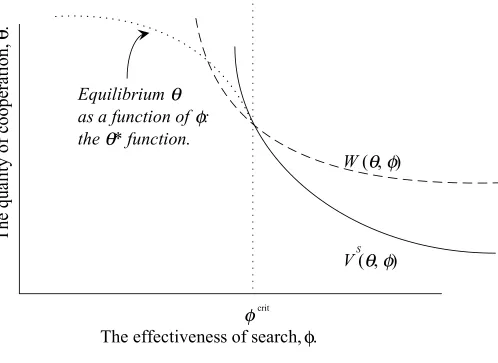
This proposition is illustrated in Figure 5 by the fact that the path followed by µ¤
(Á) runs tangent to the VS indi¤erence curve when Á is close to Ácrit.
Thus, if the W indi¤erence curve is ‡atter than theVS indi¤erence curve, as
shown in the …gure and as indicated in equation (10), an improvement inÁin that neighborhood lowers welfare. This condition is easily understood, in that it simply states that an improvement in the search technology matters more to an agent who is currently searching than to the average agent. This is what Proposition 4 establishes.
8
Appendix.
Here we discuss a variant to the basic model in which the addition of a vanish-ingly small amount of noise guarantees the existence of equilibrium across the parameter space.
In this variant, an additional feature of relationships is that they can impose a kind of psychic cost if the two agents do not get along well. This is determined by a random variable·drawn from a distribution with cdf G, densityg, and support [¡·; ·], where · > 0is a constant; the realized utility of a person in a relationship in a given period is then equal to the utility ¹of that period’s consumption minus the value of·for that relationship. (The letter·stands for ‘cost.’) The interpretation is that·gives the per-period disutility (if positive) or utility (if negative) to staying together for that particular pair of agents, based on non-pecuniary factors such as personality. This variable is realized once per relationship, and is iid across relationships. The reason for introducing this variable is that for some portions of the parameter space, if there is no such element of personality (equivalently, if·= 0), then no equilibrium exists, but an equilibrium does exist for a small postitive ·. We assume that g(·) > 0
forj·j< ·. In addition, we assume that if one is in a relationship currently, in order to …nd out what one’s level of ·would be with a given other potential partner, one must (irrevocably) break o¤ the current relationship and move to the same location as the potential partner. Thus, as · ! 0, it becomes extremely unattactive to search merely in order to …nd a relationship with a better ·. In the main model in the text, we always had · = 0, and it was noted that an equilibrium did not exist for all parameter values; now, we will assume that · > 0, in which case we will be interested in what happens as
·!0.
The sequence of events within each period is as follows. (i) Agents within a relationship learn whether they are to be separated exogenously or not. (ii) Agents without a partner search, and learn whether or not they will identify a new potential (and currently unmatched) partner in this period. (iii) Where an agent has identi…ed a new potential partner and the two are in the same location, the psychic cost,·, of their match is realized and becomes known to both partners. (iv) Then negotiations occur between the two new potential partners over the new partnership. (v) This period’s endowment for each agent is revealed. Within a partnership, this is immediately common knowledge. (vi) Each partner chooses to surrender a fractionµ2[0;1]of her output to her partner (this is the form that risk-sharing takes). (vi) Consumption occurs; in each period this is equal to the agent’s output plus net transfers received from the agent’s partner.
described byµ=eµ(·). We will be interested in the limit of such equilibria as
·!0.7
Two observations allow us to simplify the analysis when we let · ! 0. First, it is possible that a certain fraction of agents who attempt to negotiate a cooperative arrangement will be unable to commit to cooperation, because theirP curve has been shifted down by the negative realization of ·and now lies everywhere below theirT curve. For these agents, eµ(·) = 0. The set of pairs of agents for whom this is true is now an additional endogenous variable. Of course, the set of agents thatare able to commit to cooperation are those for whom·is less than or equal to some threshhold value, say ·¤. The set is
thus completely characterised by the fraction®=G(·¤
)of new pairs that are able to commit to cooperation. (The letter ‘®’ stands for ‘able to commit.’) Second, the range of the portion ofeµ(¢)that has positive values will converge to a constant. Thus, in studying the limit of equilibria as·!0, we need to focus on only a value of®andµ. (More formally, we seek a value of®andµsuch that for any sequence ·i ! 0, there is a corresponding sequence of equilibria eµi(¢)
such thateµi(¢)7¡!µ uniformly and the fraction of the set of· witheµi(·)>0
converges to®.)
It is easy to see that these modi…cations to the model do not change matters at all in the limit if an equilibrium exists with · = 0. However, when no such equilibrium exists, allowing for this small bit of noise now guarantees the existence of an equilibrium, if·is small enough. The essential point is that, if the fraction®of pairs who are able to commit drops below unity, then the e¤ect is isomorphic to a drop inÁ. We can de…neÁe=®Áas the e¤ective value ofÁ, and note that if®is less than unity in the steady state, all of the steady state analysis (beginning with Proposition 1) goes through unchanged after replacing
Á byÁe everywhere. Thus, heuristically, allowing ®to fall shifts the µe curve in Figure 3 to the right, restoring equilibrium, at the same time shifting the
P(eµ; µ; Á)curve of Figure 2 back up until it is approximately tangent to theT
curve, leaving it either slightly above or slightly below the point of tangency so that exactly a fraction®of pairs of agents who are negotiating will be able to commit to cooperation.
To see the argument more precisely, …x a value of · > 0. Suppose that
P(µcrit; µcrit;Á)¡T(µcrit)<0, so that there would have been no equilibrium with · = 0. Now, focus on the class of eµ(·) functions constructed in the following way. Each function in the class is indexed by a value·¤
2[¡·; ·], so we will write it aseµ(·;·¤
). For a given ·¤
, de…ne P¤
(µ; ·;·¤
)for any µ and
·byP¤
(µ; ·;·¤
) = 1¡¯½¯½(¹
C(µcrit)¡B¡·), where B is such that T(µcrit) =
7This discussion supposes that it is never advantageous for a partner in a functioning
relationship to dissolve the relationship in order to begin a new one with a lower·. This is valid for two reasons. First, recall that we are assuming that one cannot discover the ·
one would experience with a potential partner without separating from one’s current partner …rst. Second, note that in the limit all values of· will be close to zero, but the expected
¯½
1¡¯½(¹
C(µcrit)¡B ¡·¤
). Then seteµ(·;·¤
) for · ··¤
equal to the highest level ofµnot exceedingµoptsuch thatT(µ)·P¤
(µ; ·;·¤
)(note that this implies eµ(·¤
;·¤
) =µcrit), and seteµ(·) equal to zero for · > ·¤
. Any equilibriumeµ
function would have to be in this class.
Now, suppose that a given pair of agents are attempting to negotiate a cooperative agreement, and they both anticipate that any future cooperation either partner might have with any future partner would be characterized by eµ(·;·¤). Then, one can compute their anticpated value to searching and hence
the analogue to the ‘punishment’ curve of Figure 2, and thus for any given value of the· in their current relationship, one can compute the µ that they would choose. Thus, a given anticipated futureeµ(·;·¤
)curve induces a current eµ(·;·¤
)curve. Any anticipated value of·¤
that would induce current partners to choose the same value would be an equilibrium. Next, note that an increase in the anticipated·¤
results in an improvement in the anticipated distribution ofµ
by …rst order stochastic dominance, so a higher anticipated value of·¤
increases the value to searching, thereby shifting the punishment curve down and thus leading to a reduction in the induced·¤
. This dependence of the induced·¤
on the anticipated·¤
is continuous, because all of the e¤ects of the anticipated
·¤
on future expected utilities are continuous. Further, if the anticipated ·¤
equals·, the induced current·¤
will be equal to¡·, provided that ·is small enough (sinceP(µcrit; µcrit;Á)¡T(µcrit)<0), while if the anticipated·¤
equals
¡·, the induced current·¤ will be equal to·, provided that·is small enough
(by (7)). Thus, in between there is a unique equilibrium ·¤, and hence an
equilibrium value of®=G(·¤
).
Taking the limit as ·!0, we see that this always yields a value of ®just equal to the level required to makeP(µ; µcrit;Á)tangent toT(µ); furthermore, sinceeµ(·¤
; ·¤
) =µcrit at all times, the range of positive values ofµconverge to the single valueµ=µcrit.
This is summarized in the following proposition.
Proposition 5 If P(µcrit; µcrit;Á)¡T(µcrit) ¸ 0, then the limit of equilibria as · ! 0 is the unique solution to eµ(µ; Á) = µ with ® = 1, and is just the same as the equilibrium with · = 0. If P(µcrit; µcrit;Á)¡T(µcrit) < 0, then the limit of equilibria as ·! 0has µ = µcrit and a value of ® <1 such that
P(µcrit; µcrit;®Á)¡T(µcrit) = 0.
The comparative statics implied by this analysis are as follows. ForÁbelow
Ácrit, increases inÁworsen the degree of cooperation as re‡ected in the decrease
inµ, but they increase the fraction of people who are in relationships, as re‡ected in the decline in¾S. However, everyone who …nds a potential partner succeeds
References
[1] Acemoglu, Daron (1998). “Why Do New Technologies Complement Skills? Directed Technical Change and Wage Inequality.” Quarterly Journal of Economics CXIII:4 (November), pp. 1055-90.
[2] Baker, George; Robert Gibbons; and Kevin J. Murphy (1994). “Subjective Performance Measures in Optimal Incentive Contracts.” Quarterly Journal of Economics 109:4 (November), pp. 1125-56.
[3] Baker, George; Robert Gibbons; and Kevin J. Murphy (1997). “Implicit Contracts and the Theory of the Firm.” National Bureau of Economic Research Working Paper: 6177 (September).
[4] Banerjee, Abhijit V. and Andrew F. Newman (1991). “Risk-Bearing and the Theory of Income Distribution,”Review of Economic Studies (April).
[5] Bertrand, Marianne (1998). “From the Invisible Handshake to the Invisible Hand? How Import Competition Changes the Employment Relationship.” Princeton Industrial Relations Section Working Paper 410 (December).
[6] Coate, Stephen and Martin Ravallion (1993). “Reciprocity without Com-mitment: Characterization and Performance of Informal Insurance Ar-rangements.” Journal of Development Economics 40:1 (February), pp. 1-24.
[7] Dixit, Avinash K. (1987). “Trade and Insurance with Moral Hazard.” Jour-nal of InternatioJour-nal Economics 23:3/4 (November), pp. 201-20
[8] Farber, Henry S. “The Changing Face of Job Loss in the United States, 1981-1995”. Brookings Papers on Economic Activity (Microeconomics 1997), pp. 55-128.
[9] Helpman, Elhanan and Assaf Razin (1978). “Uncertainty and International Trade in the Presence of Stock Markets.” Review of Economic Studies45:2 (June), pp. 239-50.
[10] Kranton, Rachel E. (1996). “Reciprocal Exchange: A Self-Sustaining Sys-tem.” American Economic Review 86:4 (September), pp. 830-51.
[11] Kristof, Nicholas D. (1997). “Real Capitalism Breaks Japan’s Old Rules.” New York Times, July 15.
[12] MacLeod, W. Bentley and James M. Malcomson (1989). “Implicit Con-tracts, Incentive Compatibility, and Involuntary Unemployment. Econo-metrica 57:2 (1989), pp. 447-80.
[14] Newbery, David M. G., and Joseph E. Stiglitz (1981). The Theory of Commodity Price Stabilization. Oxford: Oxford University Press.
[15] Osborne, Martin J. and Ariel Rubinstein (1990). Bargaining and Markets.
San Diego: Academic Press.
[16] Pissarides, Christopher (2000). Equilibrium Unemployment Theory (2nd edition). Cambridge, MA: MIT Press.
[17] Ramey, Gary and Joel Watson (2001). “Bilateral Trade and Opportunism in a Matching Market,”Contributions to Theoretical Economics 1:1.
[18] Rodrik, Dani (1997). Has Globalization Gone Too Far? Washington, DC.: Institute for International Economics.
[19] Slaughter, Matthew J. (1998). “International Trade and Labor-Market Out-comes,”Economic Journal, 108:450 (September), pp. 1452-1462.
[20] Spagnolo, Giancarlo (2001). “Markets and Cooperation.” Stockholm School of Economics/EFI Working paper No. 257.
[21] Thomas, Jonathan and Tim Worrall (1988). “Self-enforcing Wage Con-tracts,” Review of Economic Studies55:4 (October), pp. 541-54.
Figure 1: The Determination of the Steady-State Number of
Searchers: Endowment Model.
45
0θ
~
P
(
θ
~ _
,
θ
;
φ
)
T
(
θ
~
)
Figure 2: The optimal choice of
θ, given
~
θ.
_
θ
optFigure3: Construction of the Equilibrium.
θ
crit45
O
θ
_
Figure 4: Income distribution effects of globalization.
Cumulative fraction of population.
C
u
m
u
la
ti
ve
f
ra
c
ti
o
n
o
f
c
o
n
su
m
p
ti
o
n
.
(1−π)σ
S1−πσ
Sa
b
c
d
e
f
g
h
i
(1−π)
}
}
}
}
(1−σ )(1−π)(ε +θε )/ε
S L H _(1−σ )π(1−θ)ε /ε
S H__
πσ ε /ε
S HS L
The effectiveness of search,
φ
.
T
h
e
q
u
al
it
y
o
f
co
o
p
er
at
io
n
,
θ
.
Equilibrium
θ
as a function of
φ
:
the
θ
* function.
φ
critW
(
θ
,
φ
)
DISCUSSION PAPERS 1999-2002 SERIES ISSN 1350-6722
99-01 I Preston Batting Strategy in Limited Overs Cricket
J Thomas
99-02 J Adda Mad Cows: Health Risk and Endogenous Discount Rates
99-03 S Pereira The Impact of Minimum Wages on Youth Employment in
Portugal
99-04 M Ottaviani Professional Advice
P Sorensen
99-05 M Ottaviani Notes on Cheap Talk
P Sorensen
99-06 M Ottaviani Price Competition for an Informed Buyer
P Sorensen
99-07 I Crawford Nonparametric Tests of Stochastic Dominance in Byvariate Distribution With an Application to UK Data
!
01-00 I Preston Racial Discrimination in English Football
S Szymanski
02-00 V Chick Formalism, Logic and Reality: A Keynesian Analysis
S Dow
03-00 M Pemberton Measuring Income and Measuring Sustainability
D Ulph
04-00 M Pemberton Technical Progress and the Measurement of National Income D Ulph
05-00 K Binmore Does Minimax Work? An Experimental Study
J Swierzbinski C Proulx
06-2000 T Swanson Conflicts in Conservation: Aggregating Total Economic Values S Muorato
07-2000 F Altissimo The Nonlinear Dynamics of Output and Unemployment in the
G Violante US
08-2000 D Acemoglu The Labour Market and Corporate Structure
A Newman
09-2000 P Garibaldi Severance Payments in Search Economics with Limited Bonding G Violante
10-2000 G L Albano Strategic Certification and Provision of Quality A Lizzeri
11-2000 P Aghion General Purpose Technology and Within-group Wage Inequality P Howitt
G Violante
12-2000 D Acemoglu Deunionization, Technical Change and Inequality P Aghion
G Violante
13-2000 G L Albano A Comparison of Standard Multi-Unit Auctions with Synergies F Germano
S Lovo
4-2000 G L Albano A Class of All-pay Auctions With Affiliated Information
15-2000 G L Albano A Bayesian Approach to the Econometrics of English Auctions F Jouneau-Sion
16-2000 R Inderst Bargaining with a Possibly Committed Seller
17-2000 R Inderst Decentralised Markets with Adverse Selection
18-2000 R Inderst Internal Competitions for Corporate Financial Resources C Laux
19-2000 G Violante Technological Acceleration, Skill Transferability and the Rise in Residual Inequality
20-2000 R. Inderst Project Bundling, Liquidity Spillovers and Capital Market
H M Müller Discipline
01-2001 T de Garidel Information Sharing in Dynamic Insurance Markets
02-2001 N Rosati How has Economic Inequality Evolved over the Past Two
Decades? A Look at the Italian Experience
04-2001 I Preston Seizing the Moment: a Blueprint for Reform of World Cricket S F Ross
S Szymanski
05-2001 I Preston Rain Rules for Limited Overs Cricket and Probabilities of Victory J Thomas
06-2001 D Sonedda Employment Effects of Progressive Taxation in a Unionised Economy.
07-2001 B M Koebel Separabilities and Elasticities
02-01 S Borghesi Sustainability For All? A North-South-East-West Model D Ulph
02-02 S Lemos The effects of the minimum wage on wages and employment
in Brazil - A menu of minimum wage variables
02-03 J Banks Wealth portfolios in the US and the UK
R Blundell J P Smith
02-04 P Legros Assortative matching in a non-transferable world
A Newman
02-05 A Calveros Quality externalities among hotel establishments: What is M Vera-Hernandez the role of tour operators?
02-06 J McClaren Globalisation and insecurity