Efficient Query Integrity for Outsourced Dynamic
Databases
Qingji Zheng
Department of Computer Science University of Texas at San AntonioShouhuai Xu
Department of Computer Science University of Texas at San AntonioGiuseppe Ateniese
Department of Computer Science Sapienza-University of Rome andJohns Hopkins University [email protected]
ABSTRACT
As databases are increasingly outsourced to the cloud, data own-ers require various security assurances. This paper investigates one particular assurance, query integrity, by which a database querier (either the data owner or a third party) can verify that its queries were faithfully executed by the cloud server with respect to the out-sourced database. Query integrity is investigated in the setting of dynamic databases, where the outsourced databases can be updated by the data owners as needed. We present a formal security defini-tion of query integrity and a provably-secure efficient construcdefini-tion. Our solution improves upon the state-of-the-art solutions by addi-tionally allowing aggregate queries and more flexible join queries. In addition, we provide better performance by eliminating a linear factor in the extra storage complexity for security purpose. Our solution also achieves a trade-off between computational and com-munication complexities.
Categories and Subject Descriptors
C.2.4 [Communication Networks]: Distributed Systems; H.2 [DATABASE MANAGEMENT]:
General Terms
SecurityKeywords
Dynamic outsourced database, query integrity, authenticated data structure.
1.
INTRODUCTION
When databases are outsourced to the cloud, security issues arise. The concern that outsourced data may be modified or (partially) deleted has led to novel solutions to assuring the storage integrity of outsourced data [2, 12, 3, 26, 8]. However, query integrity, ver-ifying whether or not queries against outsourced data are faithfully executed, has not been adequately addressed. Intuitively, query integrity aims to assure the queriers, which can be the data own-ers and third parties (e.g., the data ownown-ers’ business partnown-ers), that
Permission to make digital or hard copies of all or part of this work for personal or classroom use is granted without fee provided that copies are not made or distributed for profit or commercial advantage and that copies bear this notice and the full citation on the first page. To copy otherwise, to republish, to post on servers or to redistribute to lists, requires prior specific permission and/or a fee.
CCSW’12, October 19, 2012, Raleigh, North Carolina, USA.
Copyright 2012 ACM 978-1-4503-1665-1/12/10 ...$15.00.
their queries are executed against the outsourced data (i.e., neither a portion of it nor a modified version of it). Despite some previous studies [11, 13, 17, 18, 16, 19, 23], the problem of query integrity largely remains open.
1.1
Our Contributions
We present a formal security definition and an efficient con-struction for query integrity in the setting of outsourced dynamic database. Our solution can be characterized from three perspec-tives: (i) functionality, (ii) security, and (iii) efficiency. From the perspective of (i) functionality, our solution supports four kinds of queries — selection, projection, join, and aggregate. Whereas, the state-of-the-art solutions [13, 23] only support selection, projection and join queries, but do not support aggregate queries (see Sec-tion 5.4 for details). Moreover, our soluSec-tion supports strictly more flexible join queries, namely that the queries do not have to be de-fined with respect to pre-dede-fined keyword attributes. In contrast, the state-of-the-art solutions [13, 23] only support join queries with respect to pre-defined keyword attributes.
From the perspective of (ii) security, our solution is provably se-cure as long as the two underlying building-blocks are provably secure. The first building-block is called Authenticated Outsourced Ordered Data Set, and the second building-block is called Homo-morphic Linear Tag. Although our concrete solution is based on our specific constructions of these building-block, its security anal-ysis can be directly applied to solutions that use other (perhaps more efficient) building-blocks as long as the building-blocks sat-isfy their respective security definitions. This is due to our modular construction and “compiler"-like security analysis.
From the perspective of (iii) efficiency, our solution is character-ized as follows. Letmbe the number of attributes andnbe the number of tuples.
• Our solution incurs anO(n)storage complexity at the cloud side for security purpose, in contrast to theO(mn)of [13, 23].
• For selection query, our solution incursO(n) exponentia-tions at the querier side, which is not as efficient as theO(n)
hash operations of [13] but more efficient than theO(n) ex-ponentiation operations on bilinear map of [23].
Our solution incurs communication ofO(n)tags, which is less efficient than theO(logn)hash values of [13] but com-parable to theO(n)of [23].
of [23], wherek≤mis the number of attributes involved in the projection operation.
Our solution incurs anO(n+m)communication complexity, which is the same as in [23] but much more efficient than theO((m−k)n)of [13], wherek ≤ mis the number of attributes involved in the projection operation.
• For join queries with respect to two tables ofntuples andm
attributes, our solution incursO(n)modular exponentiations at the querier side, which is not as efficient as theO(nlogn)
hash operations of [13], but more efficient thanO(n) expo-nentiation operations on bilinear map of [23].
Our solution incurs the communication complexity ofO(n+ m)tags, which is more efficient than theO(n(logn))hash values of [13] and comparable to theO(n)of [23].
The efficiency of our solution mainly comes from the second building-block mentioned above, which is weaker than the Homomorphic Linear Authenticator introduced in [2] and may be of independent value.
1.2
Related Work
The problem of assuring query integrity in the context of out-sourced data was fundamentally related to the concept of certified data structures [27], which presents some results that are concep-tually important but not efficient. The state-of-the-art solutions to query integrity are due to [13, 23], which are the only solutions that support selection, projection and join queries simultaneously. These two solutions follow two respective approaches to the query integrity problem.
• The tree-based approach: Basically, this approach uses the Merkle hash tree [15] or its variants to index search keys [11, 17, 13, 7, 16, 31, 20, 21]. As a result, this approach leads to logarithmic complexity in terms of both communication and verification, possibly with some further tricks (e.g., using the Merkle hash tree to maintain signatures at multiple hash tree levels [11]). The best solution in this approach is due to [13], which uses the Merkle tree and the Embedded Merkle B-tree in order to reduce I/O operations.
• The signature-based approach: Basically, this approach uses the signature aggregation technique [5, 18] to aggregate the validity of query answers [18, 19, 23, 22]. As a result, this approach can lead to low (even constant) communication com-plexity, but may require special treatment for handling more powerful (e.g., projection) queries and often leads to large storage and computational complexities. The best solution in this approach is due to [23], which uses aggregate signa-tures to sign each attribute and returns a single signature as the validity proof for projection queries. This solution uses a chaining signing technique to build the index for the search key so as to facilitate range queries, and publishes a certi-fied bitmap corresponding to every update so as to facilitate dynamic updates. These cause a large storage and commu-nication overhead while including many exponentiations and pairing operations.
There are studies that are somewhat related to the theme of the present paper as well. These include: authenticating the answers to set operations using accumulator [25], authenticating the answers to aggregate queries using authenticated prefix-sums trees [14], au-thenticating the answers to join queries [30], auau-thenticating count queries with respect to multi-dimensional data while preserving
privacy [29], and assuring probabilistic integrity in selection and join operations [28]. Query integrity is also somewhat related to outsourced verifiable computation [1, 6, 10].
Paper outline.
The rest of the paper is organized as follows. Section 2 presents the functional and security definitions of outsourced dynamic datab-ase with the requirement of query integrity. Section 3 describes the first block, and Section 4 describes the second building-block. Section 5 presents the main construction of authenticated outsourced dynamic database and analyzes its security and effi-ciency. Section 6 presents an extension of the construction to ac-commodate storage integrity of outsourced dynamic database. Sec-tion 7 concludes the paper with future research direcSec-tions.
2.
QUERY INTEGRITY FOR
OUTSOURC-ED DYNAMIC DATABASES:
DEFINITI-ONS
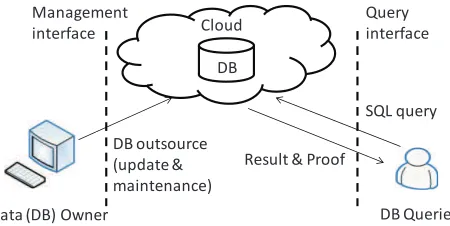
In the context of the present paper, a relational database consists of multiple tables, and each table has multiple tuples and multiple attributes. As shown in Figure 1, an outsourced database system has three participants: data owner (who outsources its database to the cloud), database server (i.e., the cloud), and database queriers (e.g., business partners of the data owner). The data owner uses a management interface to outsource its database to the cloud, in-cluding dynamic updates of the database. There is also a query interface, which can be used by any third party, including the data owner itself if desired.
Cloud
Data(DB)Owner DBQuerier
DBoutsource (update& maintenance)
SQLquery DB
Result&Proof Management
interface
Query interface
Figure 1: Outsourced dynamic database system model.
Intuitively, query integrity means that any queryqryis faithfully executed with respect to the databaseD. If we treat a queryqryas a function, the querier should be able to verify that the answer to its query is indeedqry(D). The concern is legitimate because the cloud may execute the queryqrywith respect toD′, whereD′6=D because (for example) the cloud vendor may use an outdated ver-sion ofDrather than the up-to-date one, orD′ ⊂Dbecause the cloud vendor wants to spend less resources on searching the entire
D. Moreover, the cloud may return the answer to a modified query
qry′on databaseDor even someD′ 6=D. As a concrete exam-ple, a queryqryasks for the tuples with some attribute values that belong to the interval[10,100], but the cloud actually returns the tuples whose attribute values belong to the smaller interval[10,20]. Without assuring query integrity, the querier cannot tell whether the returned answer is indeedqry(D)or someqry′(D′).
Data Structures that allow verifiable queries over dynamic sets [24, 25].
Definition 1. (AuthDDB) LetDbe a database outsourced to the server. AnAuthDDBscheme consists of the following algorithms:
• KeyGen: This algorithm takes as input the primary security parameterℓ, and outputs a pair of private and public keys
(sk, pk). We denote this by
(sk, pk)←KeyGen(1ℓ).
• SetUp: This algorithm is executed by a data ownerObefore outsourcing its databaseDto the server. By taking as input the private keyskand the databaseD, this algorithm out-puts some cryptographic auxiliary informationAuand state informationState. BothDandAuwill be outsourced to the server andStatewill be made public (so as to allow third parties to verify the query answers). We denote this by
(State,Au, D)←SetUp(sk, D)
• Update: This protocol is executed between a data ownerO
and the serverSto perform update operations, the detail of which is described byUpd. By taking as input the private key
skand the current state informationState, the data owner in-teracts with the server, which takes as input the stored data
Dand the cryptographic auxiliary informationAu. The data ownerOupdates its state information toState′from the up-date informationUpd, and the server obtainsAu′andD′by updating the stored database accordingly. We denote the pro-tocol by
(Au′,State′, D′)←(O(sk,State,Upd)↔S(Au, D))
• QueryVrfy: This is a protocol between a querierQ, which issues a SQL query qry, and the server S, which answers the query with the resultRstand a proofPrf. The querier verifies the resultRstwithPrf, and outputsrejectifRstis not valid with respect to the queryqryand the stateState; otherwise, the querier acceptsRstandPrf. We denote the protocol by
{(reject),(accept,Rst,Prf)} ←
(Q(pk,qry,State)↔S(Au, D))
We require anAuthDDBscheme to be correct, meaning that for any honest server,(sk, pk) ← KeyGen(1ℓ)
, (State,Au, D) ←
SetUp(sk, D), polynomial-many executions of theUpdate proto-col, and a queryqry, it holds that
(accept,Rst,Prf)←(Q(pk,qry,State)↔S(Au, D))
We require anAuthDDBscheme to be sound, meaning that no malicious server can return incorrect query answers without being detected by the querier. Specifically, we say anAuthDDBscheme is sound if for any queryqryon database D, the server can not return an incorrectRstsuch that
(accept,Rst,Prf)} ←(Q(pk,qry,State)↔S(Au, D)).
Formally,
Definition 2. (soundness ofAuthDDB) LetΛ = (KeyGen,SetUp,
Update,QueryVrfy)be anAuthDDBscheme andAbe a
proba-bilistic polynomial-time adversary. Consider the following security game between a challenger andA.
• The challenger runs(sk, pk)←KeyGen(1ℓ)and givepkto the adversaryA.
• Amakes oracle access toSetUp, by presenting a database
D0. The challenger computes
(State0,Au0, D0)←SetUp(sk, D0),
and givesState0,Au0 toA. The challenger makesState0 public.
• Aasks for updatingD0 adaptively withUpdi,i ≥0. The challenger computes
(Aui+1,Statei+1, Di+1)←
(O(sk,Statei,Updi,Aui, Di)↔S(Aui, Di)).
• Amay executeQueryVrfypolynomial-many times. Eventu-ally,Aoutputs a queryqryand a query resultRstwith proof
Prf.
• Awins the game if
(accept,Rst,Prf)} ←(Q(pk,qry,Statek)↔S(Auk, Dk))
for somek ≥ 0andRst 6= localRst, wherelocalRst ←
LocalQuery(qry, Dk)is produced by the challenger that faith-fully executes queryqryon databaseDk.
We say thatΛis sound if any polynomial-time algorithmAcan win the game with at most a negligible probability.
3.
BUILDING-BLOCK I: AUTHENTICATED
OUTSOURCED ORDERED DATA SET
(AUTHODS)
In this section, we introduce a building block for assuring range query integrity on ordered data set that is outsourced to the server. This building-block is called Authenticated Outsourced Ordered Data Set (AuthODS), which is similar toAuthDDB.
3.1
Definition of AuthODS
Definition 3. (AuthODS) Let E be an ordered data set. An
AuthODSscheme consists of the following algorithms, which are similar to those in Definition 1:
• KeyGen: This key generation algorithm generates the pub-lic/private key asKeyGenin Definition 1.
• SetUp: This setup algorithm is the same asSetUpin Defi-nition 1, except that the database is replaced with an ordered setE.
• Update: This update protocol proceeds is the same asUpdate
in Definition 1, except that the update operations are element insertion/deletion/update on the ordered data setE.
• QueryVrfy: This query protocol is the same asQueryVrfyin Definition 1, except that it only supports range queryqry(a, b)
that asks for all elements in the interval[a, b].
The correctness ofAuthODScan be defined similar to that of
Definition 4. (soundness ofAuthODS) For anAuthODSscheme,
Λ = (KeyGen,SetUp,Update,QueryVrfy), we consider the se-curity game as in Definition 2, except that (i) the initial database is replaced with an ordered setE, (ii) the update operation is ele-ment insertion, deletion or update on the ordered data set, and (iii) the queries are only range queriesqry(a, b)that ask for elements in the interval[a, b]. We say thatΛis sound if any polynomial-time algorithmAcan win the game with at most a negligible probability.
3.2
Construction and Analysis of AuthODS:
Merkle B-Tree
Now we describe anAuthODSscheme, which is a Merkle B-tree (MB-B-tree) and has been extensively studied in [13, 17]. Merkle B-tree applies the basic idea of Merkle tree on aB+tree structure, where the operations on Merkle B-tree (e.g., insertion and deletion) are similar to those onB+ tree. The primary advantage ofB+ tree is that it has a large fan-out, which can reduce the number of I/O operations when searching for an element [13]. LetSig = (KeyGen,Sign,Verify)be a secure signature scheme. LetEbe an ordered set. The Merkle B-tree scheme consists of algorithms as follows:
• (sk, pk)←KeyGen(1ℓ): This algorithm runsSig.KeyGen
(1ℓ)
to obtain a pair of private and public keys(sk, pk).
• (State,Au)←SetUp(sk, E): This algorithm outputs a suc-cinct signature which can be used for verification. The struc-ture of Merkle B-treeT is similar toB+ tree, where the leaves store elements in the ordered set E, and the values of internal nodes are computed from the concatenation of the values of their children via an appropriate hash function. The root of the tree will be signed to produce the state informa-tion, denoted byState=Sig.Sign(T)andAu=T.
• Update: The update protocol fulfills update operations. For simplicity, we consider the example of the replacement op-eration while assuming that the replacement preserves the order of the elements. We refer to [13] for details about the insertion and deletion operations. SupposeUpd= “update the elementEitoEi”. Upon receiving′ Updfrom the data owner, the server updatesEtoE′by replacingEiwithEi′, and updatesT toT′. The server provides a proof, a path of
EiinT, namely a sequence including values of the nodes fromEito the root of MB-tree as well as the values of these nodes’ siblings. The data owner can hash the path ofEifrom the bottom to the top and verify whether the root is valid with respect to stateStateor not. If so, the data owner updates the path from the bottom to the top by replacingEiwithEi′, which will result in a new root, signs the new root, and sets
State′=Sig.Sign(T′); otherwise, the data owner aborts.
• QueryVrfy: Given a range queryqry(a, b), the server outputs a proofPrfshowing thatRstcontains all elements in[a, b].
– IfRstis empty, which means there exists somes, such thatEs < a, b < Es+1. The server returns the proof
Prf including two paths: a path ofEs and a path of
Es+1. The querier hashes each path from bottom to the top, and verify whether the roots match the stateState, andEsis neighbor toEs+1. If so, the querier returns the null setRst,Prf, andaccept. Otherwise, abort.
– IfRstis not null, suppose the query result is(Es, . . . ,
Et), s ≤ t. The server returns the proofPrf includ-ing two paths: one path of the left-most neighbor leaf
ofEs, and the other path of the right-most leaf ofEt. Then the querier uses Prfand the result Rstto con-struct aB+ tree, and verifies whether the root of the thisB+tree is valid forState= Sig.Sign(T). If so, the querier returns (Rst,Prf,accept); otherwise, the querier aborts.
THEOREM 1. Assuming thatSigis a secure signature scheme and the hash function is collision resistant, the Merkle B-tree scheme is sound with respect to Definition 4.
4.
BUILDING-BLOCK II: HOMOMORPHIC
LINEAR TAG (HLT)
Now we present the second building block,HLT. Intuitively,
HLToffers the following property: If messagesM1, . . . , Mnare respectively tagged withσ1, . . . , σnusing some cryptographic func-tion, then for coefficients c1, . . . , cn in a pre-defined coefficient space, the aggregate messageM =Pn
i=1ciMican be verified via the aggregate tagσofσ1, . . . , σnand the coefficientsc1, . . . , cn.
HLTcan be divided into two types:
• Publicly verifiableHLT: It allows anyone (without knowing any secret) to verify the validity of tags. In order to allow any third party to verify query integrity, this type ofHLTis needed for the purpose of the present paper.
• Privately verifiableHLT: It allows someone who knows the relevant secret to verify the validity of tags. Putting this into the context of the present paper, this type ofHLTcan be used to allow the data owner (but not third parties) to verify query integrity. Therefore, this type ofHLTwill not be discussed further in the paper.
The concept ofHLTwas inspired by the notion of Homomor-phic Linear Authenticator (HLA), which was formally introduced in [3]. The difference between them is thatHLTis weaker than HLA becauseHLTonly considers attacks that do not attempt to tamper the individual tags (which is dealt with by another layer of protection for free, namely by the first building-block); whereas, HLA explicitly accommodates attacks that aim to tamper the indi-vidual tags. This makes it possible to constructHLTschemes that are more efficient that their HLA counterparts. It is worthwhile to point out the following feature ofHLTand HLA: the aggregated message M and the aggregated tagσ are sufficient to allow the verifier to test their validity without knowing the individual mes-sagesM1, . . . , Mn. This is not the case for aggregate signatures [5], batch RSA [9], and condensed RSA [18], which are not suffi-cient for the purpose ofHLTor HLA.
4.1
Definitions of HLT
Definition 5. (publicly verifiableHLT) A publicly verifiableHLT
scheme consists of the following algorithms:
• (pk, sk) ← KeyGen(1ℓ)
: This algorithm takes as input a security parameterℓ, and outputs a pair of public and private keys(pk, sk). It may optionally specify a coefficient domain Cand a message spaceM.
• σi ← TagGen(sk, Mi): This algorithm takes as input the private keyskand a messageMi∈ M, and outputs a tagσi forMi.
vector of coefficients~c = (c1, . . . , cn). It outputs an ag-gregate tagσwith respect to the aggregated messageM =
Pn
i=1ciMi.
• {0,1} ← Vrfy(pk, M′, σ′): This deterministic algorithm takes as input the public keypk, a candidate messageM′, and a tagσ′. It outputs 1 ifσ′is valid with respect toM′, and outputs 0 otherwise.
We require aHLTscheme to be correct, meaning that any faith-fully aggregated message M and tag σ are always accepted as valid. Formally, this means that for(pk, sk) ← KeyGen(1ℓ)
,
~
M = (M1, . . . , Mn) ∈ Mn,Tag~ = (σ1, . . . , σn)whereσi ←
TagGen(sk, Mi)for1≤i≤n, and~c= (c1, . . . , cn)∈ Cn, then
σ←HLTAgg(~c, ~Tag)implies1←Vrfy(pk,Pni=1ciMi, σ). The intuition behind the following security definition ofHLTis: for any tagσgenerated for messageM, there is no probabilistic polynomial time adversary that can presentM′ 6= M such that
1←Vrfy(pk, M′, σ). Formally, we have:
Definition 6. (security ofHLT) LetΛ = (KeyGen,TagGen, HLTAgg,Vrfy)be aHLTandAbe a probabilistic polynomial-time adversary. Consider the following security game between a chal-lenger andA:
1. The challenger runs(pk, sk) ←KeyGen(1ℓ)
and givespk
toA. The optional coefficient domainC and the message spaceMare specified byKeyGen.
2. Amay make oracle queries toTagGenby adaptively select-ingM1, . . . , MnfromM. The challenger computesσi ←
TagGen(sk, Mi)for1≤i≤nand returns tags(σ1, . . . , σn) toA. The challenger keeps the lists of messages and tags:
(M1, . . . , Mn)and(σ1, . . . , σn).
3. Amay make oracle queries toHLTAggby selecting a vector of coefficients~c= (c1, . . . , cn), obtain the aggregate tagσ, and runVrfy with the aggregate tagσand the aggregated messagePni=1ciMi. This can be performed polynomially many times.
4. Eventually,Aselects a vector of coefficients~c= (c1, . . . , cn), whereci∈ C, and someM′∈ M.
5. The adversaryAwins the game if1 ← Vrfy(pk, M′, σ)
andM′ 6=Pni=1ciMi, whereσ ← HLTAgg(~c, ~Tag)was computed by the challenger, whereTag~ = (σ1, . . . , σn) cor-responds to the message vector (M1, . . . , Mn)that can be identified by the coefficient vector~c = (c1, . . . , cn) pro-vided by the adversaryA.
We sayΛis secure if no probabilistic polynomial-time algorithmA can win the game with a non-negligible probability in the security parameterℓ.
From the security game, we observe that the adversaryAis only allowed to manipulate the messagesM1, . . . , Mnbut not the tags. This further explains whyHLTis weaker than the aforementioned HLA (Homomorphic Linear Authenticator) [2, 3, 26], where the adversary can manipulate both messages and tags. This can be stated as:
LEMMA 1. Any secure HLA scheme as defined in [3] is also a secureHLTscheme as defined above.
4.2
Construction and Analysis of HLT
We present aHLTscheme whose security is based on the Dis-crete Logarithm (DLOG) problem. The scheme consists of the fol-lowing algorithms.
• (sk, pk)←KeyGen(1ℓ) :
1. Letq be aℓ−bit prime and pbe another large prime such thatq|(p−1).
2. Selectv1 and v2 uniformly at random fromZp∗such that the order ofv1andv2isq
3. Selectsj1, sj2 uniformly at random fromZq∗ and set
zj=v −sj1 1 v
−sj2
2 modp, for1≤j≤m.
4. Letsk={(s11, s12), . . . ,(sm1, sm2)}andpk={v1,
v2, z1, . . . , zm}.
5. The coefficient domainCis[0, q)and the message space isM= [0, q)m.
• σi ←TagGen(sk, Mi): ForMi ∈ M, the tagσiis com-puted by selectingr1, r2uniformly at random fromZq∗and:
x = vr1 1 v
r2
2 modp,
y1 = r1+ m
X
j=1
Mi[j]sj1 mod q,
y2 = r2+ m
X
j=1
Mi[j]sj2 mod q.
Letσi= (x, y1, y2).
• σ ← HLTAgg(~c, ~Tag): Given tagsTag~ = (σ1, . . . , σn) withσi= (xi, yi1, yi2), and~c= (c1, . . . , cn), the aggregate tagσ= (x, y1, y2)is computed as:
x =
n
Y
i=1
xci
i modp,
y1 = n
X
i=1
ciyi1 modq,
y2 = n
X
i=1
ciyi2 modq.
• {0,1} ← Vrfy(pk, M, σ): To verify thatM is valid with respect to tagσ, check whether:
x =? vy1 1 v y2 2 m Y j=1
zMj [j] modp.
If it holds, return 1; otherwise, return 0.
It can be verified thatM =Pni=1ciMimatches the aggregated tagσbecause
vy1 1 v y2 2 m Y j=1
zMj [j] = v
Pn
i=1ciyi1
1 v
Pn
i=1ciyi1 2 m Y j=1 z Pn
i=1ciMi[j]
j
=
n
Y
i=i
vciyi1 1
n
Y
i=i
vciyi2 2 m Y j=1 z Pn
i=1ciMi[j]
j
=
n
Y
i=i
(vciyi1 1 v
ciyi2 2
m
Y
j=1
zciMi[j]
j )
=
n
Y
i=i
xci
THEOREM 2. Assuming DLOG problem is hard, theHLTscheme is secure according to Definition 6.
PROOF. LetM1, . . . , Mnbe the messages adaptively selected byAandσ1 = (x1, y11, y12), . . . , σn = (xn, yn1, yn2)be the corresponding tags generated by the challenger. Assume the ad-versary wins the security game with a non-negligible probability. That is, it outputs a vector of coefficients~c = {c1, . . . , cn}and a messageM′ ∈ M, such thatM′ 6= M = Pn
i=1ciMi but
1←Vrfy(pk, M′, σ), whereσ ←HLTAgg(~c, ~Tag), andTag~ = (σ1, . . . , σn). We show that ifAwins the security game with a non-negligible probability, then we can solve the DLOG problem: givenv1, v2randomly selected fromZp∗, findlogv2(v1).
Supposeσ= (x, y1, y2). Since1←Vrfy(pk, M′, σ), we have
x=vy1 1 v
y2 2
m
Y
j=1
zjM′[j].
On the other hand, asσ←HLTAgg(~c, ~Tag), we have
x=vy1 1 v
y2 2
m
Y
j=1
zjM[j],
whereM =Pni=1ciMi. Therefore, we have
m
Y
j=1
zjM′[j]= m
Y
j=1
zMj [j],
namely
m
Y
j=1
zjM′[j]−M[j]= 1.
AsM′ 6= M, let∆M[j] = M′[j]−M[j]for1 ≤ j ≤ m. Sincezj=v
−sj1 1 v
−sj2
2 , we have
v
Pm
j=1−sj1∆M[j]
1 v
Pm
j=1−sj2∆M[j]
2 = 1.
We claim thatPmj=1−sj1∆M[j] modq = 0with negligible probability becausesj1 for1≤ j≤ nare kept secret. Then we have
v1=v
Pm
j=1sj2 ∆M[j]
Pm
j=1−sj1 ∆M[j]
2 .
Performance.
As stated in Lemma 1, any secure HLA scheme is also a se-cureHLTscheme. Now we show thatHLTconstructions can be significantly more efficient than HLA schemes. Specifically, we compare ourHLTwith two HLA schemes presented in [2, 26]. We use comparable parameters that offer the same level of security. Specifically, the parameterqis 140-bit andpis 512-bit in ourHLT
scheme,pis 160-bit in [26] andNis 1024-bit in [2]. We consider
nmessages, namelyMi = (Mi[1], . . . , Mi[m])for1 ≤i≤ n, and compare the costs of the respective operations.
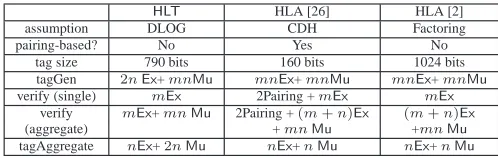
As shown in Table 1, the HLA scheme presented in [26] has the shortest tag but incurs the most expensive computation. Recall that exponentiations and multiplications in pairing groups are much less efficient than those in integer groups (e.g., the cost of one pairing is about that of 6-20 exponentiations [4]).
HLT HLA [26] HLA [2]
assumption DLOG CDH Factoring
pairing-based? No Yes No
tag size 790 bits 160 bits 1024 bits
tagGen 2nEx+mnMu mnEx+mnMu mnEx+mnMu verify (single) mEx 2Pairing +mEx mEx
verify mEx+mnMu 2Pairing +(m+n)Ex (m+n)Ex
(aggregate) +mnMu +mnMu
tagAggregate nEx+2nMu nEx+nMu nEx+nMu Table 1: Performance ofHLTand HLA, whereExdenotes ex-ponentiation andMudenotes multiplication.
5.
QUERY INTEGRITY FOR OUTSOURCED
DYNAMIC DATABASES: CONSTRUCTION
AND ANALYSIS
In this section, we begin with a discussion on the solution design space. Then, we present the main construction and analyze its se-curity. Finally, we discuss its efficiency with a comparison to the state-of-the-art solutions.
5.1
Solution Space
As discussed in the related work section, the state-of-the-art so-lutions to the query integrity problem fall into two approaches. The first approach is tree-based [13]. This approach incurs the least computational complexity because of the hash functions, but also incursO(nlogn)communication overhead. The second approach is signature-based [23]. This approach incurs high computational complexity ofO(kn)bilinear map exponentiations and communi-cation complexity ofO(n)bitmaps (a small constant bits). Both approaches incurO(mn)extra storage complexity in the cloud.
Our solution is based on a third approach. It reduces the extra complexity at the cloud side from O(mn) toO(n). It achieves a balanced trade-off between computational and communication communications. Specifically, it is less efficient than the tree-based solution in terms of computational complexity but substantially more efficient than the tree-based solution in terms of communication complexity. It is also substantially more efficient than the signature-based solution in terms of computational complexity but less effi-cient than the signature-based solution in terms of communication complexity. Perhaps more importantly, our solution can accommo-date aggregate queries, which are not supported by the state-of-the-art solutions [13, 23].
The high-level idea of our solution is the following: TheHLT
scheme generates a tag for each tuple in the table, and theAuthODS
scheme can be built on those tags, which are ordered by the search key. Intuitively, theAuthODSscheme provides two functionali-ties: one is to enable range query, and the other is to guarantee tag integrity (i.e., preventingHLTtags from being manipulated). The performance gain comes from theHLTscheme because only one aggregate tuple is needed to verify the integrity of (parts of) tuples. This is critical for the projection query because its query result only contains a portion of attributes from all tuples.
5.2
Proposed Construction
LetR be a table ofntuples with schema(A1, . . . , Am)and
r1, . . . , rnbe tuples ordered by search keyA1. LetLandU be the lower and upper bounds of the search keyA1, respectively.
LetΛRS = (KeyGen,SetUp,QueryVrfy,Update)be a secure
AuthODSscheme andΛHLT= (KeyGen,Tag,Vrfy,HLTAgg)be
a secureHLTscheme. TheAuthDDBscheme is described as fol-lows:
owner obtains two secondary security parametersℓ1andℓ2, and generates a pair of private and public keys(sk, pk),
1. Compute(ΛRS.sk,ΛRS.pk)←ΛRS.KeyGen(1ℓ1).
2. Compute(ΛHLT.sk,ΛHLT.pk)←ΛHLT.KeyGen(1ℓ2).
3. sk={ΛRS.sk,ΛHLT.sk}andpk={ΛRS.pk,ΛHLT.pk}.
4. ΛHLT.KeyGen specifies the coefficient domain C and
the message spaceM, s.t.(ri.A1, . . . , ri.Am)∈ M forri∈R,1≤i≤n.
• SetUp: The data owner takes as input the private keyskand a tableR, and obtainsStateandAuas follows:
1. Letr0andrn+1be two tuples added at both ends of ta-bleRin order to facilitate range query, wherer0.A1 =
Landrn+1.A1=U.
2. Computeσi ←ΛHLT.TagGen(ΛHLT.sk, ri) for tuple
ri,0≤i≤n+ 1.
3. LetERSbe the ordered data set, such thatERS={E0,
. . . , En+1}whereEi= (ri.A1, σi)for0≤i≤n+ 1 andERSis ordered byA1. Compute(StateRS,AuRS,
ERS)←ΛRS.SetUp(ΛRS.sk, ERS).
4. LetState=StateRSandAu = (AuRS, ERS). Rand
Auwill be outsourced to the server, andStatewill be made public.
• Update: The data owner interacts with the server to update the stored table with the update informationUpd.
Insertion: SupposeUpdis “insert the tuplerintoRwhere
rs.A1< r.A1< rs+1.A1,0≤s≤n”:
1. The data owner computesσ←ΛHLT.TagGen(ΛHLT.sk,
r).
2. LetUpdRS be “add an element ofE = (r.A1, σ) be-tweenEs andEs+1”. The data owner takes as input
UpdRS,ΛRS.skandStateRS, runs protocolΛRS.Update
with the server, who takes as inputUpdRS andAuRS.
Eventually, the data owner outputsState′RSand the server
updatesAuRStoAu′RSandERStoE′RS.
3. The data owner deliversUpdto the server, and the server updatesRtoR′.
Replacement: SupposeUpdis “update the tuplerwithr′”:
1. The data owner fetches the tagσfor the tuplerfrom the server.
2. The data owner computesσ′←Λ
HLT.TagGen(ΛHLT.sk,
r′).
3. LetUpdRSbe “update the element(r.A1, σ)with(r′.A1,
σ′)”. The data owner takes as inputUpdRS,ΛRS.sk
andStateRS, runs protocolΛRS.Updatewith the server,
who takes as inputUpdRS andAuRS. Eventually, the
data owner outputsState′RSand the server updatesAuRS
toAu′RSandERStoERS′ .
4. The data owner deliversUpdto the server, and the server updatesRtoR′.
Deletion: SupposeUpdis “delete the tupler”:
1. The data owner fetches the tagσfor the tuplerfrom the server.
2. LetUpdRSbe “delete the element(r.A1, σ)”. The data owner takes as inputUpdRS,ΛRS.skandStateRS, runs
protocolΛRS.Updatewith the server, who takes as
in-putUpdRSandAuRS. Eventually, the data owner
out-putsState′RSand the server updatesAuRStoAu′RSand
ERStoERS′ .
3. The data owner deliversUpdto the server, and the server updatesRtoR′.
We present the construction ofQueryVrfyprotocol based on the query type. Recall thatState=StateRSandAu= (AuRS, ERS).
QueryVrfyon Selection Query.
Suppose the selection query isqry =“select * fromR where
A1≥aandA1≤b”. There are two scenarios.
• If the resultRstis not null, assumeRst={rs, . . . , rt},1≤
s≤t≤n, wherers−1.A1< a≤rs.A1andrt.A1 ≤b <
rt+1.A1. The protocol proceeds as follows:
1. The server setsRst ={rs, . . . , rt}, and sendsRstto the querier.
2. The querier runs protocolΛRS.QueryVrfywith the server
for range queryqry(a, b). If the output isreject, the querier aborts; otherwise, the querier obtains range query resultRstRS= ((rs.A1, σs), . . . ,(rt.A1, σt))andPrfRS.
3. The querier randomly selects a vector of coefficients
~c= (cs, . . . , ct), computesσ←ΛHLT.HLTAgg(~c, ~Tag)
whereTag~ = (σs, . . . , σt), and runs
ΛHLT.Vrfy(ΛHLT.pk,Pti=sciri, σ). If the output is 1, the querier returns(accept,Prf= (RstRS,PrfRS),Rst);
otherwise, the querier returnsreject.
• If the resultRstis null, there exist two tuplesrs, rs+1,0≤
s ≤ n such thatrs.A1 < a, b < rs+1.A1. The querier can verify this fact by running protocolΛRS.QueryVrfywith
range queryqry(a, b), which should returnacceptandRstRS
is null.
QueryVrfyon Projection Query.
Suppose the projection query isqry=“selectA1, . . . , Akfrom
R” (k≥1). The protocol proceeds as follows:
1. The server setsRst={(ri.A1, . . . , ri.Ak),1≤i≤n}and passes it to the querier.
2. The querier runs protocolΛRS.QueryVrfywith the server on
range query(L, U). If the output isreject, the querier aborts; otherwise, the querier obtains the range query resultRstRS=
((r0.A1, σ0), . . . ,(rn+1.A1, σn+1))and proofPrfRS.
3. The querier randomly selects a vector of coefficients~c = (c1, . . . , cn)and sends it to the server.
4. The server computesr.Aj=Pni=1ciri.Aj, k+ 1≤j≤m and sends(r.Ak+1, . . . , r.Am)to the querier as part ofPrf.
5. The querier computesr.Aj = Pni=1ciri.Aj,1 ≤ j ≤ k from Rst = {(ri.A1, . . . , ri.Ak),1 ≤ i ≤ n}and the aggregated tagσ = ΛHLT.HLTAgg(~c, ~Tag), whereTag~ =
6. The querier computesΛHLT.Vrfy(ΛHLT.pk, M, σ)whereM
= (r.A1, . . . , r.Am). If the output is 1, the querier returns
(accept,Rst,Prf= (RstRS,PrfRS, r.Ak+1, . . . , r.Am));
otherwise, the querier returnsreject.
QueryVrfyon Join Query.
LetP be another table with schema(B1, . . . , Bm)and be pro-cessed bySetUp, whereB1 is the search key. For convenience, supposeP hasntuples, andA2andB2are the respective primary key for tablesRandP. Suppose the join query isqry =“select
R.∗, P.∗fromR, P whereR.As =P.Bt” (1≤s, t≤m). The protocol proceeds as follows:
1. The server setsRst= (R∗, P∗)and passes it to the querier, whereR∗andP∗are the tuples inRandPsuch thatR.A
s=
P.Bt.
2. The querier runsQueryVrfyon projection queries withqryR
= “selectA2, As fromR” andqryP = “selectB2, Btfrom
P", respectively. If either execution outputs 0, the querier aborts; otherwise, the querier obtains{(ri.A2, ri.As, σi),1≤
i≤n}and{(pj.B2, pj.Bt, σ′j),1≤j≤n}.
3. The querier identifies tuples satisfyingR.As = P.Btfrom {(ri.A2, ri.As, σi),1≤i≤n}and{(pj.B2, pj.Bt, σj′),
1≤j≤n}. Specifically, letαandβbe two sets of indices such thatα⊆ {1, . . . , n},β⊆ {1, . . . , n}andi∈α, j∈
β, ri.As =pj.Bt. Then, the querier obtains two sets of tu-ples{(ri.A2, ri.As, σi), i∈α}and{(pj.B2, pj.Bt, σ′j), j∈
β}, wherei∈α, j∈β, ri.As=pj.Bt. The querier verifies that the number of tuples inR∗equals to the number of tuples in{(ri.A2, ri.As, σi), i∈ α}, and the number of tuples in
P∗equals to the number of tuples in{(r
j.B2, pj.Bt, σj′), j∈
β}. If both are true, the querier continues; otherwise, the querier aborts.
4. The querier randomly selects a vector of coefficients~c = (c1, . . . , c|α|), computesσby aggregating tags{σi, i∈α}, and executes ΛHLT.Vrfywith~c, σ,R∗ andΛHLT.pk. The
same is executed with respect toP∗. If both executions out-put 1, the querier returns
(accept,Rst,Prf= (RstRS,R,PrfRS,R,RstRS,P,RstRS,P));
otherwise, the querier returnsreject. Here(RstRS,R,PrfRS,R) are the query result and proof when executingQueryVrfyon projection queryqryR, and that(RstRS,P,PrfRS,P)are the query result and proof when executingQueryVrfyon projec-tion queryqryP.
QueryVrfyon Aggregate Query.
Suppose the aggregate query isqry =“select SUM(A2) from
Rwhere A1 ≥ a andA1 ≤ b”. Suppose1 ≤ s ≤ t ≤ n,
rs−1.A1 < a≤rs.A1 andrt.A1 ≤b < rt+1.A1. The protocol proceeds as follows:
1. The server setsr.Aj=Pti=sri.Ajforj= 1, . . . , m, sets
Rst=r.A2, and passesRstand(r.A1, r.A3, . . . , r.Am)to the querier.
2. The querier runs protocolΛRS.QueryVrfy on range query
qry(a, b)with the server. If the output isreject, the querier aborts; otherwise, the querier obtainsRstRS= ((rs.A1, σs),
. . . ,(rt.A1, σt))andPrfRSfor the range query.
3. The querier computesσ←ΛHLT.HLTAgg(~c, ~Tag), where~c
is a vector of 1’s andTag~ = (σs, . . . , σt). The querier com-putesΛHLT.Vrfy(ΛHLT.pk, M, σ), whereM={r.A1,· · ·,
r.Am}. If the output is 1, the querier returns
(accept,Rst,Prf= (RstRS,PrfRS, r.A1, r.A3, . . . , r.Am));
otherwise, the querier returnsreject.
REMARK 1. In selection/projection/join query, we use randomly selected ~cto prevent aggregate attack. To see this, let us con-sider the case without using~c, namely~cis composed of 1s. The server hasr′
i =ri, s−1 ≤i≤t+ 1, and manipulates two tu-plesre, re+1, s ≤ e ≤ t−1, to obtainre′ = (re.A1, re.A2+
1, re.A3, . . .)andr′e+1 = (re.A1, re.A2−1, re.A3, . . .), which makesPti=sri=Pti=sri. Hence, the server could have′ ΛHLT.Vrfy
output 1 with manipulated{r′
s, . . . , rt}.′
REMARK 2. Note that our solution toward the aggregate query supports only SUM queries and weighted SUM queries.
5.3
Security Analysis
It is easy to check the correctness of theAuthDDBscheme. In what follows we focus on its security.
THEOREM 3. AssumeΛRS is a secureAuthODSscheme and
ΛHLTis a secureHLTscheme, where the coefficient space is large
enough (e.g.1/|C|is negligible). The proposedAuthDDBscheme attains the soundness with respect to the selection, projection, join and aggregate queries.
The basic idea to prove the soundness is to show that if there ex-ists a probabilistic polynomial-time adversaryAthat breaks sound-ness of theAuthDDBscheme, we can break either soundness of
ΛRSor security ofHLT.
PROOF. We show our proof through a sequence of games be-tween a challenger, who plays the role of the data owner , and ad-versary A, who acts as the malicious server.
Game 0: Game 0 is defined as in Definition 2, where the challenger only keeps the relevant public/private keys and the latest state in-formationStatek.
Game 1: Game 1 is defined as in Definition 2, where the challenger keeps the relevant public/private keys, the latest state information
Statekand the latest auxiliary informationAuk. We can see that the probability thatAwins Game 1 is at most negligibly less than the probability thatAwins Game 0.
Game 2: Game 2 is defined as in Definition 2, where the challenger keeps the relevant public/private keys, the latest state information
Statek, the latest auxiliary informationAuk, and the latest database
Dk. We can see that the probability thatAwins Game 2 is at most negligibly less than the probability thatAwins Game 1.
LetStatek,AukandDk=Rbe the latest version of the state in-formation, the auxiliary information and the database, whereStatek
=StateRS,Auk= (AuRS, ERS), andERS={(L, σ0),(r1.A1, σ1),
. . . ,(rn.A1, σn),(U, σn+1)}.
Soundness of Selection Query Suppose the adversaryAfinds a selection query qry with query result Rstand proof Prf, and wins Game 2. In other words, givenqry=“select * fromRwhere
A1 ≥aandA1 ≤b”,AreturnsRst={rs′, . . . , rt}′ andPrf = {RstRS,PrfRS}, and wins Game 2, whereRstRS={(r′s.A1, σs′), . . . ,
(r′
t.A1, σt′)}. LetlocalRst←LocalQuery(qry, DK)andlocalRstRS
← ΛRS.LocalQuery(qry(a, b), ERS), which are produced by the
SinceAwins Game 3, we have
(accept,RstRS,PrfRS)←
(Q(ΛRS.pk,qry(a, b),Statek)↔S(AuRS, ERS)).
This means that given range queryqry(a, b),RstRSis the query
re-sult on the ordered data setERSwith respect to stateStatek. On the
other hand, iflocalRstRS 6=RstRS, there exist two different query
results with respect toqry(a, b), which contradicts with the sound-ness ofΛRS. SinceΛRS is sound, we haveRstrs = localRstRS.
Therefore, we can assumelocalRst={rs, . . . , rt}.
Suppose~c= (cs, . . . , ct)is the coefficient vector sent from the challenger toA. The challenger computesσ′←ΛHLT.HLTAgg(~c,
~
Tag′), where Tag~ ′ = (σ′
s, . . . , σ′t). Since the adversary wins Game 2, it should satisfy:
1←ΛHLT.Vrfy(ΛHLT.pk,
t
X
i=s
ciri′, σ′).
IflocalRst6=Rst, there exist somei, s≤i≤t,ri6=r′i. So, we havePti=scir′i =
Pt
i=sciriwith negligible probability because
c1, . . . , cnare randomly selected fromCand|C|1 is negligible. That is, we have another equation
1←ΛHLT.Vrfy(ΛHLT.pk,
t
X
i=s
ciri, σ′),
which allows us to break security ofΛHLTiflocalRst6=Rst. This
means that ifAbreaks the soundness ofAuthDDB, we can break either the soundness ofΛRSor the security ofΛHLT.
Soundness of Projection Query suppose the adversaryAfinds a projection queryqrywith query resultRstand proofPrf, and wins Game 2. In other words, givenqry=“selectA1, . . . , AkfromR” (k ≥1),Areturns query resultRst ={(r′
i.A1, . . . , ri′.Ak),1≤
i≤n}andPrf= (RstRS,PrfRS, r′.Ak+1, . . . , r′.Am). LetlocalRst ←LocalQuery(qry, Dk)andlocalRstRS←ΛRS.LocalQuery(
qry(a, b), ERS), which are produced by the challenger with stored
Statek,AukandDk=R. SinceAwins Game 2, we have
(accept,RstRS,PrfRS)←
(Q(ΛRS.pk,qry(L, U),Statek)↔S(AuRS, ERS)).
This means that given range queryqry(L, U),RstRSis the query
re-sult on the ordered data setERSwith respect to stateStatek. On the
other hand, iflocalRstRS 6=RstRS, there exist two different query
results with respect toqry(a, b), which contradicts with the sound-ness ofΛRS. SinceΛRS is sound, we haveRstrs = localRstRS.
Therefore, we can assumelocalRst={r1, . . . , rn}.
Suppose~c= (c1, . . . , cn)is the coefficient vector sent from the challenger toA. The challenger computesσ′←ΛHLT.HLTAgg(~c,
~
Tag′), whereTag~ ′= (σ′
s, . . . , σ′t)andr′.Aj=Pni=1ciri.Aj,1≤
j≤m. SinceAwins Game 2, we have
1←ΛHLT.Vrfy(ΛHLT.pk,(r′.A1, . . . , r′.Am), σ′).
IflocalRst 6= Rst, there exist somei, j,1 ≤ i ≤ n,1 ≤ j ≤
k such thatri.Aj 6= r′i.Aj. This means that
Pn
i=1ciri′.Aj =
Pn
i=1ciri.Aj with negligible probability. Therefore, we obtain another equation
1←ΛHLT.Vrfy(ΛHLT.pk,(
n
X
i=1
ciri.A1, . . . , n
X
i=1
ciri.Am), σ′),
which allows us to break the security ofΛHLTiflocalRst6=Rst.
This means that ifAbreaks the soundness ofAuthDDB, we can break either the soundness ofΛRSor the security ofΛHLT.
Soundness of Join Query This holds because of the soundness of the projection query and the security ofΛHLT.
Soundness of Aggregate Query Suppose the adversaryAfinds an aggregate queryqrywith query resultRstand proofPrf, and wins Game 2. In other words, givenqry=“select SUM(A2) from
R whereA1 ≥ aandA1 ≤ b”,Areturns query resultRst =
r′.A
2andPrf={r′.A1, r′.A3, . . . , r′.Am,RstRS,PrfRS}, where
RstRS={(r′s.A1, σs′), . . . ,(r′t.A1, σt′)}for the range queryqry(a, b). LetlocalRst←LocalQuery(qry, DK)andlocalRstRS←ΛRS.
LocalQuery(qry(a, b), ERS), which are produced by the challenger
with storedStatek,AukandDk=R. since the adversary wins Game 2, we have
(accept,RstRS,PrfRS)←
(Q(ΛRS.pk,qry(a, b),Statek)↔S(AuRS, ERS))
This means that given range query qry(a, b),RstRS is the query
result on the ordered data setERS with respect to stateStatek.
On the other hand, if localRstRS 6= RstRS, there exist two
dif-ferent query results with respect toqry(a, b), which contradicts with the soundness ofΛRS. SinceΛRSis sound, we haveRstrs=
localRstRS, which means that any tupleri inR, wheres ≤ i≤
t, satisfies a ≤ ri.A1 ≤ b. The challenger computes σ′ ←
ΛHLT.HLTAgg(~c, ~Tag′), whereTag~ ′ = (σs′, . . . , σ′t)and~cis all 1’s. IfAwins Game 2, it should satisfy
1←ΛHLT.Vrfy(ΛHLT.pk,(r′.A1, . . . , r′.Am), σ′).
IflocalRst6=Rst, we havePti=sri.A2 6=r′.A2. Therefore, we obtain another equation
1←ΛHLT.Vrfy(ΛHLT.pk,(
t
X
i=s
ri.A1, . . . , t
X
i=s
ciri.Am), σ′),
which allows us to break the security ofΛHLTiflocalRst6=Rst.
This means that ifAbreaks the soundness ofAuthDDB, we can break either the soundness ofΛRSor the security ofΛHLT.
5.4
Performance
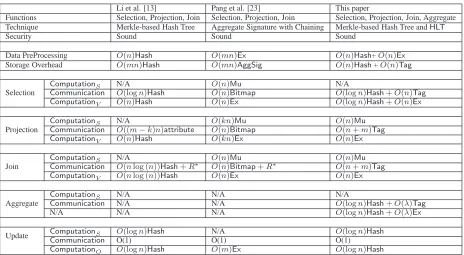
We compare the asymptotic performance of our solution with that of the two state-of-the-art solutions [13, 23]. As shown in Ta-ble 2, our solution is more expressive because it additionally sup-ports aggregate queries, such as: “select SUM(A2) fromRwhere
A1> a." Moreover, our solution allows the join query with respect to arbitrary attributes, such as: “selectR.∗, P.∗fromR, P where
R.A3 =P.B4" without requiring thatR.A3andP.B4 be search keys. Whereas, this type of join queries cannot be handled by the state-of-the-art solutions [13, 23].
Regarding pre-processing the database before outsourcing it to the cloud, our solution is more efficient than [23], and as efficient as [13]. In addition, our solution incurs the least extra storage com-plexity. To see this, we compare the three solutions with parame-ters in Table 1. Figure 2(a) shows that our solution is storage-space more efficient than [13, 23] as long as the number of attributes is greater thanTag/Hash, which is often the case. Moreover, from Figure 2(b) we can see that the storage-space requirement in our solution is independent of the number of attributes; in contrast, the storage-space complexity of [13, 23] increases linearly with respect to the number of attributes.
Li et al. [13] Pang et al. [23] This paper
Functions Selection, Projection, Join Selection, Projection, Join Selection, Projection, Join, Aggregate Technique Merkle-based Hash Tree Aggregate Signature with Chaining Merkle-based Hash Tree andHLT
Security Sound Sound Sound
Data PreProcessing O(n)Hash O(mn)Ex O(n)Hash+O(n)Ex
Storage Overhead O(mn)Hash O(mn)AggSig O(n)Hash+O(n)Tag
Selection
ComputationS N/A O(n)Mu N/A
Communication O(logn)Hash O(n)Bitmap O(logn)Hash+O(n)Tag ComputationV O(n)Hash O(n)Ex O(logn)Hash+O(n)Ex
Projection
ComputationS N/A O(kn)Mu O(n)Mu
Communication O((m−k)n)attribute O(n)Bitmap O(n+m)Tag ComputationV O(n)Hash O(kn)Ex O(n)Ex
Join
ComputationS N/A O(n)Mu O(n)Mu Communication O(nlog (n))Hash+R∗ O(n)Bitmap+R∗ O(n+m)Tag ComputationV O(nlog (n))Hash O(n)Ex O(n)Ex
Aggregate
ComputationS N/A N/A N/A
Communication N/A N/A O(logn)Hash+O(λ)Tag
N/A N/A N/A O(logn)Hash+O(λ)Ex
Update ComputationS O(logn)Hash N/A O(logn)Hash
Communication O(1) O(1) O(1)
ComputationO O(logn)Hash O(m)Ex O(logn)Hash
Table 2: Comparison of asymptotic performance, whereHashis 160 bits,Sigis 1024 bits,AggSig= 160 bits,Tag= 792 bits,Bitmap
is a small constant,Exdenotes modular exponentiation,Mudenotes modular multiplicationPairingdenotes pairing operation,kis the number of attributes in projection query,attributeis an attribute value inR,R∗denotes unmatched tuples inR, and assume |R|=|P|=nin join query. Note that our solution supports aggregate queries and more flexible join queries, and we do not count the basic search operation in the comparison.
0 0.5 1 1.5 2 2.5 3
x 105
0 1 2 3 4 5 6x 10
7
# of tuples
Storage overhead (byte)
Pang et al. Ours Li.et al.
(a)m= 10
6 7 8 9 10 11 12 13
3 4 5 6 7 8 9x 10
6
# of attributes
Storage overhead (byte)
Pang et al. Ours Li.et al.
(b)n= 215
Figure 2: Comparison of storage overhead
HashplusO(n)Ex,O(n)Ex, andO(n)Exat the querier side in or-der to aggregateHLTtags. However, our solution still outperforms [23], which incurs respective computational complexityO(n)Ex,
O(kn)Ex, andO(n)Exon bilinear group.
Regarding projection queries and join queries, our solutions re-quiresO(n+m)tags. In contrast, [13] requiresO((m−k)n)
attribute values for projection queries, andO(nlogn)hash values plus those unmatched tuples inRfor join queries. Although [23] only requiresO(n)certified bitmap (recording updated tuples in on update period) for projection queries, it requires at leastO(n) cer-tified bitmap plus those unmatched tuples inRfor join queries. It is due to the fact that [13, 23] have to fetch at least one table (either
RorP) for join queries.
Regarding aggregate queries, the computational and communi-cation complexities are the same regardless of the number of at-tributes the querier wants to aggregate. For example, our solution incurs the same complexity for queries such as: “select SUM(A1),
. . ., SUM(Ak) fromRwhereA1 > aandA1 < b" and “select SUM(A1)fromRwhereA1> aandA1< b".
6.
INTEGRATE QUERY INTEGRITY AND
STORAGE INTEGRITY
The accompanying concept to query integrity is storage integrity, namely the assurance that the outsourced data is kept intact in the cloud. Elegant solutions to storage integrity include Provable Data Possession (PDP) [2] and Proof of Retrievability (POR) [12]. In particular, PDP can achieve constant computational and communi-cation complexities in the static setting [2], and logarithmic com-putational and communication complexities in the dynamic setting [8].
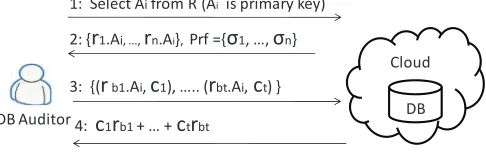
A systematic solution should assure both query complexity and storage complexity. Intuitively, query integrity is more demand-ing than storage integrity because storage integrity does not have to deal with the structure of database. However, one cannot simply adapt PDP/POR techniques to the setting of outsourced database because they deal with unstructured data. In what follows, we sketch a solution that integrates PDP-flavor storage integrity with respect to the logical structure of the outsourced database (rather than the physical structure of the database). The solution is not optimal because it incurs communication complexity ofO(n)tags and computational complexity ofO(n)exponentiations. We defer a detailed analysis of the following solution to an expanded version of this paper.
DBAuditor
Cloud
DB 1: SelectAifromR(Aiisprimarykey)
2:{
r
1.Ai,…,r
n.Ai}, Prf ={!
1,…,!
n}3: {(
r
b1.Ai,c
1),…..(r
bt.Ai,c
t)}4:
c
1r
b1+…+c
tr
btFigure 3: Procedures to ensure storage integrity
and verifies integrity of all primary keys (IDs) inRand their tags, which is showed in Steps 1 and 2. Then the auditor randomly se-lectstprimary IDs from the set of IDs andtcoefficients, denoted by(rb1.Ai, c1), . . . ,(rbt.Ai, ct), and asks the server to compute
an aggregate tupler =Pt
i=1cirbi. Supposeσis the aggregated
tag ofσb1, . . . , σbtwith coefficientsc1, . . . , ct, the auditor can
ver-ify storage integrity by runningΛHLT.Vrfy(ΛHLT.pk, r, σ). If the
output is 1, the storage assurance can be guaranteed with(1−f)t confidence, wherefis the fraction of the corrupted tuples.
7.
CONCLUSION
We presented an efficient solution to the problem of query tegrity in the setting of outsourced dynamic databases. Query in-tegrity allows a querier, the data owner or a third party, to verify that its queries were faithfully executed by the cloud server. Com-pared with the state-of-the-art solutions, our solution is: (i) more powerful by additionally supporting aggregate queries (in addition to selection, projection, and join queries), and (ii) more efficient by eliminating a logarithmic (or even linear) multiplication factor from the overall cost (depending on the type of the queries).
Our solution still incurs linear complexity. A notable direction for future research is to address the following open problem: Can we attain query integrity logarithmic (or constant) complexity as in the case of assuring storage integrity?
Acknowledgement
Qingji Zheng and Shouhuai Xu were supported in part by an AFOSR MURI grant and a NSF grant. Giuseppe Ateniese was supported in part by a Google Research Award and an IBM Faculty Award.
8.
REFERENCES
[1] B. Applebaum, Y. Ishai, and E. Kushilevitz. From secrecy to soundness: Efficient verification via secure computation. In S. Abramsky, C. Gavoille, C. Kirchner, F. Meyer auf der Heide, and P. Spirakis, editors, Automata, Languages and Programming, volume 6198 of Lecture Notes in Computer Science, pages 152–163. Springer Berlin / Heidelberg, 2010. 10.1007/978-3-642-14165-2_14.
[2] G. Ateniese, R. Burns, R. Curtmola, J. Herring, L. Kissner, Z. Peterson, and D. Song. Provable data possession at untrusted stores. In Proceedings of the 14th ACM conference on Computer and communications security, CCS ’07, pages 598–609, New York, NY, USA, 2007. ACM.
[3] G. Ateniese, S. Kamara, and J. Katz. Proofs of storage from homomorphic identification protocols. In Proceedings of the 15th International Conference on the Theory and
Application of Cryptology and Information Security: Advances in Cryptology, ASIACRYPT ’09, pages 319–333, Berlin, Heidelberg, 2009. Springer-Verlag.
[4] M. Bellare and G. Neven. Multi-signatures in the plain public-key model and a general forking lemma. In ACM Conference on Computer and Communications Security, pages 390–399, 2006.
[5] D. Boneh, C. Gentry, B. Lynn, and H. Shacham. Aggregate and verifiably encrypted signatures from bilinear maps. In Proceedings of the 22nd international conference on Theory and applications of cryptographic techniques,
EUROCRYPT’03, pages 416–432, Berlin, Heidelberg, 2003. Springer-Verlag.
[6] K.-M. Chung, Y. Kalai, and S. Vadhan. Improved delegation of computation using fully homomorphic encryption. In Proceedings of the 30th annual conference on Advances in cryptology, CRYPTO’10, pages 483–501, Berlin,
Heidelberg, 2010. Springer-Verlag.
[7] P. Devanbu, M. Gertz, C. Martel, and S. G. Stubblebine. Authentic data publication over the internet. J. Comput. Secur., 11(3):291–314, Apr. 2003.
[8] C. Erway, A. Küpçü, C. Papamanthou, and R. Tamassia. Dynamic provable data possession. In Proceedings of the 16th ACM conference on Computer and communications security, CCS ’09, pages 213–222, New York, NY, USA, 2009. ACM.
[9] A. Fiat. Batch rsa. In Proceedings on Advances in cryptology, CRYPTO ’89, pages 175–185, New York, NY, USA, 1989. Springer-Verlag New York, Inc.
[10] R. Gennaro, C. Gentry, and B. Parno. Non-interactive verifiable computing: outsourcing computation to untrusted workers. In Proceedings of the 30th annual conference on Advances in cryptology, CRYPTO’10, pages 465–482, Berlin, Heidelberg, 2010. Springer-Verlag.
[11] M. Goodrich, R. Tamassia, and N. Triandopoulos.
Super-efficient verification of dynamic outsourced databases. In T. Malkin, editor, Topics in Cryptology ´lC CT-RSA 2008, volume 4964 of Lecture Notes in Computer Science, pages 407–424. Springer Berlin / Heidelberg, 2008.
[12] A. Juels and B. S. Kaliski, Jr. Pors: proofs of retrievability for large files. In Proceedings of the 14th ACM conference on Computer and communications security, CCS ’07, pages 584–597, New York, NY, USA, 2007. ACM.
[13] F. Li, M. Hadjieleftheriou, G. Kollios, and L. Reyzin. Dynamic authenticated index structures for outsourced databases. In Proceedings of the 2006 ACM SIGMOD international conference on Management of data, SIGMOD ’06, pages 121–132, New York, NY, USA, 2006. ACM. [14] F. Li, M. Hadjieleftheriou, G. Kollios, and L. Reyzin.
Authenticated index structures for aggregation queries. ACM Trans. Inf. Syst. Secur., 13(4):32:1–32:35, Dec. 2010. [15] R. C. Merkle. A certified digital signature. In Proceedings on
Advances in cryptology, CRYPTO ’89, pages 218–238, New York, NY, USA, 1989. Springer-Verlag New York, Inc. [16] K. Mouratidis, D. Sacharidis, and H. Pang. Partially
materialized digest scheme: an efficient verification method for outsourced databases. The VLDB Journal,
18(1):363–381, Jan. 2009.
[17] E. Mykletun, M. Narasimha, and G. Tsudik. Providing authentication and integrity in outsourced databases using merkley hash trees. In UCI-SCONCE Technical Report. [18] E. Mykletun, M. Narasimha, and G. Tsudik. Authentication
and integrity in outsourced databases. Trans. Storage, 2(2):107–138, May 2006.
databases using signature aggregation and chaining. In Proceedings of the 11th international conference on Database Systems for Advanced Applications, DASFAA’06, pages 420–436, Berlin, Heidelberg, 2006. Springer-Verlag. [20] G. Nuckolls. Verified query results from hybrid
authentication trees. In Proceedings of the 19th annual IFIP WG 11.3 working conference on Data and Applications Security, DBSec’05, pages 84–98, Berlin, Heidelberg, 2005. Springer-Verlag.
[21] B. Palazzi, M. Pizzonia, and S. Pucacco. Query racing: fast completeness certification of query results. In Proceedings of the 24th annual IFIP WG 11.3 working conference on Data and applications security and privacy, DBSec’10, pages 177–192, Berlin, Heidelberg, 2010. Springer-Verlag. [22] H. Pang, A. Jain, K. Ramamritham, and K.-L. Tan. Verifying
completeness of relational query results in data publishing. In Proceedings of the 2005 ACM SIGMOD international conference on Management of data, SIGMOD ’05, pages 407–418, New York, NY, USA, 2005. ACM.
[23] H. Pang, J. Zhang, and K. Mouratidis. Scalable verification for outsourced dynamic databases. Proc. VLDB Endow., 2(1):802–813, Aug. 2009.
[24] C. Papamanthou, R. Tamassia, and N. Triandopoulos. Authenticated hash tables. In Proceedings of the 15th ACM conference on Computer and communications security, CCS ’08, pages 437–448, New York, NY, USA, 2008. ACM. [25] C. Papamanthou, R. Tamassia, and N. Triandopoulos.
Optimal verification of operations on dynamic sets. In P. Rogaway, editor, Advances in Cryptology ´lC CRYPTO 2011, volume 6841 of Lecture Notes in Computer Science, pages 91–110. Springer Berlin / Heidelberg, 2011.
[26] H. Shacham and B. Waters. Compact proofs of retrievability. In Proceedings of the 14th International Conference on the Theory and Application of Cryptology and Information Security: Advances in Cryptology, ASIACRYPT ’08, pages 90–107, Berlin, Heidelberg, 2008. Springer-Verlag. [27] R. Tamassia and N. Triandopoulos. Certification and
authentication of data structures. In AMW, 2010.
[28] M. Xie, H. Wang, J. Yin, and X. Meng. Integrity auditing of outsourced data. In Proceedings of the 33rd international conference on Very large data bases, VLDB ’07, pages 782–793. VLDB Endowment, 2007.
[29] J. XU and E.-C. CHANG. Authenticating aggregate range queries over multidimensional dataset. Cryptology ePrint Archive, Report 2010/050, 2010.
http://eprint.iacr.org/.
[30] Y. Yang, D. Papadias, S. Papadopoulos, and P. Kalnis. Authenticated join processing in outsourced databases. In Proceedings of the 35th SIGMOD international conference on Management of data, SIGMOD ’09, pages 5–18, New York, NY, USA, 2009. ACM.
[31] Y. Yang, S. Papadopoulos, D. Papadias, and G. Kollios. Spatial outsourcing for location-based services. In
Proceedings of the 2008 IEEE 24th International Conference on Data Engineering, ICDE ’08, pages 1082–1091,