ISSN (Print) : 2320 – 3765 ISSN (Online): 2278 – 8875
I
nternational
J
ournal of
A
dvanced
R
esearch in
E
lectrical,
E
lectronics and
I
nstrumentation
E
ngineering
(An ISO 3297: 2007 Certified Organization) Website: www.ijareeie.com
Vol. 6, Issue 5, May 2017
ANFIS Tuning for Optimization of Two Area
Automatic Generation Control Power System
Geoffrey Eappen 1, Lokesh verma2
Assistant Professor, Dept. of ECE, Mats University, Arang, Chhattisgarh, India1
PG Student [Power Electronics], Dept. of ECE, Mats University, Arang, Chhattisgarh India2
ABSTRACT: In order to stabilize power system for long period of time system needs a special kind of Technique which maintains its accessibility for normal as well as abnormal both condition[1]. For fulfil all demands of any kind of system, the power system needs highly accurate and reliable technique to frame such kind of Rules to achieve these demands. In case of Automatic Generation Control Power system the maintenance of two parameters needed for achieves desired output; one is to maintain frequency deviation in certain nominal value and second is to maintain Tie Line Power deviation to its nominal values [5]. These nominal values of system parameters maintain constant speed of system as well as reliable exchange of power between different Areas. Thus in this paper we presents Tuning of Two Area Power System with Adaptive neuro Fuzzy Interface System (ANFIS) method connected with PID Controller which is very reliable, and Accurate for getting demand of supply needs. The method used basics of signal process model analysis and based on the condition of system it generates its design rule for achieving system requirement.
KEYWORDS: Automatic Control System, ANFIS PID Controller.
I.INTRODUCTION
The Two Area Power system depends for their stability on two kind of thing one is to change of frequency deviation and second is to change in tie line power deviation. The change in frequency deviation manages constant speed of the system with change of load of system with certain range, whereas the tie line power manages exchange of the power within the desired limit between two areas of power system. The major purpose of the power system to maintain regular supply of the power in load with in nominal range, to achieve these there must exists equality between generation and demand of the system [3]. In this paper we present the concept of ANFIS tuning in order to achieve our demands needs for supply, for that rule generation, membership functions of both the areas are described on this paper. Also the concept of the PID controller is used in power system for getting required output to the systems; system with having PID controller needs tuning algorithm to getting its parameter values in order to get required stable output. These parameter values found by trained data structure of ANFIS tuning algorithm [2].
A. Automatic Generation Control:-
Automatic Generation Control is the kind of system that have intended for any system to regulating the power
system (used by both primary and secondary controls). Automatic Load Frequency control (ALFC) is a scheme used for maintaining the deviation in the frequency constant in the case of the abrupt change in the load of the power system for maintaining real power balance of the system [6].
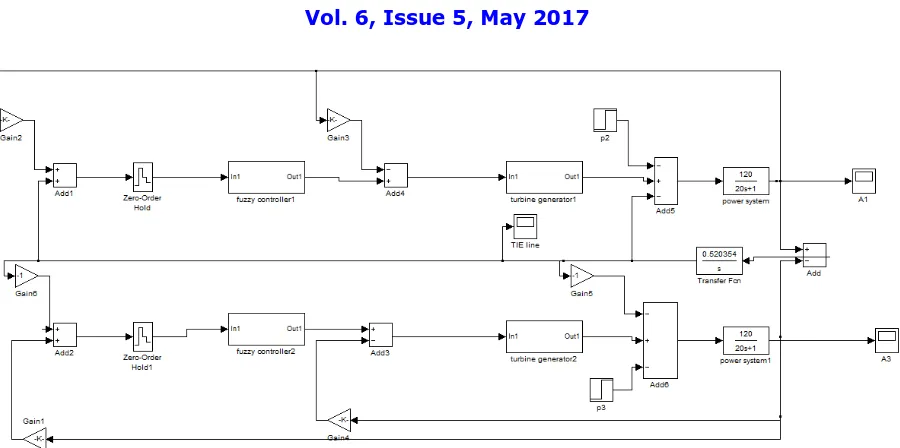
Fig1: Block diagram representation of AGC system
B. Basics of Fuzzy Logic:-
The system that deals with simultaneous handling of linguistic knowledge and numerical data is known as
fuzzy logic system. These system deals with nonlinear formation of the input data (feature) vector into the scalar Output [5]. Fuzzy logic and Fuzzy set theory established the nonlinear specifications of all kind systems.
Fuzzy logic is a kind of control scheme for different system much closer to the spirit of human thinking and natural language than the traditional logic systems. Actually this logic deals with effective means of capturing the approximate, inexact nature of the real world. Basis of this concept, the important part of the fuzzy logic controller (FLC) is a set of logical control rules connected to the dual nature of fuzzy implication and the compositional rule of illation [5]. On concluding way, the FLC sets an algorithm that can convert the linguistic control strategy on the basis of expert know- ledge into an automatic control strategy.
C. Concepts of ANFIS Controller
The ANFIS controller is uses scheme of expert information associated with system modelling process and their analysis. It has a trained data algorithm, based on which it generate kind of rules which helps for getting desired output for system [2]. This algorithm also having a tuning scheme for which it helps to figure out the parameter values of its associated controller, hence in modern’s days it attract to many scholars.
ISSN (Print) : 2320 – 3765 ISSN (Online): 2278 – 8875
I
nternational
J
ournal of
A
dvanced
R
esearch in
E
lectrical,
E
lectronics and
I
nstrumentation
E
ngineering
(An ISO 3297: 2007 Certified Organization) Website: www.ijareeie.com
Vol. 6, Issue 5, May 2017
II.METHODOLOGY
An Adaptive neuro-fuzzy interface system is a proposed hybrid version method for adaptive neural network with fuzzy interface system hence it shows some special specification for design rule of fuzzy 5it is having both the features of neural network as well as fuzzy logic. In the study point of AGC system ANFIS method uses system input and error of system as two input variables for fuzzy controller.
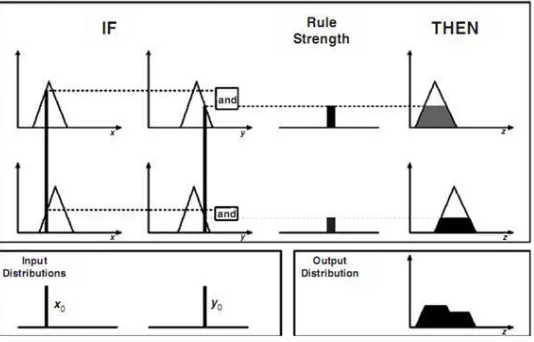
In the initialization stage fuzzy logic controller uses mamdani Membership function with certain rules assign with ANFIS structure, mamdani membership function formed rules with certain ways explain as follows:-
If (input 1 is having membership function 1) and/or (input2 is having membership function 2) then (outputn is
having membership functionn).
Fig 2 A two inputs,two rule mamdani FIS with crisp inputs
For example, a rule is make up that says- if temperature is low and humidity is low then room is cool. So here we have membership functions that define by low temperature (input1), low humidity (Input 2 ) and cool room (output1) [9]. Taking temperature as an input known to be process of fuzzification, and defining “and”/ “or” by means of fuzzy rules is known as combination of fuzzy. Rules for the mamdani membership function in ANFIS modeling are easy and understand -able for learning of process model. due to its human friendly behavior most of times it uses in the systems as compare to sugeno fuzzy membership functions, which needs computational nature in order to designing system model designing and rules creation[9].
A. Area control error
On the AGC control method each area attempts to maintain its area control error (ACE) must be zero of the interconnected system. as this error used to create area control error function such as [3] :-
ACE i = BiΔfi + ΔP tie-i-error (1)
This function expressed Bi as frequency bias factor and Δfi expressed frequency deviation for ith area and the last
Fig3 Block diagram of two area power system for LFC
B. Fuzzy PID controller Tuned with ANFIS
The ANFIS system determines its parameter values basis of fuzzy rule created by mamdani membership function with the use of training data set, which is known to be adaptive technique. In the case of ANFIS tuning hybrid learning algorithm applied which is most important features, and thus by two ways parameter adaption is carried out first is least square method for linear combination of inputs and the parameter fixing at desired stage is the second one[8]. After the resultant parameters adjustments, the approximated errors are again flows through every layer for updating the previous parameters in the second step.
Fig 5 Typical layer Architecture of ANFIS system
ISSN (Print) : 2320 – 3765 ISSN (Online): 2278 – 8875
I
nternational
J
ournal of
A
dvanced
R
esearch in
E
lectrical,
E
lectronics and
I
nstrumentation
E
ngineering
(An ISO 3297: 2007 Certified Organization) Website: www.ijareeie.com
Vol. 6, Issue 5, May 2017
Construction of the ANFIS controller is normally occurred on the parallel structure in order to improving reliability of the controller with the concept of error minimization approach. Hence multi area system gets stability very easily, and trained data structure makes evaluation for desired output at nominal values.
C.Layer structure of ANFIS system
On the Architecture figure of the ANFIS system shows two types of nodes circular node and the squared node in that case circular is fixed node and squared is adaptive one. For understanding architecture of ANFIS here two inputs x,y and one output f is considered. As per high calculation and interpretability efficiency, mamdani fuzzy model is broadly executable also it has optimal built and adaptive method [8]. The layer nature of ANFIS structure is explained in below as:-
Layer 1: layer 1 having each node in adaptive form and each node output shows membership degree of the input for fuzzy membership function (MF) described by node 1 to 5.node function in that paper is generalized bell membership function.
Oi1 = µAi(e), i=1 ,5 . (2.1)
Oi1 = µBi 5(e), i=6,10. (2.2)
Oi1expressed output of the ith node, Ai, Bi is the parameter form of fuzzy set, and x is the input of ith node.
Layer 2: this layer has 25 rules and each node output expressed activation level rules for the system.
Oi2 = wi =µAi(e) µBi(è), i=1……5 (3)
Layer 3: layer 3 is a kind of computation layer which expressed the ratio of ith rules activation level to the all activation
level for the fixed node i, so that this layer expressed the normalized firing strengths.
Oi3 = wi = wi Ʃi=1to n wi (4)
Layer 4: adaptive node calculation for the ith layer is contribution for ith rule towards all output, with having node
function expressed as:
Oi4 = wifi =wi (pix + qiy + ri)=wi(pie+ qiè+ ri) (5)
where wi is the output of the layer3, and (pi qi ri) are the resultant parameters
Layer 5: single node in this layer calculates overall output of all incoming signals expressed in summation form as follows:-
Oi5 = Ʃi=1 to n wifi = Ʃi=1to n wifi = Ʃi=1to nwi (6)
The learning rule for ANFIS structure is known to be back propagation gradient descendent, that calculates error signals from output layer segment via input nodes. With the help of modified parameters the ANFIS structure learning method is obtained. Hence overall output response is a linear combination of the modified parameters.
III. WORKING OF THE FUZZY LOGIC
Working process of the fuzzy logic is categorized in 3 parts area allocation of the inputs, rules associated with inputs & output defuzzification [3].
A.Area Allocation of inputs:-
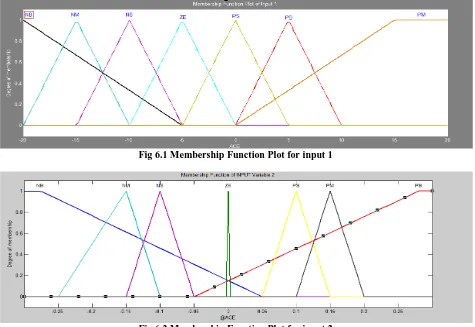
ANFIS rule base system, these are Negative Big, Negative Medium, Negative Small, Zero Error, Positive Big, Positive Medium, Positive Small. Here fig 6.1 and 6.2 express input functions of the fuzzy logic controller.
Fig 6.1 Membership Function Plot for input 1
Fig 6.2 Membership Function Plot for input 2
B. Rules Associated With the Inputs
Rules Associated for the fuzzy logic controller are expressed by fuzzy rule table As shown in the fig 7(a) the logical calculation expressed by “minmax” rule for “AND” and “OR” respectively. This is helpful for reduce calculation complexity and time consuming.
{Here NB=Negative Small, NM=Negative Medium, NS=Negative Small, ZE=Zero Error, PS=Positive Small, PM=Positive
ISSN (Print) : 2320 – 3765 ISSN (Online): 2278 – 8875
I
nternational
J
ournal of
A
dvanced
R
esearch in
E
lectrical,
E
lectronics and
I
nstrumentation
E
ngineering
(An ISO 3297: 2007 Certified Organization) Website: www.ijareeie.com
Vol. 6, Issue 5, May 2017
C. Defuzzification of the Output Variable:-
The defuzzification of the output variable is as shown in fig 7(b). here method of “centroid” is used for defuzzification. For output we used centre of two inputs.
Fig 7(b) Membership Function plot for Output
IV. RESULTS OF SIMULATION
Here the Result of the Simulation shows comparison of the conventional PID controller with ANFIS Tuned PID controller.
A.Comparison of ANFIS Tuned PID with Conventional PID Controller for two area power system.
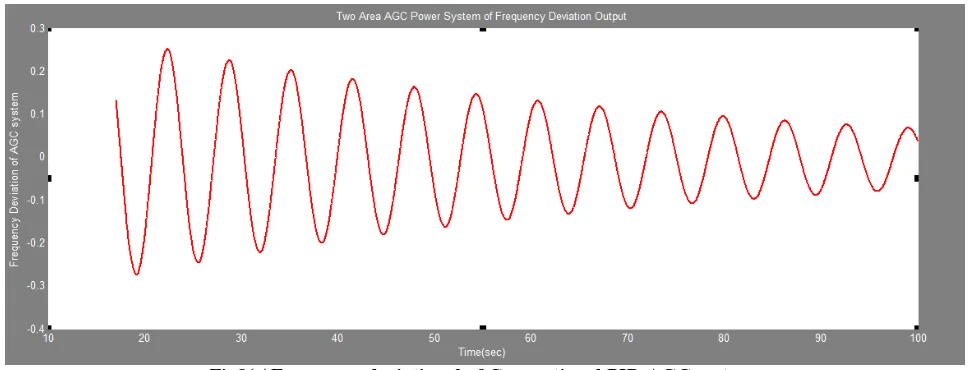
At first simulation is done on conventional PID Controller and the Result obtained by this test system is follows:-
Fig8(a)Frequency deviational of Conventional PID AGC system
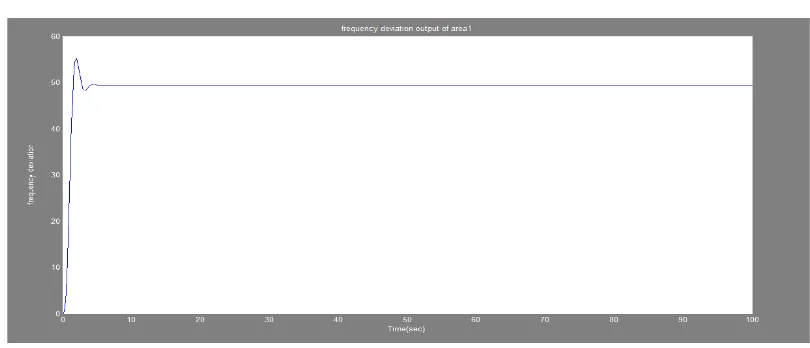
Fig 8(b) Frequency deviation Output of ANFIS Tuned AGC System
B.Comparison of Tie Line power deviation of two areas Power System.
Tie Line deviation of Conventional PID controller as shown below
Fig 8(c)Tie line deviation of conventional PID two areas AGC system
Tie line deviation obtained by two area ANFIS Tuned automatic generation control system shown below
ISSN (Print) : 2320 – 3765 ISSN (Online): 2278 – 8875
I
nternational
J
ournal of
A
dvanced
R
esearch in
E
lectrical,
E
lectronics and
I
nstrumentation
E
ngineering
(An ISO 3297: 2007 Certified Organization) Website: www.ijareeie.com
Vol. 6, Issue 5, May 2017
From the respective both the system output it is seen that AN FIS tuned PID controller gives better dynamic output result as compare to conventional one output hence the ANFIS tuned system having improved results in both the cases tie line and frequency deviation also.
V. CONCLUSION
Hence it has been realized from this paper that optimization to the stability of two area power system to its desired level achieved with different algorithm but among all of them ANFIS tuning is very reliable and convenient one which gives fast output with acquired range as we needed. Also it shows superior behaviour in the sense of complexity of the system due to the trained data set of the parameter with having structured layer architecture from the shown result it has been also find that it has capable in both normal and abnormal condition. Since PID controller handled the system for critical condition is quit reliable as compare to manually tuning of parameter by trial and error method.
Thus fuzzy PID controller with ANFIS algorithm proposed to improves trajectory tracking performance of two area power system. The stability and dynamic response of ANFIS tuned system compare with conventional PID shows good quality output. So from the given observational ANFIS tuning has improved consequences for the control of two area power systems with having convenient strategies. Here adaptive neural learning method used for information collection about to data sets of ANFIS based fuzzy modeling, so that ANFIS method makes fuzzy logic for computation of membership functions parameters that allows in best way to relate input and output data set. ANFIS shows in the sense of the analysis with having reduced nature of the settling time as well as steady state error for the system, so overall the final conclude of this paper expressed that ANFIS provide superior characteristics in terms of comparison of the conventional PID controller power system.
REFERENCES
[1] Pretty Neelam Topno, Saurabh Chanana on “Automatic Generation Control using OptimallyTuned Tilt Integral Derivative Controller” IEEE First International Conference on Control, Measurement and Instrumentation (CMI) pp 207-209 Jan 2016.
[2] Mazin I. AL-Saedi, Huapeng Wu, and Heikki Handroos on “ANFIS and Fuzzy Tuning of PID Controller for Trajectory Tracking of a Flexible Hydraulically Driven Parallel Robot Machine” Journal of Automation and Control Engineering, Vol. 1, No. 2, pp 72-75 June 2013.
[3] Prashant kumar sharma1, Mr.Geoffrey eappen on“Optimi-zation of Automatic Generation Control Scheme With Pso Tuned Fuzzy Pid Controller And Comparision With Conven-tional Pso Pid Controller” IOSR Journal of Electrical and Electronics Engineering (IOSR-JEEE) , Volume 11, Issue 1 Ver. III,PP 01-09,(Jan.– Feb. 2016).
[4] Sanjoy Debbarma, Lalit Chandra Saikia on “Effect of Fractional-Order Controller on Automatic Generation Control of a Multi-Area Thermal System” published on Chennai and Dr.MGR University Second International Conference on Sustainable Energy and Intelligent System (SEISCON) 20-22 July 2011.
[5] V.Mary Sumalatha V.Mary SumalathaV.Mary Sumalatha on “Fuzzy Inference System to Control PC Power Failures” publised by International Journal of Computer Applications Volume 28 No.4,pp 11-13 August 2011.
[6] Geoffrey Eappen and Dr.Sandeep Bhongade thesis on “optimized automatic generation control scheme including SMES in an Inter connected Power System” published by Electrical and Electronics Engineering: An International Journal (ELELIJ) Vol 2, No 3,pp 30-33 August 2013. [7] Mohamed I. Mosaada, Fawzan Salem paper on “LFC based adaptive PID controller using ANN and ANFIS techniques” Journal of Electrical
Systems and Information Technology pp 215-218 on December 2014.
[8] YuKang Liu, YuMing Zhang paper on “Adaptive Predictive ANFIS Based Human Arm Movement Modelling and Control in Machine-Human Cooperative GTAW Process” IEEE International Conference on Automation Science and Engineering pp 1465-1466 August 2015.
[9] Binod Kumar Sahu, Tridipta Kumar Pati, Jyoti Ranjan Nayak paper on “Fuzzy PID controller for load frequency control of multi source power system” International Conference on Circuit Power and Computing Technology Vol 27 pp 243-246 Feb 2015.
[10]Yagnita P. Parmar , Pimal R. Gandhi paper on “Automatic Generation Control of Two Area using Fuzzy Logic Controller” International Journal of Engineering Research and Development (IJERD) pp 76-80 April 2015.
[11] Gholamreza Khodamipour, Mahdi Yaghoobi paper on “A New Approach to Optimal ANFIS Controller on Manipulator robots” Second International Congress on Technology, Communication and Knowledge(ICTCK) pp 9-11 November 2015.
[12]S. Bhongade, Geoffery Eppen on “Coordination control scheme by SSSC and TCPS with red ox flow battery for optimized automatic
generation control” International Conference onRenewable Energy and Sustainable Energy (ICRESE) pp 106-109 on oct 2014.