A preliminary version of this paper appears in the proceedings of Eurocrypt 2013. This is the full version.
Message-Locked Encryption and Secure Deduplication
Mihir Bellare1 Sriram Keelveedhi2 Thomas Ristenpart3
March 2013
Abstract
We formalize a new cryptographic primitive, Message-Locked Encryption (MLE), where the key under which encryption and decryption are performed is itself derived from the message. MLE provides a way to achieve secure deduplication (space-efficient secure outsourced storage), a goal currently targeted by numerous cloud-storage providers. We provide definitions both for privacy and for a form of integrity that we call tag consistency. Based on this foundation, we make both practical and theoretical contributions. On the practical side, we provide ROM security analyses of a natural family of MLE schemes that includes deployed schemes. On the theoretical side the challenge is standard model solutions, and we make connections with deterministic encryption, hash functions secure on correlated inputs and the sample-then-extract paradigm to deliver schemes under different assumptions and for different classes of message sources. Our work shows that MLE is a primitive of both practical and theoretical interest.
1 Department of Computer Science & Engineering, University of California San Diego, 9500 Gilman Drive, La Jolla,
California 92093, USA. Email: [email protected]. URL:http://cseweb.ucsd.edu/~mihir/. Supported in part by NSF grants CNS-0904380, CCF-0915675 and CNS-1116800.
2 Department of Computer Science & Engineering, University of California San Diego, 9500 Gilman Drive, La Jolla,
California 92093, USA. Email: [email protected]. URL:http://cseweb.ucsd.edu/~skeelvee/. Supported in part by Bellare’s grants.
3
Contents
1 Introduction 3
1.1 Background . . . 3
1.2 Definitions and Relations . . . 4
1.3 Practical Contributions . . . 5
1.4 Theoretical Contributions . . . 5
1.5 Further Remarks and Related Work . . . 7
2 Preliminaries 7 3 Message-Locked Encryption 8 4 Practical Contributions: The Security of Fast MLE Schemes 11 5 Theoretical Contributions: Constructions without ROs 13 5.1 Extract-Hash-Check . . . 13
5.2 Sample-Extract-Encrypt . . . 15
A Relations Between MLE Privacy Notions 19
B Proof of PRV$-CDA for CE, HCE1, HCE2, RCE 22 C Instantiations and Performance of CE, HCE2, and RCE 25
D Proof of Theorem 5.1 26
1
Introduction
We introduce an intriguing new primitive that we call Message-Locked Encryption (MLE). An MLE scheme is a symmetric encryption scheme in which the key used for encryption and decryption is itself derived from the message. Instances of this primitive are seeing widespread deployment and application for the purpose of secure deduplication [1, 2, 4, 5, 7, 8, 10, 22, 23, 35, 37, 41, 45, 49], but in the absence of a theoretical treatment, we have no precise indication of what these methods do or do not accomplish.
We provide definitions of privacy and integrity peculiar to this domain. Now having created a clear, strong target for designs, we make contributions that may broadly be divided into two parts: (1) practical and (2) theoretical. In the first category we analyze existing schemes and new variants, breaking some and justifying others with proofs in the random-oracle-model (ROM) [16]. In the second category we address the challenging question of finding a standard-model MLE scheme, making connections with de-terministic public-key encryption [11], correlated-input-secure hash functions [29] and locally-computable extractors [9, 36, 46] to provide schemes exhibiting different trade-offs between assumptions made and the message distributions for which security is proven. From our treatment MLE emerges as a primitive that combines practical impact with theoretical depth and challenges, making it well worthy of further study and a place in the cryptographic pantheon. Below we begin with some background and then look more closely at our contributions.
1.1 Background
To save space, commercial cloud storage services such as Google Drive [6], Dropbox [3] and bitcasa [1] perform file-level deduplication across all their users. Say a user Alice stores a file M and Bob requests to store the same fileM. Observing thatM is already stored, the server, instead of storing a second copy of M, simply updates metadata associated toM to indicate that Bob and Alice both stored M. In this way, no file is stored more than once, moving storage costs for a file stored by u users fromO(u· |M|) to
O(u+|M|) where the big-O notation hides implementation-dependent constants.
However, as users we may want our files to be encrypted. We may not want the storage provider to see our data. Even if we did trust the provider, we may legitimately worry about errant employees or the risk of server compromise by an external adversary. When users themselves are corporations outsourcing their data storage, policy or government regulation may mandate encryption.
Conventional encryption, however, makes deduplication impossible. Say Alice stores not her file M
but its encryption CA under her password pwA. Bob would store CB, the encryption of M under his
password pwB. Two issues arise: (1) how the server is to detect that the data underlying the two ciphertexts is the same, and (2) even if it can so detect, what can it store short of (CA, CB) that allows
both parties, based on their separate respective passwords, to recover the data from what is stored. Standard IND-CPA encryption means even (1) is not possible. We might use some kind of searchable encryption [11,20,44] but it is still not clear how to solve (2). Just storing Alice’s ciphertext, for example, does not work because Bob cannot later decrypt it to recover the file, and visa versa.
Douceur et. al. (DABST) [26] proposed a clever solution called convergent encryption (CE). Alice derives a key K = H(M) from her message M and then encrypts the message as C = E(K, M) =
E(H(M), M), where H is a cryptographic hash function and E is a block cipher. (They assume the message is one block long.) The ciphertext is given to the server and the user retainsK. Since encryption is deterministic, if Bob starts from the same message he would produce the same key and ciphertext. The server can now perform deduplication on the ciphertext C, checking, when it receives C, whether or not it is already stored, and, if the latter, as before, not re-storing but instead updating meta-data to indicate an additional owner. Both Alice and Bob can decrypt C since both have the same key K.
1.2 Definitions and Relations
We introduce Message-Locked Encryption (MLE) —so named because the message is locked, as it were, under itself— with the goal of providing an encryption primitive that provably enables secure deduplica-tion.
Syntax. As depicted in Figure 2, the key generation algorithm of an MLE scheme K maps a message
M to a key K. The encryption algorithm E takes input the key K and a message M and produces a ciphertext C. The decryption algorithm D allows recovery of M from C given the key K. The tagging algorithm T maps the ciphertextC to a tag T used by the server to detect duplicates. (Tag correctness requires that tags corresponding to messages M1, M2 are likely to be the same iffM1, M2 are the same.) All algorithms may depend on a parameterP but the latter is public and common to all parties including the adversary, and thus is not a key.
Any MLE scheme enables deduplication of ciphertexts. CE is captured by our syntax as the MLE scheme that lets K =H(M),C =E(K, M) and tag T =H(C).
MLE is trivially achieved by letting the key K equal the message M. (Set C = T = ε to the empty string and have decryption simply return the key.) This degenerate solution is however useless for deduplication since the client stores as K the entire file and no storage savings result. We rule it out by requiring that keys be shorter than messages, ideally keys are of a fixed, short length.
Privacy. No MLE scheme can achieve semantic-security-style privacy in the spirit of [13, 28]. Indeed, if the target messageM is drawn from a spaceSof sizesthen an adversary, given an encryptionCofM, can recover M inO(s) trials. (For each candidate M0 ∈S test whether D(K(M0), C) =M0 and if so return
M0.) As with deterministic public-key encryption [11], we therefore ask for the best possible privacy, namely semantic security when messages are unpredictable (have high min-entropy). Adapting definitions from [11, 12, 14, 21] we formalize a PRV-CDA notion where encryptions of two unpredictable messages should be indistinguishable. (“cda” stands for “chosen-distribution attack” [12].) We also formalize a stronger PRV$-CDAnotion where the encryption of an unpredictable message must be indistinguishable from a random string of the same length (cf. [43]).
These basic notions are for non-adaptive adversaries. The corresponding adaptive versions are
PRV-CDA-A and PRV$-CDA-A. We show that PRV-CDA does not imply PRV-CDA-A but, interest-ingly, thatPRV$-CDAdoes implyPRV$-CDA-A. (See the right hand side of Figure 1 for a comprehensive relations summary.) Thus PRV$-CDAemerges as the preferred target for designs because non-adaptive security is easier to prove yet adaptive security is implied.
Tag consistency. Suppose client Alice has a messageMA and client Bob has a different messageMB.
Alice is malicious and uploads not an honest encryption of MA but a maliciously-generated ciphertext
CA such that, when Bob tries to upload CB, the server sees a tag match T(CA) =T(CB). (This does
not contradict the correctness requirement that tags are usually equal iff the messages are equal because that holds for honestly-generated ciphertexts.) The server thus keeps only CA, deleting CB. Yet later,
when Bob downloads to get CA, the decryption is MA, not MB, meaning the integrity of his data has
been compromised.
1.3 Practical Contributions
The definitional framework outlined above puts us in a position to rigorously assess —a decade after its inception in [26]— the security of convergent encryption (CE). The task is complicated by the presence and deployment of numerous variants of the basic CE idea. We address this by formulating two MLE schemes, that we callCE andHCE1, that represent two major variants of CE and between them capture the prominent existing schemes. They each make use of a RO hash function H and a deterministic symmetric encryption scheme SE. CE with SE set to a blockcipher, for example, is the scheme of [26] and HCE1 with SEas a blockcipher in counter mode with fixed IV is used within the Tahoe FileSystem (TahoeFS) [49].
CE sets K = H(M), C = SE(K, M) and tag T = H(C), while HCE1 sets K = H(M), C =
SE(K, M)kH(K) and T = H(K). The rationale for HCE1 is to offer better performance for the server who can simply read the tag as the second part of the ciphertext rather than needing to compute it by hashing the possibly long ciphertext. But we observe thatHCE1is vulnerable to duplicate faking attacks, meaning it does not even achieve TC security. We discuss the implications for the security of TahoeFS in Section 4.
We ask whether performance gains of the type offered by HCE1 over CE can be obtained without loss in consistency, and offer as answers two new schemes, HCE2and RCE. The former is as efficient as
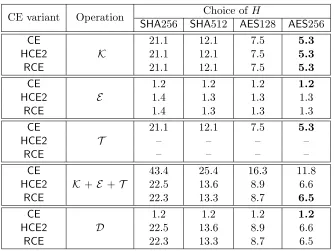
HCE1. RCE however is even more efficient, needing just one concerted pass over the data to generate the key, encrypt the message and produce the tag. On the other hand, HCE2 needs two passes, one pass to generate the key and a second for encryption, whileCE needs a third pass for producing the tag.
RCE achieves this via a novel use of randomization (all previous schemes were deterministic). Roughly (see Figure 4), encryption picks a fresh random key L and then computes SE(L, M) and K = H(M) in the same pass, finally placing an encryption of L under K, together with an appropriate tag, in the ciphertext. We have implemented all three schemes and the results (cf. Appendix C) show thatRCEdoes indeed outperform the other two.
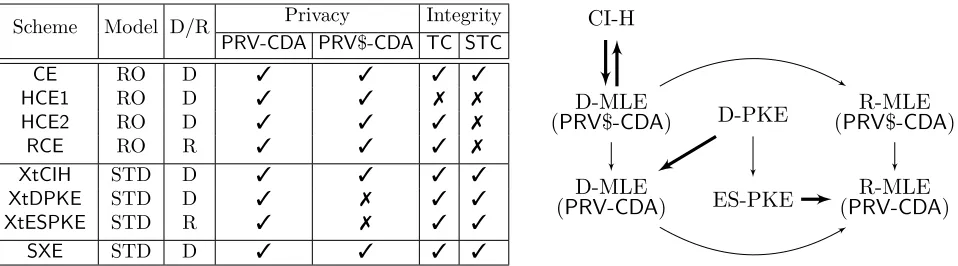
Figure 1 (table, first four rows) summarizes the findings of our security analysis of the four schemes. Under standard assumptions on the deterministic symmetric encryption scheme SE (one-time real-or-random ciphertext, or ROR, security as well as key-recovery security) and with H a RO, we show that all four MLE schemes meet our strong privacy notion PRV$-CDA. The consistency findings are more involved. As mentioned, HCE1 provides no tag consistency. The good news is that CE, HCE2and RCE
all achieve TCsecurity, so that an adversary cannot make a client recover a file different from the one she uploaded. But only CE offers STCsecurity, implying that the reduction in server cost offered by HCE1,
HCE2 andRCE comes at a price, namely loss ofSTC-security. The conclusion is that designers will need to trade performance for strong tag consistency. Whether this is fundamental or if better schemes exist is an interesting open question.
1.4 Theoretical Contributions
Is MLE possible in the standard-model? This emerges as the natural and most basic theoretical question in this domain. Another question is, how does MLE relate to other (existing) primitives? MLE has in common with Deterministic Public-Key Encryption (D-PKE) [11] and Correlated-input-secure Hash Functions (CI-H) [29] a goal of privacy on unpredictable but possibly related inputs, so it is in particular natural to ask about the relation of MLE to these primitives. The two questions are related, for showing that a primitive X implies MLE yields a construction of an MLE scheme based on X. In exploring these questions it is instructive to distinguish between D-MLE (where encryption is deterministic) and R-MLE (where encryption may be randomized). The connections we now discuss are summarized by the picture on the right side of Figure 1:
• D-PKE⇒D-MLE: We show how to construct an MLE scheme from any D-PKE scheme that is PRIV-secure in the sense of [11]. The first idea that may come to mind is to make public a public key pk
Scheme Model D/R Privacy Integrity
PRV-CDA PRV$-CDA TC STC
CE RO D 3 3 3 3
HCE1 RO D 3 3 7 7
HCE2 RO D 3 3 3 7
RCE RO R 3 3 3 7
XtCIH STD D 3 3 3 3
XtDPKE STD D 3 7 3 3
XtESPKE STD R 3 7 3 3
SXE STD D 3 3 3 3
CI-H
D-MLE (PRV$-CDA)
D-MLE (PRV-CDA)
D-PKE
ES-PKE
R-MLE (PRV$-CDA)
R-MLE (PRV-CDA)
Figure 1: Left: For each MLE scheme that we construct, we indicate whether it is in the RO or standard model; whether it is deterministic or randomized; and which security properties it is proven to possess. The assumptions for XtCIH,XtDPKE and XtESPKE are, respectively, a CI-H function, a D-PKE scheme and an ES-PKE scheme, while the others assume only a symmetric encryption scheme. Right: An arrow X → Y means we can construct primitive Y from primitive X. Dark arrows are our results while light arrows indicate trivial or known implications.
sk is needed to decrypt and the latter is not derived from M. OurXtDPKE (“extract-then-D-PKE”) solution, specified and proven in Section 5, is quite different and does not exploit the decryptability ofDE at all. We apply a strong randomness extractor toM to get the MLE key K and then encrypt
M bit-by-bit, the encryption of the i-th bit M[i] being C[i] = DE(pk, KkikM[i]). Decryption, given
K, is done by re-encrypting, for eachi, both possible values of thei-th message bit and seeing which ciphertext matchesC[i]. We assume a trusted generation of pk in which nobody retains sk. XtDPKE
hasPRV-CDAprivacy and provides STC(strong) tag consistency.
• CI-H⇔D-MLE: OurXtCIH(“extract-then-CI-Hash”) scheme derives a D-MLE scheme from any CI-H hash function [29] by using the latter in place of the D-PKE scheme in the above. XtCIHisPRV$-CDA
private while retaining STC consistency. Conversely, anyPRV$-CDA D-MLE scheme can be used to construct a CI-H hash function, making the primitives equivalent.
We believe these results are interesting as connections between prominent primitives. However, they do not, right now, yield MLE schemes under standard assumptions because providing the required D-PKE schemes or CI-H functions under such assumptions is still open and deemed challenging. Indeed, Wichs [47] shows that secure D-PKE schemes or CI-H functions may not be obtained via blackbox reductions from any assumption that may be modeled as a game between an adversary and a challenger. We note that his result applies to D-MLE as well but, as far as we can tell, not to R-MLE. One potential route to MLE with standard assumptions may thus be to exploit randomization but we are unaware of how to do this beyond noting thatXtDPKEextends to a R-MLE schemeXtESPKEbased on any ES-PKE (Efficiently Searchable PKE) scheme [11], a weaker primitive than D-PKE.
In the D-PKE domain, progress was made by restricting attention to special message distributions. In particular D-PKE under standard assumptions have been achieved for independent messages or block sources [14, 19, 21, 27]. CI-H functions have been built for messages given by polynomials evaluated at the same random point [29]. It is thus natural to ask whether we can obtain MLE under standard assumptions for special message distributions. One might think that this follows from our D-PKE ⇒ D-MLE and CI-H ⇒ D-MLE constructions and the known results on D-PKE and CI-H, but this is not the case because our constructions do not preserve the message distribution.
and the only assumption made is a standard, ROR-secure symmetric encryption scheme. 1.5 Further Remarks and Related Work
There are folklore suggestions along the lines of CE predating [26]. See [40].
Recall that we have introduced an indistinguishability-from-random notion (PRV$-CDA) for MLE and showed that it implied its adaptive counterpart. This is of broader interest for the parent settings of deterministic and hedged encryption. Here achieving adaptive security has been challenging [12]. We suggest that progress can be made by defining and then targeting indistinguishability-from-random style definitions.
Mironov, Pandey, Reingold and Segev [38] suggest deduplication as a potential application of their incremental deterministic public-key encryption scheme. But this will only work with a single client. It won’t allow deduplication across clients, since they would all have to share the secret key.
Recent work showed that client-side deduplication gives rise to side-channel attacks because users are told if another user already uploaded a file [32]. MLE is compatible with either client- or server-side deduplication (the latter prevents such server-side-channels). We note that one of our new schemes, RCE, gives rise to such a side-channel (see Section 4). MLE targets a different class of threats than proofs of ownership [31], which were proposed for deduplication systems in order to mitigate abuse of services for surreptitious content distribution.
In independent and concurrent work, Xu, Chang and Zhou [50] consider leakage resilience in the deduplication setting. They provide a randomized construction similar to RCE.
2
Preliminaries
Notations and Conventions. The empty string is denoted by ε. Ifxis a vector then |x|denotes the number of components inx,x[i] denotes thei-th component, andx[i, j] =x[i]. . .x[j] for 1≤i≤j≤ |x|. A (binary) string x is identified with a vector over {0,1} so that |x|is its length, x[i] is itsi-th bit and
x[i, j] =x[i]. . . x[j] for 1 ≤i≤j ≤ |x|. If S is a finite set then |S|denotes its size and s←$S denotes
picking an element uniformly from S and assigning it to s. For i∈N we let [i] = {1, . . . , i}. We denote
by λ∈Nthe security parameter and by 1λ its unary representation.
“PT” stands for “polynomial-time.” Algorithms are randomized unless otherwise indicated. By
y ← A(x1, . . .;R), we denote the operation of running algorithm A on inputs x1, . . . and coins R and letting y denote the output. By y←$A(x1, . . .), we denote the operation of letting y ← A(x1, . . .;R)
with R chosen at random. We denote by [A(x1, . . .)] the set of points that have positive probability of being output by A on inputs x1, . . .. Adversaries are algorithms or tuples of algorithms. In the latter case, the running time of the adversary is the sum of the running times of all the algorithms in the tuple. The guessing probability GP(X) and min-entropy H∞(X) of a random variable X are defined via
GP(X) = maxxPr[X=x] = 2−H∞(X). The conditional guessing probabilityGP(X|Y) and conditional
min-entropyH∞(X|Y) of a random variableXgiven a random variableY are defined viaGP(X|Y) =
P
yPr[Y = y]·maxxPr[X = x|Y = y] = 2
−H∞(X|Y). By SD(X;Y) we denote the statistical distance
between random variablesX and Y.
M KP K
EP C
DP M
TP T
PRV$-CDA
PRV-CDA
PRV$-CDA-A
PRV-CDA-A
Figure 2: Left: Depiction of syntax of MLE scheme MLE= (P,K,E,D,T). The parameter generation algorithm is not shown. Right: Relations between notions of privacy for MLE schemes. An arrow from A to B means that any A-secure MLE scheme is also B-secure. A barred arrow means there is an A-secure MLE scheme that is not B-secure.
CR hashing. A family of hash functionsH= (HK,H) is a pair of PT algorithms, the second determin-istic. The key generation algorithm takes input 1λ and returns a hashing keyKh. The hashing algorithm
H takes Kh and a message M and returns its hash H ← H(Kh, M). We say that H is injective if the
functionH(Kh,·) is injective for everyKh. Let game CRHchoose a keyKh←$HK(1λ), run an adversary A(Kh), and check if A’s output of M, M0 are such that M 6=M0 and H(Kh, M) = H(Kh, M0).
Advan-tage is defined as AdvcrH,A(λ) = Pr[CRAH(λ)] and we say that His CR-secure if AdvcrH,A(·) is a negligible function for any PT A.
3
Message-Locked Encryption
Syntax and correctness. An MLE schemeMLE= (P,K,E,D,T) is a five-tuple of PT algorithms, the last two deterministic — see Figure 2. On input 1λthe parameter generation algorithmP returns a public parameter P. On inputP and a message M, the key-generation algorithm K returns a message-derived key K←$KP(M). On inputs P, K, M the encryption algorithmE returns a ciphertextC←$EP(K, M).
On inputs P, K and a ciphertext C, the decryption algorithm Dreturns DP(K, C)∈ {0,1}∗∪ {⊥}. On
inputsP, C the tag generation algorithm returns a tagT ← TP(C). Associated to the scheme is amessage
space MsgSpMLE that associates to anyλ∈N a set MsgSpMLE(λ)⊆ {0,1}∗. We require that there is a function Cl such that, for all λ∈N, all P ∈[P(1λ)] and all M ∈ {0,1}∗, any output of E
P(KP(M), M)
has length Cl(P, λ,|M|), meaning the length of a ciphertext depends on nothing about the message other than its length. The decryption correctness condition requires that DP(K, C) = M for all λ ∈ N, all
P ∈ [P(1λ)], all M ∈ MsgSpMLE(λ), all K ∈ [KP(M)] and all C ∈ [EP(K, M)]. The tag correctness
condition requires that there is a negligible function δ: N → [0,1], called the false negative rate, such
that Pr[TP(C) 6= TP(C0)] ≤ δ(λ) for all λ ∈ N, all P ∈ [P(1λ)] and all M ∈ MsgSpMLE(λ), where the
probability is over C←$EP(KP(M), M) andC0←$EP(KP(M), M). We say that MLEis deterministic if K and E are deterministic. We observe that if MLE is deterministic then it has perfect tag correctness, meaning a false negative rate of 0.
Discussion. In the application to secure deduplication, the server publishesP and maintains a database that we view as a table Da, initially everywhere ⊥. In the UPLOAD protocol, the client, having P, M, computes K←$KP(M) and C←$EP(K, M). The client stores K securely. (It may do so locally or
store K encrypted under its password on the server, but the implementation is not relevant here.) It sends C to the server. The latter computes T ← TP(C). If Da[T] = ⊥ then it lets Da[T] ← C. The server provides the client with a filename or pointer that we may, for simplicity, just view as the tag
main PRV-CDAAMLE,M(λ)
P←$P(1λ)
b←${0,1}
(M0,M1, Z)←$M(1λ) Fori= 1, . . . ,|Mb|do
C[i]←$EP(KP(Mb[i]),Mb[i])
b0←$A(P,C, Z) Ret (b=b0)
main PRV$-CDAAMLE,M(λ)
P←$P(1λ) ;b←${0,1} (M, Z)←$M(1λ) Fori= 1, . . . ,|M|do
C1[i]←$EP(KP(M[i]),M[i]) C0[i]←${0,1}|C1[i]|
b0←$A(P,Cb, Z)
Ret (b=b0)
main TCAMLE(λ) STC
A
MLE(λ)
P←$P(1λ) ; (M, C0)←$A(P) If (M =⊥) or (C0=⊥) then Retfalse
T←$TP(EP(KP(M), M)) ;T0←$TP(C0)
M0←$DP(KP(M), C0)
If (T =T0) and (M6=M0) and (M06=⊥) then Rettrue
Else Retfalse
Figure 3: Games defining PRV-CDA,PRV$-CDAprivacy andTC,STC tag consistency security of MLE schemeMLE= (P,K,E,D,T).
respective (although possibly different) keys to recover M.
A trivial construction of an MLE scheme MLE = (P,K,E,D,T) may be obtained by setting the key to the message. In more detail, let P(1λ) = ε; let K
ε(M) = M; let Eε(M, M) = Tε(C) = ε;
let Dε(M, C) = M. This will meet the decryption and tag correctness conditions besides meeting the
security requirements (privacy and tag consistency) we will formalize below. However, this scheme is of no use for deduplication because the client stores the entire file as the key and no storage savings are gleaned. To avoid this kind of degenerate scheme, we insist that an MLE scheme have keys that are shorter than the message. Formally, there must be a constants c, d < 1 such that the function that on input λ ∈ N returns maxP,MPr[|KP(M)| > d· |M|c] is negligible where the probability is over the
choices ofK and the maximum is over all P ∈[P(1λ)] and allM ∈MsgSpMLE(λ). Particular schemes we construct or analyze, however, do much better, with the key-length for most of them depending only on the security parameter.
Our formulation of search via tag comparison enables fast search: the server can use the tag to index directly into a table or perform a logarithmic-time binary search as in [11]. These requirements could be relaxed to define MLE variants where search was allowed linear time (cf. [20]) or search ability was not even provided. MLE does not appear easy to achieve even in the last case.
Privacy. As we noted in Section 1, no MLE scheme can provide privacy for predictable messages, meaning ones drawn from a space of polynomial size, in particular ruling out classical semantic security. We now formalize two notions of privacy for unpredictable messages. Asource is a PT algorithmMthat on input 1λ returns (M
0, . . . ,Mn−1, Z) where M0, . . . ,Mn−1 are vectors over {0,1}∗ and Z ∈ {0,1}∗. Here n≥1 is a constant called the arity of the source. (We will only consider n ∈ {1,2}.) We require that all the vectors have the same length m(λ) for some function m called the number of messages of the source. We require that there is a function len, called the message length of the source, such that the string Mj[i] has length len(λ, i) for all i ∈ [m(λ)] and all j ∈ {0, . . . , n −1}. We require that
Mj[i1] 6= Mj[i2] for all distinct i1, i2 ∈ [m(λ)] and all j ∈ {0, . . . , n−1}, meaning the entries of each vector are distinct. We refer toZ as the auxiliary information. The guessing probabilityGPM of source
M is defined as the function which on input λ∈N returns maxi,jGP(Mj[i]|Z) where the probability
is over (M0, . . . ,Mn−1, Z)←$M(1λ) and the maximum is over all i∈[m(λ)] and allj ∈ {0, . . . , n−1}.
We say that M is unpredictable if GPM(·) is negligible. (Meaning, messages are unpredictable given the auxiliary information. We do not require that the components Mj[1], . . . ,Mj[m(λ)] of a vector
are independent, just that each, individually, is unpredictable.) We refer to −log(GPM(·)) as the min-entropy of the source. We say that M is MLE-valid if Mj[i] ∈ MsgSpMLE(λ) for all λ ∈ N, all
(M0, . . . ,Mn−1, Z)∈[M(1λ)], alli∈[m(λ)] and all j∈ {0, . . . , n−1}.
secure over a class M of PT, MLE-valid sources if AdvprvMLE-cda,M,A(·) (resp. AdvprvMLE$-,cdaM,A(·)) is negligible for all PT Aand all M ∈ M. We say that MLEis PRV-CDA(resp. PRV$-CDA) secure if it is PRV-CDA
(resp. PRV$-CDA) secure over the class of all PT, unpredictable MLE-valid sources. PRV-CDA asks for indistinguishability of encryptions of two unpredictable messages and is based on formalizations of deterministic [11,14,21] and hedged [12] PKE.PRV$-CDAis a new variant, asking for the stronger property that encryptions of unpredictable messages are indistinguishable from random strings, an adaption to this setting of the corresponding notion for symmetric encryption from [43].
The source is not given the parameterP as input, meaning privacy is only assured for messages that do not depend on the parameter. This is analogous to the restriction that messages do not depend on the public key in D-PKE [11], and without this restriction, privacy is not possible. However, the adversary
A does get the parameter.
The notions here are non-adaptive in the sense that the distribution of the next message does not de-pend on the previous ciphertext. In Apde-pendix A we give corresponding adaptive definitions PRV-CDA-A and PRV$-CDA-A, and prove the relations summarized in Figure 2. The one we highlight is that the non-adaptive PRV$-CDA implies its adaptive counterpart. This is not true for PRV-CDA and makes
PRV$-CDApreferable to achieve.
Tag consistency. Consider the games of Figure 3 and letAbe an adversary. Game TCMLEincludes the
boxed statement, while STCMLE does not. We let AdvTCMLE,A(λ) = Pr[TCMLEA (λ)] and AdvSTCMLE,A(λ) =
Pr[STCAMLE(λ)]. We say that MLE is TC (resp. STC) secure if AdvTCMLE,A(·) (resp. AdvSTCMLE,A(·)) is negligible.
Tag consistency (TC) aims to provide security against duplicate faking attacks in which a legitimate message is undetectably replaced by a fake one. In such an attack we imagine the adversary A creating and uploading C0. Later, an honest client, holding M (the formalism allows A to pick M) computes
K←$KP(M) and uploads C←$EP(K, M). The server finds that the tags of C and C0 are equal and
thus continues to store only C0. Later, the honest client downloadsC0 and decrypts under K. It expects to recover M, but in a successful duplicate-faking attack it recovers instead some messageM0 6=M. The integrity of its data has thus been violated. TC security protects against this. Note that TC explicitly excludes an attack in which M0 =⊥. ThusTC secure schemes may still admit duplicate faking attacks that lead to erasures: a client can detect corruption but no longer be able to recover their message. STC
(strong tag consistency) aims to additionally provide security against such erasure attacks. In terms of implications, STCimplies TCbutTCdoes not imply STC.
Duplicate faking attacks are not just a theoretical concern. They were first discussed in [45], yet cur-rently deployed schemes are still vulnerable, as we’ll see in the next section. Discussions with practitioners suggest that security against them is viewed as an important requirement in practice.
Given anyTCsecure scheme, we can prevent all of the attacks above by having a client, upon being informed that her ciphertext is already stored, download it immediately and check that decryption yields her message. If not, she complains. This however is not optimal, being expensive and complex and leading to deduplication side-channels (cf. [32]).
If an MLE scheme is deterministic, letting the tag equal the ciphertext will result in a scheme that is
STC secure. (In a strong sense, for the advantage of even a computationally unbounded adversary is 0 in either case. We omit the simple proof.) This provides a relatively easy way to ensure resistance to duplicate faking attacks, but the price paid is that the tag is as long as the ciphertext. CR-hashing the ciphertext (still for a D-MLE scheme) preserves STC, but for efficiency other, less effective options have been employed in practice, as we will see.
ROM. An RO [16] is a game procedure H that maintains a table H[·,·], initially everywhere ⊥. Given a query x, k with x∈ {0,1}∗ and k∈N, it executes: IfH[x, k] =⊥then H[x, k]←${0,1}k. It then returns
In lifting the privacy definitions to the ROM, we do not give the source access to H. This is to simplify our proofs. Our methods and proofs can be extended to handle sources with access to H under an extension of the definition of unpredictability to this setting in which, following [12, 42], the unpredictability of the source is independent of the coins underlying H.
4
Practical Contributions: The Security of Fast MLE Schemes
We investigate four MLE schemes, two that correspond to in-use schemes and two new schemes. Figure 4 provides pseudocode for all four schemes.
Ingredients. The schemes are built from a one-time symmetric encryption scheme and a hash function family H = (HK,H). The former is a tuple of algorithms SE = (SK,SE,SD): key generation SK, on input 1λ, outputs a keyK of length k(λ); deterministic encryption SE maps a key K and plaintext M
to a ciphertext C; and deterministic decryption SD maps a key K and ciphertext C to a message M. We require that Pr[SD(K,SE(K, M)) = M] = 1 for all λ ∈N, all K ∈ [SK(1λ)], and all M ∈ {0,1}∗. We assume that there exists a function clSE such that for all λ∈ N and all M ∈ {0,1}∗ any output of
SE(K, M) has length clSE(λ,|M|). For simplicity we assume that H and SE are compatible: H(Kh, M)
outputs a message of length k(λ) for anyKh ∈[HK(1λ)].
We require schemes that provide both key recovery security and one-time real-or-random security [43]. Let game KRSE, on input 1λ, run the adversary A. The latter can query at most once to an encryption
oracle Enc a message M to which the game replies with an encryption of M under a freshly chosen key
K. Adversary A outputs a bit string K0 and wins if K0 = K. Advantage is defined as AdvkrSE,A(λ) = Pr[KRASE(1λ)] and we say thatSE is KR-secure if AdvkrSE,A(·) is a negligible function for any PTA.
Let game RORSEon input 1λ, first choose a random bitb, and then run the adversaryA. AdversaryA
can make multiple queries to an encryption oracle Enc, each query a plaintextM ∈ {0,1}∗. Ifb= 1, then Enc will first choose a random key K←$SK(1λ) and returnC ← SE(K, M). Note that each encryption
query chooses a fresh key. If b= 0, then Enc will just return a random bit string of length clSE(λ,|M|).
To win, the adversary should guess b. Advantage is defined as AdvrorSE,A(λ) = 2·Pr[RORASE(1λ)]−1 and we say that SE is ROR-secure ifAdvrorSE,A(·) is a negligible function for any PTA.
The four schemes. The first scheme, that we simply call convergent encryption (CE), generalizes the original scheme of DABST [26]. CE encrypts by hashing the message to generate a symmetric key K, which is then used to encrypt the message usingSE. Tags are computed by hashing the entire ciphertext. (One could alternatively use the ciphertext itself as the tag, but this is typically not practical.)
The second scheme,HCE1(Hash-and-CE 1), is a popular variant of the CE scheme used in a number of systems [4, 22, 23, 49]. Compared to CE, HCE1 computes tags during encryption by hashing the per-message key and including the result in the ciphertext. Tag generation just extracts this embedded tag. This offloads work from the server to the client and reduces the number of passes needed to encrypt and generate a tag from three to two.
HCE1 is vulnerable to attacks that break TC security, as first discussed in [45]. The attack is straightforward: adversary A chooses two messages M 6= M0, computes C ← SE(H(P, M), M0) and
T ← H(P,H(P, M)), and finally outputs (M, CkT). This means an adversary, given knowledge of a user’s to-be-stored message, can undetectably replace it with any arbitrary message of the adversary’s choosing. In TahoeFS’s use of HCE1, the client additionally stores a message authentication code (MAC) computed over the message, and checks this MAC during decryption. This means that the TC attack against HCE1 would be detected. TahoeFS is, however, still vulnerable to erasure attacks. We have reported this to the developers, and are discussing possible fixes with them.
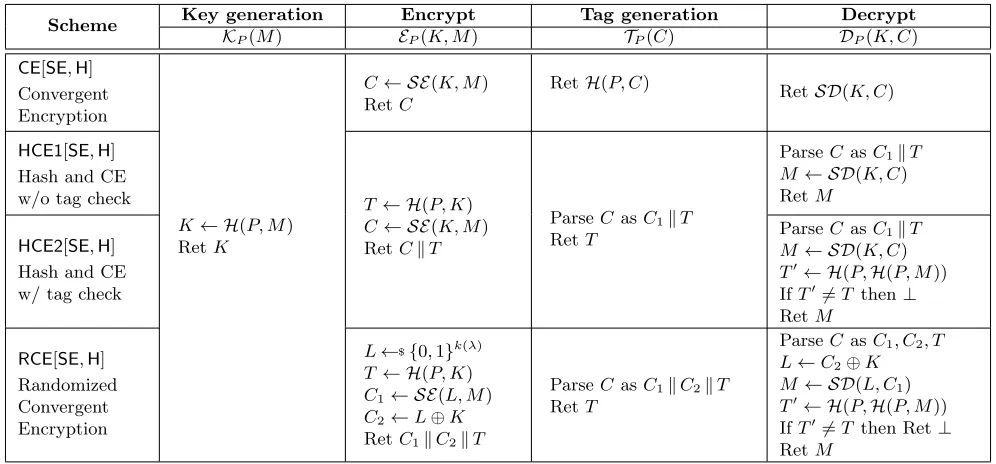
Scheme Key generation Encrypt Tag generation Decrypt KP(M) EP(K, M) TP(C) DP(K, C)
CE[SE,H] Convergent Encryption
K← H(P, M) RetK
C← SE(K, M) RetC
RetH(P, C) RetSD(K, C)
HCE1[SE,H] Hash and CE
w/o tag check T ← H(P, K)
C← SE(K, M) RetCkT
ParseC asC1kT RetT
ParseCasC1kT
M ← SD(K, C) RetM
HCE2[SE,H] Hash and CE w/ tag check
ParseCasC1kT
M ← SD(K, C)
T0← H(P,H(P, M)) IfT06=T then⊥
RetM
RCE[SE,H] Randomized Convergent Encryption
L←${0,1}k(λ)
T ← H(P, K)
C1← SE(L, M)
C2←L⊕K RetC1kC2kT
ParseC asC1kC2kT RetT
ParseCasC1, C2, T
L←C2⊕K
M ← SD(L, C1)
T0← H(P,H(P, M)) IfT06=T then Ret⊥
RetM
Figure 4: MLE schemes built using symmetric encryption schemeSE= (SK,SE,SD) and hash function familyH= (HK,H). All schemes inherit their message space fromSE(typically{0,1}∗), use as parameter generation HK, and share a common key generation algorithm. HCE1 and HCE2 additionally use the same encryption and tag generation algorithms.
For performance in practice, the important operation is deriving the ciphertext and tag from the message. This involves generating the key, followed by encryption and tag generation. CE requires three full passes to perform encryption and tag generation, while HCE1 and HCE2 require two. This is fundamental: deterministic MLE schemes that output bits of ciphertext before processing most of the message will not achieve PRV-CDAsecurity.
The fourth scheme, Randomized Convergent Encryption (RCE), takes advantage of randomization to give a version of HCE2that can generate the key, encrypt the message, and produce the tag, all together, in a single pass. RCE accomplishes this by first picking a random symmetric encryption keyL and then encrypting the message withL, and deriving the MLE keyK in a single pass. Finally it encryptsLusing
K as a one-time pad, and derives the tag from K. LikeHCE2 it uses guarded decryption.
It is easy to verify decryption correctness. Tag correctness follows as the tags are all deterministic. Privacy. We prove thePRV$-CDAsecurity of the four schemes when modelingHas a RO. In Appendix B we give a concrete-security statement together with proof that covers all four schemes. The following theorem ends up an easy corollary.
Theorem 4.1. Let H be a RO and let SE= (SK,SE,SD) be a one-time symmetric encryption scheme with key length k(·). Then if SE is both KR-secure and ROR-secure, the scheme XXX[SE,H] for XXX∈ {CE,HCE1,HCE2,RCE} is PRV$-CDA-secure.
Tag consistency. We turn to security in the sense of tag consistency. As discussed in Section 3, any deterministic scheme is STC-secure when tags are CR-hashes of the ciphertext. So too with CE. For
HCE2 and RCE, a straightforward reduction establishes the following theorem. We omit the details.
Theorem 4.2. LetSE= (SK,SE,SD)be a one-time symmetric encryption scheme and let H= (HK,H)
be a hash function family. If H isCR-secure then HCE2[SE,H]and RCE[SE,H] areTC-secure.
compared to CE. We conclude that finding fast, STC-secure schemes with O(1) tag generation is an interesting open problem, surfaced by our definitions and results above.
Discussion. The above schemes use a hash function family H. In practice, we might use SHA-256 or SHA-3, and key them appropriately by choosing a uniform bit string to prepend to messages. In Appendix C we explore various instantiations of the MLE schemes, including ones that implement the hash function by way of a block cipher. This specifically yields MLE schemes entirely built from AES, which provides efficiency benefits due to widespread hardware support for AES (i.e., AES-NI). We also report on performance there.
5
Theoretical Contributions: Constructions without ROs
We present a paradigm for constructing MLE schemes that we call Extract-Hash-Check. In particular it yields standard model constructions of MLE-schemes from D-PKE schemes and CI-H hash functions. We then present an MLE scheme based on a weaker assumption, namely any ROR symmetric encryption scheme, for particular classes of sources, based on a method we call Sample-Extract-Encrypt. It also uses an extractor.
5.1 Extract-Hash-Check
Overview. It is natural to aim to build MLE from a D-PKE scheme or a CI-H function because the latter primitives already provide privacy on unpredictable messages. However, in attempting to build MLE from these primitives, several problems arise. One is that neither of the base primitives derives the decryption key from the message. Indeed, in both, keys must be generated upfront and independently of the data. A related problem is that it is not clear how an MLE scheme might decrypt. CI-H functions are not required to be efficiently invertible. D-PKE does provide decryption, but it requires the secret key, and it is not clear how this can yield message-based decryption.
Our solution will in fact not use the decryptability of the D-PKE scheme, but rather view the latter as providing a CI-H function keyed by the public key. We apply an extractor (its seed S will be in the parameters of the MLE scheme) to the message M to get the MLE key K. Given S, M, this operation is deterministic. The scheme encrypts the message bit by bit, creating from M = M[1]. . . M[|M|] the ciphertext C =C[1]. . . C[|M|] in which C[i] is a hash of KkhiikM[i]. (The key for the hash function is also in the parameters.) To decrypt C[i] given K, hash bothKkhiik1 andKkhiik0 and see which equals
C[i]. (This is the “check” part.) The proof of privacy relies on the fact that each input to each application of the hash function will have a negligible guessing probability even given the parameters. The reduction will take an MLE source and build a source for the hash function that itself computes K and produces the inputs to the hash function. We now proceed to the details.
Ingredients. The first tool we need is a family of hash functions H = (HK,H). We define privacy in the same manner as for MLE. Namely, game PRV-CDAH is the same as PRV-CDAMLE of Figure 3
except that it uses HK and H instead of P and E. Likewise for PRV$-CDAH. IfA is an adversary we
let Advprv-cdaH,M,A(λ) = 2·Pr[PRV-CDAAH,M(λ)]−1 and Advprv$-cdaH,M,A (λ) = 2·Pr[PRV$-CDAAH,M(λ)]−1.
We say that HisPRV-CDA(resp. PRV$-CDA) secure ifAdvprv-cdaH,M,A(·) (resp. Advprv$-cdaH,M,A (·)) is negligible for all PT M, A such that M is unpredictable. The PRV-CDA formulation follows [11, 14, 29] while the
PRV$-CDAformulation follows [29].
The second tool we need is a family of extractors. This is a family Ext = {Extλ}λ∈N where
Extλ: {0,1}s(λ)× {0,1}`(λ) → {0,1}k(λ) for each λ ∈ N. We refer to s, `, k as the seed, input and
output lengths respectively. We require that the map 1λ, S, X 7→ Extλ(S, X) be PT computable. For
all λ ∈ N and all random variables (X, Z), S, K we require that SD((S,Extλ(S, X), Z); (S, K, Z)) ≤
p
P(1λ)
S←${0,1}s(λ)
Kh←$HK(1λ) RetSkKh
KSkKh(M)
K←Extλ(S, M)
RetK
ESkKh(K, M) Fori= 1 to|M|do
C[i]← H(Kh, KkhiikM[i])
RetC
TSkKh(C) RetC
DSkKh(K, C) Fori= 1 to|C|do
IfC[i] =H(Kh, Kkhiik1) thenM[i]←1
Else ifC[i] =H(Kh, Kkhiik0) thenM[i]←0
Else Ret⊥
RetM
Figure 5: MLE scheme XHC[H,Ext] associated to hash family H = (HK,H) and extractor family Ext ={Extλ}λ∈N.
may be obtained via the (average-case version of the) Leftover Hash Lemma (LHL) [24, 33].
Extract-Hash-Check construction. Let H = (HK,H) be a family of hash functions. Let Ext =
{Extλ}λ∈Nbe a family of extractors with seed lengths, input length`and output lengthk. Our
construc-tion associates to them the MLE scheme XHC[H,Ext] = (P,K,E,D,T) whose constituent algorithms are defined in Figure 5. The message space of this scheme is defined by MsgSp(λ) ={0,1}`(λ) for allλ∈
N.
We lethiidenote the encoding ofi∈Nas aλ-bit string. (We are assuming`(λ)≤2λ for allλ∈N.) The ciphertext C is a `(λ)-vector over{0,1}∗.
This MLE scheme is deterministic, hence provides perfect tag correctness. It satisfies decryption correctness as long asHis injective. (A weaker, computational decryption correctness condition is met if
His not injective but is collision-resistant.) As a consequence of being deterministic and using ciphertexts for tags, it also has unconditional consistency, namely perfectSTCsecurity. (We are, for simplicity, using the ciphertext as the tag. For greater efficiency one could CR-hash it. STC would still hold, but now computationally.) The main task is to prove privacy, which is done by the following, whose proof is in Appendix D. Here, whenMLE= XHC[H,Ext], we denote byMMLEthe class of all PT,MLE-valid sources
M such that 2k(·)·GPM(·) is negligible, where k is the output length of Ext.
Theorem 5.1. Let Ext = {Extλ}λ∈N be a family of extractors. Let H = (HK,H) be a family of hash
functions. Let MLE = XHC[H,Ext] be the MLE scheme associated to them via our Extract-Hash-Check construction. Then (1) If H is PRV-CDA-secure then MLE is PRV-CDA-secure over MMLE , and (2) If
H isPRV$-CDA-secure then MLE isPRV$-CDA-secure over MMLE .
We can directly instantiate H by a CI-H function as defined in [29]. If DPKE = (DK,DE,DD) is a D-PKE scheme, we obtain a hash familyH= (HK,H) as follows. LetHK(1λ) runDK(1λ) to get (pk,sk)
and return pk as the hash key. Let H(pk, M) =DE(pk, M). (We note that we must assume a trusted setup which executes HK as shown and discards sk, for if the server knows sk it can break the scheme. The parameters must be generated by a third party or via a secure computation protocol so that the server does not learn sk.) If DPKE meets the PRIV-security condition of [11, 14] appropriately extended to handle auxiliary inputs as above, then H will be PRV-CDA-secure. Note that this hash family is injective. Finally we note that the construction can be adapted to turn an efficiently-searchable PKE scheme [11] into an MLE scheme, but since the former may be randomized, the latter may be as well. These constructions account for the schemes calledXtCIH,XtDPKEandXtESPKEin the table of Figure 1 and the corresponding implication arrows in the picture.
D-MLE implies CI-H. Finally we justify the claim of Figure 1 that deterministic MLE implies CI-H. (Combined with the above, this makes the primitives equivalent.) Given a deterministic MLE scheme
Proj(M, T)
M1←ε; i1←0 Fori= 1 to|T|do
IfT[i] = 1 then
i1←i1+ 1 ; M1[i1]←M[i] ReturnM1
Merge(M1, M2, T)
M ←ε; i1←0 ; i2←0 Fori= 1 to|T|
IfT[i] = 1 theni1 ←i1+ 1 ; M[i]←M1[i1] Elsei2←i2+ 1 ; M[i]←M2[i2]
ReturnM
P(1λ)
S←${0,1}s(λ)
U←p(λ){0,1}n(λ) RetSkU
KSkU(M)
K←Proj(M, U) ; RetK
ESkU(K, M)
L←Extλ(S,padλ(K))
M2←Proj(M, U)
C←$SE(L, M2) RetC
DSkU(K, C)
L←Extλ(S,padλ(K))
M2← SD(L, C)
M ←Merge(K, M2, U) RetM
Figure 6: Top: The Proj and Merge algorithms. Bottom: MLE scheme SXE[SE,Ext, p] associated to symmetric encryption scheme SE= (SK,SE,SD), extractor family Ext ={Extλ}λ∈N and p: N→[0,1].
The tag algorithm TSkU(C) simply returns C.
5.2 Sample-Extract-Encrypt
Overview. We now give a construction of an MLE scheme that relies only on a standard and weak assumption, namely a one-time symmetric encryption scheme as defined in Section 4, which can be built from any one-way function. The tradeoff is that the scheme only works for a limited class of sources.
Stepping back, if we are to consider special sources, the obvious starting point is uniform and inde-pendent messages. Achieving MLE here is easy because we can use part of the message as the key to encrypt the other part. The next obvious target is block sources, where each message is assumed to have negligible guessing probability given the previous ones. D-PKE for such sources was achieved in [19]. We might hope, via the above XHC construction, to thus automatically obtain MLE for the same sources, but XHC does not preserve the block source restriction because the inputs to the hash function for different bits of the same message are highly correlated.
Our Sample-Extract-Encrypt (SXE) construction builds an MLE scheme for certain classes of block sources where a random subset of the bits of each message remains unpredictable even given the rest of the bits and previous messages. For example, if a message has some subset of uniform bits embedded within it. The scheme then uses a random subset of the message bits as a key, applies an extractor, and then symmetrically encrypts the rest of the message.
Preliminaries. First, some notation. If T ∈ {0,1}∗, we let hw(T) denote the Hamming weight of T and T the bitwise complement of T. For T ∈ {0,1}|M|, function Proj(M, T) of Figure 6 returns the hw(T)-length string formed by selecting from M the coordinates iin which T[i] = 1. If q ∈[0,1] we let
U ←q{0,1}n mean that we let U[i] = 1 with probability q and 0 with probability 1−q, independently
for each i ∈[n]. Note that the expected Hamming weight of U is then qn. Looking ahead, we will be interested in sources for which one can “gather” sufficient min-entropy by randomly taking a subset of message bits. The fraction q controls the bias with which we select any particular bit.
In this section, all sources have arity 1. LetMbe a source with number of messagesmand message lengthlen such thatlen(λ, i) =n(λ) for allλ, i∈N, meaning all messages M[1], . . . ,M[m(λ)]∈[M(1λ)]
have the same length n(λ). For p: N→[0,1] andλ∈N we let
GPM,p(λ) = max
i GP(Proj(M[i], U)|(M[1], . . . ,M[i−1],Proj(M[i], U), Z))
where the probability is over U ←p(λ){0,1}n(λ) and (M, Z) ← M(1λ) and the maximum is over all
a blocksource is a source that is 1-unpredictable. Considering smaller values of p thus relaxes the usual blocksource requirement.
Some natural sources are, or can be shown to be, p-unpredictable for small p. One obvious example is uniform messages. Short of that is any source that is sufficiently dense, meaning that a large enough fraction of the message bits have high min-entropy conditioned on all other bits. A concrete example would be sources that embed uniform bits in arbitrary locations within a message. For such a source, one can use a Chernoff bound to show that it is a p-unpredictable source for a reasonable value of prelated to the density of the message.
The Sample-Extract-Encrypt construction. Let SE = (SK,SE,SD) be a (deterministic) one-time symmetric encryption scheme with key length k(·). Let Ext ={Extλ}λ∈N be a family of extractors
with seed length s, output length k and input length `. (We’ve assumed that the output length of Ext is equal to the key length of SE.) We letn(·) =`(·)−1. Let p: N→ [0,1]. Our construction associates
to them the MLE scheme SXE[SE,Ext, p] = (P,K,E,D,T) whose constituent algorithms are defined in Figure 6. Here we let padλ(K) = Kk1k0n(λ)−|K| so that outputs of padλ are valid inputs for Extλ(S,·).
The message space of this scheme is defined by MsgSp(λ) ={0,1}n(λ) for all λ∈
N.
This MLE scheme is deterministic, hence provides perfect tag correctness. It satisfies decryption correctness due to the corrections of SE. Note that the scheme is not strictly non-trivial, since it could be that hw(U) = n(λ). However, it is non-trivial in expectation whenever p(λ) < 1, since E[hw(U)] =
p(λ)·n(λ). As a consequence of being deterministic, and using ciphertext as the tag, it also has perfect
STC security. (We are, for simplicity, using the ciphertext as the tag. For greater efficiency one could CR-hash it. STCwould still hold, but now computationally.) The following theorem establishes privacy. Here, when MLE=SXE[SE,Ext, p], we denote by MMLE the class of all PT, MLE-valid sources Msuch that 2k(·)·GPM,p(·) is negligible, where k is the output length of Ext. The proof is in Appendix E.
Theorem 5.2. Let SE = (SK,SE,SD) be a one-time symmetric encryption scheme providing ROR
security. Let Ext = {Extλ}λ∈N be a family of extractors Let p: N → [0,1]. Let MLE= SXE[SE,Ext, p]
be the MLE scheme associated to them via our Sample-Extract-Encrypt construction. Then MLE is
PRV$-CDA-secure over MMLE,p.
The key in this scheme has expected lengthp(·)·n(·). If we increasep, we get security for a larger class of sources at the cost of a larger key length, so the construction can be seen as trading key size for security.
Acknowledgments
We thank James Lentini for pointing out the STC attack against RCE, Ananth Raghunathan for early discussions about convergent encryption, the TahoeFS developers for informative discussions regarding duplicate faking attacks in TahoeFS, and the anonymous Eurocrypt 2013 reviewers for their helpful comments.
References
[1] Bitcasa, inifinite storage. http://www.bitcasa.com/. (Cited on page 3.) [2] Ciphertite data backup. http://www.ciphertite.com/. (Cited on page 3.)
[3] Dropbox, a file-storage and sharing service. http://www.dropbox.com/. (Cited on page 3.) [4] The Flud backup system. http://flud.org/wiki/Architecture. (Cited on page 3, 11.)
[5] GNUnet, a framework for secure peer-to-peer networking. https://gnunet.org/. (Cited on page 3.) [6] Google Drive. http://drive.google.com/. (Cited on page 3.)
[7] A. Adya, W. Bolosky, M. Castro, G. Cermak, R. Chaiken, J. Douceur, J. Howell, J. Lorch, M. Theimer, and R. Wattenhofer. Farsite: Federated, available, and reliable storage for an incompletely trusted environment.
[8] P. Anderson and L. Zhang. Fast and secure laptop backups with encrypted de-duplication. InProc. of USENIX LISA, 2010. (Cited on page 3.)
[9] Z. Bar-Yossef, O. Reingold, R. Shaltiel, and L. Trevisan. Streaming computation of combinatorial objects. In
Computational Complexity, 2002. Proceedings. 17th IEEE Annual Conference on, pages 133–142. IEEE, 2002. (Cited on page 3, 6.)
[10] C. Batten, K. Barr, A. Saraf, and S. Trepetin. pStore: A secure peer-to-peer backup system. Unpublished report, MIT Laboratory for Computer Science, 2001. (Cited on page 3.)
[11] M. Bellare, A. Boldyreva, and A. O’Neill. Deterministic and efficiently searchable encryption. In A. Menezes, editor,CRYPTO 2007, volume 4622 ofLNCS, pages 535–552. Springer, Aug. 2007. (Cited on page 3, 4, 5, 6, 9, 10, 13, 14, 21, 22.)
[12] M. Bellare, Z. Brakerski, M. Naor, T. Ristenpart, G. Segev, H. Shacham, and S. Yilek. Hedged public-key encryption: How to protect against bad randomness. In M. Matsui, editor,ASIACRYPT 2009, volume 5912 ofLNCS, pages 232–249. Springer, Dec. 2009. (Cited on page 4, 7, 10, 11, 21, 22.)
[13] M. Bellare, A. Desai, E. Jokipii, and P. Rogaway. A concrete security treatment of symmetric encryption. In
38th FOCS, pages 394–403. IEEE Computer Society Press, Oct. 1997. (Cited on page 4.)
[14] M. Bellare, M. Fischlin, A. O’Neill, and T. Ristenpart. Deterministic encryption: Definitional equivalences and constructions without random oracles. In D. Wagner, editor,CRYPTO 2008, volume 5157 ofLNCS, pages 360–378. Springer, Aug. 2008. (Cited on page 4, 6, 10, 13, 14.)
[15] M. Bellare, O. Goldreich, and S. Goldwasser. Incremental cryptography: The case of hashing and signing. In Y. Desmedt, editor, CRYPTO’94, volume 839 of LNCS, pages 216–233. Springer, Aug. 1994. (Cited on page 25.)
[16] M. Bellare and P. Rogaway. Random oracles are practical: A paradigm for designing efficient protocols. In V. Ashby, editor,ACM CCS 93, pages 62–73. ACM Press, Nov. 1993. (Cited on page 3, 10.)
[17] M. Bellare and P. Rogaway. The security of triple encryption and a framework for code-based game-playing proofs. In S. Vaudenay, editor,EUROCRYPT 2006, volume 4004 ofLNCS, pages 409–426. Springer, May / June 2006. (Cited on page 7, 22.)
[18] M. Blum, P. Feldman, and S. Micali. Non-interactive zero-knowledge and its applications. InProceedings of the twentieth annual ACM symposium on Theory of computing, pages 103–112. ACM, 1988. (Cited on page 12.) [19] A. Boldyreva, S. Fehr, and A. O’Neill. On notions of security for deterministic encryption, and efficient
constructions without random oracles. In D. Wagner, editor,CRYPTO 2008, volume 5157 of LNCS, pages 335–359. Springer, Aug. 2008. (Cited on page 6, 15.)
[20] D. Boneh, G. Di Crescenzo, R. Ostrovsky, and G. Persiano. Public key encryption with keyword search. In C. Cachin and J. Camenisch, editors,EUROCRYPT 2004, volume 3027 ofLNCS, pages 506–522. Springer, May 2004. (Cited on page 3, 9.)
[21] Z. Brakerski and G. Segev. Better security for deterministic public-key encryption: The auxiliary-input setting. In P. Rogaway, editor,CRYPTO 2011, volume 6841 ofLNCS, pages 543–560. Springer, Aug. 2011. (Cited on page 4, 6, 10.)
[22] J. Cooley, C. Taylor, and A. Peacock. ABS: the apportioned backup system. MIT Laboratory for Computer Science, 2004. (Cited on page 3, 11.)
[23] L. P. Cox, C. D. Murray, and B. D. Noble. Pastiche: making backup cheap and easy. SIGOPS Oper. Syst. Rev., 36:285–298, Dec. 2002. (Cited on page 3, 11.)
[24] Y. Dodis, R. Ostrovsky, L. Reyzin, and A. Smith. Fuzzy extractors: How to generate strong keys from biometrics and other noisy data. SIAM Journal on Computing, 38(1):97–139, 2008. (Cited on page 14.) [25] Y. Dodis, T. Ristenpart, and T. Shrimpton. Salvaging Merkle-Damg˚ard for practical applications. In A. Joux,
editor,EUROCRYPT 2009, volume 5479 ofLNCS, pages 371–388. Springer, Apr. 2009. (Cited on page 25.) [26] J. Douceur, A. Adya, W. Bolosky, D. Simon, and M. Theimer. Reclaiming space from duplicate files in a
[27] B. Fuller, A. O’Neill, and L. Reyzin. A unified approach to deterministic encryption: New constructions and a connection to computational entropy. In R. Cramer, editor,TCC 2012, volume 7194 ofLNCS, pages 582–599. Springer, Mar. 2012. (Cited on page 6.)
[28] S. Goldwasser and S. Micali. Probabilistic encryption. Journal of Computer and System Sciences, 28(2):270– 299, 1984. (Cited on page 4.)
[29] V. Goyal, A. O’Neill, and V. Rao. Correlated-input secure hash functions. In Y. Ishai, editor, TCC 2011, volume 6597 ofLNCS, pages 182–200. Springer, Mar. 2011. (Cited on page 3, 5, 6, 13, 14.)
[30] S. Gueron. Advanced encryption standard (AES) instructions set. Intel Corporation, 25, 2008. (Cited on page 25.)
[31] S. Halevi, D. Harnik, B. Pinkas, and A. Shulman-Peleg. Proofs of ownership in remote storage systems. In Y. Chen, G. Danezis, and V. Shmatikov, editors,ACM CCS 11, pages 491–500. ACM Press, Oct. 2011. (Cited on page 7.)
[32] D. Harnik, B. Pinkas, and A. Shulman-Peleg. Side channels in cloud services: Deduplication in cloud storage.
Security & Privacy, IEEE, 8(6):40–47, 2010. (Cited on page 7, 10.)
[33] J. H˚astad, R. Impagliazzo, L. A. Levin, and M. Luby. A pseudorandom generator from any one-way function.
SIAM Journal on Computing, 28(4):1364–1396, 1999. (Cited on page 14.)
[34] J. Kilian and P. Rogaway. How to protect DES against exhaustive key search (an analysis of DESX). Journal of Cryptology, 14(1):17–35, 2001. (Cited on page 25.)
[35] M. Killijian, L. Court`es, D. Powell, et al. A survey of cooperative backup mechanisms, 2006. (Cited on page 3.) [36] C.-J. Lu. Hyper-encryption against space-bounded adversaries from on-line strong extractors. In M. Yung,
editor,CRYPTO 2002, volume 2442 ofLNCS, pages 257–271. Springer, Aug. 2002. (Cited on page 3, 6.) [37] L. Marques and C. Costa. Secure deduplication on mobile devices. InProceedings of the 2011 Workshop on
Open Source and Design of Communication, pages 19–26. ACM, 2011. (Cited on page 3.)
[38] I. Mironov, O. Pandey, O. Reingold, and G. Segev. Incremental deterministic public-key encryption. In D. Pointcheval and T. Johansson, editors,EUROCRYPT 2012, volume 7237 ofLNCS, pages 628–644. Springer, Apr. 2012. (Cited on page 7.)
[39] N. Nisan and D. Zuckerman. Randomness is linear in space. Journal of Computer and System Sciences, 52(1):43–52, 1996. (Cited on page 6.)
[40] J. Pettitt. Content based hashing.http://cypherpunks.venona.com/date/1996/02/msg02013.html. (Cited on page 7.)
[41] A. Rahumed, H. Chen, Y. Tang, P. Lee, and J. Lui. A secure cloud backup system with assured deletion and version control. In Parallel Processing Workshops (ICPPW), 2011 40th International Conference on, pages 160–167. IEEE, 2011. (Cited on page 3.)
[42] T. Ristenpart, H. Shacham, and T. Shrimpton. Careful with composition: Limitations of the indifferentiability framework. In K. G. Paterson, editor,EUROCRYPT 2011, volume 6632 ofLNCS, pages 487–506. Springer, May 2011. (Cited on page 7, 11, 25.)
[43] P. Rogaway, M. Bellare, J. Black, and T. Krovetz. OCB: A block-cipher mode of operation for efficient authenticated encryption. InACM CCS 01, pages 196–205. ACM Press, Nov. 2001. (Cited on page 4, 10, 11.) [44] D. X. Song, D. Wagner, and A. Perrig. Practical techniques for searches on encrypted data. In 2000 IEEE Symposium on Security and Privacy, pages 44–55. IEEE Computer Society Press, May 2000. (Cited on page 3.) [45] M. Storer, K. Greenan, D. Long, and E. Miller. Secure data deduplication. In Proceedings of the 4th ACM international workshop on Storage security and survivability, pages 1–10. ACM, 2008. (Cited on page 3, 4, 10, 11.)
[47] D. Wichs. Barriers in cryptography with weak, correlated and leaky sources. In Proceedings of the 4th conference on Innovations in Theoretical Computer Science, ITCS ’13, pages 111–126, New York, NY, USA, 2013. ACM. (Cited on page 6.)
[48] Z. Wilcox-O’Hearn. Convergent encryption reconsidered, 2011. http://www.mail-archive.com/
[email protected]/msg08949.html. (Cited on page 11.)
[49] Z. Wilcox-O’Hearn and B. Warner. Tahoe: The least-authority filesystem. In Proceedings of the 4th ACM international workshop on Storage security and survivability, pages 21–26. ACM, 2008. (Cited on page 3, 5, 11.)
[50] J. Xu, E.-C. Chang, and J. Zhou. Leakage-resilient client-side deduplication of encrypted data in cloud storage. Cryptology ePrint Archive, Report 2011/538, 2011. http://eprint.iacr.org/. (Cited on page 7.)
A
Relations Between MLE Privacy Notions
We first define the adaptive versions of PRV-CDA and PRV$-CDA, and then go on to show the relations between PRV-CDA, PRV$-CDA and their adaptive versions, as described in Figure 2. We first generalize sources to take inputs.
Asource with input is a PT algorithm Mthat on input 1λ and a stringdreturns (M0, . . . ,Mn−1, Z) where M0, . . . ,Mn−1 are vectors over {0,1}∗ and Z ∈ {0,1}∗. As before n≥1 is called the arity of the source. We require that
• all the vectors have the same lengthm(λ), for some functionm called the number of messages;
• there is a functionlen, called the message length of the source, such that the string Mj[i] has length
len(λ, i) for all i∈[m(λ)] and all j∈ {0, . . . , n−1}; and
• Mj[i1]6=Mj[i2] for all distincti1, i2 ∈[m(λ)] and all j∈ {0, . . . , n−1}, meaning the entries of each vector are distinct.
These requirements are as before for sources (without inputs). As before, we refer to Z as the auxiliary information.
The guessing probability GPM of source with input M is defined as the function which on input
λ∈N returns maxi,j,dGP(Mj[i]|Z) where the probability is over (M0, . . . ,Mn−1, Z)←$M(1λ, d) and
the maximum is over all i∈[m(λ)], allj ∈ {0, . . . , n−1} and alld∈ {0,1}∗. (The domain for the latter
being infinite, the max here is interpreted as a sup and it is an implicit assumption that for a source-with-input to be valid, this sup must exist.) As compared to a source (without source-with-input) the important point here is that we maximize over das well, so only the coins underlying the execution ofMcan contribute to the guessing probability. We refer to −log(GPM(·)) as the min-entropy of M. We say that M is
unpredictable ifGPM(·) is negligible. We say thatMisMLE-valid ifMj[i]∈MsgSpMLE(λ) for allλ∈N,
all (M0, . . . ,Mn−1, Z)∈[M(1λ, d)], all i∈[m(λ)], all j∈ {0, . . . , n−1} and alld∈ {0,1}∗.
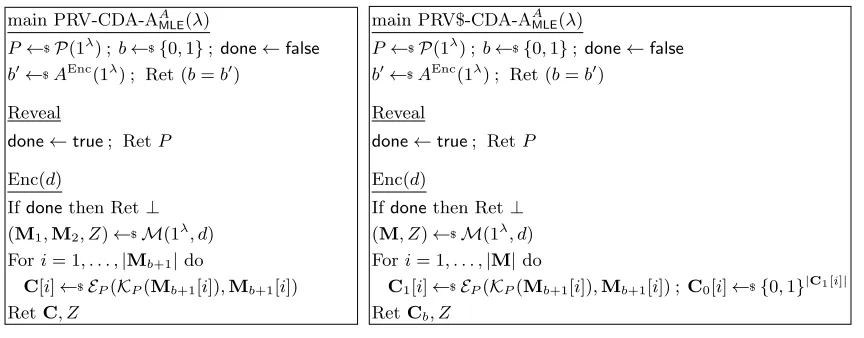
Adaptive privacy notions. Let MLE = (P,K,E,D,T) be an MLE scheme and M be MLE-valid. The adaptive chosen distribution attack games PRV-CDA-AMLE,M and PRV$-CDA-AMLE,M forMLEare
detailed in Figure 7. For the formerMwill have arity one and for the latter, arity two. In these games, the adversaryAcan make multiple, adaptive queries to its Enc oracle, specifying each time an inputdfor
M. It can then ask for the parameter with a reveal query, after which no further Enc queries are allowed. We define advantage as Advprv-cda-aMLE,M,A(λ) = 2 ·Pr[PRV-CDA-AAMLE,M(λ)]−1 and Advprv$-cda-aMLE,M,A(λ) =
2·Pr[PRV$-CDA-AAMLE,M(λ)]−1. We say that MLE is PRV-CDA-A (resp. PRV$-CDA-A) secure over a class M of PT, MLE-valid sources if AdvprvMLE-cdaa,M,A(·) (resp. AdvprvMLE$-,cdaaM,A(·)) is negligible for all PT
A and all M ∈ M. We say that MLE is PRV-CDA-A (resp. PRV$-CDA-A) secure if it is PRV-CDA-A
(resp. PRV$-CDA-A) secure over the class of all PT, unpredictable MLE-valid sources.
Relations between the notions. We have introduced four notions: PRV-CDA,PRV$-CDA,
main PRV-CDA-AA
MLE(λ)
P←$P(1λ) ; b←${0,1};done←false
b0←$AEnc(1λ) ; Ret (b=b0) Reveal
done←true; RetP
Enc(d)
Ifdonethen Ret⊥
(M1,M2, Z)←$M(1λ, d) Fori= 1, . . . ,|Mb+1|do
C[i]←$EP(KP(Mb+1[i]),Mb+1[i]) RetC, Z
main PRV$-CDA-AAMLE(λ)
P←$P(1λ) ; b←${0,1};done←false
b0←$AEnc(1λ) ; Ret (b=b0) Reveal
done←true; RetP
Enc(d)
Ifdonethen Ret⊥
(M, Z)←$M(1λ, d) Fori= 1, . . . ,|M|do
C1[i]←$EP(KP(Mb+1[i]),Mb+1[i]) ;C0[i]←${0,1}|C1[i]| RetCb, Z
Figure 7: The PRV-CDA-A and PRV$-CDA-A games.
sense: PRV-CDA-A⇒ PRV-CDA and PRV$-CDA-A⇒PRV$-CDA. (The double-arrow notation meaning security in the left sense implies security in the right.) We now show through a series of propositions the other implications and separations. Most are simple; we start with the most interesting and useful, that PRV$-CDA⇒PRV$-CDA-A. In the following, let MLE= (P,K,E,D,T) be an MLE scheme.
Proposition A.1. If MLE isPRV$-CDA secure, then it isPRV$-CDA-A secure.
Proof. We prove the above proposition by showing that for every adversaryAand sourceM, there exists another adversary B and source M0 such that for anyλ∈N
Advprv$-cda-aMLE,M,A(λ)≤qe(λ)·Advprv$-cdaMLE,M0,B(λ),
where function qe is a bound on the number of encryption queries made by A. Moreover, M0 has the
same guessing probability as M, andTM0 =O(TM), andTB =O(TA).
We use a hybrid argument. Consider gameH with behavior intermediate betweenPRV$-CDA-Awith
b= 0 and withb= 1. InH, a randomg←$[qe(λ)] andb←${0,1} are chosen. Up to theg-th encryption
query, the adversary gets random bits as replies. The g-th query gets real ciphertexts or random bits depending onbbeing 1 or 0. Further queries get real ciphertexts as replies. From a standard hybridization argument, it follows that
Pr[HA(λ)]≥ 1 qe(λ)
AdvprvMLE$-,cdaaM,A(λ).
Consider adversary B which simulates A on gameH as follows. Let M0 be the algorithm that chooses random coins R andg∈qe(λ) and simulatesA up to the g-th encryption query by using bits from R to
supply for the randomness required by A. When A makes a query to Enc, then B runs M with fresh random coins fromR to getM, Z and replies toAwith random bits (fromR) for ciphertexts, along with
Z. WhenA makes itsg-th encryption query dg, then M0 evaluates M(d) on fresh random coins — not
from R — and outputs the resulting vector of plaintexts Mand side informationZ, R, g.
Now, consider the PRV$-CDA game withM0 as the source. Importantly, the side information output
by M0, which includes the random bits R, does not reduce the conditional entropy of the output Mof
M(dg) as the coins used to run M(dg) to get Mwere picked at random, not using R. The PRV$-CDA


![Figure 5:MLE scheme XHC[Ext =H, Ext] associated to hash family H = (HK, H) and extractor family {Extλ}λ∈N.](https://thumb-us.123doks.com/thumbv2/123dok_us/7884008.1308138/14.612.76.536.53.151/figure-scheme-ext-associated-family-extractor-family-extl.webp)
![Figure 6: Top: The Proj and Merge algorithms. Bottom: MLE scheme SXE[SE, Ext, p] associated tosymmetric encryption scheme SE = (SK, SE, SD), extractor family Ext = {Extλ}λ∈N and p: N → [0, 1].The tag algorithm TS∥U(C) simply returns C.](https://thumb-us.123doks.com/thumbv2/123dok_us/7884008.1308138/15.612.66.551.53.224/figure-algorithms-associated-tosymmetric-encryption-extractor-algorithm-returns.webp)
![Figure 10: The Merkle-Damgard transform MD[EDavies-Meyer mode for messages of lengthℓ] : {0, 1}∗ → {0, 1}n over (k, n)-block cipher E in < 2k, and CTR[E], the counter mode of operation of E](https://thumb-us.123doks.com/thumbv2/123dok_us/7884008.1308138/25.612.80.532.51.151/merkle-damgard-transform-edavies-messages-length-counter-operation.webp)
![Figure 11: ⊥ Top: Key generation and encryption, together in a single pass, for a message of length ℓn usingRCE[E] for a block cipher E](https://thumb-us.123doks.com/thumbv2/123dok_us/7884008.1308138/26.612.73.539.54.279/figure-generation-encryption-single-message-length-usingrce-cipher.webp)