© 2016, IRJET | Impact Factor value: 4.45 | ISO 9001:2008 Certified Journal
| Page 482
Optimization of Surface Roughness in cylindrical grinding
Rajani Sharma
1, Promise Mittal
2, Kuldeep Kaushik
3, Pavan Agrawal
41
Research Scholar, Dept. Of Mechanical Engineering, Vikrant Institute of Technology & Management, Gwalior
2, 3, 4
Assistant Professor, Dept. Of Mechanical Engineering, Vikrant Institute of Technology & Management, Gwalior
---***---Abstract -
Cylindrical grinding is one of the important metal
cutting processes used extensively in the finishing operations. Incylindrical grinding, there are two types of output quality
characteristics Surface finish and surface roundness. I have to
do minimize the surface roughness in cylindrical grinding. There
are three process parameters which I have taken such as wheel
speed, work speed and depth of cut. I used Taguchi method,
smaller the signal to noise ratio, minimum the surface
roughness (Ra). A mathematical model is developed using
regression analysis to compare the experimental surface
roughness and predicted surface roughness. ANOVA is
calculated to determine the contribution factor of wheel speed,
work speed and depth of cut on surface roughness.
Key Words
:
Cylindrical grinding, surface roughness (Ra), surface roundness, Design of experiments (DOE), Taguchi method, S/N ratio.
1. INTRODUCTION
Cylindrical grinding is an essential process for final machining of
components requiring smooth surfa
ces and precise
tolerances.
As compared with other machining processes, grinding operation that should be utilized under optimal conditions. It is widely used in industry, grinding remains perhaps the least understood of all machining processes. There are three different process parameters like wheel speed, work speed, and depth of cut.The major operating input parameters that influence the output responses surface roughness and surface roundness. The surface quality produced in cylindrical grinding is influenced by various parameters given as follows
(i) Wheel parameters: abrasives, grain size, grade, structure, binder.
(ii) Process parameters: wheel speed, depth of cut, work speed. The empirical conditions having restricted range of validity are conventionally used in practice because grinding process involves many uncontrollable parameters. So the ground surface quality with these conditions is not reliable or acceptable in any specific situation. To achieve the required surface quality in a specific situation, process parameters can be determined through a series of experimental runs. But, that may be a time-consuming and expensive method and also it cannot determine the exact optimum because of restricted experiment.
Taguchi can conveniently optimize the grinding parameters with several experimental runs well designed.
2. TAGUCHI METHOD
© 2016, IRJET | Impact Factor value: 4.45 | ISO 9001:2008 Certified Journal
| Page 483
3. EXPERIMENTAL DATA
The experiment was planned using Taguchi’s orthogonal array
in the design of experiments, which help in reducing the number
of
experiments. The
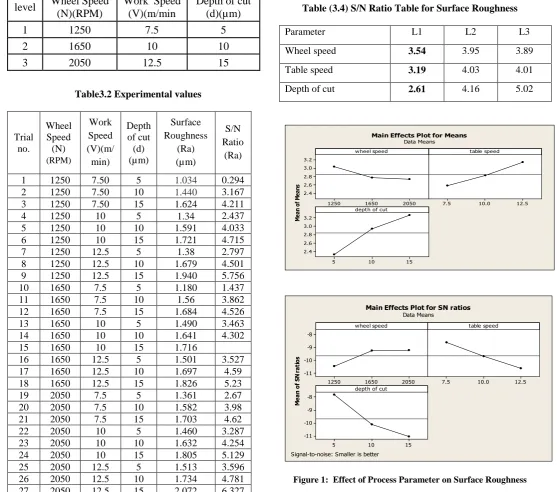
L27 orthogonal array (M. janardhan et.al) 2012.Table3.1 Parameters and Their Levels for Experiment
level
Wheel Speed
(N)(RPM)
Work Speed
(V)(m/min
Depth of cut
(d)(µm)
1
1250
7.5
5
2
1650
10
10
3
2050
12.5
15
Table3.2 Experimental values
Trial no. Wheel Speed (N) (RPM) Work Speed (V)(m/ min) Depth of cut (d) (µm) Surface Roughness (Ra) (µm) S/N Ratio (Ra)
1 1250 7.50 5 1.034 0.294
2 1250 7.50 10 1.440 3.167
3 1250 7.50 15 1.624 4.211
7
4 1250 10 5 1.34 2.437
8
5 1250 10 10 1.591 4.033
4
6 1250 10 15 1.721 4.715
6
7 1250 12.5 5 1.38 2.797
8 1250 12.5 10 1.679 4.501
9 1250 12.5 15 1.940 5.756
10 1650 7.5 5 1.180 1.437
11 1650 7.5 10 1.56 3.862
12 1650 7.5 15 1.684 4.526
13 1650 10 5 1.490 3.463
14 1650 10 10 1.641 4.302
2
15 1650 10 15 1.716
4.690
16 1650 12.5 5 1.501 3.527
17 1650 12.5 10 1.697 4.59
18 1650 12.5 15 1.826 5.23
19 2050 7.5 5 1.361 2.67
20 2050 7.5 10 1.582 3.98
21 2050 7.5 15 1.703 4.62
22 2050 10 5 1.460 3.287
23 2050 10 10 1.632 4.254
24 2050 10 15 1.805 5.129
25 2050 12.5 5 1.513 3.596
26 2050 12.5 10 1.734 4.781
27 2050 12.5 15 2.072 6.327
Lower is better S/N =-10 log [1/n (Σyi2)]
Table (3.3) Mean Response Table for Surface Roughness
Parameter L1 L2 L3
Wheel speed 1.52 1.58 1.65
Table speed 1.46 1.59 1.70
Depth of cut 1.36 1.61 1.78
Table (3.4) S/N Ratio Table for Surface Roughness
Parameter L1 L2 L3
Wheel speed 3.54 3.95 3.89
Table speed 3.19 4.03 4.01
Depth of cut 2.61 4.16 5.02
2050 1650 1250 3.2 3.0 2.8 2.6 2.4 12.5 10.0 7.5 15 10 5 3.2 3.0 2.8 2.6 2.4 wheel speed M ea n of M ea ns table speed
depth of cut
Main Effects Plot for Means Data Means 2050 1650 1250 -8 -9 -10 -11 12.5 10.0 7.5 15 10 5 -8 -9 -10 -11 wheel speed M ea n of S N ra ti os table speed
depth of cut
Main Effects Plot for SN ratios
Data Means
Signal-to-noise: Smaller is better
[image:2.595.23.581.238.730.2]© 2016, IRJET | Impact Factor value: 4.45 | ISO 9001:2008 Certified Journal
| Page 484
Table -3.5 Analysis of Variance for Surface Roughness, minitab- 16 software.
source DOF SS Mean SS F-
Ratio
p-value
Wheel speed
2 0.05652 0.02826 4.84 0.019
Table speed
2 0.38608 0.19304 33.04 0.000
Depth of cut
2 0.95909 0.47955 82.09 0.000
error 20 0.11684 0.00584
total 26 1.51854
4. Development Mathematical Modeling
Regression analysis is performed to find out the
relationship between factors and surface roughness. In
conducting regression analysis, it is assumed that
factors and the response are linearly related to each
other. A multiple regression technique was used to
formulate the wheel speed, work speed and depth of
cut to the surface roughness. The response function
representing the surface roughness can be expressed
as: Surface roughness = f (wheel speed, work speed,
depth of cut). This equation can also be written as:
Ra = 0.425 + 0.000155 x1 + 0.0483 x2 + 0.0426 x3
Table-4.1 the coefficient of regression model
[image:3.595.63.561.154.800.2]Table-4.2 comparison between experimental and predicted surface roughness.
Table 11, Comparison between experimental values and
regression model predicted values
Serial No.
Experimental surface roughness
Predicted surface roughness
%Error
1 1.034 1.194 -15.4739
2 1.440 1.407 2.291667
3 1.624 1.62 0.246305
4
1.34 1.31475 1.884328
5 1.591 1.52775 3.975487
6 1.721 1.74075 -1.14759
7 1.38 1.4355 -4.02174
8 1.679 1.6485 1.816557
9 1.940 1.8615 4.046392
10 1.180 1.256 -6.44068
11 1.56 1.469 5.833333
12 1.684 1.682 0.118765
13 1.490 1.37675 7.600671
14 1.641 1.58975 3.123096
15 1.716 1.80275 -5.05536
16 1.501 1.4975 0.233178
17 1.697 1.7105 -0.79552
18 1.826 1.9235 -5.33954
19 1.361 1.318 3.159442
20 1.582 1.531 3.223767
21 1.703 1.744 -2.40752
22 1.460 1.43875 1.455479
23 1.632 1.65175 -1.21017
24 1.805 1.86475 -3.31025
25 1.513 1.5595 -3.07336
26 1.734 1.7725 -2.2203
27 2.072 1.9855 4.17471
Predictor Coeff. Std. Error Beta T Sig.
constant 0.4252 0.1002 4.24 0.000
Welding
speed 0.00015458 0.00004081 3.79 0.001
Table
speed 0.048311 0.006529 7.40 0.000
Depth of
© 2016, IRJET | Impact Factor value: 4.45 | ISO 9001:2008 Certified Journal
| Page 485
Series -1 experimental values Series-2 predicted values
Comparision between experimental and predicted surface roughness.
5. Response Graphs for Means
5.1 Level [1] for wheel speed W1 = 1.52 Ra indicated as
the optimum situation in terms of Surface Roughness
values.
5.2 Level [1] for table speed T1 = 1.46 Ra indicated as the
optimum situation in terms of Surface Roughness values.
5.3 Level [1] for depth of cut D1 = 1.36 Ra indicated as
the optimum situation in terms of Surface Roughness
values.
5.4From ANNOVA analysis the contribution factor of
depth of cut is 82.09%, Table speed is 33% and wheel
speed is 4% seen from table (3.5)
6. CONCLUSIONS AND SCOPE OF FUTURE WORK
For main effects depth of cut and table speed have
significant effect on the surface roughness. Whereas
wheel speed have decreasing effect on the surface
roughness. This is consistent with the conclusions from
the study of other investigators.
References
1. M. Janardhan and A. Gopala Krishna, 2011: Determination And Optimization Of Cylindrical Grinding Process Parameters Using Taguchi Method And Regression Analysis. International Journal of Engineering Science and Technology, Vol. 3 No. 7. 2. Deepak Pal, Ajay Bangar, Rajan Sharma and Ashish
Yadav, 2012: "Optimization of Grinding Parameters for Minimum Surface Roughness by Taguchi Parametric”International Journal of Mechanical and Industrial Engineering (IJMIE), ISSN No. 2231 – 6477, Volume-1, Issue-3.
3. Dayananda Pai, Shrikantha S. Rao and Rio D’Souza, 2011:” Multi Objective Optimization Of Surface Grinding Process By Combination Of Response Surface Methodology And Enhanced Non-Dominated Sorting Genetic Algorithm”International Journal of Computer Applications (0975 –8887) Volume 36–No.3.
4. Jae-Sob Kwak, 2004: “Application Of Taguchi And Response Surface Methodologies For Geometric Error In Surface Grinding Process “International Journal of Machine Tools & Manufacture 45 (2005) 327–334
5. Jae-Seob Kwak, Sung-Bo Sim and Yeong-Deug Jeong,2005:” An analysis of grinding power and surface roughness in external cylindrical grinding of hardened SCM440 steel using the response surface method "International Journal of Machine Tools & Manufacture 46 (2006) 304–312.
6. M.N. Dhavlikar, M.S. Kulkarni, V. Mariappan, 2002:” Combined Taguchi and dual response method for optimization of a centerless grinding operation "Journal of Materials Processing Technology 132 (2003) 90–94.
© 2016, IRJET | Impact Factor value: 4.45 | ISO 9001:2008 Certified Journal
| Page 486
parameter optimization of submerged arc weldingin the hard facing process,"Int. J. Manufacturing Research, Vol. 2, No. 4.
8. janardhan .M. Krishna, A. Gopala, 2012:” Multi-Objective Optimization of Cutting Parameters for Surface Roughness and Metal Removal Rate in Surface Grinding Using Response Surface Methodology “International Journal of Advances in Engineering & Technology;Mar2012, Vol. 3 Issue 1, p270.
9. S. P. Tewari, Ankur Gupta and Jyoti Prakash, 2010:” Effect of welding parameters on the weldability of material” International Journal of Engineering Science and Technology Vol. 2(4).
10. Kirankumar Ramakantrao Jagtap, S.B.Ubale and Dr.M.S.Kadam, 2011:” Optimization of Cylindrical Grinding Process Parameters for Aisi 1040 Steel Using Taguchi Method” International journal of mechanical engineering and technology.
11. C.Vidal, V. Infante, P. Peças and P. Vilaça:” Application of Taguchi method in the optimization of friction stir welding parameters of an aeronautic aluminum alloy,"