© 2017, IRJET | Impact Factor value: 5.181 | ISO 9001:2008 Certified Journal | Page 1601
Effective and Secure Scheme for Video Multicasting Using Real Time
Transport Protocol (RTP)
Jitu G. Patil
1, Prof. Pyush singh
21
M-Tech Student,
2Assistant Professor, Department of Computer Science Engineering
RKDF Institute of Science and Technology, Hoshangabad Road, Bhopal, Madhya Pradesh.
---***---Abstract
- This paper describes our IntraLAN videomulticasting system that is specially designed for real time streaming of video over Local Area Networ (LAN). System allows users to make Video Transmission directly from their computer. The use of this software will greatly reduce the manual involvement and try to simplify the means of communication. Unlike other API’s this software will develop the RTP Client that can be used in any organization and can be configured in the intranet of that organization. This software can extend its functionality to Distance Education, E-learning, Video Conferencing Meetings over the internet. From the user’s point of view, the Video Multicasting can be used in any organization for communication and can be configured in the intranet of that organization.
Key Words: Video streaming, Advanced Encryption Standard (AES), Real Time-Transport Protocol (RTP), User Datagram Protocol (UDP), Secure Real Time-Transport Protocol (RTP).
1. INTRODUCTION
Today, the vigorous generation and transmission of real-time video is still an exciting problem. In our research, real-time video multicasting system is proposed because of our interest in unique immersive forecast and acquisition situations for telepresence. In particular, our video multicasting system is mixture of camera and nodes, which acquire images and perform image processing. The resulting information is streamed on a reconstruction node, which is computes the actual representation of the observed object is done. Camera and reconstruction nodes are at the same physical location and they all are connected in a local area network. The video data is then streamed to a rendering node in a real-world telepresence application, which runs at a remote location.
The APIs implemented through a standalone user interface. The RTP Client developed can be used in any organization for communication and can be configured in the intranet of that organization. A server needs to be fixed and the members of the organization can communicate with one another by simply registering and creating an account. Real Time Transmission (RTP) is a general term for a family of transmission technologies for delivery of Video communications over networks. As explained, rendering and reconstruction nodes need to share a common data structure, and, depending on the video streaming procedure, this data structure must satisfy different consistency requirements. The main contribution of this paer consists in proposing a communication framework for distributed
real-time video reconstruction and rendering and in analyzing the transmission of the subsequent streams with respect to changing networking conditions. This software could provide some essential features that rarely present in any API’s such as Video Conferencing, Audio transmission etc.
2. SCOPE AND MOTIVATION
To maintain an unwanted flow of data also Quality of service (QOS), it is to avoid packet delay in the broadcast data stream. Applying QOS and giving Multicast data packets priority over other packets. The Broadcast stream usually have some buffering built in so that losses smoothed out than the unicast communication. The data is transfer from one point-to-point communication or single directions. A service where data is delivery from a sender to some of all receiver groups are called broadcast communication. Main aim of this project is it eliminates redundant bits and gives the High quality of results, the more important gives the long distances communication by using LAN cable.
3. SYSTEM REQUIREMENT AND SPECIFICATION
This project or software is a RTP has Client/Server architecture based computer application that allows users to make Video conferencing directly from their computer. With this application, we can be made from the PC to PC, from networks to networks or between soft phone-enabled computers. The software for this application usually mimics the appearance of a real time conferencing and can take the form of either a standalone program with its own window or an embedded program in a Web application or other PC program. Conversations are conducted on a headset with a built-in microphone. The computer’s sound card is used to provide audio input and output for the application. The main RTP entities are:
3.1 User Agents: The User Agent Client is the RTP Client that initiates RTP request to a server or through an intermediary such a Proxy, Redirect, and Location Sever. The RTP server that handles RTP UAC request and sends back corresponding response.
3.2 Software Requirements –
Operating System: - Window XP/7/8.
Platform :- JDK 1.6 ,
JMF (Java Media Framework).
Development Tool :- JCreator or MyEcllips
Database: - Ms Access or MySQL.
© 2017, IRJET | Impact Factor value: 5.181 | ISO 9001:2008 Certified Journal | Page 1602
Designing software: Rational rose 98.
3.3 Hardware Requirement - Intel Pentium 4 or higher (Processor), 512 MB RAM for Windows XP/ 7 & 1GB RAM for Windows 8. Minimum 20 GB HDD. Web Camera. Speakers/Headset and Microphone LAN Card Switch for LAN Connectivity or/and Internet Any compatible Keyboard Any compatible Mouse and Keyboard.
3.4 Real Time Transmission Protocol:
RTP is described in RFC 1889 and RFC 2250. This transport protocol was developed specifically for streaming data across IP networks. RTP is the most important streaming standard. All media streams, regardless of their format and content, are encapsulated in RTP packets. RTP provides several data fields that are not present in TCP, in particular a Timestamp and a Sequence Number. RTP runs on UDP and uses its multiplexing and checksum functionalities. The Real-Time Transport Protocol (RTP) is an Internet protocol standard that specifies a way for programs to manage the real-time transmission
of multimedia data over unicast or multicast network
services. The Real-time Transport Protocol (RTP) is a network protocol for delivering audio and video over IP networks. RTP is used extensively in communication and entertainment systems that involve streaming media, such as telephony, video teleconference applications, television
services and web-based push-to-talk features. It allows
control of the media server so that the video stream is served at the correct speed. The media player is then able to reassemble the received RTP packets into the correct order and play them out at an appropriate speed. To transport real-time data on the network, a used protocol must fulfill the following constraints as fallows.
a) If the network is congested or a client is flooded by the arrivals of data the server must be able to reduce the multicast rate while respecting some temporal constraints. b) Must allow the multiplexing and the multiplexing of different types of information while synchronizing them. c) The goal of this protocol is to provide end-to-end real time data delivery, such as audio and video streams (interactive or not).
d) Resources are reserved, that allow the requested QOS to be delivered.
e) Clients may adapt to varying levels of bandwidth. Compression must allow storage of many very heavy video streams from different sources.
f) Quality of compressed objects must remain acceptable to allow high resolutions.
g) Interleaving of video frames, particularly the one used by the televised frames must be managed.
4. SYSTEM IMPLIMENTATION AND TESTING:
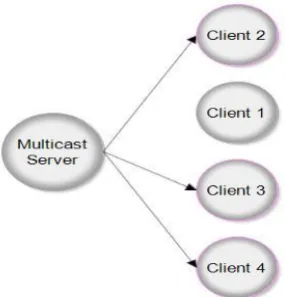
In multicast data, communication the router system are used the IGMP. Broadcast is delivery of High quality video, Bandwidth Efficiency more than unicast communication, during the transmission of the data from server to client systems. Redundant bit are introduced leading to buffering
[image:2.595.364.507.122.271.2]in order to overcome this streaming is adopted, the network is performed the live programs like cricket, audio and video conferences and live radio programs etc.
Figure 1: Multicast Communication
[image:2.595.312.559.489.563.2]IP Broadcast point to group of all receiver points. IP Broadcast over ATM point to multipoint virtual circuits (VCs) as feature of dynamically. It creates the ATM point to multipoint is a switched virtual circuits gives the IP broadcast traffic more efficient. Components required are in hardware are Computer network, switches, Ethernet cable, optical cable, and software are Linux based on Ubuntu OS (version 14.04), Wireshark analyzer to analyses the real time results. VLC Player to streaming the video and audio of Multimedia files. Because of live program connection, oriented network used (RTP) Real time transport protocol like audio and video of live conferences. RTP is Monitor Transmission statistics and quality of service (QOS) and synchronization of multiple streams.
Figure 2: Block diagram of IP Broadcast group.
© 2017, IRJET | Impact Factor value: 5.181 | ISO 9001:2008 Certified Journal | Page 1603
Figure 3: use case diagram for client and server.Figure 4: Client and Server Activity flow diagram
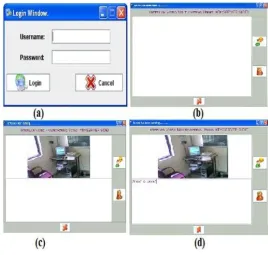
Figure 5: Implemented Server Side Images
[image:3.595.57.564.408.755.2]Server Side: Figure 5 (a) shows Login Window When user want to be login he must enter the Username and Password and the click on login button to login themselves. Figure 5 (b) shows Server Side window After Login. After login in server first window to be displayed. Figure 5 (c) shows Server Side Window This time server would be started and start to transmitting video. Figure 5 (d) shows Server Side Window When Query Inserted After query sending from client side it can be displayed on server side.
[image:3.595.282.565.473.754.2]© 2017, IRJET | Impact Factor value: 5.181 | ISO 9001:2008 Certified Journal | Page 1604
Client Side: Figure 6 (a) shows Client Login window whenuser want to be login he must enter the Username and Password and the click on login button to login themselves, if the user enter the wrong information, he must give the message for his incorrect information. Figure 6 (b) shows New Client Registration Form. Figure 6 (c) shows Client Side Window with Video. Figure 6 (d) shows Client Side Window with Query.
Testing: Aim of testing process is to identify all defects in a software product. Testing is any activity aimed at evaluating the software for quality results it produces and the quality of results it can handle. Testing is an operation to detect the differences between the expected (required) result and the actual result. Testing a program consists of subjecting the program to a test inputs or test cases and observing if the program behaves as expected. If the program fails to behave as expected, then the condition under which failures noted for later debugging and correction. Our goal is to design a series of test cases that would have a high likelihood of finding errors. The software testing techniques provide a systematic guidance for designing tests that exercise the internal logic of software components and exercise the input & output domains of the program to uncover errors in program function, behavior and performance.
Detailed Test Cases:
Te st ID
Name To Be
Tested Steps
Inpu
t Outcome
Expect ed Outpu t Resu lt 01 Userna me Field in Login Enter Userna
me abc Accept Accept Pass
Userna me Field in Login Enter Userna me <bla nk> Error Messa ge Error Messa
ge Pass
Userna me Field in Login Enter Userna me Anu
pam Accept Accept Pass
Userna me Field in Login Enter Userna
me 123 Reject Reject Pass
02 Password Field
Enter Passwo
rd abc Accept Accept Pass
Passwo rd Field Enter Passwo rd <bla nk> Error Messa ge Error Messa
ge Pass
Passwo rd Field Enter Passwo rd mess
age Accept Accept Pass
03 Username Enter Userna abc Pass
Field in Accoun t Creatio n me 04 Userna me Field in Accoun t Creatio n Enter Userna me Anu
pam Accept Accept Pass
Userna me Field in Accoun t Creatio n Enter Userna me <bla nk> Error Messa ge Error Messa
ge Pass
05 Passwo rd Field in Accoun t Creatio n Enter Passwo
rd abc Accept Accept Pass
06 Re-enter Passwo rd Field in Accoun t Creatio n Confir m Passwo rd
abc Accept Accept Pass
07 Passwo rd Field in Accoun t Creatio n Confir m Passwo rd
asd Error Messa ge
Error Messa
ge Pass
Re-enter Passwo rd Field in Accoun t Creatio n Enter Passwo
rd asd Reject
Error Messa
ge Pass
© 2017, IRJET | Impact Factor value: 5.181 | ISO 9001:2008 Certified Journal | Page 1605
exercised using “Black Box” test case design techniques. Inboth cases, the intent is to find maximum number of errors with minimum effort and time, After registering the client, Client window would be displayed. These windows displayed the video captured and transmitted form server side. In addition, the audio should be listen on respective computers. At bottom side there is button for asking the query to server side whenever discussion is in progress. This query should be displayed on server side without disturbing server transmission. Server can give the answer for that query after ending discussion.
Test Case Summary:
Test Case ID
Description
01 To Check whether blank log in is allowed.
02 To Check whether blank password is allowed.
03 To Check if the username already exists.
04 To Check whether blank username is allowed and
to ensure that a unique username is entered.
05 To accept a password from user.
06 To ensure that the user re-enters the same
password and confirms it.
07 To ensure that the password entered by the user is
at least 6 characters long.
5. CONCLUSIONS
RTP server applications transmit captured or stored median streams across the network. The main challenge in designing a video streaming application across the multimedia networks is how to deliver video streams to users with minimal replay jitters with video data security and efficient video data transmission. The media streams might be encoded in multiple media formats and sent out on several RTP sessions for conferencing with heterogeneous receivers. This paper describes a framework for video streaming services using RTP through the client-server network.
6. FURURE SCOPE:
Following are the future enhancements that can be done: a) At College level this application can be work for
teaching in multiple laboratory at single time. b) For purpose of distance learning this application
can be work for attending the lecture from remote place , if we can extends this application for internet also.
c) In future we can developed this application for conducting business meeting and conferences.
d) As build this application for Wireless network then
it work for communicating with video from remote place.
e) After extending this application for internet making
the new era of real time video communication.
f) On internet, our application would works for video
chatting with relatives and friends.
g) Using this application can works for organization
form remote place and do our works with prosperity and effectiveness.
ACKNOWLEDGEMENT
This work has been carried out as a part Master degree in Computer Science Engineering from RKDF Institute of Science and Technology, Hoshangabad Road, Bhopal, Madhya Pradesh. We would like to thanks our family, friends and specially Management, Principal, HOD and all teaching and non-teaching staff of Department for their support and guidelines.
REFERENCES
1) Abdemhim benslimane, “Real-Time Multimedia
Services over Internet”, IEEE, pp 253-261, 2000.
2) sony corporation “Streaming and Recording
Capabilities”, video communication system-technical documentation, vol. 1.1, August 2008.
3) Prof. Nitin. R. Talhar, Prof. Mrs. K. S. Thakare,” Real-time and Object-based Video Streaming Techniques with Application to Communication System”,
International Symposium on Computing,
Communication, and Control (ISCCC 2009) Proc .of CSIT, vol.1, pages 25-29, 2011.
4) Hatem BETTAHAR,” Tutorial on Multicast Video
Streaming Techniques”, 3rd International
Conference: Sciences of Electronic, Technologies of Information and Telecommunications March 27-31, 2005 – TUNISIA.
5) Eugene T. Lin, Christine I. Podilchuk, Ton Kalker,
Edward J. Delp, “Streaming video and rate scalable compression: what are the challenges for watermarking”, 2006.
6) Abhik Majumdar, Igor V. Kozintsev,” Multicast and
Unicast Real-Time Video Streaming Over Wireless LANs”, IEEE transactions on circuits and systems for video technology, vol. 12, no. 6, june 2002.
7) Lei Chen, Chung- wei Lee “Multi-level secure video
streaming over SRTP,” Proceedings of the 43rd ACM Southwest Conference, Kennesaw, GA, USA, March 18-20, 2005.
8) I. Richardson, An overview of H.264 Advanced
Video, [Online]. Available:
© 2017, IRJET | Impact Factor value: 5.181 | ISO 9001:2008 Certified Journal | Page 1606
9) H. Schulzrinne, S. Casner, R. Frederick, and V.Jacob-son, “RTP: A Transport Protocol for Real-Time Ap-plications,” IETF RFC 3550, 2003.
10)M. Baugher, D. McGrew, M. Naslund, E. Carrara, and
K. Norrman, “The Secure Real-time Transport Proto-col (SRTP),” RFC 3711, 2004.
11)C. Perkins, RTP: Audio and Video for the Internet,
Ad-dison Wesley, 2003.
12)H. Schulzrinne, A. Rao, and R. Lanphier, “Real Time
Streaming Protocol (RTSP),” IETF RFC 2326 (proposed standard), Apr. 1998. [Online]. Available: http://www.ietf.org/rfc/rfc2326.txt
13)J. Daemen and V. Rijmen, “AES Proposal: Rijndael,”
February 2002.
14)William Stalling, “Cryptography and network