Performance Evaluation of a New Type of
Polymer Profile Control Agent
Qingwang Liu, Zhe Zhang, Zhenzhong Fan, Jigang Wang
EOR Key Laboratory of the Ministry of Education, Northeast Petroleum University, Daqing City, China Email: [email protected], [email protected], [email protected],
Received 25 March 2015; accepted 30 April 2015; published 5 May 2015
Copyright © 2015 by authors and Scientific Research Publishing Inc.
This work is licensed under the Creative Commons Attribution International License (CC BY).
http://creativecommons.org/licenses/by/4.0/
Abstract
The low-permeability oil and gas resources of our country are quite common and abundant. Their reserve has accounted for one-fifth of total oil reserves of our country, and their yield has consti-tuted the important part of national petroleum annual yield, but its development is very difficult. Polymer gel technology is a technical method of improving sweep efficiency in recent years which substantially increases the viscosity of the polymer solution by adding a crosslinking agent to the polymer produced by intramolecular or intermolecular crosslinking.
Keywords
Low-Permeability, Polymer Gel, Profile Control Agent
1. Preferred Formulations of Profile Control Agent
Profile control agent is made up of main agent, crosslinking agents and additives. The main agent is HPAM; the main raw material of crosslinking agent is chromium chloride; and additive is mainly thiourea [1].
1.1. Determination of Polymer Concentration
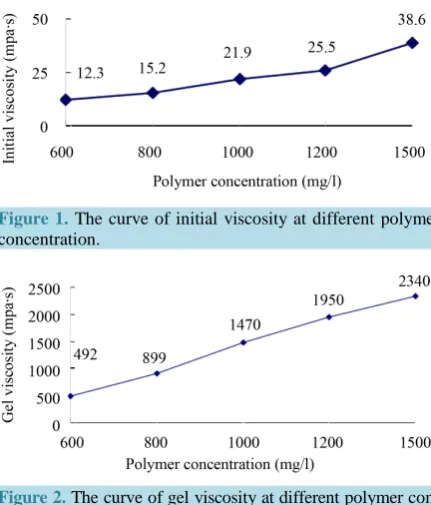
The results show that the solution initial viscosity and gel viscosity heighten with the increase of polymer con-centration. Considering the gel viscosity and actual injection ability, we determine that the suitable polymer concentration is 800 - 1200 mg/L (Figure 1 and Figure 2).
1.2. Development of Crosslinking Agent
Figure 1. The curve of initial viscosity at different polymer
[image:2.595.204.420.84.337.2]concentration.
Figure 2. The curve of gel viscosity at different polymer con-
centration.
suitable pH value of gel formation ranges 6.5 from 8.5. The optimal composition of the crosslinking agent is shown in the Table 1.
1.3. Determination of the Ratio of Crosslinking
When the polymer and the crosslinking agent are confirmed, the ratio of polymer concentration, polymer/cross- linker ratio of the polymer solution is the key factor that affects the gelling properties of the polymer solution. By experiment we found that gel viscosity increased with an increase in crosslinking ratio. Considering gel vis-cosity and economic efficiency, we determine the suitable crosslinking ratio is 15:1 (Figure 3).
1.4. The Determination of Additive Concentration
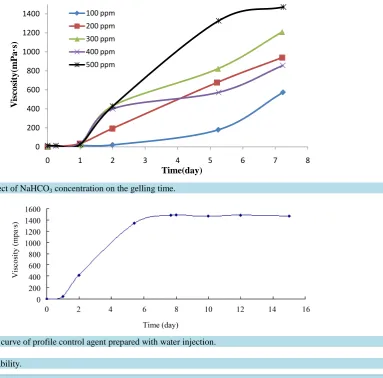
By experiment we found that NaCl and NaHCO3 could adjust the speed of the crosslinking system [2], the high-er the concentration, the fasthigh-er the crosslinking reaction. By exphigh-eriment we found that adding 600 - 800 mg/L NaCl and 500 - 750 mg/L NaHCO3 was the most suitable and the optimal concentration was 1000 mg/L with thiourea as a stabilizer for the gel formulation (Figure 4 and Figure 5).
1.5. The Determination of Profile Control Agent Formulation
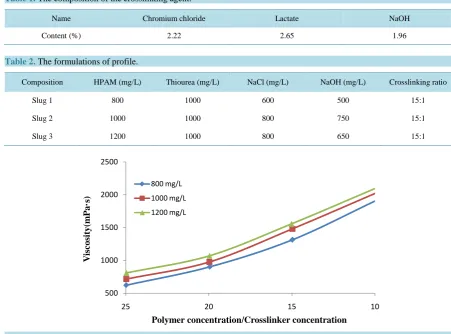
Considering the reservoir permeability, reservoir temperature, injection pressure and other factors, we determine the suitable profile control system formulation as shown in Table 2.
2. Performance Evaluation of Profile Control Agent
2.1. The Compatibility with Injected Water
By experiment we found that polymer prepared by injecting water has a good crosslinking properties with cros-slinker mixed solution, and the crosslinking system also has good compatibility with injected water (Figure 6).
2.2. Rheology
[image:2.595.206.421.89.182.2]Table 1. The composition of the crosslinking agent.
Name Chromium chloride Lactate NaOH
Content (%) 2.22 2.65 1.96
Table 2. The formulations of profile.
Composition HPAM (mg/L) Thiourea (mg/L) NaCl (mg/L) NaOH (mg/L) Crosslinking ratio
Slug 1 800 1000 600 500 15:1
Slug 2 1000 1000 800 750 15:1
[image:3.595.170.531.443.624.2]Slug 3 1200 1000 800 650 15:1
Figure 3. The curve of different crosslinking ratio and gel viscosity.
Figure 4. The effect of NaCl concentration on the gelling time.
similar to plastic non-Newtonian fluid having a yield stress [3]. The gel has large yield stress and high viscosity, which shows that gel has better control of mobility. The shear stability of profile control agent at 70˚C is shown as Table 3.
Experimental results show that the mechanical shear has greater impact on the gel strength, shear viscosity decreased by 50% in the shear conditions, but the viscosity under the shear conditions still meets the fields ap-plication requirements.
500 1000 1500 2000 2500
10 15
20 25
V
is
co
si
ty
(m
P
a
·s
)
Polymer concentration/Crosslinker concentration 800 mg/L
1000 mg/L 1200 mg/L
0 100 200 300 400 500
0 5 10 15 20
V
is
co
si
ty
(m
P
a
·s
)
Time(day) 600 ppm
Figure 5. The effect of NaHCO3 concentration on the gelling time.
Figure 6. The gel curve of profile control agent prepared with water injection.
Table 3. Shear stability.
The concentration of profile control agent (%)
No shear Shear
Initial viscosity
(mPa∙s) Gel viscosity (mPa∙s) Initial viscosity (mPa∙s) Gel viscosity (mPa∙s)
0.5 286 116,300 127 59,765
0.6 398 155,609 156 63,553
Remark: shear speed: 4000 r/min, shear time: 5 min.
2.3. The Effect of Temperature to the Gel Time of the Mixed Solution of
Polymer and Crosslinker
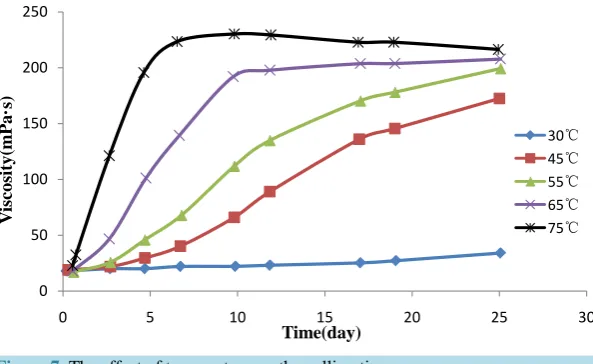
For the study of the effect of temperature to the gel time of the mixed solution of polymer and crosslinker, we placed the mixed solution of polymer and crosslinker in 30˚C, 45˚C, 55˚C, 65˚C, 75˚C environment respectively and measured the viscosity of the solution at different times [4]. The result is shown as Figure 7.
From the figure we found that temperature has great impact on the gel time, the higher the temperature, the shorter the gel time, so the gel time in cryogenic reservoir is much longer than in the mid or high-temperature reservoir for the crosslinking system.
3. Conclusions
1) Through laboratory experiments, we select a suitable formula of profile control agent. Polymer concentra-tion is 800 - 1200 mg/L. Crosslinking ratio is 15:1. Using NaHCO3 and NaCl to control the gelaconcentra-tion time of crosslinking system, their concentrations are 500 - 750 mg/L and 600 - 800 mg/L, respectively. Thiourea is the
0 200 400 600 800 1000 1200 1400
0 1 2 3 4 5 6 7 8
V
is
co
si
ty
(m
P
a
·s
)
Time(day) 100 ppm
Figure 7. The effect of temperature on the gelling time.
stabilizing agent of gel in formula, whose concentration is 1000 mg/L.
2) The crosslinking system formed by the formula has good compatibility and strong rheology with formation water and injected water, and temperature has larger effect on profile control agent.
References
[1] Small, G.P. (1986) Steam-Injection Profile Control Using Limited-Entry Perforations. Society of Petroleum Engineers, 1, 388-394. http://dx.doi.org/10.2118/13607-PA
[2] Li, M.W., Liu, H.F. and Wang, X.L. (2006) Key Techniques of Automatic Gauge Control and Profile Control for Alu-minium Strip and Foil. Transactions of Nonferrous Metals Society of China, 32, 121-126.
[3] Chang-Il, S.O.N. (2012) Diffusion Tensor Interpolation Profile Control Using Non-Uniform Motion on a Riemannian Geodesic. Journal of Zhejiang University Science C (Computers & Electronics), 94, 64-68.
[4] Liu, H.Q., Zhang, H.L., Wang, S.L., Wang, H. and Bao, S.C. (2006) Research on Mechanisms of Steam Breakthrough and Profile Control Design for Steam Soaking Well. Petroleum Science, 3, 82-85.
0 50 100 150 200 250
0 5 10 15 20 25 30
V
is
co
si
ty
(m
P
a
·s
)
Time(day)
30℃
45℃
55℃
65℃