© 2017, IRJET | Impact Factor value: 5.181 | ISO 9001:2008 Certified Journal
| Page 3380
TRACKING AND SIZE ESTIMATION OF MOTION BASED OBJECT USING
MORPHOLOGICAL KEY-POINT DESCRIPTOR (SURF (KEY POINT
DESCRIPTOR)) TECHNIQUE
SHIKHA AGARWAL, ASHUTOSH GUPTA
Shikha Agarwal
Dept. of ECE Engineering , Amity school of Engineering, Noida, India
Ashutosh Gupta Assistant Professor,
Dept. of ECE Engineering , Amity school of Engineering, Noida, India
---***---ABSTRACT -The fundamental research challenge for a
security and observation framework is to make a constant completely self-sufficient framework that is like powerful or robust. In this investigation, a robust approach for real time motion location and tracking in a dynamic scene utilizing a moving video is introduced. The recognition of the moving motion object and the tracking of the distinguished objection are refined utilizing a changed form of the upgraded SURF (KEY POINT DESCRIPTOR) calculation. This incorporates a color highlight additionally to accomplish a more precise and robust outcomes. This approach can track the distinguished protest while reemerging the scene in the wake of being absent for a brief time of 4 or 5 outlines. The standard SURF upgraded SURF (KEY POINT DESCRIPTOR), and the present approach is actualized and the outcomes are looked at for speed and precision.
Keywords: object detection, speeded-up robust features (SURF), object tracking, bounding box etc.
I.INTRODUCTION
Detection and tracking of dynamic objects has turned into a critical field for the right improvement of numerous multidisciplinary applications, for example, movement supervision [1], self-ruling robot route [2,3], and reconnaissance of vast offices [4]. This article is essentially centered around recognition of moving items from ethereal vehicles for reconnaissance, albeit other potential applications could likewise profit by the outcomes. The foundation to dynamic picture examination from moving vehicles can be isolated into four primary themes [5]: foundation subtraction strategies, inadequate elements following techniques, foundation demonstrating systems and robot movement models. Foundation subtraction techniques, for the most part utilized with stationary cameras, isolate frontal area moving items from the foundation [6,7]. Different methodologies utilize stereo difference foundation models [8] for individuals following. Kalafatic et al. [9] propose a continuous framework to identify and track semi inflexible moving items for pharmaceutical purposes that depends on processing meager optical stream along shapes. Zhang et al. [10] utilize polar-log pictures to upgrade the execution of optical stream estimation strategies. In this last case, the optical stream is just processed along the edge of
© 2017, IRJET | Impact Factor value: 5.181 | ISO 9001:2008 Certified Journal
| Page 3381
optical stream as the principle investigation system. Forinstance, Samija et al. [21] utilized a division of the optical stream in an omnidirectional camera. For this situation the development of the camera was known and the vectors of the optical stream were mapped on a circle. Utilizing optical stream strategies, Suganuma et al. [22] exhibited a stereo framework to acquire inhabitance networks and to decide bearing and speed of dynamic items for safe driving conditions. Thus, we have built up another strategy that consolidates ego motion assurance in view of static point highlights with optical stream correlation with decide pixels that have a place with dynamic articles. Chung et al. [20] proposed an edge differencing strategy that would not work for our situation because of the high recurrence vibrations in the development of right now accessible business UAVs. In the interim, our technique just tracks single static elements to decide the development of the camera. Like Sugamanuma et al. [22] we utilize optical streams methods, however rather than a stereo vision framework, we just need a solitary camera to get a rundown of all conceivable dynamic protests in the earth. Samija et al. [21] likewise utilized a solitary camera, yet the development of the camera was known before the optical stream estimation. For our situation the camera movement estimation is acquired with no further sensor. Another favorable position of our strategy is that, because of its numerical effortlessness, it can be executed continuously on the locally available UAV PC.
II.PROBLEM STATEMENT
Automatic detection and tracking of objects is one of the most important topics in designing security system. Especially, detecting object is an essential task for autonomous vehicles. When computer vision is used for this purpose, it becomes a very challenging problem because objects have different appearance and shapes. A simple and powerful tool for this problem is to transform this problem to a binary classification problem, where a local region is classified either a region with object or not with a sliding window strategy. The modified SURF (KEY POINT DESCRIPTOR) algorithm used in this paper utilizes for accurate object tracking purpose with real time operation. In this paper, we take the advantages of SURF (KEY POINT DESCRIPTOR) algorithm for object detection and tracking task on video motion tracking object.
III. SYSTEM MODEL
Object motion Recognition
Speeded Up Robust Feature (SURF (KEY POINT DESCRIPTOR)) is a dynamic improving changes and invariant scale identifier and descriptor for highlight point. The indispensable picture is utilized to SURF (KEY POINT DESCRIPTOR) for decrement of calculation. The whole of all pixels in the chose halfway locale is computed by just
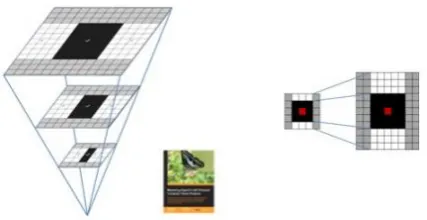
performing four operations. Thusly, when scale space is created, the measure of computational time is decreased [3, 17]. The subsequent stage of protest acknowledgment is rapidly extricating highlights utilizing the extractor in light of an estimation of Hessian network in intrigue focuses. For this situation, the extractor removes the elements of pictures for changing of different scales by resizing the crate channel without changing the picture scale. Figure 1 demonstrates picture pyramid and box channel for extraction of the elements. Hessian framework can be acquired by convolution of the second subordinate of Gabor and middle channel and a picture, and it can be communicated as Equations 1 and 2 [1].
(1)
(2)
[image:2.595.326.540.429.539.2]Where Lxx(X,σ) denotes the convolution of the second derivative of Gabor and Median filter and an input image at the point of X = I(x, y) in an input image having a scale of σ. In addition, Lxy(X,σ) and Lyy(X,σ) are the represented convolution of the second derivative of Gabor filter and an input image for xy
Figure 1: Image pyramid and Box filter
[image:2.595.325.540.626.709.2]direction (diagonal) and y direction (vertical). The method uses the box filter adapted approximation of convolution of the second derivative of Gabor to solve the problem of increasing processing time [18].
Figure 2:Reduction of dimension in feature descriptor.
64-© 2017, IRJET | Impact Factor value: 5.181 | ISO 9001:2008 Certified Journal
| Page 3382
measurement descriptor are not reasonable for continuouscondition since their computational intricacy for removing the component focuses is high. In this manner, the diminishment of measurement in highlight descriptor is important to adequately diminish computational many-sided quality to do object acknowledgment progressively conditions [15]. The lessening of measurement in highlight descriptor is utilized for ascertained course vector through scale s to decide overwhelming introduction and extending its window to π/2 for estimation of precise predominant introduction by a great deal of directional data. The rectangular window is isolated 3×3 sub-district and afterward sub-locales are re-partitioned into 5×5 sub-area. In Equation 3, 18(3×3×2)- measurement highlight descriptor
in sectioned locales makes up two element vectors.
(3)
The sum of the Haar wavelet which responses in horizontal (dx) and vertical (dy) directions are calculated. Since the Haar response is robust lighting condition, the proposed method decreases computation complexity and is also lighting invariant.
IV. PROPOSED METHOD
The proposed technique adds a color highlight to the improved SURF (KEY POINT DESCRIPTOR) calculation to make it more hearty. Video clippings of street activity recorded utilizing a camera mounted on moving vehicle are utilized for this examination. To begin with, the casings of the info video are perused. The color highlight of the protest is distinguished and put away by changing over the color from RGB to YCbCr color space. At that point the element purposes of the moving article are identified and separated between the contiguous casings utilizing the upgraded SURF (KEY POINT DESCRIPTOR) locator. The intrigue focuses are then encompassed with a rectangle box. This container is sent with its directions to the upgraded SURF (KEY POINT DESCRIPTOR) coordinating calculation to discover a match in the resulting outlines. The improvement of SURF (KEY POINT DESCRIPTOR) diminishes the quantity of the identified intrigue focuses. Likewise, it confines the way to deal with distinguish more grounded elements by changing the window measure for the scope of the non-most extreme concealment. The non-greatest concealment was connected in 7 x 7 x 3 neighborhood to diminish the quantity of highlight focuses identified and to disentangle the computations in this approach. The intrigue focuses are the focuses that are the extrema among 48 neighbors in the present level and the 2 x 49 in the level above and beneath in an octave.
Key point is the technique that is utilized to ascertain the introduction of an element point. The Key point covers an edge of 60o by moving around a round locale. The Haar wavelet is ascertained inside the round window for the even dx and vertical dy directions. The two summed vectors
decide the introduction of the element point. The sliding window moving stride is 5o and that produces many covered locales in which entirety of the reaction are figured more than once. For example, accept that the principal sliding spreads 0-60o and ascertains the Haar wavelet for the locale. At that point the following movement is for 5-65 degrees that yield a cover of 5-60o degree districts for which the reaction is as of now computed. Computation of the aggregate of level and vertical Haar wavelet reactions individually at every degree for (0-360) and store them in x[360] and y[360].
Calculate the integral of X[i] and Y[i] respectively, denoted by Dx[i] andDy[i] as given in equation (1).
(1)
The same process works for calculating, Dy[i]. The second step is to calculate the Haar wavelet responses in the 60 degree sensor region using equation (2).
(2)
After calculation of the sumy [i] by following the same step for sumx [i], the local orientation of the vector[i] is
The length of the local vector is given by equation (3).
(3)
Then choose the one vector with the maximum length. The dominant orientation of the feature points is the longest local orientation vector over all the windows. The shifting step for the sliding window is calculated at each degree.
© 2017, IRJET | Impact Factor value: 5.181 | ISO 9001:2008 Certified Journal
| Page 3383
on the grounds that the calculation will check for the shadingsegment of the protest in the following casing.
1.
Descriptor Computation
Each tracked feature descriptor is figured from the present rundown of followed intrigue focuses like in the SURF (KEY POINT DESCRIPTOR) calculation. As a result of the decoupling, we can pick not to register any descriptors whatsoever and utilize the SURF (KEY POINT DESCRIPTOR) calculation just as a tracker. At the point when descriptors are required, we guarantee a smooth casing rate by putting the new intrigue focuses in a need line and figuring their descriptors when the time spending plan permits. Likewise, on the grounds that the followed focuses may out-experience the vigor of the descriptors, particularly on the grounds that the intrigue focuses are not relative invariant, we nullify old descriptors and place them in the need line to be invigorated.
2.
Bounding box
The object of interest is defined by a bouncing box in a solitary casing. Jumping box at the same time tracks the object, takes in its appearance and recognizes it at whatever point it shows up in the video. The outcome is an ongoing following that regularly enhances after some time. Following articles through profoundly jumbled scenes is troublesome. Following turns into a testing errand under the accompanying spry moving articles, within the sight of thick foundation mess, probabilistic calculations are basic. Calculations in light of Gabor channel have been restricted in the scope of likelihood appropriations which speak to Boundary-based methodologies are additionally alluded to as edge-construct approaches depend with respect to the data given by the object limits.
3. Improved Bounding box with SURF (KEY POINT
DESCRIPTOR) Method
Input: Template video (image) Output: Location of the target
1. Begin
2. Read the Template video and the first frame of the video (image) sequence, calculate the location of the target using SURF (KEY POINT DESCRIPTOR) method;
3. Calculate the color distance of the Template image; calculate the thresholds of S and V;
4. while next frame do
5. Update the size and the location of the search Video/image
6. Calculate Euclidian distance 7. IF Euclidian distance < 0.5 then 8. Apply Bounding box and Gabor filter 8. Target lost, recalculate the location using SURF (KEY POINT DESCRIPTOR)
9. End IF
10. End While 11. End
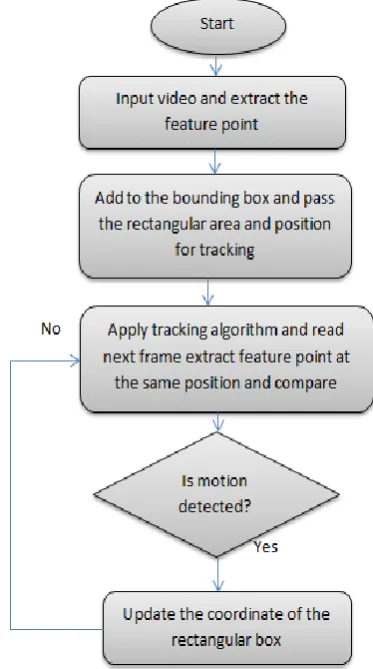
[image:4.595.340.527.243.578.2]Above steps shows the process of our algorithm. When the object is lost, SURF (KEY POINT DESCRIPTOR) is used to search in the whole image to match the target. When matching points are found, the center of the points is calculated and the search window is located around it under such a method, the system can gain good real time characteristic as well as robustness.
Figure 3: Proposed flow chart
V.RESULT
© 2017, IRJET | Impact Factor value: 5.181 | ISO 9001:2008 Certified Journal
| Page 3384
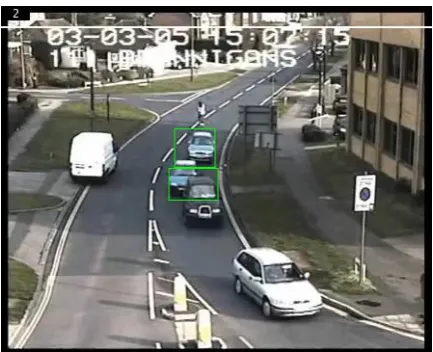
row. The center of the green line corresponds to the position [image:5.595.53.270.143.317.2]information gained by the collecting step after the particle update.
Figure 4: Input Original video
[image:5.595.324.543.144.321.2]As part of this research, we had to implement a Key point descriptor tracking device that runs entirely on software. Designing things, especially useful things on a piece of software takes effort and time.
Figure 5: Frame of bounding box
We calculate the size of input video sequence to determine the total number of rows and columns and apply tracking steps through over all image frames of input video sequence. In order to verify the accuracy of proposed method, we have calculated the centroid and boundary of a tracked object using proposed method and then compare it with the centroid and boundary which we have calculated manually and also with previous algorithm. For this reason, we determine the four corners of tracked objects’ boundary and centroid in both ways. we have presented the comparison of tracking only single object of proposed method with manual calculation, where we represent the L, R, T and B as the corners of the boundary. Here L, R, T, B indicates four
[image:5.595.53.270.408.584.2]boundary properties, where L=Left, R=Right, T=Top, B=Bottom, Cx =Value of centroid at X axis, Cy =Value of centroid at Y axis.
Figure 6: Key point of object using SURF or key descriptor
Speeded Up Robust Feature for key descriptor is a robust brightness changes and invariant scale detector and descriptor for feature point. The integral image is used to SURF (KEY POINT DESCRIPTOR) for decrement of computation. The sum of all pixels in the selected partial region is calculated by only performing four operations. Therefore, when scale space is generated, the amount of computational time is reduced. The next step of object recognition is quickly extracting features using the extractor based on an approximation of matrix in interest points. In this case, the extractor extracts the features of images for changing of various scales by resizing the box filter without changing the image scale. Figure 1 shows image pyramid and box filter for extraction of the features.
Figure 7: Video image Threshold
[image:5.595.323.545.529.704.2]© 2017, IRJET | Impact Factor value: 5.181 | ISO 9001:2008 Certified Journal
| Page 3385
can calculate the first and second moment of distribution of [image:6.595.323.549.84.319.2]intensity in the search window.
Figure 8: Final output
As shown in above figure we show the final output as motion detected in input image.
Figure 9: precision and recall
Precision and recall are the basic measures used in evaluating search strategies.
RECALL approach is the fraction of the no. of applicable records recovered to the total no. of appropriate records in the database. It is typically communicated as a percentage.
PRECISION is the ratio of the number of relevant records retrieved to the total number of irrelevant and relevant records retrieved. It is usually expressed as a percentage.
[image:6.595.53.271.129.310.2]In the diagram beyond, the two outlines might signify the performance of dissimilar search schemes. While the exact slope of the curve may vary between systems, the general inverse relationship between recall and precision remains.
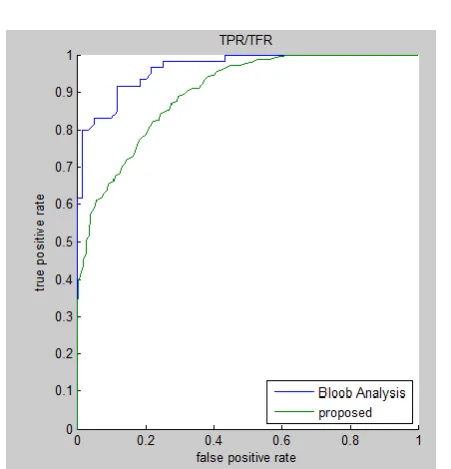
Figure 10: True positive rate over false positive rate
This paper adopts the method based on surf (Key point descriptor) algorithm to extract the background, combining the background subtraction and surf (Key point descriptor) algorithm. It can solve the problem, which building the background modeling is difficult in the process of classical background subtraction and update is not in real time. This paper also introduces the concept of whole background moreover ensures that the detected moving target information is integrated and accurate, so that can effectively avoid the occurrence of capitation moving targets.
VI.CONCLUSION
We presented the SURF (Key point descriptor) algorithm, an efficient method for tracking scale-invariant interest points without computing their descriptors. We also demonstrate a framework for outdoor tracking using SURF and achieve near real-time performance on moving video while tracking and recognizing the scene objects at the same time. Our framework has large potential for improvement for outdoor object motion reality applications. We would like to investigate better methods for tracker initialization and recovery, minimize speed disruption when the sub-graph querying strategy fails, and experiment with more sophisticated motion estimation methods.
REFERANCES
[1] Gao, T.; Liu, Z.; Yue, S. Traffic video-based moving vehicle detection and tracking in the complex environment. Cyber. Syst. 2009, 40, 569–588.
[image:6.595.51.272.370.554.2]© 2017, IRJET | Impact Factor value: 5.181 | ISO 9001:2008 Certified Journal
| Page 3386
Environment. In Proceedings of IEEE 14th InternationalConference on Advanced
Robotics, Munich, Germany, 22–26 June 2009; Volume 1, pp. 297–302.
[3] Hashimoto, M.; Takahashi, K.; Matsui, Y. Moving-Object Tracking with Multi-Laser Range Sensors for Mobile Robot Navigation. In Proceedings of IEEE International Conference on
Robotics and Biomimetics, Hainan, China, 15–18 December 2007; Volume 1, pp. 399–404.
[4] Ahn, J.H.; Choi, C.; Kwak, S.; Kim, K.; Byun, H. Human tracking and silhouette extraction for human-robot interaction systems. Pattern Anal. Appl. 2009, 12, 167–177.
[5] Talukder, A.; Matthies, L. Real-Time Detection of Moving Objects from Moving Vehicles Using Dense Stereo and Optical Flow. In Proceedings of IEEE/RSJ International Conference on Intelligent Robots and Systems (IROS 2004), Sendai, Japan, 28 September–2 October 2004; Volume 4, pp. 3718–3725.
[6] Collins, R.; Lipton, A.; Fujiyoshi, H.; Kanade, T. Algorithms for cooperative multisensory surveillance. Proc. IEEE 2001, 89, 1456–1477.
[7] Cheung, S.C.S.; Kamath, C. Robust background subtraction with foreground validation for urban traffic video. EURASIP J. Appl. Signal Process. 2005, 2005, 2330–2340.
[8] Eveland, C.; Konolige, K.; Bolles, R. Background Modeling for Segmentation of Video-Rate Stereo Sequences. In Proceedings of IEEE Computer Society Conference on Computer Vision and Pattern Recognition, Santa Barbara, CA, USA, 23–25 June 1998; pp. 266–271.
[9] Kalafatic, Z.; Ribaric, S.; Stanisavljevic, V. Real-Time Object Tracking Based on Optical Flow and Active Rays. In Proceedings of 10th Mediterranean Electrotechnical Conference (MELECON 2000), Lemesos, Cyprus, 29–31 May 2000; Volume 2, pp. 542–545.
[10] Zhang, H.Y. Multiple Moving Objects Detection and Tracking Based on Optical Flow in Polar-Log Images. In Proceedings of 2010 International Conference on Machine Learning and Cybernetics (ICMLC), Qingdao, China, 11–14 July 2010; Volume 3, pp. 1577–1582.
[11] Hall, D.; Nascimento, J.; Ribeiro, P.; Andrade, E.; Moreno, P.; Pesnel, S.; List, T.; Emonet, R.; Fisher, R.; Victor, J.; Crowley, J. Comparison of Target Detection Algorithms Using Adaptive Background Models. In Proceedings of 2nd Joint IEEE International Workshop on Visual Surveillance and Performance Evaluation of Tracking and Surveillance, Beijing, China, 15–16
October 2005; pp. 113–120.
[12] Franke, U.; Heinrich, S. Fast obstacle detection for urban traffic situations. IEEE Trans. Intell. Transp. Syst. 2002, 3, 173–181.
[13] Braillon, C.; Pradalier, C.; Crowley, J.; Laugier, C. Real-Time Moving Obstacle Detection Using Optical Flow Models. In Proceedings of 2006 IEEE Intelligent Vehicles Symposium, Tokyo, Japan, 13–15 June 2006; pp. 466–471.
[14] Leslar, M.; Wang, J.; Hu, B. Comprehensive utilization of temporal and spatial domain outlier detection methods for mobile terrestrial lidar data. Remote Sens. 2011, 3, 1724– 1742.
[15] Tissainayagam, P.; Suter, D. Object tracking in image sequences using point features. Pattern Recogn. 2005, 38, 105–113.
[16] Milella, A.; Siegwart, R. Stereo-Based Ego-Motion Estimation Using Pixel Tracking and Iterative Closest Point. In Proceedings of 2006 IEEE International Conference on Computer Vision Systems (ICVS ’06), New York, NY, USA, 5–7 January 2006; pp. 21–21.
[17] Konolige, K.; Agrawal, M.; Bolles, R.; Cowan, C.; Fischler, M.; Gerkey, B. Outdoor Mapping and Navigation Using Stereo Vision. In Proceedings of 10th International Symposium on Experimental Robotics 2006 (ISER ’06), Rio de Janeiro, Brazil, 6–10 July 2006; pp. 179–190.
[18] Jia, Z.; Balasuriya, A.; Challa, S. Sensor fusion-based visual target tracking for autonomous vehicles with the out-of-sequence measurements solution. Robot. Auton. Syst. 2008, 56, 157–176.
[19] Miller, A.; Babenko, P.; Hu, M.; Shah, M. Person Tracking in UAV Video. In Multimodal
Technologies for Perception of Humans; Stiefelhagen, R., Bowers, R., Fiscus, J., Eds.; Lecture Notes in Computer Science; Springer: Berlin/Heidelberg, Germany, 2008; Volume 4625, pp. 215–220.
[20] Huang, C.H.; Wu, Y.T.; Kao, J.H.; Shih, M.Y.; Chou, C.C. A Hybrid Moving Object Detection Method for Aerial Images. In Advances in Multimedia Information Processing (PCM 2010); Qiu, G., Lam, K., Kiya, H., Xue, X.Y., Kuo, C.C., Lew, M., Eds.; Lecture Notes in Computer
Science; Springer: Berlin/Heidelberg, Germany, 2010; Volume 6297, pp. 357–368.