© 2017, IRJET | Impact Factor value: 5.181 | ISO 9001:2008 Certified Journal
| Page 2503
Bellman Ford Shortest Path Algorithm using Global Positioning System
Ms. Kalpana , Mr. Abhishek Tyagi
Student, CSE, CET-IILM-AHL, U.P., INDIA
---***---
ABSTRACT-
Bellman ford Algorithm is used to find the shortest path from one node to another node in a graph. It can be applied on negative weights. In this paper, Global positioning system is used for adding a new functionality in Bellman ford algorithm. In this paper, using Global Positioning System the position parameter is added in the Bellman ford algorithm. From this current position is retrieved at any point. By using this current position, the distance can be determined from one node to another node. For this an algorithm is proposed and the algorithm is compared with Dijkstra’s algorithm which is also used to find out shortest path.Keywords-
Global positioning system (GPS), Bellman ford Algorithm, Dijkstra’s Algorithm, Node and Distance.1. INTRODUCTION
In this we discuss three things, these are:
1.1
Global positioning system(GPS)
The Global Positioning was introduced in 1960 under the auspices of the U.S. Airforce, but in 1974 other branches of the U.S. military joined the effort.
The Global Positioning System consist of 24 satellites, to provide worldwide position, time and velocity information. GPS makes it possible to precisely identify locations on the earth by measuring distance from the satellites.
GPS is used in a variety of ways:
To determine the position of locations.
To navigate from one location to another.
To create digitized maps.
To determine the distance between two points.
1.1.1 Working of GPS
The basis of GPS is a constellation of satellites that are continuously orbiting around the earth. These equipped with atomic clocks & radio signals that contain their exact location, time and other information. The radio signals which are transmitted from the satellites are monitored & corrected by control stations which are sent back to satellites using ground antenna. The radio signals from satellites are picked up by the GPS receiver. A GPS receiver needs only 3 satellites to plot a rough, 2D position, which will not be very accurate. Ideally, 4 or more satellites are needed to plot 3D positions, which is more accurate than 2D.
1.1.2 Three segments of GPS
© 2017, IRJET | Impact Factor value: 5.181 | ISO 9001:2008 Certified Journal
| Page 2504
1. Space segment: The satellites orbiting around the earth.2. Control segment: The control and monitoring stations.
3. User segment: The GPS recievers owned by civilians and military.
In this paper we use the GPS in Dijkstra’s algorithm for finding the current location. By using this position we calculate the distance from source to every node in the graph. From this, we also estimate the shortest path. Distance is given by a formula:
Distance= [(x2-x1)2 + (y2-y1)2+ (z2-z1)2]1/2
1.2 Bellman ford Algorithm
Bellman ford Algorithm solves the single source shortest path problem in the general case in which edges of a given digraph can have negative weights as long as G contains no negative cycles.This algorithm, like Dijkstra’s Algorithm uses the notion of edge relaxation but doesn’t use with greedy method. Again, it uses d[u] as an upper bound on the distance d[u,v] from u to v.
1.3 Dijkstra Algorithm
Dijkstra Algorithm is invented by Dutch computer scientist Edsger Dijkstra in 1956 and published in 1959, is a graph based searching algorithm that solves the single source shortest path problem. It is applied only on positive weight graphs. This algorithm is often used in routing. Dijkstra’s Algorithm is used for finding the shortest path with minimum cost.
2. RELATED WORK
GPS is used for tracking your vehicles and keeps regular monitoring. This tracking system can tell your location and that information can be observed from another remote location.Currently, Dijkstra’s Algorithm is used to finding the shortest path in global positioning system.The concept developed is focused on one of the most well known shortest path algorithm: the Bellman Ford algorithm. Although the latter using Dijkstra’s algorithm is sufficiently enough for large networks ,but Belllman Ford algorithm provides more efficiency in terms of nodes covered or path travelled.
Location based services offer many benefits to mobile user to retrieve the information about their current location & process that data to get more useful information near to their location. Using a GPS assisted phone & a web service using GPRS ,location based services can be implemented on Android based smart phones to provide services like advising client of current traffic conditions, providing routing information , helping them find nearby hotels. In paper location based services is implemented through Google Web Services & Walk Score Transit APIs on Android Phones to give multiple services to the user based on their location.
3. PROPOSED WORK
In this paper, we use bellman ford Algorithm for GPS to find shortest path instead of Dijkstra’s Algorithm. In this we find a shortest path from a source node(u in a graph) to destination node(v in a graph) and also compare our Algorithm with other shortest path algorithms such as dijkstra’s Algorithm. In this paper we give only the theoretical ideas about this process.
© 2017, IRJET | Impact Factor value: 5.181 | ISO 9001:2008 Certified Journal
| Page 2505
Fig.23.2 PROPOSED ALGORITHM
© 2017, IRJET | Impact Factor value: 5.181 | ISO 9001:2008 Certified Journal
| Page 2506
Table 1.For Finding the Shortest Path Using Dijkstra’s Algorithm.Table 2. For Finding the Shortest Path Using Bellman Ford Algorithm.
4. RESULT & ANALYSIS
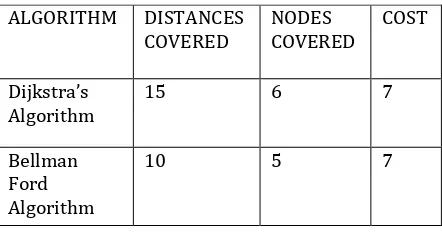
In this section, we have shown results of finding shortest path by using Dijkstra’s and Bellmanford Algorithm.
Comparative analysis is also done to show which algorithm works better.
Table 3.Comparative Analysis
5. CONCLUSION & FUTURE SCOPE
In this paper, Bellman Ford Algorithm is used to find out the shortest path in a graph and is compared with Dijkstra’s Algorithm. This provides more efficient path for GPS. Practical implementation & analysis is not given in this paper. So, in future you can implement this algorithm practically. This concept of GPS is also used on others shortest path algorithms like A* & Warshal’s algorithm etc.
STEPS N POSITIO
N DISTANCE D(B),PATH D(C),PATH D(D),PATH D(E),PATH D(F),PATH
1 {A} (2,3) 0 3,A-B 5,A-C ,- ,-
2 {A,B} (5,7) 5 3,A-B 4,A-B-C 5,A-B-D 4,A-B-E
3 {A,B,C} (8,11) 10 3,A-B 4,A-B-C 5,A-B-D 4,A-B-E
4 {A,B,C,E} (11,15) 15 3,A-B 4,A-B-C 5,A-B-D 4,A-B-E 7,A-B-E-F
5 {A,B,C,D,E} (14,19) 20 3,A-B 4,A-B-C 5,A-B-D 4,A-B-E 7,A-B-E-F
6 {A,B,C,D,E} (17,23) 25 3,A-B 4,A-B-C 5,A-B-D 4,A-B-E 7,A-B-E-F
STEPS N POSITIO
N DISTANCE D(B),PATH D(C),PATH D(D),PATH D(E),PATH D(F),PATH
1 {A} (2,3) 0 3,A-B 4,A-C ,- ,-
2 {A,B} (5,7) 5 3,A-B 4,A-B-C 5,A-B-D 4,A-B-E
3 {A,B,C} (8,11) 10 3,A-B 4,A-B-C 5,A-B-D 4,A-B-E
4 {A,B,C,E} (11,15) 15 3,A-B 4,A-B-C 5,A-B-D 4,A-B-E 7,A-B-E-F
5 {A,B,C,D,E} (14,19) 20 3,A-B 4,A-B-C 5,A-B-D 4,A-B-E 7,A-B-E-F
6 {A,B,C,D,E} (17,23) 25 3,A-B 4,A-B-C 5,A-B-D 4,A-B-E 7,A-B-E-F
ALGORITHM DISTANCES
COVERED NODES COVERED COST
Dijkstra’s
Algorithm 15 6 7
Bellman Ford Algorithm
[image:4.595.188.409.556.673.2]© 2017, IRJET | Impact Factor value: 5.181 | ISO 9001:2008 Certified Journal
| Page 2507
6. REFERENCES
[1] Pooja Singal, R.S. Chillar “Dijkstra’s Shortest Path Algorithm using Global Positioning System”, International journal of Computer Applications Vol-101,Number-6,sept-2014.
[2] Introduction to GPS (Wikipedia)
[3] Pankaj Verma , J.S Bhatia , “Design And Development Of GPS-GSM Based Tracking System With Google Map Based
Monitoring”, International Journal of Computer Science, Engineering and Applications (IJCSEA) Vol.3No.3,june 2013.
7. BIOGRAPHIES
This is Kalpana. I am pursuing final year B.Tech in the department of ComputerScience&Engg.,in CET-IILM-AHL, of AKTU. I’ve maintained consistency in academics since my schooling .I like to participate in talent events. Though I am strong in my academics, I had no interest in research, but I have developed this habit for past 1 year.