© 2017, IRJET | Impact Factor value: 6.171 | ISO 9001:2008 Certified Journal | Page 434
FEEDBACK PREDICTABLE ROBOT BASED ON BIG DATA
Mrs. G.Sangeetha Lakshmi
[1], Ms. C.Vinodhini
[2], Ms. Indhumathi
[3][1]
Assistant Professor, Department of Computer Science and Applications, D.K.M College for Women (Autonomous),
Vellore, Tamilnadu, India.
[2]
Research Scholar, Department of Computer Science and Applications, D.K.M College for Women (Autonomous),
Vellore, Tamilnadu, India.
[3]
Research Scholar, Department of Computer Science and Applications, D.K.M College for Women (Autonomous),
Vellore, Tamilnadu, India.
---***---
Abstract
-
Existing robots only try to give reasonable answers to users, not considering if the answer can make user happy or not. This paper proposed a new kind of robot, predictable robot. Predictable robot does not like existing robots which always select answers for users according to the truth, predictable robot select answers for users mainly according to the user preferences in order to make user happier. The main idea of predictable robot is to predict the user feedbacks for answers based on the big data of the user past feedbacks detected by the predictable robot.Keywords:
Predictable robot, big data, feedback data,feedback prediction.
1. INTRODUCTION
There are many kinds of robots.1–4 Chat robot is one kind of robot which can talk with human.5 There are many researches on chat robot mainly focusing on how to make robots understand more about human languages,6,7 how to apply chat robot to online information system,8 and how to apply chat robot to special applications. The goal of the general chat robots is to a reasonable answer for user's question. However, the reasonable answer is not always the answer users prefer. For example, if you ask a chat robot \Am I beautiful?" The chat robot will scan your photo, and tell you the truth. The truth maybe \You are ugly". Then, you will be angered by the answer. Certainly, the existing chat robots generally search the appropriate answers in the answer database, and not get the user personal information to make a personalized answer. So, the general chat robots cannot predictable. However, predictable is an ability of human. In some time, kind predictable is not a bad thing. For example, if your girl friend asks you \If I am beautiful?" I be predictable you will always answer \Sure, you are very beautiful". Even if it is a predictable, it can make your girl friend happy! So, this paper proposes a new kind of robot, predictable robot, which answers questions just like human not always according to the truth, but according to the user preferences. How can a predictable International Journal of Pattern Recognition and Artificial Intelligence robot know users' preferences? From users past feedbacks! For
example, if the robot answers \You are ugly", the answer will make you angry, and if the robot answers \You are beautiful", the answer will make you happy. It is obviously, the latter answer is not true, is a predictable, however, the latter answer can make you happier, which is a better feedback. Thus, the latter answer will be selected for you by predictable robot. It is obviously, predictable robot is a kind heart robot and more like human, for predictable robot wants to make human users happier. Humor robot is a kind of robot which can make human happier.10–16 However, the existing humorous computing technology has just started, humor generation ability is still very junior, and the humorous computing technology is applied to only a few chat robots, and the application of the humorous computing technology in the field of robots is still in the conceptual stage. There are also many researches on emotional robot, mainly focusing on how to identify and express emotions; 17–22 however, existing emotional robots have no ability to predictable.
2. BASIC IDEA OF PREDICTABLE ROBOT BASED
ON BIG DATA
[image:1.612.328.581.584.709.2]Although the user's preferences slightly change over time, the preference of the same user is relatively stable, and thus the user's response to the answers of a question in the past and the user's response to the answers of the question in the current are basically consistent. So, it is reasonable to predict the user's current feedback based on the user's past feedbacks.
© 2017, IRJET | Impact Factor value: 6.171 | ISO 9001:2008 Certified Journal | Page 435
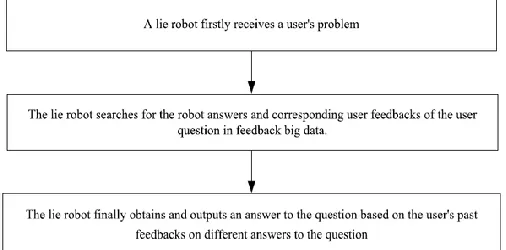
As shown in Fig. 1, a predictable robot first receives a user's problem such as \Am I beautiful?". Expected answers include \yes" or \no" or other expressions such as nodding or shaking his head. Then, the predictable robot searches for the robot answers and corresponding user feedbacks of the user question in feedback big data. The user's feedback on the answer represents the user's preferences. The predictable robot finally obtains and outputs an answer to the question based on the user's past feedbacks on different answers to the question and the user's past feedbacks on the answers to the question represent the user's preference. The answer can be expressed in a text, a video, voice or face expression.
3. FEEDBACK PREDICTION BASED ON BIG DATA
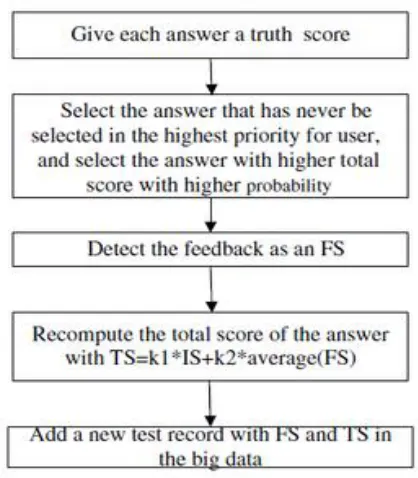
The goal of predictable robot in this paper is to find an answer that can make users happy. So, there should be a method to predict the user feedbacks to different kinds of answers, so that predictable robot can select the answer with the best feedback for user. Just like human, children always predictable little and they know little about the feedbacks of different answers. For example, when a girl asks a boy \If I am beautiful?", for the first time, the boy may tell the truth \You are ugly", the girl will sorrow and cry, which makes the boy upset, and for the second time, another girl asks the boy the same question, the boy will answer \You are beautiful", the girl will be happy and may give the boy a kiss. It is obvious, after that, when other girls ask the boy the same question, the boy will always answer \You are beautiful". From the human experience, we can learn that the feedback prediction is based on history feedback detection. The method is simple and effective for human, so will also effective for robot, as shown in Fig. 2.
[image:2.612.345.554.88.327.2]In the beginning, predictable robot just like the general chat robot has no feedback prediction ability. So, for the first time, when user asks predictable robot a question, predictable robot will select the truest answer or randomly select an answer from the answers' list just like the general chat robot. Then, predictable robot will detect the feedback of the user, which is a new step different from the general chat robot. For example, predictable robot can detect the user's face by \eye" and the user's sound by \ear". If the user laughs or smiles and so on, the feedback is happy; if the user cries and so on, then the feedback is unhappy.
Fig. 2. Feedback prediction method.
© 2017, IRJET | Impact Factor value: 6.171 | ISO 9001:2008 Certified Journal | Page 436
three different approaches have different results. In the first approach, the truth score of each answer is equal, so the future feedback prediction will be solely decided by the history feedback detection. In the second approach, the trust answer will be selected in the first run with high priority, and in the latter run, the truth score will also affect the total score a little. In the third approach, the truth degree of answers will also affect the total score a little, but not much, for each truth score is between _1 and 1. The absolute value of truth score is set less than 1 in order to make the truth score not to affect the total score a lot. Thus, in the third approach, the answer selection mainly depends on the user history feedbacks, and also considers a little about the truth of the answer. That is to say, when the feedbacks of two answers are different, we will select the answer with higher feedback score, and when the feedbacks of two answers are same, we will select the truer answer. Situation can also be changed when we want to increase the importance of the truth degree of answer, which will be considered in the following. After truth score is given, predictable robot can be put into use. In the usage process, when an answer is selected for a user, the user feedback score of the answer will be recorded into the feedback big data. For example, there are questions q1; q2; q3; . . . ; qi; . . . ; qm, and for qi, there are answers ai1; ai2; ai3; . . . ; ain, and for ai2, there are scores 0:3; 3; 2; 2; 3; 1, and for ai5, there are scores 0;_1;_2; 0. In the ai2 score, the first score 0.3 is the truth score, the scores 3; 2; 2; 3; 1 are the feedback scores of the five times when the answer is selected. In this situation, the total score should be 0:3 * k1 + (3 + 2 + 2 + 3 + 1) = 5 * k2, in which k1 and k2 decide the predictable robot how to balance between the truth degree and the user preferences when selecting an answer. When k1 = k2 = 1, the total score is 0:3 + 2:2 = 2:5. In ai5 score, the first score 0 is the truth score, the scores 0;_1;_2; 0 are the feedback scores of the five times when the answer is selected. In this situation, the total score should be 0 * k1 + (-1 - 2 + 0)/3 * k2. When k1 = k2 = 1, it is 0 -1 = -1. From the above example, we can conclude that total score (TS) of an answer is equal to the truth score (IS) multiple k1 add the average of feedback scores (FS) multiply k2. When k1 = k2 = 1, the FS is the key factor which can decide the feedback prediction result, and IS is the second factor which has affection when the FS of answers are the same, for we have set the absolute value of truth score less than 1 in order to make the truth score not to affect the total score a lot. If we do not want to consider the truth of an answer, then we can set k1 ¼ 0. We can also increase k1 to increase the affection of the truth of answers, for example, if 0 <= IS <= 1,0 <= FS <= 10; k1 = 10; k2 = 1, the affection of truth and history feedback will be the same to feedback prediction.
4. FIRST APPROACH OF PREDICTABLE ROBOT
When predictable robot needs to answer a question, predictable robot will first search the best match question (such as q5) from the big data. Then, the predictable robot will select an answer from the answers (such as a51; a52; a53; a54; a55; a56) of the question (q5) according to the total score of every answer (such as 3:2; 4:1; 0; 5:2;_0:3;_2). How to select? If predictable robot selects only the answer with the current highest score, then maybe other answers have no chance to be selected, however some answers not selected can maybe achieve higher feedback score than the answers selected. For example, in practice, for the first time of a predictable robot, IS(a31) = 0, IS(a32) = 1, IS(a33) = 0, IS(a34) = 0,FS(a31) = 0, FS(a32) = 0, FS(a33) = 0, FS(a34) = 0, and TS = k1 * IS + k2 * FS, in which 0 <= TS <= 1, 0 <= FS <= 10, k1 = k2 = 1, so TS(a31) = 0, TS(a32) = 1, TS(a33) = 0, TS(a34) = 0. Then, TS(a32) is max, so a32 will be selected for the user.
If the user feedback is 4, then TS(a31) = 0, TS(a32) = 1 + 4 = 5, TS(a33) = 0, TS(a34) = 0. So the second time and even forever a32 will be selected for the user, and no chance for a31; a33; a34 to be selected, even if FS(a33) is 8, however a33 has no chance to be selected forever.
5. SECOND APPROACH OF PREDICTABLE ROBOT
© 2017, IRJET | Impact Factor value: 6.171 | ISO 9001:2008 Certified Journal | Page 437
6. THIRD APPROACH OF PREDICTABLE ROBOT
In order to solve the problem of the second approach, predictable robot should have a better method to select answer after the first turn. Predictable robot can regard TS not as a value but as a priority for selecting, then all answers no matter with high TS or with low TS have chance to be selected, and the higher TS has higher opportunity to be selected. Then, even if TS of an answer is misdirected by past user occasional mood, the TS of the answer still has chance to be corrected in future when more users' feedbacks are detected and recorded. For example, if a32 is selected in chance after the first turn, then TS(a31) = 0 + 3 = 3, TS(a32 Þ = 1 + (4 + 3)/2 = 4:5, TS(a33) =0 + 2 = 2, TS(a34) = 0 - 1 = -1, and then after many times, TS(a31) = 0+(3 + 2 + 3 + 1)=3 = 3, TS(a32) = 1 + (4 + 3 + 3 + 3 + 5 + 4 + 4 + 5 + 3 + 5 + 5 + 6 + 5 + 4 + 4 + 4 + 4 +3 + 6 + 4 + 3 + 5)/22 = 4:2, TS(a33) = 0+(2+2+2)/3 = 2, TS(a34) = 0-1=-1, and then a34 is selected in chance, then TS(a31) = 0+(3+2+3+1)/3 = 3, TS(a32) = 1 + (4 + 3 + 3 + 3 + 5 + 4 + 4 + 5 + 3 + 5 + 5 + 6 + 5 + 4 + 4 + 4 + 4 + 3 + 6 + 4 + 3 + 5)/22 = 4:2, TS(a33) = 0 + (2 + 2 + 2)/3 = 2, TS(a34) = 0 + (-1 + 9)/2 = 4, and maybe in future, a34 will get higher TS. What's more, Predictable robot can also check and delete the FS of answer (such as FS(a34 ) = -1) which deviates a lot from the average of the FS of the answer after a lot of test times, which can avoid occasional fake feedbacks. So, we can see that regarding TS as the priority of selection can make the selection more believable. Higher TS means higher probability to be selected, which can be implemented by different kinds of algorithms. For example, there are TS(a31) = 0 + 3 = 3, TS(a32) = 1 + 4 = 5, TS(a33) = 0 + 2 = 2, TS(a34) = 0 - 1=-1, then Predictable robot can regard smallest a34 as number 1 to 10, then (TS(a31) – TS(a34 ) + 1Þ - 10 = (3 – (-1) + 1) - 10 = 5 - 10 = 50, so regard a31 as number 11 to 60, and (TS(a32 )) - TS(a34 ) + 1) - 10 = (5 - (-1) + 1)- 10 = 7 _ 10 = 70, so regard a32 as number 61 to 130, and (TS(a33 ) - TS(a34 ) + 1)- 10 = (2 - (-1) + 1) - 10 = 4 - 10 = 40, so regard a33 as number 131 to 170. The formula can be concluded as (TS(aij ) _ min(TS (a_ I )) + 1)d. In the example, d = 10, the predictable robot can use random function to generate a number from 1 to 170, and select answer according to the number range, for example, when the random number is 45, which is between 11 to 60, a31 will be selected. However, after many test times, the TS of each answer will become stable and then the selected probability will become stable. For example, TS(a31) = 3:5, TS(a32) = 4:4, TS(a33) = 2:3, TS(a34) = 8:2, then predictable robot can set smallest a33 as number 1 to 10, then (TS(a31) – TS(a33) + 1) - 10 = (3:5 - 2:3 + 1) – 10 = 2:2 = 10 = 22, so regard a31 as number 11 to 32, and (TS(a32) -TS(a33) + 1) – 10= (4:4 - 2:3 + 1) - 10 = 3:1 - 10 = 31, so regard a32 as number 33 to 63, and (TS(a34)
-TS(a33)) 1+ - 10 =(8:2 - 2:3 + 1) - 10 = 6:9 - 10 = 69, so regard a33 as number 64 to 132. It is obviously the probability of selecting each answer (note as Rij) will be stable at about R(a31) : R(a32) : R(a33) : R(a34) = 22 : 31 : 10 : 69, which means that the worst answer will also always have 10=(22 + 31 + 10 + 69) = 7:5% chance to be selected for users and it also means that 7.5% users will be hurt by the answer, so it is contradiction with the goal of predictable robot.
7. FOURTH APPROACH OF PREDICTABLE ROBOT
What approach can avoid the problem in the third approach? There are many approaches to expand the probability deviation, for example, Predictable robot can set R(a31): R(a32) : R(a33) : R(a34) =22^k : 31^k : 10^k : 69^k, and before TS(a3j) becomes stable, predictable robot sets the k as 1, after that predictable robot sets k > 1. Predictable robot can increase k with the increase of test times, for example, k = (test times)/20. In the example, predictable robot sets k = 5, then R(a31) : R(a32) : R(a33) : R(a34) = 22^5 : 31^5 :10^5 : 69^5 = 5153632 : 28629151 : 100000 : 1564031349,thus R(a34)= 1564031349 / (5153632+28629151 +100000+1564031349) is about
97.8%, R(a33) = 100000 /
(5153632+28629151+100000+1564031349) is about, 0. So, by increasing k, predictable robot can make the best answer having most of the chances to be selected after the stable phase, and make the worst answer almost having no chance to be selected after
The stable phase.
8. FEEDBACK BIG DATA FOR PREDICTABLE
ROBOT
© 2017, IRJET | Impact Factor value: 6.171 | ISO 9001:2008 Certified Journal | Page 438
9. PREDICTABLE ROBOT SYSTEM
Based on the analysis sand elaboration of the principle given above, a predictable robot system based on the principle is now shown in Fig. 4. In order to make the system more concise and practical, necessary adjustments have been made in the predictable robot system design.
[image:5.612.54.273.176.371.2]
Fig. 3. Feedback big data structure.
Fig. 4. Predictable robot system.
It can be said that this predictable robot system is one of the designs of the above principles.
Receiving module for receiving a user's problem such as \Am I beautiful?". Expected answers include \yes" or \no" or other expressions such as nodding or shaking his head. Search module is used for searching the robot answers and corresponding user feedbacks of the user question in feedback big data. The approach to obtain user information can be set according to the robot's hardware. The user's feedback on the answer represents the user's preferences. Output module for obtaining and outputting
an answer to the question is based on the user's past feedbacks on different answers to the question. The user's past feedbacks on the answers to the question represents the user's preferences. The answer can be expressed in a text, a video, voice or face expression. Feedback big data is
used for storing user information, questions,
corresponding robot answers and corresponding user feedbacks. The user feedbacks in the past represent the user's past preferences and thus can be used to predict the user's future preferences, which are used by the predictable robot to improve the user's satisfaction with the robot's answer. Although big data technology can improve the performance of predictable robots, the predictable robots can also be used in non large data scenes, but big data technology is not indispensable in predictable robots and the feedback big data can be used instead of feedback database or feedback big file.
10. RESULTS
[image:5.612.116.213.412.547.2]© 2017, IRJET | Impact Factor value: 6.171 | ISO 9001:2008 Certified Journal | Page 439
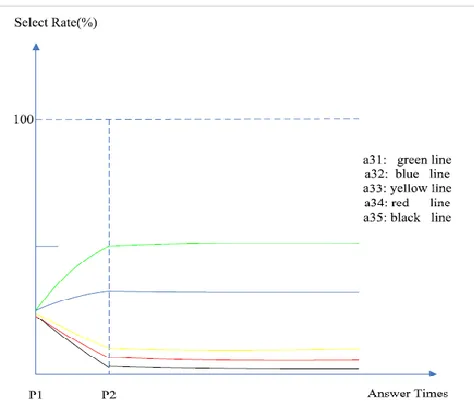
[image:6.612.332.555.79.268.2]answer according to the prediction. With the use of a predictable robot, more feedback records, more experience, more big data will be obtained by the predictable robot, and more accurate feedback prediction and more believable answer selection will be made by predictable robot to make user the happiest. The feedback big data can also be processed by big data search engine besides spark or hadoop and so on. The main difference between predictable robot with general chat robot and emotional robot is shown in Fig. 5. About the selection methods, if predictable robot considers only to select the answer with maximum of TS from the beginning to the end, maybe the answer (such as a32) with max IS will always be selected and other answers (such as a31) who can make user happier will have no chance to be selected, as shown in Fig. 6. In order to avoid the situation that IS decides all, predictable robot can give equal chances to every answer in the first turn, so that in the first turn (noted as P1 in Fig. 7), the selection probability is the same for all answers of the question, which means although the answer with maximum IS will be selected first, other answers which have never been selected will be selected one by one, so that every answer has an chance to have a initial FS. However, maybe a31 and a32 are occasionally given bad feedback for users' bad mood (for example, in the lost love day), then a31 and a32 will have no chance to be selected again, and a33 will always be selected for users (as shown in Fig. 7), which will make user unhappy.
[image:6.612.333.558.307.491.2]Fig. 5. Differences between predictable robot with general chat robot and emotional robot.
[image:6.612.36.301.420.645.2]Fig. 6. First approach of predictable robot (color online).
Fig. 7. Second approach of predictable robot (color online).
© 2017, IRJET | Impact Factor value: 6.171 | ISO 9001:2008 Certified Journal | Page 440
[image:7.612.329.567.210.422.2]chances to be selected, and the worst answer (such as a35) has almost no chance to be selected. Then, the predictable robot can almost always make users happy as shown in Fig. 9. Different from general chat robots, the condition to implement a predictable robot is that the robot should have the ability to detect the user feedback just as emotional robot. For example, the robot's \eye" such as camera and the software can recognize different emotions such cry, anger, smile, laugh from the camera video, or the robot's \ear" such as microphone and the software can recognize different sounds such cry, laugh from the sound. Another simple approach to detect the user feedback is relying on user's report. For example, after every answer, the predictable robot can ask user \If you satisfied with the answer". Although it is a simple approach, it is not a best approach, for some users do not want to answer such questions, and some users are
Fig. 8. Third approach of predictable robot (color online).
possible to give inverse feedbacks. The predictable robots can make users happier, and thus can be used to alleviate the social pressure of young people, to accompany the elderly, treatment of psychological problems of patients, which has important application value.
11. CONCLUSION
This paper proposed a new kind of robot, predictable robot that can answer questions according to users' preferences based on effective feedback prediction and feedback big data. Different from general chat robots which only try to give a reasonable answer and do not consider if the answer can make user happy or not, predictable robot can predict the user feedback and select an answer which is most likely to make user the happiest.
[image:7.612.42.279.290.494.2]Therefore, predictable robot will be more welcomed by users, and the users not only include human, but also include robots and other IOT things which can interact with predictable robots. The disadvantage of predictable robots is that when a user is a new user, or the user does not have too much feedback data, the effect of the predictable robot will be limited. The solution for the disadvantage is to forecast the feedback of a new user or a user with few feedback data based on the past feedbacks of the similar users.
Fig. 9. Fourth approach of predictable robot (color online).
REFERENCES
[1] J. R. Ruiz-Sarmiento, C. Galindo and J. Gonzalez-Jimenez, Exploiting semantic knowledge for robot object recognition, Knowl.-Based Syst. 86 (2015) 131–142.
[2] W. Y. Kwon and I. H. Suh, Planning of proactive behaviors for human–robot cooperative tasks under uncertainty, Knowl.-Based Syst. 72 (2014) 81–95.
[3] A. Al-Moadhen, M. Packianather, R. Qiu et al., Improving the e±ciency of robot task planning by automatically integrating its planner and common-sense knowledge base, in Knowledge-Based Information Systems in Practice (Springer International, New York, NY, USA, 2015), pp. 185–199.
© 2017, IRJET | Impact Factor value: 6.171 | ISO 9001:2008 Certified Journal | Page 441
[5] W. Y. Gang, S. Bo, S. M. Chen et al., Chinese intelligent chat robot based on the AIML language, in 2014 Sixth Int. Conf. IEEE Intelligent Human-Machine Systems and Cybernetics (IHMSC) (Washington, DC, USA, 2014), pp. 367–370.
[6]J Zakos and L. Capper, CLIVE–an arti¯cially intelligent chat robot for conversational language practice, in Artificial Intelligence: Theories, Models and Applications (Springer Berlin, 2008), pp. 437–442.
[7] J. K. Foderaro, Multi-personality chat robot, US Patent 7,505,892 (2009).
[8] C. H. Lai, W. C. Lin, B. S. Jong et al., Java assist learning system for assisted learning on facebook, IEEE Learning and Teaching in Computing and Engineering (LaTiCE) (Washington, DC , USA, 2013), pp. 77–82.
[9] S. Ghose and J. J. Barua, Toward the implementation of a topic specific dialogue based natural language chatbot as an undergraduate advisor, in IEEE Int. Conf. Informatics, Electronics & Vision (ICIEV) (Washington, DC, USA, 2013), pp. 1–5.
[10] B. T. C. Tay, S. C. Low, K. H. Ko et al., Types of humor that robots can play, Comput. Hum. Behav. 60 (2016) 19– 28.
[11] T. Kishi, S. Shimomura, H. Futaki et al., Development of a humorous humanoid robot capable of quick-and-wide arm motion, IEEE Robot. Autom. Lett. 1(2) (2016) 1081– 1088.
[12] M. Tahon and L. Devillers, Laughter detection for on-line human-robot interaction, Cough 85(65.0) (2015) 0– 77.
[13] M. M. Hurley, D. C. Dennett and R. B. Adams, Inside Jokes: Using Humor to Reverse- Engineer the Mind (MIT Press, Cambridge, Massachusetts, USA, 2011).
[14] P. Dybala, M. Ptaszynski, J. Maciejewski et al., Multiagent system for joke generation: Humor and emotions combined in human-agent conversation, J. Ambient Intell. Smart Environ. 2(1) (2010) 31–48.
[15] J. M. Taylor, Ontology-based view of natural language meaning: The case of humor detection, J. Ambient Intell. Humaniz. Comput. 1(3) (2010) 221–234.
[16] G. Smith and P. Eisenhardt, Robot humor and intelligence, Sci. News 175(2) (2009) 30.
[17] L. Boccanfuso, E. Barney, C. Foster et al., Emotional robot to examine different play patterns and affective
responses of children with and without ASD, in 2016 11th ACM/ IEEE Int. Conf. Human-Robot Interaction (HRI) (New York, NY, USA, 2016), pp. 19–26.
[18] M. Obayashi, S. Uto, T. Kuremoto et al., An emotional
robot, in Computational Intelligence (Springer
International, New York, NY, USA, 2015), pp. 423–443.
[19] G. Magyar and M. Vircikova, Socially-assistive emotional robot that learns from the wizard during the interaction for preventing low back pain in children, in Int. Conf. Social Robotics (Spriger International, 2015), pp. 411–420.
[20] S. H. Ji, S. J. You and H. K. Cho, Design of emotional conversations with a child for a role playing robot, in Proc. Tenth Annual ACM/IEEE Int. Conf. Human-Robot Interaction Extended Abstracts (New York, NY, USA, 2015), pp. 73–74.
[21] F. Leconte, F. Ferland and F. Michaud, Design and integration of a spatio-temporal memory with emotional in°uences to categorize and recall the experiences of an autonomous mobile robot, Auton. Robots 40(5) (2016) 831–848.
[22] X. Liu, L. Xie, A. Liu et al., Cognitive emotional regulation model in human-robot interaction, Discrete Dyn. Nat. Soc. 2015 (2015) 829387-1–829387-8.
BIOGRAPHIES:
Mrs. G.Sangeetha Lakshmi
Assistant Professor, Dept of Computer Science and Applications, D.K.M College for
Women (Autonomous), Vellore, Tamilnadu, India.
and Applications, D.K.M College for Women (Autonomous), Vellore, Tamilnadu, India.
and Applications, D.K.M College for Women (Autonomous), Vellore, Tamilnadu, India. Research Scholar, Dept of Computer Science
Ms. C.Vinodhini
Ms. K.Indumathi