© 2017, IRJET | Impact Factor value: 5.181 | ISO 9001:2008 Certified Journal | Page 2631
Perception of medical students about the use of simulators in classes
Betty Bravo Zúñiga
1, Ailyn Febles Estrada
2,
Juan P. Febles Rodríguez
3,Alemania González
Peñafiel
41
Docente Universidad Católica de Santiago de Guayaquil, Ecuador
2Docente de Universidad de las Ciencias Informáticas, Habana, Cuba
3
Docente Universidad de las Ciencias Informáticas, Habana, Cuba
4Docente Universidad Católica de Santiago de Guayaquil, Ecuador
---***---Abstract -
The article constitutes an approximation tothe way a group of students of the Catholic University of the University of Guayaquil perceives the benefits of the use of the simulators in the development of competences. On the basis of an applied survey and the participant observation, information is collected that allows to arrive at preliminary conclusions on this important subject. The fact that a minority of students are not convinced of the acquisition of clinical skills with the use of simulators, in the opinion of the authors, should not discourage research, because it was proved, with qualitative methods, that the way of using it by Part of the teachers was not always the most correct, it is therefore a question of correcting the didactic and methodological treatment.
Key Words: Simulators, medicine, clinical skills.
1.
INTRODUCTION
Consistent with current policies, admission of undergraduate students to public and private hospitals for patient assessment is more restricted; Patients often choose to avoid contact with students. In addition to the possible damage that could result from an inadequate assessment, or from a technically poorly executed procedure, is added the fact that reproducing a physical assessment, such as rectal tact, disturbs the privacy, tranquility and well-being of another being human.
Medical students are expected to have cognitive mastery and the acquisition of skills necessary for the development of their practical exercise, by making the right decisions for the patient, guaranteeing their safety. For these restrictions and bioethical considerations, since the late 1990s, the use of static simulators for procedures and medical assessment were incorporated into the practical classes of Gynecology, Obstetrics, Surgery, Pediatrics and Anesthesiology.
The Catholic University of Santiago de Guayaquil (UCSG), constituted institution of Higher Education in 1962, inaugurated the Faculty of Medical Sciences in 1968, offering the Medical Career. However, the Faculty of Medical Sciences does not have a University Hospital, so all pre-professional practical classes are taught in public
or private hospitals in the city, belonging to institutions with which there are cooperation and collaboration agreements.
The outreach profile of the Medicine Career is summarized in that the student acquires competencies that allow him to correctly perform the procedures of prevention, diagnosis, treatment and rehabilitation of the health problems of the individual, family and community.
In 2010, UCSG acquired approximately 40 static and interactive simulation models, including high-end mannequins capable of reproducing clinical, gynecological, pediatric and surgical pathologies; In addition to inducing simulated responses to drugs administered during the process.
The simulator is an apparatus, based on a computer processor that allows the reproduction of sensations that, in fact, are not happening. They have been designed of many types and are used in many areas of medical training [1]
The simulators are developed in an interactive environment, which allows the user to modify parameters and see how the system reacts to the change produced. A simulator is an apparatus that allows the simulation of a system, reproducing its behavior. Simulators reproduce sensations that are not really happening [2].
The use of simulators is based on the cognitive theory that is born of the constructivist model. Learning is the connection between knowledge and experience understood, that when its conceptions are assimilated or appropriated, it becomes the meaningful knowledge that generates and stimulates critical and creative thinking. To assert that the use of simulators in medical education is not intended to replace, in all its extremes, the traditional method Dieguez [3].
© 2017, IRJET | Impact Factor value: 5.181 | ISO 9001:2008 Certified Journal | Page 2632
development in the professional area. Therefore, thestudents of the higher cycles of the medical career, learned at the head of the patient.
At present, there are many restrictions on the admission of students to hospitals, violating privacy (bioethics) and safety (avoiding iatrogenies) of the patient. Therefore, Universities that have Medicine Careers, have initiated the implementation of new models of learning-teaching, through the use of simulated doctors.
Instruction and simulation-based education has demonstrated its effectiveness in various areas of health. [4]. [5]. Multiple studies have shown that simulation improves the acquisition of medical knowledge, favors the acquisition of certain technical skills and encourages teamwork. [6].
2. METODOLOGY
A survey was applied to students of the seventh cycle at the beginning of the B-2016 semester of the medical course that took the optional course of deepening I (clinical simulation), in the semester B 2015; Whose population is 128 students.
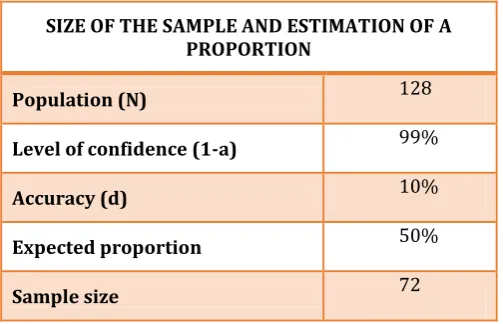
Using the calculation based on a normal distribution, we estimated the number of students who were randomly selected to conduct the survey, with a confidence level of 99% to calculate an estimated proportion of 50% with accuracy of 10% and a proportion Of 4% of losses; For which an adjusted sample of 72 students of 76 was established, in order to eliminate atypical data in the survey result.
Table -1: Selection of the sample
SIZE OF THE SAMPLE AND ESTIMATION OF A PROPORTION
Population (N) 128
Level of confidence (1-a) 99%
Accuracy (d) 10%
Expected proportion 50%
Sample size 72
3. RESULT
[image:2.595.30.282.530.692.2]Of the 72 surveys defined as valid, the following results are obtained:
Table - 2: Frequency of use of printed contents
1. How often has the contents printed on the syllabus of the optional subject of deepening I been addressed during the semester of the course? O
class frequency Absolute frequency Relative
1
Never 3 4,17%2
Hardly ever 7 9,72%3
Sometimes 26 36,11%4
Almost always 19 26,39%5
Always 17 23,61%72 100,00%
Regarding the follow-up to the syllabus, 36% agree that in some cases they have addressed the topics set out in the Optional Program for Deepening I; While a dilemma exists when 26% report that they have very often seen the contents declared in the syllabus; And 24% who have been subject to the subjects of this subject, throughout the semester. The minority adding up to 14% almost never or never have seen the syllabus units during the semester.
Table - 3: Frequency of use of the simulators
2. How often does the teacher use the simulators in their classes? se the simulators in their classes?
Class frequency Absolute frequency Relative
1
Never 1 1,39%2
Hardly ever 9 12,50%3
Sometimes 28 38,89%4
Almost always 20 27,78%5
Always 14 19,44%72 100,00%
© 2017, IRJET | Impact Factor value: 5.181 | ISO 9001:2008 Certified Journal | Page 2633
simulators during the semester they chose to study this [image:3.595.31.291.158.377.2]subject.
Table 4: Integration of knowledge
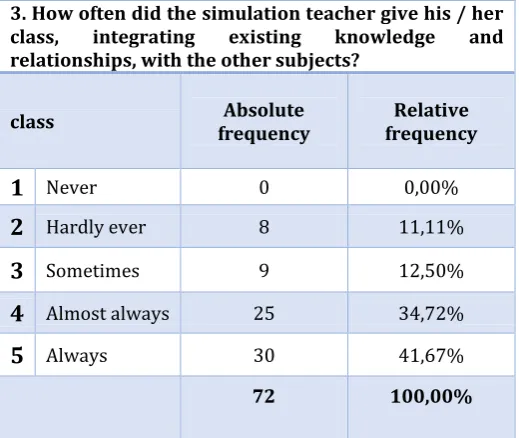
3. How often did the simulation teacher give his / her class, integrating existing knowledge and relationships, with the other subjects?
class frequency Absolute frequency Relative
1
Never 0 0,00%2
Hardly ever 8 11,11%3
Sometimes 9 12,50%4
Almost always 25 34,72%5
Always 30 41,67%72 100,00%
Referred to the justification of the subject, which states the application of theoretical-practical knowledge that allows the acquisition of clinical skills and integrating knowledge and relationships coexisting with other subjects; The majority of students report that during teacher praxis their teachers integrated this knowledge; In relation to the minority of students who answered that they almost never did.
Table 5: Use of the case stud
4. During your classes in the simulation lab, do case studies or problem-based learnig?
class frequency Absolute Relative frequency
1
Never 3 4,17%2
Hardly ever 13 18,06%3
Sometimes 21 29,17%4
Almost always 21 29,17%5
Always 14 19,44%72 100,00% [image:3.595.306.567.230.411.2]
In reference to the strategy and methodology of problem-based learning, 30% of students agree that sometimes it was applied, 21% reported that very often and 14% that their teachers always used this educational strategy; While 22% reported that they almost never or never used it.
Table 6: Use of simulated clinical cases
5. How often are the teacher's classes organized by reflection processes of the clinical cases simulated by the Hal?
class frequency Absolute frequency Relative
1
Never 5 6,94%2
Hardly ever 11 15,28%3
Sometimes 24 33,33%4
Almost always 20 27,78%5 Always
12 16,67%72 100,00%
The sum of the percentage 22% of those students who answered this question, declare that their teachers have never or hardly ever reflected on the clinical cases simulated by the Hal, 33% report that sometimes, 28% agree that almost always and 17% assure that they have always done reflection of the cases.
Reference is made to the importance of the debriefing in the simulation, so it is inconsistent that, when giving the classes of optional I deepening, there is no reflection that leads to feedback of the correct answers and amendment of errors in practice. This question also relates to the use of simulators and the strategic application of problem-based learning; for which, we see answers that do not connect this relationship.
Table 7: Use of laboratories in extracurricular time
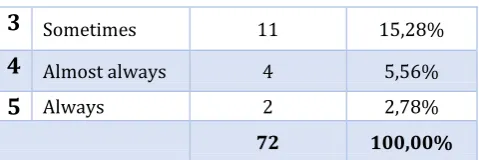
6. How often do you have access to the simulation laboratory, in extracurricular times to practice clinical processes?
class frequency Absolute frequency Relative
1
Never 45 62,50%© 2017, IRJET | Impact Factor value: 5.181 | ISO 9001:2008 Certified Journal | Page 2634
3
Sometimes 11 15,28%4
Almost always 4 5,56%5
Always 2 2,78%72 100,00%
Although this question does not respond to the relationship of the class with the teacher, it does so with the use of the simulation laboratory in extracurricular hours. It is true that for the cost of these high-tech equipment the laboratory is restricted to students who were not accompanied by a teacher. It was suggested that staff working as an occasional technical teacher should be in two shifts to allow students to enter at any time that does not correspond to their class time and if there is availability of the use of the equipment.
[image:4.595.38.278.96.176.2]Prior to this antecedent, the majority of the students 63% answered that they never have access to the Laboratory of simulation, almost never 14%. The incoherent is how 11% sometimes have access to the laboratory and even more 6% almost always or always.
Table 8: Perceives that it has acquired competences with the use of simulators
7. Do you believe that at the end of the semester and the subject of IPO you have acquired clinical skills, through the use of simulators?
class frequency Absolute frequency Relative
1
Yes
45
62,50%
2
No
27
37,50%
72
100,00%
4- CONCLUSIONS
The main objective of the subject and its learning results support the acquisition of clinical competences. The minority of students, 38% are not convinced of the acquisition of these skills through the use of simulators; As opposed to 63% who confirm having acquired clinical competences at the end of their semester.
In another aspect of student pedagogical counseling, a small number of students have presented discomfort with regard to optative and deepening teachers I, testifying that their teachers teach theoretical classes where the simulators are almost not used and do not go according to
the program of Contents that the syllabus declares, for this subject. In V cycle these students begin their approach to the clinic and pathophysiology, but it seems that when teaching their classes they do it through the use of mannequins where the students are taught invasive processes that respond to the VIII cycle where they see subjects related to Surgical Clinic and Surgery less in
On the other hand, it seems that their teachers do integrate a bag of knowledge to teach their classes, obtaining a reduced discrepancy in reference to the total percentage of the number of students surveyed in terms of the results shown in the table.
Several researchers have found that the use of simulations shortens the time required for the development of competencies, especially since the training can be repeated as many times as necessary until the skills are acquired and in a shorter time. In addition, simulation-based learning curves are better than curves based on classical training. [7].
Within the analysis about the reflection of praxis in clinical simulation, reference is made as a structure of meaningful learning the debriefing allows the feedback of knowledge and learning reinforcements of the processes learned during the practice.
This question also relates to the use of simulators and the strategic application of problem-based learning; for which, we see answers that do not connect this relationship. Therefore, one can not only perform reflection on praxis without discussing the specific clinical case for this practice of simulation.
4. DISCUSSION
Each practice, in the center or simulation laboratory, leads the teacher and students to reflect their praxis and immediate feedback, by observing and discussing recordings or records of processes performed in the simulator, where the performance of simulated or problem-based clinical situations can be assessed.
The same clinical scenario, allows the teacher to organize collaborative work groups, so that the student develops leadership and learns to make decisions under group consensus; Since, in the professional praxis, the health team is multidisciplinary.
© 2017, IRJET | Impact Factor value: 5.181 | ISO 9001:2008 Certified Journal | Page 2635
Another advantage to emphasize is that clinical cases thatdo not require the availability of pathologies present in hospitals, that is to say, many times in the schedules of the units embodied in the syllabus, have not been practiced because there is no patient who has that pathology at that time, in the hospital. The most relevant of the advantages is after his career, when he avoids iatrogenias or additional risks by an invasive procedure to his patients.
This learning environment should be considered as an area of medical research, through clinical praxis, in which the student can improve the techniques of the process that has been taught to him. Some high-fidelity simulators make it easier for the teacher to evaluate students and control over the time of use. It also allows the student to observe the student immersed in a collaborative work during his praxis and how he improves his learning during the semester.
4.1 How to innovate the teaching didactics that allows the motivation necessary to reach a significant learning in the students?
One of the current objectives of neuroscience is the foundation of the application of new strategies, which allow the reinforcement of neuronal plasticity during the class and that generates a state of alertness or attention, modifying our perception. Researches in the field of cognitive neuroscience, which consolidate educational theories and models influencing learning, are analyzed, with improvements to the didactic teaching and the application of new teaching methodologies.
Therefore, it is postulated the need to know how these learning environments are innovated from the neuroscientific educational base, which tribute to new teaching strategies and to the optimization of these virtual scenarios.
Information and Communication Technologies are essential resources for the creation of new clinical scenarios and educational environments, which acquire value by the elements that comprise it, such as high fidelity technology, affordances (it is the quality of the objects or the Properties of an environment or prepared environment that stimulates a person to perform a series of behavioral actions), continuous feetback and giving relevance to the simultaneous interactions of its main student teacher actors.
It is suggested that this learning based on simulation can become a motivational strategy when they find answers to the questions that arise from the self study of the dicent.
These reinforcement processes can be stimulated through the innovation and implementation of virtual learning
environments, such as: affordances integrated in medical simulation labs; Which improve the functionality of virtual scenarios simulating realities of their professional praxis; Where they can learn by doing and intervening from their experience, using the heuristic model and the methodology of problem-based learning.
REFERENCES
[1]. Escobar J. (2016). Reflexiones bioéticas acerca de la enseñanza de la medicina en simuladores electrónicos. Rev Colomb Bioética, 1; 1: 63-87.
[2]. Peña, P. (2009). Teoría de simuladores.Universidad de Córdoba, Colombia
[3]. Dieguez J. (2010). Importancia de los simuladores virtuales en la docencia de cirugía abdominal mínimamente invasiva. Rev Horiz Med; 10(1):42-46 [4]. Gaba, D.M. (2004) The future vision of simulation in
health care. Qual Saf Health Care; 13 Suppl1:12-10. [5]. Gaba D.M. (2000) Anesthesiology as a model for
patient safety in health care. BMJ, 320 (7237):785-788
[6]. Sanchez LD, Delapena J, Kelly SP, et al. Procedure lab used to improve confidence in the performance of rarely performed procedures. Eur J Emerg Med 2006;13(1)
[7]. Vázquez-Mata, G., Guillamer Lloveras, A. (2009). El entrenamiento basado en la simulación como innovación imprescindible en la formación médica Educación Médica 12(3), 149-145
BIOGRAPHIES
Doctora en Medicina.Docente Universidad Católica de Santiago de Guayaquil, Ecuador
Doctora en Informática. de Universidad de las Ciencias Informáticas, Habana, Cuba
© 2017, IRJET | Impact Factor value: 5.181 | ISO 9001:2008 Certified Journal | Page 2636
Magister en Educación a Distancia.