Technology (IJRASET)
Study & Enhancement of Fly spray Bug Tracking
Tool
Komal Patiyal1, Sanjay2
1,2
Computer Science & Engineering, Himachal Pradesh Technical University,Hamirpur
Abstract: As software projects become increasingly large and complicated, it becomes more difficult to properly verify the code of the project. The major limitation of the software industry is that it is unable to develop error free software. Bugs always exist in software and a Bug Tracking System(BTS) gives an organization an estimate of the amount of work that needs to be done to approach the goal of perfection. BTS which is used to solve out any type of bugs in any software. There are number of bug tracking tools which are available in the market but this study aims to provide the modification of one bug tracking tool i.e. Flyspray.
Keywords: Bugs, Bug Tracking System, Bug Report,Bug Tracking Tools,Flyspray
I. INTRODUCTION
In today’s life software has become an integral part in almost all the applications involving computer-based systems. Bug tracking systems play an important role in software development. They are used by developers, quality assurance people, testers, and end users to provide feedback on the system. This paper include the complete evaluation of Flyspray bug tracking tool. All the features that are provided by the tool including history, comments, severity, multiple database support, reminders, graphs, versions and file attachment were mentioned. In Flyspray we added two Important features which are Exporting the files to excel and fields of expected and desired output which is not present in the present tool. Benefits of adding these two features is also discussed in this. In the last the comparative study of Flyspray and Modified Flyspray is done.
II. APPROACH
For The implementation, we have used the Flyspray 0.9.9.7 version. Flyspray mainly requires PHP to run and a web server is required for its functioning. In this study WAMP server 2.5 is used. It fulfils both the requirements of PHP and the web server. MYSQL is being used as the database.
III.INTRODUCTIONTOFLYSPRAY
Flyspray is an open source lightweight, uncomplicated, web-based bug tracking system written in PHP for assisting with software development and project managements. It was originally conceived when Psi Jabber client project could not find a bug tracker that suited their needs and has been made available for everyone to users for their own projects. Flyspray is free software released under the GNU General Public License version 2.1. This essentially means that one can get Flyspray and use it free of charge. The source code is available and one can modify it to suit the needs.
A. Features of Flyspray:
1) Web-Based, Platform-Independent: Flyspray is capable of being run on many different platforms or operating systems. It lets anybody with access to a browser have access to all the features and functionality of the tool
2) Multiple Database Support: Flyspray supports multiple databases. Currently MySQL and PGSQL are supported by it.
3) 'Watching' tasks: This feature allows the user to get notification of changes through email or Jabber even if one is not currently working on the project
4) Comprehensive Task History: It is the act of keeping track of wide variety of tasks that the users of the tool do in their day to day activities
5) File Attachments: It is a simple process to attach a file with the report. It can include the screenshots about the occurrence of the bug and any other information that the user find important for fixing the bug
6) CSS Themes: Flyspray uses the CSS to achieve different layouts and colors.
Technology (IJRASET)
tasks that are sensitive in nature
9) Dependency Graphs: To allow support for the local task dependency graphs feature, an additional package can be installed
10) Comments: Used by developers to let the reporter know that what has been working on, but can also be used for clarification.
IV.LIMITATIONS The evaluation of the tool in the above section provided some limitations in it.
A. From the above features it can be interpreted that there is no provision of exporting the files to the excel sheet provided in the tool.
B. The second limitation is that while adding a new task, the reporter is not asked to enter the details about the observed behavior and the expected behavior of the task that leads to the occurrence of the bug.
V. MODIFIEDFLYSPRAY
Based on the limitations discussed in the above section, Flyspray has been modified to add the two mentioned features. The features that are added include:
A. Exporting files to MS Excel.
B. Adding the fields of expected and observed behavior while adding a new task. VI.ALGORITHMFORFLYSPRAY Step1: Start algorithm.
Step2: Gather data to describe the bug. After this report the bug in the bug tracker. Step3: If the bug is a valid bug, it will be assigned to a development team to fix.
Step4: If the same bug is already reported by any other tester, bug can be closed by changing its status as “Duplicate”.
Step5: If the bug is not so important and it is decided not to fix it & may be fixed in the next version, the status of a bug is “Deferred”.
Step6: When the developer starts fixing the bug its status changes to “Open”.
Step7: When the bug is fixed, it is retested to check whether the bug is removed or not.
Step8: The tester checks whether the bug is fixed or not. If Yes then the status is changed to “Closed”. Step9: In the last step send a feedback to the reporter.
Step10: Stop Algorithm
VII. FLOWCHARTFORFLYSPRAY
YES NO Duplicate BUG
Status of BUG Gather information to describe the
BUG.
Report the new BUG in bug tracker
Search Found
Technology (IJRASET)
NO NO YES YES NO YESFig.1 Flowchart for Flyspray
VIII. APPROACH FOLLOWED
For this research practical approach has been used. Flyspray bug tracking tool is used in the study. Features are added to improve the quality of the tool. Thus observed results were collected and compiled for the analysis and evaluation of the tool.
A. Adding the Features
In this section the above mentioned two features are added to the original tool and a modified tool is developed.
1) Exporting File to MS Excel: As in the above features one can see that there is no option of exporting the information regarding tasklist to the excel sheet. In the study this feature is added.The figure shows that the new button with the caption ‘Export to Excel’ has been added to the tasklist page. After clicking on the option export to excel, the list of tasks gets exported to the MS Excel sheet.
B. The Benefits of Adding the Feature
1) The Advantages and Possibilities of Exporting Files to Excel are Endless:
a) An xml file is plain text so can be created on the presentation server or application server; alternatively, it can be sent as an attachment to an email, or can be provided as a parameter to a web service.
b) Colors, fonts, number formats and so on can be specified.
Send a feedback to the Reporter Reopen Open Invalid, Incomplete BUG
Automatic assignment of BUG to Expert
Technology (IJRASET)
d) Column heights and widths can be specified, or auto-formatted.
e) Multiple worksheets can be created
f) Formulas can be entered in cells.
2) Adding Fields: Features shows that while adding a new task or issue to the project, Flyspray does not ask its users to enter the details about the expected behavior and the observed behavior. The difference between the two leads to the occurrence of the bug. The testers before fixing the bug needs to understand the variation in the required output. Therefore, these fields are added in the modified tool.
C. The Benefits of Adding the Feature
[image:5.612.89.547.256.415.2]The addition of these two fields proves a great asset for the developer of the project. These two fields are one of the important features that every bug tracking tool should have. The presence of the features in the tool help the testers understand the bug clearly and thus helping in the quick fixing of the bugs. And this leads to solve the common problems faced by the developers that includes poor quality of the bug reports and the scattered information across several bug reports.
Fig. 2 Adding Button
The figure shows that the new button with the caption ‘Export to Excel’ has been added to the tasklist page.
[image:5.612.75.534.475.690.2]Technology (IJRASET)
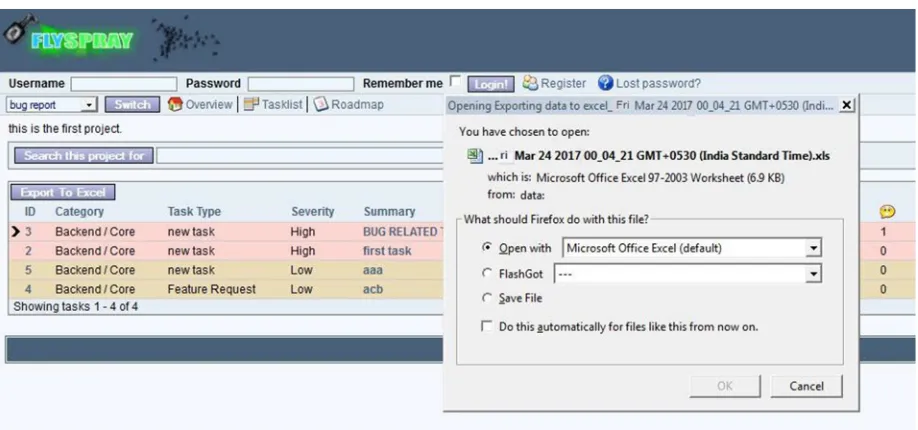
The figure shows the option to download the file in the excel sheet format. The file to be downloaded also contains the date and the time when the file is being downloaded.
Fig.4 The Excel Sheet
The figure shows the downloaded file in the excel sheet format
IX. RESULTS AND DISCUSSION
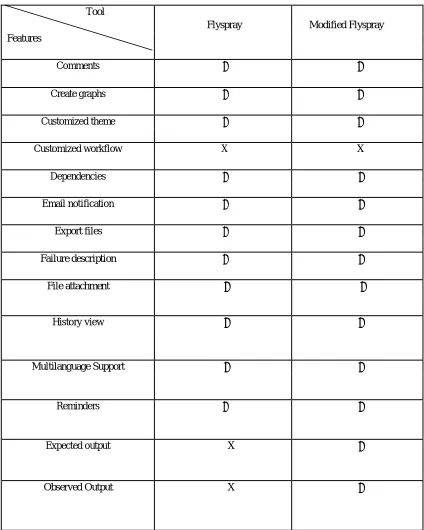
[image:7.612.94.518.153.683.2]The observed behavior of both original Flyspray and the modified Flyspray is shown in the Table 1.1. The table shows the comparison of both the tool version.
TABLE I Comparison of the Tools
Tool
Flyspray Modified Flyspray Features
Comments √ √
Create graphs √ √
Customized theme √ √
Customized workflow X X
Dependencies √ √
Email notification √ √
Export files √ √
Failure description √ √
File attachment √ √
History view √ √
Multilanguage Support √ √
Reminders √ √
Expected output X √
Technology (IJRASET)
Note: X: means feature is not available. √: means feature is not available.
From the table it can be interpreted that both the tools version support most of the features needed from a good bug tracking tool. However, modified Flyspray supports two more features. Files can be exported to excel sheet in the modified tool only, this feature is not supported by the original version of Flyspray. The original version of the tool does not have the option to provide information about the observed and the expected behavior of the issue. But, modified Flyspray includes the option of mntioning both the observed and expected behavior.
X. CONCLUSION
The objective of our paper is to have a complete evaluation of the Flyspray bug tracking tool. The features provided by the tool including severity, email notification, graphs, files attachments, version, history view, comments and reminders were mentioned. We concluded that Flyspray bug tracking system have some limitations. After the evaluation of the tool it was observed that Flyspray misses two important features i.e. exporting the files to excel and fields of expected and desired output. These two were added in the tool and then also shows the benefits of adding these features. In the last section we do the comparison of Flyspray with the modified Flyspray. So the propose modified Flyspray framework will give a improved level of satisfaction than the current Flyspray.
XI. ACKNOWLEDGMENT
I would like to take this opportunity to express my deepest gratitude to my advisor Mr. Sanjay for providing excellent guidance, encouragement and inspiration throughout the dissertation work. His extreme energy, creativity and excellent skills have always been a constant source of motivation for me. The perfection that he brings to each and every piece of work that he does always inspired me to do things right at first time. Without his invaluable guidance, this work would never have been a successful one. He is a great person and one of the best mentors. I will always be thankful to him.
I would also like to thank the faculty of Computer Science & Engineering department (SIRDA Institute of Engineering Technology) and to all my friends whose constant inspiration and support towards better work throughout my study proved to be valuable. Last but not the least I would like to dedicate this work to my amazingly loving and supportive parents and sisters who have always been supportive to me. Their love and affection has been a source of encouragement, which always motivate me to move ahead in my life.
My utmost gratitude is to the College for providing me assistance in the form of necessary library and laboratory facilities during the course and research work.
To all acknowledged, I solemnly owe this work.
REFERENCES
[1] http://www.flyspray.org/,”Flpspray”, Retrieved on 15-april-2017 at 1500Hrs. [2] http://www.flyspray.org/manual.Retrieved on 17-april-2017at 1700Hrs. [3] Ron Patton, Software Testing, 2nd ed; Pearson Education, 2006.
[4] Yogesh Singh, Software testing, 1st ed; Cambridge University Press, 2012.
[5] J. Mishra, A.Mohanty, Software Engineering, 2nd ed; Dorling Kindersley (India) Pvt. Ltd, 2012. [6] Peter Farrell Vinay, Manage Software Testing, Auerbach Publications,Taylor and Francis Group, 2008.
[7] G Abaee, D.S. Guru, “Enhancement of Bug Tracking Tools; the Debugger”, Software Technology and Engineering (ICSTE), 2nd International Conference, Vol 1, 2010.
[8] Thomas Zimmermann, Rahul Premraj, Jonathan Sillito, and Silvia Breu, “Improving Bug Tracking Systems”, 31th International Conference on Software Engineering , Vancouver, BC, Canada, 2009.
[9] E. F. Miller, “Introduction to Software Testing Technology,” Tutorial: Software Testing & Validation Techniques, Second Edition, IEEE Catalog No. EHO 180-0, pp. 4-16.
[10] Yogita Sharma, Aman Kumar Sharma, “Comparative Study of the Bug Tracking Tools”, International Journal of Advanced Research in Computer Science & Software Engineering(ijarcsse), ISSN: 2277-128X, Vol. 5 Issue 3, March - 2015.