5
XI
November 2017
Effect of Input Process Parameters on Cutting
Speed for Al/Al
2
o
3
MMC in Wire EDM
Harsimran singh1, Harmesh kumar2
1
Assistant Professor, Department of Mechanical Engineering, GCET, Jammu,India 2
Assistant Professor, Department of Mechanical Engineering BBSBEC Fatehgarh Sahib, Punjab, India
Abstract: In the present study the effect of input process parameters on cutting speed has been investigated experimentally in wire electrical discharge machining (WEDM). The experiments had been conducted under different input parameters which
were varied, those parameters are: Pulse on time (Ton), Pulse off time (Toff), Spark gap voltage (SV), Peak current (IP), Wire feed
(WF) and Wire Tension (WT). Brass wire having 0.25 mm diameter and Al/Al2O3 MMC plate having dimensions140 mm×70
mm×12 mm were used as tool and work piece material. Based on analysis of variance it was found that four parameters i.e., Ton,
Toff, SV, IP and three interactions were significant for cutting speed. Based on effect plots it was found that pulse on time and
pulse off time are the most significant factors for cutting speed. The best parameters at which maximum cutting speed can be
obtained are – pulse on time = 1.20 μs, pulse off time =16μs, peak current =190A, spark gap voltage = 20V, wire feed = 7m/min
and wire tension = 1000 gram.
Keywords: Wire EDM, ANNOVA, MMC, Cutting speed
I. INTRODUCTION
In current manufacturing, Wire electrical discharge machining (WEDM) is one of the most widely used machining process. Although many non conventional machining processes like laser machining and abrasive jet machining are available but the equipment used in those processes are too much expensive, also many problems occur like poor surface quality etc. WEDM is widely accepted machining process which is used to produce intricacies and complex shapes of material. In WEDM the material removal is done by controlled erosion through a series of repetitive sparks between electrodes i.e., work piece and tool. The electrode is a thin wire made up of copper, brass or tungsten of diameter ranging from 0.05-0.30mm. The wire electrode is pulled through the work-piece from a supply spool onto a take-up mechanism. On application of a suitable voltage, discharge occurs between the wire electrode and the work-piece in the presence of a flood of de-ionized water of high insulation resistance.
A metal matrix composite (MMC) is composite material with at least two constituent parts, one being a metal necessarily, the other material may be a different metal or another material, such as a ceramic or organic compound. When at least three materials are present, it is called a hybrid composite. Metal matrix composites (MMCs) are newly advanced materials with light weight, high specific strength, good wear resistance and a low thermal expansion coefficient. They have proven to be important advanced materials that serve as alternatives to many conventional materials, particularly when light-weight and high strength components are
needed such as in the automotive, aerospace, defense and other industries. Aluminium oxide (Al2O3) which is also called alumina,
possesses strong ionic inter bonding giving rise to its desirable material characteristics, it exists in various crystalline phases which is most stable hexagonal alpha phase at elevated temperatures, alpha phase alumina is the strongest and stiffest of the oxide ceramics, its dielectric properties, hardness and good thermal properties make it best choice for wide range of applications. High
purity alumina can be used for both oxidizing and reducing atmospheres to 19250C
It resists attack by all gases except wet fluorine and is resistant to all common reagents except hydrofluoric acid and phosphoric acid. The composition of ceramic body can be changed to enhance particular desirable material characteristics. In current research
work 20% Al2O3 reinforced Al matrix composite has been used.
II. LITERATURE REVIEW
Many researchers have worked in Wire electrical discharge machining. Azhiri et. al. presented the experimental study while
machining of Al/Sic aluminium matrix by dry WEDM process.it was found that pulse on time and current have significant effect on
CV. It was concluded in exploratory experiments that oxygen gas and brass wire results in higher cutting velocity and oxygen gas
smooth machining can be achieved at high value of Mesh size and at low value Wt. % of Sic Particles [2]. Shandilya et. al. described the response surface methodology (RSM) and artificial neural network (ANN) based mathematical modeling for the average cutting speed of SiCp/6061 Al metal matrix composite, during wire electric discharge machining (WEDM). It was found by the combined effect of input process parameters that, the voltage is more significant parameter on average cutting speed than pulse-off time and wire feed rate. Voltage was found to be more significant parameter on average cutting speed than pulse-pulse-off time and wire feed rate for 10% SiCp/6061 Al [3]. Patil et. al. investigated to examine the effect of electrical as well as non-electrical
parameters on the performance of WEDM of (Al/Al2O3p) MMC with varying volume fractions i.e., 10 % and 22%. It was found
that presence of protruding ceramic particles was significant on surface of both composites. For A6061 alloy the cutting rates varied
from 43.2 and 220.8 mm2/min. It ranged between 16.8 to 141.6 mm2/min for 10% Al/Al2O3p MMC and 9.6 to 110.4 mm2/min for
22% Al/Al2O3p MMC [4]. Yan et. al. examined the machining of Al2O3p/6061Al composite on WEDM. A negatively polarized
brass wire with a diameter of 0.25 mm was used as the tool. WEDM was used to cut both the 10 and 20 vol. % Al2O3particles
reinforced 6061Al alloys-based composite and 6061Al matrix material itself Many conclusions were drawn from experimental
work, 6061Al alloy obtained the highest cutting speed than the two Al2O3p/6061Al composites, and both the composite materials
yielded similar cutting speeds[5]. Rozenek et. al. presented experimental investigation for the effects of input machining parameters
i.e., discharge current, voltage, pulse on-time and pulse off-time) on the machining feed rate and surface roughness for machining of metal matrix composite AlSi7Mg/Sic and AlSi7Mg/Al2O3.The surface roughness and feed rate tends to increase with increase of
discharge energy. The value of feed rate V and surface roughness Ra drops slowly with decrease in voltage. The maximum cutting
speeds are also low for AlSi7Mg/Sic and AlSi7Mg/ Al2O3 composites than the cutting speed of aluminium alloy; these are
approximately 3 and 6.5 times lower. With the increase in pulse on time it resulted in higher values of feed rate and surface roughness parameter. The machining feed rate of WEDM is significantly dependent on the kind of reinforcement [6]. Fard et. al. in their work carried out experimental investigation, modeling and multi Characteristics optimization of dry wire electrical discharge machining (WEDM) process while machining of Al/Sic aluminium matrix composite (AMC Firstly, a series of exploratory experiments were conducted and it was found that brass wire and oxygen gas resulted in higher cutting velocity. Results showed that oxygen gas and brass wire guarantee superior cutting velocity. According to ANOVA, pulse on time and discharge current were
found to have significant effect on CV and SR[7].Guo et. al. investigated into shaping particles reinforced material by wire-EDM
with high-travelling speed It was found to have little influence by electrical parameters on surface roughness but selection of electrical parameters had an important effect on cutting rate. It was investigated that high machining efficiency can be obtained at high voltage, high pulse duration, large machining current, and at proper pulse [8].
From literature survey it is observed that reasonably extensive work has been published on WEDM. However, very less work has been reported for machining of Al/Al22O3 MMC to the best of the knowledge of present authors. The present work is an attempt
towards optimization of WEDM of Al/Al22O3MMC
III. EXPERIMENTATION
Experiments were performed on ELEKTRA SPRINTCUT wire-cut EDM machine according to Box Behken Design (BBD). Each
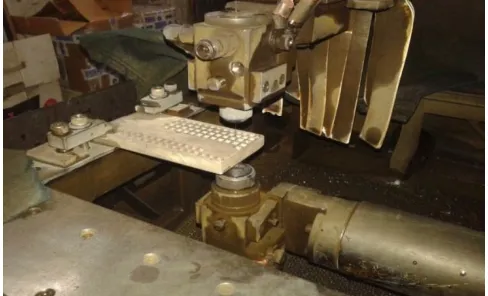
[image:3.612.203.447.568.716.2]time when an experiment was performed, a particular set of parameter combination was chosen and work piece was cut. A 5mm × 5mm rectangular cut was taken on the work piece. CNC code for cutting was generated through ELAPT software which was supplied by the manufacturer. Figure 1 shows the complete job after WEDM.
IV. RESULTS AND DISCUSSION
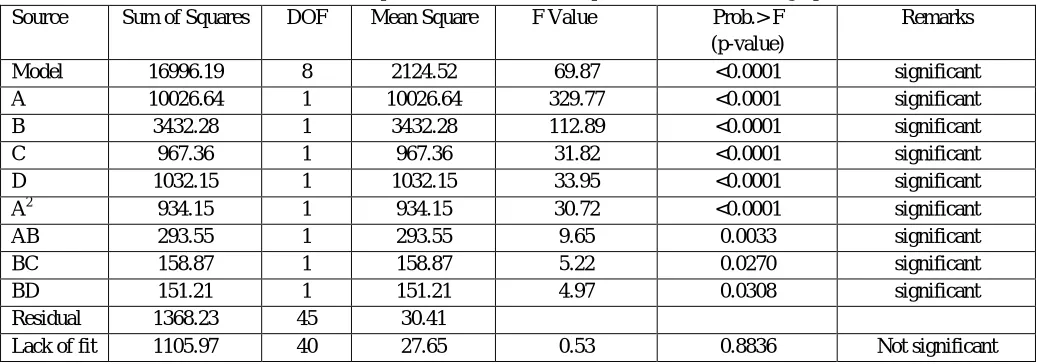
For cutting speed linear and quadratic models has been recommended by Design Expert software. Table 1 shows ANOVA for
quadratic model at 95% confidence level. Based on analysis of variance as shown in Table 1, four parameters i.e., Ton, Toff, SV, IP
and three interactions are found to be significant for cutting speed. It shows that the F value of the model is 69.87 and corresponding p value is less than 0.0001. It reveals that there is only 0.001% chance such that large F value of model can occur due to noise. Lack of fit of 0.8836 implies that it is not significant relative to pure error. Thus quadratic model is significant at 95% confidence interval.
The determination coefficient, R2 is the ratio of the explained variation to total variation and is the degree of fit. The response model
fits better to the actual data and shows less difference between predicted and actual values when R2 approaches to unity. The
obtained value of R2 = 0.8839 is in reasonable agreement with the adjusted R2 of 0.9123. Figure 3 shows the normal probability plot
of residuals for cutting speed. In the graph it is shown that errors are normally distributed as most of the residuals are clustered along straight line.
The mathematical relationship for correlating the cutting speed and the considered process variables is obtained as follows: Cutting speed =
46.66786 + 174.96194 × Ton – 4.99365 × Toff + 0.70200 × SV – 0.21615 × IP – 93.00278 × Ton2 + 2.52396 × Ton × Toff – 0.055703
× Toff × SV +0.018115 × Toff × IP (1)
[image:4.612.81.535.350.520.2]All the sources having probability less than 0.05 represents factor of statistical significance for the response. In addition to all the individual factor effects, two factor interactions are also found to be significant as shown in table 1. Figure 2 shows the plot of experimental and predicted data for cutting speed. It shows that equation 1 is adequate to give the actual relationship between process parameters and responses.ANOVA for response surface of reduced quadratic model of cutting Speed has been shown in Table 1 below.
Figure 2Actual versus predicted Figure 3 Normal probability plots of
[image:4.612.47.567.545.727.2]plot for cutting speed residuals for cutting speed
Table 1 ANOVA for response surface of reduced quadratic model of cutting Speed
Source Sum of Squares DOF Mean Square F Value Prob.> F
(p-value)
Remarks
Model 16996.19 8 2124.52 69.87 <0.0001 significant
A 10026.64 1 10026.64 329.77 <0.0001 significant
B 3432.28 1 3432.28 112.89 <0.0001 significant
C 967.36 1 967.36 31.82 <0.0001 significant
D 1032.15 1 1032.15 33.95 <0.0001 significant
A2 934.15 1 934.15 30.72 <0.0001 significant
AB 293.55 1 293.55 9.65 0.0033 significant
BC 158.87 1 158.87 5.22 0.0270 significant
BD 151.21 1 151.21 4.97 0.0308 significant
Residual 1368.23 45 30.41
Pure error 262.26 5 52.45 Corrected
total
18364.42 53
Standard Deviation 5.51 R-Squared 0.9255
Mean 75.68 Adj R-Squared 0.9123
Coefficient of Variation 7.29 Pred R-Squared 0.8839
PRESS 2132.76 Adeq Precision 34.611
Legend: A- Pulse on time, B- Pulse off time, C- Spark gap set voltage, D- Peak current, E-Wire tension rate, F- Wire feed
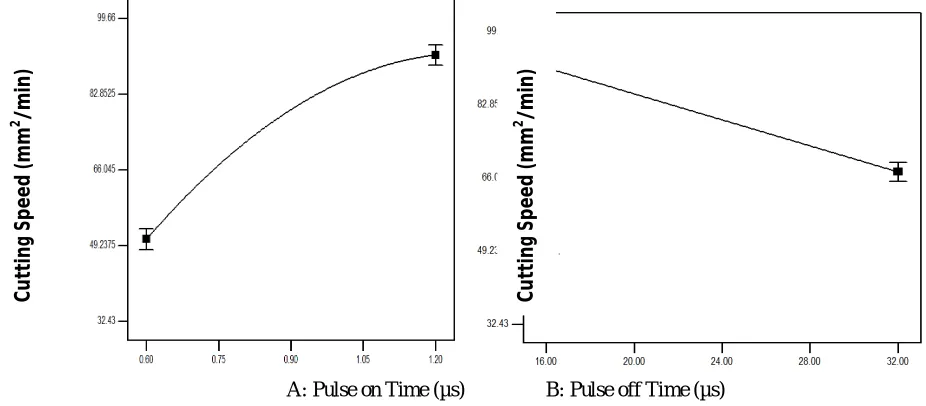
The main effect plots for cutting speed are shown in figures 4 and 5. These plots show that the cutting speed is mainly affected by
Ton, Toff, Ip and SV. When pulse on time was increased by 0.6 to 1.2 µs, the cutting speed increased significantly from 49.823 to
87.365mm2/min. The increase in cutting speed is due to the fact that higher pulse on time increases the discharge energy which leads
to rapid melting of the material. More material will get melted and vaporized and hence there will be increase in cutting speed. The present result matches the previous results obtained by [Anish et al. 2013; Tarang et al. 1995; Sarkar et al. 2006]. Increase in pulse off time decreased the cutting speed. Less discharge energy on the work piece reduces the rate of metal erosion thus decreasing the cutting speed. The cutting speed significantly improved when pulse off time was reduced. Cutting speed increased from 66.045 to
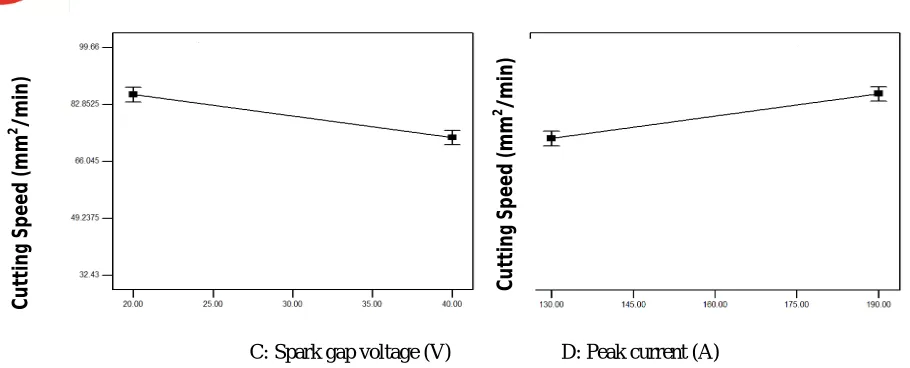
90.235mm2/min when pulse off time was decreased from 32 to 16 µs. Similarly decreasing the spark gap voltage, cutting speed
improved .Cutting speed for spark gap voltage has been assessed between 70 to 87mm2/min.
With the increase in peak current from 130 to 190 A, the cutting speed slightly increased from 72 to 80 mm2/min. The increase in
cutting speed is due to increase in discharge energy which is caused due to higher peak current that will result into increased heat density. Thus the heat will result into faster cutting speed due to erosion and melting of the material. This is similar to the results found by [Yan et al, 2005; Tarang et al., 1995; Anish et al., 2013]. Based on effect plots it has been found that pulse on time and pulse off time are the most significant factors rather than spark gap voltage and peak current which influence cutting speed. According to the trends as obtained the best parameters at which maximum cutting speed can be obtained are – pulse on time = 1.20 μs, pulse off time =16μs, peak current =190A, spark gap voltage = 20V, wire feed = 7m/min and wire tension = 1000 gram.
[image:5.612.53.516.468.671.2]A: Pulse on Time (µs) B: Pulse off Time (µs)
Fig 4 Effect of pulse on time and pulse off time current on cutting speed
C: Spark gap voltage (V) D: Peak current (A)
Fig 5Effect of spark gap voltage and peak current on cutting speed
For cutting speed three interactions have been found to be significant as shown in figures 6 to 8. These interactions are Ton × Toff,
Toff × SV and Toff × IP. Prob.>F value of these interactions are 0.0033, 0.0270 and 0.0308 respectively. When pulse off time was
kept at 16.00 and pulse on time was varied from 0.60 to 1.20, cutting speed increased significantly from 32.868 to 97.439mm2/min.
The cutting speed also increased significantly when pulse off time was set at higher level i.e. 32.00 and pulse on time was unchanged. When pulse off time was decreased from 32 to 16 µs, increment in the cutting speed was observed from 76.026 to
90.258mm2/min. When pulse off time was varied from 16 to 32 µs, at constant peak current of 130A, cutting speed was found to be
decreased from 91.286 to 5.842mm2/min.
[image:6.612.92.513.392.521.2]B: Pulse off Time A: Pulse on Time D: Spark gap voltage B: Pulse off Time
Fig 6 Interaction plot between pulse on timeFig 7 Interaction plot between pulse on time
[image:6.612.90.415.591.704.2]and pulse off time on cutting speed and pulse off time on cutting speed
Fig 8 Interaction plot between pulse off time and peak current on cutting speed
C u tt in g Sp e e d ( m m 2 /m in ) C u tt in g Sp e e d ( m m 2 /m in ) C u tt in g Sp e ed 2 C u tt in g Sp e ed 2 C u tt in g Sp e ed 2
D: Peak Current (µs)
V. CONCLUSIONS
In this study the effect of input process parameters on machining output (Cutting speed) of Al/Al2O3 MMC was investigated
experimentally. It was found that Ton, Toff, SV, IP and three interactions were significant for cutting speed. When pulse on time was
increased by 0.6 to 1.2 µs, the cutting speed increased significantly from 49.823 to 87.365mm2/min. The cutting speed significantly
improved when pulse off time was reduced. Cutting speed increased from 66.045 to 90.235mm2/min when pulse off time was
decreased from 32 to 16 µs. Similarly decreasing the spark gap voltage, cutting speed improved .Cutting speed for spark gap voltage
has been assessed between 70 to 87mm2/min. With the increase in peak current from 130 to 190 A, the cutting speed slightly
increased from 72 to 80 mm2/min. According to the trends as obtained the best parameters at which maximum cutting speed can be
obtained are – pulse on time = 1.20μs, pulse off time =16μs, peak current =190A, spark gap voltage = 20V, wire feed = 7m/min and
wire tension = 1000 gram.
REFERENCES
[1] Azhiri, R.B., Teimouri, R., Baboly, M.G. and Leseman, Z., 2013. “Application of Taguchi, ANFIS and grey relational analysis for studying, modeling and optimization of wire EDM process while using gaseous media”, International Journal of Advanced Manufacturing Technology, 71:279–295.
[2] Meena, K.L., Manna, A., Banwait, S.S., Jaswanti., 2013. “Parametric Effects during Nonconventional Machining of PR-AL-SiC-MMC, s by CNC Wire cut EDM”. International Journal of Engineering and Innovative Technology (IJEIT) Volume 3, Issue 1, July 2013. ISSN: 2277-375
[3] Shandilya, P., Jain, P.K., Jain, N.K., 2013. “RSM and ANN Modeling Approaches For Predicting Average Cutting Speed During WEDM of SiCp/6061 Al MMC”, Procedia Engineering 64 (2013) 767– 774.
[4] Patil, N.G. and Brahmankar, P.K., (2010). “Some studies into wire electro-discharge machining of alumina particulate-reinforced aluminium matrix composites”, Int J Adv Manuf Technol 48:537-555
[5] Yan B.H., Tsai, H.C., Huang, F.Y., Lee, L.C., 2005. “Examination of wire electrical discharge machining of Al2O3p/6061Al composites”, Int Mach Tools Manuf 45:251–259
[6] Rozenek, M., Kozak, J., Dalbrowski, L., Eubkowski, K., 2001. “Electrical discharge machining characteristics of metal matrix composites”, J Mater Process Technol 109:367–370
[7] Fard, R.K., Afza, R.A, Teimouri, R., 2013. “Experimental investigation, intelligent modelling and multi characteristics optimization of dry WEDM process of Al-SiC metal matrix composite”, Journal of Manufacturing Processes 15(2013) 483-494
[8] Guo, Z.N., Wang, X., Huang, Z.G., Yue, T.M., 2002. “Experimental investigation into shaping
[9] Sarkar, S., Mitra, S. and Bhattachyraya, B., 2006. “Parametric optimization of wire electric discharge machining of γ titanium alumnide alloy through an artificial neural network model”, International Journal of AdvancedManufacturing Technology, Vol. 27, pp. 501-508
[10] Tarng, Y. S., Ma, S. C. and Chung, L. K., 1995. “Determination of optimal cutting parameters in wire electrical discharge machining”, International Journalof Machine Tools and Manufacture, Vol.35, pp.1693-1701.