Technology (IJRASET)
Review Paper on ph Transmitter Showing Control
Functionality
Vaishali Kankharer#1, S. A. Khandekar*2 #
E&TC Department, Savitribai Phule Pune University
Abstract— pH is short form for the Power (p) of Hydrogen (H). pH is defined as the negative log of the Hydrogen activity, aH+ or the effective ion concentration. pH is a unit of measure which describes the degree of acidity or alkalinity of a solution. A more effective way to measure pH in an industrial setting is the potentiometric method of pH analysis. Online, continuous measurement method allows the potentiometric method. and Potentiometric analysis involves four parts like sample, sensing ph electrode, electrode reference and amplifier/readout signal. When properly combined the result is accurate, representative pH readings. The pH sensor components are usually combined into one device called a combination pH electrode. Glass is usually used as the measuring electrode. The preamplifier is a signal-conditioning device. The high-impedance pH electrode signal is given to the signal-conditioning device and converts it into a low impedance signal, which is accepted by the transmitter. A transmitter is basically a device, which accepts any measurand and converts that into a standardized transmission signal that is 4 to 20 mA. The signal conditioning process typically involves one or more steps. It involve the steps like isolate , filter & amplify the signal and convert the sensor input signal to a proportional output (4-20mA) signal that is transmitted to another control device or system. To perform this operation PIC controller is used. This paper presents the Industrial pH Transmitter With Control Functionality i.e it adjuses any pH range ( 0-14 pH) and converts that signal into 4 to 20 mA signal.
Keywords-pH, Transmitter, PIC16F, Control
I. INTRODUCTION
A transmitter is basically a device, which accepts any measurand and converts that into a standardized transmission signal i.e. 4 to 20 mA. It is used for transmission of process value from the field to remote, for local indication, recording or controlling devices. Transmitters in general are used to condition and amplify the very small signals generated by process sensors to enable them to drive other instruments, such as chart recorders, data loggers, panel meters, controllers etc. There are various types of transmitters applicable in the process industries i.e. pH transmitter, pressure transmitter, temp. transmitter, level transmitter, flow transmitter, humidity transmitter etc.
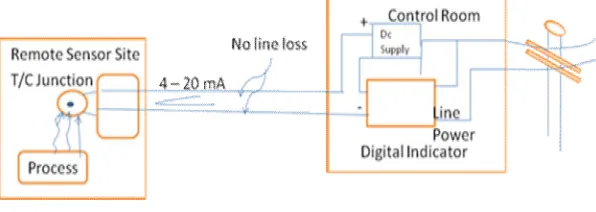
[image:2.612.162.460.547.653.2]The most widely used configuration for transmission is two-wire. The basic idea used behind the two wire transmitter is shown in fig.1. A 24V dc power supply is placed in the control room. The indicator/controller is placed in series with the supply to monitor the transmitter current drawn from the supply. The output impedance should be low since the loop drive capability of 2-wire transmitter is 400Ω to 700Ω. Use of two wire transmitter is most advantageous where the process sensor is located far away from the instrument being operated (Digital panel meter in control room) and local line power is not readily available. This distance may be anywhere from a few hundred feet to several thousand feet or more.
Fig. 1 Two Wire Transmitter Concept
Technology (IJRASET)
current increases. This increased collector current is drawn from the power supply. As the circuit drain is constant, the current variations are due to input variations. the current is adjusted to 20 mA for maximum input signal with the help of SPAN potentiometer. The indicator can be scaled to display the actual process value that this current corresponds to.
pH transmitter modules are next-generation analytical transmitters that easily interface for accurate pH measurement. The pH transmitter excludes pre-amps in pH function. Due to these features pH transmitter cost is low. Also they are easy to install. We can operate and maintain it easily.
The corrosion-resistant sealed plastic enclosure in the analytical transmitter's makes it ideal when the environments are harsh when the moisture, dust and the chemicals are prevalent. The electronics module to pH electrode via a cable is connected through the application like remote mounting option for submersion or sometimes for special mounting.
Here we are designing, simulating and building pH Transmitter for industrial applications with control capability. Implement the same using PIC16F87X microcontroller. This work consist of designing, building and testing of
A. Power supply as per the requirements.
B. User interface.
C. Signal conditioning circuit for pH sensor.
D. V - I converter in 4-20mA range.
E. System Integration to a pH Transmitter.
II. LITERATURESURVEY
In embedded system design, designers consider that there will be many different schemes for one design purpose and the system should realize some particular functions. To realize different schemes we need to go through several stages such as the hardware design, the software design, debugging and so on. For the updation of system, some one needs to select controller, electronic components and redesign. The design process can not again use the design ability and design mastery. If it takes long design cycle and be time-wasting so it would cost. With the improvement and the development of embedded technology, more SOC (system-on-chip) chips are available. The higher stability and reliability of the system performance request that the design method should be more standard and flexible, on the other hand. Designers' moto in the process design is to develop the specific functions of the system fastly. But to understand fastely and effectively the whole system , also to the system design meet requirements of product life. The Binhong Tang & Jianjun gives an ontology-based reconfigurable design method for embedded system development in this paper[1].
Mohamed Khalgui, Olfa Mosbahi, Zhiwu Li and Hans-Michael presented paper "Reconfiguration of Distributed Embedded Control Systems". They says in industry the development of distributed embedded control systems safety is not a trival activity because a failure can be critical for safety of human beings ( e.g. nuclear plant control, aircraft, car control, air and railway traffic control). They have to satisfy classically according to user requirement temporal and functional properties. But their time to market should be shorter than ever. To develop modular embedded - control systems in order to support any reusability of already developed components and to control the design complexity, the component based approaches are studied, to address all these important requirements. Control applications can be designed in industry for this component- based technologies have been proposed. For the design of distributed control applications and corresponding surrounding decapitation, the international standard IEC61499 is proposed by the International Electrotechnical Commission. In this standard, a functional block (FB) is an event triggered software component, which is composed of an implementation and an interface such that the interface contains inputs/ outputs, event/data for internations with the environment. Data contain valued information whereas, events are responsible for the block activations. Algorithms contains the fulfilment to behead is achieved by a state machine labelled as (ECC) execution contol chart. This process is also responsible for sending output events at the end of any algorithm execution[2].
Control focused soft errors detection for embedded applications by Karthik Shanker and Roman Lysecky says that computing systems must be able to continue functioning though there are soft errors. Also requires the development of new methods for self-healing circuits which can detect and recover from these soft errors. The advances in integrated circuits gives several key challenges in system reliability. Because with upcoming technology generations soft errors are expected to increase. They present an area-efficient control focused soft error detector (CNFSED) area-efficient of nonintrusively finding soft errors during the execution of a software application without conversions to the software utilization as well as the target processor. As compared to unmasked errors and control errors the soft error detector achieves high rate to detect the errors [3].
Technology (IJRASET)
code level software. The full system virtual simulation shows the control system behaviour, especially in microcontroller hardware and software. It is used for micro architecture design space exploration, control design verification, the system can be used to correct the errors which also used for evaluation of the errors which are generated within a system. This system can also used for software upgradation before components design, and it can also prevents potential problems. A aspect of this work was that the proposed virtual control system comprises all the components in a particular control system. Hence it allows the analysis of the effects from the distinct areas, e.g. the mechanical analysis of action due to a restriction software bug.
A recent survey of the advances in wireless sensor network applications has reviewed a wide range of applications for these networks and analysed agriculture as a probable area of deployment stable with a review of the factors affecting the design of sensor networks for this function. Wireless Sensor Network is a selection of actuators and sensor nodes joined by a wireless medium. It performs distributed sensing and acting efforts. In base station the sensor nodes collect data and convey over a network environment to a computer system. Depending on the information possessed, the base station takes outcomes. Then the actuator nodes execute proper actions upon the environment. This action allows users to sense and regulate the environment from anywhere. In many situations the utilization of the WSN is preferred, for instance, environment scaning, product aspect scaning, and others where control of huge areas is necessary [5].
The analytical transmitters of ABB’s Endura family are arranged for the demands of industrial clients. In this 2-wire 24 V DC instruments are recycled in measurement and supervision functions. They are generally used in industries like chemical, pulp & paper, mining, and petroleum refining. The APA592 transmitter is fully compatible with ABB's family. It covers full range of glass, antimony, and redox (ORP) electrodes. Including above points, this transmitter is suitable with many challenger sensor inputs. The APA592 has automatic temperature sensor understanding for both 2- and 3-wire RTD inputs for typical inputs such as Pt100, Pt1000, and 3k Balco [6].
In all areas of process engineering Liquiline M CM42 is a type of modular two-wire transmitter. Liquiline has one or two analog current outputs.This will depend on the ordered version. Also Liquiline can be linked to field buses as per FOUNDATION Fieldbus, Hart protocol as well as PROFIBUS PA. [7].
The SMARTPro 8966 is a type of the HART compatible with Microcontroller base. It is a two wire transmitter. This transmitter accepts inputs from different pH sensors. Then transmits it in terms of 4-20mA HART output. pH, mV and temperature measurement is possible by this transmitter. Hence the mixing of pH sensor and temperature sensor or REDOX sensor can be recycled as process sensors. The outcome of measurements are shown with the help of LCD display [8].
Industrial Electrodes as well as pH Instrumentation contributes the model PHTX-014 pH two wire transmitter. It is constructed to grant a standard 4 to 20 mA current output . This output is proportional to the pH value which is being consistant. It has constructional features like covering as well as limited size. This features grant easy installation. Also it will contain any pH
electrode with a BNC connector. In this temperature compensation is manual or automatic .It takes place with need of any 1000Ω
Platinum RTD [9].
The Honeywell produced Analytical Process Transmitter (APT) 2000 Series transmitter. This is a two-wire 24-Volt device .IT continuously measures pH or ORP in different industrial processes. Also it includes the processes like chemical, pharmaceutical, petrochemical, pulp and paper, and wastewater. To meet the measurement demands of intrinsically protected, non incentive as well as general-purpose aeras the APT2000’s NEMA 4x and IP65 rated enclosure is espetially designed. Honeywell pH or ORP sensors or sometimes a broad collection of challenger electrodes can be recycled as input for the transmitter. The accepted on the APT2000 is the current 4-20 mA. The Hart communications protocol is accessible in two-directional remote monitoring/control of the process. The transmitters designed by this company actions the widest feasible selection of advanced features. These features are ueed in a reliable and economical instrument [10].
The Sensor DirectLine® get by of an electronics module. They are associated to different pH electrodes like a Durafet® II, Durafet® III, Meredian® II or HPW7000. This sensor can be used to avoid the The use of this sensor is that it avoids the requirements for pre-amps, transmitters, and analysers. These demands are recycled in pH operations. This real design can be isolated from the sensor. Here they granting the sensor to be easily removed or replaced while retaining power to the electronics module. In case of a Nema Type 4x polysulfone housing the DL421 electronics module is involved. This module can be seated as an integral unit directly. It is directly connected to the electrode. As well as casually using an electrode with rise in succeeding technology originations. Plug-in connections are recycled in the sealed plastic housing for the pH electrode as well as 4-20 mA cordset [11].
III. SYSTEMOVERVIEW
Technology (IJRASET)
Fig. 2 Block Diagram of Proposed System
In proposed system PIC16F87X microcontroller is used. The power supply required is 12V. Also the system includes signal conditioning circuit. The signal conditioning process typically involves one or more of the following steps: isolating, filtering, amplifying, and converting a sensor input signal to a proportional output signal that is transmitted to another control device or system.PIC Microcontroller has in built A/D converter, based on RISC architecture, nearly 40 instruction required for one to four machine cycles to execute and the PIC16F877/874 0devices come in 40-pin packages. The Parallel Slave Port is implemented on this devices.
Feature of PIC Microcontroller
A. 28/40-Pin 8-Bit CMOS FLASH Microcontroller.
B. High performance RISC CPU.
C. In-Circuit Serial Programming (ICSP) via two pins.
D. Single 5V In-Circuit Serial Programming capability.
E. Processor read and write access to program memory.
F. Wide operating voltage range: 2.0V to 5.5V.
G. High Sink/Source Current: 25 mA.
H. Power saving Sleep mode.
The goal of pH of a liquid is to show the acidic or basic (alkaline) type of it. The pH factor converts the values of the hydrogen ion concentration. These values ordinarily ranges between about 1 and 10 x -14 gram-equivalents per litre - into numbers (in the range 0 and 14).
On the display of pH scale the acidic solution has a low pH value such as 0, 1, or 2. This value tally to a large concentration of hydrogen ions; which are in the range 10 x 0, 10 x -1, or 10 x -2 gram-equivalents per litre. Similarly on display of pH scale the basic solution has a high pH indications, like 12, 13, or 14. This value corresponds to a limited number of hydrogen ions which are like 10 x -12, 10 x -13, or 10 x -14 gram-equivalents per litre. Water is an example of neutral solution which indicates a pH of approximately 7.
The measurement of pH value steps in a loop parts like ph sensor, a reference electrode, a temperature sensor, a preamplifier as well as transmitter. This measurement loop is nothing but a battery. In this battery measuring electrode is acting as positive terminal. Similarly reference electrode is acting as negative terminal. The measuring electrode at positive terminal is sensitive to the hydrogen ion. This establishes a potential (voltage) directly linked to the hydrogen ion concentration value of the solution. The reference electrode produce a stable potential across which the measuring electrode can be compared.
Fig. 3 Typical pH Sensor
[image:5.612.214.398.615.678.2]Technology (IJRASET)
signal and converts it into a low impedance signal. This signal is then accepted by the analyser or transmitter circuit. The job of preamplifier is enlarges and stabilizes the signal, also make the signal less susceptible to electrical noise [11].
The function of signal conditioning circuit is in the applications of process monitoring and control engineering. In these applications it makes a practice of making a raw input signal which is used with instrumentation in a data acquisition and/or control system. The signal conditioning process typically involves one or more steps. It involve the steps like isolate , filter & amplify the signal and convert the sensor input signal to a proportional output (4-20mA) signal that is transmitted to another control device or system. Sometimes a signal conditioner can perform different type of computation functions. These computation function includes the operations on the signal like totalisation, integration, pulse-width modulation, linearization, and other math operations.
System Specifications
A. Auto / Manual temperature compensation
B. Accuracy (pH) 0.05 to 0.05 % of full reading
C. 4 digit LCD display and 2 x 1 keyboard
D. Power supply : 0 -25 Vdc
E. Output current: 4 - 20 Ma
F. pH Range : 0 - 14 pH
IV. CONCLUSION
The proposed system of pH Transmitter and control measures the pH of solution and gives the output in terms of 4 - 20mA, proportional to pH value. Here pH is a nonlinear variable and to obtain 4 -20 mA range signal conditioning circuit is used. The range of pH sensor is 0 -14 pH and the sensor output is in mV.
REFERENCES
[1] Binhong Tang, Jianjun YI, Ying Cheng, Chunhua GU, “A Reconfigurable Design Method of Sofiane Embedded Control System bases on Ontology” in IEEE
East China University of Science and Technology, Shanghai 200237, P.R.China, 978-1-4244-7161-4/10/$26.00©2010
[2] Mohamed Khalgui, Olfa Mosbahi, Zhiwu Li, and Hans-Michael Hanisch, “Reconfiguration of Distributed Embedded-Control Systems”, in IEEE/ASME
Transactions on Mechatronics, Vol. 16, No. 4, p. 684-694, August 2011
[3] Karthik Shankar, and Roman Lysecky, “Control Focused Soft Error Detection for Embedded Applications”, IEEE Embedded Systems Letters, Vol. 2, No. 4,
p.127-130, December 2010.
[4] Makoto Ishikawa, D.J. McCune, and George Saikalis,“CPU Model-based Hardware/Software Co-design,Co-simulation and Analysis Technology for
Real-Time Embedded Control Systems”, in Proceedings of the 13th IEEE Real Real-Time and Embedded Technology
[5] Miss. Vrushali R. Deore, Prof. V. M. Umale, “Wireless Monitoring of the Green House System Using Embedded Controllers”, in International Journal of Scientific & Engineering Research, ISSN 2229-5518, Vol. 3, Issue 2, pp.1-7, February-2012.
[6] “ABB Limited”, Endura APA592 pH Transmitter User Manual, DS- APA592-EN.
[7] “Endress and Hauser [I] Ltd.”, Liquiline M CM42 Transmitter User Manual, TI381C/07/en/10.08 71080895.
[8] “Forbes Marshall Pvt Ltd.”, Aquamon SMARTPro 8966 HART© Smart Two wire pH transmitter Instruction Manual CENG:IM:PH:0812:001:01,2008.
[9] “Industrial pH Instrumentation and Electrodes Pvt Ltd.”, Industrial pH Two Wire 4 to 20 mA Transmitter, PHTX-212/PHTX-014.
[10] “Honeywell Pvt Ltd.”, Sensing and Control, 11 West Spring Street Freeport, IL 61032, USA,70-82-03-32 0800.
[11] “Industrial Measurement and Control”, Honeywell 1100 Virginia Ave. Fort Washington, PA 19034 pH Electrodes User Manual, 70-82-25-102,Rev. 5, 2/04,