www.ijraset.com Volume 4 Issue VI, June 2016 IC Value: 13.98 ISSN: 2321-9653
International Journal for Research in Applied Science & Engineering
Technology (IJRASET)
©IJRASET: All Rights are Reserved
646
An Efficient Classifier using Multilayer Perceptron
for Classification of Liver patient
Pooja Shrivastava1, Yukti Kesharwani2
Dept of CSE, Dr. C. V. Raman University, Kota, Bilaspur, Chhattisgarh, India
Abstract--In medical science, Liver patients have been continuously increasing due to excessive consumption of alcohol, inhale of harmful gases, intake of contaminated food and drugs. Classification is one of the important techniques for classification of any type of data. This research work focus on the development of efficient model for classification of liver patient disease. These classifiers are very helpful for doctors to identify such types of diseases. In this research work, we will use MLP to develop the robust classifier which can classify data as lover or non liver. We have applied ILPD data set on MLP with different learning and different hidden layers. Our proposed model MLP achieved 77.77% of accuracy in case of hidden layer 2 and learning rate 0.7 as robust model.
Keywords: Classification, Multilayer Perceptron (MLP), Learning rate.
I. INTRODUCTION
Diagnosis of health condition is a very critical task faced by medical science. There are various researchers are working to diagnosis of various types of diseases that is faced by patients. Classification is also important techniques that can classify the diseases which can greatly benefit all parties involved in the health care industry. The main aim of this work is to detection of liver patient and classifies the data as liver or non liver patient. There are various authors have worked in the field of classification of classification of liver patient. A. Gulia et.al,(2014) [4] have proposed and compared C4.5, Multilayer Perceptron classifier, Random Forest classifier, Support Vector Machine classifier and Bayesian Network classifier for classification of liver patient data.The propsed random forest given highest 71.86% accuracy. B. V. Ramana et. al, (2012) [5] have proposed MLP for classification for liver patient data and compared to other classification techniques. The proposed MLP with Random subset gives highest accuracy of 74.7826% in case of BUPA liver disorder dataset and nearest neighbour with CFS gives highest accuracy of 73.0703% for ILPD dataset. S. Dhamodharan (2014) [6] have used Naïve Bayes and Forest Tree (FT) techniques to classify the liver patient data.Results show that Naïve Bayes gives better performance than Forest tree which given 75.54% of accuracy while FT tree given 72.66% of accuracy.
II. METHODOLOGY
Classification technique can be used in many fields like health care, information security, E-commerce, etc. In this research work, we have used MLP techniques as classifier to classify the liver patient.
LP (Pujari, A. K., 2001) [1] is a development from the simple perceptron in which extra hidden layers (layers additional to the input and output layers, not connected externally) are added. More than on hidden layer can be used. The network topology is constrained to be feed forward, i.e., loop-free. Generally, connections are allowed from the input layer to the first (and possible only) hidden layer, from the first hidden layer to the second and so on, until the last hidden layer to the output layer. The presence of these layers allows an ANN to approximate a variety of non-linear unctions. The actual construction of network, as well as the determination of the number of hidden layers and determination of the overall number of units, is sometimes of a trial-and-error process, determined by the nature of the problem at hand. The transfer function generally a sigmoid function.
This research work has used one of the important parameter that is learning which controls how much the weights are adjusted at each update.
III. PERFORMANCE MEASURES
Technology (IJRASET)
TABLE I
IV. DATA DESCRIPTION
The Indian Liver Patient Dataset (ILPD) data set is collected from UCI repository [2] which contains 10 attributes and 1 class. This data set is binary classification problem. The data set is also consists of 583 instances in which 416 are liver patient records and 167 non liver patient records.
V. EXPERIMENTAL WORK
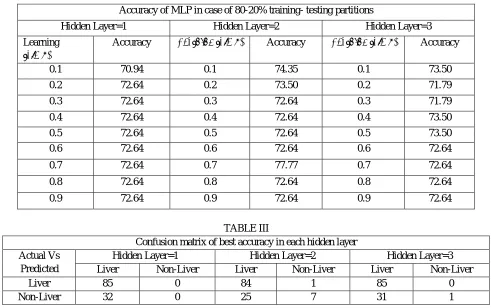
[image:3.612.60.551.390.698.2]This experiment work is focus on the classification of liver patient data. In this experiment we have used open source WEKA [3] data mining tools with5i machine. We have applied the ILPD data set to the MLP with different number of hidden layer and different learning rate in case of 80-20% training-testing partition. The learning rate range from o to 1. The proposed MLLP model gives accuracy with different learnig rate and different hidden layers as in TABLE II. The proposed model gives 77.77% of accuracy in case of hidden layer two and learning rate 0.7 as robust model. The robustness of model can be evaluated using other performance measures like sensitivity and specificity. These measures can be calculated with the help of confusion matrix which consists TP, TN, FP and FN. The specific formula shown in TABLE I. TABLE III shows that confusion matrix of best accuracy in each hidden layer where 84 samples are correctly classified and 1 sample is misclassified with liver patient while 25 samples are incorrectly classified and 1 sample is correctly classified with non liver patient in case of single hidden layer. Similarly confusion matrix shows for hidden layer two and three also. TABLE IV shows that other performance measures like sensitivity, specificity as well as accuracy.
TABLE II
Accuracy of MLP in case of 80-20% training- testing partitions
Hidden Layer=1 Hidden Layer=2 Hidden Layer=3
Learning
rate(α)
Accuracy Learning rate(α) Accuracy Learning rate(α) Accuracy
0.1 70.94 0.1 74.35 0.1 73.50
0.2 72.64 0.2 73.50 0.2 71.79
0.3 72.64 0.3 72.64 0.3 71.79
0.4 72.64 0.4 72.64 0.4 73.50
0.5 72.64 0.5 72.64 0.5 73.50
0.6 72.64 0.6 72.64 0.6 72.64
0.7 72.64 0.7 77.77 0.7 72.64
0.8 72.64 0.8 72.64 0.8 72.64
0.9 72.64 0.9 72.64 0.9 72.64
TABLE III
Confusion matrix of best accuracy in each hidden layer Actual Vs
Predicted
Hidden Layer=1 Hidden Layer=2 Hidden Layer=3 Liver Non-Liver Liver Non-Liver Liver Non-Liver
Liver 85 0 84 1 85 0
Non-Liver 32 0 25 7 31 1
Performance Measures
Accuracy (TP+TN)/(TP+TN+FP+FN) Sensitivity TP/(TP+FN)
www.ijraset.com Volume 4 Issue VI, June 2016 IC Value: 13.98 ISSN: 2321-9653
International Journal for Research in Applied Science & Engineering
Technology (IJRASET)
©IJRASET: All Rights are Reserved
648
TABLE IVPerformance measures
Performance Measures Hidden Layer=1 Hidden Layer=2 Hidden Layer=3
Accuracy 72.64 77.77 73.50
Sensitivity 100 98.82 100
Specificity 0 21.87 3.12
Fig. 1 Accuracy of MLP with best learning rate and different hidden layer
VI. CONCLUSION
Classification technique plays very important role and helpful for diagnosis of diseases in field of medical science. In medical science, diagnosis of diseases is very important to treatment of patient because health is directly related to human life. In this research work, we have used MLP techniques to classify the liver patient data. In this classification model , the specific parameter like learning rate and hidden layer is very important. The model gives 77.77% of accuracy with hidden layer two in case of learning rate 0.7 as robust model.
REFERENCES
[1] K. Pujari, , Data Mining Techniques. Universities Press (India) Private Limited. 4th ed., ISBN: 81-7371-380-4,2001.
[2] WEKA Data Mining Tools: http://www.cs.waikato,ac.nz/~ml/weka/ (Browsing date: Feb. 2016).
[3] UCI Machine Learning Repository [http://archive.ics.uci.edu/ml/datasets.html].
[4] A. Gulia, Dr. R. Vohra and P. Rani , Liver Patient Classification Using Intelligent Techniques, International Journal of Computer Science and Information Technologies, Vol. 5 (4) ,pp. pp. 5110-5115,2014
[5] B. V. Ramana and prof. M. Surendra Prasad Babu , “Liver Classification Using Modified Rotation Forest”. International Journal of Engineering Research and
Develpoement, vol 1, issue 6, pp17-24, 2012.
[6] S. Dhamodharan , “Liver Diseases Prediction Using Bayesian Classification”. National Conference on Advanced Computing, Applications & Technologies,
ISSN:2320-0790, pp. 1-3, 2014.
72.64 77.77 73.5 0 10 20 30 40 50 60 70 80 90 100
1 2 3
A cc ur ac y in P er ce nt ag e