A Review: Evaluating the Parametric
Optimization of
Electrical Discharge Machining (EDM)
by Using & Comparing
Artificial Neural Network (ANN) and Genetic
Algorithm (GA)
Dharmendra A. Gholetar#1, Kamlesh V. Dave#2 #1
M.E. Student, Department of Mechanical Engg. #2
Assistant Professor, Department of Mechanical Engg.,
C.U.Shah college of Engineering & Technology, Wadhwan city-363060,Gujarat,India)
Abstract: Artificial neural networks (ANN) and Genetic algorithms (GA) in a wide sense both belong to the class of evolutionary computing algorithms that try to mimic natural evolution or information handling with respect to everyday problems. Both methods have gained more ground in recent years, especially with respect to prediction based problems. But owing to the dynamics inherent in their evolution, they belong to somewhat disjunct development communities that interact seldom. Hence comparisons between the different methods are rare. Despite their obvious design differences, they also have several features in common that are sufficiently interesting for the innovation-oriented to follow up and so to understand these commonalities and differences. Here, there is an demonstration of how these two methodologies tackle the problem of optimize the EDM process. Electrical Discharge Machining (EDM) is a non conventional machining process, where electrically conductive materials are machined by using a precisely controlled spark that occurs between an electrode and a work piece in the presence of a dielectric fluid. It has been a demanding research area to model and optimize the EDM process in the present scenario. Lots of efforts have been exercised to model and optimize the performance and process parameters of EDM process using ANN & GA.
Keywords - Artificial neural networks (ANN), Electrical Discharge Machining (EDM), Genetic algorithms (GA),Non conventional machining process, Evolutionary computing algorithms.
1. INTRODUCTION
The selection of appropriate machining conditions for better performance during the electric discharge machining (EDM) process is based on the analysis relating the various process parameters to performance parameters. Traditionally this is carried out by relying heavily on the operator’s experience or conservative technological data provided by the EDM
machining variables. A single parameter change will influence the process in a complex way. Thus the various factors affecting the process have to be understood in order to determine the trends of the process variation. The selection of best combination of the process parameters for an optimal surface roughness involves analytical and statistical methods. In addition, the modeling of the process is also an effective way of solving the tedious problem of relating the process parameters to the surface roughness.
The settings for new materials such as titanium alloys, aluminium alloys and special steels have to be further optimized experimentally. It is also aimed to select appropriate machining conditions for the EDM process based on the analysis relating the various process parameters to Performance parameters. It is aimed to develop a methodology using an input–output pattern of data from an EDM process to solve both the modeling and optimization problems. The main objective of this review is to model EDM process for optimum operation representing a particular problem in the manufacturing environment where, it is not possible to define the optimization objective function using a smooth and continuous mathematical formula. It has been hard to establish models that accurately correlate the process variables and performance of EDM process. Improving the surface quality is still a challenging problem that constrains the expanding application of the technology. When new and advanced materials appear in the field, it is not possible to use existing models and hence experimental investigations are always required. Undertaking frequent tests or many experimental runs is also not economically justified. In the light of this, the present review describes the development and application of a hybrid artificial neural network (ANN) and genetic algorithm (GA) methodology to model and optimize the EDM process.
2. ELECTRICAL DISCHARGE MACHINING (EDM)
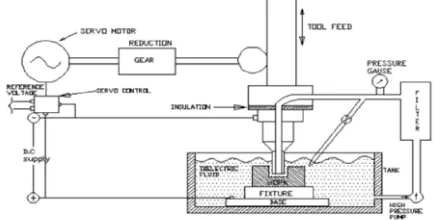
Electrical Discharge Machining (EDM) is a non-conventional machining process, where electrically conductive materials is machined by using precisely controlled sparks that occur between an electrode and a workpiece in the presence of a dielectric fluid. It uses thermoelectric energy sources for machining extremely low machinability materials; complicated intrinsic-extrinsic shaped jobs regardless of hardness have been its distinguishing characteristics. EDM founds its wide applicability in manufacturing of plastic moulds, forging dies, press tools, die castings, automotive, aerospace and surgical components. As EDM does not make direct contact (an inter electrode gap is maintained throughout the process) between the electrode and the workpiece it’s
eradicate mechanical stresses, chatter and vibration problems during machining. Various types of EDM process are available, but here the concern is about die-Sinking (also known as ram) type EDM machines (see Fig. 1.1)which require the electrode to be machined in the exact opposite shape as the one in the workpiece [18].
[image:3.612.315.535.347.457.2]Electrical discharge machining (EDM) has become one of the most extensively used non-conventional material removal process. Its unique feature of using thermal energy to machine electrically conductive parts regardless of hardness has been its distinctive advantage in the manufacture of mould, die, automotive, aerospace and surgical component. Optimal selection of process parameters is very much essential as this is a costly process to increase production rate considerably by reducing the machining time. Material removal rate (MRR) and tool wear are most important response parameters in die-sinking EDM. Several researchers carried out various investigations for improving the process performance. Proper selection of machining parameters for the best process performance is still a challenging job [2].
Fig. 1.1 Set up of Electrical Discharge Machining
The operating efficiency of an electrical discharge machine strongly depends on the gap-width controller. This controller has to adjust the size of the inter electrode gap to achieve a high workpiece removal rate and low tool-electrode wear. A model based controller synthesis cannot completely be applied in electrical discharge machining (EDM) because of the insufficient model of the removal system and the chaotic fluctuations of the gap state. To cope with these problems, optimization systems have been developed to adapt the gap-width controller to the continuously changing working conditions and process situations [3].
smaller the spark gap better the accuracy and the slower the MRR. Figure 1.2 shows the research area in park Erosion EDM Processes [6].
Fig. 1.2 Research area in Spark Erosion EDM Processes
It should be noted that although nowadays EDM is an established technology in tools and dies industry and is also integrated within CIM/CAPP environments, is still one of the expertise-demanding processes in the manufacturing industry. A complete, clear, and scientifically admissible theory of EDM has not yet been established. The best explanation of EDM material removal mechanism is offered by the thermo-electric theory, as established by extensive experimental studies; Three stages can be distinguished:
(i) Ionization and arc formation at a localized area between the electrodes, following the application of a voltage exceeding the breakdown voltage.
(ii) The occurrence of the main discharge as an electron avalanche striking the anode; low electrical resistance in the discharge channel, hydraulic restriction of the dielectric and the magnetic pinch effect establish high current densities. The cathode is struck by ions and is heated less rapidly than the anode.
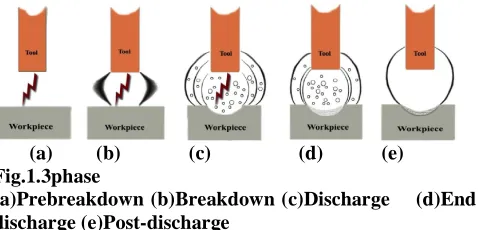
(iii) Local melting and evaporation follow and material is removed from the site of the discharge by explosion occurring after the cessation of the electrical discharge. The current density decreases with increasing discharge duration, the discharge tending to become an arc. De-ionization of the plasma channel occurs after the completion of the whole cycle and a new cycle can start at the site of the closest electrode distance. Figure 1.3 shows the phase of EDM process[7].
(a) (b) (c) (d) (e)
Fig.1.3phase
(a)Prebreakdown (b)Breakdown (c)Discharge (d)End of discharge (e)Post-discharge
The dominating thermal mechanism briefly described above is also the reason for the lack of analytical models
correlating the process variables and surface finish; for the prediction of surface roughness empirical models as well as multi-regression analysis are usually applied [7].
Owing to the complex nature of the process involving physics of the EDM spark (plasma), it is difficult to observe the process experimentally and quantify the mechanism of material removal [8].
3. PROCESS PARAMETER
G. Krishna Mohana Raoa, G. Rangajanardhaa,D. Hanumantha Rao, M. Sreenivasa Rao et. al [1] presents the effects of current, voltage, machining time and type of material on hardness. Kerosene was used as dielectric medium. Current is the most influencing factor for surface roughness. From the sensitivity analysis it is concluded that type of material is having highest influence on all performance measures. Means it is aimed at optimizing the surface roughness of die sinking electric discharge machining (EDM) by considering the simultaneous affect of various input parameters. The experiments are carried out on Ti6Al4V, HE15, 15CDV6 and M-250. Experiments were conducted by varying the peak current and voltage and the corresponding values of surface roughness (SR) were measured.
Debabrata Mandal, Surjya K. Pal , Partha Saha et. al [2]
presents the equipment used to perform the experiments is a diesinking EDM machine (VICTOR-1, Make: Electronica Machine Tool Ltd., India). In the present study MRR and tool wear have been considered for evaluating the machining performance. Material removal rate and tool wear are correlated with machining parameters such as pulse on time (Ton), pulse off time (Toff), discharge current, etc. Proper selection of the machining parameters can result a higher material removal rate and lower electrode wear. Experiments have been conducted covering wide range of current settings, pulse on time and off time settings to collect more number of data for better training of the neural network model. For each experiment, a new set of tool and work-piece has been used.
[image:4.612.50.289.539.654.2]circuits might be tolerated to stabilize the process. In stable process situations, the number of open circuits should be reduced to increase material removal. This task is fulfilled by a neural network that works as a process optimization ;electrolyte copper as electrode material & 56NiCrMoV7 as workpiece material. The neural network adapts the gap-width controller by changing the scaling factors (SV, SR) at the controller output. This neural network receives as input data the relative frequencies of arcs, open circuits, and short circuits measured during a longer period of time. Also, the actual settings of SV and SR are given as input data.
J.Y. Kao, Y.S. Tarng et. al [4] presents that develop the safety and adaptive control functions in EDM machines, real-time monitoring and evaluation of the EDM process must be established. Usually, EDM pulses, i.e. the voltage and current of the tool-workpiece gap, are often used for monitoring the EDM process, because the metal removal rate, the surface finish, and the accuracy of the component are characterized strongly by the EDM pulses. In this paper, neural networks have been proposed to monitor the EDM pulses, as neural networks are a highly flexible tool for pattern recognition and classification. It has been shown that neural networks are superior to traditional approaches in monitoring manufacturing processes.
S. Sarkar, S. Mitra, B. Bhattacharyya et. al [5]presents that wire electrical discharge machining (WEDM) of γ titanium aluminide is studied. Selection of optimum machining parameter combinations for obtaining higher cutting efficiency and accuracy is a challenging task in WEDM due to the presence of a large number of process variables and complicated stochastic process mechanisms. This paper presents an attempt to develop an appropriate machining strategy for a maximum process criteria yield. A feed forward back-propagation neural network is developed to model the machining process. The three most important parameters – cutting speed, surface roughness and wire offset –have been considered as measures of the process performance. The model is capable of predicting the response parameters as a function of six different control parameters, i.e. pulse on time, pulse off
time, peak current, wire tension, dielectric flow rate and servo reference voltage. Experimental results demonstrate that the machining model is suitable and the optimisation strategy satisfies practical requirements.
Shajan Kuriakose, M.S. Shunmugam et. al [6] reported that in the present work, the experiments have been conducted on 5-Axis CNC-WEDM machinecontrolled by closed loop dc motor system. Brass wire and zinc or aluminium coated wires
are employed as electrode. The machine is equipped with an automatic wire feed mechanism which threads the wire if a break occurs, and cuts and threads the wire for hole-to-hole positioning. WEDMprocess involves a number of machine setting parameters such as applied voltage (V), ignition pulse current (IAL), pulse-off time (TB), pulse duration (TA), servo-control reference mean voltage (Aj), servo-speed variation (S), wire speed (Ws), wire tension (Wb) and injection pressure (Inj). The material of workpiece and its height (H) also influence the process. All these parameters influence surface finish and cutting speed to varying degree. Titanium alloy was chosen as the work material and workpiece thickness (H) was kept as 60 mm. Zinc-coated brass wire of 0.25mm was used for all the experiments.
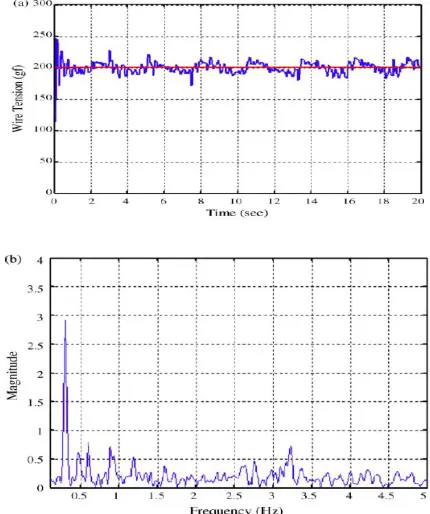
Mu-Tian Yan, Chi-Cheng Fang et. al [7] reported that In order to verify the applicability of the proposed closed loop wire tension control system, and the effectiveness of the proposed control law, experiments are conducted under the influence of the flushing condition. Then flushing pressure of the upper guide and the lower guide is 6 kgf/cm2. Fig. 3.1 shows the time response of wire tension and its corresponding fast Fourier transform with open-loop control.
[image:5.612.317.532.377.634.2]Hsien-Ching Chen, Jen-Chang Lin , Yung-Kuang Yang , Chih-Hung Tsai et. al [8] presented that they Produces tungsten and tungsten alloys by powder metallurgical processes by PLANSEE Co. Experiments were planned using a factorial design based on a Taguchi’s L18orthogonal array. The process factors and factor levels that an experimental factor with two levels (i.e.,the pulse on time, factor A) and other six experimental factors with three levels were included. The pulse on time (i.e., factor A), the pulse off time (i.e., factor B), arc off time (i.e., factor C), the servo voltage (i.e., factor D), the wire feed rate (i.e., factor E), the wire tension (i.e., factor F), the water pressure (i.e., factor G) were selected the factors for the WEDM process.
HUANG He, BAI Ji-cheng, LU Ze-sheng, GUO Yong-feng et. al [9] reported that experiments supporting the research presented in this paper were carried out on low carbon steel using an EA8 die-sinking EDM machine manufactured by Mitsubishi Electric Co. Kerosene, injected through the tubular electrode that was used as a high pressure dielectric. Through combinations of various process parameters experimental data was obtained. Six parameters were selected as the factors which influenced electrode wear; Peak current, Pulse width, Pulse interval, Dielectric pressure, Electrode cross sectional area and Machining depth.Each factor was assigned 3 levels, which were usually used in experiments.
Ulas Çaydas, Ahmet Hasçalık, Sami Ekici et. al [10]
presented that surface roughness and WLT are the main indicators of quality of a component for WEDM. both depends upon four machining parameters namely pulse duration, open circuit voltage, dielectric circulation pressure and wire feed rate and they were taken as input features. A full factorial experimental design was adopted to study to collect Ra and Wlt values. The measured performances were normalized as 0 and 1 interval by using standart min–max normalization procedure.
R.Rajesha and M. Dev Anand et. al [11]reported that the working ranges of the parameters for subsequent design of experiment, based on Taguchi’s L32 Orthogonal Array (OA) design have been selected. In the present experimental study, Working Voltage, Working Current, Oil Pressure, Pulse On Time, Pulse Off Time and Spark Gap have been considered as process variables. MRR is calculated by measuring the time of machining.
Angelos P. Markopoulos, Dimitrios E. Manolakos, Nikolaos M. Vaxevanidis et. al [12] mentioned that proposed models use data for the training procedure from an
extensive experimental research concerning surface integrity of EDMed steels. The workpiece material, the pulse current, Ie and the pulse duration, tp were considered as the input parameters of the models. More specifically, five steel grades, namely a mild steel, a carbon steel, and three alloyed steels, were tested while the pulse current, and the pulse duration varied over a wide range, from roughing to near-finishing conditions.
Kuo-Ming Tsai, Pei-Jen Wang et. al [13]presented that to establish better process model based on neural networks by comparing the predictions from different models under the effect of change of polarity between the electrode and the work material in the EDM process. Initially, pertinent process variables affecting the MRR, namely the polarity of electrode, discharge time, the peak current and the material of both the tool and the workpiece were screened by making use of the Taguchi’s method on design of experiments.
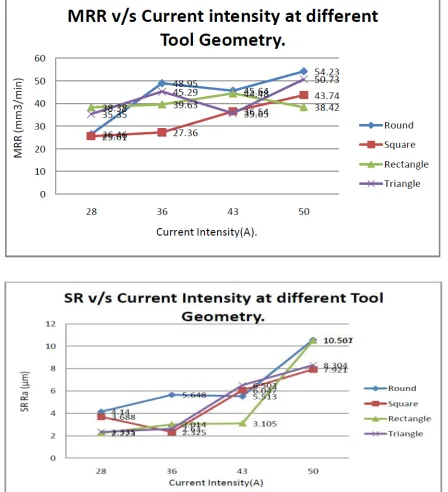
Kamlesh V. Dave et. al [15] reported that when current intensity increases, the MRR increases and so the Surface Quality decreases. But for current intensity 36 the results are different and the MRR is good and Surface Quality also good for Triangle and Rectangle Geometry [Fig. 3.1].
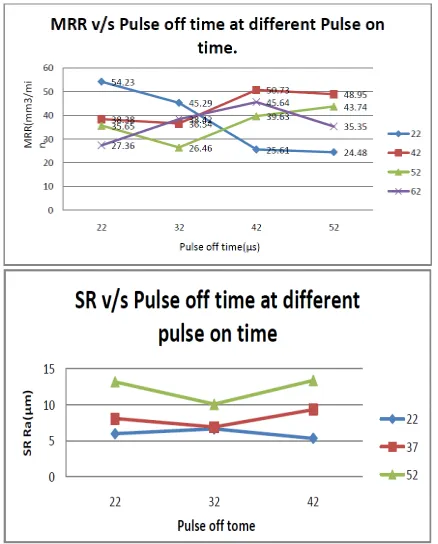
[image:6.612.312.536.378.624.2]They also described that as the pulse on time and pulse off time difference increases the MRR and SR both give negative results that MRR decreases and SR increases. But as they come nearer to each other, both the output parameters show good results [Fig. 3.2]. Gap Voltage, Current Intensity, Pulse on time, pulse off time are influential parameters to the common performance measures like MRR and Surface roughness. The rank was provided that which parameter affects the most to the least. For Surface roughness it is 1. Current intensity 2. Tool Geometry .3.Pulse off time 4. Pulse on time 5. Gap voltage and for MRR it is 1. Current Intensity 2. Pulse on time 3.Tool Geometry. 4. Pulse off time 5. Gap Voltage. The Rectangle Geometry at 43 A current gives good results for both the performance measures. Also, Pulse on time and Pulse off time range affect the MRR and SR. At PON=22 & POFF =22 hold good results but at PON=22 & POFF=62 the results are not friendly.
Fig. 3.3 Comparison of MRR and SR with pulse off time at different pulse on time
4. ARTIFICIAL NEURAL NETWORK (ANN) & GENETIC ALGORITHMS (GA)
Artificial neural networks (ANN) and Genetic algorithms (GA) in a wide sense both belong to the class of evolutionary computing algorithms that try to mimic natural evolution or information handling with respect to everyday problems. Both methods have gained more ground in recent years, especially with respect to prediction based problems. But owing to the dynamics inherent in their evolution, they belong to somewhat disjunct development communities that interact seldom. Hence comparisons between the different methods are rare. Despite their obvious design differences, they also have several features in common that are sufficiently interesting for the innovation-oriented to follow up and so to understand these commonalities and differences. Here, There is an demonstration of how these two methodologies tackle the problem of optimize the EDM process.
Fig. 4.1 Comparison of experimental and network output
Multiperceptron neural network models were developed using Neuro Solutions package. Genetic algorithm concept is used to optimize the weighting factors of the network. Hybrid models are developed for SR considering all the four materials together which can predict the behavior of these materials when machined on EDM. There is considerable reduction in mean square error when the network is optimized with GA.
Debabrata Mandal, Surjya K. Pal , Partha Saha et. al [2]
[image:8.612.54.271.378.520.2]describes that present study attempts to model and optimize the complex electrical discharge machining (EDM) process using soft computing techniques. Artificial neural network (ANN) with back propagation algorithm is used to model the process. As the output parameters are conflicting in nature so there is no single combination of cutting parameters, which provides the best machining performance. A multi-objective optimization method, non-dominating sorting genetic algorithm-II is used to optimize the process. Experiments have been carried out over a wide range of machining conditions for training and verification of the model. Testing results demonstrate that the model is suitable for predicting the response parameters, as shown in Fig. 4.2 & 4.3.
Fig. 4.2 Comparison between actual and predicted MRR
Fig. 4.3 Comparison between actual and predicted tool wear
For this problem, problem different architectures have been studied. The model with 3-10-10-2 architecture is found the most suitable for the task under consideration with learning rate as 0.6 and momentum co-efficient as 0.6. Out of 78 screened patterns, 69 respectively and having mean prediction error is as low as 3.06%.
The GA is a powerful, general-purpose optimization tool widely used to solve optimizing problems in the mathematics, engineering and so on. Genetic algorithm works with a population of feasible solutions and, therefore, it can be used in multi-objective optimization problems to capture a number of solutions simultaneously. NSGA-II is fast and elitist multi objective GA, proposed by Dev et al. The crossover and mutation operators remain as usual, but selection operator works differently from simple GA. Selection is done with the help of crowded-comparison operator, based on ranking (according to non-domination level), and crowding distance.
[image:8.612.319.482.466.676.2]Behrens A., Ginzel J. et. al [3] introduces a process control system consisting of a fuzzy gap width controller adapted by a neural network. By combining a neural network with a fuzzy controller in this way, a learning process control system is achieved.The neural network adapts the gap-width controller by changing the scaling factors (SV, SR) at the controller output. This neural network receives as input data the relative frequencies of arcs, open circuits, and short circuits measured during a longer period of time. Also, the actual settings of SV and SR are given as input data as shown in Fig. 4.4
A multilayer-perceptron was chosen as the network architecture. This network was trained using a back-propagation algorithm. Due to the software tool (Matlab Neural Network Toolbox, Version 6, Release 12), only two layered networks could be implemented. To optimize the number of neurons in the hidden layer the training progress using different networks (with a different number of neurons in the hidden layer) had to be studied.
Fig. 4.5 Error with Different Neural Networks
From Fig. 4.5, it can be seen that at least 50 neurons in the hidden layer are needed for a successful training. If more than 200 neurons are used, the ability of generalization is reduced. It might be possible to reduce the number of neurons even more by adding more layers, but this was not supported by the employed software tool.For a highly efficient removal process, a permanent adaptation of the gap-width controller to the changing process conditions is necessary. The presented process control system uses a neural network for this purpose. The benefit of this implementation compared to a pure fuzzy system is the ability of learning that comes with the neural network. In comparison to other process control systems using the term “neuro-fuzzy,” the introduced system uses the neural network as a vital part of the control system itself.
J.Y. Kao, Y.S. Tarng et. al [4]presented a neutral-network approach for the on-line monitoring of the electrical discharge machining process feed-forward neural network with the back-propagation learning algorithm is used to construct the monitoring process model. The monitoring system developed in this study is useful for the monitoring and control of the EDM process.
S. Sarkar, S. Mitra, B. Bhattacharyya et. al [5] describes parametric optimisation of wire electrical discharge machining of γ titanium aluminide alloy through an artificial neural
network model. A feed-forward neural network is used to construct the WEDM process model to determine the optimal combination of control parameters. A program was developed that will enable one to select the optimum parametric combination that will result in maximum productivity (cutting speed) while maintaining the required surface finish within limits.
Shajan Kuriakose, M.S. Shunmugam et. al [6] describes multi-objective optimization of wire-electro discharge machining process by Non-Dominated Sorting Genetic Algorithm. A multiple regression model is used to represent relationship between input and output variables and a multi-objective optimization method based on a Non-Dominated Sorting Genetic Algorithm (NSGA) is used to optimize Wire-EDM process. None of the solution in the Pareto-optimal set is better than any other solution in the set. The process engineer can select optimal combination of parameters from the Paretooptimal solution set, depending on the requirements.
Mu-Tian Yan, Chi-Cheng Fang et. al [7] describes a closed-loop wire tension control system for Micro-Wire-EDM is presented to guarantee a smooth wire transport and a constant tension value. In order to keep smooth wire transportation and avoid wire breakage during wire feeding, the reel roller is modified and the clip reel is removed from the wire transport mechanism. A genetic algorithm-based fuzzy logic controller is proposed to investigate the dynamic performance of the closed-loop wire tension control system. Experimental results demonstrate that the developed wire transport system can result in satisfactory transient response, steady-state response and robustness. The proposed genetic algorithm-based fuzzy logic controller can obtain faster transient response and smaller steady-state error than a PI controller.
The basic parameters (population size, reproduction, crossover and mutation probabilities) should be set before applying GAs to maximize the fitness function. Since the string length (25 binary bits) is not long, a small population size is needed for effectively searching by GAs. All parameters are arranged as follows: initial population size: 10; reproduction: elite selection; crossover: uniform crossover with probability 0.8; mutation probability: 0.05.Forty percent of all individuals with higher fitness values are selected as new populations of next generation for elite selection. After 20 generations, the output variable of each linguistic fuzzy set can be determined by genetic algorithm.
back-propagation neural network (BPNN),see Fig. 4.6 because it has the advantages of fast response and high learning accuracy and also optimizers for the WEDM process optimal design is developed based on the simulated annealing algorithm (SAA). SAA is a stochastic optimization technique for non-linear programming (NLP) problems. The basic idea of this method is to generate a random point in order to avoid getting trapped at a local minimum. The new worse trial point can either be accepted or rejected. The decision is based on a probability, which is computed by using a parameter called temperature. Whereas, In order to analyze the results of the experimental designs, analysis of variance (ANOVA) is utilized.
Fig. 4.6 Configuration of the BPNN model .
The ANOVA is used to investigate the Relationship between a response variable and one or more independent variables. It can be determined if the difference between the average of the levels is greater than what could reasonably be expected from the variation that occurs within the level.
This research proposes an effective process parameter optimization approach that integrates Taguchi’s parameter design method, back-propagation neural network (BPNN), genetic algorithm (GA) and engineering optimization concepts. The proposed approach can effectively assist engineers in determining the optimal process parameter settings for WEDM process under multi-response consideration. According to the implementation results obtained in the illustrative example, are summarized as follows:
1.The BPNN could be utilized successfully to predict cutting velocity (CV), roughness average (Ra) and roughness maximum (Rt) properties for WEDM process during manufacture of pure tungsten profiles after being properly trained. At the same time, the BPNN prediction models yield smaller MSE after training, namely, the BPNN was gave reasonable prediction in the experimental runs based on the BPNN approach.
2. The combining BPNN/GA optimization method is proposed in this paper that optimal setting can be obtained for the appropriate combinations of the WEDM process parameters. Additionally, the proposed algorithm of SAA approach is also by confirmation experiment carried out to check the validity within 3% error.
3. Through ANOVA, the percentage of contribution to the WEDM process, the pulse on time is the most significant controlled factor for the WEDM operation when the cutting speed, roughness average, and roughness maximum are simultaneously considered.
HUANG He, BAI Ji-cheng, LU Ze-sheng, GUO Yong-feng et. al [9] describes electrode Wear Prediction in Milling Electrical Discharge Machining Based on Radial Basis Function Neural Network. RBF neural network model uses to analyze the features ofmultiple factors impacting on the milling EDM process. Compared with the conventionally used BP neural network,the RBF neural network model established in this work has the merits of short training time and high prediction accuracy.
Ulas Çaydas, Ahmet Hasçalık, Sami Ekici et. al [10]
describes an adaptive neuro-fuzzy inference system (ANFIS) model for wire-EDM. Adaptive neuro-fuzzy inference system based on the full factorial experimentation is used for predicting surface roughness and WLT in the WEDM process. This approach can greatly improved the process responses such as surface roughness and WLT in the wire electrical discharge machining process.
R. Rajesh, M. Dev Anand et. al [11] presents Multiple regression model and modified Genetic Algorithm model are developed as efficient approaches to determine the optimal machining parameters in electric discharge machine. In this paper, working current, working voltage, oil pressure, spark gap Pulse On Time and Pulse Off Time on Material Removal Rate (MRR) and Surface Finish (Ra) has been studied. Empirical models for MRR and Ra have been developed by conducting a designed experiment based on the Grey Relational Analysis. Genetic Algorithm (GA) based multi-objective optimization for maximization of MRR and minimization of Ra has been done by using the developed empirical models. Optimization results have been used for identifying the machining conditions. For verification of the empirical models and the optimization results, focused experiments have been conducted in the rough and finish machining regions.
mathematical objects (typically fixed-length binary character strings), each with an associated fitness value, into a new population of offspring objects. Experimental value and Predicted value are analyzed by Genetic Algorithm through Crossover technique.
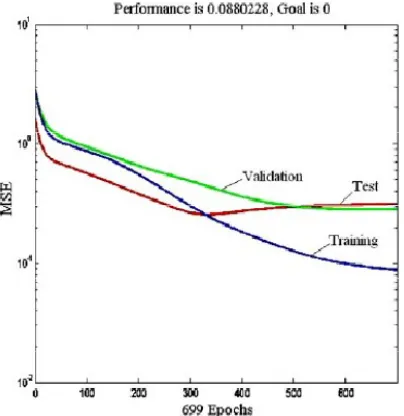
[image:11.612.50.252.335.543.2]Angelos P. Markopoulos, Dimitrios E. Manolakos,Nikolaos M. Vaxevanidis et. al [12] describes an Artificial neural network models for the prediction of surface roughness in electrical discharge machining. In the present paper Artificial Neural Networks (ANNs) models are proposed for the prediction of surface roughness in Electrical Discharge Machining (EDM). For this purpose two well-known programs, namely Matlab with associated toolboxes, as well as Netlab, were employed. Training of the models was performed with data from an extensive series of EDM experiments on steel grades; the proposed models use the pulse current, the pulse duration and the processed material as input parameters.
Fig. 4.7 Results of the neural network training
In the present paper artificial neural network models for the prediction of surface roughness in Electrical Discharge Machining of various steel grades were proposed and validated with experimental results, see Fig. 4.7. For the formulation of the ANNs and the modeling of EDM two discrete programs were used, namely: Matlab and Netlab. For Matlab model the workpiece material, the pulse duration and the pulse current were used as input parameters for the feed-forward neural network trained with the BP algorithm. This neural network was trained with experimental data acquired
from actual EDM experiments. The results obtained indicated that the proposed ANN can successfully predict the surface roughness, within the limits of the input values by which it was trained.
When using Netlab five different networks were developed, each one corresponding to a specific steel grade. This modeling required simpler neural network architecture whilst the agreement between experimental and calculated values was again very good. Moreover, the inputs and outputs of the models were plotted in three dimensional graphs, i.e., Ra values versus pulse duration and pulse current. These user-friendly graphs may be used for the prediction of the outcome of the process as well as for process planning and optimization when the surface roughness is prescribed. In general, both Matlab and Netlab models were proven to perform well for EDM, giving reliable predictions and providing thus a possible way to avoid time- and money consuming experiments.
Kuo-Ming Tsai, Pei-Jen Wang et. al [13] describes predictions on surface finish in electrical discharge machining based upon neural network models. seven models for predictions of surface finish of work in EDM process have been established and compared based upon six neural networks and a neuro-fuzzy network with pertinent machine process parameters given by the DOE method. The networks, namely the LOGMLP, the TANMLP, the RBFN, the Error TANMLP, the Adaptive TANMLP, the Adaptive RBFN, and the ANFIS have been trained and compared by the same experimental data together with the change of electrode polarity condition. According to the comparisons on the training results, it has been shown that the TANMLP, the RBFN, the Adaptive RBFN, and the ANFIS models are more accurate than the other models.
neural model can predict process performance with reasonable accuracy. Having established the process model, the augmented Lagrange multiplier (ALM) algorithm was implemented to optimize MRR subjected to three machining regimes of prescribed Ra constraints (i.e. finishing, semi-finishing and roughing) at suitable operating conditions.
Bhavesh A. Patel, D. S. Patel et. al [16] describes Electrical Discharge Machining (EDM) is a non conventional machining process, where electrically conductive materials are machined by using precisely controlled sparks that occur between an electrode and a work piece in the presence of a dielectric fluid. It has been a demanding research area to model and optimize the EDM process in the present scenario. Lots of efforts have been exercised to model and optimize the performance and process parameters of EDM process using ANN. To model ANN architectures, learning/training algorithms and nos. of hidden neurons are varied to accomplish minimum error, but the deviation is made in an arbitrary manner. Artificial Neural Network model should be generated for both electrode geometry and various electrode materials to compare the influence of both in EDM.
5. CONCLUSIONS
The surface finish of work in the EDM process can be modeled and predicted successfully by the artificial neural network with reasonable accuracy even though the EDM process has been known for its stochastic nature.
Hybrid models are developed for SR can predict the behavior of the material when machined on EDM.There is considerable reduction in mean square error when the network is optimized with GA.
Multiperceptron neural network models were developed using Neuro Solutions package. Genetic algorithm concept is used to optimize the weighting factors of the network. It is observed that the developed model is within the limits of the agreeable error when experimental and network model results are compared. It is observed that the error when the network is optimized by genetic algorithm has come down to less than 2% from more than 5%.
Hybrid models model can be used to select optimum process conditions to improve EDM process productivity and finishing capability. But Evaluating
the parametric optimization of Electrical discharge machining (EDM) by using & comparing Artificial neural network (ANN) and Genetic algorithm (GA). This will be the focus of our further research work.
REFERENCES
Journal Papers
[1] G. Krishna Mohana Raoa, G. Rangajanardhaa,D. Hanumantha Rao, M. Sreenivasa Rao, “Development of hybrid model and optimization of surface roughness in electric discharge machining using artificial neural networks and genetic algorithm.” Elsevier international journal of materials processing technology 209 (2009) 1512–1520. [2] Debabrata Mandal, Surjya K. Pal , Partha Saha,
“Modeling of electrical discharge machining process using back propagation neural network and multi-objective optimization using non-dominating sorting genetic algorithm-II.”Elsevier international Journal of Materials Processing Technology 186 (2007) 154– 162.
[3] Behrens A., Ginzel J., “ Neuro-Fuzzy Process Control System for Sinking EDM.” NAMRI/SME Journal of Manufacturing Processes Vol.5/No.1 (2003).
[4] J.Y. Kao, Y.S. Tarng , “A neutral-network approach for the on-line monitoring of the electrical discharge machining process.”Elsevier international Journal of Materials Processing Technology 69 (1997) 112– 119.
[5] S. Sarkar, S. Mitra, B. Bhattacharyya, “Parametric optimisation of wire electrical discharge machining of γ titanium aluminide alloy through an artificial neural network model.” Int J Adv Manuf Technol (2006) 27: 501–508.
[6] Shajan Kuriakose, M.S. Shunmugam, “Multi-objective optimization of wire-electro discharge machining process by Non-Dominated Sorting Genetic Algorithm.” Elsevier international Journal of Materials Processing Technology 170 (2005) 133– 141.
[8] Hsien-Ching Chen, Jen-Chang Lin , Yung-Kuang Yang , Chih-Hung Tsai., “Optimization of wire electrical discharge machining for pure tungsten using a neural network integrated simulated annealing approach.” Elsevier international Journal of Expert Systems with Applications 37 (2010) 7147–7153.
[9] HUANG He, BAI Ji-cheng, LU Ze-sheng, GUO Yong-feng, “Electrode Wear Prediction in Milling Electrical Discharge Machining Based on Radial Basis Function Neural Network.” J. Shanghai Jiaotong Univ. (Sci.), 2009, 14(6): 736-741.
[10] Ulas Çaydas, Ahmet Hasçalık, Sami Ekici, “An adaptive neuro-fuzzy inference system (ANFIS) model for wire-EDM.” Elsevier international Journal of Expert Systems with Applications 36 (2009) 6135–6139.
[11] R.Rajesh,M. Dev Anand, “The Optimization of the Electro-Discharge Machining Process Using Response Surface Methodology and Genetic Algorithms.”International Conference on Modelling, Optimization and Computing (ICMOC - 2012), Elsevier Procedia Engineering 38 ( 2012 ) 3941 – 3950.
[12] Angelos P. Markopoulos, Dimitrios E. Manolakos,Nikolaos M.Vaxevanidis, “The Artificial neural network models for the prediction of surface roughness in electrical discharge machining.” J IntellManuf (2008) 19:283–292.
[13] Kuo-Ming Tsai, Pei-Jen Wang, “comparisons of neural network models on material removal rate in electrical discharge machining.” Elsevier international Journal of Materials Processing Technology 117 (2001) 111–124.
[14] S. Assarzadeh & M. Ghoreishi, “Neural-network-based modeling and optimization
of the electro-discharge machining process.” Int J Adv Manuf Technol (2008) 39:488–500.
[15] Kamlesh V. Dave, D. S. Patel, “Influence of Electrode Geometry and Process Parameters on Surface Quality and MRR in Electrical Discharge Machining (EDM) of AISI H13, International Journal of Engineering Research and Applications (IJERA) ISSN: 2248-9622 Vol. 2, Issue 3,May-Jun 2012, pp. 1498-1505.
[16] Bhavesh A. Patel, D. S. Patel, “A review: Influence of electrode geometry and process parameters on surface quality and MRR in EDM using Artificial Neural Network.” International Journal of
Engineering Research and Applications (IJERA) ISSN: 2248-9622 Vol. 3, Issue 1, January -February 2013, pp.1645-1654.
Thesis
[17] Bhavesh A. Patel, D. S. Patel,“Influence of Electrode Material and Process Parameters on Surface Quality and MRR in EDM of AISI H13 and CFEC using ANN.”ME Dissertation, Gujarat Technological University, Ahmedabad,2013.