A Review Paper on High Speed Maglev with Smart Platform Technology
Sonali Yadav
1Snehal Jadhav
2Komal Nalawade
3Pradnyawant Kalamkar
41,2,3
BE Student
4Assistant Professor
1,2,3,4
Department of Electronics & Telecommunication Engineering
1,2,3,4AITRC Vita, India
Abstract— The use of natural resources in our day today life is increasing which leads to shortage of these resources in the upcoming generation, mainly in transportation we are wasting a lot of crude oils and other resources which leads to global earthling. The name maglev is derived from magnetic levitation. Magnetic levitation is a highly advanced technology [1]. It has various uses. The common point in all applications is the lack of contact and thus no wear and friction [6]. This increases efficiency, reduces maintenance costs, and increases the useful life of the system. The magnetic levitation technology can be used as an efficient technology in the various industries. There are already many countries that are attracted to maglev systems. Many systems have been proposed in different parts of the worlds. This paper tries to study the most important uses of magnetic levitation technology. The results clearly reflect that the maglev can be conveniently considered as a solution for the future engineering needs of the world. So in this paper we’re discussing about magnetic levitation and the uses in transportation.
Key words: Maglev, Levitation, Wear, Friction,
Transportation
I. INTRODUCTION
Magnetic Levitation is the latest in transportation technology and has been the interest of many countries around the world. A train which is capable of floating in mid-Air without any support rather than magnetic field. This train doesn't have a motorized engine neither a diesel nor a charcoal engine but uses a theory of a linear motor for its propulsion. Its maintenance cost is very low in terms of traditional engines as there is no contact between train and tracks. Since this train undergoes no friction hence this train is capable of exceeding the speed of 580km/h, thus this train is considered as flying of ground [3]. These types of train are purely for long distance travel and a futuristic invention to reduce on travel time. If a maglev train is implemented in India then Delhi is just 3& 1/2hr away from Mumbai.
Talking about smart platforms, we came up with solution for three major issues they are as follows
1) Wheelchair handicaps to board into the train. 2) Water clogging on railway tracks.
3) Green Energy
1) Government of India has already taken a great initiative to add a handicap boogie in a train but one thing they missed out is the platform for the wheelchair handicaps. It’s a very tedious job for those handicaps to board. Hence we came up with an outstanding invention which wills revolutionaries the history. We are handing each and every wheelchair handicaps a RFID card which if they swipe in the train or on a platform, an artificial sloping platform is created on the existing platform for them to board in the boogie with zero efforts
2) In rainy season we are much familiar with water clogging on railway tracks and train delays hence we came up with an amazing invention of storing all the clogged water and rain water by rain water harvesting and clogged water in a tank and using all of it for sanitization and cleaning of trains. In this project we are using sensors to detect the water clogs and triggering the pumps relevant to it to suck all the clogs and hear by preventing train delay. 3) As we all know railway station is an extensive platform
which consists of fans, upcoming train indicator, Lights, etc. which of course uses electricity. This electricity can be source to those entire gadget using solar panels which can be placed effectively over the platforms roof to generate sufficient electricity. Hence making India a better place and eco-friendly.
II. BASIC METHODOLOGY
Scope
[image:1.595.310.546.395.575.2]The use of natural resources in our day today life is increasing this leads to shortage of these resources in the upcoming Generation, mainly in transportation we are wasting a lot of crude oils and other resources which leads to global earthling. A train which is capable of floating in mid-Air without any support rather than magnetic field [7]. The scope of magnetic levitation system is most important in transportation system.
Fig. 1. Block diagram
High Speed Maglev trains are achieved by the combinations of magnetic field. This can be achieved by Levitation and Propulsion magnets which are embedded in tracks [5]. The levitation magnets help to levitate the train in midair without any support rater then magnetic fields whereas the propulsion magnets are responsible for the Too & Fro movement of the trains. Guide ways are used to keep the trains on track. RFID technology is used to create artificial platforms for wheelchair handicaps. Whereas the rain sensors and Humidity sensors are used to detect the clogged water and activate the pumps embedded in the platform to clear the clog.
A. Input-Stage 1) Hall Effect Sensor
sensor, a thin strip of metal has a current applied along it. In the presence of a magnetic field, the electrons in the metal strip are deflected toward one edge, producing a voltage gradient across the short side of the strip. In our project we are using this sensor to detect the upcoming polarity of magnet to fire the solenoid switch accordingly.
2) Humidity Sensor
Humidity sensors work by detecting changes that alter electrical currents or temperature in the air. There are three basic types of humidity sensors: capacitive, resistive and thermal. All three types of sensors monitor minute changes in the atmosphere in order to calculate the humidity in the air. 3) Capacitive Sensor
A capacitive humidity sensor measures relative humidity by placing a thin strip of metal oxide between two electrodes. The metal oxides electrical capacity changes with the atmospheres relative humidity. Weather, commercial and industries are the major application areas
4) Resistive Sensor
Resistive humidity sensors utilize ions in salts to measure the electrical impedance of atoms. As humidity changes, so does the resistance of the electrodes on either side of the salt medium.
5) Thermal Sensor
Two thermal sensors conduct electricity based upon the humidity of the surrounding air. One sensor is encased in dry nitrogen while the other measures ambient air. The difference between the two measures the humidity. In our project we are using humidity sensor to detect the humidity and moisture in soil in order to trigger the pump to avoid water clogging. 6) RFID
RFID systems consist of three components: an RFID tag or smart label, an RFID reader, and an antenna. RFID tags contain an integrated circuit and an antenna, which is used to transmit data to the RFID reader (also called an interrogator). The reader then converts the radio waves to a more usable form of data. Information collected from the tags is then transferred through a communications interface to a host computer system, where the data can be stored in a database and analyzed at a later time. In our project we are using RFID technology for handicaps to create an artificial platform for a wheel chair handicaps to board into the train. When a handicap swipes the RFID card at station after the trains arrives an artificial platform is created (slopping platform at Handicap boogie) and the artificial platform is disabled just after the handicap boards into the trains.
Note: All Sensors Output Goes To the Microcontroller for Further Processing.
B. Processing-Stage
1) Micro-controller (89s2051)
All the outputs from sensors are received by microcontroller for processing. Microcontroller takes the appropriate decisions in order to process the signal received signal. 2) Output from Hall Effect Sensor
Microcontroller get to know as to which polarity of magnet is upcoming & switches the polarity of solenoid switches just in opposite direction in order for a smooth transition
3) Output from Humidity Sensor
Microcontroller gets to know as to what is the humidity and percentage of water clogged on the railway platform and triggers the water pump for the sufficient time duration. 4) Output from RFID
Microcontroller gets to know that the Wheelchairs handicap has arrived and needs a artificial platform for him to board into the train. Hence microcontroller triggers the platform mechanism in order to create an artificial platform. (We simply cannot use a switch to trigger it as it may be highly misused).
C. Output-Stage 1) Motor Drivers
The final load (PUMP, PLATFORM MECHANISM, and SOLENOID SWITCH) requires a lot of current and voltage to drive it, which cannot be sourced directly through microcontroller.
Hence Motor Drivers are used to amplify the signal received from UC and then sourcing the final output stage.
III. LITERATURE REVIEW
In 1976, S.Yamamura proposed a Magnetic Levitation of Tracked Vehicles present status and prospects. There are more than five types of magnetically levitated tracked vehicles. All these types of magnetically levitated tracked vehicles provide the contactless support and guidance to vehicles. In this paper, he proposed such system named as Magnetic Levitation System. This system has two types one is electrodynamics levitation (EDL) and another is electromagnetic levitation (EML). Electrodynamics levitation uses the repulsive force between magnet on vehicle and induced current in secondary circuit on ground. The repulsive force is produced when the superconductive magnets are moving, and so the train is not levitated at low speed. Because of this repulsive force in EDL it gives the stability problem. In this paper he proposed the EML system which uses the attracting force between the electromagnets on vehicles and rails on ground. Because of the attracting force it gives the inherently unstable levitation system. The stability problem is solved by using EML system. To solve this problem it needs closed loop control of the magnet current in order to obtain stability.
and it is simple in design. But detailed technical comparison of the two systems EMS and EDL is not available.
In 1996, Kazuo Sawada proposed a Development of magnetically Levitated High Speed Transport System in Japan. In Japan there is very large passenger traffic in a Tokyo-Osaka corridor. So their id a requirement of a one another High speed line besides Tokaido Shinkasen and this high speed magnetic levitation train has been developed by using a Superconducting materials. This train is having number of advantages as compared to other trains. This Paper will describes a need of one more high speed line and scheme of this system is history of development and outline of new Yamanashi test link project. So Tokaido Shinkasen having a speed of 270km/hr. and it covers this area in 150 minutes. But because of traffic no the all passengers can get tickets. And this will be increase year by year. So it develops a high speed line between Tokyo and Osaka. It develops JNR (Japanese National Railway). It is having advantage of Speed, Safety, Maintenance, Pollution and Future Prospect. For designing this train Superconducting Magnets (SCM) is used. In this developed system on the guide way having two types of ground coils, one is Propulsion coil and other is Levitated coil, which is guided by the Electromagnetic forces. So because the reason mentioned above the study of JNR started in 1962, JNR selected Maglev System with Superconducting magnets.
In 1996, James R. Powell and Gordon T. Donby proposed a Maglev Vehicles. Maglev as practical concept was 1st proposed by the author in 1996. The concept was based on using light weight. Very high current superconducting loops suitably positioned on a streamlined vehicle. The magnetic interaction of permanent current in the superconducting loops with induced current in the guide way loops automatically levitated. If the external force, e.g.-A wind gust, curve or change in grade acts on vehicle a magnetic force automatically and immediately develops to oppose the external force. The magnetic force pushes the vehicle back towards its normal equilibrium suspension point. Since maglev vehicle not contact with guide way, its speed is not depending on mechanical stress, friction or wear. The first generation maglev vehicle probably will travel in air, however tuning technic is developed and long distance ultra-speed maglev travel in low pressure tunnel will emerge as 2nd generation. It can't require any energy. There are two kinds. First is superconducting approach by the author and another is a modernized version of the old Ferro-magnetic suspension approach used for magnetic bearings in centrifuge. The author also proposes Linear Synchronous Motor (LSM) as means to propelling maglev vehicles. As AC power is switch into the guide way in relatively long blocks Rg mile or more in length for those blocks on which a vehicles is passengers per day and thousands of trailer truck equivalent.
In 2013, Jaewon Lim1, Chang-Hyun Kim1, Jong-Min Lee1, Hyung-suk Han1, and Doh-Young Park1 proposed a Design of Magnetic Levitation Electromagnet for High Speed Maglev Train. This paper deals with the design of levitation electromagnet for super high speed magnetic levitation (Maglev) vehicle. Electromagnetic characteristics of levitation magnet are analyzed by finite element analysis. Levitation force ripples and cogging force are reduced by
adopting core separation. 4-pole cutoff model has been manufactured to verify the design. A static force experiment is carried out with test model. The need of fast & comfortable transportation is increased through the history. For the local train basically they have wheels because of the speed of train friction is accruing and also irregular crashes between wheels and rail, so they face some mechanical difficulties. So by the maglev train it is very easy because this train doesn't have wheels, so there is no any friction is accrue and no wear. Maglev is dividing in high speed and medium speed of maglev is depending on speed operation. Medium speed maglev is propelled by lateral movements is restricted by linear induction motor (LIM) & levitated by electromagnet. In high speed maglev application LIM is not suitable to operate due to end effect & transient constant of reaction plate. High speed maglev train levitated and propelled by LSM. As levitation electromagnetic, the field of LSM should be light weighted and system should be rapid response. In entry end and flux density lower than others poles. This flux unbalanced lead to local saturation of core and it is transmitted pole to pole. Most linear motors have normal force between movers and stators. LSM has alternative force it is utilizes by levitation force.
In 2017, Ding Jingfang, Long Zhiqiang, YangXin, Maglev Research Centre National University of Defense Technology Changsha, China proposed a Numerical Analysis of Eddy current Effect of EMS system for Medium-Low Speed Maglev Train. In this paper the Changsha Maglev Express proposed a Medium-Low Speed Maglev Train which is based on the electromagnetic suspension (EMS) and short primary linear induction motor (SLIM) propulsion system. In May 2016, the Changsha Maglev Express was design the longest Medium-Low Speed Maglev commercial demonstration line of the world. The maximum speed of this train is 100km/h. When the train moves the eddy current effect will induced at the front of the train. This paper gives the principle of the eddy current effect and also uses the3D numerical analysis method to analyze the effect of eddy current on levitation force. In this paper author uses the professional electromagnetic simulation software Ansoft Maxwell to calculate the 3D transient magnetic field numerical solution. When train is moving the magnetic field of air gap will be established between front of electromagnet module and rail. Due to variation in the magnetic field the eddy current will be generated.
YBa2Cu3O7-y (YBCO) is a non-ideal type-2 superconductor. High-Tc superconducting (HTS) maglev vehicle is show exllent levitation property by taking advantage of flux line pinning characteristics of baYBCO bulk. The electromagnetic suspension (EMS) maglev vehicle of Germany and low-temperature0 superconducting
electromagnetic suspension (EDS) maglev vehicle of Japan, which depends critically upon the advanced modern control technology, the HTS maglev vehicle dispenses with such a complex control system, having excellent advantage of energy-saving, environmental protection, safety and concision.
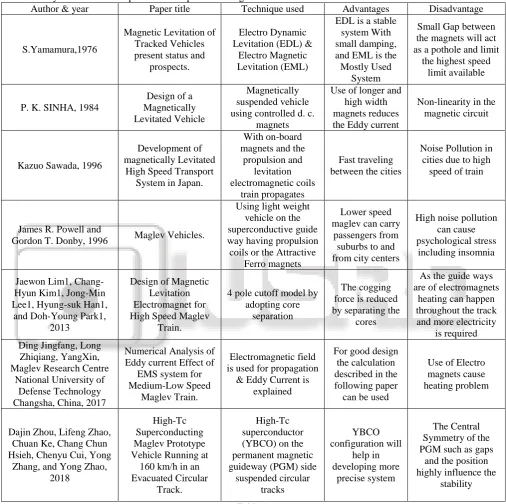
Author & year Paper title Technique used Advantages Disadvantage
S.Yamamura,1976
Magnetic Levitation of Tracked Vehicles present status and
prospects.
Electro Dynamic Levitation (EDL) &
Electro Magnetic Levitation (EML)
EDL is a stable system With small damping, and EML is the Mostly Used
System
Small Gap between the magnets will act as a pothole and limit
the highest speed limit available
P. K. SINHA, 1984
Design of a Magnetically Levitated Vehicle
Magnetically suspended vehicle using controlled d. c.
magnets
Use of longer and high width magnets reduces the Eddy current
Non-linearity in the magnetic circuit
Kazuo Sawada, 1996
Development of magnetically Levitated
High Speed Transport System in Japan.
With on-board magnets and the
propulsion and levitation electromagnetic coils
train propagates
Fast traveling between the cities
Noise Pollution in cities due to high
speed of train
James R. Powell and
Gordon T. Donby, 1996 Maglev Vehicles.
Using light weight vehicle on the superconductive guide way having propulsion coils or the Attractive
Ferro magnets
Lower speed maglev can carry
passengers from suburbs to and from city centers
High noise pollution can cause psychological stress
including insomnia
Jaewon Lim1, Chang-Hyun Kim1, Jong-Min Lee1, Hyung-suk Han1,
and Doh-Young Park1, 2013
Design of Magnetic Levitation Electromagnet for High Speed Maglev
Train.
4 pole cutoff model by adopting core
separation
The cogging force is reduced by separating the
cores
As the guide ways are of electromagnets
heating can happen throughout the track and more electricity
is required Ding Jingfang, Long
Zhiqiang, YangXin, Maglev Research Centre
National University of Defense Technology Changsha, China, 2017
Numerical Analysis of Eddy current Effect of
EMS system for Medium-Low Speed
Maglev Train.
Electromagnetic field is used for propagation
& Eddy Current is explained
For good design the calculation described in the following paper
can be used
Use of Electro magnets cause heating problem
Dajin Zhou, Lifeng Zhao, Chuan Ke, Chang Chun Hsieh, Chenyu Cui, Yong
Zhang, and Yong Zhao, 2018
High-Tc Superconducting Maglev Prototype Vehicle Running at
160 km/h in an Evacuated Circular
Track.
High-Tc superconductor (YBCO) on the permanent magnetic guideway (PGM) side
suspended circular tracks YBCO configuration will help in developing more precise system The Central Symmetry of the PGM such as gaps
and the position highly influence the
[image:4.595.44.551.134.638.2]stability
Table 1:
IV. CONCLUSION
The electro dynamic suspension and electromagnetic suspension are the techniques which are used in maglev system are systematically studies. The results are used to design and operation of magnetic levitation in a high running speed. Several conclusions are drowning from study of our system. The common point in all applications is the lack of contact and thus no wear and friction. This increases
efficiency, reduces maintenance costs, and increases the useful
REFERENCES
[1] Dajin Zhou, Lifeng Zhao, Chuan Ke, Chang Chun Hsieh, Chenyu Cui, Yong Zhang, and Yong Zhao , “High-Tc Superconducting Maglev Prototype Vehicle Running at 160 km/h in an Evacuated Circular Track” IEEE Journals and Magazines, vol.. 28, no. 3600504, 2018.
[2] Ding Jingfang, Long Zhiqiang, YangXin, Maglev Research Centre National University of Defense Technology Changsha, China, “Numerical Analysis of Eddy current Effect of EMS system for Medium-Low Speed Maglev Train”. 2nd International Conference on Robotics and Automation Engineering, 2017.
[3] Jaewon Lim1 ,Chang-Hyun Kim1 ,Jong-Min Lee1 , Hyung-suk Han1 , Doh-Young Park1 * 1 Dept. of Magnetic Levitation and Linear Drive, Korea Institute of Machinery & Materials, Korea , “Design of Magnetic Levitation Electromagnet for High Speed Maglev Train” 2013 International Conference on Electrical Machines and Systems, Oct. 26-29, 2013, Busan, Korea, no. 14042491.
[4] K. Sawada, “Development of magnetically levitated high speed transport system in Japan,” IEEE Trans. Mag., vol. 32, no. 4, pp. 2230–2235, Jul. 1996.
[5] J. R. Powell and G. T. Danby, “Maglev vehicles-raising transportation advances of the ground,” IEEE Potentials, vol. 15, no. 4, pp. 7–12, Oct.-Nov. 1996.
[6] P. SINHA, “Design of a magnetically levitated vehicle,” IEEE Trans. Mag., vol. MAG-20, no. 5, pp. 1672–1674, Sep. 1984.