PERSONALISED MOBILE LEARNING SYSTEM BASED ON
ITEM RESPONSE THEORY
M. Yarandi, H. Jahankhani, M. Dastbaz, A. R. Tawil
School of Computing Information Technology and Engineering University of East London
[email protected], [email protected], [email protected], [email protected]
Abstract: Rapid advancements in the design and integration of mobile devices and networked technologies in day to day activities are creating new perceptions about the exploitation of mobile technologies in teaching and learning. Consequently, there is growing demand for personalised, efficient and flexible systems for supporting learning in various settings. However, fulfilling learner demand for personalised support requires better understanding of activities, operational contexts and purposes for which mobile devices are deployed to support learning. Therefore, our position with regards to methods for researching mobile learning focuses on personalised learning. This paper presents an approach to designing a personalised learning system by analysing the ability of the learner based on Items Response Theory. Furthermore, in the proposed system user profile is modelled based on profile ontology.
Keywords: personalised learning, mobile learning, Item response theory, adaptive learning
1. Introduction
Mobile learning or m-learning is becoming readily available in a wide range of mobile devices (e.g. PDAs and mobile phones) and is beginning to offer the potential for great change in education. Such new technologies have motivated our research due to their significant impact on learning. Learning will move away from the traditional classroom into the learner‟s environment.
Moreover, Personalised services is nowadays an important research issue in the field of web-based and mobile learning systems because no fixed learning paths will be appropriate for all learners (Chen 2008).
Educators confirm that every individual learns according to their own learning style, needs and interests. For example, some learners are visual learners and others auditory learners. Some learners learn at a
individual learners. Nowadays, many research projects focus on using semantic knowledge models (ontology) for creating user profiles as these models have proven useful for presenting knowledge about learner‟s abilities in a specific domain. Therefore, this paper presents a novel personalised mobile learning system according to the learner‟s ability. The learners‟ ability is evaluated based on Items Response Theory and suitable courseware is delivered to individual learners based on their semantic user profiles.
This paper is organised as follows. In section 2 we will review some current personalised learning systems. After describing Item Response Theory in section 3, the test calibrated process will be present in section 4. The architecture of personalised mobile learning system will be present in section 5. The penultimate section will discuss proposed semantic model of user profile. Finally, section 7 contains a brief summary of the paper.
2. Related Work:
Recently, mobile devices with their small size, ubiquity and functional convergence, enable new possibilities for learning. Mobile learning differs from learning in the classroom or on a desktop computer, as learning may spread across locations and times (Vavoula, Pachler, Kukulska-Hulme and eds. 2009). Therefore, the learning form is dramatically changing from traditional learning to the e-learning, mobile learning and ubiquitous learning (Chen and Hsu 2008b). Mobile learning is not simply a variant of e-learning enacted with portable devices, nor an extension of classroom learning into less formal settings. Recent research has focused on how mobile learning creates new contexts for learning through interactions between people,
technologies and settings, and on learning within an increasingly mobile society.(Sharples, Taylor and Vavoula 2007) In order to design a strong personalised learning environment, we need to enable delivery learning content according to particular learner‟s needs. Therefore, most studies on the field of e-learning and mobile learning have focused on personalised learning.
Few researchers advocated that considering learner‟s ability can support personalised learning performance(Chen and Chung 2008a). However, most mobile learning systems do not consider designing adaptive tests and adapting them to the learner‟s ability. Chen et al presented a personalised e-learning system using item response theory which provides personalised learning according to difficulty parameters of course materials and learners‟ responses (Chen, Lee and Chen 2005). They proposed some personalised learning system namely personalised curriculum sequencing during learning processes(Chen 2008), a personalised intelligent mobile learning system (PIMS) to promote the reading ability of English news for individual learners (Chen, et al. 2008b), a personalised mobile learning system based on item response theory which considers vocabulary ability of learner and learning memory cycle to provide personalised learning(Chen, et al. 2008a). Baylari et al have presented a personalised multi-agent e-learning system which presents adaptive tests and acts as a human instructor and gives the learners a friendly and personalised teaching environment (Baylari, et al. 2009).
in which user profiles learned by a content-based recommender system (Gemmis, Semeraro, Lops and Basile 2008). Pan et al developed a semantic-based search method for personalised e-learning. They designed learner ontology and learning resource ontology for semantic analysis and algorithm for ontology semantic (Pan, Zhang, Wang and Wu 2007).
The strength of this study is creating adaptive tests and calculating the learner‟s ability during the learning process and updating the ontology-based user profile based on new learner‟s ability. Thus, this study designs a novel model for personalised mobile learning system based on item response theory and ontological learner‟s profile. The user profile is updated during the learning process.
3. Item Response Theory:
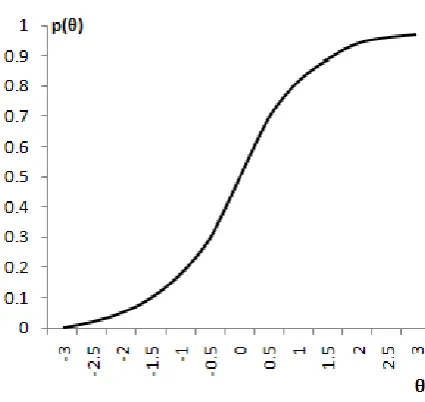
[image:3.595.311.524.110.311.2]Item response theory is a model-based approach to select the most appropriate items for examinees based on mathematics relationship between abilities and item responses. It is called Item Response Theory because the theory focuses on the item, by modelling the response of an examinee of given ability to each item in the test. The idea of item response theory is based on the assumption that the probability of a correct answer to an item is a mathematical function of person and item variables. The item variable is referred to as the item difficulty, item discrimination, and the effect of random guessing. Furthermore, in each level of ability, there will be a probability that an examinee with this ability responds correctly to this item. (There will be the probabilities of giving the correct answer across different levels of ability.) Item Characteristic Curve (ICC) presents the relationship between probabilities and abilities as shown in figure 1. (Yu 2007)
Figure 1: Item Characteristic Curve
Each item in the test has its own Item characteristic curve. However, the shape of classic Item Characteristic Curve is an s-shape. The Item Characteristic Curve is the basic building block of the Item Response Theory and other components of the theory build on this curve. (Baker 2001)
Item Characteristic Curve ( Fig 1) has two technical attributes. The first is the difficulty of an item which describes the position of ICC in relation to the ability scale (Hambleton, Swaminathan and Rogers 1991) and the second is discrimination parameter which discriminates between high-proficient examinee and less-proficient examinee. (Yu 2007) The slope of the Item Characteristic Curve reflects the discrimination parameter. (Baker 2001)The steeper curve demonstrates a much better discrimination than the flatter curve.
only one parameter. Based on this model, only the difficulty parameter can take on different values. The equation for this model is given by the following:
(1)
Where:
bi is the difficulty parameter of item i
is the ability level of examinee
P( i) is the probability that examinee with
ability can respond correctly to the item i. In the 2PL model, another parameter called discrimination degree ai is added into the
item characteristic function. The equation for this model is given by the following:
(2)
One of the facts of life in testing is that examinees will get items correct by guessing. Thus, a guess degree ci is added to
the 2PL model hence the resulting model has become known as the 3PL model. The equation for the 3PL model is:
Item Response Theory is used in the computerised adaptive test to determine the best items for examinees based on their individual abilities. Currently, the CAT concept has been successfully used in many real applications such as GMAT, GRE and TOEFL.
4. Test Calibrated Process:
In order to measure the learner‟s ability accurately Bloom suggested a system of classification based on levels of intellectual behaviour. This classification is called Bloom‟s Taxonomy. Today, educators implement Bloom‟s taxonomy to design tests and assess the degree of learning by assuring that their tests follow the criteria offered by Bloom (Krathwohl 2002).
In the first step of the test calibration, test instructors analyse the learning contents, specify learning objectives for each learning contents and design suitable multiple choice items according to the learning objective at the level of remembering and understanding based on the Bloom‟s Taxonomy. After that, every item will be assigned to a group of examinees and the examinees‟ responses are dichotomously scored. It means that, the examinee gets one for the correct answer and zero for an incorrect answer. Then mathematical procedures are applied to the item response data by the BILOG program to estimate the value of the item parameters under 3PL model and the ability parameters of the examinees. In this stage, collaborated items are created. Then the test instructor designs a few appropriate tests consisting of 10 items at each ability level. These tests are constructed for each ability scale and will be stored in the courseware database.
5. Architecture of System:
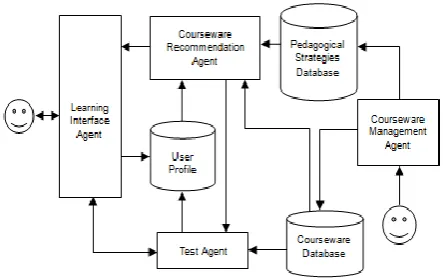
from the courseware database related to the recommended courseware. After that, it collects the result of the test and then the learner ability is re-evaluated. Finally, the user profile will be updated with this new information of learner. The courseware management agent allows the instructor to update the courseware database and pedagogical strategies database. Furthermore, this architecture has a user interface agent that allows learners to interact with the learning system friendly.
Figure 2: the architecture of adaptive mobile learning system
Based on the architecture system, the details of the system operation are summarised as follows:
1.Learner logs in the system through user interface agent.
2.If the learner is registered in the
system, courseware
recommendation agent will get his/her learning profile from user profile knowledge base. According to user profile and pedagogical strategies this agent selects and transfers appropriate courseware from courseware database to learner through user interface agent.
3.After finishing the entire courseware, test agent based on the requests of the courseware recommendation
agent selects a suitable test from the courseware database. Subsequently, this agent presents the test type to the learner through user interface agent.
4.The learner‟s response to post-test is transferred to the test agent via the user interface agent.
5.According to the collected learner‟s response and item response theory, the ability of the learner is estimated. In order to estimate the ability of the learner which is an unknown value we can assume that all the numerical parameters of the items in the test is known. The direct result is that the scale of the measurement is the same as the scale of the parameters in the item. After taking the exam and the response of the examinee to all the items are received. The items are dichotomously scored. This means that, the examinee gets one for the correct answer and zero for the incorrect answer. Hence, we will have a response pattern (U1,U2,U3,....,Uj,....,Un) which is
called item response vector, where Uj=1 represents a correct answer
given by the examinee where this is for the jth item in the test. On the contrary, Uj=0 represents an
Where is the estimation of the ability of the examinee,
is the value of likelihood function and A( ) represents the quadrature weight at a level below the examinee‟s ability.
The likelihood function has been calculated as follows:
Where Pi( ) denotes the probability
that examinee responds correctly to the ith item at a level below ability level , Qi( )= 1- Pi( ) represents
the probability that the examinee responds incorrectly to the ith item at a level below the ability level , ui=1 if the answer of ith is correct
and ui=0 if the answer of ith is
incorrect (Chen, et al. 2008a). Finally, the ability of the examinee will be updated in the user profile knowledge base.
6.For a beginner learner, the user interface agent performs a registration process. During this process the general and educational characteristics of the learner are taken and recorded to the ontology base user profile.
6. Semantic Model of User Profile:
In a personalised web-based learning system, all learners have a component of the user profile that contains the individual
learner‟s characteristics such as name, family, age, education, demands, preferences, learning style, existing knowledge, ability and so on. A key technical problem in developing adaptive applications is the issue of how to build precise and complete user profiles for individual users and how these can be used to recognise a user and describe his or her behaviour. In the proposed system, domain ontology are used to model user profiles and categorises content in order to generate a better adaptive learning environment by using the information in the user profile. This ontology-based user profile is proposed to describe characteristics of the learners, specially their ability in order to improve personalised learning.
Furthermore, during the learning process in order to estimate the learner‟s ability, the results of some technical pre-test and regular post-tests will be fed into the Item response Theory formulas and the output of the formulas will be saved in the semantic user profile. Based on the information in the user profile appropriate content will be provided to the learner. Note that the proposed intelligent learning system is a self adaptive system which will automatically be updated based on the regular post-test given by the learner at different stages of the learning. Therefore, personalisation and interactivity will promote the quality of learning for individual learners.
7. Conclusion:
the item response theory formula in order to design a personalised learning system. This system not only considers the learner‟s ability but also creates adaptive tests to select the most suitable items for the examinees. Furthermore, novel user profile ontology will be designed in order to improve personalised learning.
The proposed intelligent learning system also monitors learners at each step of learning based on the regular given test to ensure that specific targets have been made prior to the next level of learning. Consequently, learning would be performed more effectively and efficiently.
The prototype system is still being constructed. The learner will be tested by this system, which can provide a personalised mobile learning system.
8. References:
Adomavicious, G., and Tuzhilin, A. (1999), "User Profiling in Personalization Applications through Rule Discovery and Validation," Proceedings of the ACM Fifth International Conference on Data Mining and Knowledge Discovery (KDD 99), 377 - 381
Baker, F. B. (1992), Item Response Theory: Parameter Estimation Techniques, New York: Marcel Dekker.
Baker, F. B. (2001), The Basics of Item Response Theory (2 ed.), Washington: ERIC clearing house on assessment and evaluation.
Baylari, A., and Montazer, G. A. (2009), "Design a Personalized E-Learning System Based on Item Response Theory and Artificial Neural Network Approach,"
Expert Systems with Applications, 36, 8013-8021.
Chen, C.-M. (2008), "Intelligent Web-Based Learning System with Personalized Learning Path Guidance," Computers & Education, 51, 787-814.
Chen, C.-M., and Chung, C.-J. (2008a), "Personalized Mobile English Vocabulary Learning System Based on Item Response Theory and Learning Memory Cycle,"
Computers & Education, 51, 624-647.
Chen, C.-M., and Hsu, S.-H. (2008b), "Personalized Intelligent Mobile Learning System for Supporting Effective English Learning," Educational Technology & Society, 11, 153-180.
Chen, C.-M., Lee, H.-M., and Chen, Y.-H. (2005), "Personalised E-Learning System Using Item Response Theory," Computers & Education, 44, 237 - 255.
Gemmis, M. d., Semeraro, G., Lops, P., and Basile, P. (2008), "A Retrieval Model for Personalized Searching Relying on Content-Based User Profiles," Association for the Advancement of Artificial
Intelligence (www.aaai.org).
Hambleton, R. K., Swaminathan, H., and Rogers, H. J. (1991), Fundamentals of Item Response Theory (1 ed.), London: Sage publications, the International Professional Publishers.
Krathwohl, D. R. (2002), "A Revision of Bloom's Taxonomy: An Overview," Theory Into Practice, 41, 212-218.
Pan, J., Zhang, B., Wang, S., and Wu, G. (2007), "A Personalized Semantic Search Method for Intelligent E-Learning,"
International Conference on Intelligent Pervasive Computing, 11-14
Sharples, M., Taylor, J., and Vavoula, G. (2007), "A Theory of Learning for the Mobile Age," in The Sage Handbook of
E-Learning Research, London: SAGE Publications Ltd pp. 221-247.
Vavoula, G., Pachler, N., Kukulska-Hulme, A., and eds. (2009), Researching Mobile Learning: Frameworks, Tools and Research Designs, Oxford: Peter Lang.