Deterministic HEER Protocol for Heterogeneous
Reactive WSNs
Navneet Kaur
Research Scholar, Deptt of CSE, D.A.V.I.E.T Jalandhar,
Punjab, India.
Manjinder Singh Kahlon
Asstt. Professor, Deptt of CSE,D.A.V.I.E.T Jalandhar, Punjab, India.
ABSTRACT
WSNs are playing a crucial role in real world applications. Due to the features of the resource-constrained and battery-aware sensors; in WSNs energy utilization has found to be a major interesting subject of research. WSNs compose battery-powered nodes which are connected with the base station to for certain action or task. As sensor nodes are battery-powered i.e. will become dead after the consumption of the battery which is also called lifetime of WSNs. So using the energy in well-organized way may result in prolonging the lifetime of the WSNs. This paper has proposed a new HEER protocol which is deterministic in nature instead of randomization i.e. based on the probability. The proposed technique is designed and implemented in MATLAB. The comparison among the proposed and existing HEER has shown that the proposed HEER has better results in terms of network lifetime and stability period.
Keywords
: Wireless Sensor Network, Threshold-sensitive Stable Election Protocol, Low Energy Adaptive Clustering Hierarchy, Stable Cluster Head Election Protocol, Heterogeneity-aware Hierarchical Stable Election Protocol.1.
INTRODUCTION
Technology has advanced to artificial nursing extent such that it moved from wired to wireless domain. The wireless devices are area unit purposeful relying upon their battery life. Wireless communication technologies area unit endlessly growing in various areas and supply new and higher opportunities for various business environments. Recent development in wireless communication and physics have sceptre the readying of tiny, comparatively in-expensive and low-power devices referred to as small sensors which will be connected by a wireless network. These wireless micro sensor networks present a new standard for obtaining data from the surrounding environment and also allow the reliable examining of a number of environments for various applications. Wireless sensor networks have gained so much importance over the past few years because of the many applications in which the sensors can be used to monitor and control different physical phenomenon. WSNs are among the most widely used in adhoc wireless networks. WSNs are referred as infrastructure less networks that are capable of wireless communication. Recent technological advancements have enabled the development of relatively small, inexpensive wireless sensors that consume low power. These sensors can be deployed at a cost much less than those traditional wired systems. Wireless sensor network is a small system that is able to communicate over short distances. This small system is made up of sensor nodes. Sensor nodes are imagined as small computers, extremely basic in terms of their components and interfaces. It is a collection of hundreds and thousands of sensor nodes that are organized into a co-operative network. These nodes are adaptive and self-organized
and integrate the functions of collecting data, processing it and then communicating it to the other nodes in the network. These nodes work together to form a powerful sensor network. The sensing elements sense data from the environment, the processing system performs computation on the sensed data and the communication or radio system exchange the information with other nodes in the system. These sensors can detect several environmental events such forest fire, wind velocity, humidity, and soil temperature. This information can then be transmitted to a base station (BS) or sink. To extend the lifetime of the network, efficient use of available energy is the subject to be considered. WSN lifetime is the time interval between the start of the first transmission until the expiry of the last alive node i.e. the time when the operation starts until the percentage of the sensor nodes fall below a specific threshold. Since, most of the energy is consumed due to communication, so an efficient energy saving routing protocol is required to extend the survival rate or the network lifetime. Routing protocols have the capability to reduce the energy consumption of WSNs by choosing minimal routes. Among many routing protocols, the most effective is the cluster-based technique. In cluster-based routing, the sensor nodes are grouped together into a number of clusters and the nodes of the cluster send their data to a specific node called cluster head (CH). The cluster head (CH) is present in each cluster and is responsible for collecting the data from the other nodes. After gathering all the data from sensor nodes, the CH then transmits it to the sink or Base station (BS) and these local Base Stations transmit the data to the global BS, where it is accessed by the end user. The base stations are one or more components of the WSN with much more communication resources and computational energy. They act as the gateway between sensor nodes and the end user as they typically forward data from the WSN on to a server. The cluster heads are selected based upon a specific criterion. Since CHs are an important part of cluster-based routing protocols, the CH selection affects the network lifetime, energy consumption rate and the delay occurred in the delivery of packets.
2. HEER
of energy at any election round. When cluster formation is done, the CH transmits two threshold values, i.e. and . The nodes sense their environment repeatedly and if a parameter from the attributes set reaches its value, the node switches on its transmitter and transmits data.
Important Features:
1) HEER performs best for time critical applications in both homogeneous and heterogeneous environment.
2) It reduces the number of transmissions resulting in the reduction of energy consumption.
3) It increases the stability period and network lifetime.
3. RELATED WORK
Due to small batteries [1] in WSNs, the optimal and efficient usage of energy is an important factor. To enhance the life time of the network, clustering is the most efficient technique. In ECRSEP, the CHs are selected based on the weighted election probabilities of each node according to the Energy Consumption Rate (ECR) of each node. But its limitation is that all nodes should be capable of becoming a CH. Each node in TSEP [2] maintains a routing table which keeps record of the destinations and the number of hops needed to reach the destination. The nodes keep sensing the network for any kind of changes in the system can communicate the data sensed to the other nodes in the network. The reactive routing protocols, unlike the proactive, do not sense the network on a regular basis. The constant updating of routing table is not required. This is on-demand protocol which means that the nodes search for route when needed and then transmit the data. TSEP is a reactive protocol which uses three levels of heterogeneity. These protocols respond instantly to the changes in the parameters of the network. The transmission of data consumes more energy than sensing and takes place only when a certain threshold is achieved. HSEP [3] protocol is heterogeneous-aware in the sense that the election probabilities of the nodes to become CHs are weighted by their initial energy relative to other nodes in the network. It prolongs the time interval before the death of first node in the system thus increasing the stability period. As the distance between the cluster head and sink increases the power consumption is also greatly increased. HSEP reduces the transmission cost from CH to base station by considering two types of cluster hierarchies: primary and secondary CHs. The new LEACH-N [4] protocol modifies the process of CH selection by adding the factor of residual energy while calculating T(n) which is
T (n) = , n Є G
is the initial energy, is the node’s current residual energy. By applying this technique, the nodes who have consumed more energy will have less probability to become CH again. This ensures optimized way of CH selection and prolongs the network lifetime. The residual factor thus, reduces the energy cost of network nodes. The CH [5] node in the network broadcast to the radium R and forms the measuring area. The nods in the measuring area reflect back the signals to CH. The broadcasting radium R measures the nearby node distribution. The total measuring area of CH reaches a cover rate, such that the node distribution in measuring area reflects node distribution in clustering area. Also, as the R increases, the overlap rate also increases. This leads to increase in energy consumption. The node which has low node density if selected the CH, the other nodes need to travel a long distance for communication. The ESEP [7] is a protocol for cluster-head selection in a hierarchical clustered heterogeneous network.
4. PROPOSED ALGORITHM
Figure 1: Proposed algorithm
Figure 1 has shown the flowchart of the proposed algorithm. Wireless Sensor Networks (WSNs) are composed of multiple unattended ultra-small, limited-power sensor nodes. These nodes have limited processing, wireless communication and power resource capabilities, which send sensed data to sink or Base Station (BS). A novel technique as efficient Cluster head Replacement has been proposed i.e. HEER. In this the Cluster Head (CH) selection is based on the ratio of residual energy of node and average energy of network. Moreover, to conserve more energy, HEER has also utilized the Hard Threshold (HT) and Soft Threshold (ST). But HEER does not use the inter cluster data aggregation, but it is not deterministic in nature, as cluster head selection is based upon the weighted probabilities. So to overcome this problem a deterministic approach is used to enhance the cluster head selection. The idea behind deterministic cluster head selection is simple; firstly all the nodes will be sorted based upon their residual energies top 10% nodes will be selected as cluster head. So the selection criteria will have deterministic decisions because node with highest first energy will become cluster head than the probability. It will increase the overall network lifetime.
Following are the various steps required to successfully simulate the proposed technique.
Step1: First of all initialization of the sensor network will be done by setting up various constants and variables of the network.
Step2: For every sensor node i if any node has 0 or negative energy then node will be set as dead and continue for next step.
Step3: Sort the nodes according to their energies in descending fashion. Select top 10% nodes as cluster head.
a) Sort the nodes according to their residual energies in descending fashion.
b) Select the first 10% nodes as cluster heads.
Step4: Use SV and CV to transmit data between BS to CH.
Step5: Evaluate energy dissipated and update the remaining energy of each node (i) and move to step 2 again.
5. EXPERIMENTAL SETUP
[image:3.595.309.548.209.390.2]This section contains the experimental setup which has been used in this research paper. Table 1 has shown various constants and variables required to simulate this work. These parameters are standard values used as benchmark for WSNs.
Table 1. Experimental Setup
Parameter Value
Area(x,y) 100,100
Base station(x,y) 50,50
Nodes(n) 100
Probability(p) 0.1
Initial Energy(Eo) 0.5
transmiter_energy 50nJ/bit
receiver_energy 50nJ/bit
Free space(amplifier) 10nj/bit/m2
Multipath(amplifier) 0.0013pJ/bit/m4
a (energy factor between normal and advance nodes)
1
Maximum lifetime 7500
Message size 4000 bits
m (fraction of advanced nodes) 0.1
Effective Data aggregation 5nJ/bit/signal
6. PERFORMANCE ANALYSIS
[image:3.595.321.520.506.734.2]The implementation of the proposed and the existing HEER has been done in MATLAB using data analysis toolbox, following results has been achieved.
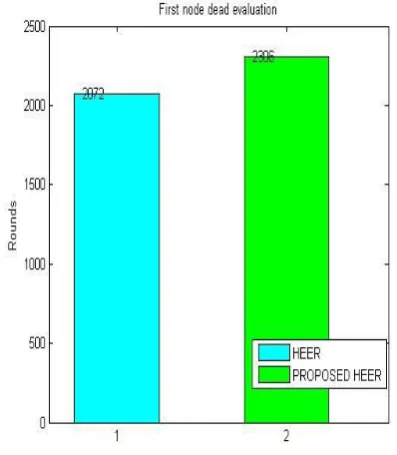
Figure 2 has shown the first node dead time comparison among the proposed and the existing HEER. it has been clearly shown that the first node dead time is more i.e. (2072- HEER and 2306- Proposed HEER) in case of the proposed HEER therefore it outperforms over the available techniques.
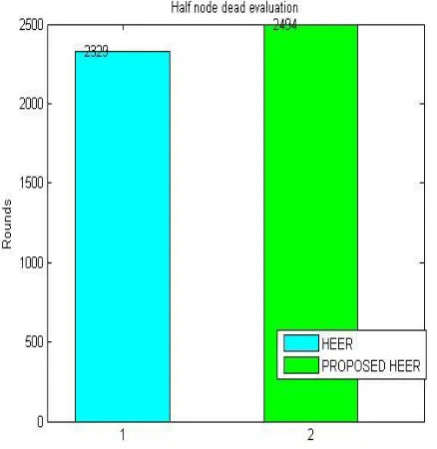
Figure 3 has exposed the half node dead time comparison among the proposed and the existing HEER. It has been clearly shown that the half node dead time (2329- HEER and 2494- Proposed HEER) is more in case of the proposed HEER therefore it outperforms over the available techniques.
Figure 3: Half node dead time evaluation
[image:4.595.62.281.130.355.2]Figure 4 has exposed the last node dead time comparison among the proposed and the existing HEER. It has been clearly shown that the last node dead time (3828- HEER and 4926- Proposed HEER) is more in case of the proposed HEER therefore it outperforms over the available techniques.
Figure 4: Last node dead time evaluation
Figure 5 has shown the Dead nodes comparison among the proposed and the existing HEER. it has been clearly shown that the dead nodes time has been extended in case of the proposed HEER therefore it outperforms over the available techniques.
Figure 5: Network lifetime evaluation
Figure 6 has shown the average energy consumption in comparison among the proposed and the existing HEER. It has been clearly shown that the average energy consumption is more in case of the proposed HEER therefore it outperforms over the available techniques.
[image:4.595.62.266.457.694.2] [image:4.595.324.527.479.722.2]Figure 7 has shown the packets sent to CH comparison among the proposed and the existing HEER. it has been clearly shown that the packets sent to CH is more in case of the proposed HEER therefore it outperforms over the available techniques.
[image:5.595.69.264.425.665.2]Figure 7: Packets sent to CH evaluation
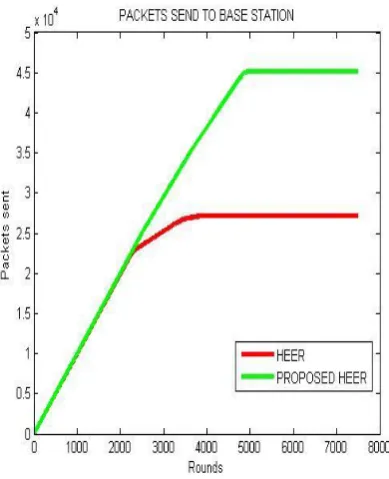
Figure 8 has shown the packets sent to BS comparison among the proposed and the existing HEER. It has been clearly shown that the packets sent to BS are more in case of the proposed HEER therefore it outperforms over the available techniques.
Figure 8: Packets sent to BS evaluation
Figure 9 has shown the improvement of the proposed HEER in (%) for network stable period i.e. 15.29 % and the network lifetime 29.023%.
Figure 9: Improvement of proposed HEER
7. CONCLUSION AND FUTURE WORK
Wireless Sensor Networks (WSNs) are composed of multiple unattended ultra-small, limited-power sensor nodes. These nodes have limited processing, power resource capabilities and wireless communication, which send sensed data to sink or Base Station (BS). A novel technique as efficient Cluster head Replacement has been proposed i.e. HEER. In this the Cluster Head (CH) selection is based on the ratio of residual energy of node and average energy of network. Moreover, to conserve more energy, HEER has also utilized the Hard Threshold (HT) and Soft Threshold (ST). But HEER does not use the inter cluster data aggregation, but it is not deterministic in nature, as cluster head selection is based upon the weighted probabilities. So to overcome this problem a deterministic approach has been proposed to enhance the cluster head selection. The idea behind deterministic cluster head selection is simple; firstly all the nodes will be sorted based upon their residual energies top 10% nodes will be selected as cluster head. So the selection criteria have deterministic decisions because node with highest first energy will become cluster head than the probability. The comparative analysis has shown that the proposed HEER outperforms over the HEER protocol with respect to the stable period and the network lifetime. In near future the further enhancement will be done by using the data aggregation techniques.
8. REFERENCES
[1] Rehman, O., Javaid, N., Manzoor, B., Hafeez, A., Iqbal, A., &Ishfaq, M. (2013). Energy Consumption Rate based Stable Election Protocol (ECRSEP) for WSNs. Procedia Computer Science, 19, 932-937.
[2] Kashaf, A., Javaid, N., Khan, Z. A., & Khan, I. A. (2012, December). TSEP: Threshold-sensitive Stable Election Protocol for WSNs. In Frontiers of Information Technology (FIT), 2012 10th International Conference on (pp. 164-168). IEEE.
[4] Li, Yuling, Luwei Ding, and Feng Liu. "The improvement of LEACH protocol in WSN." Computer Science and Network Technology (ICCSNT), 2011 International Conference on. Vol. 2. IEEE, 2011.
[5] Peng, J., Chengdong, W., Yunzhou, Z., &Fei, C. (2011, September). A Low-Energy Adaptive Clustering Routing Protocol of Wireless Sensor Networks. InWireless Communications, Networking and Mobile Computing (WiCOM), 2011 7th International Conference on (pp. 1-4). IEEE.
[6] Aderohunmu, Femi A., and Jeremiah D. Deng. "An Enhanced Stable Election Protocol (and Heterogeneous WSN." XH Wu, S. Wang,” Performance comparison of LEACH on LEACH-C protocols by NS2,” Proceedings of 9th International Symposium SEP) for Clustered Distributed Computing and Applications to Business, Engineering and Science. Hong Kong, China. 2010.
[7] Islam, M. M., Matin, M. A., &Mondol, T. K. (2012, June). Extended Stable Election Protocol (SEP) for three-level hierarchical clustered heterogeneous WSN. In Wireless Sensor Systems (WSS 2012), IET Conference on (pp. 1-4). IET.
[8] Muhamad, W. N. W., Dimyati, K., Mohamad, R., Haron, M. A., Sarnin, S., Wahab, N., & Aziz, N. H. A. (2008, December). Evaluation of Stable Cluster Head Election (SCHE) routing protocol for wireless sensor networks. In RF and Microwave Conference, 2008. RFM 2008. IEEE International (pp. 101-105). IEEE.
[9] Smaragdakis, Georgios, Ibrahim Matta, and AzerBestavros. SEP: A stable election protocol for clustered heterogeneous wireless sensor networks. Boston University Computer Science Department, 2004.
[10]Manjeshwar, Arati, and Dharma P. Agrawal. "TEEN: ARouting Protocol for Enhanced Efficiency in Wireless Sensor Networks." IPDPS. Vol. 1. 2001.
[11]Heinzelman, Wendi Rabiner, AnanthaChandrakasan, and HariBalakrishnan. "Energy-efficient communication protocol for wireless microsensor networks." System Sciences, 2000. Proceedings of the 33rd Annual Hawaii International Conference on. IEEE, 2000.