Mobile Learning Aspects and
Readiness
Hana Mohamed Eltayeb
Department of Computer science Faculty of Computer Science & IT,
Al-Zaiem Al-Azahri University, Sudan
Mohamed Osman Ali Hegazi
Department of Computer science (1) College of Computer Engineering and
Science, Salman Bin Abdulaziz University, Saudi Arabia
(2) Faculty of Computer Science & IT, Al-Zaiem Al-Azahri University, Sudan
ABSTEACT
This paper provide the aspects of mobile learning by presenting the differences techniques and aspects of using mobile devices in education according to the perspective of researches and studies in this area, it offers a comparison between e-learning and m-learning, a classification of education by mobile devices, and shows the categories of mobile learning. The paper also provides the readiness of mobile learning by presenting the results of study conducted at faculty of Computer Science and Information Technology at Al- Zaiem Al-Azahri University in Sudan.
General terms
Computer application, ICT in education, E-learning, M-learning
Keyword
e-learning , m-learning, learning, mobile, distance learning,
1.
INTRODUCTION
Universities over the past few years have either used the internet to enhance the learning, by providing online access to lecture notes, assignments and additional course related resources, or used it as medium of implementing virtual classroom, due to the revelation of IT technologies and internet attending virtual classroom lecture from remote became possible and available.
Popularity of such distance learning programs highlights the importance of flexibility in education system .Mobile devices and their use in education have extended the idea of flexibility to new frontiers .Mobile learning has different interpretations by several communities. The distinct interpretation is in its focus on learning across contexts and learning with handheld or portable devices(phones,Palms, PDA,Windows CE machaines and iPODS). Thus, mobile learning decreases limitation of learning location with the mobility of general handy devices. Learning with portable technologies, where the focus is on the technology; learning across contexts, where the focus is on the mobility of the learner, interacting with portable or fixed technology. Because most students today have some sort of internet-enabled mobile device (3G cell phone or PDA, smart phone)[14]. M learning means "acquisition of any knowledge and skill through using mobile technology anytime, anywhere that result in alteration of behavior"(Gedden S.J.) Mobile learning is convenient in sense that it is accessible virtually from anywhere, which provides access to all different materials available. M learning also bring strong portability for learning contents[3].
In this paper we are going to study the used of mobile technologies in education, the study will covers the aspects and the readiness of using mobile technologies in education (m-learning).
2.
RELATED WORKS
Mobile learning recently received considerable attention from researchers. The researches in this area came in diversity, some of them concerning about the possibilities and obstacles, some on the impact of m-learning on education, some concern about the technologies, some about the educational environments, and some on the readiness. This study focus on two areas, the technology and the readiness, in concerning with these two areas there are considerable recent researches work; for example [4] , [9] ,[12] and [13] in the area of using mobile technologies in education, and [1], [5], and [10] in the area of readiness and case study.
The contribution of this study is that; the study presents the technologies and aspects of the mobile learning from different point of views, it provides these aspects from comparison between m-learning and e-leaning point of views, and also it provides these aspects from categorization points of views. Also the study examines the readiness of m-learning by providing a case study include experiment and survey work. Another contribution of this study is that; it’s the first study in, it used one of the Sudanese University as a case study (there are more than 32 high education instituted distributed over 1,800,000 sq. km.), which can conceder it as reference work for this region and “may be” for the under developing countries.
3.
M-LEARNING Vs E-LEARNING
M-learning also seen as an extension of e-learning where the focus is on the use of mobile devices. Laouris and Laouri (2006) classified the move from e-learning to m-learning as a revolution, because it implies change of mindset when designing and planning learning environments and goals, in additional to implies the change in terminology [8].
According to the scientific conference in m-learning ( MLEARN 2004) the relation between m-learning and e-learning can be summarized as[11]:
m-Learning is a sub-set of e-Learning
m-Learning is a means to enhance the broader learning experience.
From terminology and the technology point of views mobile learning based on mobile and wireless technology while e-learning based on computer technology, that mean the contents of m-learning is adapted to the mobile connectivity , the resource limitation , and the programming concepts. Table 1 shows the differences between e-learning and m-learning in respect of the terminology and the technology
Table 1: Table 1: Differences between e-learning and m-learning environments with respect to methods of
terminology and technology
E-learning M-learning
Computer Mobile
Bandwidth GPRS, G3, Bluetooth
Multimedia Objects
Interactive Spontaneous
Hyperlinked Connected
Collaborative Networked
Media-rich Lightweight
Distance learning Situated learning
More formal Informal
Simulated situation Realistic situation Hyper learning Constructivism,
situationism, and collaborative
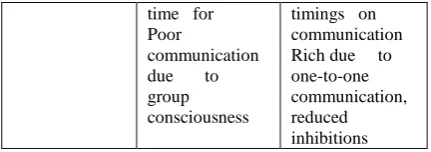
From communication point of view mobile learning in addition to asynchronous communication provides synchronous communication mechanisms and tools. Table 2 shows differences between e-learning and m-learning in respect of communication
Table 2: Differences between e-learning and m-learning environments with respect to methods
communication
Respect in E-learning M-learning
Communicati on between instructor and student
Time-delayed (students need
check e- mail Web sites)
Instant delivery of e- mails or SMS, voice communication, and social applications (wasapps, viber, …etc)
Passive Instant Communication Communication Asynchronous Synchronous Scheduled Spontaneous
Communicati on between student and student
Face-to-face Flexible and collaborations through communication application and social network tools
Audio-teleconference common
Audio and video- conference possible Private location No geographic
boundaries Travel time to
reach Internet site
No travel time since wireless connectivity
time for Poor
communication due to group consciousness
timings on communication Rich due to one-to-one communication, reduced inhibitions
In m-learning we can used varieties of methods to evaluate students, for example we can use real-life cases, site experiments, online presentation , pre-test, post-test, and group discussion . Table 3 shows differences between e-learning and m-e-learning in respect of the methods of students evolutions
Table 3: Differences between e-learning and m-learning environments with respect to methods of
evaluation
E-learning M-learning
1-to-1 basis possible Asynchronous and at times delayed
1-to-1 basis possible Both asynchronous
and synchronous Mass/standardized Customized Instruction Instruction Benchmark-based grading Performance &
improvement-based grading
Simulations & lab based experiments
Real-life cases and on the site experiments
Paper-based Less paper, less printing, lower cost
4.
MOBILE LEANING CATEGORIES AND
TECHNOLOGIES
According to Kukulska-Hulme and Traxler [6],[7] , mobile learning can be categorized according to
Technology-driven mobile learning, Portable e-Learning .
Connected classroom learning .
Informal, personalised, situated mobile learning . Mobile training, performance support .
Remote , rural or development mobile learning . Inclusion , assistivity and diversity
Large –Scale implementation
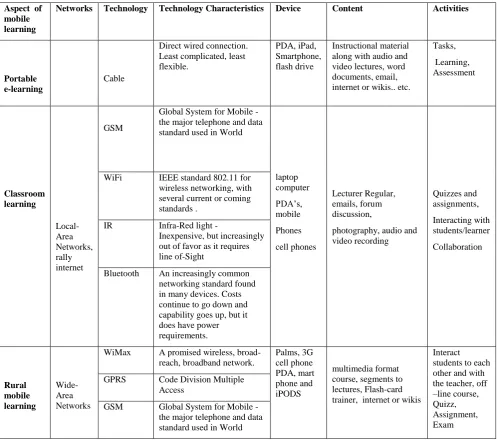
Table 4 provide a summary to these categorizes with their technologies.
[image:2.595.61.277.441.767.2]Table 4: Mobile learning categories and their technologies
Aspect of mobile learning
Networks Technology Technology Characteristics Device Content Activities
Portable e-learning
Cable
Direct wired connection. Least complicated, least flexible.
PDA, iPad, Smartphone, flash drive
Instructional material along with audio and video lectures, word documents, email, internet or wikis.. etc.
Tasks, Learning, Assessment
Classroom learning
Local-Area Networks, rally internet
GSM
Global System for Mobile - the major telephone and data standard used in World
laptop computer PDA’s, mobile Phones cell phones
Lecturer Regular, emails, forum discussion,
photography, audio and video recording
Quizzes and assignments, Interacting with students/learner Collaboration WiFi IEEE standard 802.11 for
wireless networking, with several current or coming standards .
IR Infra-Red light -
Inexpensive, but increasingly out of favor as it requires line of-Sight
Bluetooth An increasingly common networking standard found in many devices. Costs continue to go down and capability goes up, but it does have power requirements.
Rural mobile learning
Wide-Area Networks
WiMax A promised wireless, broad-reach, broadband network.
Palms, 3G cell phone PDA, mart phone and iPODS
multimedia format course, segments to lectures, Flash-card trainer, internet or wikis
Interact students to each other and with the teacher, off –line course, Quizz, Assignment, Exam GPRS Code Division Multiple
Access
Table 5 : Examples of mobile applications that can be used in m-learning
Category Examples
Mobile learning management software
MLE, MLE-moodle, MDroid, LearnEM, Classbook,
Blackboard, Blackboard Mobile, Blackboard Collaborate .. etc. Delivery tools Polaris office, officeSuite( Word
document, Pdf,..) video, photo..etc Voice and message
communication applications
Skype, Viber, Line, Voice Recorder, Assistant, WhatsApp, .. etc
Self learning Language learning (ex. learning Japanese, learning Chinese,.. etc), Quran Learning, maps, ..etc. Virtual Classrooms Virtual Classrooms, E3 Virtual
Classrooms, Splashtop, Classroom, Perculus… etc. Blogs Blogger, WordPress, Feedly ..etc
5.
MOBILE LEARNING READINESS
Mobile technologies can be one of the suitable technologies for developing and delivering the education process hence; mobile learning can be any educational interaction delivered through mobile technology, it is not limited in mobile applications that designed specifically for learning purposes, but also those designed for other used such as maps, geological, data access, self learning tools,… etc. Accordingly using mobile in learning will enhance the learning systems and provide more advantages for the educational environments by bringing the benefit of these technologies to the educational fields.
The question arises here; are the technology and the people ready to move towards mobile learning?
This section tests the readiness of using mobile in learning from two points of views:
1- The availability and the capability of the technologies in implementing educational processing (readiness of the hardware and the software).
2- The readiness of teacher and students in using mobile in learning.
5.1 Readiness of the technology:
From the previous sections we can conclude that there are varieties of mobile technologies and applications that can be used in implementing m-learning. These technologies are became more available and more usefully, it became a familiar part of the lifes, most of peoples now a day using mobile phone in talking, sending messages, chatting, taking photograph or and accessing information.
In a survey conducted on sample of 96 students from the faculty of Computer Science and Information Technology at Al-Zaiem Al-Azhari University in Sudan, we found that 100% of the student has mobile phone (cell phone) 85% of these mobiles phones are smart phones, 20% of these students in additions to mobile phone has PDA, or iPad. The survey
technologies. The survey also shows that students are used mobile in many university activities such as time table, instance messages, courses materials and group discussion. The survey almost gave the same result when it conducted to sample of 51 teachers in same faculty.
5.2 Readiness of the teachers and students
The paper used the faculty of Computer Science and Information Technology at Al-Zaiem Al-Azhari University in Sudan as case study for examines the readiness of the teachers and students towards using mobile technology in learning.
5.2.1 Study methodology:
The study conducted into two ways or mechanisms:
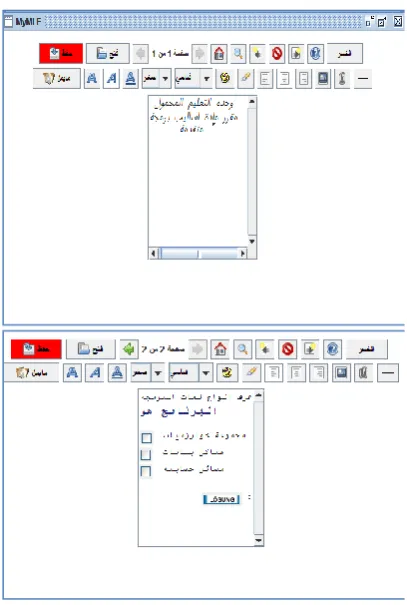
In the first mechanism we prepare m-learning model using MLE software (figure 1) and implement this model in teaching undergraduate students. The feedback from students shows that 85% of the Students liked the technology and enjoyed the experience.
The feedback from teachers (51) shows that 72% of them saw that these methods of teaching is useful and it will succeed, the rest of them (27%) saw there is still limitation in using mobile phone in learning such as the limitation in memory size, battery life, and speed. In the second mechanism we surveyed all the staff
(instructors, teaching assistance, lecturers, assistant professors, and associate professor) at the Faculty of Computer Science and Information Technology at Al-Zaiem Al-Azhari University in Sudan, the total number of the survey population is 51.
[image:4.595.327.531.424.727.2]The authors have analyzed the answers to the qualitative questions in the surveys in an attempt to gain an understanding of how current teachers view the use of mobile devices in learning environments and are they willing to do that? (teachers readiness). The analysis of teacher’s perception on m-learning points to the fact that mobile learning is widely embraced by teachers community. The majority of teachers
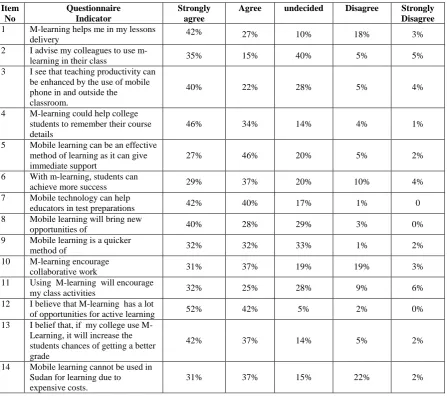
[image:5.595.77.525.169.572.2]supported the notion that the mobile technologies increase the flexibility of access to resources in learning and that they could work independently of variable resources and m-learning activities can much better engage students in the learning process. Table 6 shows summary of the survey result.
Table 6: A summary of teacher readiness survey results
Item No
Questionnaire Indicator
Strongly agree
Agree undecided Disagree Strongly
Disagree
1 M-learning helps me in my lessons
delivery 42% 27% 10% 18% 3%
2 I advise my colleagues to use
m-learning in their class 35% 15% 40% 5% 5%
3 I see that teaching productivity can be enhanced by the use of mobile phone in and outside the classroom.
40% 22% 28% 5% 4%
4 M-learning could help college students to remember their course details
46% 34% 14% 4% 1%
5 Mobile learning can be an effective method of learning as it can give immediate support
27% 46% 20% 5% 2%
6 With m-learning, students can
achieve more success 29% 37% 20% 10% 4%
7 Mobile technology can help
educators in test preparations 42% 40% 17% 1% 0
8 Mobile learning will bring new
opportunities of 40% 28% 29% 3% 0%
9 Mobile learning is a quicker
method of 32% 32% 33% 1% 2%
10 M-learning encourage
collaborative work 31% 37% 19% 19% 3%
11 Using M-learning will encourage
my class activities 32% 25% 28% 9% 6%
12 I believe that M-learning has a lot
of opportunities for active learning 52% 42% 5% 2% 0%
13 I belief that, if my college use M-Learning, it will increase the students chances of getting a better grade
42% 37% 14% 5% 2%
14 Mobile learning cannot be used in Sudan for learning due to expensive costs.
31% 37% 15% 22% 2%
6.
RESULTS
This paper presents the differences techniques and aspects of using mobile devices in education according to the perspective of researches and studies in this area. The paper provides:
1- A comparison study between e-learning and m-learning. 2- A classification of education by mobile devices. 3- The categories of mobile learning.
The paper also provides the readiness of mobile learning by presenting the results of a study conducted at faculty of Computer Science and Information Technology at Al-Zaiem Al-Azahari University in Sudan.
The paper shows that mobile technologies are ready and available for implementing m-learning, and there is a considerable readiness from the peoples to used mobile in
learning. The study shows that 85% of the student enjoyed the experiment. The survey shows that teachers attitudes toward m-learning were high they are willing to do that (Table 7 and figure 2 and 3 show some statistical results for the survey) These results are consistent with Alwraikat, Mansour A. and Al Tokhaim, Hiam results he [2].
Table 7: statistical results for teachers’ survey
# Question mean std rank
1. M-learning helps me in my
lessons delivery 3.7 1.39 High 2. I advise my colleagues to
use m-learning in their class 3.2 1.31 High
3.
I see that teaching productivity can be enhanced by the use of mobile phone in and outside the classroom.
4.
M-learning could help college students to remember their course details
3.9 1.11 High
5.
Mobile learning can be an effective method of learning as it can give immediate support
3.6 1.06 High
6. With m-learning, students
can achieve more success 3.5 1.14 High
7.
Mobile technology can help educators in test
preparations
3.5 1.27 High
8.
Mobile learning will bring new opportunities of Learning.
4 1.14 High
9.
Mobile learning is a quicker method of getting feed back in learning
3.1 1.20 High
10. M-learning encourage
collaborative work 3.9 1.10 High
11.
Using M-learning will encourage my class activities
3.5 1.29 High
12.
M-learning allows information to be accessed at anytime and anywhere for learning and real tasks
4.4 0.80 High
13.
I believe that M-learning has a lot of opportunities for active learning
3.8 1.17 High
14.
Mobile learning cannot be used in Sudan for learning due to expensive costs.
2.9 1.32 Medi
[image:6.595.49.286.67.662.2]um
[image:6.595.317.535.76.292.2]Figure 2: The Mean of teachers’ survey
Figure 3: The Standard Deviation of teachers’ survey
7.
CONCLUSION
The paper concludes that the mobile technologies can be one of the suitable technologies for developing and delivering the education process hence; there are varieties of mobile technologies and applications that can be used in implementing m-learning. The study state that these technologies are became more available and more usefully, it became a familiar part of the life, hence, most of peoples now a day using mobile phone in talking, sending messages, chatting, taking photograph or and accessing information. The paper concludes that using mobile in learning will enhance the learning systems and provide more advantages for the educational environments by bringing the benefit of these technologies to the educational fields.
The study also concludes that mobile technologies are perceived as an effective tool in improving communication and learning. In developing countries (Sudan as a case study) Finally we can conclude that mobile technologies and its applications are became important part of our life it is involved in most of our life activities and enhance these activates by the advantages of these technologies, therefore using mobile technologies in educational process will be essential to keep pace with the constant evolution and experience the reality.
8.
REFERENCES
[1] Ali Zuhdi Shaqour. 2014 “ Students' Readiness towards M-Learning: A Case Study of Pre-Service Teachers in Palestine” Journal of Educational and Social Research. Vol. 4 No.6. MCSER Publishing, Rome-Italy. September 2014
[2] Alwraikat, Mansour A and Al Tokhaim, Hiam, 2014, “ Exploring the Potential of Mobile Learning Use Among Faculty Members” International Journal of Interactive Mobile Technologies Vol. 8, No 3 pp 4-10(2014) [3] Anita Hemni, Rajkumar Kewalramani, Kanya
Mahavidyalaya, and Jaripatka,Nagpur- “M Learning :
0 0.5 1 1.5 2 2.5 3 3.5 4 4.5 5
[4] Chao, H.; Lai, C.; Chen, S.; Huang, Y., "A M-Learning Content Recommendation Service by Exploiting Mobile Social Interactions," Learning Technologies, IEEE Transactions on , vol.7, no.3, pp.221,230, July-Sept. 1 2014
[5] Fahad N. Al-Fahad, 2009 “Students' Attitudes And Perceptions Towards The Effectiveness Of Mobile Learning In King Saud University, Saudi Arabia “ The Turkish Online Journal of Educational Technology – TOJET April 2009 ISSN: 1303-6521 volume 8 Issue 2 Article 10.
[6] John Traxler 2009. Learning in a Mobile Age International Journal of Mobile and Blended Learning, 1(1), 1-12, January-March 2009
[7] Kukulska-Hulme, A. & Traxler, J., 2007. Design for Mobile and Wireless Technologies In H. Beetham & R. Sharpe (eds). Rethinking Pedagogy for the Digital Age. Routledge; New edition edition (26 April 2007)
[8] Laouris, Y. and Laouri, R. “Can Information and Mobile Technologies serve to close the gap and accelerate development? In Proceedings of MLearn 2006, Alberta, Canada, 22 – 25 October (2006).
[9] María Soledad Ramírez Montoya. 2013, “Integrating Mobile Learning Resources and its Repercussions on Instructional Design and Teaching Processes in the
Virtual Environments” THE GLOBAL JOURNAL OF HUMAN-SOCIAL SCIENCE, VOL 13, NO 7-G, page 18-24. (2013)
[10] Min Liu, Robert Scordino, Renata Geurtz, Cesar Navarrete, Yujung Ko, and Mihyun Lim, 2014,” A Look at Research on Mobile Learning in K–12 Education From 2007 to the Present” Journal of Research on Technology in Education, Volume 46, Issue 4, pages 325-372. 2014
[11] Mobile learning anytime everywhere: A book of papers from MLEARN 2004: Conference papers http://www.m-learning.org/arch...
[12] Mohamed Sarrab, Laila Elgamel, and Hamza Aldabbas. 2012 “Mobile Learning(M-learning) and Educational Environments”, International Journal of Distributed and Parallel Systems (IJDPS) Vol.3, No.4, July 2012 [13] Shadle, Susan, Ross Perkins, Doug Lincoln, Michael
Humphrey, and Eric Landrum.“Leading a Multiple Project Mobile Learning Initiative”(Research Bulletin). Louisville, CO: EDUCAUSE Center for Applied Research, April 9, 2013