http://dx.doi.org/10.4236/ojn.2015.512114
How to cite this paper: Aizu, K., Mikami, K., Tsuchiya, R., Shimizu, M., Kojima, N., Oka, N. and Nishizawa, Y. (2015) The Re-lationship between Assessment Skills and Nursing Knowledge. Open Journal of Nursing, 5, 1072-1081.
http://dx.doi.org/10.4236/ojn.2015.512114
The Relationship between Assessment
Skills and Nursing Knowledge
Keiko Aizu1*, Kasumi Mikami1, Ryoko Tsuchiya2, Mayumi Shimizu2, Nanae Kojima3, Naoki Oka4, Yoshiko Nishizawa1
1School of Health Sciences, Hirosaki University, Aomori, Japan 2School of Medicine & Hospital, Hirosaki University, Aomori, Japan 3Health Service Center, Hiroshima University, Hiroshima, Japan 4School of Education, Hiroshima University, Hiroshima, Japan
Received 5 November 2015; accepted 18 December 2015; published 21 December 2015
Copyright © 2015 by authors and Scientific Research Publishing Inc.
This work is licensed under the Creative Commons Attribution International License (CC BY). http://creativecommons.org/licenses/by/4.0/
Abstract
This research aimed to clarify the relationship between nursing students’ levels of structural knowledge and assessment skills. Participants were 17 third-year university students majoring in nursing who participated individually in the experiments. The experiments included a nursing- scene task, free-recall task, and sorting task. Experiments were conducted before and after their clinical practice. Each student’s level of structural knowledge was calculated from the free-recall and sorting task responses, and each student’s assessment skill was calculated from the nursing- scene task responses. Levels of structural knowledge were significantly higher in post-examination compared with pre-examination (p < 0.01). Assessment skills scores were also significantly higher in post-examination compared with pre-examination (p < 0.001). When comparing assessment skills in relation to levels of structural knowledge, the high-structured group (n = 5) had signifi-cantly higher scores for their conclusions and reasons than the low-structured group (n = 5) (p < 0.001). Information-collecting scores in the task case did not differ between the low- and high- structured groups, although the high-structured group tended to mention information that was not included in the task case (p < 0.10). Well-structured knowledge of students in the high-structured group seemed to enable them to acquire and activate highly related information during assess-ment. Students in the high-structured group apparently made assessments not only by using in-formation given but also by over viewing inin-formation comprehensively.
Keywords
Structural Knowledge, Assessment, Clinical Practice, Cognitive Psychology
1. Introduction
Recently, nurses are required to have a high level of clinical judgment due to changes in the types of diseases of aged patients and advances in medical technology. The thinking process that a nurse goes through when caring for patients is called the “nursing process” which includes the processes of “assessment”, “nursing diagnosis”, “planning”, “implementing” and “evaluation” [1]. Specifically, assessment is the process of collecting patient information, analyzing the situation, and understanding the problem or potential problem [2]. Nurses are re-quired to have high-level skills in assessment given that nursing diagnosis, planning, and implementing are based on assessment.
In clinical practice, nursing students are required to care for patients and provide needed nursing care as li-censed nurses do even though they are students. Therefore, even students in clinical practice are expected to have high-level assessment skills. However, Sasabe et al. reported that at graduation, students’ self-evaluations of their assessment skills were low [3]. After Sasabe et al. improved the students’ assessment skill training, evaluations of their information collecting and analytical skills were relatively higher whereas evaluations of practice or physical assessments to solve problems were low [4]. Sasabe et al. also mentioned the need for con-tinuous college education in the thinking process of nursing [4]. Therefore, high-level assessment skill education for nursing students is very important in nursing education.
Yura and Walsh [5] defined the nursing process as a problem-solving activity to clarify patients’ problems and needs in order to provide appropriate care. If the nursing process is indeed a problem-solving activity, know-ledge of cognitive psychology will provide a new perspective for developing ways to train assessment skills.
For example, Chi et al. [6] demonstrates that one’s knowledge structure affects how one solves problems. Moreover, they found that the structural knowledge of an expert in a particular field is more structured than that of a novice. “Structuring knowledge” is the process of uniting and unifying new knowledge with the knowledge that one already has. It is said that in problem-solving, once certain knowledge is activated, other related know-ledge is also activated. Therefore, one can use obtained knowknow-ledge to solve problems. The structural knowknow-ledge of experts allows them to employ their knowledge to solve a problem effectively. Nurses and nursing students can also effectively use their knowledge for assessment if their knowledge about nursing is well structured.
When considering ways to improve student assessment skills, the relationship between students’ structural knowledge and assessment skills must be understood because the amount and structure of knowledge affect the ways of problem-solving. However, there is little research on assessment skills in relation to structural know-ledge despite the abundant research on nursing-process education. Both in the United States and in Japan, stan-dardized patients or students’ self-assessments by the Objective Structured Clinical Examination (OSCE) are used in assessment education (e.g., Hemming and Jennrich [7], Mitsuki et al. [8]). However, standardized pa-tients and the OSCE focus on students’ behaviors and ways of thinking. It is difficult to say whether there are enough studies about the knowledge utilized for assessment.
Therefore, this study aims to clarify the relationship between the structural knowledge of nursing students and their assessment skills.
In this study, we organized the structural knowledge of nursing students through a measure of category clus-tering. Measurements were made by free recall of verbal materials in experiments. Various measures were de-veloped to clarify the development of memory or structural knowledge. Adjusted-ratio-of-clustering-S (ARCS; Inoki [9]) is a category clustering measurement adopted in this research for its ability to measure clusters even when free recall numbers are small. ARCS is considered suitable for measuring novices’ structural knowledge. We evaluated assessment skills through an assessment process using the contents “collecting information” and “nursing problems and causes”. A quantified examination of the relationship between structural knowledge and assessment skills becomes possible by evaluating levels of structural knowledge and assessment skills together, which has never been done before. Clarifying differences in assessment skills based on levels of structural knowledge is linked to clarifying the structural knowledge effective in assessment. This would be important for developing an education strategy to improve structural knowledge that is useful for assessment.
2. Method
2.1. Participants
ex-plained to 35 students who were randomly sampled from the students enrolled in Basic Nursing Practice in the 2014 academic year. Of these students, 17 volunteered to participate in this study.
2.2. Materials
Participants were individually interviewed and participated individually in the experiments. Three tasks were administered: a nursing-scene task, free-recall task, and sorting task. One experiment took approximately 60 to 90 min. Experiments were conducted before and after each participant’s clinical practice, during the period from July to November 2014.
2.3. Case Content of the Nursing-Scene Task
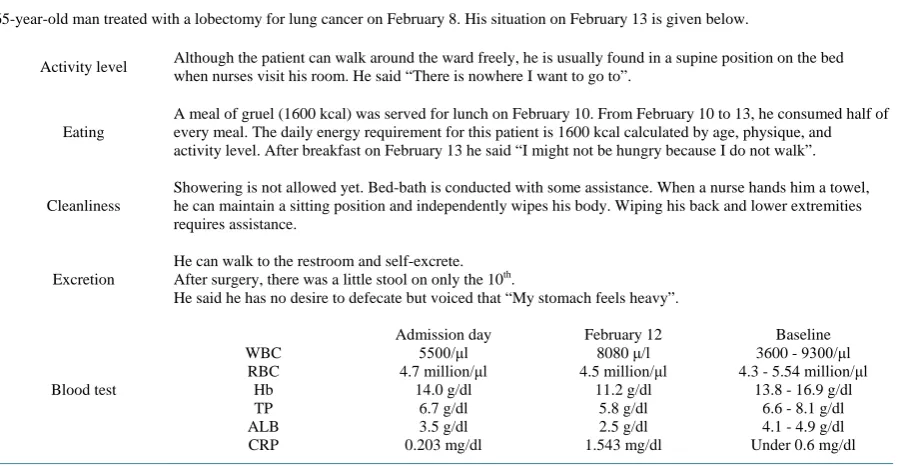
The originally conceived case was about a patient who had increased energy demand five days after lobectomy for lung cancer but who lacked sufficient energy intake (see Table 1 for details).
2.4. Verbal Materials for the Free-Recall Task
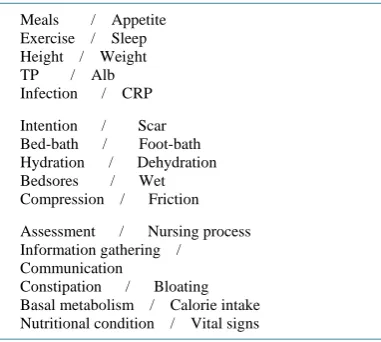
Fifteen pairs of 30 terms were chosen from a textbook used by the participants. The terms were related to the nutritional-metabolic pattern in Gordon’s functional health patterns, which is knowledge needed for assessment. Participants had studied the terms prior to the experiments. Two researchers engaged in nursing education chose the terms so that the terms could be paired with complementary terms. Examples of terms used in the free-recall test are shown in Table 2.
2.5. Procedures
2.5.1. Nursing-Scene Task
The case was presented on paper to the participants and they were asked to answer orally.
[image:3.595.91.542.487.720.2]Participants were asked to discuss the problems and factors of the issues in the case. They were asked not on-ly to give conclusions but also to think about how they thought about the case. Participants were asked to assess the problems related to the nutritional-metabolic pattern.
Table 1. Case for the clinical-scene task.
Instruction:
Please discuss the problems and factors of the issues in this case. Please discuss how you thought about the case as well as your conclusions. The problems are related to the nutritional-metabolic pattern.
65-year-old man treated with a lobectomy for lung cancer on February 8. His situation on February 13 is given below.
Activity level Although the patient can walk around the ward freely, he is usually found in a supine position on the bed when nurses visit his room. He said “There is nowhere I want to go to”.
Eating
A meal of gruel (1600 kcal) was served for lunch on February 10. From February 10 to 13, he consumed half of every meal. The daily energy requirement for this patient is 1600 kcal calculated by age, physique, and activity level. After breakfast on February 13 he said “I might not be hungry because I do not walk”.
Cleanliness
Showering is not allowed yet. Bed-bath is conducted with some assistance. When a nurse hands him a towel, he can maintain a sitting position and independently wipes his body. Wiping his back and lower extremities requires assistance.
Excretion
He can walk to the restroom and self-excrete. After surgery, there was a little stool on only the 10th.
He said he has no desire to defecate but voiced that “My stomach feels heavy”.
Blood test WBC RBC Hb TP ALB CRP Admission day 5500/μl 4.7 million/μl 14.0 g/dl 6.7 g/dl 3.5 g/dl 0.203 mg/dl February 12 8080 μ/l 4.5 million/μl 11.2 g/dl 5.8 g/dl 2.5 g/dl 1.543 mg/dl Baseline 3600 - 9300/μl 4.3 - 5.54 million/μl
Table 2.Verbal materials for the free-recall task.
Meals / Appetite Exercise / Sleep Height / Weight TP / Alb Infection / CRP
Intention / Scar Bed-bath / Foot-bath Hydration / Dehydration Bedsores / Wet Compression / Friction
Assessment / Nursing process Information gathering /
Communication
Constipation / Bloating Basal metabolism / Calorie intake Nutritional condition / Vital signs
2.5.2. Free-Recall Task
Experimental procedures were explained to the participants before the task. Terms were visually presented on a personal computer screen for 3 each. To prevent rehearsal using short-term memory, participants were asked to do a calculation task (i.e., adding 10 adjacent numbers for 30 s). After the calculation task, participants were asked to recall memorized terms in free order for 120 s. Participants’ responses were recorded with an IC re-corder. One trial consisted of visual presentation of the terms, the calculation task, and free recall. Six trials were carried out for each participant.
2.5.3. Sorting Task
A white board (58 cm width × 43 cm height) and 30 cards (6 cm width × 1.5 cm height) each displaying a term were presented to the participants, who were asked to categorize these cards into groups using their own think-ing.
2.6. Analysis
2.6.1. Assessment Skills
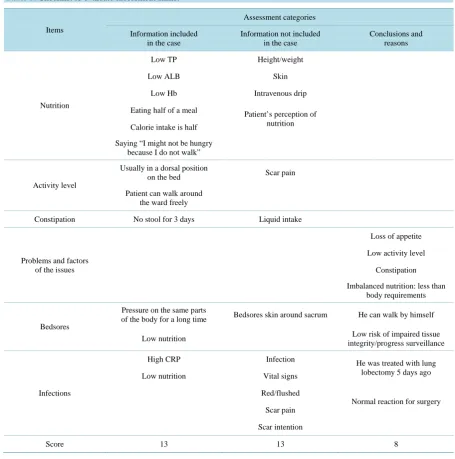
We created a checklist to evaluate assessment skills for the nursing-scene task. The checklist’s validity was checked by four researchers including two teachers and two clinical experts. The checklist comprised three as-sessment categories and 34 items: “conclusions and reasons” had 8 items and “information paid attention to” had 26 items, of which 13 items were included in the case and 13 items were not included in the case (Table 3).
2.6.2. Structural Knowledge
ARCS scores were used to measure levels of structural knowledge. ARCS scores were measured based on free-recall responses. When two words from the same category were recalled together, the two words were eva-luated as well structured by the participant. In this case, the “same category” would mean that the participant sorted the two terms into the same group in the sorting task. ARCS scores ranged between the numerical values of 0 and 1, and a higher score indicates a higher level of structural knowledge.
2.6.3. Relationship between Assessment Skills and Structural Knowledge
Participants were divided into two groups based on their post-examination ARCS score in the sixth trial: Partic-ipants who scored over 0.90 points were assigned to the high-structured group and particPartic-ipants who scored less than 0.80 points were assigned to the low-structured group. We compared the mean scores of the assessment skills of two groups.
2.6.4. Data Analysis
Table 3.Checklist to evaluate assessment skills.
Items
Assessment categories
Information included in the case
Information not included in the case
Conclusions and reasons
Nutrition
Low TP Height/weight
Low ALB Skin
Low Hb Intravenous drip
Eating half of a meal Patient’s perception of
nutrition Calorie intake is half
Saying “I might not be hungry because I do not walk”
Activity level
Usually in a dorsal position
on the bed Scar pain
Patient can walk around the ward freely
Constipation No stool for 3 days Liquid intake
Problems and factors of the issues
Loss of appetite
Low activity level
Constipation
Imbalanced nutrition: less than body requirements
Bedsores
Pressure on the same parts
of the body for a long time Bedsores skin around sacrum He can walk by himself
Low nutrition Low risk of impaired tissue integrity/progress surveillance
Infections
High CRP Infection He was treated with lung
lobectomy 5 days ago Low nutrition Vital signs
Red/flushed
Normal reaction for surgery Scar pain
Scar intention
Score 13 13 8
2.7. Ethical Considerations
The Ethics Committee of Hirosaki University Graduate School of Medicine gave ethical approval for this study. Participants were provided with a complete explanation about the objective and process of the study. Written consent was obtained from each participant. All participants voluntarily participated and were free to withdraw from the study at any time.
3. Result
We analyzed the data of the 13 participants who participated in both pre- and post-examinations (before and af-ter clinical practice). The data of 4 participants who participated in only the pre-examination were excluded.
3.1. Structural Knowledge
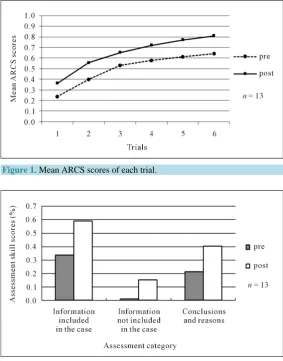
Mean ARCS scores of trials 1 to 6 and mean ARCS scores of pre- and post-examinations were compared (Figure 1).
As a result of analysis of variance, mean ARCS scores increased with each trial in both pre- and post-exami- nations. The score of the sixth trial became the peak value (F[5, 60] = 102.54, p < 0.001). Also, mean ARCS scores were significantly higher post-examination compared with pre-examination (F[1, 12] = 11.14, p < 0.01). There were no interactions between the trials and pre- and post-examinations (F[5, 60] = 0.363, p > 0.10).
3.2. Nursing-Scene Task
Each participant’s assessment protocol was derived from the nursing-scene task responses. We evaluated each participant’s assessment skills using the checklist and calculated the average score of each assessment category for each participant. We then compared the mean average scores of the pre- and post-examinations (Figure 2).
[image:6.595.171.455.344.706.2]The main effect of the pre- and post-examinations was significant based on variance analysis (F[1, 12] = 27.64, p < 0.001). Assessment skill scores of the post-examination were higher than those of the pre-examina- tion. Also, the main effect of the category was significant (F[2, 24] = 42.48, p < 0.001). Multiple comparisons by Ryan’s method were conducted. As a result, there were significant differences between “information in-cluded in the case” and “information not inin-cluded in the case” (t[24] = 9.17), between “information inin-cluded in the case” and “conclusions and reasons” (t[24] = 3.77), and between “information not included in the case” and “conclusions and reasons” (t[24] = 5.40). The average score of “information included in the case” was the high-est and the average score of “information not included in the case” was the lowhigh-est. There were no interactions between the assessment categories and pre- and post-examinations (F[2, 24] = 1.71, p > 0.10).
Figure 1. Mean ARCS scores of each trial.
3.3. Relationship between Assessment Skills and Levels of Structural Knowledge
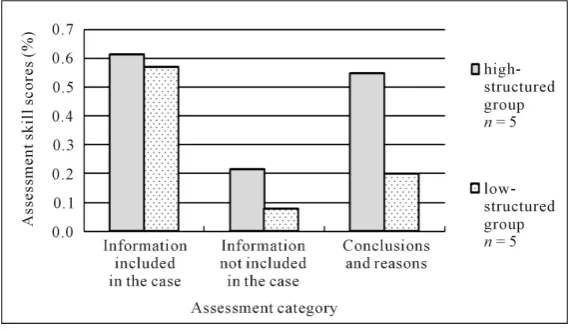
Participants were divided into two groups based on their post-examination ARCS scores in the sixth trial. Five participants who scored over 0.90 points were assigned to the high-structured group, and 5 participants who scored less than 0.80 points were assigned to the low-structured group. Participants who scored 0.81 - 0.89 points were excluded from this analysis.
Mean average scores of each category were compared between the low-structured group and high-structured group (Figure 3). The main effect of the groups was significant based on variance analysis (F[1, 8] = 10.57, p < 0.05). The main effect of the assessment category was also significant (F[2, 16] = 47.59, p < 0.001). Further-more, a significant interaction was found between levels of structural knowledge and assessment category (F[2, 16] = 5.80, p < 0.05). Simple main effects were tested for structural knowledge and assessment categories. As a result, the simple main effect of structural knowledge in “conclusions and reasons” was significant (F[1, 24] = 21.15, p < 0.001). Scores of the high-structured group were significantly higher in “conclusions and reasons” compared with those of the low-structured group. Also, the simple main effect of structural knowledge in “in-formation not included in the case” was marginally significant (F[1, 24] = 3.31, p < 0.10). Scores in the high-structured group tended to be higher than those in the low-structured group. The simple main effect of structural knowledge in “information included in the case” was not significant.
4. Discussion
4.1. Memory Model and Structural Knowledge in Cognitive Psychology
First, an overview of the memory model and structural knowledge in cognitive psychology will be followed by a discussion of the structural knowledge of the nursing students. In cognitive psychology, a memory model is considered an operation of acquiring new information. According to Baddeley [10], in a memory model, new information is operated on in working memory to become long-term memory. New information is associated with long-term memory knowledge through the working memory operation. In this study, acquiring knowledge as long-term memory is called “memorizing.” When memorizing new information, it is associated with already existing knowledge of situations, with the information used to facilitate structural knowledge and its activation when needed [10]. In nursing science, when acquiring new information, associating new information with a clinical setting related to the information facilitates activation of structural knowledge during assessment, which makes possible the effective utilization of knowledge.
4.2. Levels of Structural Knowledge and Assessment Skills
[image:7.595.171.457.529.694.2]Next, we will discuss the relationship between levels of structural knowledge and assessment skills. Assessment is the collection and interpretation of information. Its purpose is to decide whether or not a problem exists, such as a problem requiring nursing intervention or a potential problem [2]. Therefore, we analyzed the categories
“information paid attention to” and “conclusions and reasons” based on responses to a nursing-scene task. In “information paid attention to”, we found no difference between students with low and high levels of structural knowledge in the percentage who mentioned information that was directly provided in the task case. The high-structured group tended to mention necessary information that was related to but not directly provided in the task case. The percentage who mentioned a decision made along with its reasons was also significantly higher in the high-structured group.
Benner [11] explains five steps to nursing mastery. Because novices lack experience to base their decisions on, phenomena must be understood based on objective data from an observable patient. Therefore, novices barely understand a given situation. In the next step, advanced beginner-level nurses have knowledge and experience to base their decisions on. Therefore, for patients presenting similar symptoms as a previous patient, nurses are able to determine what to observe and what type of nursing is needed [11]. The low-structured group in this study corresponds to Benner’s novice level. Although nurses in the low-structured group were able to pay atten-tion to informaatten-tion directly menatten-tioned in the task case as well as those in the high-structured group, they were unable to mention any related information. They were unable to use unmentioned knowledge because their knowledge of nutritional-metabolic patterns was not structured. In contrast, knowledge of nutritional-metabolic patterns was structured in the high-structured group, making it possible for them to acquire and activate highly related knowledge about the case. Benner [11] also stated that novices have difficulty comprehensively analyz-ing data due to a fragmentary understandanalyz-ing of a situation. Only a low percentage of the low-structured group was able to state their decisions in relation to their reasons, which is also a characteristic of Benner’s novice lev-el. Although the low-structured group was able to notice important information, they could make a decision us-ing one piece of information but had difficulty makus-ing a decision that demanded comprehensive understandus-ing of several pieces of information because of their fragmentary knowledge of the situation.
These above-mentioned assessment characteristics will be discussed from the perspective of cognitive psy-chology. In one study, Gobband Chi [12] analyzed the difference between an expert and a novice from the same field that was shown a picture related to their field and asked to comment about it. First, there were no differ-ences in visually observed characteristics, although experts commented more often about characteristics not vi-sually observed. Second, whereas novices only listed the characteristics, experts talked about details related to a characteristic they had commented about. In a study comparing the ways in which experts and novices solved a physics problem, Chi [6] found that experts predicted unwritten events based on information given to solve the problem. Chi [6] stated that information gained in fragments might not be appropriately used and must be struc-tured around a basic concept for it to be appropriately used. In the present study, the assessment characteristics of the high-structured group match that of Chi’s characteristics of an expert. Because information was structured and the relationships between the information were understood, decisions were not made using one piece of in-formation but rather by over viewing the inin-formation comprehensively to determine whether the problem re-quired nursing intervention.
4.3. Structural Knowledge before and after Clinical Practice
symptoms that require comprehensive consideration of the situation for nursing. Therefore, through clinical practice, one must integrate fragmentary information by comprehensive assessment of the situation. Thus lec-ture-based knowledge facilitates the connection between obtained knowledge and knowledge from clinical set-tings.
Experience in clinical practice improves students’ structural knowledge for its effective utilization in making assessments in a clinical setting. Knowledge required to make assessments is utilized to facilitate structural knowledge, which makes it possible to make assessments through comprehensively understanding the situation. It was clarified that well-structured knowledge facilitates the development of the assessment skills. Therefore, promoting education that facilitates the structuring of knowledge is important for improving students’ assess-ment skills.
5. Conclusions
1) Scores of structural knowledge regarding nutrition evaluation were significantly higher after clinical prac-tice.
2) Scores of assessment skills after clinical practice were raised significantly compared with those before clinical practice.
3) Regarding the relationship between levels of structural knowledge and assessment skills, information-col- lecting scores did not differ between the low- and high-structured groups, although the “conclusions and reasons” score was significantly higher in the high-structured group. The high-structured group tended to mention infor-mation that was not stated in the task case.
4) Through clinical practice, students develop structural knowledge that can be utilized in a clinical setting to improve assessment skills.
6. Limitations
In this study, we compared assessment skills and levels of structural knowledge using randomly chosen data from students before and after their clinical practice without controlling the content of clinical practice. There-fore, whether the content of clinical training actually promoted structural knowledge remains uncertain. Discus-sions were based on clinical practice experience and past studies. Future research should investigate teaching strategies for acquiring structural knowledge that can be utilized in a clinical setting, and its effects on assess-ment skills must be tested. In addition, the number of participants in this study was low because the experiassess-ments took a long time and few students volunteered. Consequently, our analyses were based on a small amount of da-ta from a limited sample. Further studies with larger sample sizes and more diverse populations (e.g., other schools, other grades) are needed.
Acknowledgements
This study was supported by JSPS KAKENHI Grant-in-Aid for Young Scientists (B) Grant Number 25862099. The authors are grateful to the participants of this study, who provided us with invaluable information.
References
[1] The American Nurses Association (2015) The Nursing Process.
http://www.nursingworld.org/EspeciallyForYou/What-is-Nursing/Tools-You-Need/Thenursingprocess.html
[2] Gordon, M. (2008) Assess Notes: Nursing Assessment & Diagnostic Reasoning. F.A. Davis Company, Philadelphia.
[3] Sasabe, M., Manabe, E., Fujita, J., Komatsu, M., Mitsuhashi, M., Babaguchi, Y., Nishida, N., Nakagawa, M., Fuku-moto, M. and Okayama, Y. (2009) Evaluation of Clinical Nursing Skills of University Students in Nursing Course at Time of Graduation. Bulletin of School of Nursing Kyoto Prefectural University of Medicine, 18, 55-63. (In Japanese with English Summary)
[4] Komatsu, M., Izumi, M. and Okubo, Y. (2011) Nursing Practical Skills and Educational Issues among Nurses at Com-pletion of Nursing Curriculum and Nurses in the First to Third Years after Graduation. Journal of Kyoto Prefectural
University of Medicine, 120, 781-791. (In Japanese with English Summary)
[6] Chi, M.T.H., Feltovich, P.J. and Glaser, R. (1981) Categorization and Representation of Physics Problems by Experts and Novices. Cognitive Science, 5, 121-152. http://dx.doi.org/10.1207/s15516709cog0502_2
[7] Hemming, T.R. and Jennrich, J.A. (2013) Using Standardized Patients to Strengthen Nurse Practitioner Competency in the Clinical Setting. Nursing Education Perspectives, 34, 118-121. http://dx.doi.org/10.5480/1536-5026-34.2.118 [8] Mitsuki, S., Mouri, T., Sasagawa, H. and Takishita, Y. (2011) The Effectiveness and Areas of Program, Which Is Part
of the Fundamental Nursing Education to Improve Clinical Nursing Competence. Journal of Kyoto Prefectural
Uni-versity of Medicine, 120, 769-780. (In Japanese with English Summary)
[9] Inoki, S. (1989) Comparison of Measures of Category Clustering for Children’s Memory. Bulletin of the Faculty of
Home Economics Hiroshima Woman’s University, 25, 45-52. (In Japanese with English Summary)
[10] Baddeley, A.D. (1997) Human Memory: Theory and Practice (Revised Edition). Psychology Press, East Sussex.
[11] Benner, P. (2001) From Novice to Expert. Prentice Hall Health, New Jersey.
[12] Gobb, C. and Chi, M. (1986) How Knowledge Is Structured and Used by Expert and Novice Children. Cognitive
De-velopment, 1, 221-237. http://dx.doi.org/10.1016/S0885-2014(86)80002-8
[13] Murayama, K. (2004) Effects of Test Format on Learning Strategy and Perceived Utility. The Japanese Journal of