Enhanced Rotational Invariant Fingerprint Matching
Algorithm based on Minutiae
Raman Preet Singh
M.Tech (CSE) IGEF- Abhipur Punjab Technical University
Jalandhar, India
Rubal Jeet
Asst. Professor (CSE) IGEF - Abhipur Punjab Techinal University
Jalandhar, India
ABSTRACT
Fingerprint characterstic of every human are unique and sta-ble, therefore widely accepted for personal identification. Online and real time applications require minimum response time for the matching process. In this paper an enhanced algo-rithm is introduced to make the matching prcess rotational invariant.The proposed algorithm is robust to match two iden-tical fingerprint images which are spatially aligned at different rotational angles and gives better FMR and FNMR ratio for images rotated at different angles.
General Terms
Minutiae, Rotation, Pattern Matching, Bifurcation, Terminati-on.
Keywords
Matching Score, FMR, FNMR
1.
INTRODUCTION
Fingerprint identification is much more reliable than other biometric modal such as signature, face and speech [1]. The problem of resolving the identity of a person can be catego-rized into two fundamentally distinct types of problems with different inherent complexities (i) Verification and (ii) Re-cognition. Verification refers to the problem of confirming or denying a person’s claimed identity. Recognition refers to the problem of establishing a subject’s identity [2]. All matching algorithms are based on two types of ridge description, Pattern based and Minutiae based. Pattern based ridge description found by scientist like arch, loop, whorl and more. However, the most popular and common ridge descriptions method used is minutiae. Our proposed algorithm is also based on minut-iae. Minutiae can be classified into two categories which are ridge bifurcation and ridge ending.
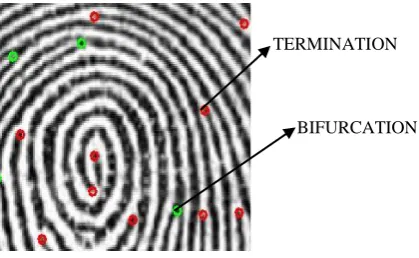
Fig 1: Fingerprint image showing termination and bifur-cation
Ridge bifurcation is the junction where the ridge separates into two ridges. Ridge ending is the termination of ridge flow. Minutiae approach is widely used because they can be found in every fingerprint.Everytime a single person place his finger on sensor may produce a different image because it is not pos-sible to place the finger at exactly the same place, hence it may produce images with slightly rotated or translated images as compared to the original image. FVC 2004 database is used in the matching process.
2.
RELATED WORK
A fast multiresolution based core point detection algorithm involves two steps: Firstly, the low resolution direction field to localize a singular area which includes core point. Secon-dly, high resolution direction field of singular area is used to precisely localize the core point. These two step method, fast and precisely localize the core point in block levels.
A fingerprint matching algorithm [5] based on error propag-ation in which ridge informpropag-ation and Hoiigli transfo-rnrpropag-ation are adopted to find several minutiae pair and the correspond-ences between them, which are used to estimate the common region of two fingerprints and the alignment parameters.
On the basis of [6] Delaunay triangulation (DT) in computat-ional geometry, a fingerprint matching algorithm based on DT which developed a matching algorithm to find reference mi-nutiae pairs (RMPs). Using DT on the topological structure of minutiae set, a DT net is formed with minutiae as vertexes.
A novel improved fingerprint image matching algorithm based on vector matching method with variable weight modi-fication was proposed in which features are extracted from fingerprint image as “vector points” and an improved vector matching method with weight modification is used to match these features.[7]
A minutia matching algorithm is used based on minutiae-centered circular regions to ensure the speed of matching and the robustness to non-linear distortion in a fingerprint image. In this, a circular region is constructed around each minutia, which can be regarded as a secondary feature. Using the con-structed regions, the algor-ithm can find matched minutiae more rapidly via regional matching. Since each minutia’s region is formed from only a small area of the fingerprint, our algorithm is more tolerant to non-linear distortion when com-pared to global matching appr-oaches.
A fingerprint matching algorithm was presented by Chengming Wen and Tiande Guo convex hulls for eliminating spurious matching in fingerprint matching is used. It is very important for improving the performance of fingerprint matching algorithm to reducing spurious matching [9]. TERMINATION
[image:1.595.57.267.596.725.2]3.
PROPOSED FINGERPRINT
MATCH-ING ALGORITHM
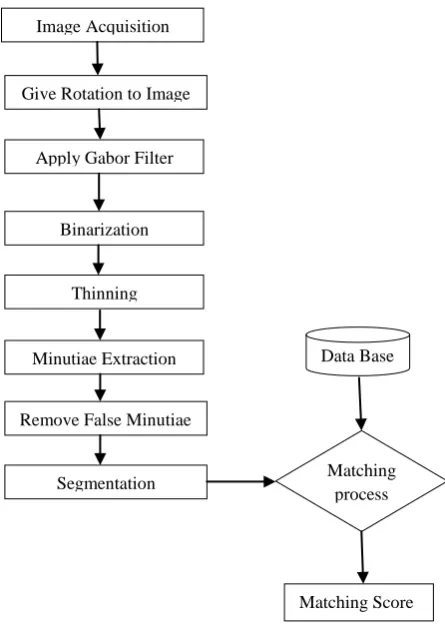
Proposed fingerprint matching algoritm require preprocessing steps on 8 bit Gray scale fingerprint image.Gabor Filter, Binarization, Thinning are the processes comes under prepr-ocessing. As the aim of proposed algorithm is to make the matching process rotation invariant so the images from the FVC 2004 database are rotated by using predefined function of matlab at defferent angles -500, -300, -100, 100, 300, 500. This range of angles is considered because it is assumed that most of the sensors doesnot take the inputs more than this specified range.The flow chart of the proposed algorithm is given below.
[image:2.595.57.280.236.551.2]
Fig 2: Flow Chart of the Proposed Algorithm.
3.1
Pre-Processing
After capturing the image from the sensor, it requires prepro-cessing to enhance the basic characterstics of an image, which have substantial effect on finding the different minutiae points in the input image.
A linear filter known as GABOR filter is added to enhance the edge detection.It is appropriate because its frequency and orientation representations are similar to those of the human visual system. Fingerprint Image Binarization is to transform the 8-bit Gray fingerprint image to a 1-bit image with 0-value for ridges and 1-value for furrows. After the operation, ridges in the fingerprint are highlighted with black color while fur-rows are white.
Ridge Thinning is to eliminate the redundant pixels of ridges till the ridges are just one pixel wide. It uses an iterative, para-llel thinning algorithm. In each scan of the full fingerprint
image, the algorithm marks down redundant pixels in each small image window (3x3). And finally removes all those marked pixels after several scans. All these features are inbuilt functions of the MATLAB.
3.2
Minutiae Extraction
In general, for each 3x3 window, if the central pixel is 1 and has exactly 3 one-value neighbors, then the central pixel is a ridge branch. If the central pixel is 1 and has only 1 one-value neighbor, then the central pixel is a ridge ending.
1
1
Fig 3(a). Termination Fig 3(b). Bifurcation
The average width D between the ridges is calculated. The average width D between the ridges means the average dis-tance between two neighbour ridges. The estimation of D value is easy. First Thinned image is scanned row wise and then add all pixels in that row having value 1. Then divide the length of the row with the above added value to get the width between the ridges.To get accurate results, perform such kind of row scan upon number of other rows and then scan of colu-mns is also carried out, At last all the inter- ridge widths are averaged to get the accurate value of D. With this minutiae marking process, thinned ridges of the fingerprint image are marked with a unique ID so that further operation can be con-ducted. [12]
3.3
False Minutiae Removal
The preprocessing steps are not sufficient to acheive an accu-rate matching score. Because lack of amount of ink and due to the cross links between the ridges due to excess of ink may not be properly removed by preprocessed steps. Follo-wing is the steps can be used to remove the false minutiae points:
The distance between the one bifurcation and one termination ic computed, if it is less than D and also these to minutiae points are on a same ridge then eliminate these points. Where D is the distance cal-culated before. It is the average distance between two parallel side by side ridges.
If the distance calculated between two neighbour minutiae (bifurcation) points are same and also they are on same ridge, and then eliminate these two mi-nutiae points.
Then the distance between two ridge endings (ter-mination) is computed, if it is within a distance D and theis direction is same (small angle diffla-ction is possible).Then these two ridge ending poin-ts can be considered as false minutiae but the condi-tion is there should not be any other ridge ending located between them.
Distance D between the two ridge endings is less than D then eliminates the two ridge endings.
1
1
1
1
Image Acquisition
Give Rotation to Image
Binarization Apply Gabor Filter
Thinning
Minutiae Extraction
Remove False Minutiae
Segmentation
Data Base
Matching process
3.4
Segmentation
Segmentation is useful to be recognized for each fingerprint image. The image area without effective ridges and furrows is first discarded since it only holds background information. Then the bound of the remaining effective area is sketched out since the minutia in the bound region are confusing with those spurious minutia that are generated when the ridges are out of the sensor.An Improved Fingerprint Image Segmentation algorithm is used. According to the shortcomings of division algorithm of the variance method based on gray characte-ristics, the improved algorithm can not only effectively reduce the effect on the division process by noise, and it is also appli-cable to different quality and different levels of the fingerprint images, especially for the low quality fingerprint image with majority of low gray level, it can realize accurate division, the effect is better than that of traditional variance method, and has good robustness.
3.5
Minutiae Matching Process
Proposed algorithm is invariant to rotation of images. It identifies the Minutiae points (bifurcation and ridge ending) in the input image. It set one of the minutiae as target minuti-ae (the minutiminuti-ae having high intensity value in the canter of the image). Each minutia is represented by the function F (x, y,θ).
Where x and y are the spatial co-ordinates and θ represents the angle from a refrence point identified. It uses the following formula for translation.
Translation of X coordinate = (Template image X coordinate – input image X cordinate)
Translation of Y coordinate = (Template image Y coordinate – input image Y cordinate)
The polar coordinates for the correspondance between the input image and the template image can be calculated as X= r cos , y =r sin
Rotational parameter is calculated by the following equation with help of Pythagoras theorm.
Angle = tan-1
After finishing the minutiae matching process the Matching score can be calculated as
Matching score = * 100
Number of minutiae matched is the minutiae matched in the template image and the input image.
And R = Number of minutiae identified in Input image.
S = Number of minutiae identified in Template image (image stored in database).
Therefore total number of minutiae is the sum of minutiae identified in the input image and the template image.
4.
EXPERIMENTAL RESULTS
[image:3.595.323.553.121.303.2]Input image rotated at different angles -50,-30, -10, 10, 30, 50 is shown below.
Fig 4: Input image rotated at angles -50,-30,-10, 10, 30, 50.
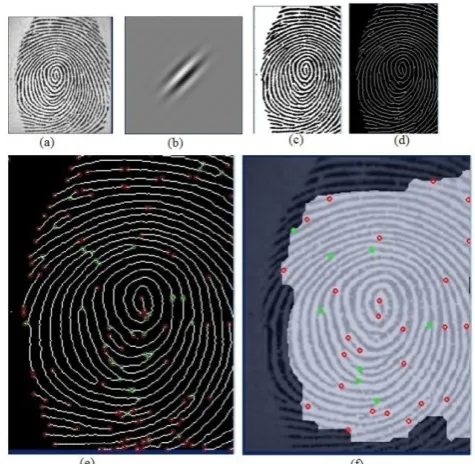
The following figure shows the output of various steps of pro-posed algorithm.
Fig 5: (a)Original image (b)Gabor filter output (c)Bin-arized image (d)Thinned image (e)Marked minutiae (f) Segmentation
[image:3.595.323.561.366.598.2]Table 1. Matching score of fingerprint images
Fingerprint Owner
Rotational angles of fingerprint images
-50 -30 -10 10 30 50
1 87.9 90.2 95.3 96.7 92.1 88.7
2 89.5 91.2 97.8 98.8 92.5 87.8
3 90.6 90.5 95.7 97.2 91.5 89.4
4 91.3 89.7 96.8 95.4 94 86.3
5 89.7 92.6 97.2 97.4 90.5 90
Average 89.8 90.84 96.56 97.1 92.12 88.44
Minimum 87.9 89.7 95.3 95.4 90.5 86.3
Maximum 91.3 92.6 97.8 98.8 94 90
FMR is the probability that the system will decide to allow access to an (FMR) imposter is given in an equation.
FMR =
FNMR is the probability that the system denies access to an approved user is given in an equation.
FNMR =
These ratios are observed at different angles of rotations listed below.
Table 2. FMR and FNMR ratio at different angles
Rotational angles of fingerprint images
-50 -30 -10 10 30 50
FMR 1.20% 5.50% 7% 11% 6.20% 0.08%
FNMR 7.32% 3.49% 1% 0.67% 2% 6.87%
5.
CONCLUSION
It leads to better FMR and FNMR ratios tested at various angles of a fingerprint image. The FMR decreases as the angle of deviation from the template image increases. Wheras FNMR increases as angle of deviation from the template im-age increases.The proposed algoritm is Rotational invariant as i can match the same images rotated upto 500 angle with very minimum FMR ratio. Therefor the rotational invariant algo-rithm is accurate and less time consuming because it requires simple calculations to find the rotational parameters and matching process. So by using this algorithm rotational fin-gerprint matching process can be enhanced to give more accu-rate results.
6.
ACKNOWLEDGMENTS
I would like to place on record my deep sense of gratitude to Ms.Rubal Jeet (Asst Professor) Dept. of COMPUTER SCI-ENCE, IGCE, Abhipur, India, for his generous guidance, help and useful suggestions.
I also wish to extend my thanks to Mr. Bhupinder Singh, H.O.D of Computer Science Department of IGCE, Abhipur and all faculty member of CSE department for attending my seminars and for their insightful comments and constructive suggestions to improve the quality of this research work.
I am extremely thankful to Dr. Promila Kaushal Principal, IGCE Abhipur, for providing me infrastructural facilities to work in, without which this work would not have been possi-ble.
7.
REFERENCES
[1] B. Miller, “Vital Signs of Identity” IEEE Spectrum, vol. 31, no. 2, pp. 22-30, 1994.
[2] Anil Jain Sharath Pankanti, “Fingerprint Classification and Matching” 2004.
[3] Anil Jain, Lin Hong and Ruud Bolle, “On-Line Finger-print Verification”, IEEE Transactions on Pattern Analy-sis and Machine Intelligence, vol.19, No.4, pp. 302-313, 1997.
[4] Wriwai Zhang, “Singular Point Detection in fingerprint Image” Accept by ACCV 2002.
[5] YingHAO, Tieniu TAN, Yunhong WANG “An Effecitve Algorithm for Fingerprint Matching” 0-7803-7490-IEEE 2002.
[6] Ning Liu, Yilong Yin, Hongwei Zhang Computer De-partment, Shandong University, Jinan, 250100, China. “A Fingerprint Matching Algorithm Based On Delaunay Triangulation Net” The Fifth International Conference on Computer and Information Technology (CIT’05) 0-7695-2432-X/05 IEEE 2005.
[7] Wang Yuan1 Zhou Fuqiang2 Yao Lixiu1 (School of Electronic, Information and Electrical Engineering, Shanghai Jiao Tong University, China) “Automatic Fin-gerprint Matching using Improved Vector Matching Al-gorithm” 1-4244-1135-1/07/IEEE 2007.
[8] Haiyong Chen, Hongwei Sun, Kwok-Yan Lam “A fast and elastic fingerprint matching algorithm using minuti-ae-centered circular regions” 0-7695-2989-5/07 IEEE 2007.
[9] Chengming Wen, Tiande Guo. “An efficient algorithm for fingerprint matching based on convex hulls” 978-0-7695-3645-3/09 IEEE 2009.
[10] Chin Hoi Lai Shahrel A. Suandi“Fingerprint Reference Point Detection Using Triangle’s Angle 1-4577-0255-6/11/2011 IEEE.
[11] Li, C. Li, J. Fu, B. Yang, X. "Fingerprint Verification Based on DFB and Hu Invariant Moments", Journal of Computational Information Systems, vol.8, no.4, pp1407-1414, 2012.
[12] Mar Min, Yadana Thein “Intelligent Fingerprint Recog-nition System by Using Geometry Approach”, IEEE Trans.PAMI, 18(8), pp. 799-806, 2009.
[14] M. Arantes, A. N. Ide and J. H. Saito, "System for fin-gerprint minutiae classification and recognition", Pro-ceedings of the Ninth International Conference on Image Processing (ICONIP 2002), Vol. 5, pp. 2474-2478.
[15] Orchid Country Club, Singapore, 2002Kovacs2Vajna ZM. "A fingerprint verification system based on triangu-lar matching and dynamic time warping." IEEE Trans on Pattern Analysis and Machine Intelligence, 2000, 22 (11): 1266�1276.
[16] Wang X C, Li J W, Niu Y M. Definition and extraction of stable points from fingerprint images[J] .Pattern Recognition, 2007,40, 40 (6) :1804-1805
[17] Maio D, Maltoni D, Cappelli R et.ai, FVC2004: Third Fingerprint Verification Competition, Proc. Int. Conf. Biometric Authentication, 2004.