BIROn - Birkbeck Institutional Research Online
Siridetkoon, P. and Dewaele, Jean-Marc (2017) Ideal self and ought-to self
of simultaneous learners of multiple foreign languages. International Journal
of Multilingualism , ISSN 1479-0718. (In Press)
Downloaded from:
Usage Guidelines:
Please refer to usage guidelines at or alternatively
International Journal of Multilingualism
ISSN: 1479-0718 (Print) 1747-7530 (Online) Journal homepage: http://www.tandfonline.com/loi/rmjm20
Ideal self and ought-to self of simultaneous learners of
multiple foreign languages
Pitchayapa Siridetkoon a & Jean-Marc Dewaele b
a Faculty of Humanities, Naresuan University, Muang Phitsanulok, Thailand; b Department of Applied Linguistics and Communication, Birkbeck College, University of London, London UK
To cite this article: Pitchayapa Siridetkoon & Jean-Marc Dewaele (2017): Ideal self and ought-to self of simultaneous learners of multiple foreign languages, International Journal of Multilingualism, DOI: 10.1080/14790718.2017.1293063
To link to this article: http://dx.doi.org/10.1080/14790718.2017.1293063 Published online: 25 Feb 2017.
ABSTRACT
This study explores the motivation of five university students who simultaneously studied L2 English and additional L3s (Chinese, Japanese and Korean) in a language specialist major in a Thai university. It aims to start filling the gap in research on the motivation of multiple language learners across their different languages. The findings show that while English did threaten some learners’ motivation to study other foreign languages (FLs), it also
encouraged them to study other FLs. Learners of multiple FLs developed unique
motivational systems in which the interrelationships of multiple motivations were dynamic and complex. Students’ motivation to study other FLs was mainly generated by the
immediate need and the imagined future use of that particular language.
Introduction
Multiple language motivation has been under-researched. Previous studies that touched upon the topic of third language (L3) motivation, very often emphasised the increasing importance of English as an international language and how learning English reduces learners’ motivation to learn L3s or even local languages (e.g. Dörnyei, Csizer, & Nemeth, 2006; Gabrys-Barker, 2011; Henry, 2010, 2011; Ushioda, 2009, 2013). Some researchers reported that learners have separate language selves (Lau, Yeung, Jin, & Low, 1999; Mercer, 2011; Yeung & Wong, 2004); however, few studies investigated how these different
language self systems operate or coexist. The current study, thus, aims to investigate the complex interactions in the motivation systems of Thai university students learning various FLs.
Literature review
Gardner and Lambert’s (1972) concepts of integrative and instrumental motivation used to dominate research in Second Language Acquisition. The former referred to the learner’s desire to identify with the members of the target language community, the latter
CONTACT Pitchayapa Siridetkoon [email protected] Faculty of Humanities, Naresuan University, Muang, Phitsanulok 65000, Thailand
© 2017 Informa UK Limited, trading as Taylor & Francis Group ARTICLE HISTORY
Received 28 July 2016 Accepted 5 February 2017 KEYWORDS
Motivation; L2 motivational self system; ideal self; ought- to self; third language acquisition; L3 motivation
especially about their applicability outside the bilingual Canadian context. Yashima (2002) found that the concept of integrative motivation behind the study of English did not fit in the Japanese context as students had no intention to join the American or other English- speaking communities, so she proposed the concept of ‘international posture’ (IP) which is an ‘interest in foreign or international affairs, willingness to go overseas to stay or work, readiness to interact with intercultural partners, and [...] openness or a non-ethnocentric attitude toward different cultures’ (p. 57). By the late 1980s, some researchers started arguing for a need to refocus motivation research. This resulted in a new era, the so- called cognitive situated period (Dörnyei & Ushioda, 2011). It combined a desire to bring language motivation research in line with mainstream motivational psychology and a focus on
situated analysis of the specific learning context, such as the immediate classroom
environment. Influential theories from this period are Dörnyei’s three-level framework of L2 motivation (1994) and Williams and Burden’s social constructivist model (1997, 1999) which emphasises the influence of cultural context and social situation.
The changing landscape of motivation studies from the process-oriented period towards a more socio-dynamic perspective was linked to the globalisation of English and the growing interest in the complex interaction between individual and context. Dörnyei (2005, 2009) proposed ‘L2 Motivational Self System’. Dörnyei distinguished three main components – the ideal self, the ought-to self, and L2 learning experiences. Ideal self is the person’s hope, aspiration or wish to possess certain attributes. Ought-to self refers to the attributes that the person believes he or she ought to possess as a result of one’s perceived duties, obligation or responsibilities towards family or significant others. L2 learning experience comprises immediate learning environments and experiences (Dörnyei, 2009). This concept has been validated in various contexts and in different languages (e.g. Jiang & Dewaele, 2015; Taguchi, Magid, & Papi, 2009).
In his overview chapter on research on motivation and attitudes, Dewaele (2009) reported an increasing shift from quantitative, etic approaches to qualitative emic per- spectives1. The observation by post-modernist researchers that learners are more than bundles of variables stripped of intentionality and individuality (Lantolf & Pavlenko, 2001) seems to have resonated with traditionally quantitative researchers such as Dörnyei who now agrees that motivation develops non-linearly and is hard to measure by objective, quantitative means. He was also inspired by dynamic system theory (DST) which considers ‘the combined impact of multiple factors which influence every human decision and every social
Motivation research on L3 is scant compared to the large volume of English L2 motivation research. Previous studies on motivation to learn multiple languages other than English reported that learners often had negative attitudes towards other FLs due to the global presence of English. Studies in Hungary revealed that English was more popular than German, a regional lingua franca and other FLs taught in the country such as French, Italian and Russian (Csizér & Dornyei, 2005; Dörnyei et al., 2006). Henry (2010) found a negative influence of English among Swedish high school students learning other FLs, especially among boys. Dewaele (2005) also found that Flemish high school students considered English L3 a ‘cool’ lingua franca but were more negative towards FrenchL2 because of the fraught relationship with that language community in Belgium. Ushioda (2013) warned that the global status of English ‘may have negative consequences for students’ motivation to learn other foreign, national or local languages’ (p. 2).
Although previous research showed lower levels of motivation among students to learn languages other than English, suggesting global English as a factor that precipitated the change, some studies showed that other FLs still attracted learners (Zaragoza, 2011). Even though the population of learners of FLs other than English is not so large compared to those of English, the attempt to promote multilingualism in many parts of the world, such as in the EU or ASEAN countries, will only make the study of a larger diversity of FLs more important. The number of multilingual FL learners will increase. Some studies on English L2 and other FLs showed positive attitudes towards the latter, which challenges belief in English’s negative influence on learning other languages (Henry, 2012).
Is the study of English pushing the study of other FLs aside? In secondary schools, the introduction of two obligatory FLs forces learners to become trilingual or multilingual with different levels of competence in L2s and L3s. Henry, Apelgren, and 2008 (2008) found that after nearly one year of introduction of a new L3 course (French, Spanish, German and sign language) to Swedish learners of L2 English, students had higher ideal self scores for L3s than for English. Henry’s (2011) and Zaragoza’s (2011) studies showed similar outcome. The effect of global English does not affect learners’ motivation to learn other L3s among monolingual Swedish and Mexican.
It seems that in simultaneously learned languages, English does not always have a negative influence on other FLs. Some learners can be even more motivated to learn an extra FL, considering it as a way to further their horizon and possibility for job opportunities (Grin, 2001; Zaragoza, 2011). The predominant view of English’s negative influence on other FLs might impede the attempt to promote extra FL learning if such belief creates self-fulfilling prophecies or misconceptions among parents or education providers that they should make less effort to promote other FL learning. This might result in a less diverse language
curriculum.
There are many underlying factors one needs consider when dealing with learners’ motivation. In order to focus more on the dynamic nature of motivation among multiple language learners, qualitative studies are needed to investigate the interactions and fluctuations in learners’ motivation systems. The present study aims to do just that.
Research questions
(1) Do simultaneous FL learners perceive any differences between their L2 English ideal self and their L3 ideal self?
(2) Do simultaneous FL learners perceive any differences between their L2 English ought- to self and their L3 ought-to self?
Methodology
An emic perspective was adopted to investigate the concept of possible selves across languages. Simultaneous learners of various languages were interviewed about their FL learning experience. The aim was to capture the possible underlying causes of motivational behaviour across FLs. According to Dörnyei (2007), interviews yield rich and in-depth data because of their exploratory nature. They help to explore new emerging issues and still maintain ‘systemic coverage of the domain’ based on the interview guide (p. 143). Our study could be described as retrospective longitudinal. Dörnyei (2007) defined this approach as the process in which the data ‘are gathered during a single investigation in which respondents are asked to think back and answer questions about the past’ (p. 84). Students were interviewed and asked to recollect their experiences and personal attitudes towards FL learning in the past. Dörnyei (2007) suggested the interval between the
task/event and the retrospective interview should be as short as possible in order to avoid incorrect or inaccurate data.
Participants
Table 1. Participants’ profiles with respect to gender, year of study, and languages known.
Name Gender Year Major Languages known
Peter male 4 Korean English, Korean, French, Japanese, Vietnamese
Jane female 4 Korean English, Korean
Mac male 4 Japanese English, Japanese
Sue female 2 Chinese English, Chinese, Korean
Kate female 3 Japanese English, Japanese, Korean
The participants were selected from a larger group of students who contributed data for the PhD research of the first author. All the participants were informed about the purpose of the research and their right to withdraw from the research at any time. Consent form was signed and filled before collecting data. It was explained that the data and identity of the participants would not be made public. The researcher made it clear to the students that their participation or non-participation in this study would not affect their course grade. The researcher did not personally know the participants and did not teach any courses during the period of data collection. The research design and instruments received ethical approval from the relevant committee in the authors’ research institution and in the participants’ university.
Procedure
We used semi-structured interviews. A set of questions was developed (see appendix). The interviews were conducted in the Thai language by the first author who is familiar with the local context, in order to elicit the richest possible data, unconstrained by English
Analysis
Interviews were read and reread in order to find instances where participants mentioned keywords relating to motivation. For example, ought-to self was coded when the
participants mentioned their family as a reason for learning FL(s): ‘my mother wanted me to study Chinese’. The initial coding was group into four categories based on Dörnyei’s (2005, 2009) L2 motivational self system framework: L2 English ideal self, L2 English ought-to self, L3 ideal self and L3 ought-to self. For example, the statement, ‘My English is much better since I joined English medium programme. I am happy with myself, but I want to improve more before I graduate’ was coded as English ideal self, and ‘I like Korean, but decide to study Chinese because my mum told me China’s economy is much bigger’ was coded as L3 ought-to self. There are nine themes as shown in Table 2.
Results
L2 English ideal self
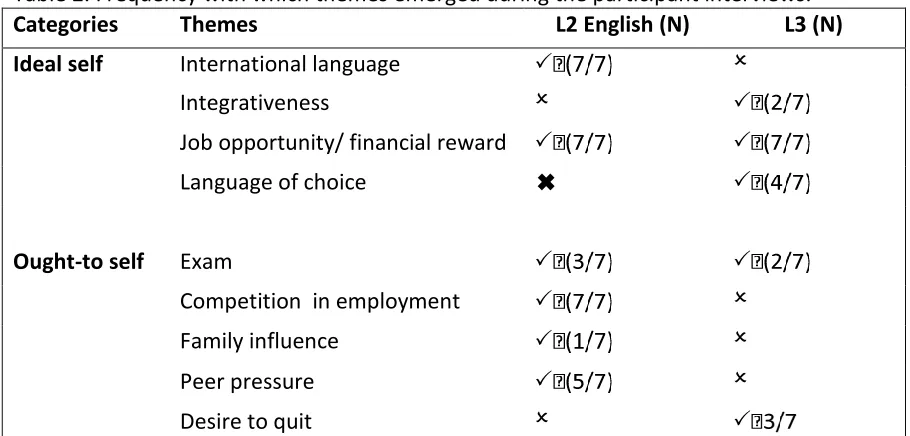
[image:7.595.66.521.347.565.2]All seven participants in the study – five Asian FL students and two English-medium business students – reported positive attitudes towards English, viewing it as an inter- national language. The Asian language students expressed the long-term goal of using
Table 2. Frequency with which themes emerged during the participant interviews.
Categories Themes L2 English (N) L3 (N)
Ideal self International language
Integrativeness
Job opportunity/ financial reward
Language of choice ✖
Ought-to self Exam
Competition in employment
Family influence
Peer pressure
Desire to quit
Note: ✓ means the topic had been raised by some participants while ✗ means none of the participants had mentioned the topic.
English in the future while the two business students emphasised their immediate needs as the major reason to improve their English.
In the current study, the Asian language student group (or L3 major students onward) and their ideal self will be discussed first. L2 English ideal self appeared to be relatively obscure when L3 major students were asked to relate it to their future career. This group of
participants expressed their strong wish to learn, but no obvious motivated behaviour was mentioned.
Although there were strongly positive attitudes towards English among our partici- pants, some very different opinions were observed among those studying Eastern languages who reported high English ideal self. Instead of fulfilling their dream of being proficient in English, they opted for another language.
English is a must for everyone, but I decided to study Korean major because it’s quite rare. You can study English anywhere anytime, but for Korean, you can’t find it taught outside university. [...] I study English longer. It certainly will be a part of my life. Whenever I feel that my English is weak, it is easy to learn or to find a tutor. So I put all my efforts on Korean. English can wait. (Pichet)
Due to limited linguistic resources, these students could not afford to study as many languages as they wanted, so they invested in language learning one at a time with English at the end of the priority list for some of them. The interviews suggest that Eastern FL students had very positive attitudes towards L2 English, but decided to put it on hold during their acquisition of another FL.
I chose Japanese major not English because I have studied English long enough to learn by myself. If I want to practice English, it is easy. There is also the Internet [where he can find more than enough materials]. It is easy. (Mana)
Despite the confidence in their English background knowledge and the ability to relearn the language at any time, students reported dramatic attrition in English. For example, when asked by foreigners for directions, Pichet said that he could not reactivate English as he thought he could. ‘I understood what they were asking from me but I could not articulate in English. Only Korean words came into my mind’. Neither did they mention any attempt to practice and sustain their English knowledge as they thought they would
have done. ‘Since I was here (studying at college), my English was stopped. Like I stop English to increase Chinese [input]. I have less English class’ (Sopa). Students were also aware of the trade-offs themselves.
While the Asian FL students appeared to have a faraway goal and vague idea of how they were going to make use of English, English-medium business students appeared to have more realistic goals and both short-term and long-term plan. These students whose environment required them to speak English on a daily basis, were also found to be highly motivated to practise the language. The students, like Araya, had set their goal of why and how they should learn English.
Every week, I watch a film and write a reflection. At first, the teacher assigned this as home- work, but after that I keep doing this on my own. [...] I just want to be able to communicate in English with my teachers, friends and foreigners. (Araya)
Although English-medium business students were also taught Chinese, they invested more in L2 English and thought that English would be the primary tools for them to get a job while L3 would be add-on abilities – something they could put in their language profile. Araya also had a long-term plan for their English education and career.
The English-medium business students had more vivid ideal self and investment in English while L3 major students shared the desire to become proficient in English but could not afford the time and energy or still had not felt the need to take action. Nevertheless, English still has it spell on learners as can be seen from their positive attitudes towards the
language. The general perception of international English in society proved to have massive influence on learners.
L2 English ought-to self
The L2 English ought-to self of L3 major students and business students will be discussed next. The ought-to self was observed while students reflected on both immediate and distant goals. Regarding the immediate goals, students put effort into the study of English to avoid undesired results like poor grades, bad exams and losing out in the class- room
competition (fear of losing face and being compared with other fellow students). Some of them, such as Mana, felt the need to push themselves up to the classroom standard.
The reason I try to improve my English speaking is because of peer pressure. My friends can speak English but I can’t. I can do the exams but I can’t speak English. If I graduate, what job can I do if I can’t speak English? (Mana)
Another student, Jittra, seemed to have an English ideal self as she frequently mentioned her desire to be proficient in English. However, her narrative turned out to be more about the ought-to self. She said she always wanted to study English because it was an
international language, which would be necessary for her future career, but in her narrative about English learning experience, the story was told otherwise.
For English, it is ok for me. I have not used it for a while. But I still want to study more because it is important. [...] I never have a long-term future goal for English. I never think about how I am going to make use of English in the future. What I thought about English is that ‘Oh, there will be an exam. Or the teacher will make us speak in front of the class.’ I studied English just to pass the exams. (Jittra)
Expectation still had an impact on the students’ decision and motivation towards the
language although students appeared to be independent in choosing subjects of their study. Some of them seemed to study English because other people stressed its importance. The student (Kirati) was influenced by her family’s expectation but she also saw the advantages if she followed their guidance.
My uncle told me that if I study languages, there were no professional skills like doctor or other careers. Many jobs require FL ability but most of them are not good jobs. I have to be ‘cream de la cream’ because only those with the best scores and skills get well-paid jobs. I’m afraid that I will be unemployed. I have to practice English. (Kirati)
English should be our mother tongue by now. Other countries like Philippines, Vietnam, Malaysia, they speak English better than us. [...] I wondered how Thai workers could earn a living if they cannot speak English. (Mana)
This is the feared future self, which Markus and Nurius (1986) described as one of future selves that regulate the person’s behaviour by preventing them from doing something that might result in undesirable outcomes. The interviewee did not want to be losing out in the job market. In Mana’s opinion, most Thais will be challenged by the regional economic integration. The ought-to self was displayed as the interviewee contemplated the distant goal with the urge to be proficient in English so that Thai people would not lose their jobs to foreigners.
While ought-to self is important for some students as a driving force for their immediate goals like grades, exams, classroom performance, a lot of interviewees voiced their concerns about future career and losing out their job to non-Thai workers.
L3 ideal self
Learning a L3 is a daring move for students who come in contact with the language for the first time at university. They did not know whether they would like it or not until they get involved in the process of learning. At university, students might feel stuck when they dis- cover that the L3 of their choice was not what they really wanted or could not see the point to continue learning. Unlike English, the L3 was spoken in much narrower circles, which meant fewer chances for communication and real authentic practice unless learners immersed themselves in the L3 environment.
The self-perceived lack of competence in L2 English was one of the reasons why some students decided to divert their effort from English to an L3. Investment in an L3 became an alternative for those who did not want to study science or mathematics but did not do well in English either. The sense of achievement and language competence reinforced Kirati’s confidence and increase her L3 ideal self, which was the success she had never experienced in English classes.
No matter how I try, I just could not get English. I have studied English from nursery but just started learning Japanese at university. It had been less than four years for Japanese and now I know more Japanese than English. (Kirati)
One of the reasons why language learners decided to invest in L3 might lie in fact that they perceived it as a language of opportunity. When they came to university, students such as Mana felt that they had diverse background knowledge in L2 English, but every- one can have a fresh start in L3.
We have different background knowledge in English. But for the third language, everyone is equal. We don’t feel intimidated because everyone faces difficulties all the same. (Mana)
ASEAN will make it difficult for Thai people to get a job. Our English is poor. We cannot compete with other countries. But I know Japanese. This is not going to be any
problems for me at all. (Kirati)
Japanese is necessary and useful. At least if my English is poor, I have the advantage of knowing Japanese. I can work in different market. Everybody can speak English. I have access to another world because I know Japanese. I will look smart in the eyes of other people. (Mana)
Some other students might not have had such a strong future-self image but most of them were motivated by future financial rewards. The establishment of overseas companies and foreign investment in the country create jobs and thus result in high demand for people proficient in that particular language. Some students, such as Mana, therefore, viewed studying the L3 as increasing opportunities for their future career, which motivated them to attain the required proficiency.
I started from low grade in Japanese. I almost got D. The first semester I got only C or C+. After that, I could adapt myself to the language and teaching style, so I got A or B. I feel that I can do it. Then, I study harder telling myself ‘Think of the future. This language is worth a lot of money.’ [...] I also look at the seniors who were granted scholarship to study in Japan and get high salary job after they graduated. I use this as a driving force. I want to be like them, so I tell myself ‘keep going.’ (Mana)
While integrativeness was expected to be a reason for learning the L3 as a major, the findings revealed that when it came to formal education, students such as Sopa did not want to risk future unemployment to study the preferred language. Their personal preference of cultural products was perceived as less important because it could be obtained outside the formal education setting.
I like Korean pop culture and always want to study Korean. But I think about my future career, so I decide to study Chinese major instead because the demand for Chinese language is much higher. (Sopa)
Apart from interest in cultural products, ethnic background of learners was also one of the reasons students were motivated to learn. Students with Chinese heritage background attributed their desire to study Chinese language to their family’s origin. Araya said,
I choose Chinese because my family is of Chinese origin. My grandparents speak Chinese [dialect]. I hear them speak and wish that I could speak Chinese too. [...] My family thinks it is a good idea to learn Chinese as well. Moreover, Chinese is very popular nowadays. (Araya)
L3 ought-to self
Strong ought-to self was observed in students who primarily learned the L3 not by their own choice. Some of these students could not attend an English major because their admission scores were not high enough. Some were influenced by their parents. Their initial responses to the new language were dislike, boredom and anxiety. However, most of these students reported a change in their attitudes after giving it a try, resulting in increased motivation. As stated earlier, studying an L3 is like exploring a new territory. Learners had no idea what it would be like. According to students’ narrative accounts, ought-to self is the result of students’ negative resistance towards a new language when they found out that it was not what they expected, but they could not drop the subject. The unfamiliar alphabets and complicated grammar structures were the major causes of discouragement for Mana, Jittra and Sopa to continue studying the new language.
I had never seen Japanese characters before. I didn’t even know if they would have students without basic knowledge like me to study in Japanese major because other students had already studied Japanese in their high school. [...] I was really stressed. It was so difficult. But as the semester passed, I became more familiar with the language and the teachers’ style of teaching. Learning Japanese is easy and fun. (Mana)
I wanted to study Political Science but my scores was only enough to get me in Korean major. [...] I did not choose Korean major because of the Korean singers and that stuff. I just thought it was a new language. I just wanted to learn something new. (Jittra)
I don’t want to study Chinese at all. I wanted to study Korean because I like Korean pop music. Then, I think about my future career that Chinese would be more useful. (Sopa)
At university, choosing a major is a very important decision. It means a lot to students because it might affect their career plan. Students who did not have enough prior information about the language they choose as their major or took the wrong decision based on advice of others might have to spend four years studying a language they were not really interested in. Thus, when the students found themselves in such situation, they had only two choices – they could change their major in the next academic year or admit the consequence of their decision and go on with their study.
The students who had decided to continue studying L3 despite the initial difficulties and negative experiences, expressed strong ought-to self at the beginning of the course. After that, they used different strategies to overcome learning difficulties and negative feeling they had with the language. Mana told the researcher he thought he made a wrong decision to study Japanese and considered changing the major. However, the idea of wasting a year to begin in another major kept him from changing the major.
I am quite an old-fashioned person. I did not want to waste my time. I did not want to start again. [...] Yes, it was difficult. I was shocked when I first encountered Japanese, but later on I could adapt myself. (Mana)
The two business students did not report an L3 ought-to self during the interview, contrary to their strong English ought-to self. Due to the nature of the L3 beginner and inter- mediate courses they were taking, business students did not find the L3 as difficult and demanding as L2 English. English thus was the dominant language in their daily lives both for socialising and academic purposes. Students were free to choose the language of their own choice, so they might not felt the same pressure from social and family expectations to do well in their L3. Also, there was no immediate need, nor any obligation to study the L3.
Discussion Ideal self
Both the L3 major students and the business students reported high ideal self in English, but the former did not exhibit much motivated learning behaviour. These L3 major students emphasised the importance of English for their future career and expressed the desire to be proficient in English, but their goals seemed rather vague. They were similar to Japanese students in Yashima, Zenuk-Nishide, and Shimi-zu’s (2004) study who had ‘a short-term realistic goal related to examinations and grades, and a somewhat vague long-term
objective related to using English for inter- national/intercultural communication’ (p. 121). Yashima (2002) defined this kind of attitudes towards English as ‘international posture’. Ushioda (2013) also noted that sometimes students’ motivations seem overlapping with IP. In contrast, the two business students from the international programme who had an immediate need of English in their learning environment had more concrete plans and actions to improve their English.
For the L3 ideal self, differences were observed between the L3 major students and the business students. Although all of them agreed that L3 could offer them job opportunity, business students still perceived English as a major language of communication while L3 would provide them with a competitive edge in job market. L3 major students, on the other hand, intended to use the L3 rather than English in their future career. They felt that the knowledge of the L3 could lead to jobs and financial rewards. Both L3 major students’ and business students’ reasons for learning L3s were instrumental, but the former seemed to invest more due to both immediate need and long-term plan.
The interview data offered illustrations of the dynamic nature of motivation that under- goes the state of ebb and flow over time depending on the students’ immediate need and their future plans. The L2 English ideal self of L3 major students seemed to be suspended during the process of pursuing another FL. The amount of effort put into FL learning shifted when more FLs were involved. This change was caused by both internal and external
out of the picture, the desire to bridge the gap between the actual self and the ideal self was temporarily deferred, regardless of the extremely positive attitude towards English. Although Dörnyei et al. (2006) argued that there has been a decrease in motivation to learn languages other than English because students feel that knowing English is enough, the results from this study suggest that the picture might be more nuanced. The L3 was
perceived as desirable for both English and non-English majors but it was combined with an anxiety that ‘English only’ is not enough as English becomes the language everyone knows and seems to lose it premium value (Grin, 2001). The findings showed that students of an L3 had a powerful vision of ideal self to sustain their learning effort despite the presence of global English. There were many reasons behind students’ motivation to learn an L3, namely, students making their own active choice, L3 offering them job opportunity and financial rewards, and having integrative orientation towards learning L3.
While the importance of English was recognised by all our students, their choices were still diverse. Students still saw the opportunities other FLs could offer. For them, English was the most important language, but knowing other FLs offered possibilities they could not ignore and some decided that English could wait.
Ought-to self
For both L3 major and business students, L2 English ought-to self originated from fear of failing exams, high competition both in the classroom and in the job market, but only one student mentioned family influence. The fact that family influence had not been mentioned by most students differed from what Taguchi et al. (2009) and Kormos, Kiddle, and Csizér (2011) observed about family expectation in the Asian context that was a major factor in learners’ motivational thinking. This is probably because with or without family’s
expectation, students themselves could perceive the importance of English and its global status. While fear of failing exams and classroom performance were the major and
immediate concern among all participants, some students were able to transform ought-to self to be ideal self as the two concepts were found overlap- ping (e.g. Chen, 2012).
L3 major students, however, perceived the L3 differently from business students. Although L3 major students considered both FLs they knew as equally important, they had a strong L3 ought-to self while business students had no sense of obligation to study L3s to meet
anybody’s expectation. This is because L3 major students had both future plan and immediate need to pass the challenging L3 courses they enrolled in each semester while business students chose the L3 as elective core courses. Due to the nature of elective courses, they were studying in beginner-intermediate level which was not too demanding. English ought-to self and L3 ought-to self of the participants were slightly different. Stu- dents had studied English longer and knew what to expect in English, but the L3 was like a new territory for many students. This was especially true for those without much prior information before they decided to study a specific L3. As L3 motivation is prone to greater fluctuation (Mercer, 2011), students’ shifts of L3 self were more pronounced. This study confirms prior studies that ought-to self, when influenced by significant others, can
integrate into ideal self (e.g. Chen, 2012; Kim, 2009). In this case, a lot of L3 major students who were unhappy to learn the new L3 at the beginning of the course could shift their ought-to self and eventually achieved creating a future L3 ideal self and continued studying in the same major.
dislike for the new language, most L3 major students felt satisfied with the out- comes of their perseverance and could reach the ideal self state, seeing themselves achieve the desired results. It was thus necessary to help learners overcome difficulties in learning and continue their language study by developing their ought-to self to ideal self.
Feedback from students also confirmed McKay’s (2012) remarks about the impact of global English creating an economic divide and inequality of access to English education because some families had not been able to afford the private lessons for their children. There is general awareness of the economic value of English (Grin, 2001) but not every- body could access it.
The current study showed that students’ motivation fluctuated throughout the period of time affected by multiple internal and external factors. Positive attitudes towards English were not always sufficient to sustain students’ efforts if it was not considered fitting in their plan for the future. Meanwhile, dislike for other FLs could be overcome by the students’ perceived improvement of their performance, necessity, or the idea of future rewards. Such ‘combined impact of multiple factors’ (Dörnyei et al., 2014) confirmed the dynamic nature of motivation in various FLs.
Conclusion
This study suggests that type and level of motivation can vary across languages among multiple FL learners. The variation across different FLs confirms previous studies (e.g. Dewaele, 2005; Dörnyei et al., 2006; Henry, 2010). It suggests that English is not necessarily the bogeyman that dampens interest in other FLs (e.g. Dörnyei et al., 2006; Henry, 2010; Ushioda, 2013). The positive effects of language attitudes and contact with cultural pro- ducts were not restricted to English. Ideal selves and ought-to selves in different languages coexisted in complex relationships, and some were temporarily suspended in order to allow others to develop themselves. This lends support to a non-linear view on the development of motivation in various FLs (Dörnyei et al, 2014).
To conclude, the Ideal L2 and L3 Selves and the L2 and L3 Ought-to Selves of our students who were simultaneously studying L2 English and additional L3s (Chinese, Japanese and Korean) were shaping each other, linked to a host of internal and external factors.
Notes
Etic analyses are based on the use of carefully defined and relatively stable concepts from the analytic language of the social sciences, which allows generalisations and comparative research across languages, situations and cultures. Emic analyses, on the other hand, focus on the participants’ perspectives and interpretations of behaviour, events and situations using the descriptive language of participants (Pike, 1964). Generalisations are impossible with such a perspective.
Disclosure statement
No potential conflict of interest was reported by the authors.
References
Boonkit, K. (2002). Listening strategies with television text: A study of Thai university students of English as a foreign language. University of Tasmania.
Chen, S.-A. (2012). Motivation and possible selves: An interview study of Taiwanese EFL learners. Language Education in Asia, 3(1), 50–59.
Dewaele, J.-M. (2005). Investigating the psychological and emotional dimensions in instructed language learning: Obstacles and possibilities. The Modern Language Journal, 89(3), 367–380. Dewaele, J.-M. (2009). Perception, attitude and motivation. In V. Cook & Li Wei (Eds.), Language teaching and learning (pp. 163– 192). London: Continuum.
Dörnyei, Z. (1994). Motivation and motivating in the foreign language classroom. Modern Language Journal, 78, 515–523.
Dörnyei, Z. (2005). The psychology of the language learner: Individual differences in second language acquisition. Mahwah, NJ: Lawrence Erlbaum.
Dörnyei, Z. (2007). Research methods in applied linguistics. Shanghai: Oxford University Press. Dörnyei, Z. (2009). The psychology of second language acquisition. Oxford: Oxford University Press. Dörnyei, Z., Csizer, K., & Nemeth, N. (2006). Motivation, language attitudes and globalisation a Hungarian
perspective. Clevedon: Multilingual Matters.
Dörnyei, Z., Muir, C., & Ibrahim, Z. (2014). Directed motivational currents: Energising language learning through creating intense motivational pathways. In D. Lasagabaster, A. Doiz & J. M. Sierra (Eds.), Motivation and foreign language learning: From theory to practice (Vol. 9–29). Amsterdam: John Benjamins.
Dörnyei, Z., & Ushioda, E. (2009). Motivation, language identities and the L2 self. In Z. Dörnyei & E. Ushioda (Eds.), Motivation, language identity and the L2 self (pp. 1–8). Bristol: Multilingual Matters.
Dörnyei, Z., & Ushioda, E. (2011). Teaching and researching motivation. London: Longman. Gabrys-Barker, D. (2011). Appraisal systems in L2 vs. L3 learning experiences. International Journal of Multilingualism, 8(2), 81–97.
Gardner, R. C. (1985). Social psychology and second-language learning: The role of attitudes and motivation. London: Edward Arnold.
Gardner, R. C. (2001). Integrative motivation and second language acquisition. In Z. Dörnyei & R. Schmidt (Eds.), Motivation and second language acquisition (pp. 1–19). Honolulu, HI: The University of Hawaii. Gardner, R. C., & Lambert, W. E. (1972). Attitudes and motivation in second language learning. Rowley, MA:
Newbury House.
Grin, F. (2001). English as economic value: Facts and fallacies. World Englishes, 20(1), 65–78.
Hayes, D. (2008). Becoming a teacher of English in Thailand. Language Teaching Research, 12(4), 471–494. Henry, A. (2010). Contexts of possibility in simultaneous language learning: Using the L2 motivational self
system to assess the impact of global English. Journal of Multilingual and Multicultural Development, 31(2), 149–162.
Henry, A. (2011). Examining the impact of L2 English on L3 selves: A case study. International Journal of Multilingualism, 8(3), 235–255.
Henry, A. (2012). L3 motivation. (PhD.), Goteborgs Universitet, Goteborg.
Henry, A., & Apelgren, B. M. (2008). Young learners and multilingualism: A study of learner attitudes before and after the introduction of a second foreign language to the curriculum. System, 36, 607–623. Jessner, U. (2006). Linguistic awareness in multilinguals English as a third language. Edinburgh: Edinburgh
University Press.
Jessner, U. (2009). The role of metalinguistic knowledge in L2 and L3 development: A dynamic-systems-theory perspective. The Modern Language Journal, 92, 270–283.
Jiang, Y., & Dewaele, J.-M. (2015). What lies bubbling beneath the surface? A longitudinal perspective on fluctuations of ideal and ought-to L2 self among learners of English in Chinese universities. International Review of Applied Linguistics, 53(3), 331–354.
Kim, T.-Y. (2009). The L2 motivational self system among Japanese, Chinese and Iranian learners of English: A comparative study. In Z. Dornyei & E. Ushioda (Eds.), Motivation, language identity and the L2 self (pp. 66– 97). Bristol: Multilingual Matters.
Kormos, J., Kiddle, K., & Csizér, K. (2011). Goals, attitudes and self-related beliefs in second language learning motivation: An interactive model of language learning motivation. Applied Linguistics, 32 (5), 495–516. Lantolf, J., & Pavlenko, A. (Eds.). (2001). (S)econd (l)anguage (a)ctivity theory: Understanding second language
learners as people. London: Longman.
Lau, I. G., Yeung, A. S., Jin, J., & Low, R. (1999). Toward a hierarchical, multidimensional English self- concept. Journal of Educational Psychology, 91(4), 747–755.
Markus, H., & Nurius, P. (1986). Possible selves. American psychologist, 41(9), 954.
Mercer, S. (2011). Towards an understanding of language learner self-concept. Dordrecht: Springer. Pike, K. L. (1964). Language in relation to a unified theory of the structure of human behaviour. The Hague: Mouton. Taguchi, T., Magid, M., & Papi, M. (2009). The L2 motivational self system among Japanese, Chinese and
Iranian learners of English: A comparative study. In Z. Dörnyei & E. Ushioda (Eds.), Motivation, language identity and the L2 self (pp. 66–97). Bristol: Multilingual Matters.
Ushioda, E. (2009). A person-in-context relational view of emergent motivation, self and identity. In Z. Dörnyei & E. Ushioda (Eds.), Motivation, language identity and the L2 self (pp. 215–228). Bristol: Multilingual Matters.
Ushioda, E. (2013). Motivation and ELT: Global issues and local concerns. In E. Ushioda (Ed.), International perspectives on motivation: Language learning and professional challenges (pp. 1–17). Hampshire: Palgrave Macmillan.
Williams, J., & Burden, R. L. (1997). Psychology for language teachers. Cambridge: Cambridge University Press. Williams, M., & Burden, R. (1999). Student’s developing conceptions of themselves as language learners.
Modern Language Journal, 83, 193–201.
Yashima, T. (2002). Willingness to communicate in a second language: The Japanese EFL context. National Federation of Modern Language Teachers Associations, 86(1), 54–66.
Yashima, T., Zenuk-Nishide, L., & Shimizu, K. (2004). The influence of attitudes and effect on willingness to communication and second language communication. Language Learning, 54(1), 119–152.
Yeung, A. S., & Wong, E. K. (2004). Domain specificity of trilingual teachers’ verbal self-concepts. Journal of Educational Psychology, 92(2), 360–368.
Zaragoza, E. D. C. (2011). Identity, motivation and plurilingualism. In G. Murray, X. Gao, & T. Lamb (Eds.), Identity, motivation and autonomy in language learning (pp. 91–106). Bristol: Multilingual Matters.
Appendix: Topics of interviews and interview questions
Students’ language profile (1) Language History (2) Language Choice
(3) Language Dominance (4) Language Attitudes Interview questions
1. How many languages do you study? How long have you studied each language? 2. Why do you decide to study the particular language(s)?
3. Do friends and family affect your decision to study that language(s)? 4. What do you feel about each language?
5. Do you have any difficulties in studying foreign languages? Is it the same for every foreign language that you have studied?
6. Do you feel anxious in classroom or when using foreign language outside class? 7. Do you think teaching methods are the same in different FL classroom?
8. Is the learning environment of FL classes similar to one another, in case of English and other L3s? 9. Have you ever felt bored or demotivated to learn FLs?