BIROn - Birkbeck Institutional Research Online
Forrester, Gillian and Rodriguez, A. (2015) Slip of the tongue: implications
for evolution and language development. Cognition 141 , pp. 103-111. ISSN
0010-0277.
Downloaded from:
Usage Guidelines:
Please refer to usage guidelines at or alternatively
1
Slip of the tongue:
2
Implications for evolution and language development
3
Gillian S. Forrestera* and Alina Rodriguezb,c
4
5
aDepartment of Psychology, Faculty of Science and Technology, University of
6
Westminster, 115 New Cavendish Street, London, England, W1W 6UW
7
8
bDepartment of Epidemiology and Biostatistics, School of Public Health, Imperial
9
College London, Faculty of Medicine, St Mary’s Campus, Norfolk Place, Paddington,
10
London, W2 1PG, UK
11
12
cDepartment of Psychology, Mid Sweden University, Östersund, Sweden
13
14
Author contact details:
15
*Gillian S. Forrester: email: [email protected]
16
Alina Rodriguez: [email protected]
17
18
*Correspondence concerning this article should be addressed to:
19
20
Dr. Gillian S. Forrester
21
Department of Psychology, Faculty of Science and Technology,
22
115 New Cavendish Street, University of Westminster, London, W1B 2UH
23
Email: [email protected]
24
25 Manuscript
Abstract
26
A prevailing theory regarding the evolution of language implicates a gestural stage
27
prior to the emergence of speech. In support of a transition of human language from a
28
gestural to a vocal system, articulation of the hands and the tongue are underpinned
29
by overlapping regions dominant within the left hemisphere. Behavioral studies
30
demonstrate that human adults perform sympathetic mouth actions in imitative
31
synchrony with manual actions. Additionally, right-handedness for precision manual
32
actions in children has been correlated with the typical development of language,
33
while a lack of hand bias has been associated with psychopathology. It therefore
34
stands to reason that sympathetic mouth actions during fine precision motor action of
35
the hands may be lateralized. We employed a fine-grained behavioral coding
36
paradigm to provide the first investigation of tongue protrusions in typically
37
developing 4-year old children during cognitive tasks that required varying degrees of
38
manual action: precision motor action, gross motor action and no motor actions. The
39
rate of tongue protrusions was influenced by the motor requirements of the task and
40
tongue protrusions were significantly right-biased for only precision manual motor
41
action (p < .001). From an evolutionary perspective, tongue protrusions can drive new
42
investigations of how an early human communication system transitioned from hand
43
to mouth. From a developmental perspective, the present study may serve to reveal
44
patterns of tongue protrusions during the motor development of typically developing
45
children. Further research may contribute to our understanding of cerebral
46
lateralization of cognitive function.
47
48
Keywords: tongue, language, cerebral lateralization, typically developing children
49
1. Introduction
51
The tongue is one of the largest muscles in the human body, controlled by the
52
hypoglossal nerve (twelfth cranial nerve). Following brain injury, tongue protrusions
53
can be used as a diagnostic tool to determine the anatomical level of damage (Riggs,
54
1984). Patients are asked to stick their tongue out straight. Damage to tongue muscles
55
or the hypoglossal nerve can result in tongue weakness, causing the tongue to deviate
56
towards the weak side (ipsilateral). Conversely, lesions originating from the motor
57
cortex will cause contralateral tongue weakness. Such anatomical organization
58
suggests contralateral hemispheric motor control of articulatory left and right tongue
59
actions. Although the primary role of the tongue is for mastication, swallowing and
60
gustation, a secondary, but critical role of the tongue is phonetic articulation.
61
Moreover, the tongue also becomes active in nonverbal synchrony with manual motor
62
tasks. For example, have you ever found yourself performing a manual task and
63
notice that your tongue is pressed between your lips with the tip protruding from the
64
mouth? This behavior is commonly observed in young children (Mason & Proffit,
65
1974) and may be noticeable in adults when pursuing high precision manual dexterity
66
that requires focused attention, like threading a needle (Givens, 2002). To date, the
67
origin of this motor action and the basis of its functionality, have gone unexplored.
68
69
To date, the literature concerning tongue protrusions concentrates on involuntary
70
tongue protrusion, also called ‘tongue thrust’, ‘reverse swallow’ or ‘immature
71
swallow’. Tongue thrust has been mainly associated with psychopathology and is
72
considered to be an orofacial muscular imbalance whereby the tongue “protrudes
73
through the anterior incisors during swallowing, speech, and while the tongue is at
74
rest” (Council on Children with Disabilities, 2006). Tongue thrust has been
documented in patients with Dystonia (Schneider, Aggarwa, Dupont, Tisch,
76
Limousin, Quinn & Bhatia, 2006), Down’s syndrome (Limbrock, Fischer-Brandies &
77
Avalle, 1991), Rett syndrome (Einspieler, Kerr & Prechtl, 2008), Tourette's syndrome
78
(Strassing, Hugo & Muëller, 2004), Angelman syndrome (Williams et al., 2006) and
79
in children with non-organic failure to thrive (Mathisen, Skuse, Wolke & Reilly,
80
1989). However, tongue thrust has also been reported in 67-95% of typically
81
developing children aged 5-8 years. It is thought that for most children, it will
82
extinguish by the age of six, as a typical swallowing motor action is developed
83
(Mason & Proffit, 1974). In contrast, involuntary tongue thrust relating to reflexive
84
swallowing actions may differ in function and neural origin from the tongue
85
protrusions produced by typically developing individuals during tasks of high
86
concentration.
87
88
Theories regarding the evolutionary and developmental basis of tongue protrusions
89
during tasks of concentration range from: motor overflow during attentional processes
90
(e.g. Waber, Mann & Merola, 1985), to the physical rejection of the bottle or breast to
91
by infants to indicate satiation (e.g. Morris, 1978). While the former has not been
92
formally investigated, in the latter scenario, it has been hypothesized that the tongue
93
protrusion action is retained throughout development as a symbol of rejection,
94
implying: ‘back off’ or `leave me in peace` (e.g. Ingram, 1990). Anecdotal evidence
95
of such an interpretation can be found in Western culture where tongue protrusions
96
have become a popular symbol utilized by celebrities to ward off unwanted public
97
attention. However, if a protruded tongue results from an involuntary, innate behavior
98
to indicate satiation, one should find evidence of this symbolic defiance gesture across
99
cultures. While there is a paucity of empirical data to consider, contrary to the above
hypothesis, in Tibet, the protrusion of the tongue is considered to be a greeting
101
(Tsering, 2007).
102
103
A more compelling theory regarding the origins of nonverbal mouth actions (not
104
specific to protrusions) is rooted in the evolution and development of language
105
processes. It has been hypothesized that human speech evolved from a
106
communication system based on hand gestures (Armstrong, Stokoe & Wilcox, 1995),
107
supported by the properties of a ‘mirror’ neuron system (Rizzolatti & Arbib, 1998).
108
This system serves both the production and perception of actions, potentially making
109
a critical contribution to the emergence and development of motor skills for willed
110
communication (Gallese, Fadiga, Fogassi & Rizzolatti, 1996).
111
112
Behavioral evidence from chimpanzee and human studies supports such a synergy.
113
For example, chimpanzees generated sympathetic mouth movements significantly
114
more often during tasks requiring fine motor manipulation compared with tasks
115
requiring gross motor actions (Waters & Fouts, 2002). In humans, Gentilucci,
116
Benuzzi, Gangitano & Grimaldi (2001) demonstrated that the pronunciation of a
117
syllable could be selectively disrupted when producing a simultaneous grasping action
118
with the hand aimed at target objects of a non-congruent size of the mouth
119
vocalization. The finding suggests that the fine motor articulation required for
120
grasping is processed similarly by both hand and mouth in humans, thus they tend to
121
complement each other. In fact, so tightly are the two motor systems entwined that
122
when either gesture or speech is disrupted the other becomes delayed (Chu &
123
Hagoort, 2014).
124
Neuroimaging findings indicate close links between brain regions related to speech
126
production and those controlling movement of the hands and arms (Erhard, Kato,
127
Strupp, Andersen, Adriany, Strick & Ugurbil, 1996; Rizzolatti & Arbib, 1998;
128
Rizzolatti & Craighero, 2004). Specifically, Broca’s area is activated when imitating
129
hand movements and preparing grasps (Iacoboni, Woods & Mazziotta, 1998) in
130
addition to actual or internal speech (Hinke, Hu, Stillman, Kim, Merkle, Salmi &
131
Ugurbil, 2003), supporting the notion of a common neural substrate for hand and
132
mouth articulation. Thus, in modern humans, there exists an association between
133
speech and gesture that transcends the speaker to communicate, whereby vocalization
134
and the synchronous arm movements appear intertwined in the mutual cognitive
135
activity of language and remain linked throughout the lifespan (Iverson & Thelen,
136
1999).
137
138
In humans, the observation of grasp alone can activate preparation of the same motor
139
act (Fadiga, Fogassi, Pavesi & Rizzolatti, 1995). These findings are reminiscent of the
140
observed and actual grasping behaviors discovered in monkey (Rizzolatti, Camarda,
141
Fogassi, Gentilucci, Luppino & Matelli, 1988), underpinned by a mirror neuron
142
system. Broca’s region in humans and the analogous neural region in the monkey
143
brain (F5) may act as a supramodal processor for planned, structured action sequences
144
represented by both the hands and the mouth (e.g. Petersson & Hagoort, 2012;
145
Pulvermu ller & Fadiga, 2010). This sort of system would support perception-action
146
coupling and may have catalyzed the emergence of syntactic processes found in
147
modern human language (e.g. Forrester, Leavens, Quaresmini & Vallortigara, 2011;
148
Forrester, Quaresmini, Leavens, Spiezio & Vallortigara, 2012; Tabiowo & Forrester,
149
2013). Such a processor, dominant within the left hemisphere may have also given
rise to human population-level right-handedness (Annett, 2002), for efficiency in
151
carrying out sequences of structured motor actions (e.g. Forrester, Quaresmini,
152
Leavens, Mareschal & Thomas, 2013).
153
154
Modern humans demonstrate population-level right-handedness for both object
155
manipulation and gesture (Marchant, McGrew & Eibl-Eibesfeldt, 1995). Recent
156
studies of child handedness indicate that right-handedness is correlated with typical
157
language development (Kastner-Koller & Keimann, 2007) and that consistent hand
158
dominance in early infancy (6-14 months) is associated with subsequent advanced
159
language skills (18-24 months) (Nelson, Campbell & Michel, 2014). Moreover, a lack
160
of hand dominance (e.g. mixed-handed, ambi-preference) may indicate disruption to
161
the cerebral lateralization of language function (e.g. Crow, Crow, Done & Leask,
162
1998; Delcato, 1966; Orton, 1937; Rodriguez, Kaakinen, Moilanen, Taanila,
163
McGough, Loo & Järvelin, 2010; Yeo, Gangestad & Thoma, 2007; Yeo, Gangestad,
164
Thoma, Shaw & Repa, 1997). Thus, strength of handedness has been proposed to be a
165
useful behavioral marker of children at risk for dysfunction of subsequent language
166
processes long before language develops (e.g. Forrester, Pegler, Thomas &
167
Mareschal, 2014). Although it has never been systematically investigated, one may
168
hypothesize that tongue protrusions produced during manual actions may comprise a
169
lateralized component, consistent with a left hemisphere dominant neural generator.
170
171
The present study sought to investigate the frequency and laterality of tongue
172
protrusions in order to provide the first empirical dataset reflecting tongue protrusions
173
in typically developing four year-old children. Tongue protrusions were assessed
174
during six tasks of high concentration requiring either: fine motor object
manipulation, gross motor object manipulation or no object manipulation. Based on
176
the limited existing evidence we hypothesized increasing frequency of tongue
177
protrusions during tasks requiring prehension and additionally considered a left
178
hemisphere (right side) bias in the direction of protrusion. Findings are discussed in
179
light of both developmental and evolutionary theories.
180
181
2. Material and Methods
182
183
2.1. Participants
184
Fourteen typically developing male (n = 8) and female (n = 6) children (age range:
185
53-56 months; mean age = 54.21 months) were randomly sampled from a previously
186
recorded cohort of 150 children during their participation in a neuropsychological
187
battery of cognitive tasks (see Rodriguez & Waldenström, 2008). Rationale for the
188
age range was predicated by a previous report of tongue thrust identified in 67-95% of
189
typically developing children aged 5-8 years, but tending to extinguish by the age of
190
six (Mason & Proffit, 1974). Importantly, participants were considered to have
191
reached an age by which any concerns with delayed language development would
192
have been identified. Children participating in this study were reported to have no
193
symptoms of language dysfunction. All children were right-handed as deemed by
194
maternal and self-reports. All children came from two-parent homes with an average
195
disposable monthly income of 25000 Swedish Crowns, which corresponds to Swedish
196
national average representing 5th-8th income deciles (Swedish Statistical Central
197
Bureau).
198
All behavior was digitally recorded in the home of the individual participants with the
200
participant’s mother close by. The procedures for this study involving human
201
participants were in accordance with ethical standards of the responsible committee
202
on human experimentation (institutional and national) and with the spirit of the
203
Helsinki Declaration of 1975, as revised in 2000.
204
205
2.2. Data Collection
206
Tongue protrusion behaviors were observed during a subset of the neuropsychological
207
test battery of assessed tasks (Small World, Board Game, Lock and Key, Knock and
208
Tap, Picture Block, Story Recall). This set of challenging tasks were part of a battery
209
of tests conducted to assess cognitive, behavioral, and emotional development (see
210
Rodriguez & Waldenström, 2008). The Small World and Board Game tasks were
211
performed with the child’s mother and were designed to assess the mother-child
212
relationship during free-play (Small World) and structured-play (Board Game). All
213
other tasks were performed with a female experimenter. All tasks were conducted on
214
a table surface in the home of the child. All tasks except one (Story Recall) required
215
an element of object manipulation (fine motor or gross motor action) as defined by the
216
instructions. For the purposes of the present study, we were interested in the duration
217
of the task for each individual, the motor requirement of the task and the frequency
218
and laterality of spontaneous tongue protrusions produced by the child. The tasks
219
were as follows:
220
221
Fine Motor Action
222
Small World: subjects were provided with a small amount of small world play toys
224
such as miniature dolls, porcelain tea set, and furniture packed into a miniature
225
suitcase. Subjects were observed during independent play and/or interaction with the
226
mother for five minutes. All objects were small and some objects had small moving
227
parts, requiring fine coordinated manipulation.
228
229
Board Game: A challenging board game was presented to both child and mother.
230
Turn taking was required and a roll of the die determined a destination based on a
231
combination of a color and a picture. If the picture was present in the column of the
232
given color, a small playing chip was placed on this space on their own board. The
233
object of the game was to complete a full row or column before the other player and
234
thus varied in time across participants. The collection of cards and the movement of
235
playing chips across the spaces of the board required fine motor coordination.
236
237
Lock and Key: Subjects were provided with a 4 locked metal padlocks, ranging in
238
shape and size, and a set of five keys on a single ring. Each key opened one lock. The
239
process for opening a lock was demonstrated by the experimenter. The child was
240
given five minutes to open all the locks. This task required fine motor coordination to
241
manipulate both keys and locks.
242
243
Gross Motor Action
244
245
Knock and Tap: This task was taken from the NEPSY neuropsychological test battery
246
(Kemp, Kirk & Korkman, 2001; Korkman, Kirk & Kemp, 2000) to tap attention and
247
effortful control in four-year-olds. The experimenter engaged the child in the manual
motor sequence task. The experimenter sat opposite the child with hands laid flat on
249
the table. The child was asked to mirror the position. The child indicated which hand
250
s/he used most often. The experimenter explained that whenever she knocked (closed
251
fist) on the table, the child was to tap (opened palm down, e.g. slap) on the table. In
252
contrast, whenever the experimenter tapped (opened palm down) on the table the
253
child was to knock. Several practice trials were given to make sure that the child
254
understood the task instructions. Fifteen test trials followed. This task required gross
255
motor movements, and did not require any object manipulation. This task required
256
inhibition of the prepotent action, i.e. imitation of the experimenter’s hand movement
257
and was not timed.
258
259
Picture Block: The experimenter presented the child a small, 2D square picture of a
260
bear with a ball. The experimenter and child talked about the distinctive features of
261
the picture. The child was then presented with nine approximately 2 inch square
262
blocks. Each block portrayed a small segment, i.e. 1/9th of the 2D picture on the top
263
surface. The cubes were presented in mixed order, but all correct picture segments
264
were always facing up and the child’s task was to place the nine blocks to copy the
265
2D picture. Five minutes were allotted to this task. This task required the spatial
266
rotation of blocks into position in accordance with the defined picture.
267
268
No Motor Action
269
270
Story Recall: The experimenter read the Narrative Memory story from NEPSY (47,
271
48) suitable for four-year-olds. The story comprised of a complex plot involving
272
several characters and events. Children were asked to listen to the story and then were
asked to recall information under free and cued-recall conditions. This task did not
274
require any fine or gross manual motor actions and was not timed.
275
276
2.3. Data Coding
277
Videos were viewed on Windows Movie Media Player providing a viewing resolution
278
of 30 frames per second. Tongue protrusions were coded based on the following
279
criteria. A tongue protrusion was defined as any visible protrusion of the tongue from
280
or within the mouth. Although the duration of protrusions was not calculated, the start
281
of a protrusion was identified by a visible distortion of the cheek or lip, or by the
282
visible appearance of the tongue through the lips. Only the starting point of the
283
protrusion was considered. While some children performed tongue sweeps, beginning
284
with a protrusion and sweeping to the left or right, there were too few of these events
285
to be considered for further analysis. Viewing video footage of 30 frames per second
286
allowed for fine resolution coding of these events. Under these criteria, tongue
287
protrusions could be internal or external. However, internal protrusions required clear
288
visual distortion of the cheek or lips for identification. Tongue protrusions were
289
identified for lateral position i.e. directed the tip towards the left or the right of the
290
individual. When a lateral position was unclear (e.g. central), a protrusion was only
291
considered for tests of frequency and rate, but not for tests of laterality. It is possible
292
that central protrusions were lateralized, but not to an identifiable extent by the coder.
293
Any instance where one side of the mouth was otherwise engaged was not considered
294
for the final coded data. For example, if the subject was chewing something on the
295
left side of their mouth (e.g. their sleeve, a toy) and protruded their tongue to the right,
296
this was excluded from the coded data set. Tongue protrusions occurred as events
297
rather than bouts (e.g. quick successive repetitions of the same action) and were
analyzed accordingly. All subject footage was observed for as long as it took to reach
299
the end of all tasks, which was on average 50 minutes (+/- 10 minutes).
300
301
2.4. Data Analysis
302
Analyses of variance and appropriate post-hoc tests were used to assess frequencies,
303
rates and lateral biases of group-level tongue protrusions. Laterality Index scores (LI)
304
were calculated using the formula [LI = (R-L)/(R+L)], with R and L being the
305
frequency counts for right and left navigational path frequency counts. LI values vary
306
on a continuum between -1.0 and +1.0, where the sign indicates the direction of
307
tongue protrusion preference. When R=L, then LI is zero, i.e. no lateral bias. Positive
308
values reflect a right protrusion while negative values reflect a left preference. The
309
absolute value depicts the strength of protrusions. In order to assess differences in the
310
frequencies of tongue protrusions across tasks, rates were calculated. Rates were
311
equal to the frequency of tongue protrusions for a given task for a specific individual
312
divided by the duration in minutes to complete the task. All statistical tests were
two-313
tailed (alpha < .05).
314
315
3. Results
316
Raw frequencies of tongue protrusions for each individual by task are presented in
317
Table 1. Tongue protrusions frequencies are divided into left, right and central
318
directions. For ANOVA tests, where sphericity was not assumed, Greenhouse-Geisser
319
correction was used. Non-parametric Wilcoxon signed-rank tests were used for all
320
post-hoc analyses.
321
322
- Insert Table 1 -
324
3.1. General Description of Tongue Protrusions
325
Across participants, the frequency of tongue protrusions ranged between 16-49, (M =
326
30; SD = 9.89). On average, the group elicited significantly more detectable external
327
(frequencies: M = 16.79, SE = 1.62; proportions: M = 0.562, SE = 0.027) versus
328
internal tongue protrusions (frequencies: M = 13.21, SE = 1.395; proportions: M =
329
0.438, SE = 0.027) collapsed across all tasks (frequencies: t(13) = 2.417, P = 0.031;
330
proportions: t(13) = 2.314, P = 0.038). A 1-way ANOVA indicated no significant
331
difference in the frequency of tongue protrusions across tasks: small world (M = 5.23,
332
SE = 3.07); Board Game (M = 5.50, SE = 2.07); Lock and Key (M = 4.29, SE = 3.34);
333
Knock and Tap (M = 4.14 SE = 3.44); Picture Block (M = 5.50, SE = 3.39); Story
334
Recall (M = 5.29, SE = 4.75) [F(5, 65) = 5.812, p = 0.277]. However, as tasks varied
335
in duration or time to completion (see Table 2), thus rates of tongue protrusions per
336
minute (rate = (seconds to complete task/ # of tongue protrusions)/60)) were also
337
calculated to equalize the weighting that each task contributed to the dataset (see
338
Table 3).
339
340
- Insert Table 2 -
341
- Insert Table 3 -
342
343
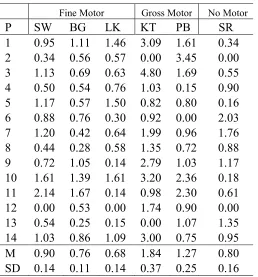
A 1-way ANOVA indicated a significant difference in rates across tasks [Small World
344
(M = 0.90, SE ± 0.15); Board Game (M = 0.76, SE ± 0.11); Lock and Key (M = 0.68,
345
SE ± 0.14); Knock and Tap (M = 1.84 SE ± 0.37); Picture Block (M = 1.27, SE ± 346
0.25); Story Recall (M = 0.77, SE ± 0.17) [F(2.72, 35.41) = 4.52, p = 0.011].
347
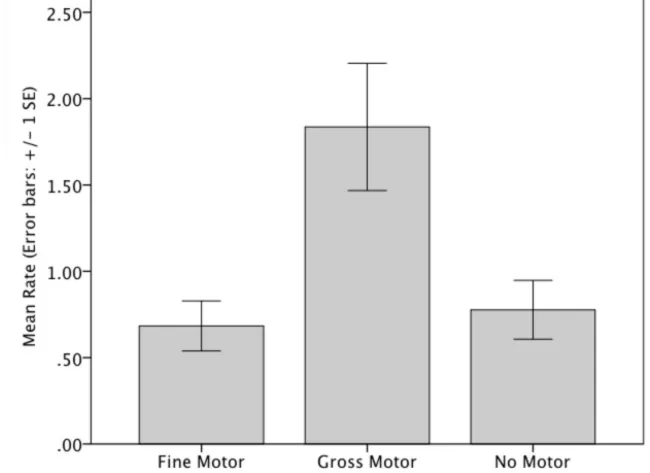
Additionally, a 1-way ANOVA revealed a significant difference in task motor
requirement (fine motor, gross motor and no motor) [F (2, 26) = 6.67, p = 0.005] (see
349
Figure 1).
350
351
- Insert Figure 1 –
352
353
Post-hoc analyses revealed that tongue protrusion rates for tasks requiring gross
354
motor actions (M = 1.55, SE ± 0.23) elicited a significantly greater rate of tongue
355
protrusions than tasks requiring fine motor action (M = 0.78, SE ± 0.08) (Z = -3.42;
356
p = .001), or no motor action (M = 0.77, SE ± 0.17), (Z = -2.27; p = .023).
357
358
3.2. Lateralized Tongue Protrusions
359
Frequency of left and right tongue protrusions revealed that participants demonstrated
360
a significant bias for right tongue protrusions (frequencies: M = 10.79, SE ± 1.82)
361
versus left tongue protrusions (frequencies: M = 5.57, SE ± 0.78) collapsed across all
362
tasks (Z = -2.76; p = .006). (see Figure 2).
363
364
- Insert Figure 2 –
365
366
Further analyses of lateral tongue protrusion biases were conducted employing LI
367
scores. LI scores ensure equal weighting of participant contribution to the analysis
368
(see Table 4).
369
370
- Insert Table 4-
371
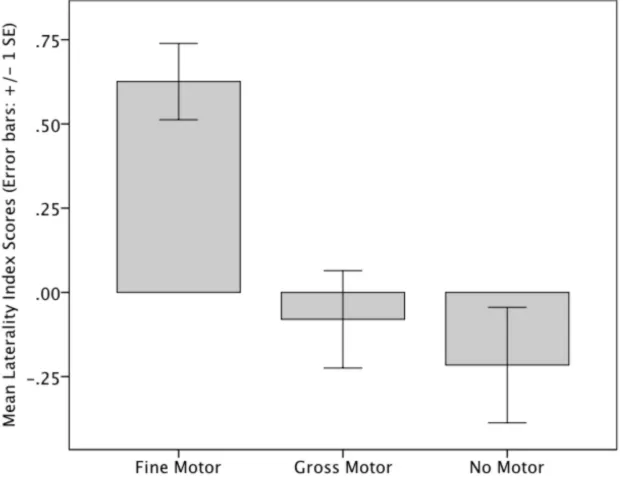
A 1-way ANOVA of laterality index scores of tongue protrusions was calculated by
373
motor condition (fine motor, gross motor and no motor), resulting in a significant
374
difference for mean LI scores across motor conditions [F (2, 26) = 12.36, p < 0.001]
375
(see Figure 3).
376
377
- Insert Figure 3 –
378
379
Post-hoc analyses by motor condition showed that fine motor condition (M = 0.63, SE
380
± 0.11) elicited significantly more right-biased tongue protrusions compared with the
381
gross motor condition (M = -0.08, SE ± 0.15) (Z = -2.91; p = .003) and the no motor
382
condition (M = -0.22, SE ± 0.17) (Z = -2.80; p = .005). Additionally, mean LI scores
383
by task were as follows: Small World = .46, Board Game = .71, Lock and Key = .52,
384
Knock and Tap = .30, Picture Block = -.28, Story Recall, -.22.
385
386
4. Discussion
387
388
4.1. Rates of Tongue Protrusions
389
The findings from this investigation demonstrated that tongue protrusions commonly
390
occur in typically developing 4-year old children. Although the literature is sparse, the
391
result is consistent with an earlier report of the incidence of tongue thrust in typically
392
developing children aged 5-8 years (Mason & Proffit, 1974). In the present study,
393
fourteen participants exhibited tongue protrusions while engaging in a range of
394
cognitive tasks requiring fine motor action, gross motor action, or no motor action.
395
There were significantly more visible external tongue protrusions overall, where the
396
tongue breached the lips, compared with internal tongue protrusions, where the
tongue created a bulge in the cheek or lips but was not externally visible. However,
398
this result could be due to the fact that internal tongue protrusions may not always be
399
visually detectable and our findings represent a subset of all tongue protrusions.
400
401
Tasks of fine and gross manual motor action elicited tongue protrusions. This finding
402
supports the theory that hand and mouth actions sympathize with one another as a
403
result of a single system of communication that is independent of modality (McNeill,
404
1992). The motor coupling is believed to occur due to shared neural resources for
405
hand actions (Iacoboni, Woods & Mazziotta, 1998) and actual or internal speech
406
(Hinke, Hu, Stillman, Kim, Merkle, Salmi & Ugurbil, 2003) and is further supported
407
by behavioral evidence demonstrating selective disruption of speech syllables when
408
the hands are required to perform non-congruent articulations (Gentilucci et al.,
409
2001). However, tongue protrusions were also reported during the Story Recall task
410
that had no manual motor requirement. This additional finding supports the position
411
that the hands need not be active to elicit tongue protrusions. It is possible that tongue
412
protrusions will be elicited if a task involves active language processing as required
413
by the Story Recall task.
414
415
The rates of tongue protrusions differed significantly across tasks. Rates were
416
calculated to account for the varying task durations and time to completion per
417
participant. While all tasks elicited tongue protrusions in most children, gross motor
418
tasks elicited significantly more tongue protrusions than fine motor and no motor
419
tasks. This finding is in not inconsistent with our hypothesis, predicting more frequent
420
tongue protrusions in tasks of requiring prehension. However, this finding is in
421
contrast to non-human primate research reporting that chimpanzees generated
sympathetic mouth actions at a significantly higher frequency during tasks of fine
423
motor manipulation compared with tasks requiring gross motor manual actions
424
(Waters & Fouts, 2002). However, Waters & Fouts (2002) considered mouth actions
425
that were not specific to tongue protrusions. It is possible that the gross motor tasks in
426
the present study required a greater rate of grasping-type hand actions in comparison
427
to the fine motor tasks. Additionally, we consider that the gross motor tasks were both
428
tasks of significant difficulty. The Knock and Tap and Picture Block tasks were both
429
effortful tasks, requiring inhibition of prepotent responses and spatial manipulations,
430
respectively. Future studies may consider how grasping rate and task difficulty
431
influences tongue protrusions in typically developing children.
432
433
The tasks included in the gross motor condition included the Knock and Tap task and
434
the Picture Block task. The Picture Block task did not elicit significantly greater
435
tongue protrusion rate than other tasks (aside from the Board Game task). The Knock
436
and Tap task, however, did elicit significantly more tongue protrusions than all fine
437
motor and no motor tasks. It is possible that the opening and closing of the hand
438
required by the fifteen trials was sufficient to elicit complementary and sympathetic
439
tongue protrusions. Alternatively, we consider the structure of the Knock and Tap
440
task. This task possessed structured rules, rapid turn-taking and hand gesturing
441
performed with only the dominant right hand. Participants were asked to respond with
442
the opposite hand position as the experimenter. The task measures effortful control
443
and the ability to inhibit behavioral impulsivity of the prepotent response (i.e.
444
imitation of the experimenter’s hand position) and may have also required an element
445
of symbolic representation. This process may involve internal speech rehearsal of the
446
task rules to actively control hand movements. One interpretation of the finding is that
the Knock and Tap task required foundational components of the communication
448
system, engaging both symbolic hand gestures and the internal rehearsal of the verbal
449
instructions. The task elements may even resemble proto language processes both in
450
turn-taking sequences and symbolic representation of manual gestures. While
451
structured sequences are known to be a distinctive component of language (e.g.
452
Hauser, Chomsky & Fitch, 2002), it has been suggested that they also appear in
453
nonlinguistic domains such as object manipulation and gesture (for a review see,
454
Tettamanti, 2003). The rule-based motor activity required by the Knock and Tap task
455
may be likened to sequences of behavioral units, possessing the properties of an
456
action-based proto-syntax prior to the emergence of speech (Corballis, 2009). One
457
hypothesis is that sympathetic tongue protrusions increased with tasks demand for
458
rule-based structured sequences of action and the comprehension and production of
459
symbolic hand gestures (e.g. Gentilucci et al., 2001). Based on evolutionary theory,
460
goal directed sequences of actions are foundational components of human
461
communication driven by left hemisphere dominant processes that can manifest as
462
lateralized motor action (MacNeilage Rogers & Vallortigara, 2009).
463
464
4.2. Laterality of Tongue Protrusions
465
A significant group-level right side bias was revealed for the frequency of tongue
466
protrusions. The motor-level analyses demonstrated that fine motor tasks revealed
467
right-biased tongue protrusions. Laterality was next explored using laterality index
468
(LI) scores across fine motor, gross motor and no motor task groups. Unlike tests of
469
frequency, LI scores ensured equal weighting of each task to the analysis. The fine
470
motor action condition revealed significantly right-lateralized tongue protrusions
471
compared with the gross action condition and the no motor action condition.
Additionally, all three tasks revealed mean LI scores consistent with a strong right
473
bias (e.g. Oldfield, 1971).
474
475
We considered that all fine motor tasks required precision grasp and was likely to be
476
conducted by the dominant right hand and left hemisphere. The Small World task
477
included a variety of small dollhouse toys and dolls with manipulable limbs. The
478
Board Game task required moving a token across a board and the manipulation of
479
small flat discs that required precision grasp to collect. The Key and Lock task
480
required bimanual coordinated action (e.g. McGrew & Marchant, 1997) to open pad
481
locks. One hand (non-dominant) held a lock in a power grip while the other hand
482
(dominant) used a precision grasp to manipulate a key. One interpretation of this
483
finding is that fine motor tasks precipitate use of the dominant hand because it is more
484
dexterous in for operations involving sequences of fine manipulation. Studies of
485
cerebral lateralization implicate the left hemisphere and the right hand dominant for
486
such processes in the majority of the population (e.g. MacNeilage et al. 2009). We
487
propose that the dominant hand elicited lateralized sympathetic tongue action driven
488
by the support of common left hemisphere dominant neural system for the motor
489
structures that underpin communication processes (McNeill, 1992).
490
491
Gross motor tasks did not reveal a lateral tongue protrusion bias. Although the Knock
492
and Tap task did not require precision grip, it did demonstrated a weak right biased LI
493
score, possibly due to the fact that it required the use of the dominant hand. The
494
Picture Block task conversely, demonstrated a weak left biased LI score. A potential
495
reason this task did not reveal a lateral bias may have been because it did not require a
496
dominant hand. Blocks were easily slid across the surface of the table and did not
require turning, as the correct pictures were already oriented face-up for the
498
participant. Studies of primate manual laterality have found that gross motor actions
499
(e.g. reaching) can often fail to exhibit a significant hand preference as actions lack
500
the precision motor skill required for grasping (for a review see: Hopkins, 2006).
501
502
The present study offers the first investigation of tongue protrusions during cognitive
503
tasks requiring varying degrees of motor precision. We report on spontaneous tongue
504
protrusions in a population of typically developing children and suggest that tongue
505
protrusions are commonly exhibited by typically developing right-handed children.
506
Tongue protrusions were detected both internally and externally to the mouth
507
suggesting that this behavior may not cease in adulthood, but conscious awareness of
508
one’s physical actions may cause tongue actions to become less detectable in order to
509
conform with social norms. Our findings support an intrinsic connection between
510
actions of the mouth and hands that is consistent with behavioral studies indicating
511
that vocalizations are accompanied by spontaneous and synchronous rhythmic hand
512
movements, visible from early infancy (e.g. Masataka, 2001). Our findings suggest
513
that hand and tongue actions possess a reciprocal relationship such that when
514
structured sequences of hand actions are performed they are accompanied by
515
spontaneous and synchronous tongue action. The detection of lateralized tongue
516
protrusions is consistent with a left hemisphere dominant unified communication
517
system involving both the hands and the mouth (McNeill 1992) and additionally is
518
consistent with a gestural origin of language position (Armstrong, Stokoes & Wilcox,
519
1995; Corballis, 2002). To further explore the evolution of speech and gesture, future
520
research may consider whether tongue protrusions increases in rate, strength of
521
laterality and temporal synchrony during manual motor tasks that possess
foundational structured components of communication (e.g. hierarchical sequences of
523
actions). Due to the overlapping neural resources underpinning hand and mouth motor
524
capabilities, the derivation of motor action patterns provides a novel method to draw
525
inference about the evolution of different cognitive abilities.
526
527
ACKNOWLEDGMENTS
528
We thank R.-P. Grossett for assistance with video data coding and Angela Fernholm,
529
Pia Risholm-Mothander, and Karin Brocki for data collection. We thank Ulla
530
Waldenström for the launch of the original cohort (Women’s Experience of
531
Childbirth) from which this dataset is derived. This data collection was funded by a
532
grant from The Swedish Research Council to Alina Rodriguez (principal
533
investigator). Work on this study was partially funded by VINNMER grant
534
(Rodriguez).
535
536
References
537
Annett, M. (2002). Handedness and Brain Asymmetry. The Right Shift Theory,
538
Sussex: Psychology Press.
539
540
Armstrong, D.F., Stokoe, W.C., & Wilcox, S.E. (1995). Gesture and the Nature of
541
Language. Cambridge, MA: Cambridge University Press.
542
543
Byrne, R.W. & Byrne, J.M. (1991). Hand preferences in the skilled gathering tasks of
544
mountain gorillas (Gorilla gorilla berengei). Cortex, 27, 521-536.
545
Chu, M. & Hagoort, P. (2014). Synchronization of speech and gesture: Evidence for
547
interaction in action. Journal of Experimental Psychology: General, 143(4),
1726-548
1741. http://dx.doi.org/10.1037/a0036281.
549
550
Corballis, M.C. (2002). From hand to mouth: The origins of language. Princeton, NJ:
551
Princeton University Press.
552
553
Corballis, M.C. (2009). The evolution of language. Annals of the New York Academy
554
of Sciences, 1156, 19–43. DOI: 10.1111/j.1749-6632.2009.04423.x
555
556
Council on children with disabilities; section on developmental behavioral pediatrics;
557
Bright Futures Steering Committee; Medical Home Initiatives For Children With
558
Special Needs Project Advisory Committee (2006). Identifying infants and young
559
children with developmental disorders in the medical home: an algorithm for
560
developmental surveillance and screening. Pediatrics, 118, 405-20. DOI:
561
10.1542/peds.2006-1231
562
563
Crow, T.J., Crow, L.R., Done, D.J., & Leask, S. (1998). Relative hand skill predicts
564
academic ability: global deficits at the point of hemispheric indecision.
565
Neuropsychology, 36, 1275–1282. http://dx.doi.org/10.1016/S0028-3932(98)00039-6
566
567
Delcato, C.H. (1966). Neurological organization and reading. Springfield, Illinois:
568
Erhard, P., Kato, T., Strupp, J.P., Andersen, P., Adriany, G., Strick, P.L., & Ugurbil,
570
K. (1996). Functional mapping of motor in and near Broca’s area. Neuroimage, 3,
571
S367. DOI: 10.1016/S1053-8119(96)80369-7
572
573
Einspieler, C., Kerr, A.M., & Prechtl, H.F.R. (2005). Is the early development of girls
574
with Rett disorder really normal? Pediatric Research, 57, 696-700.
575
DOI:10.1203/01.PDR.0000155945.94249.0A
576
577
Fadiga, L., Fogassi, L., Pavesi, G., & Rizzolatti, G. (1995). Motor facilitation during
578
action observation—a magnetic stimulation study. Journal of Neurophysiology, 73,
579
2608–2611.
580
581
Forrester, G.S., Leavens, D.A., Quaresmini, C., & Vallortigara G (2011). Target
582
animacy influences gorilla handedness. Animal Cognition, 14, 903–907.
583
DOI 10.1007/s10071-011-0413-6
584
585
Forrester, G.S., Pegler, R., Thomas, M.S.C., & Mareschal, D. (2014). Handedness as
586
a marker of cerebral lateralization in children with and without autism. Behavioural
587
Brain Research, 15, 14-21.DOI: 10.1016/j.bbr.2014.03.040
588
589
Forrester, G.S., Quaresmini, C., Leavens, D.A., Mareschal, D., & Thomas, M.S.C.
590
(2013). Human handedness: An inherited evolutionary trait. Behavioural Brain
591
Research, 237, 200–206. DOI: 10.1016/j.bbr.2012.09.037
592
Forrester, G.S., Quaresmini, C., Leavens, D.S., Spiezio, C., & Vallortigara, G. (2012).
594
Target animacy influences chimpanzee handedness. Animal Cognition, 15, 1121–
595
1127. DOI: 10.1007/s10071-012-0536-4
596
597
Gallese, V., Fadiga, L., Fogassi, L., & Rizzolatti, G. (1996). Action recognition in the
598
premotor cortex. Brain, 119, 593–609. DOI.org/10.1093/brain/119.2.593
599
600
Gentilucci, M., Benuzzi, F., Gangitano, M., & Grimaldi, S. (2001). Grasp with hand
601
and mouth: a kinematic study on healthy subjects. Journal of Neurophysiology, 86,
602
1685–1699.
603
604
Givens, D.V. (2002). The nonverbal dictionary of gestures, signs & body language
605
cues: From Adams-apple jump to zygomatic smile. Spokane, Washington: Center for
606
Nonverbal Studies Press.
607
608
Hauser, M.D., Chomsky, N., & Fitch, W.T. (2002). The faculty of language: what is
609
it, who has it, and how did it evolve? Science, 298, 1569-1579.
610
DOI:10.1126/science.298.5598.1569
611
612
Hinke, R.M., Hu, X., Stillman, A.E., Kim, S.-G., Merkle, H., Salmi, R., & Ugurbil,
613
K.J. (2003). Functional magnetic resonance imaging of Broca's area during internal
614
speech. Neurophysiology, 90, 3304-16. DOI: 10.1097/00001756-199306000-00018
615
616
Hopkins, W.D. (2006). Comparative and familial analysis of handedness in great
617
apes. Psychological Bulletin, 132, 538-559. DOI:10.1037/0033-2909.132.4.538
619
Iacoboni, M., Woods, R.P., & Mazziotta, J.C. (1998). Bimodal (auditory and visual)
620
left frontoparietal circuitry for sensorimotor integration and sensorimotor learning.
621
Brain, 121, 2135– 2143. DOI: http://dx.doi.org/10.1093/brain/121.11.2135
622
623
Ingram, J. (1990). The Science of Everyday Life. Markham, Ontario: Penguin Books
624
Canada.
625
626
Iverson, J.M., & Thelen, E. (1999). Hand, mouth, and brain: The dynamic emergence
627
of speech and gesture. Journal of Consciousness Studies, 6, 19-40.
628
629
Kastner-Koller, U., Deimann, P., & Bruckner, J. (2007). Assessing handedness in
pre-630
schoolers: Construction and initial validation of a hand preference test for
4-6-year-631
olds. Psychology Science, 49, 239-254.
632
633
Kemp, S.L., Kirk, U., & Korkman, M. (2001). Essentials of NEPSY Assessment. John
634
Wily & Sons.
635
636
Korkman, M., Kirk, U., & Kemp, S. (2000). NEPSY. Administrasjonsanvisningar.
637
Stockholm: Psykologiförlaget AB.
638
639
Limbrock, G.J., Fischer-Brandies, H., & Avalle, C. (1991). Castillo-Morales'
640
Orofacial Therapy: Treatment of 67 children with Down Syndrome. Developmental
641
Medicine & Child Neurology, 33, 296–303. DOI:
10.1111/j.1469-642
8749.1991.tb14880.x
644
McGrew, W.C., & Marchant, L.F. (1997). On the other hand: current issues in and
645
meta analysis of the behavioral laterality of hand function in nonhuman primates.
646
Yearbook of Physical Anthropology, 40: 201-232. DOI:
10.1002/(SICI)1096-647
8644(1997)25+<201::AID-AJPA8>3.0.CO;2-6
648
649
McNeill, D. (1992). Hand and mind: What gestures reveal about thought. Chicago:
650
University of Chicago Press.
651
652
MacNeilage, P.F., Rogers, L.J., & Vallortigara, G. (2009). Origins of the left and right
653
brain. Scientific American, 301, 60–67. DOI:10.1038/ scientificamerican0709-60
654
655
Marchant, L.F., McGrew, W.C., & Eibl-Eibesfeldt, I (1995). Is human handedness
656
universal? Ethological analyses from three traditional cultures. Ethology, 101, 239–
657
258. DOI: 10.1111/j.1439-0310.1995.tb00362.x
658
659
Masataka, N. (2001). Why early linguistic milestones are delayed in children with
660
Williams syndrome: Late onset of hand banging as a possible rate-limiting constraint
661
on the emergence of canonical babbling. Developmental Science, 4, 158–164.
662
DOI: 10.1111/1467-7687.00161
663
664
Mason, R.M., & Proffit, W.R. (1974). The tongue thrust controversy: Background and
665
recommendations. Journal of Speech and Hearing Disorders, 39, 115-132.
666
DOI: 10.1044/jshd.3902.115
667
Mathisen, B., Skuse, D., Wolke, D., & Reilly, S. (1989). Oral-motor dysfunction and
669
failure to thrive among inner-city infants. Developmental Medicine and Child
670
Neurology, 31, 293-302. DOI: 10.1111/j.1469-8749.1989.tb03998.x
671
672
Morris, D. (1978). Manwatching: A Field Guide to Human Behaviour. St Albans,
673
Hertsfordshire, UK: Triad/Panther Books.
674
675
Nelson, E.L., Campbell, J.M., & Michel, G.F. (2014). Early handedness in infancy
676
predicts language ability in toddlers. Developmental Psychology, 50, 809-14. DOI:
677
10.1037/a0033803
678
679
Oldfield, R.C. (1971). The assessment and analysis of handedness: the Edinburgh
680
inventory. Neuropsychologia, 9, 97–113.
681
682
Orton, S.T. (1937). Reading, writing, and speech problems in children. New York:
683
Norton: Charles C Thomas Pub Ltd.
684
685
Petersson, K.M., Folia, V., & Hagoort, P. (2012). What artificial grammar learning
686
reveals about the neurobiology of syntax. Brain and Language, 120, 83-95. DOI:
687
10.1016/j.bandl.2010.08.003
688
689
Pulvermu ller, F., & Fadiga, L. (2010). Active perception: sensorimotor circuits as a
690
cortical basis for language. Nature Reviews Neuroscience, 11, 351-360. DOI:
691
10.1038/nrn2811
692
Riggs, J.E. (1984). Distinguishing between extrinsic and intrinsic tongue muscle
694
weakness in unilateral hypoglossal palsy. Neurology, 34, 1367–68. DOI:
695
10.1212/WNL.34.10.1367
696
697
Rizzolatti, G., & Arbib, M.A. (1998). Language within our grasp. Trends in
698
Neurosciences, 21, 188–194. DOI: http://dx.doi.org/10.1016/S0166-2236(98)01260-0
699
700
Rizzolatti, G., & Craighero, L. (2004). The mirror-neuron system. Annual Review of
701
Neuroscience, 27, 169-92. DOI: 10.1146/annurev.neuro.27.070203.144230
702
703
Rizzolatti, G., Camarda, R., Fogassi, L., Gentilucci, M., Luppino, G., & Matelli, M.
704
(1988). Functional organization of inferior area 6 in the macaque monkey. II. Area F5
705
and the control of distal movements. Experimental Brain Research, 71, 491–507.
706
DOI: 10.1007/BF00248741
707
708
Rodriguez, A., & Waldenström, U. (2008). Fetal origins of child
non-right-709
handedness and mental health. The Journal of Child Psychology and Psychiatry,
710
49(9), 967-976. DOI: 10.1111/j.1469-7610.2008.01923.x
711
712
Rodriguez, A., Kaakinen, M., Moilanen, I., Taanila, J., McGough, J.J., Loo, S., &
713
Järvelin, M.-R. (2010). Mixed-handedness is linked to mental health problems in
714
children and adolescents. Pediatrics,125, 340-49. DOI: 10.1542/peds.2009-1165
715
716
Schneider, S.A., Aggarwa, A., Bhatt. M., Dupont, E., Tisch, S., Limousin, P., Lee, P.,
717
Quinn, N., & Bhatia, K.P. (2006). Severe tongue protrusion dystonia: clinical
syndromes and possible treatment. Neurology, 26, 940-3. DOI:
719
10.1212/01.wnl.0000237446.06971
720
721
Strassnig, M., Hugo, R., & Muëller, N. (2004). Electroconvulsive therapy in a patient
722
with Tourette's Syndrome and co-morbid obsessive compulsive disorder. The World
723
Journal of Biological Psychiatry, 5, 164-166.
724
725
Tabiowo, E., & Forrester, G.S. (2013). Structured bimanual actions and hand transfers
726
reveal population-level right-handedness in captive gorillas. Animal Behaviour, 86,
727
1049-1057. DOI: 10.1016/j.anbehav.2013.09.010
728
729
Tettamanti, M. (2003). Language acquisition and processing: hierarchically
730
organized cognitive processes. Ph.D. thesis. University of Zurich.
731
732
Tsering, B.K. (2008). Tibetan culture in the 21st century. Tibetreport,
733
http://tibetreport.wordpress.com/2008/12/23/tibetan-culture-in-the-21st-century/
734
735
Waber, D.P., Mann, M.B., & Merola, J. (1985). Motor overflow and attentional
736
processes in normal school-age children. Developmental Medicine & Child Neurology
737
27, 491–497. DOI: 10.1111/j.1469-8749.1985.tb04573.x
738
739
Waters, G.S., & Fouts, R.S. (2002). Sympathetic mouth movements accompanying
740
fine motor movements in chimpanzees (Pan troglodytes) with implications toward the
741
evolution of language. Neurological Research, 24, 174-80.
742
DOI: http://dx.doi.org/10.1179/016164102101199585
744
Williams, C.A. et al. (2006). Angelman syndrome 2005: updated consensus for
745
diagnostic criteria. American Journal of Medical Genetics, 1;140A, 413–418.
746
DOI: 10.1002/ajmg.a.31074
747
748
Yeo, R.A., Gangestad, S.W., Thoma, R., Shaw, P., & Repa K (1997). Developmental
749
instability and cerebral lateralization. Neuropsychology, 11, 552-61.
750
http://dx.doi.org/10.1037/0894-4105.11.4.552
751
752
Yeo, R.A., Gangestad, S.W., & Thoma, R.J. (2007). Developmental instability and
753
individual variation in brain development: Implications for the origin of
754
neurodevelopmental disorders. Current Directions in Psychological Science, 16,
245-755
249. DOI: 10.1111/j.1467-8721.2007.00513.x
756
757
Figure Legends
758
759
Figure 1.
760
761
Figure 1. Mean rates of tongue protrusions across motor conditions.
762
763
Figure 2.
764
765
Figure 2. Right and left tongue protrusions collapsed across all tasks.
766
767
Figure 3.
769
Figure 3. Tongue protrusion mean laterality index scores across motor conditions.
770
Highlights
Tongue and hand articulations are controlled by left hemisphere biased brain regions
Tongue protrusions in children were right lateralized for only precision manual tasks
The rate of tongue protrusions was influenced by both motor and language syntax
Tongue protrusions provide a new method to study language evolution and
Figure 1
Figure 2
Figure 3
Table 1. Left, right and central tongue protrusion frequencies by task and motor
condition.
P = participant, SW = Small World, BG = Board Game, LK = Lock and Key, KT = Knock and Tap, PB = Picture Block, SR = Story Recall; (l) = left, (r) = right, (c) = central, M = mean, SD = standard deviation
Fine Motor Gross Motor No Motor
Table 2. Time to complete task in seconds.
P = participant, SW = Small World, BG = Board Game, LK = Lock and Key, KT = Knock and Tap, PB = Picture Block, SR = Story Recall, M = mean, SD = standard deviation
P SW BG LK KT PB SR
1 380 540 410 97 335 354
2 355 531 423 105 174 338
3 319 699 383 125 356 330
4 360 552 393 116 412 333
5 359 422 240 73 224 365
6 342 471 400 131 420 444
7 401 565 376 151 250 442
8 545 863 415 133 334 407
9 334 344 421 86 406 460
10 335 346 411 206 229 334
11 336 180 423 123 209 391
12 318 456 424 207 398 367
13 331 472 391 124 224 400
14 290 418 384 140 160 377
Table 3. The rate of tongue protrusions by motor condition and task
P=participant, SW = Small World, BG = Board Game, LK = Lock and Key, KT = Knock and Tap, PB = Picture Block, SR = Story Recall, M = mean, SD = standard deviation
Fine Motor Gross Motor No Motor
P SW BG LK KT PB SR
Table 4. Laterality index scores by motor condition
P = participant, M = mean, SD = standard deviation
P Fine Motor Gross Motor No Motor
1 0.43 0.27 1.00
2 1.00 -0.43 0.00
3 1.00 0.69 -1.00
4 1.00 0.00 0.00
5 1.00 -1.00 -1.00
6 0.67 0.00 -0.43
7 0.00 0.33 0.80
8 -0.33 -1.00 -1.00
9 0.43 0.11 0.14
10 0.73 -0.50 0.00
11 0.33 -0.50 -1.00
12 1.00 0.71 0.00
13 1.00 0.00 -0.33
14 0.50 0.20 -0.20
M 0.63 -0.08 -0.22
SD 0.42 0.54 0.64