Tasker, Fiona and Wood, S. (2016) The transition into adoptive parenthood:
adoption as a process of continued unsafe uncertainty when family scripts
collide. Clinical Child Psychology & Psychiatry 21 (4), pp. 520-535. ISSN
1359-1045.
Downloaded from:
Usage Guidelines:
Please refer to usage guidelines at or alternatively
MS accepted for publication 3Feb2016 in Clinical Child Psychology & Psychiatry for
Special Section on “Adoption” scheduled for publication in October 2016 (vol.21, no.4)
The transition into adoptive parenthood:
Adoption as a process of continued unsafe uncertainty when family scripts collide
Fiona Taskera & Sally Woodb
a
Department of Psychological Sciences, Birkbeck University of London, Malet Street,
Bloomsbury, London WC1E 7HX United Kingdom
b
Cambridgeshire County Council, Children's Social Care, Babbage House, Castle Park,
Castle Hill, Cambridge, CB3 0AT United Kingdom
DRAFT: Please do not quote or cite without permission.
Author Note:
Correspondence concerning this article should be addressed to Fiona Tasker,
Department of Psychological Sciences, Birkbeck University of London, Malet Street,
Bloomsbury, London WC1E 7HX United Kingdom or via email to [email protected]
Acknowledgements
The authors wish to thank the adopting parents who participated in the longitudinal
study over their transition to adoptive parenthood. We particularly thank the parents who also
helped us review our initial analyses. We also wish to acknowledge the professional help of
Dr Louise Earley and Dr Frances Minhinnick who reviewed our findings. We also thank the
The transition into adoptive parenthood:
Adoption as a process of continued unsafe uncertainty when family scripts collide
Abstract
Our prospective study investigated couples’ expectations of adoptive parenthood and
explored how these changed with their actual experience of parenthood. Six heterosexual
couples were interviewed just before placement began and six months after the children had
arrived. Interpretative Phenomenological Analysis (IPA) was used to analyse both sets of
interview data. Expectations of adoptive parenthood mostly transformed smoothly into
adoption experience for couples but challenges were experienced when family scripts
collided and a continued feeling of unsafe uncertainty then prevailed within these newly
formed family systems. Family script collision seemed a particular problem for couples
adopting sibling pairs. To further professional practice in working with families over the
transition to adoptive parenting we suggest that professionals keep in mind a framework that
includes: Internal and external world influences on family members, Intergenerational issues,
Family scripts, and the Structural challenges of adoption (IIFS).
Introduction
Professionals who work with families in fostering and adoption services need to recognise
the particular relational challenges facing adoptive parents to minimize the possibility of
adoption difficulties and disruption (Selwyn, Meakings & Wijedasa, 2015). Understanding
the family processes adoptive parents experience may enable the development of more
effective adoption support, thus increasing the likelihood of satisfactory and stable adoption
placements (Palacios & Brodzinsky, 2010). Substantial systemic research has been conducted
on new parents’ adjustment during the transition to biological parenthood (Lindblom et al.
2014) but much less is known about parental psychological adjustment and family processes
during the adoption transition. Our prospective interview study aimed to understand the
process of family identity transition experienced by heterosexual couples as their adopted
children arrived and settled into their new family.
The Challenges of Adoptive Parenthood
A few publications have offered guidance on the transition to adoptive parenthood to
support adoptive parents and professionals in the field. For example, from the reports of
parents in their U.K. survey of the factors involved in adoption disruption Selwyn and
colleagues wrote a readily accessible book, including helpful chapters on settling into
adoptive family life (Selwyn et al., 2015). Likewise the British Association for Adoption and
Fostering’s widely used training programme “Preparing to Adopt” has included a useful
module on learning to live together as an adoptive family based on first-hand accounts of
adoptive parents, children and young people (Fursland, 2010). Professionals in adoption
work in the U.S. also have written books for prospective adoptive parents and professionals
on supporting adoptive families with the ongoing challenge of parenting children who have
Research on into the effects of the transition into adoptive parenting from the point of
view of adoptive parents is aptly summarized by McKay and colleagues who reviewed 11
mixed methods studies that focused on heterosexual couple’s adjustment to adoptive
parenting and used standardized measures to report on changes in mental health, physical
health, and couple relationship satisfaction in the immediate post- adoption period (McKay,
Ross & Goldberg, 2010). McKay et al.’s review concluded that post-adoption depression was
relatively common. Findings from one longitudinal study indicated that adoptive mothers
experienced similar rates of depression six weeks post-adoption to those experienced by
biological mothers in the post-partum period (Senecky, Agassi, Inbar, Horesh, Diamond,
Bergman and Apter, 2009). However, Senecky and colleagues also noted that the rate of
depression in their sample of 39 Israeli women dropped from pre to post adoption as the
highest rates of depression were reported by participants two months prior to placement of an
internationally adopted child, who was aged between 2 to 25 months old at the time of
placement.
Some authors have concluded that adjustment to adoptive parenthood is often less
stressful than adjustment to parenthood after birth, especially if the adopted children are
young (Ceballo, Lansford, Abbey & Stewart, 2004; Levy-Shiff, Bar & Har-Even, 1990).
Ceballo and colleagues suggested that this was because adoptive parents were generally older
than birth parents and had learnt more coping responses during their life course. Other
researchers have pointed out that adoptive couples also have often been together longer than
primiparous mothers and their partners and that couples who adopt often have surmounted
relationship stresses associated with infertility (Levy-Shiff et al., 1990). Furthermore,
compared with many birth parents, adoptive couples tend to be more financially secure at
Nevertheless couples who have waited a long time to become adoptive parents to a
much wanted child may minimize some of the difficulties encountered in parenthood,
perhaps particularly so when using self-report checklists in quantitative studies (Brodzinsky
& Huffman, 1988). Quinton, Rushton, Dance and Mayes (1998) described adoptive parents
as experiencing “instant parenthood” (p.156) and queried whether previous studies had fully
examined the particular stresses of adoption. Qualitative studies have begun to explore
adoptive parents’ experiences. For example, one prospective study of a U.K. sample of 27
adoptive parents highlighted the challenges parents encountered in adopting from their initial
application to finally being selected, a process that on average took around two years to
complete (Dance & Farmer, 2014). An earlier study of 39 Canadian couples who had adopted
a child within the preceding two years likewise concluded that the transition to adoptive
parenthood was stressful (Daniluk and Hurtig-Mitchell, 2003). Daniluk and Hurtig-Mitchell
identified three main themes in their phenomenological analyses of participants’ interviews:
the process of coming to terms with dashed hopes of biological parenthood and deciding to
adopt; psychologically surviving the uncertainties of adoption screening and placement;
coming “full-circle” to overcome the challenges of adoption to grow into parenthood. In the
USA Foli (2010) interviewed 21 adoptive parents (mostly mothers) who had adopted their
child between one and 24 years previously and also identified themselves as having been
depressed at some point post-adoption. Foli found that these parents indicated they and
others, including extended family members, often held unrealistic expectations of being a
“super parent” and with problem-free hopes of family life that were not met in the reality of
adoption. Foli’s findings from her retrospective study of adoptive parents were further
corroborated by findings from separate focus group interviews held with adoptive parent
Just as in the transition to biological parenthood couples adopting a child (or children)
face new identity challenges as they take on new roles as a parent and expand their family
system from a dyad to a triad or more to include consideration of their child or children
(Goldberg, 2009). Partners may also struggle to offer support to each other as they are
stretched by these new challenges. In addition to these factors facing all new parents in
couple relationships, Goldberg argued that adoptive parents will likely encounter particular
pressures: they will likely contact adoption agencies after much debate about whether to
adopt, often after a lengthy process of realizing infertility, and they may have met with
doubts or ignorance about adoption expressed by extended family members (and others), and
further in the process of adopting they will have experienced much scrutiny by professionals.
Goldberg also considered that additional challenges could be encountered by LGBT adopters
or those who adopted a child of another racial or ethnic group. Thus, adoptive parents are
confronted by unique stresses, conflicts and challenges that might be expected to further
complicate the more universal developmental tasks and problems faced by other adults in
their parenthood identity transition (Brodzinsky & Schechter, 1990).
Adoptive parents may also be challenged by the demands of parenting children, who
may arrive in the adoptive family with particular difficulties that quickly confront the new
parent’s expectations. Ruston’s (2003) review summarized three main sets of issues
encountered by adoptive parents of children adopted from care: children’s challenging
emotional and behavioural problems; children’s special educational needs; and establishing a
close emotional relationship with a child who has previously not had a positive and
supportive experience of family life.
Other researchers also have stressed that pre-adoption factors play a role in
post-adoption adaptation and the possibility that a placement is disrupted (Selwyn et al. 2015). In
about their own expectations of family and how they considered the pre-adoption lives of
their soon to arrive children. Studies have focused on evaluating the effects on adopted
children’s well-being of pre-adoption experiences and also post-adoption contact
arrangements with birth relatives but less attention paid to the impact these factors have on
adoptive parenting (for a review see Triseliotis, 2011). Nevertheless, a retrospective
qualitative UK study of 11 couples who had adopted a child between 1977 and 2001 found
that the trend towards greater openness about adoption, together with the inclusion of birth
relatives in direct or indirect contact arrangements, presented a complex task for adoptive
parents in both establishing and retaining kinship ties (Jones & Hackett, 2011). Furthermore,
a detailed study of five children’s experience of moving from foster care into their adoptive
parents’ home indicated that this was of itself a difficult transition for all concerned (Boswell
& Cudmore, 2014). Social workers, adoptive parents and foster carers all focused on the
child making a fresh start with adoption rather than acknowledging the child’s sense of foster
care loss.
Statistics compiled by the British Association for Adoption and Fostering (BAAF)
from a survey of Local Authorities and Health Care Trusts across the UK have identified that
around half of the children waiting for adoption are part of a sibling group, although they
may never have lived together or have been housed separately while in foster care (BAAF
press release, 2014). Boddy (2013) reported that many of the children waiting to be placed in
sibling groups were older and brought with them more complicated pre-adoption histories
than did single children. A series of studies of single children or children placed for adoption
as part of a sibling group when aged between 5 to 11 years old and followed up over a period
of six years found that 71% were still with their adoptive parents at follow-up (Rushton &
Dance, 2004). In the majority of these cases the adoption was described as a positive
reported either that the placement continued but was less happy, or recalled a previous point
where the child or children placed had temporarily left the adoptive family, or reported that a
placement had ended. Rushton and Dance also noted that the degree to which the adoptive
parents expressed doubt about the placement’s success at the one year follow-up was
significantly associated with subsequent placement disruption, thus highlighting the
importance of the settling in period for placement stability. Further, when children had
difficulties settling with the adoptive family then reported levels of family stress, difficulties
in forming relationships, and children’s behavioural problems all correlated. About
two-thirds of the adoptive parents with sibling placements reported family stresses, but in most
cases not all the children placed were considered as difficult and in fact placements of a
single child were more likely to end in disruption or continue to be reported as difficult at
follow-up. We considered that adopting a sibling group could present a particular challenge
to couples since the existing subsystem would be challenged to adapt not only to the needs
of each child, but also to the inclusion of a pre-formed sibling sub-system.
Research Aim
The prospective qualitative study reported here examined the experience of becoming
adoptive parents using interview data from six heterosexual married couples. Previous studies
have focused either on retrospective data from adoptive parents, or tracked their progression
through adoption services from application and assessment to the placement of a child. Our
prospective study of the adoption process, which focused both on couples’ expectations and
their subsequent experience of family change, was designed to highlight the couple’s
transition to parenthood experience from news of placement through the first six months of
adoptive family life when the challenge of adopting a child or children from the local
authority care system was still fresh. Our study focused on how the couple’s prior
children and how that manifested six months after placement, thus highlighting issues
occurring in the important settling in period post-placement. In particular we considered
whether the experience of becoming adoptive parents to an individual child, or to a sibling
group, challenged the couple in different ways.
Method
Research design
A qualitative short-term prospective study was designed employing Interpretative
Phenomenological Analysis (IPA). Six heterosexual couples who were becoming first time
parents were interviewed when couples were expecting the arrival of their children
(pre-adoption) and followed-up six months after the children’s arrival (post-(pre-adoption). Three
couples were adopting a pair of siblings (Couples 1,2,3) and three couples were adopting a
single child (Couples 4,5,6).
Participants
A prospective non-clinical sample of adoptive parents was recruited through social
workers in an area adoption team in the middle of England. Social workers then advertised
the study to eligible couples within their client base using the team’s newsletter and display
boards. Potential participants were given a telephone number to ring and further details of
participation were discussed with the research team and written details mailed out. Each
participant provided written consent prior to interview and audio-recording. The study was
given ethical clearance after scrutiny by a University institutional review board, the area
adoption team, and the appropriate NHS and Local Authority Research Governance Group.
The selection criteria employed in the study specified the recruitment of heterosexual
children themselves. As leading IPA researchers have suggested (e.g. Smith, Flowers and
Larkin, 2009), we aimed to recruit a relatively homogeneous sample of adoptive families,
thus adoptions involving trans-racial placements, international adoptions, adoptions by single
parents or parents identifying as LGBTQ, or those involving children with specific special
needs were not included to limit sample variation due to these important factors. At the time
of their first interview adoptive parents also had to have been told that they were to have a
particular child (or children) placed with them, but not yet to have received the child(ren) into
their home. Thus couples were seen at a time when the arrival of children was imminent, and
expectations of adoption heightened, but their thoughts were as yet uninfluenced by their
children’s arrival.
At pre-adoption interviews participants were between 29-44 years old with a mean
age of 37 years (mothers’ mean age =36.5 years; fathers’ mean age=38.5 years). All
mothers-to-be and fathers-to-be were in full-time work prior to adoption. Two mothers-to-be
and two fathers-to-be had left the education system at minimum school leaving age, two
fathers-to-be had completed further educational qualifications and the remaining four
mothers-to-be and two fathers-to-be had completed college degrees. All six couples were
married prior to adoption and had been together between 6.5-16 years (mean length of time
together 10.25 years). All couples and children were of white British ethnicity. Altogether
couples adopted six boys and three girls ranging from infants under two years old to children
aged over five years. Each of the three pairs of adopted siblings had been housed together
both in their birth families and in foster care placements prior to being adopted by
participants in our study.
Basic demographic details were collected at the beginning of the study so sample
parameters and contextual factors could be gauged. At the end of each of the pre-adoption
interviews couples gave consent in principle for a follow-up interview 6 months post –
placement and all were completed.
Each semi-structured couple interview took place in the couple’s own home and took
between one and two hours. The main questions asked at pre-adoption explored each couple’s
expectations and preparation for adoption, whether they planned to parent in the same way or
differently compared to their own childhood experience, what they knew about the child(ren)
they were adopting, and how they thought family life might change for each of them
individually, as a couple, and with their extended family. Post-adoption interviews asked
couples to describe their experience of adoption: whether it was as they expected or more or
less challenging and how it had affected them as individuals, as a couple and within their
extended family. Audio-recordings of all interviews were subsequently transcribed verbatim.
In the pseudonym attributed extracts presented below transcript quotes have been edited with
… to indicate missing extraneous information and […] to indicate text edited for anonymity.
Data Analysis
Data analysis followed the principles of IPA (Smith et al., 2009). An idiographic
priority is given in IPA, therefore, each pre-adoption interview transcript was analysed in full
chronological interview order and all were analysed before the post-adoption interviews
happened. This analysis schedule was repeated with the post-adoption interviews.
After several readings of a transcript, the initial coding aimed to capture the
experiential claims, concerns, and understandings of each participant (Larkin, Watts &
Clifton, 2006). In particular we sought to retain the phrases, comparisons and metaphors that
coding. In the next phase of coding, interpretations were suggested and emergent themes
formed. Interpretations were then clustered together to give a draft table summarizing
emergent themes for each couple at pre- and post-adoption. Initially all the transcripts were
analysed by the second author, who had interviewed all the couples at both pre- and
post-adoption waves. Then transcripts and analyses were reviewed and refined in discussion with
the first author. The final rounds of analyses pooled together themes from across all
pre-adoption interviews and post-pre-adoption interviews respectively to form superordinate
(summary) themes.
Three points of data quality control and thematic verification ensued in the final
stages of analyses to subject themes to modifications reflecting minor clarifications. Firstly,
one of the interviewed couples reviewed their own pre- and post-adoption transcripts and our
analyses of their themes. Secondly, the same couple also reviewed the thematic summary of
each couple’s data and the draft report of findings across the entire follow-up study. Finally,
the superordinate thematic summary and draft report were reviewed by two professionals
unconnected with the project, both of whom were experienced IPA researchers (a
psychologist in the adoption field and a systemic psychotherapist).
Findings
Pre-adoption analyses
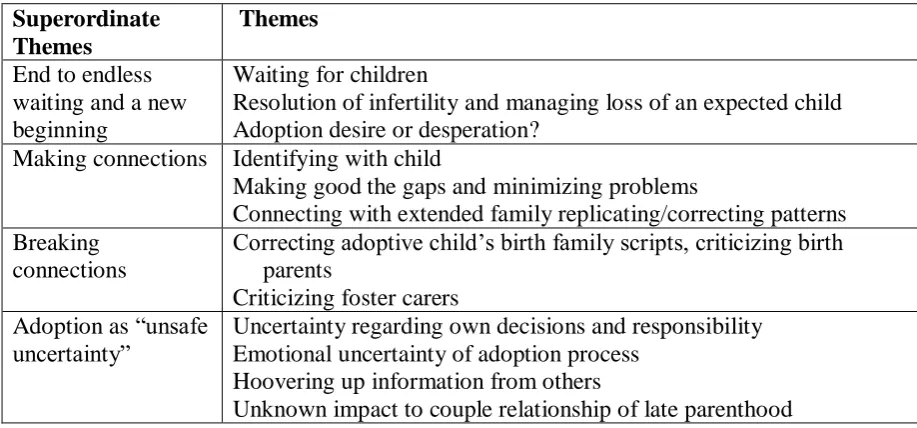
At pre-adoption interviews four superordinate themes were identified from the
transcripts (see Table 1). The first superordinate theme captured participants’ hopes that
adoption would bring an end to their endless wait for children, and help them to manage an
abstract sense of loss of a birth child with whom they had expected to begin their family. All
six couples talked about waiting: waiting for the expected birth child that never arrived,
adoption process. As Mary (Couple 3) poignantly said: “We’ve waited ever since we got
together” (P25, L30). There was a sense that adopting finally would resolve their
disappointment and provide a resolution of what had gone before. Diane (Couple 1) hoped
that adoption would: “Put a bit of foreclosure on all that had happened before … once we had
decided on adoption we felt happy to forget about IVF” (P5, L23).
TABLE 1 ABOUT HERE
Thus, couples expressed a powerful desire to adopt, or perhaps even a sense of
desperation. On the one hand, the desire to adopt was emphasized by the participants and was
reiterated by the couple who helped with the audit. On the other hand, the research team and
both of the auditing professionals additionally saw elements of desperation in participants’
accounts, as well as perhaps a feeling of resignation that the selection process was mainly in
the hands of the adoption professionals rather than under their control. Simon (Couple 5)
said: “We are quite prepared to accept any child”.
All six couples talked about making connections within their respective families
(pre-adoption interview superordinate theme 2). Some couples already appeared to be identifying
with the children they were adopting, even though their knowledge of the children was only
based on reading profiles and seeing photos. Ian (Couple 3) said: “you could read something
in [the profile] that was perhaps like myself … or I could read something and be like that’s
Mary that is” (P9, L19).
Part of making connections with their child seemed to be about feeling that the couple
could make good the gaps in the child’s earlier life, perhaps linked into ideas of rescuing the
child and repairing past damage. Participants all wanted to make a difference to the child they
were going to adopt and make reparation for the often traumatic start their children had
4 P11, L20). Couples engaged in a process of reconciling the information they had received
about their child’s pre-adoption history with their desire to see their child settled smoothly
into their home with prior difficulties swiftly overcome. Social workers seemed to have
shared potentially negative information about the childrenwith the couple, but the couple’s
capacity to absorb this appeared to be limited since they minimized the importance of the
children’s previous history. For instance, Roger (Couple 1) reported that the early neglect the
children had experienced was “nothing specific, just general neglect” (P3, L17).
Connections were already being made between the child(ren) and the couple’s
extended family, as Mary (Couple 3) summed up: “Everyone’s making connections as they
do … that shows ownership and acceptance and they are seen as part of the family
…everyone’s really excited” (P10, 24). Participants did not mention any instances of
extended family members expressing ambivalence about the children’s arrival. Perhaps any
reservations would have been difficult to voice at this exciting time for the whole family.
Nonetheless, some couples commented that an extended family member seemed not to
understand why a particular child might have been placed for adoption. For instance, Anne
said to Simon: “Your dad found it hard to understand … it was difficult for him to understand
how neglect can affect [the children]” (Couple 5 P16, L17).
Couples also invoked intergenerational family scripts (Byng-Hall, 1995a) in
describing how they planned to parent their children. For example, three of the couples
sought to replicate gendered scripts practised by their family of origin around “the nurturing
stay at home mum”: “We had our mums there at home; always there when we came home
from school, which we feel is important” (Mark Couple 4 P9, L25). The importance of an
available or stay at home parent for a needy child also may have been emphasized by
adoption professionals, although professional influence on this point was not evident in the
dialogues of three of the couples concerned the unsuitability of physical chastisement, which
their own parents had used on them: “Obviously social services insist there is no smacking
and we got smacked as children, so we wouldn’t do that. I would do that differently, but you
can’t anyway when you’re adopting” (Anne Couple 5 P13, L26).
Alongside making connections, a process of breaking connections also seemed to be
taking place for couples (pre-adoption interview superordinate theme 3). Two of the couples
said that they might need to correct powerful intergenerational family scripts that adopted
children might bring with them from their birth families: “My worry for Chantelle is that we
break the cycle that happened to her mum, and possibly her mum before her” (Mary Couple 3
P5, L9). Couples also had thought hard about why birth parents were giving their child up for
adoption and it was probably easier to fathom why when the child had been previously
abused or neglected. Two couples were particularly critical of the child(ren’s) birth parents
and this seemed to provide an acceptable rationale both for adoption and the children’s need
to break connections with their birth parents. For example, Roger (Couple 1) described the
children’s birth parents as having “no boundaries at all” (P3, L23). Couples also similarly
described the need to rescue children from unsatisfactory foster care. Roger followed up his
criticism of the children’s birth parents by also describing the foster carers’ lack of
boundaries: “there are older kids in the [foster carer’s home], well one of them walked in
while we were there and swore” (P15, L9).
A fourth superordinate theme evident in the pre-adoption interview transcripts was
that prospective adoptive parents appeared to be in a state of “unsafe uncertainty” (Mason,
1993) as they anticipated their child(ren)’s arrival. Mason has defined unsafe uncertainty as
when family members in systemic psychotherapy express fearful reservations about the
present and the future, not knowing what will happen or what courses of action would be safe
interview in five cases: either there was uncertainty about the adoption decisions that had
been made, or one (or both) parents-to-be expressed concerns about how they would manage
to parent the children. For example, Louise (Couple 4) described their imminent parenthood
as: “quite scary as well, you don’t know if you’ll do it right, if all will be OK” (P11, L41).
Roger (Couple 1) summed up an impending sense of responsibility: “all this huge
responsibility of looking after two boys who are going to be a bit wild” (P26, L6). Even the
very practical decisions the parents-to-be had to make could seem like a risky leap into the
unknown, such as which beds to buy for the children (deliberated by Couple 3). Competition
with other prospective adoptive parents for the “limited supply” of children to adopt seemed
to add to a sense of unsafe uncertainty in three of the six interviews. Anne (Couple 5) said “it
felt like a sort of competition, who would get the best one” when she described the profiling
evenings (P18, L25). Couples also appeared anxiously keen to hoover up any information
they could glean about parenting from social workers, foster carers, extended family
members, friends who already had children, and other adopters. For example, although Susan
and Tony (Couple 2) questioned the competence of the foster carers their soon-to-be adopted
children had been placed with, they also mentioned having learnt the most from these foster
carers.
Lastly in relation the superordinate theme of unsafe uncertainty, all six couples
mentioned concerns about the potential of children to threaten their relationship. Ian (Couple
3) said: “what we hope is that it will bring us even closer together but you know we’ve got an
unknown quantity coming in so it could go from one extreme to the other. It could be the
worst thing that’s ever happened to us” (P18, L21). Couples talked about the impact of a
child on their lives and emphasized that they were becoming parents later than expected.
Couples felt they would lose their sense of spontaneity, as Susan (Couple 2) said: “When
adoption affecting their couple relationship, personal identity concerns were less prominent
(only two mothers-to-be mentioned concerns related to their careers).
Post-placement analyses
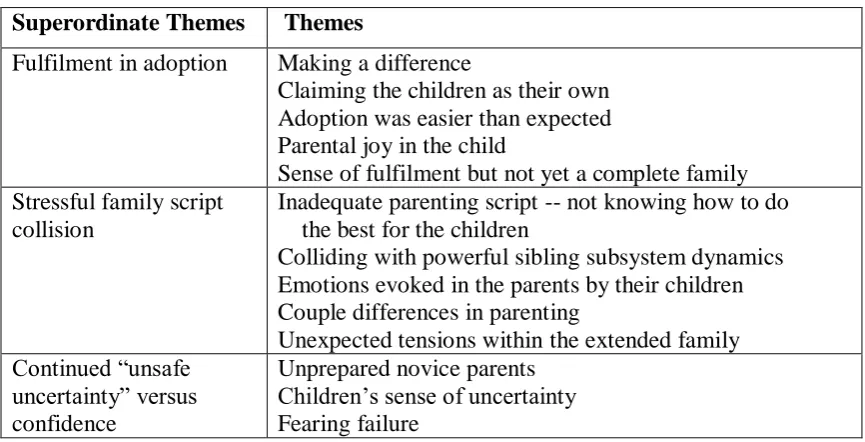
Three superordinate themes emerged from the analyses of the post-adoption
interviews: fulfilment in adoption, the stress of family script collision, and continued unsafe
uncertainty (Table 2). Notwithstanding the mixture of positive and negative themes running
through the post-adoption interviews, a sense of fulfilment in adoption pervaded all the
transcripts (post-adoption interview superordinate theme 1). Couples felt they were making a
difference to their children and clearly enjoyed seeing them grow and develop. Ian (Couple 3)
described their children as “unrecognisable from the children who came here” (P3, L31). And
throughout the interviews all six couples claimed the children as their own both directly “they
felt like ours straightaway” (Mary, Couple 3, P5, L31) and indirectly “They seem to pick up
our mannerisms” (Mary, P10, L1). Four of the six couples said that the adoption transition
was easier than they had expected: “He seemed to settle in really quickly, well seemed to, it
wasn’t until he had been here 3 months we noticed he seemed much better, started calling us
Mummy and Daddy. It all went really smooth.” (Louise Couple 4 P1, L7).
TABLE 2 ABOUT HERE
Three of the four couples who had found adoption easier than anticipated had adopted
only one child. Couples who had adopted one child conveyed a real sense of joy in their
children; they vividly described their first meeting with their child and continued discussing
their child with the same awestruck wonder: “it was just wow!” (Louise Couple 4 P2, L15).
These couples also had adopted the youngest children in the sample and seemed to have
developed a preoccupation with their parent- child relationships. For instance, Louise
in reality we are watching him, I just well up in tears often, don’t I?” (P7, L34). Nevertheless,
for those who had adopted only one child the thought remained that they may not yet be a
‘complete’ family as they considered the advantages and disadvantages of adopting another
child.
The post-adoption stories of couples who had adopted two children contained
glimpses of fulfilment, but their stories conveyed an overwhelming sense of the couple being
extremely busy and this may have obscured some of their joy in their children. Of the couples
adopting siblings only Mary (Couple 3) spontaneously said: “I love it, find it really
rewarding, you day is full, your life is full” (P4, L31).
The second superordinate theme concerned various stressful collisions between
different family scripts. A key part of the stress expressed in three of the couple interviews
was in not feeling confident that they had a parenting script that they could cope with their
children or do their best for them. Susan (Couple 2) said they were: “worrying about them
worrying, so not only are we worrying about what they are worrying about, but worrying
about worrying!” (P7, L8). Of the couples adopting a single child only one briefly mentioned
not knowing what to do next in coping with their daughter who had some developmental
difficulties: “We just felt helpless, we just wanted to help her. We couldn’t make her happy.”
(Anne Couple 5 P6, L34).
All three couples adopting sibling pairs seemed to be contending with the stress of
colliding with their children’s pre-existing family scripts. Powerful adopted sibling dynamics
enacted family scripts that varied in their particular content and these clashed with the
couples’ own script expectations of a sharing and caring family. Couples who had adopted
siblings said that their children were sometimes fiercely competitive for parental affection or
about fairness: “We had to measure drinks, he’d measure it, and he’d count broccoli” (P10,
L11). In other cases the sibling pair excluded their adoptive parents as they focused on their
own needs or on each other’s needs with the older child sometimes looking after the younger
child. For example, Mary (Couple 3) said: “the most stressful thing for me is if they are sick
in the night, they haven’t called for us and have sorted themselves out” (P6, L25).
Stressful script collision also was evident in the challenge that participants felt new
parenthood issued to each of them as a person and to their established couple subsystem. The
children evoked unexpected powerful emotions in these new parents. For example, Tony
(Couple 2) expressed his shock at the strength of his feelings: “They make you angrier than
you would ever expect you could be angry at times” (P.10, L39). Individual differences in
parenting style were noticed particularly by couples adopting siblings. Diane (Couple 1) said
“we didn’t expect it but I think Roger is too tough and I’m too soft at times” (P16, L43).
Couples described the children as strengthening their couple relationship and challenging it at
times. Four of the six couples felt the arrival of children had strengthened their relationship in
many ways and four couples also felt that the children’s arrival had challenged them. For
example, Couple 1 expressed a mixture of positive and negative feelings. Roger said “When
we put our minds to something that sort of pulls us together” (P17, L19). Yet when Diane
encountered open hostility from the children they had adopted Diane worried that: “Roger
would think it’s just me and how I deal with them” (P19, L33) despite Roger’s reassurance:
“I feel for her … it’s awful knowing he’s kicking and spitting at her” (P20, L31).
Another aspect of the superordinate theme of stressful family script collision was the
challenge couples felt in connecting their new children into the extended family system
Unexpected tensions with some extended family members were detailed in three
post-adoption interviews. For one couple keeping the extended family at a distance immediately
isolate ourselves but we wanted to get it right first, give [the children] a chance to settle, and
the wider family struggled with that a bit” (Diane Couple 1 P17, L36). In other families both
the new parents and their extended family members seemed unprepared for the children’s
behaviour and were upset by their differing reactions to the children. Susan (Couple 2) said:
“Me and my mum had one run in … I’d been a little hard, I gave him [her son] a punishment
and she revoked it in front of me … so I kind of had to walk out to the garden… and she
came out and started crying.” (P14, L21). Nevertheless, four of the six couples described at
least some positive connections forged between the new adoptive family unit and their wider
family system: “[they] treat [the children] on every level as if they were our own” (Ian
Couple 3 P11, L7).
As in pre-adoptive interviews, continued concerns around the super-ordinate theme of
unsafe uncertainty were manifest in post-adoption interviews but in new ways. Perhaps the
continued feelings of unsafe uncertainty were rooted in the unspoken reality that a child could
be removed at any time, after all these children had indeed been placed from the statutory
care system. Nevertheless, post-placement couples did not mention fears of the children being
removed back into the care system but instead focused their interviews on how unprepared
they felt for the task of parenting. For example, Roger (Couple 1) reflected on the day they
received their children: “There’s no preparation for what you are taking on … we just wanted
time to stop still didn’t we?” (P21, L24). Related to the theme of feeling unprepared was the
continued questioning and anxiety couples revealed about their ability to parent the children
they had adopted. Some talked about practical details such as: “Driving with them back in the
car thinking what do we do with them? Where shall we take them? … [But] when you are a
parent you know where the parks are” (Mary Couple 3 P11,L50). Others felt that their novice
status as new parents was visible to others: “You’re conscious what people think when you
their children also had experienced a continued sense of uncertainty about the adoption; for
example Mary (Couple 3) said that her children: “had their birthdays and Christmas and
thought that was it, they would only be having one with us and we said “no, you are here
now, forever” (P2, L26). Couples adopting siblings also hinted at, or directly mentioned,
fearing failure: “what if it doesn’t work out?” (Diane, Couple 1, P17, L.30). There was even
an honest acknowledgement of having wanted to give the children back, as Mary (Couple 3)
said albeit in a light-hearted way: “We did have a few times when they were vile to each
other, in the first few weeks it was really testing, I could have happily given them back” (P6,
L34).
In contrast to the continued sense of unsafe uncertainty expressed by couples adopting
a pair of siblings, unsafe uncertainty seemed not to mark post-adoption interviews with
couples who had adopted single children. Couples with just one child conveyed a reassured
sense of confidence in being able to know what to do by being able to read their children’s
needs and moods. For example, Claire (Couple 6) described attuning to her son’s needs
“[He’s] being a bit clingy to me at the moment, it’s difficult to describe … I can just tell how
he feels” (P2, L30).
Discussion
The transition to adoptive parenthood for heterosexual couples was explored prospectively in
our study of six self-selected white heterosexual couples as they adopted a child, or a pair of
siblings, from the statutory care system in the UK. On the one hand, our IPA study
highlighted themes from couples’ pre-adoption interviews that disappeared from their
post-adoption narratives six months later, e.g. concerns about coming to parenthood later than
expected. Further, a new feeling of contented fulfilment in parenthood was evident to some
extent in all post-adoption interviews. New parents conveyed that they were doing their
positive picture of adjustment to new parenthood depicted in prior quantitative research on
adoptive parents (Ceballo et al., 2004; Levy-Shiff et al., 1990; McKay et al., 2010).
On the other hand, the present study indicated that some of the underlying meanings
for couples of pre-adoption themes had particular implications post-adoption. Firstly, the
largely unanticipated collision of different family scripts sometimes felt overwhelmingly
stressful post-adoption, yet pre-adoption couples had only thought of making new family
connections and breaking old patterns. Secondly, prior to adoption couples appeared to
experience adoption as a journey into a new family terrain of unsafe uncertainty and for some
couples continued feelings of unsafe uncertainty pervaded their follow-up interviews six
months post-adoption placement. Our findings indicated that couples adopting older sibling
pairs appeared to face a greater challenge to their couple sub-system in the adoption transition
than did couples accommodating to the placement of a single younger child. Nevertheless,
these conclusions would necessarily need confirmation from a larger more rigorous
quantitative study.
The concept of ‘unsafe uncertainty’ (Mason, 1993) was helpful in looking at the
couples’ experiences both prior to their children coming and after their children had arrived.
For our interviewees, all of whom had been unable to conceive birth children, there was a
sense that even prior to embarking on the demanding process of becoming adoptive parents
they had long been in a position of ‘unsafe uncertainty’ in regard to the much desired
possibility of parenthood. This ‘unsafe uncertainty’ seemed to be exacerbated by aspects of
the adoption process: Would they be approved? Would the adoption panel approve the match
with a particular child? And what would the children be like? The emotional impact of unsafe
uncertainty seemed to be heightened in the pre-adoption process when couples relayed
‘horror stories’ of profiling meetings, as Dance & Farmer (2014) also have indicated. This
be helped to achieve a sense of confidence in their capacity to parent prior to having children
with significant needs placed with them.
Our prospective study and IPA approach indicated that the implications of the
children’s histories prior to adoption had been only partly thought through by some new
parents, who were then shocked by their adopted child’s thoughts or behaviour. According to
the couples interviewed eight of the nine children in our sample had experienced previous
abuse and/or neglect, thus children’s earlier experiences of family life may have led them to
hold intensely negative scripts concerning parental intentions and motives. Lindsey and
Barrett (2006) have described ways in which concepts such as mother and father, daughter
and son were changed by the experience of abuse and neglect. But post-placement couples
appeared to be caught unprepared for their children’s, attributions and emotions, without
seeming to realise the variety of ways in which children may have adapted to maltreatment or
the physical or psychological unavailability of a birth parent or attachment figure. In the
post-placement interviews adoptive couples mainly focused on how to make their child or children
happy in their new family. Our results here deserve further specific research attention as our
study did not specifically investigate the information given in pre-placement adoption
preparation sessions and how this influenced post-placement adjustment. Nonetheless, our
findings did suggest that couples did not fully appreciate the implications of pre-placement
information given by adoption professionals, indicating that this needs further consideration
within adoption preparation sessions and additional consideration post-placement.
Prior to adoption some couples did recognize that their soon-to-be arriving child(ren)
might have different family scripts to their own, but a key aspect of the pre-adoption
super-ordinate theme breaking connections was the belief that after placement their child would
make a fresh start and leave these patterns behind (see also Boswell & Cudmore, 2014). Six
should know what to do to help their adopted child feel happy and secure, yet this clearly
may take a longer period of time. Additionally, there was a sense that the strategies that
parents-to-be sometimes employed pre-adoption to manage their level of unsafe uncertainty
had not helped them appreciate the challenges their children would present (e.g. minimizing
the implications of previous neglect).
Some couples felt they lacked support from their family of origin as they struggled
with new parenthood. Out of a concern to see their children settle in to their new home, and
perhaps linked to a desire to establish their own authority as new parents, some couples found
it difficult to realise the post-adoption connections with their own family of origin they had
anticipated prior to the children’s arrival. Moreover, inter-generational differences in
approach to parenting, or difficulties in understanding the needs of adopted children, may
have exacerbated this. Some adoption services already provide additional workshops for
extended family members to attend to help families understand the needs of children who
have been in the local authority care system.
In our sample family script collision and continued feelings of unsafe uncertainty
post-adoption seemed to be paramount in the time two interviews of couples who had
adopted a pair of siblings. Perhaps the anxiety of being placed in a new family may have
perhaps prompted adopted siblings to seek some certainty in their relationship with each
other and in their joint established script of prior family life. Thus, siblings may have been
more resistant to the overtures of their new adoptive parents than were single adopted
children. Nevertheless, since it was beyond the scope of our qualitative investigation, we
were unable to make assessments of other factors, such as each child’s attachment behaviours
or each parent’s capacity for understanding mental states, which might have meant that these
parents struggled more than did others in the sample (see Fonagy, Steele, Steele, Moran and
children in our sample. Consequently, the age of the children and their singleton-sibling
adoption status were confounded in our analyses and a further study would be necessary to
explore the independent contribution of each of these factors. It is also conceivable that
family script collision and the continued sense of ‘unsafe uncertainty’ would resolve in time
for couples who had adopted siblings as it had at six months post-adoption for couples
adopting who had just one child. Again only a further longer-term follow-up study could
effectively determine this.
Clinical and Adoption Service Implications: a new framework for professional practice
Specialist clinical training for professionals working in adoption services has been
widely advocated (Grotevant & McDermott, 2014) and integrative practice can broaden the
services that can be offered to families and a multi-disciplinary collaborative approach to
formulation can enhance our understanding of adoptive families (Dallos & Vetere, 2010). In
reviewing the findings of our study it was clear that the transition to an adoptive family
presented family members with a complex interplay of internal and external processes. Thus,
the transition to adoptive parenthood reminded us of the value of integrating systemic and
psychoanalytic theoretical frameworks in applying our findings to practice.
Our pre-adoption findings indicated that couples adopting children held strong
internal representations of their own family of origin experiences and sensed their extended
family’s expectations, and perhaps held a fantasized image of a long awaited untroubled
child. We suggest that the couple’s expectations then clashed post-adoption with the looked
after child’s often disturbed internal representation of family (Brinich, 1980, 1990; Cairns,
2008). The external world influences of adoptive parents and their children may also clash as
both parties bring with them their own family histories influenced by the ‘social Grraacces’
Findings from our study suggest that during the transition to adoptive parenting
professionals working with these families need to support a move from feelings of unsafe
uncertainty to feelings of safe enough uncertainty; a therapeutic process that Mason has
detailed (Hardham, 2006; Mason, 1993). From a secure position of safe enough uncertainty
family members can then improvise new patterns of family interactions and create a shared
new adoptive family script as described by Byng-Hall (1995a&b). We recognize that
adoption professionals also may be troubled by concerns about unsafe uncertainty as they
work with potential adopters and follow the progress of children placed from the care system,
thus this framework may also be helpful for these professionals. We suggest the following
agenda to assist professionals in empowering families pre- and post-adoption to move on
from thoughts of unsafe uncertainty: Internal and external world influences on family
members, Intergenerational issues, Family scripts, and the Structural challenges of adoption
(IIFS). We do not propose the IIFS agenda as a formula for adoption practice, instead we
offer it as a useful acronym to help professionals and families keep in mind the multiple,
dynamic processes entailed in adoption.
References
Boddy J (2013) Understanding permanence for looked after children: A review of research for the
Care Inquiry.
http://www.fostering.net/sites/www.fostering.net/files/resources/england/understanding-permanence-for-lac-janet-boddy.pdf accessed 13Dec2014
Boswell S and Cudmore C (2014) ‘The children were fine’: acknowledging complex feelings in the
Brinich P (1980) ‘Some potential effects of adoption on self and object representations’,
Psychoanalytic Study of the Child 35: 107-33.
Brinich P (1990) ‘Adoption, ambivalence and mourning: Clinical and theoretical inter-relationships’.
Adoption & Fostering 14(1): 6-17.
British Association for Adoption & Fostering (2014) Brothers and sisters being separated due to
shortage of adopters. BAAF Press Release 3rd November 2014. Available from
http://www.baaf.org.uk/newsreleases/siblings-national-adoption-week-northernireland-2014
(accessed 16th January 2015).
Brodzinsky DM and Huffman L (1988) Transition to adoptive parenthood. Marriage & Family
Review 12(3-4): 267-286.
Brodzinsky DM and Schechter M (1990) The Psychology of Adoption. Oxford, England: Oxford
University Press.
Byng- Hall J (1995a) Rewriting Family Scripts: Improvisation and Systems Change. New York: The
Guilford Press.
Byng- Hall J (1995b) Creating a secure base: some implications of attachment theory for family
therapy. Family Process 34: 45-58.
Ceballo R, Lansford J E, Abbey A and Stewart A J (2004) Gaining a Child: Comparing the
Experiences of Biological Parents, Adoptive Parents, and Stepparents. Family Relations
53(1): 38-48.
Cairns K (2008) Enabling effective support: secondary traumatic stress and adoptive families. In: D
Hindle and G Shulman (eds) The Emotional Experience of Adoption: a psychoanalytic
perspective. Oxford, England: Routledge.
Dance C and Farmer E (2014) Changing lives and changing minds: the experiences of adoptive
parents from application to approval. Adoption & Fostering 38: 101-114.
Daniluk J C and Hurtig-Mitchell J (2003) Themes of Hope and Healing: Infertile Couples’
Experience of Adoption. Journal of Counselling & Development 81: 389-399.
Divac A and Heaphy G (2005) Space for GRRAACCES: training for cultural competence in
supervision. Journal of Family Therapy 27: 280-284.
Eldridge S (2009) 20 things adoptive parents need to succeed. New York, NY: Random House.
Fonagy P, Steele M, Steele H, Moran G S and Higgitt A C (1991) The capacity for understanding
mental states: The reflective self in parent and child and its significance for security of
attachment. Infant Mental Health Journal 12: 201-218.
Foli K J (2010) Depression in adoptive parents: a model of understanding through grounded theory.
Western Journal of Nursing Research 32: 379-400.
Foli K J, Lim E, South S C and Sands L P (2014) “Great expectations” of adoptive parents: Theory
extension through structural equation modeling. Nursing Research 63: 14-25.
Fursland, E. (2010) Preparing to Adopt - Trainer's Guide. London, UK: British Association for
Adoption & Fostering.
Goldberg A E (2009) The transition to adoptive parenthood. In: T W Miller (ed) Handbook of
stressful transitions across the lifespan. New York, US: Springer.
Gray, D. D. (2007) Nurturing adoptions: Creating resilience after neglect and trauma. Indianapolis,
IN: Perspectives Press
Grotevant H D and McDermott J M (2014) Adoption: Biological and social processes linked to
adaptation. Annual Review of Psychology 65: 235-265.
Hardham V (2006) Bridges to safe uncertainty: An interview with Barry Mason. Australian & New
Zealand Journal of Family Therapy 27: 16-21.
Jones C and Hackett S (2011) The role of ‘family practices’ and ‘displays of family’ in the creation
of adoptive kinship. British Journal of Social Work 41: 40-56.
Larkin M, Watts S and Clifton E (2006) Giving voice and making sense in Interpretative
Phenomenological Analysis. Qualitative Research in Psychology 3(2): 102-120.
Levy- Shiff R, Bar O and Har-Even D (1990) Psychological profile of adoptive parents-to-be.
American Journal of Orthopsychiatry 60: 258-267.
Lindblom J, Flykt M, Tolvanen A, Vanska M, Tittinen A, Tulppala M and Punamaki R-L (2014)
Dynamic family system trajectories from pregnancy to child’s first year. Journal of Marriage
& Family 76: 796-807.
Lindsey C and Barrett S (2006) A systemic conceptual framework. In: J Kendrick, C Lindsey and L
Tollemach (eds) Creating New Families: Therapeutic Approaches to Fostering, Adoption
and Kinship Care. London: Karnac.
Mason B (1993) Towards positions of safe uncertainty. Human Systems: The Journal of Systemic
Consultation and management 4: 189-200.
McKay K, Ross LE and Goldberg A E (2010) Adaptation to Parenthood during the Post- Adoption
Period: A Review of the Literature. Adoption Quarterly 13: 125-144.
Palacios J and Brodzinsky D (2010) Adoption research: trends, topics, outcomes. International
Journal of Behavioral Development 34: 270-284.
Quinton D, Rushton A, Dance C and Mayes D (1998) Joining New Families: A Study of Adoption
and Fostering in Middle Childhood. Chichester, UK: Wiley.
Rushton A (2003) The adoption of looked after children: A scoping review of research. London, UK:
Social Care Institute for Excellence.
http://www.scie.org.uk/publications/knowledgereviews/kr02.pdf (Accessed January 12,
2016)
Rushton A and Dance C (2004) The outcomes of late permanent placements: The adolescent years.
Selwyn J, Meakings S and Wijedasa D (2015) Beyond the adoption order; Challenges, interventions
and adoption disruption. London, UK: British Association for Adoption and Fostering.
Senecky Y, Agassi H, Inbar D, Horesh N, Diamond G, Bergman Y S and Apter A (2009)
Post-adoption depression among adoptive mothers. Journal of Affective Disorder 115: 62-68.
Smith J A, Flowers P and Larkin M (2009) Interpretative Phenomenological Analysis: Theory,
Method & Research. London: Sage.
Triseliotis J (2011) The current state of post-adoption contact. Educational & Child Psychology
Table 1. Summary of pre-adoption IPA themes.
Superordinate Themes
Themes
End to endless waiting and a new beginning
Waiting for children
Resolution of infertility and managing loss of an expected child Adoption desire or desperation?
Making connections Identifying with child
Making good the gaps and minimizing problems
Connecting with extended family replicating/correcting patterns Breaking
connections
Correcting adoptive child’s birth family scripts, criticizing birth parents
Criticizing foster carers Adoption as “unsafe
uncertainty”
Uncertainty regarding own decisions and responsibility Emotional uncertainty of adoption process
Hoovering up information from others
Table 2. Summary of post-placement IPA Themes.
Superordinate Themes Themes
Fulfilment in adoption Making a difference
Claiming the children as their own Adoption was easier than expected Parental joy in the child
Sense of fulfilment but not yet a complete family Stressful family script
collision
Inadequate parenting script -- not knowing how to do the best for the children
Colliding with powerful sibling subsystem dynamics Emotions evoked in the parents by their children Couple differences in parenting
Unexpected tensions within the extended family Continued “unsafe
uncertainty” versus confidence