Published Online January 2014 (http://www.scirp.org/journal/jis) http://dx.doi.org/10.4236/jis.2014.51002
Comparative Evaluation of Elliptic Curve Cryptography
Based Homomorphic Encryption Schemes for a Novel
Secure Multiparty Computation
Sankita J. Patel, Ankit Chouhan, Devesh C. Jinwala
Department of Computer Engineering, S V National Institute of Technology, Surat, India Email: [email protected], [email protected], [email protected]
Received November 30, 2013; revised December 30, 2013; accepted January 6, 2014
Copyright © 2014 Sankita J. Patel et al. This is an open access article distributed under the Creative Commons Attribution License, which permits unrestricted use, distribution, and reproduction in any medium, provided the original work is properly cited. In accor- dance of the Creative Commons Attribution License all Copyrights © 2014 are reserved for SCIRP and the owner of the intellectual property Sankita J. Patel et al. All Copyright © 2014 are guarded by law and by SCIRP as a guardian.
ABSTRACT
In this paper, we focus on Elliptic Curve Cryptography based approach for Secure Multiparty Computation (SMC) problem. Widespread proliferation of data and the growth of communication technologies have enabled collaborative computations among parties in distributed scenario. Preserving privacy of data owned by parties is crucial in such scenarios. Classical approach to SMC is to perform computation using Trusted Third Party (TTP). However, in practical scenario, TTPs are hard to achieve and it is imperative to eliminate TTP in SMC. In addition, existing solutions proposed for SMC use classical homomorphic encryption schemes such as RSA and Paillier. Due to the higher cost incurred by such cryptosystems, the resultant SMC protocols are not scalable. We propose Elliptic Curve Cryptography (ECC) based approach for SMC that is scalable in terms of computa- tional and communication cost and avoids TTP. In literature, there do exist various ECC based homomorphic schemes and it is imperative to investigate and analyze these schemes in order to select the suitable for a given application. In this paper, we empirically analyze various ECC based homomorphic encryption schemes based on performance metrics such as computational cost and communication cost. We recommend an efficient algo- rithm amongst several selected ones, that offers security with lesser overheads and can be applied in any applica- tion demanding privacy.
KEYWORDS
Elliptic Curve Cryptography; Privacy Preservation; Secure Multiparty Computation
1. Introduction
Our handhelds have become smaller; computers faster; disks larger; networks more efficient and we enjoy band- widths like never before; everything grew exponentially. All this sums up to a very favourable environment for data collection, transfer and storage. In order to fully utilize this data, there is a need to perform collaborative com- putation on data. However, the data collected mostly con-tain information related to individuals, their financial status, lifestyle and social behaviour in general. Joint computation on data may pose threat to privacy of indi-vidual’s data. Hence, there is a need to protocol a device that performs joint computation on private data without revealing data to other parties. Secure Multiparty Com-
putation (SMC) addresses this issue. The general frame- work for SMC consists of specifying a random process that maps m inputs (local inputs of parties) to m outputs (desired outputs) [1]. The random process describes de- sired functionality. We focus on addition function in this paper.
13
to compute the desired functionality on the union of their databases, without ever pooling or revealing their data.
Consider the interaction between different intelligence agencies; for security purposes, these agencies cannot allow each other free access to their confidential infor- mation; if they did, then a single mole in a single agency would have access to an overwhelming number of sources. It is much more likely that suspicious behaviour would be detected if different agencies were able to per-form computations on their combined data [2].
One way to compute the desired functionality is to use Trusted Third Party (TTP). In this scenario, parties send their data to TTP and TTP then computes results on par- ties’ data and sends the output to all parties. However, the pivotal question in cryptography is to achieve TTPs that are indeed trusted. This demands protocols that eliminate TTP. In this paper, we propose a protocol that eliminates TTP.
There are three approaches to performing desired func- tionality in Secure Multiparty Computation viz. the Obli- vious Transfer [3] Protocol, the homomorphic encryption [4] and the secret sharing [5]. The oblivious transfer pro- tocol is costly in terms of computational and communi- cation overheads. The secret sharing based approach gives better results in terms of computational cost due to primitive operations involved [6]. However, it requires existence of private channels. In addition, as pointed out in [7], the communication cost is higher due to message exchange between other parties in the protocol as ex-plained in Section 3. The homomorphic encryption based approach does not require existence of private channel and assures high level of privacy. Hence, we focus on homomorphic encryption based approach in this paper. The homomorphic encryption is introduced in Section 2. In literature, there do exist approaches that perform secure multiparty computation using homomorphic en- cryption. However, they use classical encryption schemes [8,9]. Elliptic Curve Cryptography (ECC) based ap- proach gives promising results as classical encryption schemes [10,11]. This is due to the higher per bit security provided by ECC. To give an example, to provide equi- valent security of 1024-bit RSA, an ECC scheme needs 160 bits parameters [12]. Hence, in this paper, we utilize ECC based approach to implementing secure multiparty computation. The approach is described in Section 3. We investigate various additively homomorphic encryptions schemes and analyze them empirically in Section 4.
A few approaches utilize ECC based encryption sche- mes. However, they require multiple encryptiondecryp- tion at each site and hence are computationally expensive [13,14]. In our approach, we avoid multiple cipher oper- ation at each site and thus reduce the computational cost of SMC. We justify this in Section 3.
2. Background and Related Work
The multi-party computation problem was introduced by Yao [15] and extended by Goldreich, Micali and Wig- derson [16]. The basic method they use is to represent the problem as combinatorial circuit. Participating parties then run a protocol for every gate in the circuit. Though general and simple, the approach exhibits combinatorial explosion in terms of circuit size and hence not scalable for large inputs. Apart from scrambled circuit, Goldreich [1] presents various other methods to perform multiparty computation such as homomorphic encryption and secret sharing. In literature, various applications such as Priva- cy Preserving Data Mining [17,18], Private statistical information retrieval [19,20], Privacy Preserving Data- base access [21] have been proposed that demand Secure Multiparty Computation among parties.
In Privacy Preserving Data Mining, various approach- es for classification [22], clustering [23] and association rule mining have been proposed [24]. The basic building blocks in these approaches are private value addition and comparison. In this paper, we focus on private value ad- dition. To give an example, in privacy preserving distri- buted clustering implements weighted average prob- lem(WAP) as a basic building block [25]. Parties first perform local clustering at each site and then global cluster means are calculated using WAP. For example, consider two party scenario with party A and B. The sum of records and number of records for single cluster after computing local cluster means at party A and B is sumA,
nA and sumB, nB respectively. Global means are com-
puted using
(
sumA+sumB) (
nA+nB)
. This requires the global addition of private value as a basic operation. Di- vision is then carried out by parties locally [7].In Wireless Sensor Network, the in-network process- ing demands the privacy. The in-network processing re-fers to on-the-fly processing of data packets by inter- mediate nodes before being communicated them to the base station. However, to protect the privacy of individu- al sensor reading, this on-the-fly processing must be done in a privacy preserving way. This process uses notion similar to multiparty computation. However, the compu- tation is carried out at aggregator node only and not at all the nodes. This process utilizes homomorphic encryption schemes to be implemented at intermediate nodes.
2.1. Homomorphic Encryption
multiparty computation and a wide variety of privacy preserving protocols.
The additive homomorphic algorithm whose input is the public key of the encryption scheme and two cipher- texts, and whose output is
( )
1( )
2(
1 2)
k k k k
p p p p
E m + E m =E m +m ; where
k p + is the homomorphic addition function,
k p
E is the public- key encryption function and m1 and m2 are elements in the domain of data. We refer additively homomorphic encryption scheme based on ECC in this paper.
2.2. Elliptic Curve Cryptography (ECC)
ECC is a public key cryptography approach based on the algebraic structure of elliptic curves over finite fields [10,11]. There are two types of finite fields where the elliptic curves are defined: prime fields Fp, where p is a
large prime number, and binary fields F2m. In this work, we are interested in the use of elliptic curves over prime fields E (Fp). A nonsupersingular elliptic curve E over Fp
is defined as the solution of
(
x y,)
∈Fp×Fp to the cu-bic equation:
2 3
ax b mod p
y =x + +
where a, b∈Fp such that 4a
3 + 27b2 ≠ 0 (mod p) to-
gether with a special point ∞ called the point at infinity, The group of points forms an abelian group with addition operation so that the addition of any two points results in another point on the same curve. The security of ECC based cryptographic protocol is based on the Elliptic Curve Discrete Logarithm Problem (ECDLP). The ECDLP can be defined as the problem of finding the sca- lar k such that Q = kP given Q and P (generator point).
2.3. Algorithms Used for Evaluation
We utilize additively homomorphic encryption schemes for evaluation. We investigate four algorithms that are additively homomorphic. They are Elliptic Curve Nac- cache-Stern (EC-NS) Encryption [26], Elliptic Curve Okamoto-Uchiyama (EC-OU) Encryption [27], Elliptic Curve Paillier (EC-P) Encryption [28] and Elliptic Curve Elgamal(EC-EG) Encryption [29]. First three schemes are described in [30] and are Elliptic Curve variants of the previously proposed schemes by Naccache-Stern [26], Okamoto-Uchiyama [27] and Pailler [28]. EC-EG is the variant of ElGamal [29]. Original ElGamal is multiplica- tively homomorphic while EC-EG is transformed to ad- ditive group and hence is additively homomorphic. The pseudo code and other details may be found in [30].
3. The Proposed Approach: Secure
Multiparty Computation Using ECC
We propose novel approach to Secure Multiparty Addi- tion problem using ECC. Secure Multiparty Addition
have beem implemented for privacy preserving data mining using homomorphic encryption [25] and secret sharing [7]. However, the approach of [25] uses classical public key encryption scheme and hence is computation- ally expensive. Further, multiple cipher operations at each site increased the computational cost. The secret sharing based approach proposed in [7] is efficient in terms of computational cost. However, due to two rounds of information exchange among parties increases the communication cost. Among the three approaches to implement SMC viz. the oblivious transfer based, the homomorphic encryption based and the secret sharing based, we focus on homomorphic encryption based ap- proach.
We allow parties to communicate in ring topology. Consider three party scenario with parties A, B and C with private values m1, m2 and m3 respectively. Parties
need to compute m1+ m2 + m3 securely.One party in the
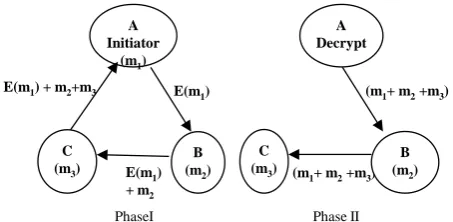
protocol is randomly designated as the Initiator party. The proposed approach considering party A as the In- itiator is shown in Figure 1.
As shown in Figure 1, the initiator first encrypts its private value using ECC based encryption scheme. The resultant ciphertext (which is in the form of elliptic curve point) is sent to next party in the ring. Next party does not perform any cipher operation but just adds its own private value (mapped to elliptic curve point) with the received cipher text. This process is repeated and finally initiator receives the message E(m1) + m2 + m3 at the end
of phase I. In phase II, initiator decrypts the message by removing the noise (that was added during encryption) from the message and computes m1+ m2 + m3. Here, in-
itiator just removes the noise in order to get desired sum. Hence, we have slightly modified the decryption proc-esses of algorithms to get the sum value. This sum is then sent to next party in the ring and eventually all parties will receive the sum.
4. Theoretical Analysis
In this section, we discuss the computational and com- munication cost of our proposed approach.
Figure 1. Secure Multiparty Addition using Elliptic Curve Cryptography.
E(m1)
+ m2
E(m1) + m2+m3 E(m1)
A Initiator
(m1)
B (m2)
C (m3)
(m1+ m2+m3)
A Decrypt
(m1+ m2+m3)
B (m2)
C (m3)
[image:3.595.311.538.593.704.2]15
4.1. Computational Cost
The computational cost is mainly due to the operations in first phase where parties send data to the next party in ring. However, we need to consider the cost for initiator and the rest of the parties separately. This is because the initiator encrypts and decrypts the data and the rest of the parties just need to add their data in the received data. Suppose to encrypt the data, time taken is T1. It is pointed out in [10] that by means of O(logk) addition and doubling, one can compute k. M value. Hence, T1 be- comes O(logk). Further, to decrypt the data, time taken is T2. Let us have the time taken by other parties to add their data point is T3. Hence, the computation cost for initiator can be = (O(logk) + T2) = O(logk). For the rest of the parties the cost becomes T3 and hence O(1). For total of N parties the cost becomes O(logk) + O(N).
4.2. Communication Cost
Our proposed approach involves two phases. In first phase, single message (as elliptic curve points) is com- municated by each party to the next party in the ring. Hence, total N messages are transmitted for N party sce- nario. In second phase, only the sum (that is calculated) by initiator party is communicated to all parties in a ring. The last party in the ring need not send this sum to in- itiator. Hence, total (N-1) messages are transmitted in second round. Thus for N parties in the protocol, the communication cost becomes O(N) i.e. linear in terms of number of parties.
4.3. Comparison with Secret Sharing Based
Approach
Our proposed approach is closest to the approach of [7]. In [7], privacy preserving clustering protocol is proposed using secret sharing scheme. The basic building block they use is the secure multiparty addition. Hence, we compare our approach with the approach of [7]. The ap- proach of [7] is efficient in terms of computational cost due to primitive operations required in secret sharing scheme. However, approach of [7] requires message ex- change among every other party in the protocol. Table 1
[image:4.595.57.287.685.738.2]shows the comparison in communication cost. We achieve O(N) complexity with respect to communication cost as compared to O(N2) of secret sharing based ap- proach. Hence, our approach achieves scalability with respect to number of parties in the distributed scenario.
Table 1. Comparison with respect to communication cost between our approach and approach of [7].
Phase I Phase II Total Complexity
Our approach N (N-1) 2N-1, hence O(N)
Approach of [7] N(N-1) N(N-1) 2N(N-1), hence O(N2)
5. Experimental Results
In this paper, we focus on comparative evaluation of ECC based homomorphic encryption schemes to imple- ment secure multiparty addition. We implement our pro- posed secure multi party addition protocol using four ECC based schemes such as EC-NS, EC-OU, EC-P and EC-EG.
5.1. Experimental Setup
We carry out the experiments in JAVA. The experiments are conducted on three different machines to emulate the true distributed scenario consisting of three parties. All machines have similar configuration of Intel Core i5 processor, 4GB of RAM and 3.20 GHz of processing power. All reported results are averaged from 5 runs of the protocol.
All the participating parties initially agree upon the ECC parameters required for the respective ECC algo- rithm. The ring topology among the parties is set up and each party knows its neighbor on ring. One party in a ring is randomly designated as Initiator.
The secure three party addition protocol is imple- mented with four different homomorphic algorithms based on ECC. Our test application successfully shows fully functional secure three party addition protocol over real network.
5.2. Experimental Results
We evaluate ECC based encryption schemes for secure multiparty addition based on two metrics viz. the com- putational cost and the communication cost. Computa- tional cost is measured as time taken for computation and communication cost is measured as number of bytes ex- changed over communication channel.
We perform experiments with different ECC parame- ter sizes viz. 112-bit, 160-bit and 256-bit. For EC-OU, the prime value is 341 bit long and for remaining encryp- tion schemes, prime value is similar to the size of Elliptic Curve Parameter Size i.e. 112 bit or 160 bit or 256 bit.
Table 2 shows the cost for running secure three party addition protocol using four ECC based encryption schemes.
Table 2. Results for Secure Multiparty Addition using various ECC based encryption schemes.
Encryption Scheme
112-bit 160-bit 256-bit
Time (Mili seconds) Cost (Kilobytes) Time (Mili seconds) Cost (Kilobytes) Time (Mili seconds) Cost (Kilobytes)
EC-OU 316 1116 335 1759 399 2719
EC-EG 254 1740 286 2766 322 4865
EC-NS 303 4224 349 4906 402 7487
[image:5.595.293.540.250.524.2]EC-P 247 2437 285 3741 351 7123
Table 3. Results for Secure Multiparty Addition using various ECC based encryption schemes keeping 341-bit primes for all schemes.
Encryption Scheme
112-bit 160-bit 256-bit
Time (Mili seconds) Cost (Kilobytes) Time (Mili seconds) Cost (Kilobytes) Time (Mili seconds) Cost (Kilobytes)
EC-OU 316 1116 335 1441 399 2719
EC-EG 309 4849 321 5181 357 6474
EC-NS 336 5538 382 6198 407 8124
EC-P 326 5515 356 6504 383 8760
Table 3 shows that keeping 341-bit prime value fixed
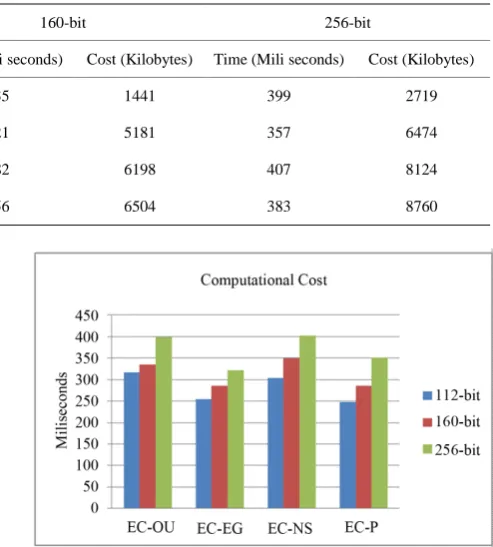
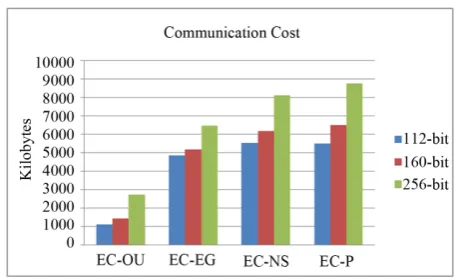
for all schemes results in higher computational cost for the encryption schemes other than EC-OU. In these ex- periments, we found that EC-OU and EC-EG takes lesser time where as EC-OU takes lesser space which is rea- sonably lesser than the other three schemes. Results for computational and communication cost are shown in
Figures 2 and 3 respectively for varying length of
primes.
Results for computational and communication cost for 341-bit fixed length prime are shown in Figures 4 and 5
respectively. As shown in Figures 4 and 5, if we consid- er both computational and communication cost, EC-OU perform better than all algorithms selected for evaluation.
6. Conclusion
In this paper, we propose a novel approach to securing multiparty computation using elliptic curve cryptography. We empirically evaluated various ECC based homomor- phic encryption schemes for our proposed protocol. We demonstrate that EC-OU algorithm performs better among four selected algorithms. Our secure multiparty addition protocol achieves better efficiency in terms of communication cost as compared to corresponding secret sharing based approach and hence is scalable with re- spect to a number of parties. In addition, we highlighted various applications such as privacy preserving data mining as the candidate applications for our proposed approaches.
Figure 2. Comparison of Computatio nal cost for various ECC schemes for varying length of prime.
[image:5.595.310.541.566.704.2]17
Figure 4. Comparison of Computational cost for various ECC schemes for 341-bit prime.
Figure 5. Comparison of Communication cost for various ECC schemes for 341-bit prime.
Our future includes incorporating EC-OU based secure multiparty computation in privacy preserving data min- ing application.
REFERENCES
[1] O. Goldreich, “The Foundations of Cryptography,” Vol. 2. Cambridge Univ. Press, Cambridge, 2004.
[2] Y. Lindell and B. Pinkas, “Secure Multiparty Computa- tion for Privacy-Preserving Data Mining,” Journal of Pri- vacy and Confidentiality, Vol. 1, No. 1, 2009, pp. 59-98.
[3] M. Rabin, “How to Exchange Secrets by Oblivious Transfer,” Technical Report Tech. Memo TR-81, Aiken Computation Laboratory, 1981.
[4] D. Josep Ferrer, “A new privacy homomorphism and applications,” Information Processing Letters, Vol. 60, No. 5, 1996, pp. 277-282.
http://dx.doi.org/10.1016/S0020-0190(96)00170-6
[5] A. Shamir, “How to Share a Secret,” Communication of the ACM, Vol. 22, No. 11, 1979, pp. 612-613.
http://dx.doi.org/10.1145/359168.359176
[6] T. B. Pedersen, Y. Saygin and E. Savas, “Secret Sharing vs. Encryption-Based Techniques for Privacy Preserving Data Mining,” UNECE/Eurostat Work Session on SDC, 2007.
[7] S. Patel, S. Garasia and D. Jinwala, “An Efficient
Ap-proach for Privacy Preserving Distributed K-Means Clustering using Shamir’s Secret Sharing Scheme,” In: T. Dimitrakos, R. Moona and D. Patel, Eds., Trust Man- agement VI, IFIP Advances in Information and Commu-nication Technology, Vol. 347, Springer, Boston, 2012, pp. 129-144.
[8] G. Jagannathan and R. N. Wright, “Privacy-Preserving Distributed k-Means Clustering over Arbitrarily Parti- tioned Data,” KDD, ACM Press, 2005, pp. 593-599.
[9] S. Jha, L. Kruger and P. McDaniel, “Privacy Preserving Clustering,” 10th European Symposium on Research in Computer Security, 2005, pp. 397-417.
[10] N. Koblitz, “Elliptic Curve Cryptosystems,” Mathematics of Computation, Vol. 48, 1987, pp. 203-209.
http://dx.doi.org/10.1090/S0025-5718-1987-0866109-5
[11] V. S. Miller, “Use of Elliptic Curve in Cryptography,” In: Proceedings of Advances in Cryptology (CRYPTO’85), Springer Verlag, 1986, pp. 417-426.
[12] Certicom Research, “Standards for Efficient Cryptogra- phy—SEC 1: Elliptic Curve Cryptography,” 2009.
[13] A. C. Patel, U. P. Rao and D. R. Patel, “Privacy Preserv-ing Association Rules in Unsecured Distributed Envi-ronment Using Elliptic Curve Cryptography,” Proceed-ings of International Conference on Computing Commu-nication & Networking Technologies (ICCCNT), 2012, pp. 1-5.
[14] M. Rajalakshmi and T. Purusothaman, “Privacy Preserv-ing Distributed Data MinPreserv-ing usPreserv-ing Randomized Site Se-lection,” European Journal of Scientific Research, Vol. 64, No. 4, 2011, pp. 610-624.
[15] A. C. Yao, “Protocols for Secure Computations,” Pro-ceedings of the 23rd Annual IEEE Symposium on Foun-dations of Computer Science, 1982, pp. 160-164. [16] O. Goldreich, S. Micali and A. Wigderson, “How to Play
any Mental Game,” Proceedings of the 19th Annual ACM Symposium on Theory of Computing, 1987, pp. 218-229.
[17] B. Pinkas, “Privacy Preserving Data Mining,” Journal of Cryptology, Vol. 50, No. 3, 2002, pp. 177-206.
http://dx.doi.org/10.1007/s00145-001-0019-2
[18] B. Pinkas, “Cryptographic Techniques for Privacy-Pre- serving Data Mining,” SIGKDD Explorations Newsletter, Vol. 4, No. 2, 2002, pp. 12-19.
http://doi.acm.org/10.1145/772862.772865.
[19] W. L. Du and M. J. Atallah, “Privacy-Preserving Coop-erative Scientific Computations,” 14th IEEE Computer Security Foundations Workshop, Nova Scotia, 11-13 June 2001, pp. 273-282.
[20] W. L. Du and M. J. Atallah, “Privacy-Preserving Statisti-cal Analysis,” Proceedings of the 17th Annual Computer Security Applications Conference, New Orleans, 10-14 December 2001, pp. 102-110.
[21] W. L. Du and M. J. Atallah, “Protocols for Secure Re- mote Database Access with Approximate Matching,” 7th ACM Conference on Computer and Communications Se-curity (ACMCCS 2000), The First Workshop on Security and Privacy in E-Commerce, Athens, 1-4 November 2000, pp. 87-111.
[image:6.595.59.290.85.221.2] [image:6.595.58.289.259.398.2]Min-ing,” In Advances in Cryptology—Crypto2000, Lecture Notes in Computer Science, volume 1880, 2000.
[23] J. Vaidya and C. Clifton, “Privacy-Preserving k-Means Clustering over Vertically Partitioned Data,” Proceedings of 9th ACM SIGKDD International Conference on Knowledge Discovery and Data Mining, ACM Press, 2003, pp. 205-216.
[24] J. Vaidya and C. Clifton, “Privacy Preserving Association Rule Mining in Vertically Partitioned Data,” 8th ACM SIGKDD International Conference on Knowledge Dis-covery and Data Mining, 2002, pp. 639-644.
[25] S. Jha, L. Kruger and P. McDaniel, “Privacy Preserving Clustering,” Proceedings of 10th European Symposium on Research in Computer Security, 2005, pp. 397-417.
[26] D. Naccache and J. Stern, “A New Public Key Crypto-
system Based on Higher Residues,” ACM Conference on Computer and Communications Security, 1998, pp. 59- 66.
[27] T. Okamotoand S. Uchiyama, “A New Public-key Cry- ptosystem as Secure as Factoring,” EUROCRYPT, 1998, pp. 308-318.
[28] P. Paillier, “Public-Key Cryptosystems Based on Com-posite Degree Residuosity Classes,” EUROCRYPT, 1999, pp. 223-238.
[29] T. ElGamal, “A Public Key Cryptosystem and a Signa-ture Scheme Based on Discrete Logarithms,” CRYPTO, IT, Vol. 31, No. 4, 1985, pp. 469-472.
![Table 1. Comparison with respect to communication cost between our approach and approach of [7]](https://thumb-us.123doks.com/thumbv2/123dok_us/7980402.756561/4.595.57.287.685.738/table-comparison-respect-communication-cost-approach-approach.webp)