Microcolumn field sampling and flow injection techniques
for mercury speciation.
WEI, Jian.
Available from Sheffield Hallam University Research Archive (SHURA) at:
http://shura.shu.ac.uk/20513/
This document is the author deposited version. You are advised to consult the
publisher's version if you wish to cite from it.
Published version
WEI, Jian. (1993). Microcolumn field sampling and flow injection techniques for
mercury speciation. Doctoral, Sheffield Hallam University (United Kingdom)..
Copyright and re-use policy
ProQuest Number: 10701160
All rights reserved
INFORMATION TO ALL USERS
The quality of this reproduction is d ep en d en t upon the quality of the copy submitted.
In the unlikely ev en t that the author did not send a co m p le te manuscript
and there are missing p a g es, these will be noted. Also, if material had to be rem oved, a n o te will indicate the deletion.
uest
ProQuest 10701160
Published by ProQuest LLC(2017). Copyright of the Dissertation is held by the Author.
All rights reserved.
This work is protected against unauthorized copying under Title 17, United States C o d e Microform Edition © ProQuest LLC.
ProQuest LLC.
789 East Eisenhower Parkway P.O. Box 1346
MICROCOLUMN FIELD SAMPLING AND FLOW INJECTION
TECHNIQUES FOR MERCURY SPECIATION
by
Jian Wei
A thesis submitted in partial fulfilment o f the requirements of Sheffield Hallam University for the degree o f D octor o f Philosophy
February 1993
Sponsoring Establishment: Division o f Chemistry
School o f Science
Sheffield Hallam University
Collaborating Establishment: National Rivers Authority
North West Region
ACK N O W LED G EM EN T
The work described in this thesis was carried out in the Chemistry division, School o f Science, Sheffield Hallam University, during the period 1988 to 1992.
I would like to express my thanks to Dr. C.W. McLeod and Dr. D.J. M owthorpe for their helpful advice and encouragement throughout the supervision of this work, to Mr. A.G. Cox and Mr. D. Anderson who gave me a lot help, to the other technical staff o f the division and to my fellow postgraduate students for their assistance.
I would also like to thank Mr. J. Rollins, Dr. J. Tacon and Dr. P. D. Jones and
National Rivers Authority (North West Region) for their hospitality and assistance during the course of the investigations on the Manchester Ship Canal. The help o f Dr. P.B. Stockwell and P S Analytical is greatly appreciated.
ABSTRACT
Mercury is one of the most toxic heavy metals, and many serious incidents have resulted from mercury poisoning. The methylation of mercury and it's amplification by marine life have aggravated this pollution problem. Studies over the last three decades have shown that the toxicity o f mercury is related to chemical form. A basic aim o f the research has been to devise new methodology for the measurement and speciation o f mercury. Key points of the investigation reported were the. literature review of methodologies and techniques for mercury speciation and the development o f a novel manifold which incorporates microcolumns of sulphydryl cotton which have a relatively high affinity and selectivity for inorganic and / or organomercury, and to utilise a continuous flow procedure for mercury speciation based on flow injection - atomic fluorescence spectrometry. This new and novel system has been used for the determination and speciation of mercury in a variety of water samples. The other column packing materials, eg. xanthate cotton, activated alumina and 8-hydroxy- quiniline were also investigated.
A further aspect o f element speciation concerns the development o f a field sampling technique using sulphydryl cotton columns. Sample collection and preconcentration using microcolumns at the site o f sampling was successfully performed. Preliminary experiments indicated that the field sampling technique in combination with FIA - AFS was a robust and potentially useful speciation tool. Field surveys on mercury distribution and speciation in the Manchester Ship Canal and the River Rother have been intensively carried out in collaboration with the National Rivers Authority ( North West Region ). The analytical data on different mercury species in waters o f the Manchester Ship Canal are reported for the first time. A high correlation between organomercury and organolead in the Manchester Ship Canal is found and the related data have been assessed in order to clarify the possible origins for organomercury.
CONTENTS
CHAPTER 1. INTRODUCTION...1
1.1 Mercury in the Environment... 1
1.1.1 Mercury distribution in the environment... 1
1.1.2 Biochemical pathways of mercury in the environm ent... 7
1.1.3 The use of mercury in industry... 9
1.1.4 The chemistry o f mercury...10
1.1.5 General problems o f mercury pollution...16
1.2 Analytical methods for determination and speciation o f mercury...19
1.2.1 Cold vapour - atomic absorption spectrometiy and cold vapour - atomic fluorescence spectrometry with various sample pretreatment procedures...19
1.2.2 Comparison between cold vapour - atomic absorption spectrometry and cold vapour - atomic fluorescence spectrometry techniques...24
1.2.4 Gas chromatography and high performance liquid chromatography
with solvent extraction...30
1.2.5 Limitations in speciation measurement... 34
1.2.6 The aim of the present w o rk ... 36
CHAPTER 2. EXPERIM ENTAL...38
2.1 Instrum entation... 38
2.2 Reagents...41
2.3 Preparation of sulphydryl cotton fibre...42
2.4 Preparation of xanthate cotton fibre...43
2.5 Preparation of microcolumns with different packing m aterials...43
2.6 Practical Details... 44
2.6.1 Sample collection... 44
2.6.2 Sample pretreatment...45
2.6.3 Sample storage... 45
2.7 Field surveys in the Manchester Ship Canal... 48
2.7.1 Cruise details and sample stations...48
2.7.2 Field sampling k it... 50
2.8 Analysis procedure for survey w ork...53
2.8.1 Determination of organomercury...53
2.8.2 Determination of inorganic mercury... 54
2.8.3 Determination of total m ercury... 56
2.9 Field survey in the River R other... 57
2.9.1 Survey details and sample positions...57
2.9.2 Analysis procedure...58
CHAPTER 3. MERCURY SPECIATION BASED ON MICROCOLUMN SEPARATION AND FLOW INJECTION ANALYSIS... 61
3.1 Introduction... 61
3.2.1 Performance of sulphydryl cotton columns... 63
3.2.2 Method development based on the sulphydryl cotton microcolumn - flow injection - atomic fluorescence spectrometry technique...64
3.2.3 Determination and speciation of mercury in water samples...84
3.2.4 Deposition/elution characteristics of phenylmercuric acetate... 86
3.3 Studies with other column packings...87
3.3.1 Xanthate cotton microcolumns...87
3.3.2 Activated alumina microcolumns... 91
3.3.3 8 - Hydroxyquinoline microcolumns... 97
3.4 Conclusions... 99
CHAPTER 4. DEVELOPMENT OF MICROCOLUMN - FIELD SAMPLING TECHNIQUE FOR MERCURY SPECIATION...103
4.1 Field sampling... 103
4.2 Results and discussion - Manchester Ship Canal...110
4.2.2 Speciation and distribution of mercury in the surface w ater... 112
4.2.3 Distribution of total mercury and other metals in sediments...115
4.2.4 Distribution of lead in water and sediment... 125
4.2.5 Correlation between organomercury and organolead in Manchester Ship Canal...126
4.3 Results and discussion - The River Rother... 130
4.3.1 General features...130
4.3.2 Distribution of organomercurials... 132
4.3.3 Distributions of inorganic and total mercury... 133
4.4 Conclusion... 139
CHAPTER 5. GENERAL CONCLUSION AND RECOMMENDATION... 141
APPENDICES... 145
I. SIMPLE OXIDATIVE PRETREATMENT FOR THE DETERM INATION OF ORGANOMERCURY IN TOLUENE EXTRACTS... 146
CHAPTER 1
INTRODUCTION
1.1 M ercury in The Environm ent
1.1.1 M ercury D istribution in The Environm ent
Mercury is one of the most toxic elements, producing serious irreversible neurological damage, especially when in the methylmercury form. A number o f very severe instances of mercury poisoning have been reported which suggest that organomercury compounds constitute what is probably the most dangerous category o f chemical pollutant in the environment. The best known and most publicised case o f
mercury pollution has been related to mercury poisoning in Japan [ 1 ] as a result o f consumption o f high levels o f methylmercury in foodstuffs. For this reason mercury
speciation has been the subject of extensive studies in the last 40 years.
A major problem with mercury pollution is that mercury is ubiquitously distributed and may be found in trace amounts in all parts of the environment. Hence it is often
Table 1.1 Concentrations of mercury in the environment
Area or material Concentration*
Atmosphere
Rain water
Fresh water
Ocean
Sediment
Soils
Fish
0.5 - 50 ng m"3 ( 20 ng m~3 mean )
0 -2 0 0 ng I"1
10 - 50 ng 1"! (uncontaminated) 150 - 700 ng 1“1 (industrial area)
0 - 270 ng H (depends on depth) 600 ng 1"1
(Minamata Bay)
0.23 -3 .4 2 f.igg"1 (dry weight)
10 - 2000 ng g' •1
0.02 - 0.65 j_ig g-1# (wet weight)
* Data from Bowen, H. J. M, Environmental chemistry o f the
elements, Academic Press, London ( 1979 ).
# Data from " Aquatic Environment Monitoring R e p o rt" N o.26,
1988 - 89, by M.A.F.F. UK.
it is not surprising that traces of mercury appear everywhere and that, with a little help from man as well as natural processes, it cycles readily between soil, water, air, plants and animals. Representative concentrations of mercury in the environment are given in Table 1.1. The levels can vary considerably with geographical position and distance
from pollution sources. Reports of mercury levels in top soils are extremely variable, ranging from 0.01 ppm to 2.0 ppm, and may be much higher around areas o f industrial
and agricultural usage.
The soluble mercury concentration in open sea waters is rarely above 0.3 pg l'l
due to the dilution effects and absorption by sediments. In coastal areas which are subject to industrial waste contamination, mercury levels may exceed 3 jag 1"1. In U.K. coastal water, the level o f mercury was reported around 0.04 pig 1“1 [ 2 ], and in the Irish sea levels ranging from 0.025 - 0.05 pg l"1 were found [ 3 ]. Rain water and snow-melt water analysis have revealed figures around 0.011 - 0.428 pg
\~^
[ 4 ].A major contributor to the high level of mercury in river w ater is the proximity o f
mining and mineralised areas. The water is often acidic in such locations due to the oxidation o f sulphide from sulphide ores, which contributes to increased solubility o f mercury species. Levels o f mercury in fresh water were reported from around 0.02 -0.1
Mg l-1 [ 5 ] .
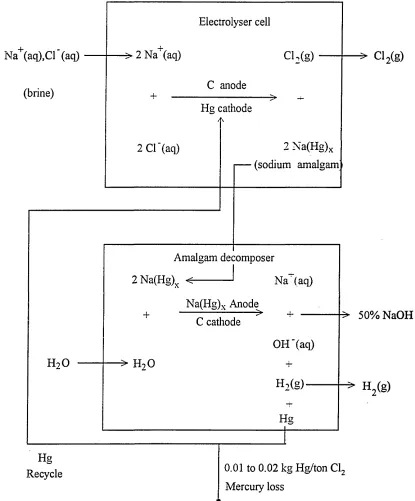
High concentrations o f mercury in the aquatic environment are almost invariably associated with chemical plants manufacturing chlorine, sodium hydroxide, and
R E A C TA N TS PRO CESS P R O D U C T S
Na (aq),Cl (aq)
(brine)
H 20
Hg
Recycle
Electrolyser cell
2 Na (aq) CU(g)
C anode
+
■>
Hg cathode
2 C l(aq) 2 Na(Hg)x
(sodium amalgam
Amalgam decomposer
2 Na(Hg)x
<
---1 Na (aq)+ Na(Hg)x Anod^
C cathode
-> H 20
OH"(aq)
H2(g) R>
Hg
0.01 to 0.02 kg Hg/ton Cl2 Mercury loss
1982 EC directive for mercury discharge standard: 50 pg 1
» ci2(g)
50% NaOH
H 2(g)
[image:15.613.97.512.105.606.2]mercury) is relatively stable it forms at the cathode instead o f gaseous hydrogen:
C anode: Cl" (aq) — > C l2(g) + e" (1.1.1a)
Hg cathode: Na+ (aq) + e" + Hg — > Na(Hg) (1.1.1b)
(sodium amalgam)
Hg + Na+(aq) + Cl" (aq) — > Na(Hg) + Cl2(g) (1.1.1c)
The liquid amalgam is then allowed to flow into a decomposer where it becomes the anode. The sodium is oxidised back to Na+ and hydrogen is released at a carbon cathode:
C cathode: H20 + e " --- > H2 (g) + OH- (aq) Na(Hg) anode: Na(Hg) ---> Na+(aq) + e" + Hg
Na(Hg) + H20 ---> Na+(aq) + OH'(aq) +H2(g) + Hg
(1.1. If)
The mercury ( except for a small fraction ) is then recycled to the electrolyser and concentrated sodium hydroxide removed for sale. The 0.01 - 0.02 kg o f mercury lost per tonne o f chlorine seems a small quantity until one takes account o f the fact that
nearly 2500 tones o f chlorine are produced in mercury cells each day. Treatment o f waste from mercury cells with sulphur powder columns has been used to minimise mercury pollution, but a great quantity o f mercury is still lost to the environment. It was assumed for a long time that because mercury sulphide is relatively inert and insoluble, it would settle rapidly to the bottoms of rivers and lakes and remain there. In fact most o f it did just that, but many researchers discovered that certain anaerobic
(l.l.l.d)
bacteria are capable of decomposing and methylating insoluble mercury salts, converting approximately 1% o f what is contained in the sediments to methylmercury,
and dimethylmercury. This permits mercury to enter the water phase and the fresh water food chain and accounts for the high concentrations observed in fish [ 6,7 ].
Once the role of mercury cell chloro-alkali production in fresh water mercury
pollution was recognised, steps to control discharges were rapidly taken.
Native mercury enters the atmosphere through the actions o f volcanoes and
earthquakes and evaporation from water and soil surfaces. The background level o f mercury in the atmosphere under "normal" conditions has been variously estimated at less than 1 }ig m~3. However, localised natural deposits may increase this level as much
as twenty fold.
Man's industrial activities dramatically augment atmospheric levels, especially in enclosed areas. In electrical and chloro-alkali factories, the concentration o f mercury in air may be in excess of 0.1 mg m"3, and even higher closer to the source o f emission.
Traces o f mercury occur in all plants and animals so far examined. Plants may absorb and concentrate mercury from soil, even to the extent that droplets o f the metal have been found in the capsules o f chick - weed [ 8 ]. Levels o f mercury in plant tissue were reported from 0.2 - 45 mg kg"l ( dry weight ) [ 9,10 ]. Animals, which are involved in long food chains, tend to accumulate a level of mercury far in excess o f that found in their immediate environment. For examples, predatory birds, such as owls, eagles and falcons, are sometimes found to have greater than 100 mg k g 'l o f mercury in certain organs ( especially the livers and kidneys ). This mercury may have come from natural sources but it is more frequently from seed dressings, water pollutants,
1.1.2 Biochemical Pathways of Mercury in The Environment.
It is apparent that, whilst inorganic forms o f mercury are toxic to plants and animals, organic complexes may prove to be more toxic and a long term hazard in the environment.
Mercury and its inorganic compounds undergo a variety o f chemical and biological transformations. For example, it is now well known that methyl- and dimethylmercuiy are found in the aquatic environment due to the activities o f free-living bacteria and fungi. This methylation process has also been observed to be mediated by enzyme systems in rotting fish and lake sediment, in addition to that caused anaerobically by the methanogenic fungus and members o f the genus. It is suggested that this is a chemical process in which methylcobalamin is involved [11 -1 3 ], The methylation is
CH.
N, :N N,
Hg
2+OH
;N N
N'
L— 1SI
LN N/
.Co
:N
L.
-HgOAc:N, Co
I / 1 \ 1
N -H N
+ CH3Hg (1 .1 .2 )
L_
Nachieved by at least two biochemical pathways. One route is non-enzymatic under anaerobic conditions. The mercury (II) ion is methylated by methylcobalamin, a methyl derivative o f Vitamin B12, formed by methane producing bacteria.
As the reaction requires anaerobic conditions and since in these conditions the main source o f mercury is mercuric sulphide, it is unlikely that the reaction takes place to any great extent. The aerobic pathway occurs within cells, in which methionine is normally
enzyme enzyme
Both reactions are possible in the upper sediments, particularly sediments in
shown in Figure 1.2. The reactions are also favoured by low pH. Methylation may also occur for other species present in water, e.g. metal ions from elements such as Pb, Sn, Si, Tl, Pt.
It would appear that mercury in water sediment is in two forms. In the upper sediments the material is biochemically active, while in the lower ( inorganic mineral layers ) there is little or no activity, and weathering may be the only way the mercury is
released again. The upper sediments are involved in the sorption o f cations, and mercury (II), one of the poorly sorbed ions, is easily replaced by other cations.
suspension, where the outer surface is aerobic and the inner surface anaerobic. This is
water aerobic methylation
s o32' /s o4,2'
upper sediment HgS Hg2+ anaerobic methylation
lower sediment HgS
A series o f chemical and biochemical reactions tend to lead mercury to the end products methylmercury and dimethylmercury, both o f which are concentrated in fish,
and so become involved in the food chain. Although not much methylmercury is produced in water sediments, it is bioamplified and since a great deal o f mercury is present in w ater sediments one can expect its formation to continue for a long time.
1.1.3 The Use o f Mercury in Industry
Mercury is used primarily in elemental form because it is the only unreactive metal that is a liquid at ordinary temperatures and hence can be used as a fluid conductor o f electricity. The largest tonnage use of mercury in industry is in the Castner-Keller process for making chlorine and caustic soda by the electrolysis o f brine, using a rocking mercury cathode. It is still very widely used; The products inevitably contain traces o f mercury and, since they have so many outlets, have added to the mercury burden o f the environment. ( One of the main parts of this research was a field survey on distribution and speciation of mercury along Manchester Ship Canal; it is chlorine manufacture that is thought to have been responsible for the major inorganic mercury discharge into the canal for many years. This is reported in Chapter 4 .)
CH3-HgCl
Methylmercuric chloride
CH3-Hg-CH3 Dimethylmercury II CH3-Hg-CN
Methylmercuric nitrile
Cj> C H 3- H g - 0 - C - C H 3
Methylmercuric acetate
Figure 1.3 Structures of some organomercurial compounds
released to the environment
1.1.4 The Chemistry of Mercury
M ercury has the electronic configuration [Xe] 4 fl^ 5 d ^ 6 s^ . It loses two electrons ( but no more ) to form dipositive ions. Since the values o f standard electrode potentials for the couple Hg^+/Hg and Hg2^+/Hg are so similar ( +0.854 / +0.793 )
[ 14 ], essentially all oxidizing agents are able to oxidise mercury to mercury (I) and further to the mercury (II) state. Therefore many mercury (II) compounds may be also
readily reduced to the Hg (I) or mercurous state. In Hg (I) compounds, tw o mercury atoms are associated to give Hg2^+ ions. Such compounds are always diamagnetic,
whereas an Hg+ ion { [X e]4 f^5 d ^ 6 s^ } would be paramagnetic with one unpaired
electron.
CH3-Hg-OH
Hydroxomethylmercury II
/(
Hg— O— C— CH,Acetatophenylmercury II
CH3CH2-Hg-Cl
Ethylmercuric chloride
CH 3- H g — N H -C ,*n h X N— CN
Mercury has so many peculiarities o f it's own that it stands quite apart from the
other metallic elements. The most important of these, though by no means the only
one, is it's very high ionisation potential in the gaseous state. The values [ 15 ] for the
first and second ionisation's of this element are:
First Second
Mercury 10.43 18.75 eV
The value o f 10.43 eV is higher than that for any cation-forming element except
hydrogen ( 13.53 ), which explains it's strong tendency to form covalent rather than
ionic bonds. M oreover it has a strong tendency to form covalent links with sulphur,
nitrogen and chlorine, and to a lesser extent with chlorine, bromine, and iodine, but not
with fluorine ( owing to the weak acidity of hydrogen fluoride ).
It is known that for mercury the s-p energy separation is relatively large, hence promotion to the valence state (5d^6s^6p^) is difficult; This is no doubt associated with the relative inertness of mercury and also with its low electron affinity, as the added electron will occupy a p orbital. On the other hand, the small d-s separation for
Hg2+ suggests that d-s mixing may occur, resulting in a distortion o f the coordination arrangement [ 16 ]. This is why inorganic mercury ions often occur as various complex forms with different coordination numbers, and both inorganic and organo mercury species in natural and polluted waters normally coordinate to give anions. In the presence o f chloride ions Hg (II) forms chloro-complex species ( e.g. in sea waters ). The donor atoms o f the ligands are p-block elements, in particular S, N, O, and Cl in
natural waters. These properties provide a theoretical basis o f improving our understanding o f states of different mercury species in waters.
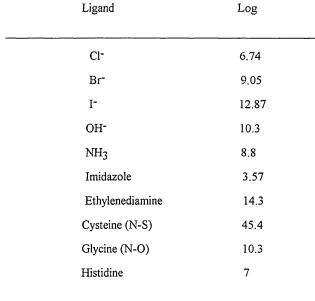
ligand. Stability constants for some mercuric complexes are listed in Table 1.2.
Reactions with these groups can result in different complexes depending on whether
the metal is present as Hg2+ or R-Hg+, whether the ligand is a mono- or di-thiol, and
dependent on the relative concentrations o f mercury and -SH groups. Importantly,
complexes o f the type R-Hg+ bind sulphydryl group stoichiometrically [ 17 ], which is fundamental to specific and quantitative deposition/elution o f mercury in this work.
Table 1.2 Stability constants of 1:1 mercuric complexes#
Ligand Log
ci- 6.74
B r 9.05
I- 12.87
OH- 10.3
n h3 8.8
Imidazole 3.57
Ethylenediamine 14.3
Cysteine (N-S) 45.4
Glycine (N-O) 10.3
Histidine 7
[image:23.617.149.464.303.604.2]It was reported [ 1 8 ] that the hydrogen ion concentration can affect formation o f the
Hg-S complex, and that the presence o f other ligands competing for mercury also
affects the binding o f mercury with -SH groups.
M ost proteins contain various ligands for binding with mercury, including
sulphydryl groups. There are also numerous enzymes that react with organic and
inorganic mercurials with resultant changes either in spectral characteristics or in
enzyme activity. In addition, most bacterial and plant proteases have -SH groups
essential for proper functioning, and most are inactivated due to the formation o f Hg-S
bonds [ 19 ]. This loss o f activity, however, is not due to actual loss o f -SH groups but
to a change in protein conformation [ 20 ].
Organomercury compounds are species in which there is bonding between mercury
and organic carbon. Organomercury derivatives, some o f which are shown in
Figure 1.2 are typically covalent compounds. Mono-alkylmercurials are very important
species in the light o f environmental toxicology. Methylmercury behaves as a class b
acceptor ( a soft acid ) and readily reacts with large sulphur donor atoms in amino
acids. The nature o f RHgX derivatives, depends markedly on the electro-negativity o f
halogen (X). Because of the substantial ionic character o f the Hg-X bond, ionisation o f
RHgX is significant. Such derivatives tend to dissolve readily in polar solvents, such as
water. The cation MeHg+ has been likened to H^; Also the degree o f dissociation o f
M eHg-X in water is often similar to that of H-X [ 21 ]. This property is critical for the
separation o f MeHgCl from other mercury species by means o f ion exchange.
It is quite well known that the methylation o f mercury to CH3Hg+ occurs in the
aquatic environment and is significant as regards Hg toxicity. The methylation has been
widely reported to arise from biochemical pathways. Even so, there are just tw o classes
simple preparative routes. There is however considerable diversity in the nature o f the
organic radical R. The mechanism o f transfer o f alkyl groups from various metals to
mercury (II) salts has been reported by McAuliffe [17]. For example, transmetallations
o f mercury (II) salts with tetraalkyltins in methanol/water mixtures was shown and this
is illustrated in the following reaction:
R4Sn + HgX2 > RHgX + R3SnX ( X = C l I ) (1.1.4)
In work reported later in this thesis, a high degree o f correlation between alkyllead
and methylmercury distributions was observed from a field survey carried out in the
Manchester Ship Canal. Presumably, a similar transmetallation between alkyllead and
mercury (II) can occur; Both lead and tin belong to the same family in the periodic
table and have a similar outer electronic structure. A detailed discussion o f this topic is
given in Chapter 4.
An important chemical reaction of organomercury is the replacement o f mercury by
halogens, which is termed halogeno-demercuration. All kinds o f diorganomercurials
and organo-mercurials react with chlorine, bromine, or iodine under a variety o f
generally mild conditions to yield alkyl halides and mercuric halides, as illustrated in
equations (1.1.5) and (1.1.6):
R2Hg + X2 — > RX + RHgX (1.1.5)
RHgX + X2 — > RX + HgX2 (1.1.6)
A variety o f other reagents have been used to bring about halogenodemercuration.
These include Br2, I3‘, and IC1, cupric halides and cadmium halide [ 22 ].
converting organomercury into the inorganic form.
Diorganomercurials can also be decomposed by mineral acids, the process being
termed acidolysis [ 22 ]:
R2Hg + HX — > RH + RHgX
RHgX + HX — > RH + HgX2
(1.1.7)
(
1
.1
.8
)Vigorous conditions are required for the second stage. This acidolysis, as a method o f
wet digestion, has been applied to the pretreatment o f samples for total mercury
determination by many workers.
The reduction of organomercury compounds is another important reaction which
has been studied and applied to the cleavage of the Hg-C bond. Fortuitously, the
reduction yields a hydrogeno-demercuration product and is carried out either with
sodium amalgam, hydrazine or electrolytically [ 23 ]. However, metal hydrides are the
best reagents for effecting reductive demercuration, the process being rapid and usually
remarkably free o f side reactions. Among the hydrides that have been used are lithium
borohydride, lithium aluminium hydride, and sodium trimethoxyborohydride [ 24 ]. By
far the most popular reagent, however, is sodium borohydride in aqueous sodium
hydroxide. This was developed in 1966 by Bordwell and Douglass [ 25 ], who
established the stoichiometry to be that shown in equation (1.1.9):
This reaction has been successfully used for organic synthesis and also applied to the
conversion o f organomercurials to inorganic mercury for speciation and determination 4RHgCl + 4 0 H “ + BH4- ~> 4RH + 4Hg + 4C1" + H2B 0 3“ + H 20 (1.1.9)
1.1.5 General Problems of Mercury Pollution
Mercury is distributed widely in the earth's crust, in sea, ground and rainwaters, in
plants and animals. Importantly, all phyla and species naturally contain trace levels,
present either as inorganic or organomercury compounds, or both. It is known that
mercury participates in the biological life cycle. The biological conversion o f inorganic
mercury into organomercury is particularly significant since extensive industrial and
agricultural usage of mercurials affects and increases the distribution in specific regions.
The toxic effects of mercury depend, inter alia, on it's chemical form, the size o f the
dose, and the route of entry into the body. Metallic mercury can enter the body by
ingestion, through the skin, and by injection. If swallowed it passes through the
gastrointestinal tract without being absorbed and hence causes little or no adverse
effects. Inhalation of mercury vapour can cause either acute or chronic effects. If
metallic mercury is heated, it can liberate vapour of sufficient concentration to produce
severe or even fatal effects. The classical manifestations in such instances are fine
tremors, gingivitis and erethism.
Best known among inorganic mercury compounds for being toxic is mercuric
chloride ( corrosive sublimate ). A gram or two taken by mouth will cause corrosion o f
the oesophagus and stomach, resulting in vomiting and diarrhoea as well as bleeding
from the intestinal tract. When absorbed into the body, inorganic mercury tends to be
deposited in the kidneys in higher concentrations than in any other organ and tissue
[31 ], Ordinarily these deposits have little or no pathological effect.
Organomercury compounds are very hazardous and their inhalation, ingestion or
absorption via the skin leads rapidly to nervous system disorders. From a toxicological
point o f view it is necessary to distinguish between three classes o f organo- mercurials:
alkyl, aryl, and alkoxyalkyl. O f the three, alkyl-mercury derivatives present a special
damage. The most disastrous case of environmental mercury poisoning, and perhaps
the most illustrative of the complicated ecological pathways o f mercury, occurred
about 40 years ago in the Japanese fishing port of Minamata [ 1 ]. A chemical company
constructed a plastics plant which used organomercurials as catalysts and each year a
small quantity of methylmercuric chloride was discharged into the M inamata river and
adjacent Yatsushiro Bay. In 1953. a strange illness affected the local people. This came
to be known as Minamata disease. By 1963 it had been established that the "disease"
was caused by mercury in the staple food of the community - fish taken from the Bay.
By 1975, it was estimated that as many as 10,000 persons had been affected by
Minamata disease, 703 seriously and permanently maimed and more than 100 killed, as
well as the birth of numerous babies with congenital defects. In Japan a research
institute has been established to study the health related effects o f mercury poisoning
[ 1 ],
The role and behaviour of methylmercury in aquatic ecosystems and particularly in
food chains has been given considerable attention. A number o f reports have revealed
that the predominant form of mercury in aquatic life is methylmercury [ 32-36 ].
Methylmercury may be present not only as a result of man-made pollution but also
from natural biological processes. An important aspect of the Minamata disease is the
extent to which mercury becomes concentrated in fish relative to the waters o f the Bay.
Certain substances, of which methylmercuric chloride is an excellent example, tend to
be concentrated along ecological food chains, by a process known as bioamplification.
Any substance which is slightly more soluble in the tissues o f simple organisms than in
the surrounding water will be a more concentrated component o f the diet o f the more
complex species which feed on the simple ones. Thus, at each higher tropic level in the
food chain the toxin becomes more concentrated. Since humans are usually at the top
diets, with tragic results such as Minamata disease.
Once in the human body organomercurials and divalent mercury both react with a
large number o f enzymes, usually inhibiting catalysis o f essential metabolic reactions
[ 37 ]. This apparently results from the strong bonds formed between the large Hg ions
and sulphydryl group (-SH) on the amino acid cysteine in enzymes. The mercury-
containing groups can disrupt the enzymes' structure [ 37 ], consequently impeding its
catalytical function.
CH3HgCl + Enzyme-SH —> CF^Hg-S-Enzyme + H+ + Cl" (1.1.10)
The specificity and affinity of the sulphydryl group (-SH) for inorganic and
organomercury species has been exploited in the work reported later in this thesis.
Fish in'contact with water containing mercury at 0.01 pg H in solution and 300pg
kg~l in sediments, have been found with concentration o f 314 pg kg"* in their flesh, a
31,000 bioamplification (over the water levels). At Minamata, mercury levels in some
fish attained 50 pg g 'l (50 ppm) wet weight in contrast to other regions where levels
around 0 . 2 pg g~* were common.
To conclude we can say that the toxicity and biological effects o f mercury, in both
its organic and inorganic forms, strongly depend on its chemical forms. Consequently,
the ability to distinguish different forms of mercury in the hydrosphere gives an
increasing awareness of its presence and distribution in the environment as well as its
toxicological importance in terms of its environmental impact. The various
methodologies and techniques used for mercury speciation have undergone rapid
development in the last 30 years and will be discussed and evaluated in the next
1.2 A nalytical M ethods for D eterm ination and Speciation o f M ercury
Although numerous methodologies and techniques have been developed for
mercury speciation, only a few are considered to be well suited to the determination o f
different mercury species present at ultra-trace concentrations ( pg I-1 - ng I-1 ) in
waters and other environmental samples. Such procedures should provide extremely
high sensitivity so that pre-analysis manipulation of the sample is not necessary. In this
section, the techniques offering the best combination of advantages for mercury
speciation are classified and discussed, according to their modes o f detection namely,
(1) Cold vapour - atomic absorption and atomic fluorescence spectrometry with
various sample pretreatment procedures;
(2) GC and HPLC methods with solvent extraction;
(3) Atomic emission spectrometry and mass spectrometry with various separation
and pretreatment processes;
(4) Hydride generation - cryogenic trapping with GC - GFAAS.
1.2.1 Cold Vapour - Atomic Absorption Spectrometry and Cold Vapour - Atomic
Fluorescence Spectrometry With Various Sample Pretreatment Procedures
Cold vapour - atomic absorption spectrometry ( CV-AAS ) and cold vapour -
atomic fluorescence spectrometry ( CV-AFS ) methods detect mercury in its elemental
form. Therefore, the determination and speciation o f mercury require decomposition o f
the organomercury species. Up to now, all decomposition methods have been either (a)
two step processes ( e.g. oxidation and reduction ) or (b) a one step process
( reduction). These are discussed separately.
Two Step Pretreatment
developed 2 decades ago [ 38,39 ] remains preminent, and constitutes the basis o f
official/reference methods [ 40-43 ]. In a typical determination, the inorganic mercury
in the sample can be determined directly following reduction to elemental form. Total
mercury can be determined by prior decomposition of all organomercury species into
inorganic mercury followed by the use of reducing agent as before. Organomercury is
determined by difference. It is apparent that the chemical pretreatment o f samples for
mercury speciation by CV-AAS or CV- AFS requires an oxidation and a reduction
step.
The most widely used reducing agent is tin chloride in acidified media. Kimura and
Miller [ 44 ] were the first to use the reaction between inorganic mercury (II) and
tin (II), as a means of isolating the metal from it's matrix. Since then, numerous
methods have adopted the same principle.
Another step in the pretreatment o f samples containing organomercurials is the
conversion o f organo-bound mercury into the inorganic form. The very low
concentration of different mercury species in natural waters makes it critical to achieve
maximum conversion efficiency and to avoid any contamination. A wide variety o f
procedures have been employed for this purpose.
The earliest proposal, made by Armstrong et al. [ 45 ], was the use o f ultra-violet
radiation as a means o f oxidising organic matter in sea water prior to the determination.
In this case for the determination of total phosphorus. Soon after, ultra-violet
irradiation coupled with CV-AAS was used by a number o f workers for the
determination o f organomercury compounds and mercury speciation : in river waters
by Goulden and Afghan [ 46 ], in sea waters by Fitzgerald et al.[ 47 ], in industrial
waste water by Dujmovic and Winkler [ 48 ], and in natural water by Kiemeneij and his
co-worker [ 49 ]. Determinations with and without irradiation made possible the
reported that complete photo-oxidation took at least 24 hours. Winkler and his co
worker completely decomposed a range o f organomercury compounds in less than 1 0 minutes with either a 150 W medium- pressure or a 15 W low-pressure U.V source.
Kiemeneij et al. found only 60% of methylmercuric chloride was oxidised in 20 minutes
when using a pure mercury lamp, but 1 0 0% in 1 0 minutes with a zinc / cadmium / mercury lamp. Some detailed work on the efficiency of ultra-violet irradiation was
carried out by the Mercury Analysis Working Party of the Bureau International
Technique Du Chlore [ 50 ]. It reported that a range of organomercury compounds
could be completely oxidised to the ionic state by UV irradiation in 15 minutes or less
and that sample volumes up to 2 litres can be treated with no increase in irradiation
time when using efficient stirring. However, some results showed that organic matter in
waters seriously reduces the efficiency in which the organo-mercury compounds are
destroyed. It was considered advisable, therefore, to restrict the UV irradiation method
to drinking water and "clean" river water. It was also stated that care should be taken
and that only water miscible organic solvents should be used to prepare the
organomercury master calibration solutions.
In recent years few reports have been published concerning mercury speciation
except for a study by Morita and Sugimoto [ 51 ], who used an automated flow
injection (FI) system consisting o f an on-line ultra-violet and acid digestion manifold.
Organomercury compounds were decomposed in a flow system by first merging the
sample stream with a stream of 0.5 M of sulphuric acid and then irradiating for 1.5
minutes with a UV lamp of 400 W prior to reduction and detection. The limit o f
detection was reported as 0.18 pg 1"^, and the sampling rate up to 2 0 samples per hour.
The decomposition of organomercury compounds under various stimuli and
mechanisms has been widely studied [ 52, 53 ]. Over a quite long period, oxidation
been the subject of an interlaboratory trial carried out jointly by the ASTM and the
EPA o f U.S [ 54,55 ]. It was generally agreed that oxidative conversion of all forms o f
organomercurials in waters to inorganic form is feasible prior to reduction to elemental
mercury. A variety of strong acids ( HC1, H2SO4, HNO3 ), oxidants (H2O2,
KMn0 4 , K2Cr2 0 7, K /^ O g ) and elevated temperatures have been used and officially
recommended. As with conversion of organomercury into inorganic mercury, many
workers in this area have favoured a number of different combinations. Early trials
were done by Hatch et al. [ 39 ], who used CV-AAS detection following oxidation o f
organic matter with sulphuric acid and potassium permaganate. The limit o f detection
for total mercury in solution was reported as 1.0 pg H . Omang [ 56 ] utilised a
mixture o f potassium permanganate and sulphuric acid, with overnight standing time.
The oxidation procedure was thoroughly investigated by different workers [40,57-69],
who tested various oxidative systems, as listed in the results presented in Table 1.3.
Their results indicated that because of the presence of powerful oxidising reagents
there is a high tolerance to organic pollutants and chloride. However, high blanks
reduced the sensitivity of the method. Strict control of blanks was necessary for
determinations at concentration of 1 pg H Hg and below.
Ping and Dasgupta [ 60 ] recently reported successful conversion using Fenton's
reagent ( Fe II + H2O2 ) for speciation of mercury in water and urine samples.
Satisfactory recoveries were obtained for inorganic, methyl- and phenyl- mercury.
As discussed in section 1.1, both organomercury and diorgano-mercury compounds
react with chlorine, bromine, or iodine under a variety o f generally mild conditions to
give cleavage o f the Hg-C bond. The stability of bromine solution and excellent
reaction efficiency for brominolyses makes bromine a preferred choice in analytical
applications [61 ]. In this work an on - line brominolysis was used for decomposition
Table 1.3 V arious w et digestion procedures for m ercury determ ination*
Wet digestion procedures Measurement
Boiling with potassium persulphate in nitric acid AFS
Boiling with potassium persulphate in nitric acid AAS
Heating at 80°C for 9 h with potassium
permanganate in sulphuric acid AAS
Boiling with potassium persulphate AAS
Hydrochloric acid and a bromide/bromate solution AAS
Heated at 80°C for 4 h with potassium persulphate AAS
Boiling with potassium permanganate in sulphuric acid AAS
* Data from reference 58.
One Step Pretreatment
In contrast to the oxidation procedures, reductive decomposition o f organo
mercury compounds occurs more readily, is simpler and more efficient with a single
step to elemental mercury.
Amongst a few candidate reagents sodium borohydride is a preferred choice.
Nevertheless, it has rarely been used in analytical procedures for mercury speciation as
first reported in 1971 by Braman [ 26 ]. Shortly thereafter Sharma and Davis [ 62 ] and
Taffatetti et al [ 63 ] reported the use o f this reagent for conversion o f organomercury
in w ater and urine samples. Oda and Ingle [ 64 ] described methods using selective
reduction with tin chloride and sodium borohydride for determinations o f inorganic and
[ 65 ], and sodium borohydride-cupric sulphate [ 6 6 ] have also been reported. This
one step process is, to some extent, attractive because of it's simplicity and freedom o f
reagent blanks relative to the 2 step procedures. A one step procedure has been
investigated recently in some detail [ 67,68 ].
1.2.2 Comparison Between Cold Vapour - Atomic Absorption Spectrometry and Cold
Vapour - Atomic Fluorescence Spectrometry Techniques
The most convenient and widely used measurement techniques for the
determination and speciation of mercury in environmental samples, especially in waters,
are CV-AAS and CV-AFS utilising the 253.7 nm line.
The basic reaction for the spectroscopic transition o f elemental mercury is
illustrated as below:
Hg° + hv ==== Hg°* (1.2.1)
where H g° is ground state mercury atom; Hg°* is excited mercury atom; h is Plancks
constant and v is frequency ( hv is the photo energy ). The ground state atom absorbs
energy to yield the excited state which emits radiation through de-excitation. Atomic
absorption can occur when radiation of a selected frequency passes through a vapour
containing ground state atoms. Some o f the radiation can be absorbed by excitation o f
the atoms, and the intensity of the radiation at a wavelength corresponding to the
energy o f the photon hv is decreased. If the concentration o f R ° in the vapour is
increased, the decrease in radiant energy will be greater. Since each species o f atom can
exist only in specific excited states, the photon energies required for each atomic
species will be different. Only photons at the wavelengths corresponding to specific
signal is directly related to the number o f ground state atoms in the optical path o f the
spectrometry, and this is the basis of atomic absorption spectroscopy. The application
o f atomic absorption spectrometry to analytical chemistry began by Walsh [69] in 1955
and with the determination of mercury by Dean and his co-workers [70] in the 1960s'.
In the case o f mercury, the excitation energy for mercury atoms using the 253.7 nm
line is 4.88 ev [ 71 ]. The resonance line at 253.7 nm is the one most commonly used
for the atomic absorption measurement [72], A simple diagram expressing the
spectroscopic transition process for mercury is shown in Figure 1.4.
excited state
absorption
ground state
4.88 ev resonance fluorescence
Figure 1.4 Diagrammatic representation of the atomic
absorption and fluorescence of mercury
Atomic fluorescence is the result o f the initial absorption o f resonance radiation
followed by re-emission at the same or some low frequency:
Hgo* — > H g° + hv (1.2.2)
In analytical atomic fluorescence the sample is reduced to an atomic vapour and then
excited by radiant energy o f a suitable wavelength. The excited atoms emit energy
when they return to the lower excited state to the atomic ground state. The intensity o f
emitted fluorescence energy is measured and is a function o f the concentration o f the
exciting radiation to decrease the amount of scattered radiation, from the excitation
source entering the monochromator. This arrangement is particularly important in the
case o f resonance fluorescence when the excitation radiation is o f the same wavelength
as the fluorescence radiation. Mercury emission at 253.7 nm is due to resonance
fluorescence [ 73 ] ( also see Figure 1.4 ). The mercury atomic fluorescence analysis
line is also 253.7 nm [ 72 ].
The spectral theory pertinent to atomic fluorescence as a viable spectrometric
analytical procedure was given initially by Winefordner and Vickers [ 74 ]. A
theoretical inference made by West [ 75 ] suggested that cold vapour atomic
fluorescence spectrometry should be more sensitive and produce considerably less
spectral interference from non-specific absorption compared with the corresponding
atomic absorption spectrometry technique. This theoretical inference was later verified
experimentally by Thompson and Godden [ 76 ], and a considerable number o f appli
cations have also been reported [ 77-79 ]. Today, although the most commonly used
method for determination and speciation of mercury is cold vapour - atomic absorption
spectrometry, there are several disadvantages associated with the use o f atomic
absorption spectrometry as the means of detection. There is a limited linear calibration
range and spectral interference arising from non-specific background absorption [ 77 ].
Furthermore fluorescence measurements result in approximately one order o f
magnitude lower detection limits than those given by absorption measurements [ 72 ].
That is because fluorescence is measured relative to the background signal, whereas
atomic absorption is measured as the difference between two relatively intense signals.
In the former case, electronic amplification is a more effective procedure, and photon-
counting detection can be used to advantage. Additionally, for the determination o f
mercury, the atomic fluorescence system is inexpensive and simple in both construction
1.2.3 Atomic Emission Spectrometry and Mass Spectrometry With
Various Separation and Preconcentration Procedure
Atomic emission spectrometry ( AES ) and mass spectrometry ( MS ) are powerful
analytical techniques, and have been actively researched in recent years. The coupling
o f chromatography and use o f state-of-the-art excitation sources offer considerable
potential for element speciation and determination, particularly where high sensitivity is
required.
Atomic Emission Spectrometry
The earliest work in the application of AES to mercury speciation was done
independently by Braman [ 26 ] and Bache et al. [ 81 ]. The former determined
metallic, dimethyl- and total mercury in waters after sodium borohydride reduction and
membrane probe diffusion prior to spectral emission detection. A lower limit o f
detection was reported down to 4 parts per trillion. Bache [ 81 ] applied coupled gas
chromatography with microwave emission spectrometric method to the analysis o f
methyl mercury in fish samples. This method extended the pioneering w ork by W estoo
[82], which consisted of extraction o f a fish sample with hydrochloric acid, extraction
o f methylmercury into benzene, cleavage of Hg-S bond, isolation o f methylmercury as
hydroxide and finally reconversion to the chloride for gas chromatography separation.
Five kinds of organomercuric compounds were tested, and the absolute detection limits
reported for different organomercuric compounds were from 0 . 6 - 8 . 8 ng.
Much of the systematic work in mercury speciation using microwave emission
spectrometry ( MES ) can be attributed to Giovanoli and Greenway [ 83 ] and Talmi
[ 84 ]. They discussed the practical aspects of MES with direct alkaline digestion or
procedures, enhancement of sensitivity, and a number of useful determinations for
methyl- and dimethylmercury. The limit of detection for the analysis o f 50 ml water
samples was reported as i ng I- *. Further developments include application o f
microwave induced plasma emission spectrometry with alkaline digestion to speciation
o f mercury in biological samples [ 85-88 ]. For example in 1983, Chiba and Fuwa [ 89 ]
determined alkylmercury in sea water at the nanogram per litre level using atmospheric
pressure helium microwave induced plasma emission spectrometry. In comparison with
Talmi's work, the Fuwa study obtained a 500-fold sample preconcentration factor and
reported the methylmercuric chloride in selected seawater as 2.03 ng 1“* with 89%
recovery.
A semi-automated GC-MES system for speciation of mercury in biological samples
has also been described by Decadt and Baeyens [90]. They proposed two procedures
based on the quantitative formation of iodoacetic acid - organomercury complexes and
selective extraction into a organic solvent. The limit o f detection o f methylmercury was
1.5 pg 1"! of homogenate.
Krull and Bushee [ 91 ] were pioneers in the development o f inductively coupled
plasma - atomic emission spectrometry ( ICP-AES ) for mercury speciation. They
demonstrated that high performance liquid chromatography (HPLC) can be used to
separate different mercury species, and with a post-column cold vapour generation
detection limits ranged from 32 to 62 pg 1"! for four mercuric compounds.
Panoro and Erickson [ 92 ] used a direct current plasma -atomic emission
spectrometer (DCP-AES) interfaced with GC to perform highly specific determinations
o f methylmercury in biological samples. Optimisation o f the GC-DCP-AES interface
resulted in a limit of detection of 38 pg H . Most recently, a microwave plasma ( M P )
- AES coupled with capillary gas chromatography and an alternative current plasma
[ 93 ]. Colon and Barry [ 94 ] combined an alternative current plasma ( ACP ) - atomic
emission spectrometer ( AES ) with HPLC. Both groups obtained limits of detection
down to ng H level or lower for the determination o f organomercurials in
environmental samples.
Mass Spectrometry
Mass spectrometry (MS), which has been rapidly developed and widely used in the
last 2 0 years, is mainly characterised by high speed, sensitivity and selectivity in the
structural determination of organic compounds.
The first attempts at mercury speciation by gas chromatography - mass
spectrometry were made by Jenson et al. [ 33 ] in 1969, and later by W estoo and his
co-workers [ 95 ] using the isotope dilution technique. Isolation o f different
organomercury compounds by multi-extractions prior to gas chromatography
separation and sensitive quantitation by isotope dilution - mass spectrometry detection
were achieved. During the last 15 years, GC-MS has been widely utilised for
determination and speciation of mercury in biological samples and in water samples
[ 96-100 ]. This method offers some advantages over GC-AES procedures for mercury
speciation, because of increased sensitivity and being less prone to interferences.
However, the disadvantages of the method due to the limitation o f preconcentration by
extraction and the small quantity o f sample used in GC ( pi level ), restricted it's
application to the speciation of mercury in water samples. The limit of detection
reported for organomercurials in aqueous solutions was at the 1 ppb level after solvent
extraction into benzene and concentration of this extract to a few microlitres.
The high detection power of inductively coupled plasma mass spectrometry ( ICP -
MS ) makes possible the determination and speciation of mercury in biological and
interest for this technique are it's low detection limit, it's freedom from spectral
interferences, and the possibility of isotope dilution analysis. Beauchemin et al. [ 101 ]
have proposed a method which describes the extraction o f organomercurials from
biological matrices with the subsequent determination o f mercury after sample
introduction by the How injection ( FI ) technique. A simple isotope dilution analysis
was also reported. This method has been applied with excellent results to
organomercurials in two marine biological standard reference materials.
Bushee [ 102 ] proposed a HPLC - ICP - MS system for speciation o f mercury in
tuna and in contact iens solutions. The limits of detection in the low pg 1"* region were
improved further by post-column cold-vapour generation. Spiked water samples were
also used to validate the method. It is apparent that pretreatment procedures for ICP-
MS detection to some extent complicate sample handling and thereby increase the
problem o f contamination. A further development of ICP-MS for mercury speciation in
natural waters and reference sediments has recently been described by Haraldsson and
his colleagues [ 103 ]. Cold vapour generation with sodium borohydride was integrated
with the nebuliser flow and used to convert all organomercuric compounds into
elemental form. The outlet tubing from the generation vessel was connected directly to
the plasma torch. The method gave a limit of detection o f 0.08 ng H with precision o f
3% at the 1 ng H level.
1.2.4 Gas Chromatoizraphv and High Performance Liquid Chromatography W ith
Solvent Extraction
The speciation of mercury in biological materials and water samples using gas
chromatography (GC) and high performance liquid chromatography (HPLC) has been
studied by a number o f authors [ 104,105 ]. In this section, only GC-electron capture
general GC and HPLC techniques, are discussed. Other combined techniques are
covered in other sections according to their modes of detection.
Gas Chromatography - Electron Capture Detection
Since the pioneering achievement of Westoo [ 82,106,107 ] and o f Sumino
[ 108,109 ] in the 1960's, considerable efforts have been expended in the development
o f reliable, precise, and sensitive methods for the gas chromatographic determination o f
alkylmercuriais, particularly in fish, other biological samples and in waters. The
potential utility o f some organomercury compounds for the determination at trace level
o f various inorganic species by means of GC after their conversion into organic
derivatives has also been investigated. Most of the published methods involved
extraction o f organomercurials halides [ 33, 110-116 ] or other derivatives, e.g.,
dithizonates [ 117]. An extraction procedure is necessary to remove the sample matrix,
which could otherwise poison the column. Matrix separation is achieved by adding to
the organic phase a reagent such as cysteine [106-110], glutathione [ 1 1 1 ], or
thiosulphate [ 1 1 2 ], which form strong water soluble alkylmercury complexes to effect
extraction into the aqueous phase. Halide is then added to the aqueous phase, and the
alkylmercury halides formed are back-extracted into an organic phase. Aliquots o f this
phase are finally injected into the gas chromatography system.
With this technique, Cappon and Smith [1 12 ] determined methylmercury in whole
blood samples, while Watts and his co-workers [ 113 ] applied the same system to
determination o f methyl- and ethyl-mercury in fish samples with the same limit o f
detection o f 1 ug kg' 1 ( wet w eight).
Cappon and Smith [ 114 ] have further improved the GC-ECD approach. Methyl-,
ethyl- and phenyl-mercury underwent extractions for separation and subsequent
with tetramethyltin, and isolated as organomercury species for further measurement.
Limits o f detection for different mercury species were reported at the 1 ng l" 1 level or
lower.
Since 1980. much work on GC-ECD for mercury speciation has been undertaken to
improve sensitivity and to simplify the pretreatment procedures. Cappon and Smith
[1 1 4 ] and Goolvard and Smith [1 1 5 ] have proposed an alkaline digestion method for
pretreatment o f biological samples instead of acidification and extraction. This method
has, to some extent, simplified pretreatment procedures. A further study focusing on
the behaviour of the GC column has been carried out by O'Reilly [ 116 ]. He reported
that passivation treatment of the diethylene glycol succinate columns by lowering the
column temperature to 115°C and injecting mercuric chloride solution ( 1 mg ml”1) into
the column, produced extraordinarily efficient columns, which was o f significant benefit
to chromatographic peak shape and sensitivity. The practical limit o f quantitation was 2
- 5 pg l" 1 in the original samples. There was a relatively high freedom from interferences because of the high performance of the column. Afterwards, the US Food
and Drug Administration (FDA) [ 117 ] organised an inter-laboratory study on the GC-
ECD method for speciation of mercury in fish samples, which was collaboratively
studied by Hight and Capar [ 118]. The limit of detection of mercury was reported at
the level o f 0.05 p g g 'V
M ore recently the use of a high resolution capillary column was proposed by
Brooks and Snowden [ 119 ], in order to overcome the limitation o f conventional
packed columns. These limitations are due in part to organomercuric halides exhibiting
poor GC properties on packed columns, and losses of analyte which may readily occur
particularly at low concentration levels [ 117],
GC-ECD has recently been developed [ 120 ] to meet the need to modify an official
extraction procedures gave a more rapid analysis with an average recovery o f 100.5%.
Filippelli [ 122 ] has reported an alternative extraction procedure based on the
extraction o f an organomercuric chloride by benzene, followed with re-extraction by a
thiosulphate solution, and analysis by GC-ECD. The limit of detection was 2 (.ig 1"! as
Hg (II). There have been some recent application of GC-ECD for speciation o f
mercury in natural waters which merit attention. Because analysis o f natural waters is
more difficult than biological samples due to the extra phase-transfer and
preconcentration required. Lee and Mowrer [ 123 ] used a capillary column - GC -
ECD system following adsorbent preconcentration of the mercury species using
sulphydryl cotton. A limit o f detection down to the sub-ppt levels was achieved for lake
and snow-melt water samples. Wang and Cui [ 124 ] determined trace methylmercury
in sea water by GC-ECD with a multi-extraction procedure. A recent review o f the
application of GC-ECD for mercury speciation has been published by Horval et.al
[ 125 ], in which modifications to organomercury extraction procedures are dealt with.
High Performance Liquid Chromatography with Electrochemical Detection
High performance liquid chromatography (HPLC) has been utilised for many years
as a separation and analysis technique. The early work involved electrochemical
detection [ 126,127 ]. Measurement was based on the separation o f H g^+, M eHg+,
EtHg+ and PhHg^ on a packed column followed by detection using a platinum
working electrode coated with a thin layer of mercury, in place o f the normal dropping
mercury electrode. Purification of the solvent was required to remove reducible species
which gave rise to excessive background currents and increased detector noise.
MacCrehan and Durst [ 128 ] subsequently utilised differential pulse electrochemical
detection with the same HPLC parameters for the determination of MeHg+, EtHg+
detailed optimisation procedure for his system and discussed the advantages o f HPLC -
differential pulse technique for detection of organomercuric cations. Holak [ 130 ]
described a HPLC system with polarographic detection in dropping mercury and
hanging mercury drop modes for the determination of organomercury compounds.
In recent years, electrochemical detection has rarely been coupled with HPLC for
mercury speciation because of it's limitations. However, Evans and M ckee [ 131 ]
reported their work using reductive electrochemical detection coupled with reversed -
phase liquid chromatography to determine inorganic mercury and three
organomercurials in spiked water samples. Limits of detection varied from 1 -2 (.ig 1“ ^.
One o f the main limitations o f electrochemical measurement for HPLC is poor
sensitivity. Furthermore a time consuming preconcentration step is required in many
cases. Another important potential interference in electrochemical detection is the
adsorption of organic matter on the electrode surface. An adsorbed layer o f organic
matter may hinder the diffusion of the active species, thus diminish or eliminate the
diffusion current and cause a non-linear relationship between reduction current and
concentration of active species [ 131 ].
1.2.5 Limitations in Speciation Measurement
Most o f methods for mercury speciation can be divided broadly into two categories:
(i) those methods that are likely to determine the readily available inorganic mercury
and total mercury after pretreatment o f samples.
(ii) those methods, which in addition, are likely to determine inorganic and organo
mercury respectively as a direct approach for mercury speciation.
Inspection of various methods summarised in Figure 1.5 reveals the wide variety o f
techniques that have been employed for the speciation of mercury in waters and in