Diffusion quantum Monte Carlo study of three-dimensional Wigner crystals
N. D. Drummond, Z. Radnai, J. R. Trail, M. D. Towler, and R. J. Needs
TCM Group, Cavendish Laboratory, University of Cambridge, Madingley Road, Cambridge CB3 0HE, United Kingdom 共Received 10 July 2003; revised manuscript received 25 September 2003; published 27 February 2004兲
We report diffusion quantum Monte Carlo calculations of three-dimensional Wigner crystals in the density range rs⫽100–150. We have tested different types of orbital for use in the approximate wave functions but none improve upon the simple Gaussian form. The Gaussian exponents are optimized by directly minimizing the diffusion quantum Monte Carlo energy. We have carefully investigated and sought to minimize the poten-tial biases in our Monte Carlo results. We conclude that the uniform electron gas undergoes a transition from a ferromagnetic fluid to a body-centered-cubic Wigner crystal at rs⫽106⫾1. The diffusion quantum Monte Carlo results are compared with those from Hartree-Fock and Hartree theory in order to understand the role played by exchange and correlation in Wigner crystals. We also study ‘‘floating’’ Wigner crystals and give results for their pair-correlation functions.
DOI: 10.1103/PhysRevB.69.085116 PACS number共s兲: 71.10.Ca, 71.15.Nc, 73.20.Qt
I. INTRODUCTION
Electrons in a uniform potential are expected to crystallize at low-densities to minimize their interaction energy.1,2 In this paper we investigate Wigner crystals in three dimensions using quantum Monte Carlo 共QMC兲 methods within the variational 共VMC兲 and diffusion 共DMC兲 approaches. The DMC method is currently the most accurate available for calculating the zero-temperature ground-state energy of ex-tended quantum-mechanical systems.
There has been some debate about the density at which the transition from a Fermi fluid to a Wigner crystal should occur in three dimensions. In their pioneering DMC study of the phases of the electron gas, Ceperley and Alder3obtained a transition density of rs⫽100⫾20,
4
but a more recent DMC study gave rs⫽65⫾10.5 Moreover, highly accurate DMC
energies for the low-density fluid have recently become available,6which may further modify predictions of the tran-sition density. The primary goal of this work is to provide highly accurate DMC energies for three-dimensional Wigner crystals and to use them in conjunction with the fluid data of Zong et al.6 to predict an accurate value for the transition density.
To achieve sufficient accuracy we have carefully studied the possible sources of error in our calculations, including finite-size effects, timestep errors, and population control er-rors. We have used three procedures for optimizing the trial wave functions: minimization of the variance of the energy within VMC,7,8minimization of the VMC energy, and mini-mization of the DMC energy.
We compare our results with recently published fully-self-consistent unrestricted Hartree-Fock 共HF兲calculations,9 and with the results of a simple version of Hartree theory, which allows us to understand the effects of exchange and correla-tion in Wigner crystals.
Finally, we discuss ‘‘floating’’ Wigner crystals in which the homogeneous and isotropic nature of the ground state is restored, relating their properties to those of a ‘‘fixed’’ crys-tal. DMC results for the pair-correlation functions共PCF’s兲of floating Wigner crystals are compared with those of the fluid phases.
II. QUANTUM MONTE CARLO METHODS
We have performed both VMC and DMC calculations us-ing the CASINOpackage.10 In VMC, expectation values are calculated using an approximate many-body wave function, the integrals being performed by a Monte Carlo method. The approximate wave function normally contains a number of variable parameters, whose values are obtained by an opti-mization procedure.
In the DMC method3,11 the imaginary time Schro¨dinger equation is used to evolve an ensemble of electronic configu-rations towards the ground state. The fermionic symmetry is maintained by the fixed-node approximation,12 in which the nodal surface of the wave function is constrained to equal that of an approximate wave function. We will refer to the approximate wave functions used in VMC and DMC as trial-wave functions. The fixed-node DMC energy provides a variational upper bound on the ground-state energy with an error that is second order in the error in the nodal surface.13,14
The trial wave function introduces importance sampling and controls both the statistical efficiency and the final accu-racy that can be obtained. In DMC the final accuaccu-racy de-pends on the nodal surface of the trial wave function via the fixed-node approximation, while in VMC the final accuracy depends on the entire trial wave function, so that VMC en-ergies are more sensitive to the quality of the trial wave function than DMC energies. Apart from the fixed-node ap-proximation, DMC results may be subject to bias from the use of the short-time approximation 共finite timestep errors兲, population control errors, and effects from the finite size of the simulation cell. We have made strenuous attempts to re-duce these errors: see Sec. IV. The statistical errors in our QMC data are estimated using the blocking method15 to eliminate the effects of serial correlation.
III. TRIAL WAVE FUNCTIONS
A. The Slater-Jastrow form
⌿共R↑,R↓兲⫽eJ(R↑,R↓)D
↑共R↑兲D↓共R↓兲, 共1兲 where D↑ and D↓ are Slater determinants of up- and down-spin single-particle orbitals and R↑ and R↓ denote the coor-dinates of the up- and down-spin electrons, respectively, and eJ is the Jastrow correlation factor.
B. Jastrow factors
We have used Jastrow factors of the form
J⫽⫺1
2
兺
i兺
j „u0共ri j兲⫹S1共ri j兲…, 共2兲
where
u0共ri j兲⫽ A ri j
冠
1⫺exp
冉
⫺ ri j Fi j冊冡
exp
冉
⫺ri j 2L02
冊
, 共3兲 with Fi j⫽冑
2A if electrons i and j have the same spin andFi j⫽冑A if the electrons have opposite spins. This term
sat-isfies the electron-electron cusp conditions.16,11The constant L0 is set to 0.3 of the Wigner-Seitz radius of the simulation cell and A is a free parameter. The u0 term is set to zero for ri j greater than the Wigner-Seitz radius, resulting in a small
discontinuity in the Jastrow factor of less than 2⫻10⫺5 in magnitude. To investigate possible bias from this discontinu-ity we compared the values of the two standard estimators of the kinetic energy involving the gradient and Laplacian of the trial wave function from a very long VMC run at rs
⫽100. The estimators agreed to within the statistical error, which was smaller than in our final DMC runs.
The second term in the Jastrow factor is given by
S1共ri j兲⫽共ri j⫺L
⬘
兲2ri j2
兺
l⫽0
L
␣lTl
冉
2ri j⫺L
⬘
L
⬘
冊
⫹B
⬘
共ri j⫺L⬘
兲2冉
L
⬘
2 ⫹ri j
冊
, 共4兲 where Tlis the lth Chebyshev polynomial, L⬘
is theWigner-Seitz radius of the simulation cell, and B
⬘
and␣l areparam-eters to be determined.
C. Orbitals for the Slater determinants
The Slater determinants for the crystalline phases were formed from localized nonorthogonal single-particle orbitals centered on the lattice sites of a body-centered-cubic 共bcc兲 crystal. A bcc crystal is expected to be favored in the low-density limit because it has the lowest Madelung energy. Throughout, we use(r) to denote a spatial orbital centered on the origin. Periodic orbitals for use in a simulation of a finite system subject to periodic boundary conditions are constructed for each lattice point in the simulation cell by summing over all the replicas of centered on that lattice point. Clearly, if all the individual orbitals are periodic then their Slater determinant is too. We use a Jastrow factor con-taining only homogeneous terms, see Sec. III B, with the
differences between electron coordinates being evaluated un-der the minimum image convention. Hence the overall wave function is periodic.
In their VMC and DMC studies of Wigner crystals, Ceperley17 and Ceperley and Alder3 used Gaussian orbitals,
共r兲⫽exp共⫺Cr2兲. 共5兲 They determined C by variational methods, with the Jastrow factor being optimized simultaneously.
Ortiz et al.5 used exponentials of two-parameter Pade´ functions,
共r兲⫽exp
冉
⫺Cr 21⫹kr
冊
, 共6兲and determined the values of C and k and the parameters in their Jastrow factor by minimizing the variance of the energy within VMC.
We have also investigated two new types of orbital for Wigner crystals. A straightforward generalization of Eq. 共5兲 is to use a linear combination of Gaussian orbitals,
共r兲⫽
兺
i⫽1
NG
iexp共⫺Cir
2兲. 共7兲
We have also considered orbitals based on an expansion in the eigenstates of a simple harmonic oscillator. An orbital is constructed by multiplying the simple Gaussian function by a polynomial. For a bcc lattice with identical orbitals on each site the polynomial should have the full symmetry of the lattice, i.e.,
共r兲⫽exp共⫺Cr2兲关1⫹␣r2⫹r4⫹␥共x2y2⫹x2z2⫹y2z2兲
⫹O共r6兲兴, 共8兲
where r⫽(x, y ,z). This orbital has considerable flexibility at small r.
D. Optimization of the trial wave functions
Parameters in the trial wave functions may be optimized in a variety of ways. In principle the DMC energy depends only on the nodal surface of the wave function, which is determined by the form of the orbital. It is therefore best to minimize the DMC energy directly with respect to the pa-rameters in the orbitals, but this is a costly and laborious procedure which we have carried out only for the Gaussian parameter C of the simple Gaussian orbital. In principle the DMC energy does not depend on the Jastrow factor, so it cannot be optimized in this fashion.
We first studied the simple Gaussian and Pade´ forms of Eqs. 共5兲and共6兲, using energy variance minimization to op-timize the C parameter and the parameters in Jastrow factor, and minimization of the VMC energy with respect to varia-tions in k, but we found the optimal value of k to be very close to zero. The Pade´ orbital seems to offer little advantage over a simple Gaussian orbital at the densities studied (100 ⭐rs⭐150).
of Eq.共7兲, together with a Jastrow factor, using VMC energy variance minimization. However, again, it was found that in practice this orbital offers no advantage over a single Gauss-ian function at the densities studied.
We attempted to optimize the ␣ parameter in the har-monic oscillator form of Eq. 共8兲 for a Wigner crystal at rs
⫽100, but the resulting wave function gave a DMC energy within the error bars of the one obtained by setting ␣⫽0.
We have therefore adopted the simple Gaussian orbital of Eq. 共5兲 for our main calculations. We have adopted the fol-lowing procedure to optimize the trial wave functions. The A parameter in the Jastrow factor was optimized by minimiza-tion of the VMC energy, the parameters in the S1part of the Jastrow factor by energy variance minimization, and the C parameter in the Gaussian orbitals by minimization of the DMC energy. These minimizations were performed in turn until the changes in the parameters were negligible. We found that the DMC-optimized exponents obey C ⬇0.11rs⫺3/2, which gives rather smaller values than those used by Ceperley17,3(C⬇0.2rs⫺3/2) and considerably smaller than those predicted by HF theory or the simple Hartree model (C⬇0.5rs⫺3/2), see Sec. VII.
IV. ACCURACY OF THE DMC RESULTS
Our DMC algorithm is essentially that of Umrigar et al.18 Here we explore the sources of error in our DMC calcula-tions and justify our choices of the parameters for the final production runs, which are summarized in Sec. IV D. Unless otherwise stated, we use simple Gaussian orbitals throughout this section.
A. Finite-size effects
We used periodic boundary conditions and the Ewald in-teraction energy to reduce the finite-size effects. We tested the convergence of the Ewald sums and found that truncation errors were less than 10⫺3of the statistical error bars on the final DMC runs.
The energy per electron at a given density depends on the number of electrons in the simulation cell. We wish to obtain the energy per electron in the limit that the number of elec-trons per simulation cell goes to infinity. Two approaches have been used previously when dealing with finite-size ef-fects in QMC simulations of Wigner crystals. Ortiz et al.5 used large simulation cells and found the finite-size errors to be less than their statistical error bars of 8.5⫻10⫺6 a.u. per electron for numbers of electrons in excess of 500. Ceperley,17,3on the other hand, used smaller system sizes in conjunction with an extrapolation scheme.
Because we wish to work to very high accuracy, we use quite large simulations cells and the extrapolation formula derived by Ceperley,17
E⬁⫽EN⫹ b
rs3/2N, 共9兲
where the constants E⬁ and EN are the total energies per electron of the infinite system and the system with N elec-trons, and b is independent of both rs and N.
Starting from a two-parameter Pade´ orbital and corre-sponding Jastrow factor optimized in a 64-electron simula-tion cell, we attempted to further optimize the wave funcsimula-tion in a 216-electron unit cell. This attempt did not lead to a lowering of the VMC energy, suggesting that the 64-electron simulation cell is adequate for optimization purposes; this size of cell was used in all of our subsequent optimization runs.
B. Population control biasing
The use of a finite population of configurations results in a positive bias in the DMC energy which, it is argued, falls off as the reciprocal of the target population.18This turns out to be a genuine problem in the case of Wigner crystals where we are able to work to extremely high precision. An example of the problem of population control biasing is shown in Fig. 1, where it can be seen that the bias is indeed positive and that it falls off roughly as the reciprocal of the target popu-lation.
The simplest method for avoiding population control bi-asing is to use a large target population. Alternatively, the reweighting scheme developed by Umrigar et al.18 can be used. In our tests we found this scheme to work well, pro-vided the number of reweighting factors was about the same as the number of timesteps over which average local energies are correlated 共between 100 and 1000 timesteps of 30 a.u.兲. However, with this many reweighting factors present, the total weight at each timestep fluctuated enormously and very long simulations were required in order to obtain meaningful statistics. We found it to be more efficient to use larger popu-lations than to employ the reweighting scheme. For this rea-son, we did not use the reweighting scheme in our produc-tion runs.
Including more parameters in the Jastrow factor can lead to a significant reduction in population control biasing, as illustrated in Fig. 2. This shows that, when the reweighting scheme is not used, DMC energies obtained with a a poor Jastrow factor and a small target population 共solid line兲are
FIG. 1. DMC energy against target population for a 64-electron crystal at rs⫽100. The Gaussian exponent was C⫽0.000 135 and
too high, but when a larger population is used in conjunction with the same Jastrow factor 共dashed line兲 the energies are similar to those obtained with a good Jastrow factor and a small population共dotted line兲. Improving the overall quality of the trial wave function reduces the population control bias because it reduces the fluctuations in the population. The results shown in Fig. 1 in which the Jastrow factor consisted only of the u0term therefore represent a worst-case scenario.
C. Timestep biasing
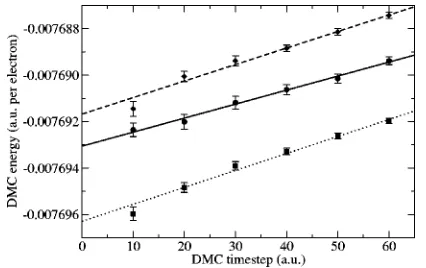
[image:4.612.72.281.56.192.2]The variation of DMC energy with timestep is shown in Fig. 3 for three different Jastrow factors. It can be seen that the bias is always positive and that it grows linearly with timestep; therefore we can largely eliminate the bias by car-rying out simulations at a number of different timesteps and performing a linear extrapolation to zero timestep.
The differences between the DMC energies in Fig. 3 are due to population control and timestep bias. The solid and dashed curves were obtained using the same target popula-tion of 100 configurapopula-tions, but with different Jastrow factors. The population control bias at fixed timestep is clearly smaller for the Jastrow factor with A⫽438.389共solid line兲 than for A⫽563.157 共dashed line兲. The dotted line was ob-tained with a target population of 800 configurations, which essentially removes the population control bias. Because the solid and dotted curves are approximately parallel we deduce that the population and timestep errors are approximately independent of one another. Furthermore, it is clear that al-tering the Jastrow factor has a considerably greater effect on the population control bias than on the timestep bias.
In Fig. 4 we show that timestep bias remains a problem even with a well-optimized Jastrow factor and a large target population which essentially removes the population bias. However, this figure again shows that a linear fit is appropri-ate when extrapolating to zero timestep.
D. Parameters for the production runs
The final production runs were characterized as follows. 共1兲The Gaussian exponents in the orbitals were optimized by minimizing the DMC energy, the A parameters by mini-mizing the VMC energy, and the other parameters in the Jastrow factors by minimizing the variance of the energy, as described in Sec. III D. The S1 terms in the Jastrow factors contained between four and six parameters per spin.
共2兲A target population of 640 configurations was used. This, together with the optimized Jastrow factor, should en-sure that population control errors are negligible.
共3兲 At each density, DMC calculations were performed using between four and six different timesteps and the energy was extrapolated linearly to zero timestep.
共4兲A variety of system sizes were used共see Table II兲, and the energies were extrapolated to infinite system size using Eq. 共9兲.
V. RESULTS AND DISCUSSION
A. DMC energies obtained using DMC-optimized Gaussian orbitals
The values of the exponents obtained by optimizing the DMC energy are shown in Table I, along with the final DMC
FIG. 2. DMC energy against Gaussian exponent for a 64-electron crystal at rs⫽125, using a timestep of 30 a.u. and A
[image:4.612.332.540.57.192.2]⫽597.901. Solid line: DMC energies with a Jastrow factor consist-ing of only the u0 term and a target population of 100 configura-tions; dashed line: DMC energies for the same Jastrow factor, but with a target population of 800 configurations; dotted line: DMC energies obtained with a fully optimized Jastrow factor共with both u0and S1terms兲and a target population of 100 configurations.
FIG. 3. DMC energy of a 64-electron crystal at rs⫽100 against
timestep for different values of the A parameter in the Jastrow factor of Eq.共3兲and different target population sizes. The S1term was not present in the Jastrow factor. The Gaussian exponent was C
[image:4.612.69.282.507.641.2]⫽0.000 11 in all cases. Solid line: A⫽438.389, target population 100 configurations; dotted line: A⫽438.389, target population 800 configurations; dashed line: A⫽563.157, target population 100 con-figurations.
FIG. 4. DMC energy of a 64-electron crystal at rs⫽110 against
energies. These were found by using the DMC results shown in Table II in conjunction with the finite-size extrapolation formula of Eq. 共9兲. Using the results for rs⫽100 and rs
⫽125, we obtained a good fit, giving b⫽1.26(3).
B. Electronic charge densities obtained using the different orbitals
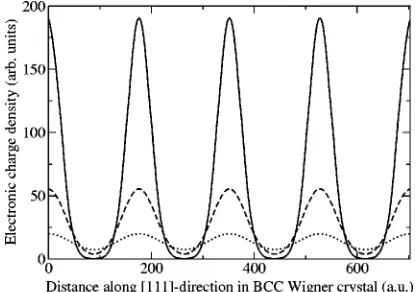
In Fig. 5 we plot the electronic charge densities for a rs
⫽100 crystal, calculated using HF theory orbitals共see Sec. VII兲, from the DMC-optimized orbitals but without a Jastrow factor, and within DMC using an optimized Jastrow factor.
The HF theory orbitals are very localized, whereas the orbitals optimized within DMC are much more diffuse. However, the inclusion of a Jastrow factor results in the charge density from the DMC-optimized orbitals becoming more localized on lattice sites, although not to the same ex-tent as the HF orbitals. The VMC charge density obtained with the optimized Slater-Jastrow wave function is very close to the DMC density shown in Fig. 5. The peak differ-ence between the VMC and DMC charge densities is 4.7% of the peak DMC density, and therefore an extrapolated estima-tion of the QMC charge density, (r)⬇2DMC⫺VMC, would be very similar to the DMC density.
The Jastrow factor in a Wigner crystal serves to further localize the electrons on their lattice sites. Therefore, whereas HF theory gives very localized Gaussian orbitals, in an optimized Slater-Jastrow wave function we find the orbit-als to be much more diffuse, with the localization being caused by correlation effects from the Jastrow factor. Corre-lation effects allow electrons to invade each other’s space to some extent without incurring a high potential-energy
pen-alty; hence the overall charge density is less localized than in HF theory, and the kinetic energy is lower as a result.
VI. LOCATING THE FLUID-TO-CRYSTAL TRANSITION DENSITY
In order to locate the density at which the transition from the Fermi fluid to the crystal occurs, we fit the DMC energy data for these phases to interpolating functions. The correla-tion energy is defined as
Ec共rs,兲⫽E共rs,兲⫺EHF共rs,兲, 共10兲
where E is the total energy, EHF is the HF ground-state
en-ergy,is the polarization. Ceperley17proposed a fitting form for the correlation energy of a Fermi fluid as a function of rs,
Ec共rs兲⫽
␥ 1⫹1
冑
rs⫹2rs, 共11兲
where␥, 1, and 2 are fitting parameters. We make use of the highly accurate DMC energies of Zong et al.6for the ferromagnetic fluid phase at low densities, which used trial-wave functions including ‘‘backflow’’ effects. We found an excellent fit to Eq. 共11兲 giving ␥1⫽⫺0.093 99, 1 1
⫽1.5268, and 21⫽0.28882. We also tried fitting the fluid data to the form proposed by Perdew and Zunger,19which is based upon Eq.共11兲, but includes an assumed dependence on polarization, so that the partially polarized and unpolarized data of Zong et al. could be used. The2value of this fit was not so good, however.
At low densities the total energy of a crystal phase can be expanded as
E共rs兲⫽
f0
rs⫹
f1
rs
3/2⫹ f2
rs
2⫹O共rs⫺
5/2兲
, 共12兲
where the兵f其are constants.20The first of these is taken to be f0⫽⫺0.895 93 in order to give the Madelung energy in the TABLE I. Orbital exponents optimized by minimizing the DMC
energy, and the final DMC energies per electron 共extrapolated to zero timestep and infinite system size兲 for the different rs. All entries are in a.u.
rs C共DMC兲 DMC energy
100 0.00011 ⫺0.0076765(4)
110 0.0001 ⫺0.0070312(5)
125 0.00009 ⫺0.0062458(4)
[image:5.612.333.541.58.204.2]150 0.000063 ⫺0.0052690(3)
TABLE II. DMC energies in a.u. per electron 共extrapolated to zero timestep兲 at different densities and system sizes, which are characterized by the number of electrons in the simulation cell.
rs System size DMC energy
100 64 ⫺0.0076961(2)
100 216 ⫺0.0076823(3)
100 512 ⫺0.0076788(8)
110 64 ⫺0.0070483(2)
125 64 ⫺0.0062599(2)
125 216 ⫺0.0062495(1)
150 64 ⫺0.0052797(1)
FIG. 5. Electronic charge density along a具111典 direction pass-ing through the lattice sites of a bcc Wigner crystal at rs⫽100.
[image:5.612.51.298.622.733.2]low-density limit. We found that our DMC data fitted Eq. 共12兲very well, giving f1⫽1.3379 and f2⫽⫺0.552 70. These values are in reasonable agreement with the parameters found using a completely different method by Carr20 and Carr, Coldwell-Horsfall and Fein,21who have calculated the zero-point lattice-vibrational energy of a Wigner crystal in order to give an analytical result of f1⫽1.325. Furthermore, they use perturbation theory to obtain the approximate result f2⫽⫺0.365. This phonon model is in good agreement with our Wigner crystal energies at large rs, but it gives energies
which are too high at smaller rs.
The energies of the ferromagnetic fluid and bcc crystalline phases at low densities calculated by different authors are shown in Fig. 6. We found the transition from the fluid to crystalline phases to occur at rs⫽106⫾1, in agreement with
the original result of Ceperley and Alder.3 Note, however, that the transition density predicted using the fluid data of Zong et al.6in conjunction with the crystal data of Ceperley and Alder would be somewhat lower, at about rs⫽127. Our
Wigner crystal energies are slightly lower than those of Cep-erley and Alder, even though they studied a Bose crystal, which must have a lower energy than the corresponding fer-mion one. We believe this difference must be due to some small bias in the results of Ceperley and Alder.3 Fitting Eq. 共12兲 to the crystal data of Ceperley and Alder, we find that f1⫽1.4309 and f2⫽⫺1.1058. The discrepancy with the ana-lytical result of Carr for f1is consistent with the presence of a small, positive, systematic bias in the crystal results of Ceperley and Alder.
Our transition density is considerably lower than the value of rs⫽65⫾10 obtained by Ortiz et al.5,22The statistical error
bars on their data are much larger than on the fluid data of
Zong et al.6 or on our Wigner crystal data, which hampers detailed comparisons. However, it appears that the main rea-son for the discrepancy is that Ortiz et al. place the ferro-magnetic fluid higher in energy than Zong et al. Some bias in the results of Ortiz et al. is expected because they used plane-wave nodes while Zong et al. used optimized backflow nodes, but this is not enough to explain the difference be-tween the results.
For the crystal phase, we may estimate the fixed-node error resulting from the use of the HF orbitals by taking the difference between DMC energies calculated using the HF and DMC-optimized orbitals. At rs⫽100 we find this
differ-ence to be 8.9(1)⫻10⫺5 a.u. per electron. Zong et al.23have calculated the fixed node errors resulting from the use of plane-wave orbitals for the fluid phases as 1.87(5)
⫻10⫺5 a.u. per electron for the unpolarized fluid and 0.84(7)⫻10⫺5 a.u. per electron for the fully polarized fluid. Therefore, although the correlation energy of crystals is smaller than fluids at the same density, the fixed-node errors resulting from the use of HF orbitals are considerably larger in crystals than in fluids.
VII. HF AND OTHER SIMPLE THEORIES
HF theory is described as ‘‘restricted’’ when the spin or-bitals are products of space and spin parts which are occu-pied in pairs with identical space parts, and ‘‘unrestricted’’ when the space parts are different or when they are not oc-cupied in pairs. Within the quantum chemistry community the standard definition of the correlation energy is the differ-ence between the exact and restricted HF energies, but in a Wigner crystal the electrons are localized in space individu-ally and a description within restricted HF theory is not pos-sible. We therefore define the correlation energy as the dif-ference between the exact and unrestricted HF energies.
A recent self-consistent unrestricted HF study of electrons in a uniform potential gave stable Wigner crystal solutions for rs⭓4.5 in three dimensions.
9
Here we develop simplified versions of the HF model which almost exactly reproduce the results of the fully self-consistent HF studies9 at low densities and compare the results with our DMC ones.
In the low-density regime, the overlap between orbitals centered on neighboring lattice sites is small and therefore we expect the Hartree and HF energies to be similar. Let us take the wave function of the crystalline phase to be a Har-tree product of normalized Gaussian orbitals,
共r兲⫽
冉
2C
冊
3/4
exp共⫺Cr2兲, 共13兲
centered on lattice sites. The Gaussian exponent C is to be determined variationally.
The resulting kinetic energy per electron is easily evalu-ated as T⫽3C/2. The spatial charge density is simply the superposition of the Gaussian charge densities due to each orbital. The electrostatic energy EH of this charge
[image:6.612.73.278.55.198.2]distribu-tion may be readily evaluated, but we must subtract off the self-energies E0 of each Gaussian. The total energy per elec-tron is therefore given by
FIG. 6. Energies of the ferromagnetic fluid and bcc crystalline phases at low density. The Madelung energy of the bcc lattice has been subtracted off and the resulting energy multiplied by rs
E⫽T⫹EH⫺E0⫽3C 2 ⫹
2 ⍀ G
兺
⫽0exp共⫺G2/4C兲
G2 ⫺
冑
C
.
共14兲 where the G are the reciprocal lattice vectors and ⍀
⫽4rs3/3 is the volume of the primitive unit cell.
Differentiating this energy with respect to the Gaussian exponent and approximating the sum by an integral, we find that
E
C⬇ 3 2⫺
2⍀C2. 共15兲
The approximation is valid for large rs, where the density of
reciprocal lattice vectors is large. Hence we find the optimal value of C to be C⫽1/2rs3/2, which is precisely the result obtained by Wigner2using a spherical approximation.
Integrating Eq. 共15兲with respect to C we obtain the en-ergy E⫽3C/2⫹/2⍀C⫹f (rs), where the function f (rs) is the ‘‘constant’’ of integration. Inserting the optimal value of C and making use of the fact that, in the limit of low densi-ties, E must tend to the Madelung energy of the crystal lat-tice, we find
E⫽ 3
2rs3/2⫹ M
rs
, 共16兲
where M is the Madelung constant of the lattice.
The simple Hartree model of Eq. 共14兲 and the further simplifying approximation of Eq. 共16兲 give energies which are very close to the full HF results for rs⬎50; for example,
the energy of Eq.共14兲agrees with that of the full HF result to within 0.006%, whereas the energies at rs⫽100 agree to
within 0.001%. The agreement between the fully self-consistent HF data and the simpler approximations is just as good for a face centered lattice. These results demonstrate that exchange energies between orbitals on different sites are extremely small. The exchange interactions are only significant between nearest-neighbor Gaussian orbitals and the exchange energy per electron is given by EX⫽⫺(Nn/2)
冑
C/ exp(⫺CR2), where Nn is the number ofnearest neighbors and R is the nearest-neighbor distance. This expression gives extremely small energies for the low densities studied here.
We have also calculated DMC energies using the orbitals obtained from HF theory,9and Jastrow factors optimized us-ing energy variance minimization. The results are summa-rized in Table III. The extrapolation of the DMC results to infinite system size was carried out using Ceperley’s
extrapo-lation scheme with his value of b⫽1.5.17 Comparing the data in Table III with that in Tables I or,II we see that the DMC energy obtained at rs⫽100 with the HF orbitals is
significantly higher than that obtained with DMC optimized orbitals. Some population control bias is present in the re-sults in Table III, but we estimate this to be about 2% of the difference between the rs⫽100 DMC energies obtained with the HF and DMC-optimized orbitals.
The strength of correlations in a system may be measured by the ratio of the correlation energy to the total energy, Ec/E. The DMC results of Zong et al.6 indicate that in the fluid phases Ec/E tends to a positive constant as rs→⬁,
while for the Wigner crystal our results show that Ec/E tends to zero as rs→⬁. In this sense one may think of Wigner
crystals as being weakly correlated systems at low densities.
VIII. MAGNETIC BEHAVIOR OF THE CRYSTALLINE PHASES
The tiny energy differences between ferromagnetic and antiferromagnetic crystals proved to be too small to resolve in our QMC calculations. It might be possible to resolve them using a correlated sampling approach within VMC. Such an approach should provide an accurate value for the energy difference between two systems, 1 and 2, if 兩⌿1兩2
⯝兩⌿2兩2 throughout the configuration space, which should hold for ferromagnetic and antiferromagnetic crystalline phases at sufficiently low densities. HF theory predicts fer-romagnetic behavior in the low density limit but according to the theory of Thouless24 such a system should be antiferro-magnetic. In their path integral QMC calculations, Candido, Bernu, and Ceperley25 have indeed found antiferromagnetic behavior for bcc Wigner crystals at low densities, although the energy differences are much smaller than our statistical error bars.
IX. FLOATING WIGNER CRYSTALS
The Hamiltonian of the uniform electron gas is invariant under the simultaneous translation or rotation of the electron positions. However, our trial Wigner crystal wave functions break these symmetries and, for example, the resulting charge densities are inhomogeneous, see Fig. 5. These wave functions represent Wigner crystals which are ‘‘pinned’’ by some small external influence. Pinning of Wigner crystals may arise from the presence of impurities or boundaries, and therefore the broken symmetry solutions are physically rel-evant, but Wigner crystals may also be mobile, in which case it is better to describe them as floating crystals.
One way of restoring the homogeneous and isotropic na-ture of the trial function is to consider a linear combination of displaced and rotated copies of the fixed wave function ⌿. This gives a floating wave function,
⌿F⫽
冕
⌿共R共⍀˜兲共兵ri⫺⌬其兲兲d⍀˜ d⌬, 共17兲where R(⍀˜ ) represents a rotation of all the electron positions and the integrals are over all possible solid angles ⍀˜ and TABLE III. HF results and DMC results obtained using HF
theory orbitals. All entries are in a.u.
DMC energy
rs C共HF兲 HF energy 共512 electrons兲 共Infinite system兲
displacements⌬. ⌿F gives rise to a homogeneous and
iso-tropic charge density n(r)⫽N/⍀, where N is the number of electrons and⍀ is the volume of the system.
Wave functions for floating Wigner crystals in extended systems have been discussed briefly by, for example, Bishop and Lu¨hrmann,26 and by Mikhailov and Ziegler.27 Rather more attention has been devoted to restoring the共rotational兲 symmetry in two-dimensional models of quantum dots.27,28 In finite systems the energy gain per electron from restoring the symmetry can be substantial but for an infinite system it turns out to be negligible.
Using a trial function where the single-particle orbitals in the Slater determinant are⫽e⫺Cr2, we have obtained
ana-lytical results at the variational level for the case when the translational symmetry is restored. We found that the differ-ence in total energy is equal to the kinetic energy of the center of mass of the fixed crystal (3C/2), making the en-ergy difference per electron negligible共this result also holds when a translationally invariant Jastrow factor is included兲. We also found that the expectation value of any operator that only depends on relative electron coordinates is the same for ⌿ and⌿F at the variational level. We expect the same
con-clusions to be true in DMC as well; in particular, we found that under open boundary conditions the nodal surface of the fixed and the translationally averaged trial functions are identical.
Despite the similarities in their energies, there is an im-portant qualitative difference between the fixed and floating Wigner crystal wave functions. The fixed wave function can be written as a sum of disconnected partial wave functions, in the form⌿⫽兺MM, where the overlap between theM
tend exponentially to zero as N→⬁. From this it follows that it represents an insulator.29,30 On the other hand, the same is not true for the floating wave function, resulting in con-ducting behavior.
X. PAIR-CORRELATION FUNCTIONS
A. Definitions
The spin-dependent PCF is defined as
g,⬘共r,r
⬘
兲⫽冓
兺
i, j⫽i ␦,i␦⬘,j␦共
r⫺ri兲␦共r
⬘
⫺rj兲冔
n共r兲n⬘共r
⬘
兲 .共18兲 It would be very costly to evaluate the full six-dimensional function g,⬘(r,r
⬘
) for a Wigner crystal within QMC. How-ever, for a homogeneous and isotropic system g depends only on the separation between electrons, r⫽兩r⫺r⬘
兩, so thatg,⬘共r兲⫽ ⍀ 4r2
1
NN⬘
冓
i, j兺
⫽i ␦共r⫺兩ri⫺rj兩)
冔
, 共19兲where we have used n(r)⫽N/⍀. This one-dimensional function is much less costly to evaluate accurately than Eq. 共18兲, hence we can obtain the PCF for a floating Wigner
crystal. Since the expectation value of any operator that de-pends only on the difference between electron coordinates is the same for fixed and floating crystals, see Sec. IX, we can evaluate g,⬘(r) using our fixed trial function.
Furthermore, the expectation value of the potential energy of the system can be written in terms of the spin-independent PCF, g(r)⫽14兺,⬘g,⬘(r),
冓
i, j兺
⫽iv(兩ri⫺rj兩)
冔
⫽冕
n共r兲n共r⬘
兲g共r,r⬘
兲v共兩r⫺r⬘
兩兲dr dr⬘
⫽N
2
⍀
冕
4r2g共r兲v共r兲dr, 共20兲 which holds even for an inhomogeneous system such as the fixed Wigner crystal. Studying the PCF of a floating crystal therefore provides insight into the physics of the fixed crystal as well.B. Discussion and results for the PCF’s
We evaluated Eq. 共19兲 within VMC and DMC by accu-mulating g,⬘(r) in radial bins. Our best estimates of g were obtained using the extrapolated estimator g(r) ⬇2gDMC⫺gVMC. We calculated g,⬘(r) at rs⫽110 for a
ferromagnetic and an antiferromagnetic Wigner crystal using our optimized trial wave functions. For comparison, we have also calculated g,⬘(r) for the unpolarized fluid phase at rs⫽110, using a trial wave function consisting of
determi-nants of plane waves and a Jastrow factor optimized using energy variance minimization.
All of the biasing effects that apply to the DMC energy may also affect the PCF’s. We found that this was indeed the case, as we have obtained results that showed very small but statistically significant differences when, for example, differ-ent timesteps were used or when differdiffer-ent Jastrow factors were used in conjunction with small population sizes. Unlike the energy, it was not possible to use an extrapolation scheme to remove the timestep bias, as it showed no clear pattern. We found that finite-size effects in the PCF’s were very small, however, as results obtained for 64 electrons were not significantly different from those obtained with 512 electrons.
A further source of bias, which does not apply to the energy, arises from the use of the extrapolated estimator. Fig-ure 7 shows that the extrapolation can make a significant difference, and to check the reliability of this method we have evaluated the PCF using different quality Jastrow fac-tors. As might be expected, the VMC and DMC results var-ied significantly, but the final extrapolated results were al-most independent of the Jastrow factor, the differences being only slightly larger than the statistical error. This source of bias is therefore small and on a comparable level to the oth-ers.
For comparison, the HF result is also shown, together with the result obtained from the DMC-optimized orbitals, but without the Jastrow factor. The spin-independent PCF for the ferromagnetic crystal is not included as it was found to be almost identical to that of the antiferromagnetic crystal. The HF orbitals are very strongly localized and give the most rapidly varying PCF, whereas the PCF from the more diffuse DMC-optimized orbitals is much smoother.
It is interesting that the extrapolated PCF of the floating crystal shows strong oscillations at distances much larger than rs. This can be understood in terms of Eq. 共20兲. The
potential energies of the fixed and floating crystals are the same, but their charge densities and PCF’s are quite different. For the floating crystal n(r) is constant while g(r,r
⬘
) oscil-lates strongly, whereas for a fixed crystal the charge density n(r) oscillates and g(r,r⬘
) is expected to be much smoother. Another interesting point is the large difference between the extrapolated parallel/antiparallel-spin PCF’s of the crys-tal and the fluid, see Fig. 9. For the cryscrys-tal, the PCF strongly reflects the underlying crystal structure composed ofalternat-ing spins, whereas for the fluid phase the two are almost identical. The energies of the two systems are, however, al-most the same.
XI. CONCLUSIONS
We have carried out a careful DMC study of the bcc Wigner crystal in the density range 100⭐rs⭐150. We have
experimented with several types of orbital in the trial wave functions but have been unable to improve upon the Gauss-ian form used in previous work. We have, however, opti-mized the Gaussian exponent by directly minimizing the DMC energy, which reduces the fixed node errors. We have also taken care to eliminate other biases in our DMC simu-lations, particularly those from timestep errors, population control bias, and finite-size effects. We estimate that the uni-form electron gas undergoes a transition from a ferromag-netic fluid to a bcc crystal at rs⫽106⫾1.
We have used Slater-Jastrow-type trial wave functions for our studies. Multiplying the Slater determinant by a pairwise repulsive Jastrow factor makes the charge density more inhomogeneous because the electrons in Wigner crystals are localized in space individually. This behavior contrasts with that found in many other systems where a pairwise repulsive Jastrow factor tends to smooth out the charge density.
The results of HF theory and Hartree theory are very simi-lar because the exchange interaction between orbitals on dif-ferent sites is small. The orbitals obtained within unrestricted HF theory 共and Hartree theory兲 are very strongly localized and the kinetic energy within HF theory is larger than in our DMC calculations with the fully optimized trial wave func-tions. We have defined the correlation energy to be the dif-ference between the exact and unrestricted HF energies. With this definition, and in the low density limit, Wigner crystals are weakly correlated systems. The inclusion of correlation in a Wigner crystal wave function beyond the unrestricted HF level results in the electronic charge density spreading out from the lattice sites. In this sense correlation delocalizes FIG. 7. Spin-independent PCF in the antiferromagnetic floating
crystal at rs⫽110, illustrating the extrapolation procedure. Solid line: extrapolated estimator; dashed line: DMC result; dotted line: VMC result. The statistical errors are less than 0.003.
FIG. 8. Spin-independent PCF for the antiferromagnetic floating crystal and unpolarized fluid at rs⫽110. Solid line: extrapolated estimator for the crystal; dotted line: HF result; dashed-dotted line: VMC result obtained using the DMC optimized orbitals but without a Jastrow factor. The dashed line shows the extrapolated estimator for the unpolarized fluid. The statistical errors are less than 0.003 except for the dashed-dotted line around r⫽0.
the electrons. Although the correlation energies of the crystal phases are smaller than those of the fluid phases at the same density, the use of HF orbitals within the trial wave functions results in larger fixed node errors for the crystal phases.
The variational energy for a floating Wigner crystal is lower than that of the fixed crystal by the kinetic energy of the center of mass, which is a negligible energy per particle for large systems. The expectation value of any operator that depends only on the difference between electron coordinates is the same for the fixed and floating crystals. We can
there-fore obtain the PCF’s of a floating Wigner crystal rather sim-ply from calculations on the fixed crystal.
ACKNOWLEDGMENTS
Financial support was provided by the Engineering and Physical Sciences Research Council 共EPSRC兲, UK. M.D.T. acknowledges the Royal Society and Z.R. acknowledges the Gates Cambridge Trust for financial support. Computational facilities were provided by the High Performance Computing Facility at the University of Cambridge, and the Computer Services for Academic Research共CSAR兲in Manchester, UK.
1E.P. Wigner, Phys. Rev. 46, 1002共1934兲. 2E.P. Wigner, Trans. Faraday Soc. 34, 678共1938兲.
3D.M. Ceperley and B.J. Alder, Phys. Rev. Lett. 45, 566共1980兲. 4We use Hartree atomic units,ប⫽兩e兩⫽m
e⫽4⑀0⫽1, throughout. The density parameter rs is defined by 4rs
3
/3⫽⍀/N, where N/⍀ is the number of electrons per unit volume.
5G. Ortiz, M. Harris, and P. Ballone, Phys. Rev. Lett. 82, 5317 共1999兲.
6
F.H. Zong, C. Lin, and D.M. Ceperley, Phys. Rev. E 66, 036703 共2002兲.
7C.J. Umrigar, K.G. Wilson, and J.W. Wilkins, Phys. Rev. Lett. 60, 1719共1988兲.
8P.R.C. Kent, R.J. Needs, and G. Rajagopal, Phys. Rev. B 59, 12 344共1999兲.
9J.R. Trail, M.D. Towler, and R.J. Needs, Phys. Rev. B 68, 045107 共2003兲.
10R. J. Needs, M. D. Towler, N. D. Drummond, P. R. C. Kent, and A. Williamson, CASINO Version 1.6 User Manual共University of Cambridge, Cambridge, 2002兲.
11W.M.C. Foulkes, L. Mitas, R.J. Needs, and G. Rajagopal, Rev. Mod. Phys. 73, 33共2001兲.
12J.B. Anderson, J. Chem. Phys. 65, 4121共1976兲.
13J.W. Moskowitz, K.E. Schmidt, M.A. Lee, and M.H. Kalos, J.
Chem. Phys. 77, 349共1982兲.
14P.J. Reynolds, D.M. Ceperley, B.J. Alder, and W.A. Lester, Jr., J. Chem. Phys. 77, 5593共1982兲.
15H. Flyvbjerg and H.G. Petersen, J. Chem. Phys. 91, 461共1989兲. 16T. Kato, Commun. Pure Appl. Math. 10, 151共1957兲.
17D.M. Ceperley, Phys. Rev. B 18, 3126共1978兲.
18C.J. Umrigar, M.P. Nightingale, and K.J. Runge, J. Chem. Phys.
99, 2865共1993兲. 19
J.P. Perdew and A. Zunger, Phys. Rev. B 23, 5048共1981兲. 20W.J. Carr, Phys. Rev. 122, 1437共1961兲.
21W.J. Carr, R.A. Coldwell-Horsfall, and A.F. Fein, Phys. Rev. 124, 747共1961兲.
22M. Harris, Ph.D. thesis, Max-Planck-Institute for Solid State Re-search, Stuttgart, Germany, 1998.
23F. H. Zong and D. M. Ceperley共unpublished兲.
24D.J. Thouless, Proc. Phys. Soc. London 86, 893共1965兲. 25L. Candido, B. Bernu, and D. M. Ceperley共unpublished兲. 26R.F. Bishop and K.H. Lu¨hrmann, Phys. Rev. B 26, 5523共1982兲. 27S.A. Mikhailov and K. Ziegler, Eur. Phys. J. B 28, 117共2002兲. 28C. Yannouleas and U. Landman, Phys. Rev. Lett. 82, 5325共1999兲. 29I. Souza, T. Wilkens, and R.M. Martin, Phys. Rev. B 62, 1666
共2000兲.