Measuring the speed of the conscious components of recognition memory: Remembering is faster than knowing
Stephen A. Dewhurst, Selina J. Holmes, Karen R. Brandt Department of Psychology, Lancaster University
Graham M. Dean
Faculty of Media, Art and Society, Southampton Institute
Please address correspondence to: Stephen A. Dewhurst Department of Psychology
Lancaster University Lancaster LA1 4YF
England
Three experiments investigated response times (RTs) for remember and know responses in recognition memory. RTs to remember responses were faster than RTs to know responses, regardless of whether the remember/know decision was preceded by an old/new decision (two-step procedure) or was made without a preceding old/new decision (one-step procedure). The finding of faster RTs for R responses was also found when remember/know decisions were made retrospectively. These findings are inconsistent with dual-process models of recognition memory, which predict that recollection is slower and more effortful than familiarity. Word frequency did not influence RTs, but remember responses were faster for words than for nonwords. We argue that the difference in RTs to remember and know responses reflects the time taken to make old/new decisions on the basis of the type of information activated at test.
According to dual-process models of recognition memory, previously studied items can be identified as old either because they are consciously recollected or because they evoke a feeling of familiarity (e.g., Atkinson & Juola, 1974; Jacoby, 1991; Jacoby & Dallas, 1981; Mandler, 1980, 1988; Yonelinas & Jacoby, 1996). This distinction is supported by findings from studies showing that recollection and familiarity can be dissociated
experimentally. For example, recollection is more sensitive than familiarity to levels-of-processing manipulations (e.g., Gardiner, 1988; Khoe, Kroll,
Yonelinas, Dobbins, & Knight, 2000; Mulligan & Hirshman, 1995) and divided attention (e.g., Gardiner & Parkin, 1990; Jacoby & Kelley, 1992; Jacoby, Woloshyn, & Kelley, 1989), while familiarity is more sensitive than recollection to modality changes between study and test (e.g., Gregg & Gardiner, 1994; Toth, 1996). There is also evidence that recollection and familiarity are supported by different brain regions. For example, findings from several studies indicate that recollection is dependent on the
hippocampus while familiarity is dependent on the surrounding medial temporal lobe regions (e.g., Aggleton & Brown, 1999; Tulving &
Markowitsch, 1998; Yonelinas, Kroll, Dobbins, Lazzara, & Knight, 1998). Recollection and familiarity can thus can be dissociated both behaviorally and in terms of their underlying neural substrates (see Yonelinas, 2002, for a review).
recognition decision as either a remember (R) response if they can consciously recollect the item’s study presentation, or a know (K) response if they
recognize the item on the basis of familiarity but cannot consciously recollect its study presentation. The distinction between remembering and knowing was originally used to describe the states of awareness that characterize retrieval from episodic and semantic memory respectively (Tulving, 1985). However, subsequent findings have often been interpreted within a dual-process framework (e.g., Dewhurst & Anderson, 1999; Dewhurst & Hitch, 1999; Jacoby, Yonelinas, & Jennings, 1997; Rajaram, 1993, 1996; Yonelinas, 2002).
Although the distinction between remembering and knowing is consistent with the view that recognition memory involves two separate processes, some studies that have used the remember-know procedure have produced findings that are inconsistent with the predictions of dual-process models. For example, dual-process models attribute the word frequency effect (WFE) in recognition memory (better recognition of low-frequency than high-frequency words) to a greater enhancement of familiarity for the
low-frequency words following their study presentation (e.g., Jacoby & Dallas, 1981; Mandler, 1980). However, Gardiner and Java (1990) found a WFE in R rather than K responses, suggesting that word frequency influences
recollection rather than familiarity (see Dewhurst, Hitch, & Barry, 1998, for similar findings). This is consistent with the view that the WFE reflects the greater distinctiveness of low-frequency words (Glanzer & Adams, 1990; Rajaram, 1996; Reder, Nhouyvanisvong, Schunn, Ayers, Angstadt, & Hikari, 2000).
relative speed of the recollection and familiarity processes. According to dual-process models, familiarity is a rapid and automatic dual-process that places relatively low demands on cognitive resources, whereas recollection is a slower and more effortful process that places greater demands on cognitive resources (e.g., Atkinson & Juola, 1974; Jacoby, 1991; Mandler, 1980, 1988; Yonelinas & Jacoby, 1994, 1996). This view is supported by the findings of Hintzman and Caulton (1997) that under speeded test conditions participants can make old/new decisions more rapidly than they can make judgements that require recollection of the learning episode. Further support for this position is provided by the findings of Boldini, Russo, and Avons (2004) who used a speed-accuracy trade-off procedure to separate the recollection and familiarity processes. They found that modality matches (assumed to influence
familiarity) enhanced recognition with early response deadlines, while deep processing (assumed to influence recollection) enhanced recognition with late response deadlines. However, findings from remember-know investigations are inconsistent with the view that familiarity is faster then recollection. For example, Gardiner, Ramponi, and Richardson-Klavehn (1999) found that R responses can be made as rapidly as K responses under speeded test
effects of levels-of-processing in R responses with both early and late response deadlines.
Further evidence that recollection can be triggered automatically comes from response time (RT) studies showing that R responses are made more rapidly than K responses. For example, Dewhurst and Conway (1994) instructed participants to make old/new decisions followed by R/K decisions to items judged as old. They found that old judgements were made more rapidly to items that were subsequently categorized as R responses rather than K responses (see Dewhurst et al., 1998, for similar findings). Dewhurst and Conway argued that R responses have an all-or-none quality while K
responses have to undergo post-retrieval processing in order to determine their familiarity relative to other items in the test list. Similar findings were reported by Henson, Rugg, Shallice, Josephs, and Dolan (1999) who instructed
participants to make R, K, or new (N) judgements to test items. They found that both R and N judgements were associated with faster RTs than K judgements. Henson et al. suggested that the slower RTs for K responses reflect the difficulty of making old judgements without the recollection of contextual details, and that such decisions are particularly effortful when test items evoke a degree of familiarity that falls on the K/N threshold.
In his review of dual-process models, Yonelinas (2002) argued that the slower RTs for K responses are an artefact of instructions that ask participants to make a K response only if an item is not recollected. He suggested that such instructions encourage participants to wait until both processes are completed before making their decision. If the slower RTs for K responses are merely due to demand characteristics, then the findings have little empirical or
of the underlying processes, then they have clear implications for models of recognition memory.
The present study investigated the relative speed of remembering and knowing by measuring RTs in a series of variations on the remember-know procedure. Experiments 1 and 3 used the procedure introduced by Dewhurst and Conway (1994) in which participants made a timed old/new followed by an untimed R/K decision for each item before proceeding to the next item. Positive recognition decisions were divided into R and K responses and RTs to the old/new decision were compared. This is what Eldridge, Sarfatti, and Knowlton (2002) have referred to as a two-step procedure, whereby
participants make separate old/new and R/K decisions before moving on to the next item. Experiment 1 also included a one-step condition (Eldridge et al., 2002) in which participants made a timed R/K decision without a preceding old/new decision. Experiment 2 attempted to decouple the R/K decision from the old/new decision by instructing participants to make old/new decisions to the full set of test items before seeing them a second time and making R/K judgements for each item previously judged as old.
Experiments 1 and 2 also included a word frequency manipulation. As noted above, the presence of the WFE in R responses is counter to the
predictions of dual-process models, which attribute the recognition advantage for low-frequency words to a greater enhancement of familiarity following their study presentation (Jacoby & Dallas, 1981; Mandler, 1980). However, it is possible that the presence of the WFE in R responses is an artefact of the two-step remember-know procedure in which decisions of subjective
based on familiarity and that items initially recognized on that basis are subsequently categorized as R responses when the slower recollection process has been completed. Comparison of the one-step and two-step procedures allowed us to investigate this possibility. The presence of the WFE in R responses was also taken to indicate the consistent use of R and K response categories in the different test conditions. In previous RT investigations, variables that influenced hit rates in R and K responses did not affect RTs (Dewhurst & Conway, 1994; Dewhurst et al., 1998). This may also be an artefact of the two-step procedure. We therefore included word frequency as an independent variable in the analysis of RTs. The exception to this was Experiment 3, which used a words-versus-nonwords manipulation. The rationale for this is explained in the introduction to Experiment 3.
Experiment 1
The aims of Experiment 1 were (i) to confirm previous findings that old/new decisions are faster for items subsequently categorized as R responses than for items subsequently categorized as K responses and (ii) to test whether this finding is an artefact of the two-step remember-know procedure. One group of participants followed the two-step procedure used by Dewhurst and Conway (1994). In the analysis of RTs, hits were divided into R and K
responses on the basis of the second response and RTs to the old/new decision were compared. A second group of participants followed the one-step
based simply on trace strength (see also Gardiner, Java, &
Richardson-Klavehn, 1996). We therefore included a guess (G) option in addition to R and K.
Hicks and Marsh (1999) found that the one-step procedure introduced a liberal response bias whereby correct and false R and K responses increased relative to the two-step procedure. They suggested that a single R/K/N
decision is the more difficult procedure as it requires participants to choose between three options. The two-step procedure involves only binary decisions and is therefore the easier of the two. We therefore expected RTs to the R/K decision in the one-step procedure to be slower than RTs to the yes/no
decision in the two-step procedure. The effects of word frequency in hits, false alarms, and RTs were also investigated.
Method
Participants. Fifty six undergraduate volunteers from Lancaster University took part in Experiment 1. All were native English speakers. They were tested at individual work stations in groups of between five and eight and were paid for their participation.
participant. The order of test items was also randomized separately for each participant. The dependent measures were the number of R, K, and G responses given in the recognition test and their respective response times.
Procedure. Study items were presented one at a time on Apple
Macintosh computers. Each word remained on the screen for 1 second with an intertrial interval of 1.5 seconds. Participants were instructed to read the words silently in preparation for a memory test, the nature of which was not
specified. After all the words had been presented, participants were engaged in a nonverbal distractor task (solving arithmetic problems) for 10 minutes and were then given the instructions for the recognition test. Participants were informed that they were about to see another sequence of words, some of which had appeared in the previous set. Their task was to identify the words that appeared in the earlier set by pressing the appropriate response key on the numberpad on the right hand side of the keyboard. Participants then received instructions for R, K, and G responses (taken from Dewhurst & Anderson, 1999). Briefly, they were told to make an R response if they could consciously recollect seeing an item in the study list and could recall contextual details such as associations or images generated at the time. They were told to make a K response if a word felt familiar from the study list but they could not
recollect any details of its previous occurrence. They were told to make a G response if they were unable to decide if a word had appeared or not.
appeared 500 ms. after the old/new response, and trials were separated by a 2 second interval. Participants were instructed to make the old/new decision as quickly and as accurately as possible but to take as long as they needed for the remember/know decision.
The one-step condition featured a go / no go procedure. Participants in this group were instructed to press the 1 key if they could recollect seeing an item in the study list (remember response) or the 2 key if the item felt familiar from the study list (know response). This pattern was reversed for half the participants. Participants were instructed to press the space bar with their left hand if their response was a guess. They were asked to make the R/K decision as quickly and as accurately as possible. They were told not to make a
response if they did not recognize the item, in which case it would be removed from the screen after five seconds. Items remained on the screen for five seconds or until a response key was pressed. Test items were separated by a two second interval.
Results and Discussion
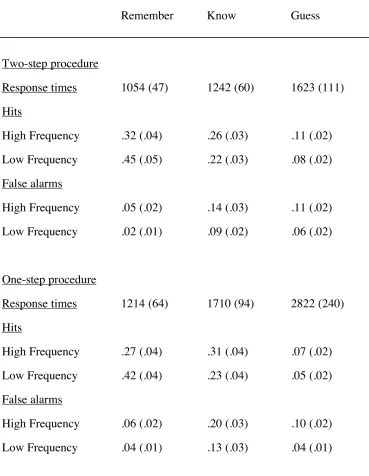
Table 1 shows the mean RTs and mean proportions of correct and false R, K, and G responses. Note that RTs for the two-step condition represent the mean latencies for “old” judgements divided into R and K responses on the
basis of the untimed R/K decision, while RTs in the one-step procedure
represent mean latencies for R and K responses without a preceding old/new
decision. Alpha was set at .05 in all statistical analyses. Guess responses were
statistical analysis, the RTs from all participants were collated and outliers (RTs greater than 2.5 standard deviations from the mean) were identified. Outliers were calculated separately for R, K, and G responses and removed from the individual data files. A total of 22 outliers were removed from the two-step condition (11 R, 9 K, and 2 G responses) and 25 from the one-step condition (15 R and 10 K). These represented less than 5% of the total number of responses.
Please insert Table 1 about here
A preliminary analysis of RTs consisted of a 2x2x2 (Group x Frequency x Response Type) mixed Analysis of Variance (ANOVA) conducted on data from participants who made correct responses in each of the four cells created by crossing Frequency (high versus low) and Response Type (R versus K). This confined the analysis to 45 of the 56 participants (23 in the two-step procedure and 22 in the one-step procedure). Frequency did not significantly influence RTs and did not interact with Response Type, F < 1 in both cases. For the two-step condition, the mean RTs for R responses (in ms) were 995 for high-frequency and 1029 for low-frequency, while the mean RTs for K responses were 1300 for high-frequency and 1254 for
low-frequency. In the one-step condition, mean RTs for R responses were 1221 for high-frequency and 1177 for low-frequency, while the mean RTs for K
analysis of RTs. The ANOVA showed that R responses overall were reliably faster than K responses, F (1,53) = 38.40, MSE = 84029.07. In addition, RTs in the two-step condition were reliably faster than RTs in the one-step condition, F (1,53) = 15.95, MSE = 169921.19. Group also interacted with Response Type, F (1,53) = 7.76, MSE = 84025.25. Analysis of simple main effects showed that the increase in RTs with the one-step procedure was present in K responses, F (1,106) = 23.71, MSE = 126975.13, but not in R responses, F (1,106) = 2.77, MSE = 126975.13, p = .10.
The numbers of correct R and K responses were entered into a 2x2x2 (Group x Frequency x Response Type) ANOVA. The main effect of Group was not significant, F < 1. The main effect of Response Type was significant, with participants making more R than K responses overall, F (1,54) = 5.91, MSE = 42.11. A significant main effect of Frequency was also observed, whereby overall recognition was greater for low-frequency words than for high-frequency words, F (1,54) = 9.79, MSE = 2.64. These effects were qualified by a significant interaction between Frequency and Response Type, F (1,54) = 20.98, MSE = 10.87. Analysis of simple main effects showed a significant advantage for low-frequency words in R responses, F (1,108) = 30.15, MSE = 6.75, and a significant advantage for high-frequency words in K responses, F (1,108) = 7.44, MSE = 6.75. A similar analysis of false alarms showed that they were greater for high-frequency than for low-frequency words, F (1,54) = 26.98, MSE = 1.53, and were more likely to be categorized as K than as R responses, F (1,54) = 42.87, MSE = 4.68. None of the
interactions reached statistical significance.
recognition decisions were reliably faster when items were categorized as R responses rather than K responses. These findings are inconsistent with the view that familiarity is a rapid and automatic process and recollection is slower and more effortful. Instead, the findings suggest that old decisions based on recollection can occur rapidly and automatically, while decisions based on familiarity require additional processes, possibly in order to
determine their familiarity relative to other items in the test. The results of the one-step condition indicate that these findings are not an artefact of the two-step remember-know procedure. Even without a preceding old/new decision, R responses were executed reliably faster than K responses. These findings are again consistent with the view the R responses can be made rapidly and
automatically in an all-or-none manner. The finding that RTs are slower in the one-step procedure relative to the two-step procedure is consistent with the suggestion of Hicks and Marsh (1999) that the one-step procedure is the more difficult of the two, as it requires a decision between three alternatives (R, K, and new) rather than successive binary decisions. The finding that this effect was reliably present only in K responses provides further support for the all-or-none nature of recollective experience.
Analysis of the numbers of hits showed a WFE in R responses, with participants making more R responses to low-frequency than to high-frequency words. This is consistent with findings reported previously by Gardiner and Java (1990) and by Dewhurst et al. (1998). A mirror effect was also observed, in that the effect of frequency in false alarms was in the opposite direction to the effect observed in hits. This is also consistent with previous findings (e.g., Glanzer & Adams, 1985, 1990).
The aim of Experiment 2 was to test the view that the difference in RTs between R and K responses reflects demand characteristics, whereby participants delay making a K response until both processes are completed (Yonelinas, 2002). This was investigated by presenting test items twice and decoupling the R/K decision from the old/new decision. On the first
presentation, participants made old/new decisions for the full set of test items. The items were then presented again and participants were asked to indicate whether their previous old/new decisions had been based on recollection or on familiarity. Any differences in RTs to old/new decisions between items
subsequently categorized as R or as K responses should reflect genuine
differences in the speed of the decision, rather than a strategy that prioritizes R responses.
Method
The Method was the same as the two-step condition of Experiment 1 with the following modifications: A new group of 50 undergraduates took part, none of whom had taken part in the previous experiments. The recognition test was divided into two stages. In the first stage, participants were asked to press the 1 key if they recognized a word from the study list and the 2 key if they did not. Speed and accuracy of response were again
emphasized. In the second stage, the recognition list was presented again, in a different random order, and participants were asked to recall the basis on which they had made each positive decision in the first stage. They were asked to press R if their previous recognition decision had been based on
responses they made at the first stage as it was feared this would artificially inflate the numbers of K responses.
Results and Discussion
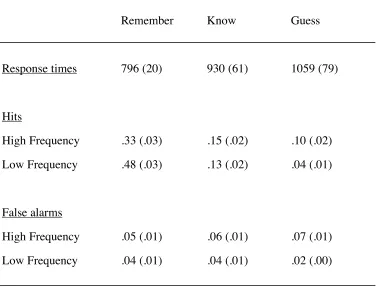
Following the procedure described for Experiment 1, 37 outliers were removed (23 R, 10 K, and 4 G), representing less than 5% of the total number of responses. Table 2 shows mean RTs and mean proportions of correct and false R, K, and G responses. Preliminary analysis of RTs on the 33
participants who made responses in each cell showed neither a significant effect of Frequency nor a significant interaction between Frequency and Response Type, F < 1 in both cases. Mean RTs for R responses were 794 for high-frequency and 775 for low-frequency, while mean RTs for K responses were 839 for high-frequency and 868 for low-frequency. The RT data were therefore collapsed across Frequency and the analysis was expanded to the 45 participants who made at least one correct R and one correct K response. The resulting data were analyzed in a related t-test which showed that RTs to the initial old/new decisions were reliably faster for items that were later
categorized as R responses rather than K responses, t ( 44) = 2.13. Please insert Table 2 about here
In the analysis of hits, the main effect of Response Type was
(1,49) = 80.95, MSE = 3.01, but not in K responses, F (1,49) = 1.76, MSE = 3.01. False alarms were greater for high-frequency than for low-frequency words, F (1,49) = 5.65, MSE = 1.21. Neither the effect of Response Type nor the interaction between Frequency and Response Type were significant in the false alarms, F < 1 in both cases).
The results of Experiment 2 provide strong evidence against a demand characteristics explanation of the faster RTs for R responses (Yonelinas, 2002). Recognition decisions that were subsequently categorized as R
responses were made more rapidly than decisions subsequently categorized as K responses, even though the R/K decision was decoupled from the old/new decision. Participants were not informed of the distinction between R and K responses when making their old/new decisions and therefore would not have adopted a strategy of waiting until both processes were complete before making their response.
Experiment 3
Experiment 3 therefore featured a words-versus-nonwords manipulation. Nonwords are unlikely to activate stored knowledge and will therefore be encoded less distinctively than words. The encoding of nonwords is more likely to feature phonological or orthographic details, which may be less diagnostic of a prior presentation and may result in slower RTs at test. Experiment 3 investigated this possibility.
Method
The Method was the same as the two-step condition of Experiment 1 with the following modifications: Participants were a new group of 40 students from Lancaster University. Stimuli consisted of 60 words and 60 nonwords, divided into two study lists of 30 words and 30 nonwords each. The words were selected from the Toronto Word Pool, Friendly, Franklin,
Hoffman, & Rubin, 1982) and were of moderate to high frequency. Nonwords were selected from the ARC Nonword Database (Rastle, Harrington, & Coltheart, 2002) and were all pronounceable.
Results and Discussion
Following the procedure used in Experiments 1 and 2, 49 outliers (29 R, 16 K, and 4 G) were removed, again representing less than 5% of the total number of responses. Contrary to the effects of word frequency in
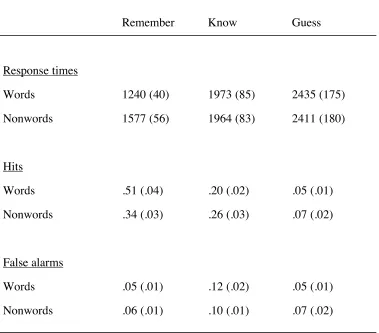
Words-versus-nonwords was also observed, F (1,33) = 6.20, MSE = 148239.54, whereby RTs to words were faster than RTs to nonwords. This was qualified by a significant interaction between Response Type and Words-versus-nonwords, F (1,33) = 9.65, MSE = 105418.89. Analysis of simple main effects showed that R responses to words were reliably faster than R responses to nonwords, F (1,33) = 13.05, MSE = 148239.54, whereas K responses to words and nonwords did not differ reliably, F < 1. R responses were faster than K responses for both words and nonwords, F = 94.98 and 26.44 respectively, MSE = 96051.43. Table 3 shows the mean hit and false alarm rates collected from all 40 participants, plus the mean RTs from the subset of 34 participants described above.
Please insert Table 3 about here
A 2x2 ANOVA on the numbers of correct R and K responses showed that participants recognized more words than nonwords, F (1,39) = 7.46, MSE = 12.26, and made more R than K responses, F (1,39) = 17.86, MSE = 73.74. The interaction was also significant, F (1,39) = 26.68, MSE = 18.24. Analysis of simple main effects showed that more R responses were made to words than to nonwords, F (1,39) = 40.77, MSE = 12.26, while more K responses were made to nonwords than to words, F (1,39) = 6.36, MSE = 12.26. A similar analysis on the false alarms showed that these were more likely to be categorized as K than R responses, F (1,39) = 15.34, MSE = 7.87. The effect of Words-versus-nonwords and the interaction were not significant for the false alarms, F < 1 in both cases.
1994; Dewhurst et al., 1998) that stimulus characteristics do not influence RTs, despite having significant effects on hit rates. However, despite the difference between words and nonwords, R responses were faster than K responses for both types of stimuli. The finding that words were associated with more R responses and fewer K responses than nonwords is consistent with the findings of Gardiner and Java (1990).
General Discussion
The results of three experiments confirm previous findings that R responses are made more rapidly than K responses (Dewhurst & Conway, 1994; Dewhurst et al., 1998; Henson et al., 1999). These findings are inconsistent with the view that recollection is a slower and more effortful process than familiarity. According to dual-process models, recollection is a resource-demanding task that is mediated by consciousness (Jacoby & Dallas, 1981) and requires the same effortful processes as those used in tests of recall (Mandler, 1980). The present findings show that recognition decisions based on recollection, at least as measured by R responses, can be made rapidly and accurately. In contrast, K responses require additional post-retrieval processes, possibly in order to determine their familiarity relative to other items in the test.
The present findings are also inconsistent with the suggestion by Yonelinas (2002) that the faster RTs for R responses are an artefact of
more rapidly to items that were subsequently categorized as R responses, even when the R/K decision was decoupled from the old/new decision. Under such conditions, participants would not be aware that their recognition decisions could be based on two different processes. These findings therefore provide strong evidence against a demand characteristics account.
The finding that R responses are made more rapidly than K responses appears to be incompatible with previous findings that recognition decisions are faster when based on familiarity. For example, Boldini et al. (2004) found that effects of modality manipulations (presumed to influence familiarity) were observed with an early response deadline whereas a levels-of-processing manipulation (presumed to influence recollection) affected recognition only with a late response deadline. Similarly, Hintzman and Caulton (1997) found that old/new decisions were made more rapidly than decisions that required recollection of the learning episode. It is difficult to compare the findings of the present study with findings from response deadline studies as forcing participants to make speeded responses may alter the nature of the recognition decision. However, it is notable that Gardiner et al. found levels-of-processing effects in R responses with both early and late response deadlines, suggesting that R responses can be made rapidly and automatically (see also
Konstantinou & Gardiner, in press).
The inconsistencies between the above findings and those of the present study can be resolved by assuming that RTs to R and K responses do not reflect the time-course of the recollection and familiarity processes per se, but rather the time taken to make old/new decisions on the basis of the
responses reflect the time taken to make old/new decisions in the absence of contextual information. Similarly, Dewhurst and Conway (1994) argued that recognition decisions that do not feature recollective experience require additional processing in order to evaluate the familiarity of an item relative to other items in the test list. The present findings support these accounts. In contrast, when a test item cues contextual details, such as thoughts, images, and associations made at encoding, old/new decisions can be made rapidly. The faster RTs for R responses therefore reflect the greater ease of making such decisions when supported by the recollection of contextual information. We would also argue that it is the cueing of this information at test that gives rise to the subjective experience of remembering by mentally reinstating aspects of the encoding context. Rather than being the product of a slow and effortful retrieval process, the present findings indicate that such processes can occur rapidly and automatically.
The cueing of contextual information at test may also account for the faster RTs for R responses to words relative to nonwords observed in
Experiment 3. This finding is consistent with the view that the encoding of words is likely to feature information activated from long-term memory, such as images, associations, and autobiographical references. These details are cued when the words are presented again at test and support rapid and
Some researchers have interpreted R and K responses in terms of signal detection theory (e.g., Donaldson, 1996; Dunn, 2004; Hirshman & Master, 1997). According to unidimensional signal detection models,
recognition decisions are based on an underlying dimension of trace strength or familiarity. Participants make R/K decisions by setting an old/new criterion and a higher remember/know criterion for items judged to be old. Items that exceed the second criterion are judged as R responses, while items falling between the two criteria as judged as K responses. The present findings are not inconsistent with trace strength models, as one would expect highly familiar items to be recognized more rapidly than less familiar items. Indeed, Wixted and Stretch (2004) have recently shown that a unidimensional signal detection model predicts faster RTs for R than for K responses in both hits and false alarms. They also argue that such findings cannot be explained by dual-process remember-know models. However, this argument is based on the assumption that R and K responses map directly onto the recollection and familiarity processes. As suggested above, it is more likely that R and K responses reflect differences in the time taken to make a recognition decision based on the information provided by these processes, rather than the speed of the processes themselves.
Although the present findings can be explained by unidimensional signal detection models, there is converging evidence from both behavioral and brain imaging studies that R and K responses differ in more than just familiarity or confidence (see Gardiner & Richardson-Klavehn, 2000, for a review). While it is possible that a continuum of trace strength or confidence underlies recognition decisions, we have argued that other types of
autobiographical references (see also Dewhurst & Conway, 1994; Johnson, Hashtroudi, & Lindsay, 1993; Reder et al., 2000). It is this additional
information that distinguishes R from K responses. The multiattribute nature of R responses is more accurately reflected in multidimensional signal detection models (e.g., Banks, 2000; Rotello, Macmillan, & Reeder, 2004). Such models represent a number of dimensions in a single spatial
representation, which can then be projected onto unidimensional decision axes. However, like unidimensional models, multidimensional signal detection models are concerned with modelling the decision process itself rather than the subjective experience that accompanies it. Whilst they place constraints on the nature and operation of the psychological processes in a model, they are not a substitute for psychological explanations of recognition memory. They should therefore be seen as complementary to first person accounts, such as the remember-know procedure, rather than rival theories.
they cannot be falsely recognized on the basis of pre-experimental familiarity. It is also notable that the recognition advantage for low-frequency words was always observed in R responses. This is consistent with findings from
previous research (e.g., Dewhurst et al., 1998; Gardiner & Java, 1990) and indicates that the presence of the WFE in R responses is not an artefact of the two-step procedure. The presence of the WFE in R responses despite the procedural variations also indicates that participants were using R and K responses appropriately in the different test conditions.
To summarize, the main finding from the present study is that R responses are made more rapidly than K responses, regardless of the type of remember-know procedure used (one-step or two-step) and of the location of the R/K decision within the procedure (immediate or delayed). These findings indicate that subjective experiences of remembering and knowing do not map directly onto the recollection and familiarity processes, at least as
conceptualized in dual-process models of recognition memory. Instead, experiences of remembering occur rapidly and automatically, while experiences of knowing may involve evaluative decisions that require
Acknowledgement.
This research was supported by Grant R000237594 awarded by the Economic and Social Research Council and by Grant F/00185/G awarded by the
References
Aggleton, J.P., & Brown, W.M. (1999). Episodic memory, amnesia, and the hippocampal-anterior thalamic axis. Behavioral & Brain Sciences, 22, 425-486.
Atkinson, R.C., & Juola, J.F. (1974). Search and retrieval processes in recognition memory. In D.H. Krantz, R.C. Atkinson, R.D. Luce, & P. Suppes (Eds.), Contemporary developments in mathematical psychology, Vol. 1, Learning, memory and thinking, (pp. 243-293). San Francisco, CA: Freeman.
Banks, W.P. (2000). Recognition and source memory as multivariate decision processes. Psychological Science, 11, 267-273.
Boldini, A, Russo, R, & Avons, S.E. (2004). One process is not enough! A speed-accuracy tradeoff study of recognition memory. Psychonomic Bulletin & Review, 11, 353-361.
Dewhurst, S.A., & Anderson, S.J. (1999). Effects of exact and category repetition in true and false recognition memory. Memory & Cognition, 27, 665-673.
Dewhurst, S.A., & Conway, M.A. (1994). Pictures, images, and recollective experience. Journal of Experimental Psychology: Learning, Memory, & Cognition, 20, 1088-1098.
Dewhurst, S.A., & Hitch, G.J. (1999). Cognitive effort and recollective experience in recognition memory. Memory, 7, 129-146.
Dewhurst, S.A., Hitch, G.J., & Barry, C. (1998). Separate effects of word frequency and age of acquisition in recognition and recall. Journal of Experimental Psychology: Learning, Memory, & Cognition, 24, 284-298.
Dunn, J.C. (2004). Remember-know: A matter of confidence. Psychological Review, 111, 524-542.
Eldridge, L.L., Sarfatti, S., & Knowlton, B.J. (2002). The effect of testing procedure on remember-know judgments. Psychonomic Bulletin & Review, 9, 139-145.
Friendly, M., Franklin, P. E., Hoffman, D., & Rubin, D. C. (1982). The Toronto Word Pool: Norms for imagery, concreteness, orthographic variables, and grammatical usage for 1,080 words. Behavior Research Methods and Instrumentation, 14, 375-399.
Gardiner, J.M. (1988). Functional aspects of recollective experience. Memory & Cognition, 16, 309-313.
Gardiner, J.M., & Java, R.I. (1990). Recollective experience in word and nonword recognition. Memory & Cognition, 18, 23-30.
Gardiner, J.M., Java, R.I., & Richardson-Klavehn, A. (1996). How level of processing really influences awareness in recognition memory. Canadian Journal of Experimental Psychology, 50, 114-122.
Gardiner, J.M., & Parkin, A.J. (1990). Attention and recollective experience in recognition memory. Memory & Cognition, 18, 579-583.
Gardiner, J.M., Ramponi, C., & Richardson-Klavehn, A. (1999). Response Deadline and Subjective Awareness in Recognition Memory. Consciousness and Cognition, 8, 484-496.
Gardiner, J.M., & Richardson-Klavehn, A. (2000). Remembering and knowing. In E. Tulving & F.I.M. Craik (Eds), Handbook of memory (pp. 229-244). New York: Oxford University Press.
Glanzer, M., & Adams, J.K. (1985). The mirror effect in recognition memory. Memory & Cognition, 13, 8-20.
Glanzer, M., & Adams, J.K. (1990). The mirror effect in recognition memory: Data and theory. Journal of Experimental Psychology: Learning, Memory, & Cognition, 16, 5-16.
Henson, R.N.A., Rugg, M.D., Shallice, T., Josephs, O., & Dolan, R.J. (1999). Recollection and familiarity in recognition memory: An event-related functional magnetic resonance imaging study. The Journal of Neuroscience, 19, 3962-3972.
Hicks, J.L., & Marsh, R.L. (1999). Remember-know judgments can depend on how memory is tested. Psychonomic Bulletin & Review, 6, 117-122.
Hintzman, D. L., & Caulton, D. A. (1997). Recognition memory and modality judgments: A comparison of retrieval dynamics. Journal of Memory and Language, 37, 1-23.
Hirshman, E., & Master, S. (1997). Modeling the conscious correlates of recognition memory: Reflections on the remember-know paradigm.
Memory and Cognition, 25, 345-351.
Jacoby, L.L., & Dallas, M. (1981). On the relationship between autobiographical memory and perceptual learning. Journal of Experimental Psychology: General, 110, 306-340.
Jacoby, L.L., & Kelley, C.C. (1992). Unconscious influences of memory: Dissociations and automaticity. In E.A.D. Milner & E.M.D. Rugg (Eds.), The neuropsychology of consciousness (22. 201-233). San Diego, CA: Academic Press.
Jacoby, L.L., Woloshyn, V., & Kelley, C.C. (1989). Becoming famous without being recognized: Unconscious influences of memory produced by dividing attention. Journal of Experimental Psychology: General, 118, 115-125.
Jacoby, L.L., Yonelinas, A.P., & Jennings, J.M. (1997). The relation between conscious and unconscious (automatic) influences: A declaration of independence. In J.D. Cohen & J.W. Schooler (Eds.), Scientific approaces to the question of consciousness (pp, 13-47). Hillsdale: Erlbaum.
Johnson, M.K., Hashtroudi, S., & Lindsay, D.S. (1993). Source monitoring. Psychological Bulletin, 114, 3-28.
Khoe, W., Kroll, N.E.A., Yonelinas, A.P., Dobbins, I.G., & Knight, R.T. (2000). The contribution of recollection and familiarity to yes-no and forced-choice recognition tests in healthy subjects and amnesics.
Neuropsychologia, 38, 1333-1341.
Konstantinou, I., & Gardiner, J.M. (in press). Conscious control and memory awareness when recognising famous faces. Memory.
Mandler, G. (1980). Recognizing: The judgment of previous occurrence. Psychological Review, 87, 252-271.
Mandler, G. (1988). Memory: Conscious and unconscious. In P.R. Solomon, G.R. Goethals, C.M. Kelley, & B.R. Stephens (Eds.), Memory: Interdisciplinary approaches (pp. 84-106). New York: Springer-Verlag.
Mulligan, N, & Hirshman, E. (1995). Speed-accuracy trade-offs and the dual process model of recognition memory. Journal of Memory & Language, 34, 1-18.
Rajaram, S. (1993). Remembering and knowing: two means of access to the personal past. Memory & Cognition, 21, 89-102.
Rajaram, S. (1996). Perceptual effects on remembering: Recollective processes in picture recognition memory. Journal of Experimental
Psychology: Learning, Memory, & Cognition, 22, 365-377.
Rastle, K., Harrington, J., & Coltheart, M. (2002). 358,534 nonwords: The ARC Nonword Database. Quarterly Journal of Experimental Psychology, 55A,1339-1362.
Reder, L.M., Nhouyvanisvong, A., Schunn, C.D., Ayers, M.S., Angstadt, P., & Hikari, K. (2000). A mechanistic account of the mirror effect for word frequency: A computational model of remember-know judgements in a continuous recognition paradigm. Journal of Experimental Psychology: Learning, Memory, & Cognition, 26, 294-320.
Toth, J.P. (1996). Conceptual automaticity in recognition memory: Levels-of-processing effects on familiarity. Canadian Journal of Experimental Psychology, 50, 123-138.
Tulving, E. (1985). Memory and consciousness. Canadian Psychologist, 26, 1-12.
Tulving, E., & Markowitsch, H.J. (1998). Episodic and declarative memory: Role of the hippocampus. Hippocampus, 8, 198-204.
Wixted, J.T., & Stretch, V. (2004). In defense of the signal-detection interpretation of remember-know judgements. Psychonomic Bulletin & Review, 11, 616-641.
Yonelinas, A.P. (2002). The nature of recollection and familiarity: A review of 30 years of research. Journal of Memory & Language, 46, 441-517.
Yonelinas, A. P., & Jacoby, L.L. (1994). Dissociations of processes in recognition memory: Effects of interference and response speed. Canadian Journal of Experimental Psychology, 48, 516-534.
Yonelinas, A. P., & Jacoby, L.L. (1996). Noncriterial recollection: Familiarity as automatic, irrelevant recollection. Consciousness & Cognition, 5, 131-141.
Table 1. Mean RTs and mean proportions of correct and false R, K, and G responses (with standard errors) in Experiment 1.
Remember Know Guess
Two-step procedure
Response times 1054 (47) 1242 (60) 1623 (111) Hits
High Frequency .32 (.04) .26 (.03) .11 (.02) Low Frequency .45 (.05) .22 (.03) .08 (.02) False alarms
High Frequency .05 (.02) .14 (.03) .11 (.02) Low Frequency .02 (.01) .09 (.02) .06 (.02)
One-step procedure
Response times 1214 (64) 1710 (94) 2822 (240) Hits
High Frequency .27 (.04) .31 (.04) .07 (.02) Low Frequency .42 (.04) .23 (.04) .05 (.02) False alarms
High Frequency .06 (.02) .20 (.03) .10 (.02) Low Frequency .04 (.01) .13 (.03) .04 (.01)
Table 2. Mean RTs and mean proportions of correct and false R, K, and G responses (with standard errors) in Experiment 2.
Remember Know Guess
Response times 796 (20) 930 (61) 1059 (79)
Hits
High Frequency .33 (.03) .15 (.02) .10 (.02) Low Frequency .48 (.03) .13 (.02) .04 (.01)
False alarms
High Frequency .05 (.01) .06 (.01) .07 (.01) Low Frequency .04 (.01) .04 (.01) .02 (.00)
Table 3. Mean RTs and mean proportions of correct and false R, K, and G responses (with standard errors) in Experiment 3.
Remember Know Guess
Response times
Words 1240 (40) 1973 (85) 2435 (175)
Nonwords 1577 (56) 1964 (83) 2411 (180)
Hits
Words .51 (.04) .20 (.02) .05 (.01)
Nonwords .34 (.03) .26 (.03) .07 (.02)
False alarms
Words .05 (.01) .12 (.02) .05 (.01)
Nonwords .06 (.01) .10 (.01) .07 (.02)