Munich Personal RePEc Archive
Do Institutions Impact Innovation?
Tebaldi, Edinaldo and Elmslie, Bruce
Bryant University, University of New Hampshire
February 2008
Online at
https://mpra.ub.uni-muenchen.de/8757/
Do Institutions Impact Innovation?
by
Edinaldo Tebaldi
Assistant Professor of Economics
Department of Economics
Bryant University
1150 Douglas Pike
Smithfield, RI 02917
Phone: 401-232-6901
e-mail:
[email protected]
and
Bruce Elmslie
Department of Economics
University of New Hampshire
e-mail: [email protected]
Abstract
This paper contributes to the literature on institutions and economic growth by conducting an empirical examination on the links between innovation and institutions. Using cross-country data and the instrumental variable method, this study finds that institutional arrangements explain much of the variation on patent production across countries. We find evidence that control of corruption, market-friendly policies, protection
of property rights and a more effective judiciary system boost an economy‟s rate of innovation. Most of the
previous literature on institutional and economic performance finds a positive association between institutions and levels of income and between institutions and the transitional growth rates of per capita income; however an unambiguous empirical association between institutions and the steady state growth has not yet been established. Based on the theoretical model developed by Tebaldi and Elmslie (2006), which shows that the impacts of institutions on innovation spillover to the growth rate of GDP per capita, this paper shows evidence of a growth effect through innovation, i.e., institutions have a growth effect on income because
institutional quality affects an economy‟s rate of innovation, the engine of economic growth. Moreover, this
study finds that controlling for institutional quality; geographic-related variables are not significant in explaining patent production. This paper also finds evidence to support the idea that in the long-run human capital accumulation is an important variable in shaping institutions.
JEL code: O3 - Technological Change; Research and Development
Keywords: Institutions, innovation, economic growth
* We would like to thank the participants of the seminars at the University of New Hampshire, Union College, Bryant University, and CAEN-Graduate Programs in Economics – Brazil, for their helpful and insightful comments
.
Do Institutions Impact Innovation?
1. Introduction
A fundamental challenge for the economics profession lies in explaining the mechanisms of
economic growth. There is little doubt that significant progress has been made during the last five decades
in growth modeling and economists‟ understanding of the mechanisms of economic growth. It also
appears that economists have reached a consensus on the notion that long-run economic growth is
primarily a product of technical innovation. However, there is still much to learn about the factors that
ultimately determine a country‟s rate of innovation. Fundamentally, growth economists are still struggling
to understand the linkages between institutional quality and innovation and to incorporate institutions into
the standard theoretical framework of economic growth (Sala-i-Martin, 2002; Huang and Xu, 1999). The
publication of the breakthrough paper of Kormendi and Meguire (1985) and the availability of datasets on
institutional quality1 greatly contributed to the opening of a new front for empirical research aimed at
evaluating the influences of institutional-related variables on economic performance [levels and growth
rates of output per capita] (e.g. Barro, 1991; Knack and Keefer, 1995; Mauro, 1995; Hall and Jones, 1999;
Acemoglu et al. 2001 and 2004; McArthur and Sachs, 2001; Acemoglu and Johnson, 2005; Alcala and
Ciccone, 2004; Easterly and Levine, 2003). Most of the previous literature on institutional and economic
performance finds a positive association between institutions and levels of income (e. g Hall and Jones,
1999; Acemoglu et al. 2001 and 2004; Alcala and Ciccone, 2004; Easterly and Levine, 2003) and between
institutions and the transitional growth rates of per capita income (e.g. Barro, 1991; Mauro, 1995).
However, an unambiguous empirical association between institutions and the steady state growth has not
yet been established and the question whether institutions affect the steady-state growth rate of income is
still open. In addition, very little has been done in terms of evaluating empirically the influences of
institutional quality on technical innovation. This study contributes to this literature by examining
empirically the links between technical innovation and the quality of institutional arrangements.
1
This paper develops an econometric model for technical innovation derived from a theoretical
model developed in Tebaldi and Elmslie (2006), which gives simple testable predictions regarding the
mechanism by which institutions2 influence technical innovation. Specifically, we test the prediction that
institutions boost technical innovation (patent production) and also examine how different kinds of
institutions (Control of Corruption, Rule of Law, Regulatory Quality and Risk of Expropriation) affect the
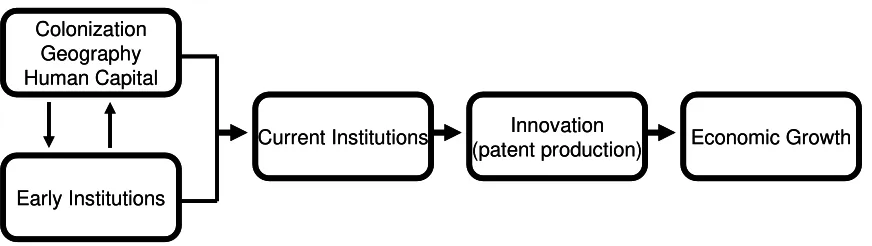
production of patents. The empirical strategy used to assess the questions posed above is derived from
Figure 1, which presupposes that early institutions are associated with the colonization process, geography
and early accumulated human capital; and the interaction of these factors determine current institutions
(Rule of law, Control of Corruption, Regulatory Quality and the Risk of Expropriation). Furthermore,
current institutions affect technical innovation (measured by patent production), which ultimately affects a
country‟s economic performance. The econometric analysis conducted in this paper consists of estimating
OLS and instrumental variable (IV) cross-country regressions, where the dependent variable is the number
[image:4.612.121.557.407.530.2]of patents (a measure of innovation).
Figure 1: Institutions and Economic Growth
Colonization Geography Human Capital
Early Institutions
Current Institutions Innovation
(patent production) Economic Growth Colonization
Geography Human Capital
Early Institutions
Current Institutions Innovation
(patent production) Economic Growth
This paper provides evidence that control of corruption, market-friendly policies, protection of
property rights and a more effective judiciary system boost an economy‟s rate of innovation. In addition, it
2
This study follows Sala-i-Martin (2002) and the word institutions (or institutional arrangements) refers to a hypothetical variable that accounts for:
i)Law enforcement: enforcement of property rights, existence of a working legal system and the independence of the judiciary system;
ii)Political institutions: democracy, political stability, public representatives chosen by vote and the existence of class organizations;
iii) Market structure: economic freedom, anti-trust regulations, openness to international trade, modern bank system, working credit system and organized stock and bond markets;
also shows a growth effect through innovation, i.e., institutions have a growth effect on income because
institutional quality affects an economy‟s rate of innovation, the engine of economic growth. This paper
also finds empirical evidence to support Lipset‟s (1960) theoretical arguments that in the long-run human
capital accumulation is a key variable in shaping institutions.
The rest of the paper is organized as follows: Section 2 briefly discusses the intrinsic challenges in
conducting empirical evaluation on institutions and outlines the difficulties in measuring innovation.
Section 3 presents the data. Section 4 evaluates the empirical model and discusses the estimates. Section 5
summarizes the paper‟s findings.
2. Background
It is standard procedure in the empirical growth literature to include institutions in growth
regressions as an ordinary explanatory variable of steady state per capita output (e.g. Kormendi and
Meguire, 1985; Barro, 1991; Mauro, 1995; Knack and Keefer, 1995 and 1997; Oliva and Rivera-Batiz,
2002; Esfahani and Ramirez, 2003; Dollar and Kraay; 2003). This approach implicitly assumes that
institutions affect the productivity of factors of production and implies that countries with better
institutional arrangements will experience faster growth rates of per capita output. Despite the appeal of
this argument, most of the empirical analyses report only weak evidence that better institutional
arrangement leads to faster growth (see Levine and Renelt, 1992; Esfahani and Ramirez, 2003). Moreover,
there is a fundamental problem in this analysis. Regression analysis based on Kormendi and Meguire
(1985) cannot provide evidence that institutions affect long-run growth rates of the economy. The
dependent variable (growth rates of output per capita) only accounts for the transitional dynamics of per
capita income over a specific period of time and cannot be interpreted as steady state growth rate of per
capita income. In other words, a statistically significant coefficient on an institutional measure supports
the argument that institutions have a positive effect on transitional growth rates of output per capita, but
one cannot jump to the conclusion that this implies steady-state growth effects.
Furthermore, economists are increasingly aware that institutional arrangements affect knowledge
arrangements affect the long-run growth of output. Therefore, if one wants not only to diagnose the
problem of growth, but also search for ways to stimulate growth, it is very important to understand how
institutions and innovation are linked. Few growth models explicitly address this issue (e.g. Huang and
Xu, 1999; Fedderke, 2001; Gradstein, 2004; Tebaldi and Elmslie, 2006) and no empirical cross-country
analysis directly exploits such a link.
2.1 An Empirical Model of Innovation
The model developed by Tebaldi and Elmslie (2006) suggests that changes in technology are
associated with the quality of institutional arrangements. Specifically, a variable that accounts for
institutional quality enters directly into the production function of new ideas, but not as a choice variable.
Therefore, R&D firms make decisions on the demand for human capital taking institutions as given.
Consider the equation:3
))
(
(
T
A
Z
AH
A
A
where A measures technical knowledge, HA is human capital engaged in R&D, and Z denotes the quality
of the institutional structure, which depends on both the set of institutions in place (T) and the state-of-art
technology.
It is assumed that Z increases as the institutional arrangements (T) improve
0 T Z
. It is also
assumed that improvements in technology make existing institutions relatively obsolete,4 which implies
that
0
A
T
T
Z
A
Z
. To make this specification workable, Z is defined as
Z
T
/
A
a, where 0 < a <1. Accordingly, the production function of new technologies is given by:
a a 1
T
H
A
A
A
(1)3
This specification overlooks the influences of physical capital on knowledge production. The rationale supporting this formulation is the idea that knowledge production is more human capital intensive.
4
The logic behind this formulation is that institutions are a necessary input for the production of
new R&D projects. Good institutions help in the process of registering new patents, diffusion of ideas
across researchers, diffusion of current knowledge, enforcement of property rights and reduce the
uncertainty of new projects; all factors that stimulate R&D activities. Therefore, in this theoretical
formulation, ceteris paribus, good institutions are expected to impact positively in the rate of technical
innovation. In addition, the model developed by Tebaldi and Elmslie (2006) also shows that the impact of
institutions on innovation spillovers to income such that, at the steady state, the growth rate of output
increases as the institutional quality improves. More specifically, the model implies that in the steady state
the growth rate of GDP per capita is equal to the growth rate of technology. Therefore, from a theoretical
standpoint, showing that institutions impact the rate of innovation implies that institutions impact the
growth rate of GDP per capita.
Although equation (1) intuitively associates changes in technology to institutional arrangements, it
is a nonlinear differential equation and cannot be directly estimated. One can overcome this obstacle by
rewriting it as a discrete equation:
At At At 1 A1t 1aHAt1Ta
(1A)Equation 1A can be transformed to linearity by taking logarithms of both sides. Adding an error
term and reparametrizing the model generates:
ln(Ai,t)
0
1ln(HAi,t1)
2ln(Ai,t1)
3Tˆi
i,t (2)where t represents time, i indexes observations, Tˆ denotes the logarithmic transformation of T and v is
random disturbance. This empirical equation is specified in terms of Tˆ rather than ln(T) because i) this
study uses standardized measures of institutions, which have zero mean and assume negative values,
preventing the use of logarithmic transformations and ii) the true measure of institutions is not known, so
Tˆ is used as a proxy for ln(T).5 This procedure has become standard in the literature (e.g. Dollar and
Kraay, 2003; Acemoglu et al., 2001; La Porta et al., 1999; Hall and Jones, 1999). Despite the apparent
5
simplicity of equation 2, its estimation is difficult due to endogeneity and the difficulties in measuring A
and T.
i) Measuring Institutions and Innovation
We follow a growing branch of the growth literature that suggests that subjective institutional
measures provide relevant information about growth-promoting institutional arrangements and thus can be
used as proxies for institutions (e.g. Kormendi and Meguire, 1985; Mauro, 1995; Moers, 1999; Hall and
Jones, 1999; McArthur and Sachs, 2001; Acemoglu et al., 2001; Dollar and Kraay, 2003; Acemoglu et al.,
2005a and 2005b). Specifically, this study uses four subjective measures of institutions: i) Rule of Law, ii)
Control of Corruption, iii) Regulatory Quality and iv) Risk of Expropriation. Section 3 provides more
details about these variables.
There is no problem incorporating technical innovation into theoretical economic models.
However, there are serious limitations to most methods aimed at developing a proxy for quantifying
innovation. In fact, difficulties in finding an empirical counterpart for technical innovation have limited
empirical studies on technical innovation and economic performance (Romer, 2002). Albeit imperfect, we
develop a proxy for innovation using the sum of patents registered over a specific period. This approach
follows recent studies that suggest that one can use “patents to create systematic measures of intangibles
[innovation/knowledge] that drive economic growth” (Romer, 2002: ix, Foreword).
Schmookler (1966), Griliches (1979) and Griliches (1984) are the pioneers in using patent count
as a measure of innovation. These authors also provide the foundations for the specification of a
production function of knowledge as a function of R&D expenditure and the existing stock of knowledge.
These contributions have opened a new and promising front for research, allowing researchers to use
“patent data to get an empirical handle on quantifying the „importance‟ or „value‟ of innovations,
measuring flows of technological knowledge and characterizing the technological development and
impact of particular institutions and countries” (Jaffe and Trajtenberg, 2002:2).
Three main concerns regards the reliability of patent count as a measure of innovation can be
raised: i) not all inventions are patented because some do not meet certain criteria necessary for an
may not be patented because economic agents may strategically “rely on secrecy or other means of
appropriability” (Jaffe and Trajtenberg (2002: 4) and iii) not all patents have the same quality. If the first
and second limitations were present, the use of patents would underestimate the actual production of
knowledge/innovation. In addition, the second problem may be aggravated in countries with poor
protection of private property rights and fragile legal systems. In this case, it may be optimal for
innovators to choose to rely on secrecy to protect their inventions. However, “it is widely believed that
these limitations [i and ii] are not too severe, but that remains an open empirical issue” (Jaffe and
Trajtenberg, 2002: 56). In addition, one could invoke the „law of large number” and argue that the third
limitation will not play any role given a significantly large sample size (Griliches, 1990). Despite these
and other6 well known drawbacks the use of patent counts to measure innovation [or change in the stock
of knowledge] is now widely supported (e.g. Griliches, 1979, 1990 and 1994; Aghion and Howitt, 1992;
Paul Romer, 2002; and Jaffe and Trajtenberg, 2002). According to Griliches (1990), “[I]n spite of all the
difficulties, patents statistics remain a unique resource for the analysis of the process of technical change”
(Griliches, 1990:1702). This study follows this approach and uses patent counts as a measure for
innovation. Specifically, the accumulated number of patents granted over a period is utilized as a proxy
for knowledge production/innovation, that is:
T i T
t t i i
T i T
i A A p P
A ,
0 , 0
, ,
,
where p denotes the number of patents granted to country i and t indexes time.
Substituting the equation above into equation (2) generates:
T i i i
Ai T
i H A T
P, ) 0 1ln( ,0) 2ln( ,0) 3ˆ ,
ln(
(3)It is worth noticing that equation 3 differs from the empirical specification of previous studies that
estimate a production function for patents. For instance, Griliches (1990) and Jaffe and Lerner (2002)
specify an equation for patents as a function of R&D expenditure by different economic agents
(universities, firms and government) using the previous production of patents as a proxy for existing stock
6
of knowledge. The use of personnel engaged in R&D instead of R&D expenditure represents a change of
the focus (from input costs to the input itself), but as shown by Griliches (1994), these variables are highly
correlated and should contain comparable information about the production process. Moreover, equation 3
is an expanded version of the Romer (1990) and Jones (1995) knowledge production functions. More
precisely, it highlights the significant role that institutional arrangements have in the process of knowledge
production.
ii) Measuring the Stock of Knowledge
Sedgley (2005) proposes to estimate the initial stock of knowledge by utilizing the ratio of total
patents issued during a specific period over the growth of the number of volumes in the collection of the
national library during the same period. Sedgley (2005) applies this method to conduct a time-series
evaluation of innovation in the U.S. However, data limitation prevents the use of this procedure here.
Moreover, in this study the key role of the stock of knowledge (A) is to measure a country‟s share of
world knowledge and determine its position on a hypothetical world knowledge frontier. So, this study
utilizes two alternative proxies for the initial stock of knowledge: patent flow in the initial period and a
relative measure of book production. The rational for using these proxies is discussed below.
For simplicity‟s sake, it is useful to distinguish two kinds of knowledge: explicit knowledge and
tacit knowledge. Explicit knowledge refers to knowledge that can be easily systematized and stored in
printed material or multimedia so that it can be easily transmitted across individuals and the scholarly
community. Tacit knowledge is knowledge internalized by individuals and rooted in individual
experience, personal beliefs, perspectives and values. This kind of knowledge is difficult to formalize and
convert into media (words or models) that can be easily shared and understood by other individuals
(Polanyi, 1966; Zoltan and Perner, 1999; Clark, 2004).
While tacit knowledge can be very important at the firm level, since it may translate into
competitive advantage (Laszlo and Laszlo, 2002), explicit knowledge, whether privately acquired and/or
public knowledge, is the key force in the innovation process and also seems to be a closer parallel to the
production in a region may spillover into neighboring regions can only be supported if the new knowledge
is made available to economic agents in neighboring areas.
Because there are a variety of modes for communicating and exchanging knowledge across
individuals, such as books, reference material, television, internet, etc., there exist several difficulties in
moving from a theoretical definition of knowledge to a quantitative measure of knowledge even if we
restrict our attention to explicit knowledge. However, it seems plausible to assume that much of the
explicit knowledge available to a society is contained in its literary production. As a result of the book
production revolution in the middle of the fifteenth century, a “much greater proportion of the population
has the chance to acquire education, culture and information” (Kipphan, 2001:5). Moreover, Cochran
(2001) argues that the “epoch of printing … transmuted and magnified the inscribing powers of writing,
creating previously unimaginable possibilities to organize and institutionalize secular knowledge”
(Cochran, 2001: 3, emphasis added).
These arguments support the idea that the stock of knowledge can be proxied by the country‟s
share of world book production (new titles). The logic behind this formulation is that a significant share of
a society‟s knowledge is transmitted across individuals and from generation to generation through books,
so that a highly knowledgeable society is expected to produce a large number of book titles and
consequently should have a larger share of world book production. So, a country‟s share of world book
production is used as a proxy for the starting stock of knowledge (concrete measure of the current
knowledge stock) in the regression analysis. For robustness purposes, we use two measures: the share of
applied and pure sciences book production, and the share of all new titles. In addition, we also use the
initial flow of patents to approximate the stock of knowledge.
iii) Endogeneity
Another problem in estimating equation 3 is the potential endogeneity of the right-hand variables.
In a cross-section of countries one can address the issue by using the initial values of H and A, which are
predetermined and uncorrelated with the error term. However, T is measured contemporaneously and is
(OLS). To eliminate this problem, a set of instruments for institutions, which needs to be correlated with
current institutions but uncorrelated with innovation should be used.
The empirical literature on institutions suggests that much of the variation in current institutions
can be explained by geography-related variables and historically determined factors such as colonial status
and origin of the legal system (Hall and Jones, 1999; La Porta et al., 1999; McArthur and Sachs, 2001;
Acemoglu et al., 2001 and 2004; Acemoglu and Johnson, 2005). Following this approach, current
institutions are modeled as follows:
i i i
i
i H G R
Tˆ
1
2 0,
3
3
(4)whereTˆ denotes institutions, H0denotes the initial endowment of human capital, G is a vector of
geographical variables, R is a vector of “other” exogenous determinants of institutions (e.g., colonial
status or legal origin) and is a vector of random disturbances.
Equation 4 is very similar to the empirical specification for institutions found in La Porta et al.
(1999), McArthur and Sachs (2001) and Acemoglu et al. (2001 and 2004). However, this study proposes
to add previously accumulated human capital as a determinant of current institutions. More specifically,
this equation states that the initial level of human capital is an important input in the shaping of early
institutional arrangements.7
Acemoglu et al. (2001 and 2004) argue that early institutions were affected by geography because
the colonization process endogenously responded to certain environmental conditions, creating institutions
specific to the colony‟s geography. Specifically, colonies characterized by a heavy burden of infectious
disease (e.g. malaria and yellow fever) discouraged the formation of European-type settlements. In these
non-settler colonies “… colonial powers set up ´extractive states´…. These institutions did not introduce
much protection for private property, nor did they provide checks and balances against government
expropriation” (Acemoglu et al., 2001:1370). On the other hand, geographically advantaged settlement
colonies were relatively free to engage in processes that replicated in some way European social
7
This proposition is motivated by the work of Bernard Mandeville (early 1700), who argues that the development of institutions is an evolutionary process depending on generations of accumulated knowledge (Rosenberg, 1963). In addition, a recent article by Glaeser at al. (2004) also shows that human capital positively impacts institutions, “even
arrangements, which ultimately helped to develop better institutions and generate a system that protected
private property rights in these colonies (Denoon, 1983; Acemoglu et al., 2001). Denoon (1983) argues
that many settler colonies (e.g. US, Canada, Australia and New Zealand) had representative institutions
during the colonial period and that those institutions constituted the basis of the modern institutions that
emerged in those countries. Engerman and Sokoloff (2003), Gallup et al., (1999) and Sachs (2000) also
support the view that adverse geography negatively affects the development of growth-promoting
institutions.
It has also been argued that the historically predetermined origin of the legal system may have had
a very important role in determining a country‟s current institutional arrangements, that is, “[a] civil legal
tradition, then, can be taken as a proxy for an intent to build institutions to further the power of the State”
(La Porta et al., 1999:.232). The different civil law systems were spread throughout “the world through
conquest, colonization, imitation and voluntary adoption” (La Porta et al., 1999:231). La Porta et al.
(1999) suggest categorizing the legal systems into 5 groups: common law (British), French civil law
(France), German civil law (German), Scandinavian civil law (Scandinavia) and socialist law (Soviet
Union). Each of these legal systems is based on a set of principles that demarcate the role of the
government in protecting property rights, defining regulatory systems and instituting political freedom.
For instance, from a theoretical viewpoint, countries whose legal systems are based on the common law
tradition are expected to be less interventionist and favor political and economic freedom when compared
to countries whose legal system is based on one of the other legal traditions. Countries with socialist laws
tend to have protectionist governments and limited political freedom (La Porta et al., 1999).
Therefore, equations 3 and 4 form a system of equations - where T and P are endogenous - that
links patent production (innovation) to institutions. This specification implies that the origin of the legal
system, geographically related variables and the initial human capital endowment determine current
institutions, but are uncorrelated with current production of patents (innovation). This setup may be
contentious because one could argue that these variables are directly correlated with the production of
patents even after controlling for institutions. This would imply that the system is not properly identified.
institutions, but has no direct effect on current innovation (patent production), so the colonial legacy
variables should not be correlated with equation 3‟s error term. In other words, the innovation effect from
the colonial legacy is felt through the impact on current institutions rather than directly influencing current
innovation. Additionally, as argued previously, the initial human capital endowment may have affected
early institutions, which ultimately shaped current institutions. Because current innovation is a function of
contemporary institutions this variable could have an indirect effect on current patent production via
current institutions. Finally, geography-related variables may have a direct effect on current institutions as
well as a direct effect on innovation. Because this is an empirical question, it is examined together with
the estimation of the model. The concerns regarding the identification of the model constitute, in fact, an
empirical issue that can be evaluated by testing if the instruments are correlated with the equation 3‟ error
term. Following Acemoglu et al. (2001 and 2004) and Acemoglu et al. (2005a), this study uses the
Hansen‟s J test to examine whether the variables listed above satisfy the requirements for valid
instruments.
3. Data and Measurement Error
There are several cross-country measures of institutional quality available for conducting
empirical research. The most common measures used in the growth and institutions literature include
autocracy, government effectiveness, executive constraints, risk of expropriation, and (control of)
corruption. However, many of these proxies for institutions are highly correlated (see La Porta et at.,
1999; Glaeser et al., 2004) and the choice of the institutional measure for conducting empirical work is, in
general, ad hoc.
This study uses four different measures of institutions. Three of these measures are from a dataset
developed by Kaufmann et al. (2003), which covers 199 countries. Specifically, it utilizes an average
index through the time periods 1996, 1998, 2000 and 2002 of Rule of Law, Control of Corruption and
Regulatory Quality. These measures of institutions “are based on several hundred variables measuring
organizations” (Kaufmann et al., 2003:3). The Rule of Law, Control of Corruption and Regulatory Quality
variables range between -2.5 and 2.5, with higher scores indicating better institutional arrangements.8
The fourth measure of institutional quality is a proxy for market institutions and measures the risk
of confiscation and forced nationalization. This variable is used with the purpose to conform to other
studies in the growth and institutions literature. It is calculated as the average value for each country over
the period 1985-1995 and ranges between 0 and 10 with higher scores representing better institutions and
thus lower risk of confiscation or forced nationalization. This variable is originally from Political Risk
Services, but it was taken from McArthur and Sachs (2001). 9
The data on patents is from the World Bank and the United States Patent and Trademark Office
(USPTO). The USPTO provides information about the numbers of patents granted to non-residents back
to the 1970s, that is, inventions created in countries other than the U.S. whose inventors wish to patent
their ideas in the US market. Non-resident patenting suggests that those inventions have some
non-negligible economic value and may embody a valuable contribution to the stock of knowledge. A proxy
for innovation using USPTO data can be defined as follows:
USPTO
t
USPTO i
i USPTO
i it
i A A p P
A
2003
1970 1970
, 2003 ,
8Regulatory Quality “includes measures of the incidence of ma
rket-unfriendly policies such as price controls or inadequate bank supervision, as well as perceptions of the burdens imposed by excessive regulation in areas such as
foreign trade and business development” (Kaufmann et al.,2003:3). Rule of Law includes “several indicators which measure the extent to which agents have confidence in and abide by the rules of society. These include perceptions of the incidence of crime, the effectiveness and predictability of the judiciary and the enforceability of contracts. Together, these indicators measure the success of a society in developing an environment in which fair and predictable rules form the basis for economic and social interactions and importantly, the extent to which property
rights are protected” (Kaufmann et al., 2003:3). Control of Corruption “measures perceptions of corruption,
conventionally defined as the exercise of public power for private gain…. The presence of corruption is often a
manifestation of a lack of respect of both the corrupter (typically a private citizen or firm) and the corrupted (typically a public official or politician) for the rules which govern their interactions and hence represents a failure of
governance according to our definition” (Kaufmann et al., 2003:4).
9
Glaeser at al. (2004) argue that these measures of institutions (Risk of Expropriation, Control of Corruption, Rule
where p denotes the number of patents granted to country i.10
The World Bank makes available data on patents granted by each country‟s patent office to
residents from 1995 to 2001. This data is used to generate another proxy for innovation between 1995 and
2001.11
WB
t WB i
i WB
i it
i A A p P
A
2001
1995 1995
, 2001 ,
Despite the fact that patent counts greatly differ across these datasets; there is a 0.81 correlation
between the natural logarithms of
P
iUSPTOand
P
iWB for the period 1995-2001 and a 0.79 correlationbetween these measures using all available data (USPTO: 1970-2003 and World Bank: 1995-2001). The
model is estimated using both the USPTO and World Bank datasets. This necessitates running regressions
for each dataset, which demands collecting data that match the time periods for which the statistics on
patents are available.
As previously discussed, equation 3 can be estimated only if an objective measure of the initial
stock of knowledge is provided. This study uses the initial flow of patents and a share of book production
to approximate the stock of knowledge. Data on book production are from several years of the UNESCO
Statistical Yearbook and defined as the number of book titles produced (non-periodical publications) by
each country. The statistics include book production in applied sciences, pure sciences, social sciences,
philosophy, arts, geography, history and generalities. In a cross-section analysis such as the one
undertaken in this study, the initial values play a key role in determining the parameter estimates. In order
to minimize noise from a single year‟s data the calculations are made using the average number of books
produced over a five year period. In a few cases, the statistics are not available for all five years during the
time period considered and the average is calculated using the available information. Specifically, for the
regressions using patent data from the USPTO, A0 is calculated as follows:
10
This proxy for innovation may be biased against countries whose inventors do not target the U.S. market or due to
high transaction costs due to distance for example, which may affect an inventor‟s decision to patent a new invention in the U.S.
11
US 1972 1968 t US , t i 1972 1968 t i , t i , 0 n B n B A
where B denotes yearly book title production, i indexes countries, t indexes time and n denotes the number
of years for which the data is available. This variable can be interpreted as the share of average yearly
book production relative to book production in the United States. As previously discussed, this variable is
intended to proxy the initial stock of knowledge. To conform to the availability of the patent data, this
variable is measured over 1968 to 1972 and over 1995 to 1999. Moreover, two alternative measures are
utilized: the share of all new titles produced and the share of applied and pure sciences book production.
The second approximation of the stock of knowledge is built as follows:
1963 1970 t i , t p i , o p Awhere p denotes the number of patents granted to country i and t indexes times.
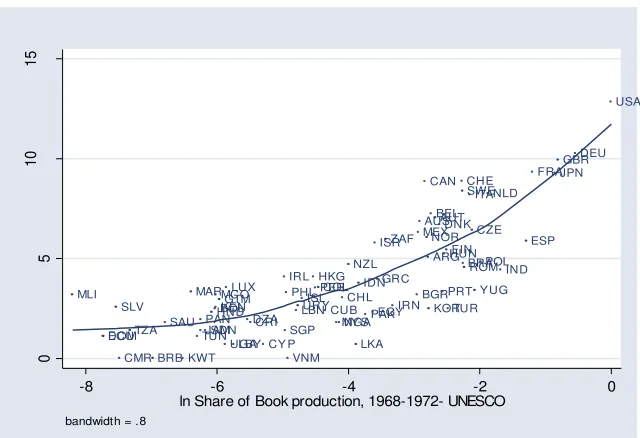
Figure 1 shows that the two measures of the initial stock of knowledge are highly correlated, so
the model‟s estimates should not differ significantly when using either of these proxies. In addition, the
high correlation between the share of book production and the initial stock of patents also suggests that
knowledgeable societies are more innovative. Therefore, our strategy of using the share of book
production to proxy initial knowledge seems to be reasonable.
Personnel engaged in R&D is measured as the total number of scientists, engineers, technicians
and supporting staff engaged in research and development. The data on personnel is expressed as a
full-time equivalent. This variable is from several years of the UNESCO Statistical Yearbook. The data is not
comprehensive in the sense that it does not provide a large cross-section of countries for the same year. In
numerous cases, the statistics are available just for a few years during the time period considered.
Averages over a five years period are utilized to maximize the sample size. Specifically,
i 1972 1968 t i , t i , 0
A L n
H
where L denotes labor force engaged in R&D, i indexes countries, t indexes time and n ≤ 5 denotes the
number of years for which the data is available. This variable is measured over 1968 to 1972 and over
1995 to 2001.
The idea that the development of institutions is an evolutionary process depending on previously
accumulated knowledge is accounted for in the empirical model by including a variable that measures
human capital accumulation in the early 20th century. This variable is calculated as the number of students
in school in 1920 per square kilometer.
i i , 0 i ,
0
h
area
H
where h0denotes the number of students in school in 1920, area denotes the country land area and i
indexes countries.
Data on students enrolled in primary and secondary schools in early 20th century is from Mitchell
(2003a, 2003b, 2003c). Mitchell provides these statistics back to the eighteenth century only for a few
countries. A representative cross-country sample can be only collected around 1920. Mitchell reports the
number of children enrolled in primary and secondary schools for 68 countries in 1920 and statistics for
52 countries around the 1930s. Therefore, combining the actual 1920 data with estimates of the number of
students enrolled in 1920 based upon the 1930 numbers allows one to get a sample comprised of 120
countries.12 The country area, which is needed to calculate the schooling density variable, is from the
United Nations and based upon the current geopolitical arrangement. Countries that experienced changes
in their boundaries, such as the former USSR republics, Paraguay, Peru, Bolivia, India, Ivory Coast, Mali,
Mauritania, Algeria and Zaire were not included in the regression analysis.13
The geographic variables are taken from McArthur and Sachs (2001) and La Porta et al. (1999).
We use i) mean temperature, which measures the 1987 mean annual temperature in Celsius; ii) coastal
land, which quantifies the proportion of land area within 100 km of the coast and iii) latitude, which
12
We use the geometric growth rates in the estimations. For instance, if a country has data on enrollment between 1930 and 1940, the geometric growth rate between these periods is utilized to estimate enrollment back to 1920.
13
quantifies the absolute value of the latitude, is scaled to take values between 0 and 1. This variable is taken
from La Porta et al. (1999).
The colonial legacy is measured by a set of dummy variables that identify the origin of a country‟s
legal system. Specifically, these dummies identify if the origin of the legal system is English, French,
German, Scandinavian, or Socialist. These variables were taken from La Porta et al. (1999).
Measurement error
Almost all economic variables are measured with error and this problem is augmented in this
study due to the nature of the variables being studied. If an explanatory variable is measured with error, it
is necessarily correlated with the error term. In the presence of measurement error OLS estimates will be
biased and inconsistent (Davidson and MacKinnon, 1993). According to Hall and Jones (1999), this
problem can be addressed together with the endogeneity issue by using the IV estimator. Consider that
institutions are measured with an error, such that:
Tˆi Ti
i (5)where Tˆ is unobserved institutions,
T
is measured institutions and is the measurement error.Substituting equation 5 into equation 3 gives:
ln(Pi,T)
0
1ln(HAi,0)
2ln(Ai,0)
3Ti
3
i
i,t (6)The explanatory variables from equation 3 and 4 can be stacked in matrices Z=[HA0 A0] and
X=[H0 G R] respectively. If X is a valid instrument for
T
, then E[X‟v]=0. Assuming that isuncorrelated with v, Z and X; 3 is identified by the orthogonality conditions and both the measurement
error and the endogeneity concerns are addressed. Therefore, it is crucial for the reliability of estimates to
select variables to instrument institutions that are uncorrelated with the error term of the second-stage
regressions.
4 Regression Analysis
Table 1 presents descriptive statistics for the variables utilized in this study. The differences in the
production is strongly correlated with all four measures of institutions. We use regression analysis to test
if the positive relationship between institutions and patent production holds as we account for other factors
that influence patent production. Several alternative specifications and different methods of estimation are
utilized to evaluate the robustness of the results. We follow Acemoglu et al. (2001 and 2004) and La Porta
et al. (1999)andestimate equation 4 using OLS. Subsequently, equation 5 is estimated using OLS and the
IV methods.14
4.1 The Determinants of Institutions
Despite the fact that appraising the determinants of institutions is not the primary goal of this
study; our model of patent production requires finding suitable instruments for institutions. This
necessitates at least some evaluation of the determinants of institutions.15 Our empirical strategy closely
follows the literature by instrumenting institutions with legal origins (La Porta et al. 1999), geography
(Acemoglu, 2001; Rodrik, 2000) and historical levels of human capital. Our estimates of the first stage
regressions for the four measures of institutions considered in the paper conform to most of the results
previously found in the literature.
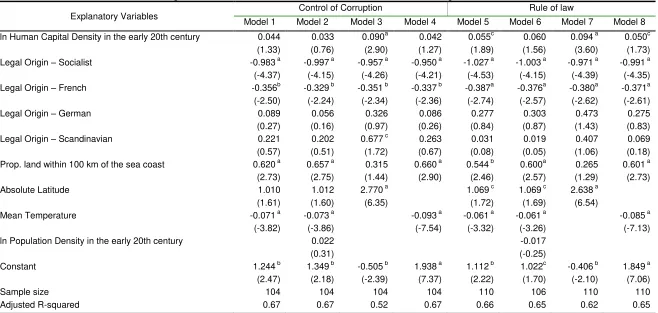
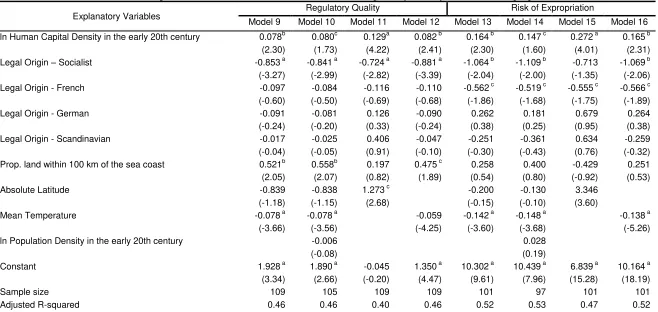
Tables 3 and 4 provide the estimates of equation 4 using the four different institutional measures.
The adjusted R-squared indicates that over 60 percent of the variation in Control of Corruption and Rule
of Law can be explained by the set of explanatory variables included in the estimates. The model explains
about 50 percent of the variation in Regulatory Quality and Risk of Expropriation. The overall fit of the
model is in accordance with previous studies in the field (e.g. Acemoglu et al., 2001 and 2004; La Porta et
al.,1999). It is worth noticing that mean temperature and latitude are highly correlated (-0.85) and provide
comparable information about climate conditions. Including these two variables simultaneously may cause
severe multicollinearity but not improve the model‟s fit. The best parsimonious specification seems to
include only mean temperature and the share of land in the coast as controls for geographic influences.
14
We also estimated the model using the GMM estimator. The sizes of the GMM and 2SLS coefficients were very similar and the qualitative conclusions identical. The GMM estimates are not reported in the paper and can be provided upon request.
15
To sum up, the estimates provide evidence that historical levels of human capital, legal origins,
and geographically related variables are important in explaining institutions. In addition, controlling for
the variables mentioned above, all of the tested regressions suggest that historical levels of population
density has no effect on shaping current institutions.16
Our estimates of the first stage regressions contribute to the literature because the regression
analysis is conducted using a recent dataset on institutional quality and a measure of human capital
accumulation in the early 20th century. Furthermore, the results discussed above are in accordance with
previous findings in this field. For instance, La Porta et al. (1999) find that French and Socialist legal
origins have negative effects on the measures of governance, i.e., a property rights index, a business
regulation index and a corruption index. Hall and Jones (1999), La Porta et al. (1999), Acemoglu et al.
(2001), McArthur and Sachs (2001) and Acemoglu and Johnson (2005) also find that geographically
related variables affect current institutions. While we are able to replicate the findings of previous
empirical examinations, this study adds a new finding that schooling density in the early 1900‟s also helps
to explain current institutions. This finding is consistent with the reasoning of Lipset (1960), which argues
that human capital accumulation contributes to shape more benign politics, less violence and more
political stability. As noticed by Glaeser et al. (2004), “[t]he key human capital externality is not
technological but political: courts and legislatures replace guns. These improvements in turn bring about
greater security of property and economic growth.” (p. 282).
4.2 Institutions and Innovation: IV Estimates
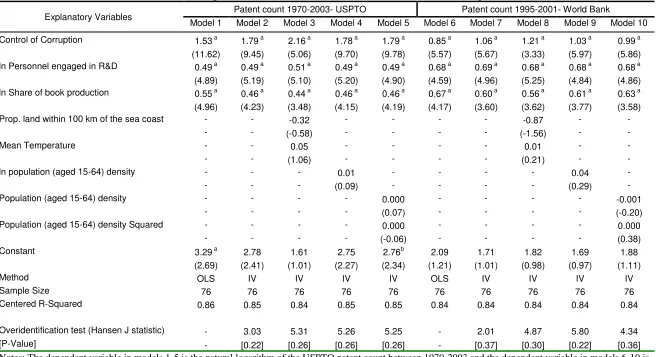
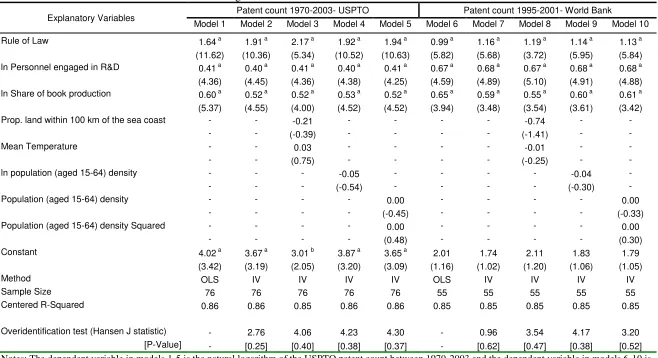
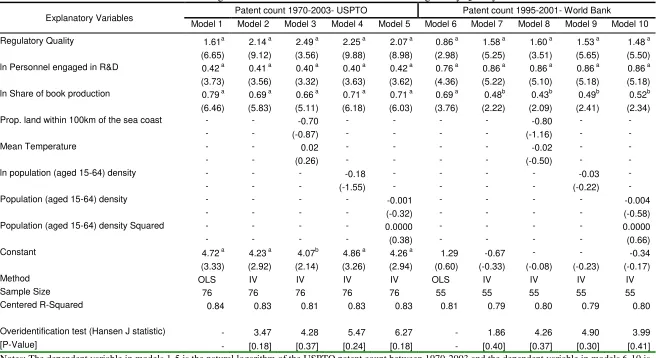
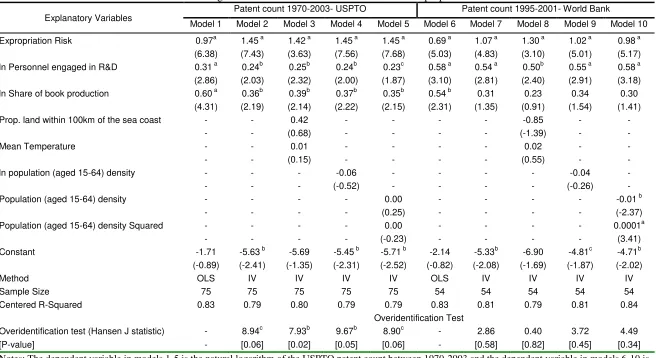
Tables 5 through 8 report the regressions of the determinants of innovation using different
measures of institutions and patent counts from both the USPTO and the World Bank. In these four tables,
the dependent variable in models 1 thru 5 is the USPTO patent count between 1970 and 2003 and the
dependent variable in models 6 thru 10 is the World Bank patent count between 1995 and 2001. Models 1,
2, 6 and 7 only include variables suggested by the theoretical model. The other models are augmented to
16
evaluate the model‟s robustness. Models 1 and 6 are OLS estimates and all of the other models are IV
estimates.
The results show that the OLS estimates underestimate the impact of institutions on innovation. In
all regressions the IV estimates of the coefficients on institutions are larger than the corresponding
coefficients generated by OLS. This clearly indicates that there exists significant measurement error in the
institutional variables, which is not accounted for in the OLS regressions, thus generating significant bias
in the OLS estimates.17
In all of the regressions the coefficients on personnel engaged in R&D and share of book
production have the expected signs and are statistically significant.18 While these variables are not our key
interest, they control for the size of an economy and the position of a country on the world knowledge
frontier, allowing us to evaluate the net influences of institutions on patents production.19 It is important to
emphasize that countries that are far from the technological frontier do not patent as much as the others.
Therefore, failure to control for the distance from the technological frontier may bias the estimates of the
impact of institutions on innovation. In this study the share of book production (and initial flow of patents)
supposedly controls for a country's distance from the technological frontier (level of development).
The results do not support the presence of scale effect from personnel engaged in R&D on patent
production. In all of the regressions, the null hypothesis that the coefficient on personnel engaged in R&D
is equal to one is rejected (at the 1% and 5% levels of significance) in favor of the alternative hypothesis
that the coefficients are less than one. This implies that long-run growth of technology (patent production)
17
This finding is consistent with Acemoglu et al. (2001).
18
In Table 7, models 7 through 10, the coefficients on book production are only marginally significant.
19
In a set of regressions not reported in the paper, we tested an alternative measure of book production. More precisely, we use the share of applied and pure science book production instead of the share of all new titles produced. There are no significant quantitative differences compared to those results reported in Tables 5-7, which
corroborates the model‟s specification. However, the coefficient on applied and pure science book production is
cannot be sustained only with the increase of the workforce engaged in P&D. This finding contradicts the
predictions from Romer (1990)‟s model, but is in accordance with the findings reported by Jones (1995).
The estimates provide evidence that, controlling for the size of an economy and the position of a
country on the world knowledge frontier, institutions have a strong positive effect on innovation.
Specifically, the coefficients on institutional measures are positive and statistically significant in all of the
regressions reported in Tables 5 through 8. This suggests that economies that have market-friendly
policies, lower perception of corruption, or whose judiciary systems are more effective and predictable
will experience higher rates of innovation (patent production). For example, the estimates suggest that if
Brazil had the same market regulatory system as that of the U.S. (the difference in the regulatory quality
index between these two countries is about 1.2), Brazilian residents would have produced about 2.5 times
more patents than what they actually produced between 1970 and 2003. The model also suggests that
controlling for the differences between the Brazilian and the U.S. indexes of control of corruption or rule
of law, Brazilian patent production, between 1970 and 2003, would be approximately four times larger
than it actually was. The presence of measurement errors in quantifying institutions implies that
interpretation of the coefficients (marginal effects) of the model may be imprecise. However, the impacts
of improving institutions on patent production seem to be quite large and have the right direction.
It is worth noticing that the estimated size of the coefficients on institutions is larger than what
was hypothesized by Tebaldi and Elmslie (2006). More specifically, the model developed by Tebaldi and
Elmslie (2006) assumes that the coefficient on institutions should rage between 0 and 1, but our estimates
provide evidence that the coefficient on institution is greater than one. This result may be generated due to
the presence of measurement errors in quantifying institutions or imprecise model specification.
The specification above implicitly assumes that adverse geography affects innovation through an
indirect effect from institutions. This specification is similar to those used by Acemoglu et al. (2001 and
2004) and Hall and Jones (1999). However, Gallup et al. (1999), Sachs (2000) and McArthur and Sachs
(2001) argue that geography may have a direct effect on production as well as an indirect effect from
instance, mean temperature (climate) may affect the health of the personnel engaged in R&D20. Models 3
and 8 in Tables 5 through 8, report the estimates of the basic model augmented with mean temperature and
the share of land in the coast. The regressions provide no support to the claim that geographically related
variables have direct effects on innovation. Specifically, once we have controlled for institutions, the
coefficients of mean temperature and share of land in the coast are insignificant at the standard levels of
significance in all regressions.21
4.3 Robustness
Although the results detailed in the presentation seem reasonable, the estimates are subject to the
validity of the IV estimates, which ultimately depends on the assumption that the model is properly
identified by the set of proposed instruments. Of course, we recognize that the instruments are not perfect
and that the exclusivity assumption may be violated. For instance, although initial human capital is
expected to not be correlated with current innovation (patent production), there are channels (e.g. omitted
variables, measurement error) by which initial human capital may be correlated with the error term of the
second-stage regressions. To alleviate concerns about the validity of the instruments, we follow Acemoglu
et al. (2005a) and Alcala and Ciccone (2004) and use the Hansen's J statistic (Hansen, 1982) to evaluate
the overidentifying restrictions in the IV regressions. In general, the overidentification tests suggest that
the correlation between the instruments proposed and the error term is not significant. The results give
more confidence in the validity and robustness of the estimates. However, the test does cast some doubt
that the model for risk of expropriation is correctly identified.
The functional form chosen for the empirical model is also subject to imperfections, so alternative
specifications can be used to check the robustness of the results. A key concern regarding the validity of
the specification is motivated by the idea that countries that are far from the technological frontier do not
patent as much as the others, independently from the quality of institutions. Another concern originates
20McArthur and Sachs (2001) refer to this effect as “disease ecology”.
21
from the idea that developed and developing countries may respond differently to changes in institutional
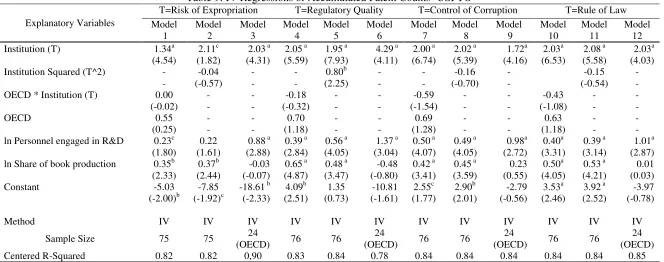
quality. We address these concerns by estimating three alternative models, whose estimates are shown in
Table 9. Models 1 and 3 test if innovation in OECD and non-OECD countries responds differently to the
quality of institutions. The estimates show no differential effect for countries in the technological frontier
(OECD) and countries far from the technological frontier (non-OECD countries). In addition, a quadratic
model on institutions (Model 2) also shows no differential effect. These results suggest that the impact of
institutional quality on innovation is important for countries in the technological frontier as well as for
countries far from the technological frontier. This finding also refutes the idea that the link between
institutions and patenting found in this study could be by showing a relationship between the level of
development and a country's distance from the technological frontier.22
5 Final Remarks
Recently researchers have turned to study the impacts of institutions on economic performance.
However, one can identify the following important gaps in the empirical institutional growth literature: i)
the econometric specification used in institutions-related growth studies is not entirely supported by
formal theoretical models; ii) the impact of institutions on technical innovation is overlooked in empirical
investigations of cross-country economic performance; and iii) there is no clear empirical evidence
supporting the claim that institutions affect an economy‟s steady state growth rate of per capita income.
This study contributes to the literature by conducting an empirical examination on the links between
innovation and institutions that addresses the points raised above.
The estimates obtained show that institutional arrangements positively contribute to explain much
of the variations on patent production across countries. Specifically, we find evidence that control of
corruption, market-friendly policies, protection of property rights and a more effective judiciary system
boost an economy‟s rate of innovation (patent production).
22
While most of the previous literature on institutional and economic performance is able to show a
positive association between institutions and levels of income and between institutions and the transitional
growth rates of per capita income, an unambiguous empirical link between institutions and the steady state
growth has not yet been established. Based on the theoretical model developed by Tebaldi and Elmslie
(2006), which shows that the impacts of institutions on innovation spillover to the growth rate of GDP per
capita, this paper shows evidence of a growth effect through innovation, i.e., institutions have a growth
effect on income because institutional quality affects an economy‟s rate of innovation, the engine of
economic growth.
The econometric estimates also provide evidence that the impact of institutional quality on
innovation is important for countries in the technological frontier as well as for countries far from the
technological frontier. This result is important because it refutes the idea that countries that are far from
the technological frontier do not patent as much as the others, independently from the quality of
institutions. This research also finds that geography, per se, cannot explain differences in innovation
across countries. Geography affects innovation, but only through institutions. This paper also provides
empirical evidence that in the long-run human capital accumulation is an important variable in shaping
References
Acemoglu, Daron, Simon Johnson and James A. Robinson (2001). “The Colonial Origins of Comparative Development: An Empirical investigation,” American Economic Review, 91(5): 1367-1401.
Acemoglu, Daron, Simon Johnson and James A. Robinson (2004). “Institutions as the Fundamental Cause
of Long-Run Growth,” NBER, Working Paper 10481.
Acemoglu, Daron and Simon Johnson (2005). “Unbundling Institutions,” Journal of Political
Economy.113(5): 949-95.
Acemoglu, Daron, Simon Johnson, James A. Robinson, Pierre Yared (2005a). “From Education to Democracy?” Working Paper 11204. http://www.nber.org/papers/w11204
Acemoglu, Daron, Simon Johnson, James A. Robinson, Pierre Yared (2005b). “Income and Democracy”
Working Paper 11205. http://www.nber.org/papers/w11205
Alcala, Francisco And Antonio Ciccone (2004). “Trade and Productivity”, Quarterly Journal of
Economics, 119 (2), 613-46
Aghion, Philippe and Peter Howitt (1992). “A Model of Growth through Creative Destruction,”
Econometrica, 60(2): 323-351.
Barro, Robert (1991). “Economic Growth in a Cross Section of Countries,” Quarterly Journal of Economics, 106(2): 407-43.
Clark, Donald (2004). Knowledge. From http://www.nwlink.com/~donclark/knowledge/knowledge.html.
Downloaded in 01/25/05
Cochran, Terry (2001). Twilight of the Literacy: Figures of Thought in the Age of Print. Cambridge,
MA: Harvard.
Davidson, Russell and James G. MacKinnon. (1993). Estimation and Inference in Econometrics. New
York: Oxford University Press.
Denoon, Donald (1983). Settler Capitalism: The Dynamics of Dependent Development in the
Southern Hemisphere. Oxford: Clarendon Press.
Dollar, David and Aart Kraay (2003). “Institutions, Trade and Growth,” Journal of Monetary Economics,
50: 133-162.
Easterly, William and Ross Levine (2003). “Tropics, Germs, and Crops: How Endowments Influence Economic Development,” Journal of Monetary Economics, 50: 3-39.
Engerman, Stanley L. and Kenneth L. Sokoloff (2003). “Institutions and Non-Institutional Explanations of
Economic Differences,” NBER Working Paper 9989.
Esfahani, Hadi Salehi and María Tereza Ramírez (2003). “Institutions, Infrastructure and Economic Growth,” Journal of Economic Development, 70: 443-447.
Fedderke, Johannes (2001). “Growth and Institutions,” Journal of International Development, 13: 645-670.
Gastil, Raymond D. (1979). Freedom in the World: Political Rights and Civil Liberties. New York : Freedom House.
Glaeser, Edward L., Rafael La Porta, Florencio Lopes-de-Silanes and Andrei Shleifer (2004). “Do
Institutions Cause Growth?,” Journal of Economic Growth, 9(1), 271-303..
Gradstein, Mark (2004). “Governance and Growth,” Journal of Development Economics, 73: 505– 518.
Griliches, Zvi (1979). “Issues in Assessing the Contribution of R&D to Productivity Growth,” Bell Journal of Economics, 10(1): 92-116.
Griliches, Zvi (1990). “Patent Statistics as Economic Indicators: A Survey,” Journal of Economic Literature, 28(4): 1661-1770.
Griliches, Zvi (1994). “Productivity, R&D and the Data Constraint,” American Economic Review, 84(1): 1-23.
Griliches, Zvi (ed) (1984). R&D, Patents and Productivity. Chicago: University of Chicago Press.
Hall, Robert E. and Charles Jones (1999). “Why Do Some Countries Produce So Much More Output Per Worker Than Others?,” Quarterly Journal of Economics, 114(1): 83-116.
Hansen, L. (1982). “Large Sample Properties of Generalized Method of Moments Estimators,”
Econometrica, 50, 1029-1054.
Huang, Haizhou and Chenggang Xu (1999). “Institutions, Innovations and Growth,” American Economic Review, 89(2): 438-443.
Jaffe, Adam B. and Manuel Trajtenberg (2002). Patents, Citations & Innovations. Cambridge-MA,
The MIT Press.
Jaffe, Adam B. and Josh Lerner (2002). “Reinventing Public R&D: Patent Citations on the Impact of
NASA and other Federal Las on Commercial Innovation.” In: Jaffe Adam B. and Manuel
Trajtenberg. (2002). Patents, Citations & Innovations. Cambridge-MA, The MIT Press. pp.
287-335.
Jones, Charles (1995). “R&D-Based Models of Economic Growth,” Journal of Political Economy, 103:4: 759-784.
Kaufmann, Daniel , Aart Kraay and Massimo Mastruzzi (2003). “Governance Matters III: Governance
Indicators for 1996–2002,” Policy Research Working Paper No. 3106.
Kipphan, Helmut. (2001). Handbook of Print Media: Technologies and Production Methods. Berlin:
Springer-Verlag Berlin Heidelberg.
Knack, Stephen and Philip Keefer (1995). “Institutions and Economic Performance: Cross-Country Tests
Using Alternative Institutional Measures,” Economics and Politics, 7(3): 207-227.
Knack, Stephen and Philip Keefer (1997). “Does Social Capital Have an Economic Payoff? A
Cross-Country Investigation,” Quarterly Journal of Economics, 112(4): 1251-1288.