Vivek Kant Jogi
School of Studies in Electronics, Pt. Ravi Shankar Shukla University, Raipur, India Email: [email protected]
Received 24 October 2013; revised 25 November 2013; accepted 2 December 2013
Copyright © 2014 by author and Scientific Research Publishing Inc.
This work is licensed under the Creative Commons Attribution International License (CC BY). http://creativecommons.org/licenses/by/4.0/
Abstract
In order to improve the performance of polymer light-emitting devices, driving voltages, current efficiency, luminance and power efficiency of different cathode metals such as Ca/Al, CsF/Al, LiF/Al and LiF/Ca/Ag were compared. The results show that cathode metals CsF/Al contain the highest current efficiency, maximum luminance and power efficiency. Therefore, we can choose the CsF/Al to be the cathode for improving the performance of polymer light-emitting devices.
Keywords
PLED; Current Efficiency; Power Efficiency; Current Density
1. Introduction
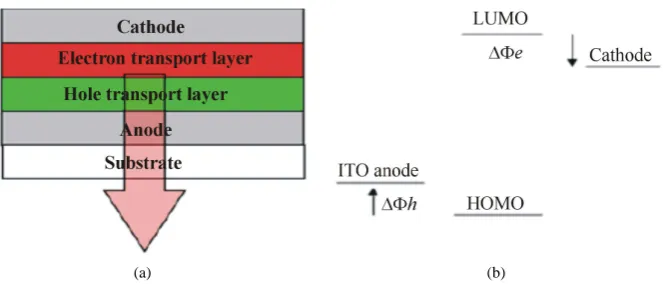
A PLED consists of very thin layers of polymer films sandwiched by two electrodes [1]. In a typical PLED structure, there are two polymer layers, one of which functions as the hole transporting layer and the other func-tions as the light-emission layer as shown in Figure 1(a). An indium tin oxide (ITO) layer is generally used as the transparent anode, which allows the light generated within the diode to leave the device [1]. The metal ca-thode is conveniently deposited on top of the polymer by thermal evaporation [1]. The devices’ performance strongly depends on effective charge injection from the electrodes to the organic medium and charge transport in the organic materials.
(a) (b)
Figure 1. The basic structure (a) and the energy level for the operation (b) of a PLED.
2. Devices Fabrication Characteristic
Commercial available indium-tin oxide (ITO) from Sigma Aldrich is used as anode of the PLEDs because of its not only transparent but also high conductivity. Besides, its ionization potential is just about 4.8 eV that is easy to transport the holes into the PEDOT (HTL) layer. The ITO glass obtains 30 Ω/□ resistances. Moreover, it was rinsed by the de-ionized water for removing the dusts & the other particles on the surface and baked at about 120˚C for an hour to evaporate the water vapor. After that, the UV-ozone treatment was used to enrich the oxy-gen and reduce the oxyoxy-gen vacancies. That can improve the conductivity of the ITO layer for helping the trans-port of hole easily [3].
The poly (3,4-ethylene dioxythiophene), PEDOT solution was spin-coated onto the ITO layer at about 20 seconds. Control the spinning speed of the spin-coating machine is of importance. The first 5 seconds must use a slow spinning speed about 400 rpm after that the spinning speed wasturned to 2000 rpm to provide the homoge-neous and high quality layer. Finally, the PEDOT layer was dried by the infrared lamp. The electron transport layer and emissive layer was spin coated by the poly (9,9-dioctylfluorene) (PFO) solution below 400 rpm spin-ning speed at the first 5 seconds to control the homogeneous layer. Then, the spinspin-ning speed of the spin-coating machine was increased to 1000 rpm for 40 seconds and baked by the infra-red lamp for the evaporating mini-mum 10 minutes.
For deposition of the metal cathode the thermal evaporation machine (Vacuum coating systems Model 12A4D) is used to deposit the thin-film metal layers on the dried PFO layer with the deposition rate of 1.5 nm/s. During the deposition, the pressure of the chamber must need to be controlled to about 5 × 10⁻⁶ mbar for the successful thermal evaporation. Besides, the thickness of thin metal layers is 100 nm each (involving the protec-tive metal layer).The different fabricated specimens are
Device A: ITO/PEDOT/PFO/Ca/Al, Device B: ITO/PEDOT/PFO/CsF/Al, Device C: ITO/PEDOT/PFO/LiF/Al, Device D: ITO/PEDOT/PFO/LiF/Ca/Ag.
The current, voltage, luminance and electroluminescence (EL) of the devices are measured using spectropho-tometer.
3. Results and Discussion
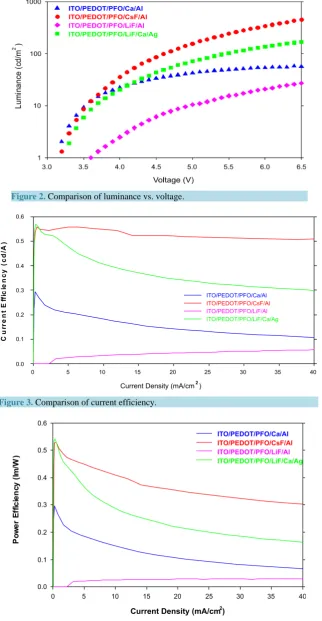
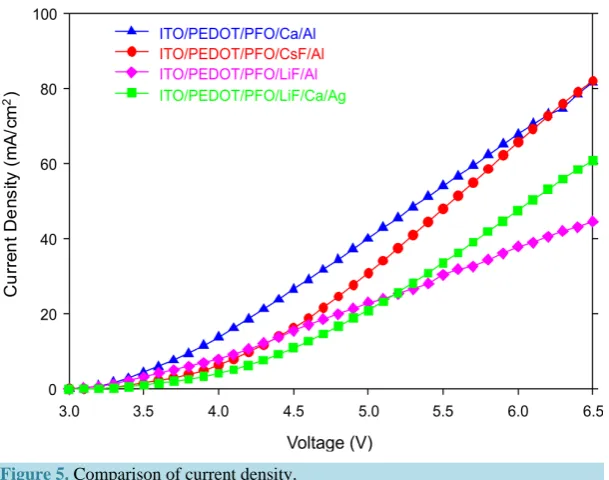
PFO layer was used to be the emissive layer so the EL spectrums of these four devices have two blue emission peaks that are 440 nm and 460 nm. Figures 2-5 show the comparison of luminance vs. voltage, Current Effi-ciency, Power Efficiency and Current Density of Device A, B, C and D respectively.
Figure 2. Comparison of luminance vs. voltage.
Figure 3. Comparison of current efficiency.
Figure 5. Comparison of current density.
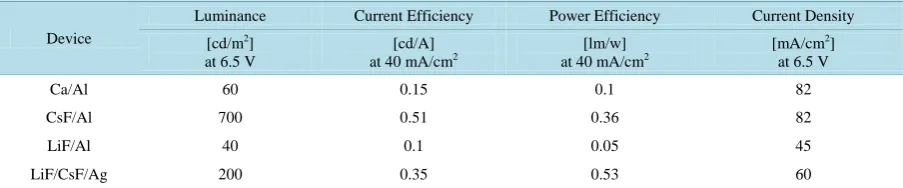
specimens, the maximum luminance at the same voltage of CsF/Al is the highest. Therefore, we can reduce the driving voltage and increase the luminance through the changing the cathode materials such as LiF/Ca/Ag or CsF/Al. From Figure 3, only the Device B (Red) (CsF/Al) keeps steady, which is the most stable curve out of these four specimens. Furthermore, CsF/Al also is the highest curve of the graph that means it has the highest current efficiency. For example, if the current density is 40 mA/cm2, the current efficiency of CsF/Al is 0.51 cd/A which is the highest one mean it has lowest power consumption. Therefore CsF/Al and LiF/Al are the lowest and highest power consumption respectively. From Figure 4, when the current density is 40 mA/cm2, the power efficiency of CsF/Al is 0.3 lm/W which is highest. The power efficiency of CsF/Al and LiF/Ca/Ag are the better choice of the cathode for providing the higher power efficiency and lower power consumption of PLEDs. From Figure 5, Device B (Red) CsF/Al has the most of rapid increases, achieved the highest level of current density. For example, when the applied voltage is 6.5 V, the CsF/Al curve can achieve the highest current den-sity 8.2 mA/cm2. It expresses that CsF/Al can generate the highest brightness when the driving voltage is 6.5 V. Besides, its curve increases rapidly that mean it is easy to achieve the designed brightness level. Therefore, it is high sensitive and low reaction time lap. Comparison of the total performance of these four specimens from Ta-ble 1, we got the results that CsF/Al is the best materials because it’s performance such as the best of current ef-ficiency, power efef-ficiency, current density and maximum luminance. That means, it does not only provide the higher luminance with lower driving voltage but also reduce the power consumption. Furthermore, CsF/Al is easy to achieve the turn on voltage to provide the luminance quickly due to its properties of current density (low reaction time lap). By the consideration of the above factors, LiF/Ca/Ag also can be used to replace the Ca/Al as a cathode of PLEDs though its performance is worse than CsF/Al. Compared with the normal materials (Ca/Al); LiF/Ca/Ag really has a large improvement. Besides, the LiF/Al is the worst specimens out of the other three samples.
: >LiF Ca Ag>Ca Al>LiF Al
PERFORMANCE CsF Al
4. Conclusion
but also reduce the response time lap. As the supporting results of this research, the total performance of the PLEDs can be improved by selecting the appropriate cathode materials as CsF/Al.
References
[1] Deng, X.-Y. (2011) Light-Emitting Devices with Conjugated Polymers. International Journal of Molecular Sciences, 12, 1575-1594. http://dx.doi.org/10.3390/ijms12031575
[2] Pope, M. and Swenberg, C.E. (1982) Electronic Processes in Organic Crystals and Polymers. Oxford University Press, New York.
[image:5.595.87.539.101.195.2]