Citation:
Hynan, AE (2013) How I use the internet and online social media: experiences of young people who use Augmentative and Alternative Communication (AAC). Doctoral thesis, Manchester Metropolitan University.
Link to Leeds Beckett Repository record: http://eprints.leedsbeckett.ac.uk/1261/
Document Version: Thesis
The aim of the Leeds Beckett Repository is to provide open access to our research, as required by funder policies and permitted by publishers and copyright law.
The Leeds Beckett repository holds a wide range of publications, each of which has been checked for copyright and the relevant embargo period has been applied by the Research Services team.
We operate on a standard take-down policy. If you are the author or publisher of an output and you would like it removed from the repository, please contact us and we will investigate on a case-by-case basis.
How I use the internet and online social
media: Experiences of young people who use
Augmentative and Alternative Communication
(AAC).
Amanda Hynan
A thesis submitted for partial fulfilment of the requirements of the
Manchester Metropolitan University
for the degree of Doctor of Philosophy
Department of Health Professions
“My laptop is completely lifeless, flatlined, I feel sick. If I don’t have my computer, then I can’t send text messages or emails, do college assignments or
finish off the work I bring home… I can’t laugh and joke with my friends online, tell them about my day and ask about theirs. I can’t describe to them
how I’m feeling or make plans to meet up. My physical world might still be limited … but there are parts of my life that know no boundaries… All I’ll have to communicate with now is a battered old alphabet board that won’t
reach around the globe the way I need it to.”
1
Abstract
This thesis addresses a specific gap in the literature base regarding the self-reported experiences of using the internet and online social media by adolescents and young adults (young people) who use augmentative and alternative communication (AAC) within the UK. The research took a socially constructivist approach and used a qualitative methodology to conduct semi-structured interviews with twenty-five young people (aged 14-24) with complex communication needs. The data was
collected over a period of eighteen months within a mainstream school, two specialist schools, four specialist colleges and an adult residential centre.
The study is based within the context of adolescent development for young people who use AAC. Peer relationships are important to adolescents (Helseth & Misvaer, 2010) and Smith (2005) identified establishing friendships is difficult for young people who use AAC in light of their physical and complex communication challenges which increases the risk of loneliness. Using online communication technology can help mitigate feelings of loneliness with people who use AAC (Cooper, Balandin & Trembath, 2009), although significant barriers for access have been identified (McNaughton & Bryen, 2007). The views of young people who use AAC are under-represented on the topic of the internet and online social media. There are important legal obligations to seek the views of young people with disabilities (Article 12, United Nations Convention on the Rights of the Child, 1989; Article 21, United Nations Convention on the Rights of Persons with Disabilities, 2006) but progress has been slow to include the voices of young people with significant communication impairment (Morris, 2003; Rabiee, Sloper and Beresford 2005; Wickenden, 2009).
2 environments, may be applicable to perceptions of social inclusion within virtual communities.
3
Dedication
For Dermot, Veronica and Jonnie.
4
Acknowledgements
First and foremost I would like to thank all the young people who gave their time to this research. Their determination to take part in the interviews took great personal commitment and effort and was inspirational. Their insights are extremely valuable and I hope by creating this written story together, we will be able to ensure their voices are heard by a wider audience than just me. I would also like to thank Rohan Slaughter, Tom Kipling, Gemma Mitchell, Laura Day, Tom Kelly and Gregor
Gilmore. I would also like to extend my gratitude to all the people that I cannot name for their support, enthusiasm and expertise.
My supervisory team: Dr Janice Murray, Professor Juliet Goldbart and Dr Geoff Bunn have all gone beyond the call of duty to support and steer me through the research journey. Their attention to detail and level of commitment to the project has been remarkable. Thanks to Janice for the invaluable advice on so many different levels and making the journey so enjoyable. Most of all I would like to thank you for your laughter, straight talking, and for always being there when I needed you. Thank you to Juliet for the interesting questions, philosophical insights and inspiration. You too were always there and never too busy to help. The confidence I felt in being able to contact you both about anything and everything is, I know from my Ph.D. peers, a rare gift in the world of supervisors. Thank you to Geoff for joining the journey with enthusiasm and bringing your robust clarity to the process at key moments. I would also like to thank Manchester Metropolitan University for funding this research and my attendance at conferences.
5
Table of contents
Abstract ... 1
Dedication ... 3
Acknowledgements... 4
Table of contents ... 5
List of Figures and Tables ... 12
Chapter 1 – Introduction ... 13
1.1. Structure of the thesis ... 13
1.2. Impetus for the study ... 14
1.3 Significance of the study ... 16
1.4. The research aim ... 17
1.5. Philosophical position ... 17
1.6. Terminology ... 18
Chapter 2 – Literature review ... 20
2.1. Introduction ... 20
2.2. Part One: An overview of AAC ... 20
2.2.1. Introduction ... 20
2.2.2. The mode ... 21
2.2.3. The means ... 23
2.2.4. Representation system ... 23
2.2.5. Interactional strategies within face-to-face conversations ... 25
2.2.6. Time considerations within AAC-mediated face-to-face conversations ... 27
2.2.7. Narrative and humour ... 28
2.2.8. Summary ... 29
2.3 Part Two: Historical development of AAC ... 30
2.3.1. Introduction ... 30
2.3.2. Historical context ... 30
2.3.3. Development of voice output Apps on mainstream devices ... 32
2.3.4. The reaction of the AAC industry and the development of VOCA devices ... 35
2.3.5. The future? ... 36
6
2.4. Part Three: The internet and online social media within the lives of young people,
including those with physical disabilities, within westernised societies ... 38
2.4.1. Introduction ... 38
2.4.2. Rights of people with disabilities ... 38
2.4.3. Internet use by youth populations ... 40
2.4.4. Social capital and internet-based research ... 41
2.4.5. Online social ties of young people ... 44
2.4.6. Online self-representation ... 46
2.4.7. Self-determination ... 49
2.4.8. Potential risks within online environments ... 52
2.4.9. Summary ... 53
2.5. Part Four: The internet and online social media within the lives of young people who use AAC ... 54
2.5.1. Introduction ... 54
2.5.2. Use of computers, the internet, online social media and mobile phone technology by people who use AAC ... 54
2.5.3. Challenges for using the internet and online social media ... 57
2.6. Summary of the literature review chapter ... 58
2.7. The research objectives ... 59
Chapter 3 – Methodology ... 60
3.1. Introduction ... 60
3.2. Theoretical framework ... 60
3.2.1. Disability studies ... 60
3.2.2. Feminist research principles and disability studies ... 61
3.2.3. International Classification of Functioning, Disability and Health (ICF) ... 62
3.2.4. Challenges of internet-focused research ... 63
3.2.5. Summary ... 64
3.3. Methodological underpinnings ... 65
3.3.1. A socially constructivist/constructionist paradigm ... 65
3.3.2. A qualitative research approach ... 66
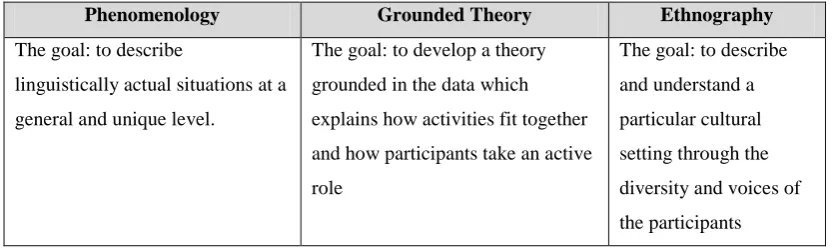
3.3.3. Discussion of three common qualitative approaches ... 67
3.3.4. Traditional Grounded theory ... 70
3.3.5. Constructivist Grounded Theory ... 71
7
3.4.1. Ethical approval... 73
3.4.2. Researcher positionality ... 74
3.4.3. Pilot Investigation ... 74
3.4.4. Pilot investigation participant ... 75
3.4.5. Pilot investigation data collection ... 75
3.4.6. Pilot investigation data analysis ... 75
3.4.7. Reflective learning from the pilot investigation ... 77
3.5. Procedure ... 79
3.5.1. Recruitment ... 79
3.5.2. Inclusion criteria ... 80
3.5.3. Ethical variations ... 81
3.5.4. Participant information ... 81
3.5.5. Informed consent ... 85
3.6. Study design ... 86
3.6.1. Introduction ... 86
3.6.2. Data collection ... 87
3.6.2.1. Settings ... 87
3.6.2.2. Semi-structured interviews ... 88
3.6.2.3. Total communication and low tech AAC ... 88
3.6.2.4. Group meetings ... 89
3.6.2.5. Demonstrations ... 90
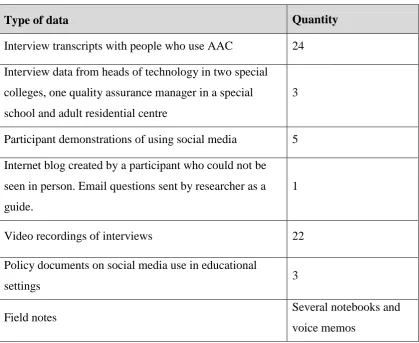
3.6.2.6. Summary of data sources ... 90
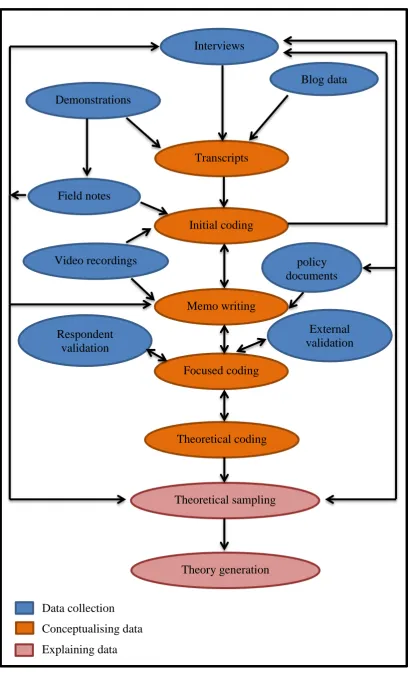
3.6.3. Data Analysis ... 92
3.6.3.1. Transcription ... 93
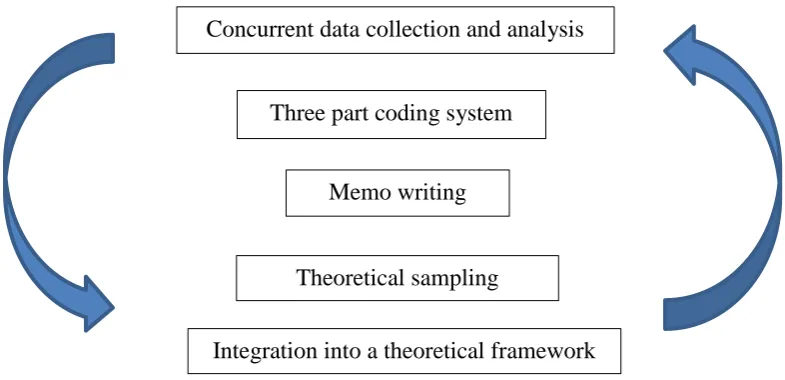
3.6.3.2. Concurrent data collection and analysis ... 93
3.6.3.3. Initial coding ... 95
3.6.3.4. Focused coding ... 95
3.6.3.5. Theoretical coding... 96
3.6.3.6. Memo writing ... 97
3.6.3.7. Theoretical sampling ... 98
3.6.3.8. Theory generation... 98
3.6.4 Summary ... 99
8
4.1. Introduction ... 102
4.2. Explanatory notes on data presentation ... 106
4.3. Desire to use the internet and online social media ... 108
4.3.1. Desire to be online ... 108
4.3.2. Desire to extend use ... 109
4.3.3. Summary ... 111
4.4. Reported use of the internet and social media ... 111
4.4.1. The internet ... 112
4.4.2. Online social media sites ... 113
4.4.3. Email ... 117
4.4.4. Texting and mobile phones ... 117
4.4.5. Frequency of use ... 118
4.4.6. Summary ... 119
4.5. Describing support ... 120
4.5.1. Introduction to and training to use the internet and online social media ... 120
4.5.2. Collaboration ... 123
4.5.3. Challenges regarding support ... 125
4.5.4. Summary ... 131
4.6. Online challenges ... 132
4.6.1. Online safety awareness ... 132
4.6.2. Resilience ... 135
4.6.3. Restrictions to use ... 139
4.6.4. Reduced privacy ... 140
4.6.5. Summary ... 140
4.7. Access technology ... 141
4.7.1. Computer access without additional equipment ... 141
4.7.2. Computer access with additional equipment ... 142
4.7.3. Challenges associated with access technology ... 144
4.7.4. Summary ... 146
4.8. VOCA issues ... 146
4.8.1. Advantages of integrated VOCAs ... 146
4.8.2. Disadvantages of integrated VOCAs ... 147
9
4.8.4. Repairing VOCAs and future planning ... 152
4.8.5. Summary ... 152
4.9. Self-determination ... 153
4.9.1. Autonomy and authorship ... 153
4.9.2. Enhanced privacy ... 154
4.9.3. Summary ... 155
4.10. Self-Representation ... 156
4.10.1. Information about self ... 156
4.10.2. Conversational equality ... 159
4.10.3. Expressing humour ... 160
4.10.4. Narrative record of activities ... 161
4.10.5. Summary ... 161
4.11. Online social ties ... 162
4.11.1. Bonding social ties ... 162
4.11.2. Maintaining social ties ... 164
4.11.3. Bridging online social ties ... 166
4.11.4. Summary ... 168
4.12. Memos ... 169
4.13. Generating the grounded theory of internet and social media use by young people who use AAC ... 176
4.13.1. Nature of the theory ... 176
4.13.2. Central phenomenon ... 177
4.13.3. Causal conditions ... 177
4.13.4. Limitations for achieving the central phenomenon ... 177
4.13.5. Context ... 178
4.13.6. Interaction/actions ... 178
4.13.7. Strategies ... 178
4.13.8. Consequences ... 179
4.13.9. Summary ... 179
Chapter 5 - Discussion ... 181
5.1. Introduction ... 181
The research objectives: ... 182
10
5.3 Causal conditions ... 184
5.3.1. Access methods that facilitate the use of mainstream computers ... 185
5.3.2. Availability of mainstream technology on integrated VOCAs ... 186
5.3.3. Human support to access and use digital technology and online social media .. 187
5.3.4. Requesting to use the internet and online social media ... 189
5.3.5. Evidence of use of the internet and online social media ... 190
5.3.6. Summary of causal conditions ... 191
5.4. Limitations for achieving the central phenomenon... 191
5.4.1. VOCAs and mainstream computer issues ... 191
5.4.2. Limited use of mainstream mobile technologies and Apps ... 193
5.4.3. Restrictions on use ... 197
5.4.4. Limited technical support from personal staff ... 200
5.4.5. Parental technical knowledge and skill limitation ... 203
5.4.6. Individual skills ... 204
5.5. Interaction and action ... 205
5.6. Context ... 208
5.7. Strategies ... 208
5.8. Consequences ... 212
5.8.1. Self-determination ... 212
5.8.2. Enhanced self-representation ... 214
5.8.3. Social capital ... 216
5.8.4. “Talk to everyone” ... 217
5.8.5. Reduced isolation ... 218
5.8.6. Resilience ... 219
5.8.7. Dating opportunities ... 222
5.9. Relevance and significance of the grounded theory of internet and online social media use by young people who use AAC ... 223
Chapter 6 - Conclusions ... 227
6.1. Conclusions ... 227
6.2. Strengths and limitations of the study ... 229
6.2.1. Strengths ... 229
6.2.2. Limitations ... 230
11
6.4. Potential areas of further study ... 232
Chapter 7 – Practical applications and concluding comments ... 234
7.1. Practical applications of the proposed grounded theory ... 234
7.2. Concluding comments ... 237
References ... 239
Appendices ... 277
APPENDIX A - THEMES AND QUESTION GUIDE... 277
APPENDIX B – DETAILED INFORMATION SHEET ... 279
APPENDIX C – BRIEF INVITATION ... 282
APPENDIX D – DIFFERENTIATED INFORMATION SHEET ... 283
APPENDIX E - STANDARD CONSENT FORM ... 284
APPENDIX F – DIFFERENTIATED CONSENT FORM ... 285
APPENDIX G – APPROVAL OF ETHICAL VARIATION TO INCLUDE 14 YEAR OLD ... 286
APPENDIX H – APPROVAL OF ETHICAL VARIATION TO INCLUDE PARENTS AND SCHOOL STAFF ... 287
APPENDIX I: QUESTIONS SENT VIA EMAIL TO 2 PARTICIPANTS (pre-prepared answers on VOCA and blog) ... 288
APPENDIX J – JOURNAL ARTICLE OF PILOT INVESTIGATION ... 289
APPENDIX K –JOURNAL OF INITIAL FINDINGS ... 290
APPENDIX L – THEMATIC NETWORKS FROM PILOT INVESTIGATION ... 293
APPENDIX M – ANONYMISED VERBATIM TRANSCRIPT 1 ... 297
APPENDIX N – ANONYMISED INTERVIEW TRANSCRIPT 2 (excerpt) ... 306
12
List of Figures and Tables
Table 1: Table illustrating the distinctions of three common qualitative approaches and areas of flexibility with other qualitative approaches (Adapted from Holloway and Todres (2003)………. 67
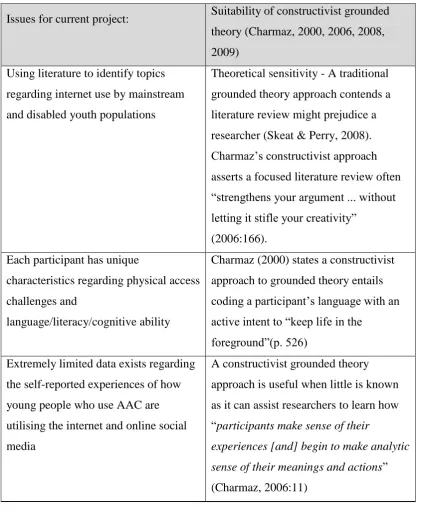
Table 2: Issues identified within the current project and the suitability of
constructivist grounded theory (Charmaz, 2000, 2006, 2008, 2009)……….. 72
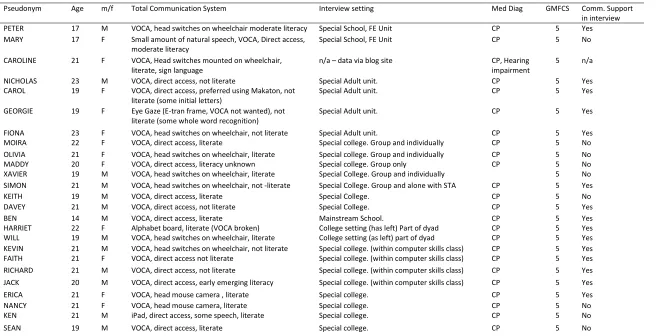
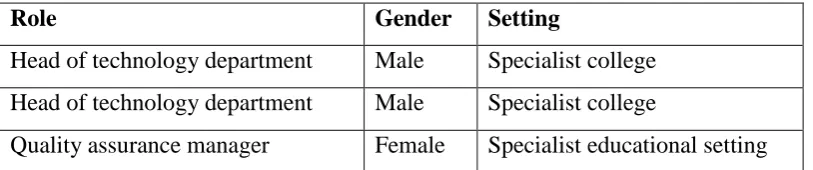
Table 3: Participants’ who use AAC demographic information……… 83 Table 3a: Additional adult participants……….. 84
Table 4: Table outlining literacy, access methods of participants and how they use
mainstream technology (n=25)……… 85
Figure A: Schematic representation of the steps suggested by Charmaz (2006) for
conducting a constructivist grounded theory study………..……… 87
Table 5: Table showing data sources and quantity………. 92
Figure B: The schematic representation of data collection occasions over eighteen
months……… 94
Figure C: Constructing a grounded theory through constant comparison…….. 101
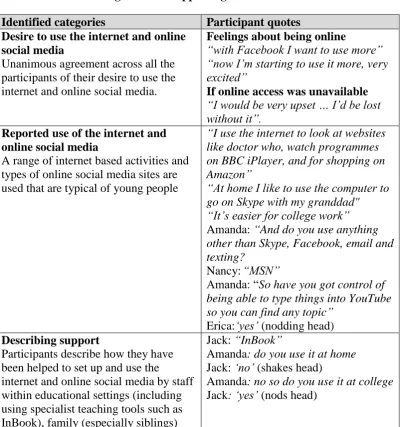
Table 6: Identified categories and supporting raw data excerpts……… 103
Table 7: Component elements of the categories ……… 105
Figure D: Proposed grounded theory of internet and online social media use by
young people who use AAC……… 180
Figure E: Practical applications of proposed grounded theory of internet and online
13
Chapter 1
Introduction
This thesis adds new knowledge to the field of augmentative and alternative communication (AAC), firstly by re-dressing the specific gap within the United Kingdom literature base for the self-reported experiences of using the internet and online social media by young people who, due to physical disabilities and complex communication needs, choose to use AAC to support their total communication strategies. Secondly, through the development of a grounded theory of internet and online social media use by young people who use AAC to explore whether outcome measures focused on social inclusion within community environments may be applicable to perceptions of social inclusion within virtual communities.
1.1.
Structure of the thesis
The thesis is divided into seven chapters. Chapter One informs the reader of the structure of the thesis and provides an explanation of the impetus and significance of the study. It also articulates the research aim and philosophical position taken before finishing with an explanation of why particular terminology is used within the main body of the thesis. Chapter Two reviews the literature within a quadripartite format: part one gives an overview of the field of AAC to contextualize issues of
communicative interaction within face-to-face environments. This will orientate the reader to factors that impact on the research design and illustrate how online
14 internet and online social media by people who use AAC. Chapter Two concludes with a summary of the literature review and states the research objectives.
Chapter Three describes the methodology. It starts by setting out the theoretical framework and methodological underpinnings before moving on to describe in detail the procedural factors relating to the overall study design including the data collection and analysis process. Chapter four presents the data interpretation by revealing the nine categories that emerged from the data (supported by transcript excerpts) and then moves on to demonstrate how a core category was identified. A proposal is then made for a new theory (grounded in the data) of internet and online social media use by young people who use AAC.
Chapter Five discusses the significance of the findings in relation to existing literature in order to illustrate the relevance and contribution of the grounded theory proposal. The layout of this chapter is based on the theory elements which are presented in diagrammatic form at the end of chapter four. Chapter Six outlines the conclusions drawn from the study, the limitations and strengths that have been identified and areas for potential further research. Finally, chapter seven outlines the practical applications of the grounded theory. A refined grounded theory was developed in order to provide a more accessible version for those seeking to apply the grounded theory on a more practical level; the theory has been re-focused to more prominently consider
facilitators and barriers relating to use of the internet and online social media by young people who use AAC. The chapter then closes the thesis and the research story by offering a short section of concluding comments.
1.2. Impetus for the study
15 the basis for the development of computer based communication aids that have
pioneered many innovations, such as word prediction software to increase the speed of communication. The challenge for the industry has always been to balance the enormous potential of computer technology against individual characteristics such as motor, sensory and perceptual skills as well as cognitive and linguistic demands (Higginbotham et al. 2007). As society has hurtled through a digital communication ‘revolution’ since the mid-nineties (that shows no signs of slowing), using technology
to communicate has become an accepted and essential aspect of most people’s lives. For many years, people who used AAC technology to communicate were noticeably unique whereas nowadays people are glued to handheld communication devices wherever you go.
The initial seed of this research project was sown through my undergraduate research project to look at the social opportunities of adolescents who AAC in 2008. By 2010, the implications of the rapidly developing world of social networking through online social media sites (such as Facebook) led me to want to explore the ramifications of this ‘brave new world’ for people who used AAC devices. I was particularly keen to
look at this in relation to adolescents and young adults as the popularity of the internet and online social media is apparent within this age demographic (Ofcom Consumer Experience Report, 2012).
This research desire was shaped by literature highlighting factors which may be relevant for young people who use AAC during adolescent development. Young people with cerebral palsy have fewer opportunities for social experiences with friends than their peers (Kang, Palisano, Orlin, Chiarello, King & Polansky, 2010). Smith (2005) identified via a literature review that very little research has been carried out within the field of AAC that addresses issues of adolescence. She identifies many areas of adolescence that may be challenging for young people who use aided AAC, for example,
“establishing secure social networks may be particularly difficult … The physical movement required to be part of a group requires independent mobility. Having to rely on an adult to physically locate a student within a
16 This has implications for emotional and mental health which is known to be supported by strong social networks. Brage and Meredith (1994) found loneliness is directly associated with adolescent depression. Smith (2005) and Light, McNaughton,
Krezman, Williams, Gulens, Galskoy and Umpleby (2007) both stress the importance for young people who use AAC to be able to establish intimate friendships and access emotional support during adolescence.
Cooper, Balandin and Trembath (2009) found that AAC and other communication technologies helped to mitigate feelings of loneliness. McNaughton and Bryen (2007) within their review of published research into how AAC can increase societal
participation reported the internet and online communication were useful for supporting social networks. However significant technical, policy and financial barriers have been identified for people who use AAC in terms of using the internet (DeRuyter, McNaughton, Caves, Bryen & Williams, 2007).
1.3 Significance of the study
Having established that adolescence may be challenging for young people who use AAC in terms of creating social networks it was important to establish the
significance of conducting research within this area. Over the last decade it has been recognised that the AAC database needs strengthening around issues of social inclusion. Alant, Bornman and Lloyd (2006) suggested the importance of research within the AAC field is growing in light of the push towards evidence-based practice, especially from the viewpoint of understanding communication contexts and
17 The stance taken by this study is to create an opportunity for the views of young people who use AAC to be represented. This has been influenced by the growing legal obligations to create platforms for the voices of children and young people to be heard (Article 12, United Nations Convention on the Rights of the child, 1989; Article 21, United Nations on the Rights of Persons with disabilities, 2006; Every Child Matters: Change for Children, 2004) and the evidence that progress to include the voices of young people with significant communication impairment has been slow (Morris, 2003; Rabiee et al. 2005; Wickenden, 2009).
1.4. The research aim
This general aim of the current research is to look at how the growing popularity within westernised societies of the internet and online social media for social
communication may be influencing the social inclusion opportunities of young people who use AAC. The specific research objectives (section 2.7) will be outlined in more detail after the literature review.
1.5. Philosophical position
I interpret the aim of this research as facilitating an opportunity for adolescents and young adults who have physical disabilities and complex communication needs to offer their insights and experiences of using the internet and online social media. I believe by embracing a social constructivist paradigm the research will remain open to the creation of new knowledge and interpretations through an interactive process. This is important as the cultural backgrounds of the participants (adolescents and young adults who use AAC) and myself (a female speech and language therapist in her late forties) vary in terms of age, physical and communication abilities but may also overlap in terms of using the internet and online social media. I interpret my researcher voice as that of a
““passionate participant” as facilitator of multi-voice reconstruction” (Guba & Lincoln, 1994:112)
18 However, it also takes a hybrid slant by pulling in some of the conceptual grounded theory ideas outlined by Corbin and Strauss (1990) and interpretations of their work from lecture material offered by Graham Gibbs (Gibbs, 2010). The data collection was through qualitative methods, mainly through face-to-face interviews but in line with a grounded theory approach other sources were identified and sought as theory generation progressed.
1.6. Terminology
Terminology within the field of disability is a contentious issue and subject to much academic discussion. There is on-going debate about the following terms: ‘physically disabled people’ and ‘people with physical disabilities’. The former is associated with
the UK understanding of the Social Model of Disability as outlined by the UPIAS document, Fundamental Principles of Disability (1975). The latter is the term often used in other countries, such as the USA and Australia, which broadly speaking believes in prioritising the person rather than disability (Shakespeare & Watson, 2001).
Many opinions are voiced around the terms and a few of the different perspectives are offered here. Oliver (1983, 1990) acknowledges the issue of putting people first but states the preferred terminology within the disabled movement is ‘disabled people’ as it makes a political statement that people are disabled by society’s response to their
differences. Koca-Atabey (2013) discusses how the term ‘people with disabilities’ struck her on her first visit to the USA. She was used to the UK term and the
American term reminded her of a comment by Davis and Green (1999, cited by Koca-Atabey, 2013) that it makes disability sound like a piece of luggage to be carried around. Shakespeare and Watson (2001) within a broader discussion about whether the UK social model is outdated, question whether the term ‘disabled people’ risks imposing the term ‘disabled’ upon people who may not see their impairment as the
defining aspect of their identity.
19 suggested by Balandin (2002) to replace ‘severe communication impairments’. In
their 2011 paper, von Tetzchner and Basil (2011) describe how the term ‘complex communication needs’ has been widely adopted within the AAC literature base but
feel despite being well intentioned it is rather vague. They also outline the variety of terms used to describe how people use AAC such as: ‘people who use augmentative and alternative communication’, ‘aided communicator’, ‘aided speaker’ and ‘AAC user’ which philosophically attempt to capture what a person can do.
Within this study, I will use ‘people with physical disabilities’, ‘people with complex communication needs’ and ‘people who use augmentative and alternative
communication’ or ‘people who use AAC’ as well as occasionally ‘AAC users’. I
have a sympathetic view towards the political and philosophical British social model stance of ‘physically disabled people’, but wish to maintain consistency with the field
of AAC and put people first across both physical and communication descriptions. I am using the term ‘complex communication needs’ as it is not the intention of this
study to define individual communication impairment, however, within the participant information section it was deemed useful to offer a broad description of the degree of physical and communicative impairment. In order to respect the stance of quoted or discussed authors then ‘disabled people’ may be used if it is clear that this is their preferred term.
20
Chapter 2
Literature Review
2.1. Introduction
This thesis examines the intersection between: physical disability and complex communication needs, AAC, and the internet and online social media through an adolescent/young adult lens. This necessitates exploring theoretical perspectives from different disciplines: disability studies, the field of AAC, speech and language
therapy, sociology and psychology. This chapter presents the epistemological canvas from which the research objectives were conceptualised.
This chapter will take a quadripartite form; the first section gives an overview of the field of AAC to contextualise issues that are relevant to the research objectives, data collection methods and factors that impact on the use of the internet and online social media by people who use AAC. The second section will provide an overview of the historical development of technology within the AAC field and how this intersects with mainstream technological advances. The third area will consider internet and online social media research for young people within westernised societies, including those with disabilities, in regard to issues surrounding: accessibility legislation, the popularity of the internet and online social media, online social ties,
self-representation, self-determination and the potential risks posed by the internet. The fourth section will discuss the literature base in regards to the use of the internet and social media by young people who use AAC.
2.2. Part One: An overview of AAC
2.2.1. Introduction
Severe motor impairment (most commonly caused in childhood by cerebral palsy) can make it difficult to use natural speech (Fauconnier et al. 2009). Total communication strategies focus on maximising and developing an individual’s ability to integrate
21 Petrides, Griffiths, Lysley & Price, 2012). AAC can augment (add to) or act as an alternative to natural speech and writing, and understanding communication needs will guide different strategy decisions (Alant et al. 2006). This section will give an overview of the field of AAC in order to explain how it works. It will also look at the impact that using AAC has on face-to-face interactions and outline some of the resulting conversational challenges. It is necessary to raise these issues in order to orientate the reader to topics that arise within the course of the thesis and to give context to how they relate to the internet and online social media, as there are overlaps with AAC equipment (section 2.2.2), access technology (section 2.2.3) and language representation (section 2.2.4). Issues of interactional strategies (section 2.2.5), time (section 2.2.6) and narrative challenges (section 2.2.7) are relevant to the data
collection, transcription and data analysis sections and contextualise how being online intersects with issues of face-to-face communication for people who use AAC.
AAC is described on the Communication Matters website
(www.communicationmatters.org.uk) as using techniques which support or replace spoken communication. Murray and Goldbart (2009) provide a summary of four interconnected components that are useful to consider when thinking about an AAC system:
the mode - meaning what type of AAC system a person is using
the means – referring to how someone accesses their communication mode,
they can either do this via direct connection with a device or indirectly through some kind of scanning system and one or more switches
the representationalsystem being used – is it written language, symbols,
photographs etc.
the interaction strategies - e.g. starting conversations, changing topics,
repairing communication breakdowns
2.2.2. The mode
22 reached to introduce some form of AAC in order to support their total
communication. In England and Wales intervention usually falls under the remit of a speech and language therapist (Clarke, McConachie, Price & Wood, 2001).
Introducing AAC has been shown to support language, communication and literacy (Light & McNaughton, 2012) without adversely affecting natural speech development (Millar, Light & Schlosser, 2006; Schlosser & Wendt, 2008). The following outlines the modes or types of AAC that can be considered.
AAC is differentiated between ‘unaided’ or ‘aided’ communication depending on whether a person uses additional equipment. ‘Unaided’ forms refer to gesture or sign language (within this thesis some participants used Makaton signing
(http://www.makaton.org/). ‘Aided’ forms fall into two categories: low tech (not
requiring an additional power source), for example, books, charts and boards. The other category of ‘aided’ AAC falls into ‘light-tech’ (simple, single message devices) and ‘high-tech’ (complex, flexible computer-based devices) all of which require a
23 aspect for considering the mode of communication is to adopt a holistic view known as total communication which values and respects every method used by an individual to communicate and receive messages.
2.2.3. The means
Identifying the best way for a person to access AAC can be very complex if a person has significant motor impairments. Dowden and Cook (2002, cited by Beukelman & Mirenda, 2005) describe the two broad categories of access as ‘direct selection’ or ‘indirect selection’ (more commonly in the UK called direct and indirect access).
Direct access (selection) is through four routes: physical contact and force (to operate a touchscreen, mouse, keyboard, joystick, etc.), pointing with no contact (including systems which use some form of eye gaze), pointing with contact but no force
(communication books or alphabet boards), and picking up and exchanging (symbol cards or photos). Colven and Judge (2006) describe how indirect access (selection) refers to the need for an intermediate step to be taken before an individual can make a selection on a device. They describe how a wide range of disabilities can
“affect a person’s interaction with technology” (p.7) such as motor control problems, visual problems, cognitive involvement and developmental needs which necessitate some kind of switch/scanning method of access to a computer. They explain an onscreen selection set (for example, an onscreen keyboard, a grid, a page) is presented and then a cursor scans through the information either in groups or one at a time and when the desired item is reached the user indicates their choice through using some kind of switch selection (there are many types available).
2.2.4. Representation system
This area is of particular importance within the context of the current research as the internet and online social media are predominantly text-based environments. O’Keefe, Kozak and Schuller (2007) carried out focus group research with AAC users aimed at identifying research priorities for the field of AAC, one of which was to
24 The representational system explains the way that language is represented within different AAC modes, for example in written form, symbols or photographs. For people who may have limited exposure to literacy there will be significant implications for how they can engage with an online environment.
Representational systems on high-tech VOCA devices require management strategies to address the formulation, storage and retrieval of messages (Beukelman & Mirenda, 2005). Literate individuals may create messages on a letter-by-letter or word-by-word basis or retrieve complete sentences. Non-literate individuals can use symbols and there are many types of symbolised vocabularies available. Symbols are described at one end of the scale as transparent (easily guessed) and at the other end as opaque
(abstract). Light and McNaughton (2012) discuss the difficulties of representing vocabulary and language concepts graphically and how there is no empirical basis for many of the systems available which are often based on ideas of representation from the symbol developers.
Developmental stage and individual skills in areas such as attention, language and literacy impact on the type of representational system chosen. People with complex communication needs often face challenges in areas such as literacy (Smith, 1992; Browning 2002) and language domains (Sturm & Clendon, 2004). Brekke and von Tetzchner (2003) describe how language is created through the shared
“communicative activities of the members of a culture” (p. 176)
and discuss how the developmental pathways for achieving proficiency are different for hearing children who lack the motor skills to use natural speech. One pathway is for children to use pictographic representations that gradually become more complex with the goal of achieving orthographic writing. They discuss how this approach requires language to be taught in a formal way via collaboration between a
25
2.2.5. Interactional strategies within face -to-face conversations
This area has been considered as the data collection method involved face-to-face conversations and because the use of the internet and online social media has significance for reducing the challenges that people who use AAC may have in negotiating face-to-face conversations. Murray and Goldbart (2009) describe how conversational management strategies such as repairing misunderstandings, changing topic, starting conversations and turn-taking are different within face-to-face
conversations when one partner uses AAC. They suggest this means formal training is often needed as skills within this area can impact on the success of face-to-face
conversations and the speaking communication partner can adopt a supportive role by using strategies such as: understanding verbal and non-verbal productions of yes and no, asking open questions, trying not to second guess and/or appear impatient.
Exploring one of these issues, turn-taking, will put into context how the use of the internet and online social media may change the intrapersonal perceptions of
communicative skills and interpersonal communication dynamics for people who use AAC. Goffman (1964) stated turn-taking within conversations is socially organised and ratified by those involved and interference can disrupt the success of the
conversation. Sacks, Schegloff and Jefferson (1974) proposed a model for turn-taking organisation, which they believed had robust cross-cultural validity. One of their observations was that turn transitions are characterised by no overlap or gap, or very slight overlaps and minimal gaps. People rarely speak at the same time and if this occurs one of them will drop out quickly. Gaps between turns are usually minimal and a variety of non-verbal, vocal and linguistic signals are used to signpost transition points. For example intonation may fall towards the end of a turn, the speaker may prolong eye contact to indicate they are going to stop soon, or use other postural and gestural cues.
Clarke and Wilkinson (2008) discuss the evidence that shows adults tend to control conversations with children who used aided communication and a picture of
26 viewed in rather a negative light (von Tetzchner & Grove, 2003). Bloch (2011) states research to look at AAC talk-in-interaction is still in its infancy and discusses the value of Conversational Analysis (CA) as a
“systematic, data-driven study of naturally occurring talk-in-interaction” (p. 261) that is useful for understanding AAC-mediated communication. Clarke and Wilkinson (2007) used CA to look at the interaction between children who used VOCAs and speaking peers. They found a shared responsibility was taken for turn construction and suggested this is advantageous to both communicators. The VOCA becomes a resource and both partners provide locations for its use within the exchange. This allows minimal input from the person using the device to be understood in terms of both humour and competence. Bloch (2011) also used CA to look at turn-taking for AAC-mediated conversations within case study research between a person who used AAC and a speaking partner who knew each other well. He found they tended to co-construct a conversational turn by joint production of an utterance initiated by the person who used AAC. This may be the production of one word or letter which the speaking partner then takes over in order to confirm their understanding. Bloch states some people who use AAC may have a negative reaction to this and interpret their turn as having been interrupted. He concluded overall that utterance completion cannot be judged as good or bad as in some cases it assists the exchange of meaning but can also lead to a breakdown which takes more time and energy to fix than would initially have been required.
27 used AAC. The most notable difference in the telecommunications condition was how the person who used AAC used a greater variety of utterance types including ‘wh’ questions. In the face-to-face condition more statements were used by both
parties with the person who used AAC using the same strategy noted by Bloch (2011) of initiating a topic via a statement and then waiting for the communication partner to guess. Using telecommunications meant the person who used AAC had to produce complete message forms which Gandell and Sutton suggest may support the development of literacy and language skills.
It must be remembered that misunderstandings and communication breakdown can still occur through the exchange of electronic messages especially due to the lack of non-verbal communication cues which can make expressing emotions, especially sarcasm, problematic and also increase the risk of ‘flaming’ where arguments, abuse,
harassment, or slander flare up either intentionally or due to misunderstandings (Mann & Stewart, 2000).
2.2.6. Time considerations within AAC-mediated face-to-face conversations
Murray and Goldbart (2009) also emphasize another important conversational strategy is to give the person using AAC additional time. Typical conversational speaking rates vary between 150-250 words per minute (Goldman-Eisler, 1986, cited by Beukelman & Mirenda, 2005). Measuring rates for people who use AAC is dependent on a multitude of personal and technical equipment factors but speeds of between 2-15 words per minute are average (Higginbotham, Shane, Russell & Caves, 2007). Extended time lapses between turns are a defining aspect of AAC-mediated conversations. Todman, Alm, Higginbotham and File (2008) say perceptions of people who use AAC often focus negatively on their slow rates of communication, and opportunities to tell stories or talk about things that are important are often denied within fast-moving interactions. Many research areas within the field of AAC focus on speeding up conversational rate (Todman et al. 2008).
28 communication partners often take a dominant position making the interaction
asymmetrical and placing the people who use AAC into a passive role. The typically speaking partner is likely to: ask more closed questions, be less responsive to
communication attempts, have decreased expectations of communicative competence and give insufficient pause time between turns. Their study found when typically speaking communication partners extended the time they paused between turns, sometimes for as long as 45 seconds, young people who used AAC showed a greater number of conversational responses. Extended pause time within conversations may be one of the most difficult aspects for a typically speaking partner to feel comfortable with. Extended pauses of longer than 2-3 seconds challenge pragmatic conventions within conversations and unless sanctioned in some way can lead to feelings of discomfort and also lower perceptions of social competence (McLaughlin & Cody, 1982; McCarthy & Light, 2005; McCoy, Bedrosian, Hoag & Johnson, 2007; Todman et al. 2008).
Another implication for the time taken to have face-to-face conversations is the challenge it presents for attention skills. Thistle and Wilkinson (2012) describe how carrying out the dual task of following a conversation and operating a technical device creates additional pressure for people who use AAC as they have to focus on typing text (or locating symbols) whilst following the thread of a conversation which in certain situations can also change direction during the composition of their intended message. The communication partner also has to maintain attention and stay focused on the thread of the conversation, as depending on the complexity of the message, it may take people who use AAC a considerable time to prepare their message,
especially if it is a novel message that has not been pre-prepared.
2.2.7. Narrative and humour
One of the challenges of using AAC is the creation of personal narratives and being able to express humour (Grove & Tucker, 2003). Waller (2006) discusses how discourse can be described as taking two forms,
“transactional (expressing concrete needs/wants and transferring information) and interactional conversation (telling jokes/sharing
29 Narratives and storytelling support friendships and expressions of identity as well as making sense of experiences and Waller (2006) explains people who use AAC can have pragmatic difficulties in terms of knowing how to structure a story and operational problems in terms of speed and physical exertion. Narrative-based intervention for young people with complex communication needs using scaffolding strategies which were developmentally appropriate had positive results (Grove & Tucker, 2003; Waller & O’Mara, 2003). Aside from intervention, another area of
investigation is harnessing computational power to create algorithm based
programmes that can generate simple forms of humour (Ritchie, Manurung, Pain, Waller, Black & O’Mara, 2007) or narratives from collected sensor data and stored
personal information (Coles-Kemp, Reddington & Williams, 2011; Black, Waller, Turner & Reiter, 2012; Reddington & Tintarev, 2011) but there are hurdles to overcome in relation to personal data protection (Coles-Kemp et al. 2011).
This section has been included in the overview of AAC as it is important to recognise the relevance of self-expression through interactional communication, as Grove and Tucker (2003) explain having the ability to self-report and share personal experiences is crucial for the development of a social identity. Although there may be huge
computational advances in the future for VOCAs, one of the present advantages of online social media sites as explained by Livingstone (2008) is the
“exciting yet relatively safe opportunity to conduct the social psychological task of adolescence – to construct, experiment with and present a reflexive
project of the self in a social context”(p. 396)
2.2.8. Summary
30 online social media on communication experiences from the perspective of people who use AAC.
2.3 Part Two: Historical development of AAC
2.3.1. Introduction
This section considers the technological development of AAC within the broader mainstream development of communication technology to conceptualise the research interest to look at the use of the internet and online social media by people who use AAC. DeRuyter et al. (2007) state the ‘digital revolution’ over the last twenty years within mainstream technology and the development of wireless connectivity is going to have far reaching consequences for people who use AAC.
2.3.2. Historical context
The AAC-RERC (2011) white paper describes how the roots of AAC developed from the desire to help people with complex communication needs to express themselves. Hourcade, Pilotte, West and Parette (2004) describe how intervention evolved within the speech and language therapy profession during the 1970s with an initial focus on an ‘unaided’ approach using gesture and sign language to support the development of
speech. Disadvantages remained for those whose motor abilities prevented accurate sign production and the limitation of other people’s knowledge of sign language. Vanderheiden (2002) explains how three distinct threads helped form the basis for the field of AAC during the 1970s: early electromechanical communication and writing systems, research into the development of language and work to develop
31 formally organised field bringing together people from many different disciplinary backgrounds.
‘Aided’ communication tended to be in the form of communication boards (with
pictures or writing) and was considered a last resort as there was a concern that use of these would impede the development of speech production (Vanderheiden, 2002). There was also a belief that ‘unaided’ and ‘aided’ systems should not be used simultaneously (Hourcade et al. 2004). A move in the philosophical basis of speech and language therapy intervention to recognise the functional use of language made ‘aided’ AAC practices more attractive (Hourcade et al. 2004). The goal to acquire
natural speech was no longer considered a priority although there was a growing recognition that ‘aided’ AAC could support the development of speech. Many aided language representation systems were developed in the form of stylised symbols and early forms of electronic communication devices emerged which produced messages on a screen or printed onto paper and some early advances in switch and scanning technology occurred.
Vanderheiden (2002) says the development of the Apple II (1977) was when
computer support for people with disabilities really was considered in earnest. During the 1980s/90s, in response to computer advances, speech synthesis technology and alternative access methods, a small dedicated AAC industry developed producing computerised devices. Chapple (2011) charts how early devices in the 1980s were basic computers with a voice synthesizer attached. Using a basic keyboard people could create novel messages one letter at a time or store whole phrases under two or three letter combinations. Later in the decade he explains how communication devices shifted to being language-based and were pre-programmed with words and sentences which were often represented by pictures or icons within a static display.
32 cursor that reacted to movement. Two of the most important advances at this time were the ability to interface with a computer which allowed the use of email and word processing via pictorial language systems and the options to interface via USB ports and wireless technology (initially radio and infrared technology, subsequently Bluetooth technology and more recently 3G mobile phone technology dongles or wireless connection through WiFi).
In 2000, a device appeared which Chapple (2011) says was truly revolutionary. Firstly, it combined static overlays with dynamic touch screen displays which
increased speed dramatically, secondly it ran on a Windows CE format which opened up the use of address books, calendars and some computer games, and thirdly it allowed mobile phone calls to be made and received though the device via an Air card and SIM card and paved the way for current devices on the market today to receive text messages. By 2007, totally integrated communication aids were available from many manufacturers meaning single machines could operate as a communication device and a personal computer or continue to interface with an external computer.
DeRuyter et al. (2007) summarised how AAC technology had integrated mainstream technology through three primary approaches:
“(a) “dedicated” AAC systems housed in specially designed hardware, (b) proprietary AAC software functions on a mainstream operating system and housed in specially designed hardware, and (c) proprietary AAC software functioning on a mainstream operating system and housed in a mainstream
device” (p. 262).
They concluded (in 2007) that many features important to those who use AAC could cross into larger markets (e.g. older adults) and the AAC industry must make
mainstream manufacturers aware of this and also ensure access to email, mobile phones and all the services provided by the internet are available within
communication devices.
2.3.3. Development of voice output Apps on mainstream devices
Within the last few years the mainstream mobile technology industry has indeed ‘woken up’ to AAC. Voice output Apps have been developed which can be used on
33 of using mainstream mobile technologies and having access to communication based AAC software within the same mainstream device. This initially started on the Apple platform and Higginbotham and Jacobs (2011) explain how Apple’s development of the iPad, and the emergence of non-iPad tablets, has not only changed the face of mobile technology, but by supporting voice output Apps, has also changed the face of AAC with increased choice for: cheaper products, alternative access options, and standard or specific software applications.
The literature base is proliferating around the use of mobile technology and Apps within the field of AAC. Some Apps have been judged appropriate for people with autism who use AAC (Sennott, 2011) whilst others may not have been developed around principles of language acquisition and research evidence (Light &
McNaughton, 2012). Researchers are attempting to develop frameworks within which Apps can be evaluated in relation to individual need (Gosnell, Costello & Shane, 2011a, 2011b; Alliano, Herriger, Koutsoftas & Bartolotta, 2012). Hershberger (2011) warns ill-considered App solutions may lead to people who use AAC and their families losing faith in the potential support of AAC. He suggests, in line with McBride (2011), that whilst remaining enthusiastic about mobile technologies for people with complex communication needs, AAC procedures must be applied to evaluate individual needs and guide decisions about technological solutions. Many Apps targeted at mass markets may not be specific enough for people with complex communication needs (Beukelman, 2012, cited by McNaughton & Light, 2013). McNaughton and Light (2013) state the goal of any device must be to focus on communication rather than the technology. They also outline how the cost of follow-up technical sfollow-upport is included in the price of traditional AAC devices which is not the case with AAC Apps on mobile technologies (there is little, if any, technical support available post purchase).
34 AAC developers will be able to share creative innovations across the Google
platform. The lowered costs of mainstream devices may enable AAC consumers to use multiple devices across different aspects of their lives. Vocabularies could also be stored within Cloud (online) storage systems and synced across the different devices. However, they also warn that the very nature of the open-source approach, which is so different to Apple, may provide challenges as there is no standard system for
developers to refer to so Apps may be compromised in how they can interact with each other. The impact of mobile technologies is recognised as causing a large shift within the AAC industry. McNaughton and Light (2013) summarise the impact of mobile technologies as
“increased awareness and social acceptance of AAC in the mainstream, greater consumer empowerment in accessing AAC solutions, increased
adoption of AAC technologies, greater functionality and interconnectivity, and a greater diffusion of AAC research and development” (p. 108)
So to sum up this section, there have never been so many opportunities available to the people who use AAC and those who support them. People with complex
communication needs have a right to use new technologies to access education, social networking, games, entertainment and information sourcing and it is vital their
35 App improvements are made he can see this being his main communication aid. Hyatt (2011) speaks about how buying an iPad has changed her social communication opportunities and describes using it within a hotel bar with her friends. She liked the back light and clear display in the dimly lit environment and the good typeface size of the App made reading at a distance possible. She described how accessing the internet over the hotel WiFi system allowed her to share a depth of communication about areas of her life which would not have been possible on her single-function VOCA.
2.3.4. The reaction of the AAC industry and the development of VOCA devices
As DeRuyter et al. (2007) identified, the high cost and long term procurement of VOCAs means they may remain in service for longer than mainstream technologies and can be difficult to update as technological advances are made. They also state
“many AAC technologies have focused primarily on supporting face-to-face communication” (p.259)
meaning the focus has not always been on the convergence of communication functions within one device.
However, since 2007, the situation has been changing rapidly and traditional VOCA manufacturers have been responding to the increased market pressure created by the mainstream mobile technology market and the development of voice output Apps. On the hardware side, integrated VOCAs are becoming far more powerful as computers and some of the latest models (as of 2013) are lightweight, have front and back facing cameras and full access to the internet and mobile phone technology which enables users to access, produce and share content on social media sites. Software is
36
2.3.5. The future?
Shane, Blackstone, Vanderheiden, Williams and DeRuyter (2012) paint an optimistic view of the future where they suggest that advances in technology may produce personalised solutions for alternative access for people who use AAC in the future. Some of the areas they discuss are the on-going progress with Radio Frequency Identification (RFID) which is the wireless non-contact technology used to transfer data by the recognition of tags attached to objects. They suggest, for example, it might be used to recognise an AAC user and then, in terms of their location, present them with context relevant vocabulary, e.g. a doctor’s surgery. They also discuss the
promise of the Raising the Floor project called the global public inclusive
infrastructure (GPII)1 which is aiming to provide accessibility to any device, anytime, anywhere by storing a person’s individual computer requirements in the ‘cloud’. This
means any device could become a portal through which individualised services can be delivered. The Cloud4all project2 is based on a European Grant to develop key parts of GPII. Another area of possibility Shane et al. (2012) mention, is the potential for camera detection and microphones which will be able to use any type of motion to control a computer and they suggest
“an individual could approach any computer, anywhere and, without touching it, have the virtual assistive technology and virtual interfaces called up from the cloud, adjusted to their exact setting, and available for them to use” (p. 9). They also allude to ‘crowd sourcing’ where human and computer based assistants could be called up through devices by sending a message ‘into the cloud’ and asking
other people for help. Finally, they speak about Near Field Communication (NFC) which allows machines near each other to connect and this could help people with physical disabilities to, for example, pay for things without having to enter pin numbers on a terminal.
1 GPII is a Raising the Floor project (www.raisingthefloor.org) dedicated to making the internet
accessible to everyone. It is made up of organisations from academia, industry, consumers, non-government organisations, activists etc.
2 The Cloud4all project (http://cloud4all.info/) is funded by the 7th Framework Programme of the
37 The other side of this bright view of the future is discussed within the 2012 State of the science conference in AAC: ARC-RERC final report (AAC-RERC, 2012). It outlines how technical innovation can influence how disability may be experienced and also extended. They discuss how the rise of voice controlled technology and also movement sensor operating systems may prevent people with physical disabilities and complex communication challenges from accessing mainstream technology, thereby heightening the risk of exclusion. Wise (2012) warns this may mean that
communication systems break down rather than improving. It is vital in order to strike a balance between the promises and possible limitations offered by new technology that the views of people with disabilities are sought in order to understand their perceptions, especially those who are traditionally under-represented.
2.3.6. Summary
The description of the changes from the 1970s to the present day (and maybe beyond) shows how enormous philosophical and technological shifts have occurred over the past few decades in regard to AAC, particularly in terms of technological advances over the past twenty years. This has resulted in an AAC field which supports people with physical impairments and complex communication needs to engage in many aspects of the modern digital age. VOCAs have evolved from being very bulky and primarily designed to support face-to-face communication to sleek lightweight mobile technologies which can connect with the internet and online social media through wireless technology. Recently mainstream technology has also embraced the concept of AAC and voice output communication Apps and mobile technologies are creating a paradigm shift within the traditional field of AAC which has been described as the ‘democratization’ of AAC (Rummel-Hudson, 2011). People within modern society,
especially the younger generation, expect to be able to use the internet and online social media and Soderstrom (2009) says young people who are unable to engage with online activity are at risk of being marginalised and excluded from their peer communities.
38 carried out one of the rare studies which have sought the views of children who use AAC within the UK. She carried out research exploring the views and experiences of children about high-tech AAC devices and found they had insightful information about the limitations of their VOCAs which they felt sometimes had little value to them. They had limited inclusion in service provision decisions over choice of equipment, how the device was organised or the vocabulary available. There is a startling lack of evidence within the United Kingdom on the experiences of using the internet and online social media by young people who use AAC so many of the issues highlighted above have been reported by professionals and developers and the
perspectives of those who use AAC is required.
2.4. Part Three: The internet and online social media within the
lives of young people, including those with physical disabilities,
within westernised societies
2.4.1. Introduction
This part will consider issues regarding the use of the internet and online social media within westernised societies, in order to consider some of the popular perceptions of online technology for youth populations, including those with disabilities. It will start with an overview of UK legislation recognising the rights of people with disabilities to access cultural materials; it will then examine data on the use of computer
technology by young people with and without disabilities, to illustrate how ubiquitous use has become for young people.It will move onto giving a brief outline of social capital and the implications for social ties and self-representation within online environments. It is recognised these are vast areas and so information given will be targeted specifically to the online technology research agenda.
2.4.2. Rights of people with disabilities
39 “improving the delivery to disabled pupils of information which is readily accessible
to pupils who are not disabled” (Home Office, 2010, Chapter 15, Part 6, Chapter 1, Section 88, Schedule 10).
In 2009, the United Kingdom ratified the UN Convention on the Rights of Persons with Disabilities (Office for Disability Issues, HM Government, 2009). Article 30 of the convention states the right for people with disabilities to participate in cultural life, recreation, leisure and sport, specifying a member state takes
“appropriate measures to ensure that persons with disabilities:
a) Enjoy access to cultural materials in accessible formats” (United Nations, 2006).
Figures released in the 2012 Ofcom Consumer Experience Report show only 46% of people with mobility challenges had home access to the internet. A lack of practical attention to access can risk favouring already privileged groups (Clayton &
Macdonald 2013) and people unable to digitally engage may feel increasingly isolated (Goggin & Newell, 2003). As discussed previously, access technology refers to the additional adaptations people with disabilities may require to access ‘off the shelf’ equipment (Watling, 2011). People with disabilities on limited budgets can encounter high costs, lack of support and inaccessible internet sites (Lewis, 2010; Watling, 2011; Macdonald & Clayton, 2012).
Within the Ofcom report (2012) on home internet use by a single disability group, age was a significant variable; among the 15-34 year age group percentages were
comparable, 92% of non-disabled and 90% with mobility challenges had home access to the internet (Ofcom, 2012). In light of the popularity of being online within this age group it is important to seek the views of those with mobility challenges about their experiences of using the internet and online social media. There is a growing
40
2.4.3. Internet use by youth populations
According to Lathouwers, Moor and Didden (2009), little data is available on use of the internet by disabled young people as most research has focused on non-disabled adolescents and the evidence that is available is sometimes conflicting from different countries. They cite Clancy (2002) and DeBell and Chapman (2003) as finding reduced internet use within different groups of young people with disabilities (physical, visual or hearing) in comparison to non-disabled peers in the USA. This was also suggested by Raghavendra, Wood, Newman and Lawry (2012b) who found reduced internet use by Australian adolescents with physical disabilities in
comparison to peers without disabilities. In contrast, Lidstrom, Ahlsten and
Hemmingsson (2010) compared questionnaire information from 215 Swedish children and youths with physical disabilities (mean age 12.10 years) with data from the ‘Kids
and Media 2006’ (a survey by the Swedish Media Council), (Mediaradet 2006, cited by Lidstrom et al. 2010), to compare reported activities outside of school. They found a higher proportion of children with physical disabilities were engaged with ICT activities as they had a more uniform profile than children without disabilities who were engaged in a broader range of activities outside school. This higher level of use was also found within hearing impaired young people in Israel who used the internet for significantly longer each week than hearing individuals (Barak & Sadovsky, 2008).
Gross (2004) says, within westernised societies,
“the increasing pervasiveness of the internet in the lives of adolescents is now well established” (p. 634).
Valkenburg and Peter (2009) review research looking at the social consequences of internet use by adolescents. They note that in the 1990s much research suggested that being online had a negative effect on the social connectedness of adolescents. They suggest the reasons for these findings may be firstly, very few adolescents were online then, so those that were, had little access to the remainder of their offline social
networks and, secondly the types of sites available did not encourage social
41 good online social connections to their peers. Lenhart, Purcell, Smith and Zickuhr (2010) reported 93% of young people in America had access to the internet and 73% used social networks. Figures are similar in the UK, 93% of 12-15 year olds are reported to have access to the internet with 75% having an active social networking profile (Ofcom, 2011). Survey data collected from 25 European countries (n=25,142 children and parents) shows on average 50% of children (9-16 years), have access to the internet in their bedroom and 40% via a mobile device and these figures are higher for Northern European countries (Livingstone, Haddon, Gorzig & Olafsson, 2011). Opportunities for online entertainment and social communication are strong
motivators for digital engagement among young people (Livingstone & Helsper, 2007). Mesch and Talmud (2010) conclude young people evaluate a wide range of options when considering keeping in contact with their peers and online and offline communication converges with choices made over
“face-to-face, email, instant messaging, chat rooms, phones, SMSs – according to their communicative needs” (p.95).
The issue to bear in mind according to Livingstone and Helsper (2007) is that simply using the internet is not a goal in itself and research must try to understand how using the internet links to the broader social inclusion/exclusion agenda. They warn of the risks of a digital divide developing amongst young people that threatens opportunities for inclusion as most young people expect their peers to be online and social media use is integral to their relationships.
2.4.4. Social capital and internet -based research
The concept of social capital has been utilised by researchers when looking at the value of the internet and social media in regard to social ties (Valenzuela, Park & Kee, 2009). Social capital