“ANALYSIS OF SECURITY ISSUES AND CHALLENGES IN BIG DATA
AMONG SMB’S”
Ms Neetu Kumari M. Tech Research Scholar,
Department of Computer Science, Rajasthan College of Engineering for Women,
Jaipur, Rajasthan
ABSTRACT
The current research study entitled
“Analysis of Security Issues and Challenges with Big Data in SMB’s” . Innovation of
new technology and its adoption contributes
not only increasing the business values but
as well facilities the business growth and
agility to an organization. The development
of the current big data is still faced with
many problems especially security and
privacy protection. Currently many
organizations realize the big data security
issues and actively take actions on big data
information security problems. Information
security is critical important for Internet
enterprises. System security adopts
techniques such as redundancy, network
separation, access control, authentication
and encryption. Security issues are caused
by openness, boundless, freedom of the
networks, the key to solve such issues are
making network free from them and turning
network into controllable, manageable inner
system. In current research paper
respondents opinion were statistically
analyzed with One Way ANOVA with the
help of SPSS Software and the obtained P
value was highly significant therefore the
results concluded that null hypothesis H0:
There is no significant relationship between
Big data Security, risks and Benefits among
SMB’s in India is rejected and alternate
hypothesis which states that H1: There is a International Research Journal of Mathematics, Engineering and IT
ISSN: (2349-0322) Impact Factor- 5.489, Volume 5, Issue 4, April 2018 Website- www.aarf.asia, Email : [email protected] , [email protected]
significant relationship between Big data
Security, risks and Benefits among SMB’s in
India is accepted and proved. This paper
summarizes the characteristics of big data
information security, and focuses on
conclusion of security problems under the
big data field and the inspirations to the
development of information security
technology. Finally, this paper outlooks the
future and trend of big data information
security.
Key Words: - Big Data, Data Security, Data Privacy, SMB’s, Technology, India.
1. INTRODUCTION:
Big data is a collective term referring
to data that is so large and complex that it
exceeds the processing capability of
conventional data management systems and
software techniques. However with big data
come big values. Data becomes big data
when individual data stops mattering and
only a large collection of it or analyses
derived from it are of value. With many big
data analyzing technologies, insights can be
derived to enable better decision making for
critical development areas such as health
care, economic productivity, energy, and
natural disaster prediction.
The term Big Data appeared for the
first time in 1998 in a Silicon Graphics
(SGI) slide deck by John Mashey having the
title Big Data and the Next Wave of Infra
Stress. The first book mentioning Big Data
is a data mining book that came to fore in
1998 too by Weiss and Indrukya. The first
academic paper having the word Big Data in
the title appeared in the year 2000 in a paper
by Diebold.
Characteristics of Big data are elaborated in
The Indian SME industry has grown
significantly over the years owing to a rise
in better opportunities that can sustain the growth of such businesses. Be it the growing
investment opportunities or greater adoption
of innovative technology, Indian SMEs are
now emerging as one of the most important
market players in recent times. They are also
expected to surpass traditional corporates in
terms of growth and revenue generation
within the next couple of years.
According to a report by The Ministry of
Micro, Small and Medium Enterprises, the
Indian SME sector has emerged as one of
the fastest growing industries in the country
over the past couple of decades. This industry is also playing a vital role in
facilitating employment generation and is helping in the industrialisation of rural and
backwards areas, thus, reducing regional disparities, and assuring more equitable
distribution of national income and wealth.
It has taken over 50 years of
collective effort from both the government
and the people of India to facilitate the
growth of the SME sector so far. However,
along the way, some industry experts
identified clearly defined the issue of Big data Security and Privacy within this space that require immediate resolution in order to ease business operations in India
A detailed Literature has been
reviewed to make the study relevant. Few
key observations obtained from Literature
cited are elaborated below:
Lindell et al. (2002) presents an
improved implementation of the two party cases, using Yao‘s garbled circuits (GCs).
Du and Atallah gives statement of SMC
problem and various applications (Du, 2001b). This paper gives guidelines for
SMC research with different applications
where SMC can be applied efficiently.
Verykios et al. presents various
approaches to protect sensitive rules during
transaction processing. (Clifton, 2002)
Clifton et al. gives tools for privacy
preserving data mining; in this random
number mechanism is used to preserve
privacy of individuals. In this, if two parties
collaborate they can get the data of third
party (Verykios, 2003).
Agrawal et al. presented new
protocols for different functions
intersections, size and equi-join. And
demonstrated that these protocols revealed
insignificant information apart from what
can be revealed from the query result. They
presented a method to compute equi-join
size but this methodology outflows some
information about tuples which are
combined, on the basis of duplicates
distribution (Agarwal, 2003).
Maurer presented the role of
cryptography to achieve security in
databases and addresses the issue of
specifying and accomplishing
confidentiality in a framework where the database is not fully trusted (Maurer, 2004).
Verykios et al. gives an overview of privacy
preserving data mining techniques. A
detailed review and classification hierarchy
of previous published work has been given
(Verykios, 2004).
Zhan et al. (2004) present the
randomized response techniques to perform
privacy preserving data mining operations.
In this paper authors considered multi-group
i.e. attributes are partitioned in specific
number of groups. Brickell et al. (2005)
present a SMC based algorithm to compute
shortest distance and secure union in the
environment where parties are ―honest but curious‖.
Trevathan (2005) present a model to
conduct secure and anonymous online
auctions. Methods are proposed to detect
fraudulent in e-commerce. The proposed
auction server. It can be used for various
real life online applications.
Karr et al. (2005) presented the case,
when data is stored in distributed databases
and regulated by various statistical
organizations then what is the way of
accomplishing, secure linear regression for ―horizontally partitioned data‖. They also
proposed the methods for the records that use the secure sum protocols, MPC protocol,
to find the least squares estimators for
disjoint sets of data.
Liu et al. (2006) explore probability
of using multiplicative random projection
matrix for protecting distributed data
privacy during data mining. Raymond et al. (2006) present (α, k) anonymity prototype to
protect identification and associations of
critical information in data. In this paper,
quasi-identifier and equivalence class
concepts are used for global and local recoding. This work, experiments different
variables set and comparative study of the
result.
3. RESEARCH METHODOLOGY
RESEARCH METHODOLOGY Objectives of
Research
To analyze issues and Challenges of Big Data Security among SMB‘s.
To provide insight on the effects of perceived risks, requirements and benefits in big data security for SMB‘s.
Hypothesis of Research
H0: There is no significant relationship between Big data Security, risks and Benefits among SMB‘s in India.
Research Design Exploratory – To know the parameters and formulate the hypotheses. Analytical – To analyze the parameters found out.
Selected SMB’s under study
Dr B Lal Clinical Labrotory Private Limited, Jaipur Gravita India Limited, Jaipur
Elektrolites (Power) Pvt. Ltd., Jaipur Sampling Design Stratified Random sampling Method
Sample Size (a)Employees of Selected SMB‘s (Sample Size= 300) Data collection
Techniques
Primary Data collection – A framed set of questionnaire for customers of two wheelers in Rajasthan
Analytical tools For Pilot Study
Cronbach‘s alpha for reliability and Kaiser Meyer‘s Rank Test for Variability
Statistical Analysis for hypothesis testing
Chi Square Test, Multivariate ANOVA, Students‗t‘ test.
4. PROBLEM STATEMENT
With the fabulous development of
information technology, big data application
prompts the development of storage,
network and computer field. It also brings
new security problems.
The development of the current big
data is still faced with many problems
especially security and privacy protection.
Currently many organizations realize the big
data security issues and actively take actions
on big data information security problems.
Information security is critical important for
Internet enterprises.
This security challenge caused by
big data has attracted the attention of
information security and industrial
community domain. This paper summarizes
the characteristics of big data information
security, and focuses on conclusion of
security problems under the big data field
and the inspirations to the development of
information security technology. Finally,
this paper outlooks the future and trend of
big data information security.
5. RESULTS AND ANALYSIS
5.1 Demographic Details of respondents Demographic study means study of
both quantitative and qualitative aspects of
selected human population. Quantitative
aspects include composition, age, gender,
size, and structure of the population.
Qualitative aspects are the research specific
factors such as current usage of big data.
Demographic variables of current research
study are evaluated in table 1 below.
TABLE 1 DEMOGRAPHIC DETAILS OF CUSTOMERS AS RESPONDENTS
Sample characteristic Category No of Respondents
HERO( N=300)
Gender Male 69%
Female 31%
Age Group ( Years)
18-25 16%
26-30 24%
31-35 31%
36-40 19%
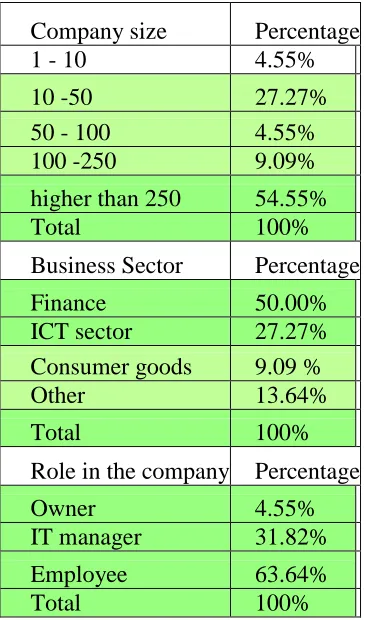
Company size Percentage
1 - 10 4.55%
10 -50 27.27%
50 - 100 4.55%
100 -250 9.09%
higher than 250 54.55%
Total 100%
Business Sector Percentage
Finance 50.00%
ICT sector 27.27% Consumer goods 9.09 %
Other 13.64%
Total 100%
Role in the company Percentage
Owner 4.55%
IT manager 31.82%
Employee 63.64%
Total 100%
In short, small and mid-sized businesses
have focused an appropriate level of concern
on the business risks that affect those most.
The next-and far more important-question is
how they will reduce those concerns,
address the risks by actually implementing
solutions to protect their businesses
5.2 Analysis of Security issues of Big data in SMB
The protection gap
But despite awareness of the risks
they face and clarity about the best ways to
mitigate them, a striking number of small
and mid-sized businesses not only trail the
state of the art, but lack even the most basic
protection for their business information.
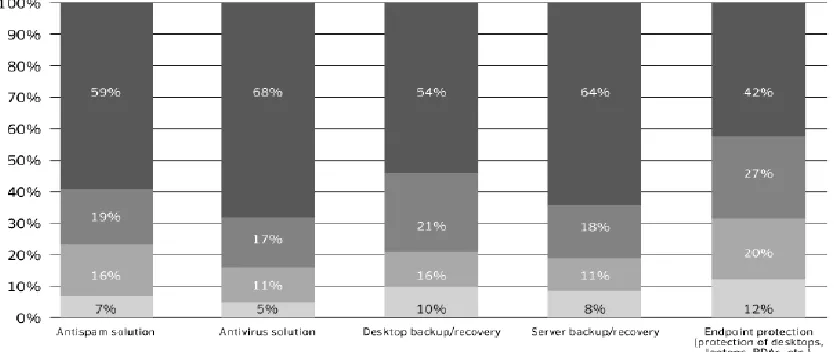
Figure 2 shows the status of planning and
[image:7.612.196.379.35.345.2]Figure 2 : Status of Planning and Implementation across the Segment
More than a third of these businesses
operate with no protection against viruses
and spam. Many others are protected only
by half-measures: backup/recovery for
servers but not desktops for example, or
antivirus point solutions that can't protect
mobile endpoints or defend against
fast-changing, fast-moving, complex threats that
use multiple techniques to attack digital
assets. As Ray Boggs, Vice-President of
SMB research for IDC puts it, "Of course
SMBs know better, but they are too often
focused on business opportunities outside
the company to pay attention to the risks
they are taking right at home."
What's stopping them? Through the
survey, SMBs report the familiar constraints
of staffing, time, and budget, as shown in
Figure 3
These limits are especially severe at
businesses that lack even a single in-house
dedicated IT staff member-true for 42% of
survey participants. What's more, their
median IT security and storage budgets
hover around $4,500 per year-barely enough
to keep up with obsolescence, much less
growth. The survey did reveal one promising trend-despite downdrafts
throughout the economy as a whole, 90% of
SMB survey participants reported their IT
security and storage budgets trending up, or
at least not in decline.
Consequences
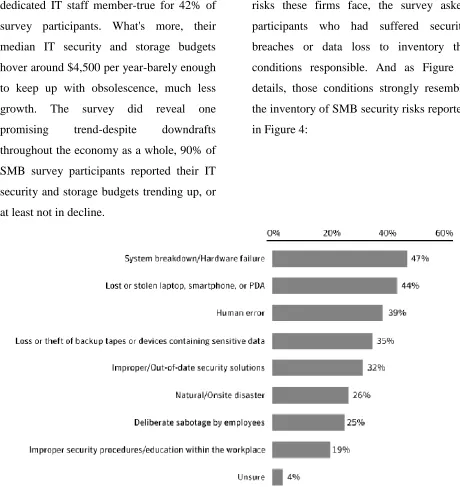
To assess the economic scale of the
risks these firms face, the survey asked
participants who had suffered security
breaches or data loss to inventory the
conditions responsible. And as Figure 3
details, those conditions strongly resemble
[image:9.612.72.532.100.587.2]the inventory of SMB security risks reported in Figure 4:
Not surprisingly, a cross-comparison of
Figure 4 against Figure 2 shows that security
incidents and data losses are concentrated
exactly where SMB gaps and shortfalls
leave vulnerabilities. Here are just a few
examples:
• 44% of breaches involve compromised
mobile devices-endpoints like laptops and
PDAs that are overlooked in many SMB security plans
• 39% involve sabotage, human error, or
poor procedures-while SMB security
concentrates on threats from outside the
network
• 35% of breaches involve failures in backup
processes-known vulnerabilities for SMB
servers, desktops, and laptops Solid, regular
backup practices can mitigate the risks of
inevitable hardware failures, but lapses may
have serious consequences
Hypothesis Testing
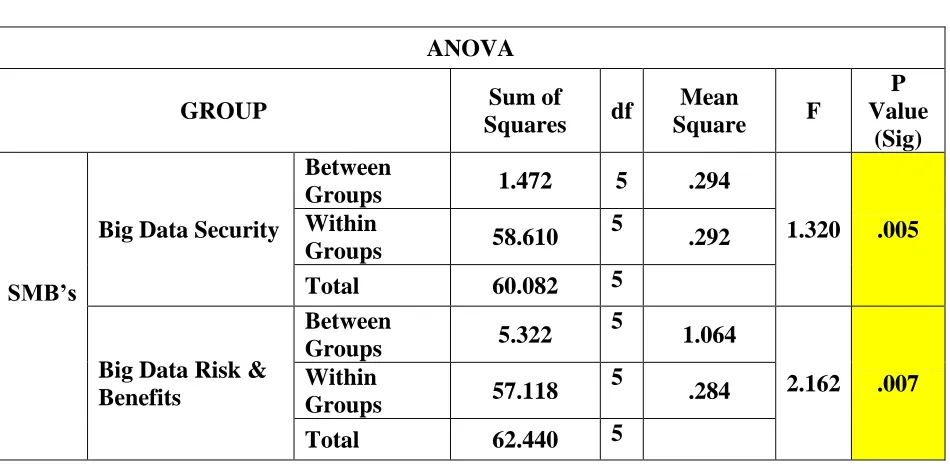
In current research study on results
obtained above of respondents the values were statistically analyzed above Likert‘s
scale values with one way ANOVA by using
SPSS and results are as mentioned
:
ANOVA
GROUP Sum of
Squares df
Mean
Square F
P Value
(Sig)
SMB’s
Big Data Security
Between
Groups 1.472 5 .294
1.320 .005 Within
Groups 58.610
5
.292
Total 60.082 5
Big Data Risk & Benefits
Between
Groups 5.322
5
1.064
2.162 .007 Within
Groups 57.118
5
.284
Respondents opinion were statistically
analyzed with One Way ANOVA with the
help of SPSS Software and the obtained P
value was highly significant therefore the
results concluded that null hypothesis H0:
There is no significant relationship between
Big data Security, risks and Benefits among SMB‘s in India is rejected and alternate
hypothesis which states that H1: There is a significant relationship between Big data
Security, risks and Benefits among SMB‘s
in India is accepted and proved.
Few observations based on respondents reported for protection of Big data in SMB are as described:
Protection principles
Losses and business risks like these
are not necessary. Even when staff, time,
and budget constraints stand in the way of a
systematic solution, small and mid-size
businesses can improve their security
posture with simple, cost-effective
protection measures like these:
Stay informed
Some of the best things in IT
security are free. Information resources
won't keep technical defenses up to the
minute, but periodic reports like the
Symantec Internet Security Threat Report
can keep even the smallest business aware
of trends in the threat environment, and how
best to defend against them.
Back up data
They may be tedious and
time-consuming, but backups-even manual
backups-offer some of the highest returns
available among IT initiatives. Protection
against natural disaster, hardware failure,
and above all human error gives a business
continuity and confidence in the face of a
wide range of risks. Include off-site storage
of encrypted data as part of a mature backup
and recovery program.
Protect from the inside
Employee error, fraud, and
vandalism can compromise a company's most sensitive and valuable information-and
legally required disclosures can savage its
reputation. Simple policies and
controls-starting with elimination of duplicate or
portable data stores-can substantially
improve your security posture. The Payment
Card Industry offers excellent guidance on
data protection, appropriate for members
and nonmembers alike.
Don't forget physical security By far the oldest component of data
protection, physical security still ranks high
in importance. Policies for screen-locking,
tracking, and others are easy to
implement-often as simple as keeping the right doors
locked. And every one of them cuts the odds
of the worst-case data-loss scenario, when a
device containing critical data falls under a
thief's control for an extended time with low
chance of exposure.
When the time comes to invest in
upgrading your electronic protection, here are three additional principles to consider:
Use layered security
Threats escalate, and even
sophisticated protections can fail against
new attacks. Multi-layer defenses protect
against local breakthroughs or single-point
failures of any one technology or method.
The latest defense-in-depth strategies
combine antivirus and anti spam software
with firewalls, intrusion prevention, device
and application control, and patch
management solutions.
Deploy comprehensive security Depth is critical, but don't neglect
breadth. Security plans should cover
desktops, laptops, and messaging servers.
Mobile devices-whether carried in by
outsiders or taken out by employees-are the
most difficult to protect. But new endpoint
protection technologies quarantine
connections until new devices demonstrate
compliance with all relevant security
policies, and ensure that security products
are regularly updated to block new threats.
Use solution providers for needed expertise
You are exposed to a single
company's security and threat environments,
but your local solution provider sees
tens-even hundreds. If staffing and time
constraints are keeping you from effective
information protection, your local IT
consultant or reseller can help you explore a
cost-effective way forward.
6. CONCLUSION AND
RECOMMENDATIONS
To handle big data and to work with
it and obtaining benefits from it a branch of
science has come up and is evolving, called
Data Science. Data Science is the branch of
science that deals with discovering
knowledge from huge sets of data, mostly
unstructured and semi structured, by virtue
of data inference and exploration.
Symantec's latest security offering,
Symantec Protection Suite (SPS), is
designed, scaled, and priced to meet SMB
The only suite offering comprehensive
protection across laptops, servers, messaging
gateways, and backup and recovery
environments, SPS delivers proven
protection for business information and
computers, helps defend against aggressive
new malware and spam threats, and backs
up and quickly recovers computers and
information in the event of a problem. Information security in big data
environment is a promising field in
information security. This paper introduces impact to information security from SMB‘s
aspects of big data security. In general,
improving system efficiency and provide
general cloud storage functions on premise
to ensure user data and access authority are
theresearch direction of future safe big data
utility and computing. At present, more
things need to be done in cryptograph searching and reduplicate data removing.
REFERENCES
Ahmed, M., Chowdhury, A. S. M., Ahmed,
M., Rafee, M. H. et al. (2012), `An
advanced survey on cloud computing
and state-of-the-art research issues.',
International Journal of Computer
Science Issues (IJCSI) 9(1).
Ahronovitz, M., Amrhein, D., Anderson, P.,
de Andrade, A., Armstrong, J.,
Arasan, B., Bartlett, J., Bruklis, R.,
Cameron, K. and Carlson, M. (2011),
`Cloud computing use cases white
paper'.
Aljabre, A. (2012), `Cloud computing for
increased business value',
International Journal of Business and
Social Science 3(1), 234{239.
Arendt, L. (2008), `Barriers to ict adoption
in smes: how to bridge the digital
divide?', Journal of Systems and
Information Technology 10(2),
93{108.}
Ashwin Machanavajjhala, Daniel Kifer,
Johannes Gehrke, and
Muthuramakrishnan
Venkitasubramaniam. L-diversity:
Privacy beyond k-anonymity. ACM
Transactions on Knowledge
Discovery from Data, 2007,
Bessani A, Correia M, Quaresma B, et al.
DEPSKY: Dependable and secure
storage in a cloud-of clouds [C]
//proc of the 6thConf on Computer
System. New York: ACM,
2011:31-46
Chen Mingqi, Jiang He. USA Information
Network Security New Strategy
Analysis in Big Data [J]. Information Network Security. 2012(8):32—35
Goel S., Hofman J.M., Lahaie S., Pennock
D.M. and Watts D.J.. Predicting
consumer behavior with Web search.
National Academy of Sciences,
2010, 7 (41): 17486– 17490
http://www.wired.com/science/discoveries/
magazine/16-07/pb_theory
Lei Zou, Lei Chen and M. Tamer zsu.
k-automorphism: a general framework
for privacy preserving network
publication. // Proceedings of the
35th International Conference on
Very Large Data Bases (VLDB‘2009), Lyon, France, 2009:
946-957
Mao Ye, Peifeng Yin, Wang-Chien Lee, and
Dik-Lun Lee. Exploiting
geographical influence for
collaborative point-of-interest
recommendation.//Proceedings of the
34th international ACM SIGIR
conference on Research and
development in Information
Retrieval(SIGIR'11), Beijing, China,
2011: 325-334
Meng Xiao-Feng, Ci Xiang. Big Data
Management: Concepts, Techniques
and Challenges. Journal of Computer
Research and Development, 2013, 50(1): 146-169 (in Chinese)
Narayanan A, Shmatikov V. How to break
anonymity of the Netflix prize
dataset. ArXiv Computer Science
e-prints, 2006, arXiv:cs/0610105: 1-10
Study Finds Web Sites Prying Less: Shift
May Reflect Consumer
Concerns[EB/OL]. http://www
CNN.com, 2002-03-18A survey of
data disclosing in 2010 by
Verizon[EB/OL].[2012-05-10].
Sweeney L..K-Anonymity: a model for
protecting privacy.
InternationalJournal on Uncertainty,
Fuzziness and Knowledge-based
Systems, 2002, 10 (5): 557-570
Sweeney L..K-Anonymity: Achieving
k-Anonymity Privacy Protection using
Generalization and Suppression.
Ying X. and Wu X.. Randomizing social
approach. //Proceedings of the SIAM
International Conference on Data Mining (SDM‘08), Georgia, USA,