Challenges and Security Issues in Big Data
Analysis
Reena Singh
1, Kunver Arif Ali
2Lecturer, Dept. of Computer Science Engineering, Swami Vivekananda Subharti University, Meerut, India1
Assistant Professor, Dept. of Electronics & Communication Engineering, Swami Vivekananda Subharti University,
Meerut, India1
ABSTRACT: This paper introduces a detailed analysis of big data security issues and challenges. Data has become an indispensable part of every economy, industry, organization, business function and individual. The amount of data in world is growing day by day because of use of internet, Smartphone, social network, fine tuning of ubiquitous computing and many other technological advancements. Big Data is a term used to identify the datasets that whose size is beyond the ability of typical database software tools to store, manage and analyse. Generally size of the data is Petabyte and Exabyte. Most of the data is partly structured, unstructured or semi structured and it is heterogeneous in nature. Due to its specific nature, Big Data is stored in distributed file system architectures. Hadoop and HDFS by Apache are widely used for storing and managing Big Data. Analysing it, is a challenging task as it involves large distributed file systems which should be fault tolerant, flexible and scalable. Traditional database systems is not able to capture, store and analyse this large amount of data. Security and privacy issues are magnified by velocity, volume, and variety of big data, such as large-scale cloud infrastructures, diversity of data sources and formats, streaming nature of data acquisition, and high volume inter-cloud migration. Therefore, traditional security mechanisms, which are tailored to securing small-scale static (as opposed to streaming) data, are inadequate. In this paper, we highlight the some important concept of big data-specific security and privacy challenges so that it will bring renewed focus on fortifying big data infrastructures.
KEYWORDS: Big data, Petabyte, Exabyte, Database, velocity, volume
I. INTRODUCTION
Fig1. Big Data
The origin of the term ‗Big Data‘ is due to the fact that we are creating a huge amount of data every day. At the KDD Big Mine 12 Workshop Usama Fayyad in his invited talk presented amazing data numbers about internet usage, among them are the following: each day Google has more than 1 billion queries, Twitter has more than 250 million tweets per day, Per day Face book has more than 800 million updates, and YouTube has more than 4 billion views per day. Big Data is a heterogeneous mix of data both structured (traditional datasets –in rows and columns like DBMS tables, CSV‘s and XLS‘s) and unstructured data like PDF documents, e-mail attachments, images, manuals , medical records such as x-rays, ECG and MRI images, forms, rich media like graphics, video and audio, contacts, forms and documents. Businesses are primarily concerned with managing unstructured data, because about 80 per cent of enterprise data is unstructured [3].
The era of ―big data‖ has ushered in a wealth of opportunities to advance science, improve health care, promote economic growth, reform our educational system, and create new forms of social interaction and entertainment. These opportunities bring with them increasing challenges related to data security and privacy. Security and privacy issues are magnified by velocity, volume and variety of big data such as large scale cloud infrastructures, diversity of data sources and formats, streaming nature of data acquisition and high volume inter cloud migration. The use of large scale cloud infrastructures, with a diversity of software platforms, spread across large networks of computers, also increases the attack surfaces of the entire systems. These challenges includes-
Lack of effective tools and approaches for securely managing large-scale data and distributed data sets
3rd party data sharing
vulnerabilities in ever-expanding public databases and
technological advancements that are outpacing policy as it relates to digital security and privacy
Security and privacy concerns are growing as big data becomes more and more accessible. Data is being produced at an ever increasing rate. This growth in data production is being driven by:
individuals and their increased use of media;
organizations;
the switch from analogue to digital technologies; and
The proliferation of internet connected devices and systems.
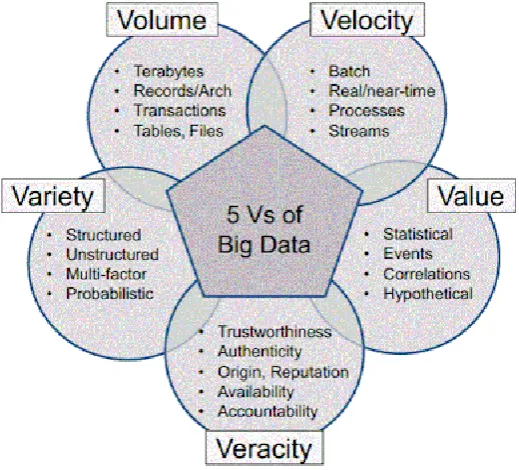
Scientists break down Big Data into many dimensions as shown in fig. (2): Volume, Velocity, Variety, Veracity and Value [4, 5].
1. Volume- Volume measures the amount of data available to an organization, which does not necessarily have
2. Velocity- Data velocity measures the speed of data creation, streaming, and aggregation. Ecommerce has rapidly increased the speed and richness of data used for different business transactions (for example, web-site clicks) how fast the data is being produced and how fast the data needs to be processed to meet the demand.
3. Variety- Data variety is a measure of the richness of the data representation – text, images video, audio, etc.
We are creating data in all forms -unstructured, semi structured and structured data. This data is heterogeneous is nature. Most of our existing tools work over homogenous data, now we require new tools and techniques which can handle such a large scale heterogeneous data.
4. Veracity- This deals with uncertain or imprecise data. It refers to the noise, biases and abnormality in data.
This is where we find out if the data that is being stored and mined is meaningful to the problem being analyzed. The data we are generating is uncertain in nature. It is hard to know which information is accurate and which is out of date.
5. Value- Data value measures the usefulness of data in making decisions. It has been noted that ―the purpose of
computing is insight, not numbers‖ .The data we are working with is valuable for society or not.
Fig 2.Characteristics of Big Data
Types of Big Data: There are two types of big data. -Structured Data
-Unstructured Data.
1. Structured Data: Structured Data are numbers and words that can be easily categorized and analyzed. These data are generated by things like network sensors embedded in electronic devices, smart phones, and global positioning system (GPS) devices. Structured data also include things like sales figures, account balances, and transaction data.
When making an attempt to understand the concept of Big Data, the words such as ―maps reduce‖ and ―Hadoop‖ cannot be avoided.
Hadoop
Hadoop, which is a free, Java-based programming frame work, supports the processing of large sets of data in a distributed computing environment. It is a part of the Apache project sponsored by the Apache Software Foundation. Hadoop cluster uses a Master/Slave structure [6]. Using Hadoop, large data sets can be processed across a cluster of servers and applications can be run on systems with thousands of nodes involving thousands of terabytes. Distributed file system in Hadoop helps in rapid data transfer rates and allows the system to continue its normal operation even in the case of some node failures. This approach lowers the risk of an entire system failure, even in the case of a significant number of node failures. Hadoop enables a computing solution that is scalable, cost effective, fault tolerant and flexible. Hadoop Framework is used by popular companies like Google, Yahoo, Amazon and IBM etc., to support their applications involving huge amounts of data.
Hadoop has two main sub projects – -Map Reduce &
-Hadoop Distributed File System (HDFS).
Map Reduce
Hadoop Map Reduce is a framework [7] used to write applications that process large amounts of data in parallel on clusters of commodity hardware resources in a reliable, fault-tolerant manner. A Map Reduce job first divides the data into individual chunks which are processed by Map jobs in parallel. The outputs of the maps sorted by the framework are then input to the reduce tasks. Generally the input and the output of the job are both stored in a file-system. Scheduling, Monitoring and re-executing failed tasks are taken care by the framework.
Hadoop Distributed File System (HDFS)
HDFS [8] is a file system that spans all the nodes in a Hadoop cluster for data storage. It links together file systems on local nodes to make it into one large file system. HDFS improves reliability by replicating data across multiple sources to overcome node failures.
Big data applications
The big data application refers to the large scale distributed applications which usually work with large data sets. Data exploration and analysis turned into a difficult problem in many sectors in the span of big data. With large and complex data, computation becomes difficult to be handled by the traditional data processing applications which trigger the development of big data applications [9].
Google‘s map reduce framework and apache Hadoop are the defacto software systems [10] for big data applications, in which these applications generates a huge amount of intermediate data. Manufacturing and Bioinformatics are the two major areas of big data applications.
Big data provide an infrastructure for transparency in manufacturing industry, which has the ability to unravel uncertainties such as inconsistent component performance and availability. In these big data applications, a conceptual framework of predictive manufacturing begins with data acquisition where there is a possibility to acquire different types of sensory data such as pressure, vibration, acoustics, voltage, current, and controller data. The combination of sensory data and historical data constructs the big data in manufacturing. This generated big data from the above combination acts as the input into predictive tools and preventive strategies such as prognostics and health management. Another important application for Hadoop is Bioinformatics which covers the next generation sequencing and other biological domains. Bioinformatics [11]-[12] requires a large scale data analysis uses Hadoop.
Big data advantages
the potentially sensitive information that is not protected in an appropriate manner and makes sure it is stored according to the regulatory requirements.
There are some common characteristics of big data, such as a) Big data integrates both structured and unstructured data.
b) Addresses speed and scalability, mobility and security, flexibility and stability.
c) In big data the realization time to information is critical to extract value from various data sources, including mobile devices, radio frequency identification, the web and a growing list of automated sensory technologies.
All the organizations and business would benefit from speed, capacity, and scalability of cloud storage. Moreover, end users can visualize the data and companies can find new business opportunities. Another notable advantage with big-data is, big-data analytics, which allow the individual to personalize the content or look and feel of the website in real time so that it suits the each customer entering the website. If big data are combined with predictive analytics, it produces a challenge for many industries.
The combination results in the exploration of these four areas: a) Calculate the risks on large portfolios
b) Detect, prevent, and re-audit financial fraud c) Improve delinquent collections
d) Execute high value marketing campaigns
II.LITERATURE REVIEW
Big data is a term for massive data sets having large, more varied and complex structure with the difficulties of storing, analyzing and visualizing for further processes or results. The process of research into massive amounts of data to reveal hidden patterns and secret correlations named as big data analytics. The growth of big data has raised a number of eyebrows as far as the challenges are concerned. Several authors have discovered a plethora of challenges which include data storage and privacy. Sachchidanand Singh et al. explained the concept, characteristics & need of Big Data and different offerings available in the market to explore unstructured large data [13]. Changqing ji et al. discussed the scope of Big Data processing in cloud computing environment [14]. Dan Garlasu et al. proposed architecture for managing and processing Big Data using grid technologies [15]. Xiaoxue Zhang et al described the storage challenges of Big Data and they analyzed those using Social Networks as examples [16]. They further classified the related research issues into the following classifications: small files problem, load balancing, replica consistency and de-duplication. Meiko Johnson also did some work on the privacy issues involved with Big Data. He classified these challenges into the following taxonomy: interaction with individuals, re-identification attacks, probable vs. provable results, targeted identification attacks and economics effects visualize and understand their algorithm results. Kapil Bakshi et al [17] discussed the architectural considerations for big data are concluded that despite the different architectures and design decisions, the analytics systems aim for Scale-out, Elasticity and High availability. Chansup Byun et al. brought together the Big Data and Bigcompute by combining Hadoop clusters and MPI clusters [18]-[19]. Tyson Condie et al. discussed the machine learning computational models for Big Data [20]. Xindong Wu et al. presented a HACE theorem that characterizes the features of the Big Data revolution and proposed a Big Data processing model from the data mining perspective [21]. Dr. Sun-Yuan Kung proposed cost-effective design on kernel-based machine learning and classification for Big Data learning applications [22].
III. BIG DATA SECURITY AND PRIVACY CHALLENGES
1. Secure Computations in Distributed Programming Framework:
2. Security Best Practices for Non-Relational Data Stores:
Non-relational data stores popularized by NoSQL databases are still evolving with respect to security infrastructure. For instance, robust solutions to NoSQL injection are still not mature each NoSQL DBs were built to tackle different challenges posed by the analytics world and hence security was never part of the model at any point of its design stage. Developers using NoSQL databases usually embed security in the middleware .NoSQL databases do not provide any Support for Enforcing it explicitly in the database. However, clustering aspect of NoSQL databases poses additional challenges to the robustness of such security practices.
3. Secure Data Storage and Transaction Logs:
Data and transaction logs are stored in multi-tiered storage media manually moving data between tiers gives the it manager direct control over exactly what data is moved and when. However as the size of data set has been and continues to be, growing exponentially, scalability and availability have necessitated auto-tiring for big data storage management. Auto-tiering solutions do not keep track of where the data is stored, which poses new challenges to secure data storage.
4. End Point Input Validation/Filtering:
Many big data use cases in Enterprise settings require data collection from many sources, such as end point devices for example, a security information and event management system (SIEM) may collect event logs from millions of hardware devices and software application in an enterprise network. A key challenge in the data collection process is input validation: how can we trust the data? How can we validate that a source of input data is not malicious and how can we filter malicious input from our collection? Input validation and filtering is a daunting challenge posed by untrusted input sources, especially with the Bring Your Own Device (BYOD) model.
5. Real –Time Security/Compliance Monitoring:
Real time security monitoring has always been a challenge, given the number of alerts generated by (Security) devices. These alerts (correlated or not) lead to many false positive, which are mostly ignored or simply ―clicked away‖, as humans cannot cope with the shear amount. This problem might even increase with the bid data given the volume and velocity of data streams however, big data technologies might also provide an opportunity, in the sense that these technologies do allow for fast processing and analytics of different types of data.
6. Scalable and Composable Privacy-Preserving Data Mining and Analytics:
Big data can be seen as a troubling manifestation of big brother by potentially enabling invasions of privacy, invasive marketing, decreased civil freedoms, and increase state and corporate control. A recent analysis of how companies are leveraging data analytics for marketing purpose identified an example of how a retailer was able to identify that teenager was pregnant before her father knew. Similarly anonym zing data for analytics is not enough to maintain user privacy. For example AOL released anonymized search logs for academic purposes ,but users were easily identified by their searchers .Netflix faced a similar problem when users of their anonymized data set were identified by correlating their Netflix movie scores with IMDB scores. Therefore, it is important to establish guidelines‟ and recommendations for preventing inadvertent privacy disclosures.
7. Cryptographically Enforced Access Control And Secure Communication:
To ensure that the most sensitive private data is end to end secure and only accessible to the authorized entities, data has to be encrypted based on access control policies. Specific research in this area such as attribute-based encryption (ABE) has to be made richer, more efficient, and scalable. To ensure authentication, agreement and fairness among the distributed entities, a cryptographically secure communication framework has to be implemented.
8. Granular Access Control:
shared is often swept into a more restrictive category to guarantee sound security granular access control gives data managers a scalpel instead of a sword to share data as much as possible without compromising secrecy.
9. Granular Audits:
With real time security monitoring, we try to be notified at the moment an attack takes place. In reality, this will not always be the case (e.g., new attacks, missed true positives). In order to get to the bottom of the missed attack, we need audit information. This is not only relevant because we want to understand what happened and what went wrong ,but also because compliance, regulation and forensics reasons .in that regard ,auditing is not something new, but the scope and granularity might be different. For example, we have to deal with more data objects, which probably are (but not necessarily) distributed.
10. Data Provenance:
Provenance metadata will grow in complexity due to large provenance graphs generated from provenance- enabled programming environments in big data applications. Analysis of such large provenance graphs to detect metadata dependencies for security/confidentiality applications is computationally intensive.
IV. CHALLENGES IN BIG DATA ANALYSIS
1. Heterogeneity and Incompleteness: When humans consume information, a great deal of heterogeneity is
comfortably tolerated. In fact, the nuance and richness of natural language can provide valuable depth. However, machine analysis algorithms expect homogeneous data, and cannot understand nuance. In consequence, data must be carefully structured as a first step in (or prior to) data analysis. Consider, for example, a patient who has multiple medical procedures at a hospital. We could create one record per medical procedure or laboratory test, one record for the entire hospital stay, or one record for all lifetime hospital interactions of this patient. With anything other than the first design, the number of medical procedures and lab tests per record would be different for each patient. The three design choices listed have successively less structure and, conversely, successively greater variety. Greater structure is likely to be required by many (traditional) data analysis systems. However, the less structured design is likely to be more effective for many purposes.
2. Scale: Of course, the first thing anyone thinks of with Big Data is its size. After all, the word ―big‖ is there in the
very name. Managing large and rapidly increasing volumes of data has been a challenging issue for many decades. In the past, this challenge was mitigated by processors getting faster, following Moore‘s law, to provide us with the resources needed to cope with increasing volumes of data. But, 9 there is a fundamental shift underway now: data volume is scaling faster than compute resources, and CPU speeds are static.
3. Timeliness: The flip side of size is speed. The larger the data set to be processed, the longer it will take to analyze. The design of a system that effectively deals with size is likely also to result in a system that can process a given size of data set faster. However, it is not just this speed that is usually meant when one speaks of Velocity in the context of Big Data. There are many situations in which the result of the analysis is required immediately. For example, if a fraudulent credit card transaction is suspected, it should ideally be flagged before the transaction is completed – potentially preventing the transaction from taking place at all. Obviously, a full analysis of a user‘s purchase history is not likely to be feasible in real-time. Rather, we need to develop partial results in advance so that a small amount of incremental computation with new data can be used to arrive at a quick determination.
5. Human Collaboration: In spite of the tremendous advances made in computational analysis, there remain many patterns that humans can easily detect but computer algorithms have a hard time finding. Indeed, CAPTCHAs exploit precisely this fact to tell human web users apart from computer programs. Ideally, analytics for Big Data will not be all computational – rather it will be designed explicitly to have a human in the loop.
V. CONCLUSION
The paper is a systematic study of various security issues and challenges of Big Data analytics. Big Data is a very challenging research area. Through better analysis of the large volumes of data that are becoming available, there is the potential for making faster advances in many scientific disciplines and improving the profitability and success of many enterprises. However, many technical challenges described in this paper must be addressed before this potential can be realized fully. Furthermore, these challenges will require transformative solutions, and will not be addressed naturally by the next generation of industrial products. We must support and encourage fundamental research towards addressing these technical challenges if we are to achieve the promised benefits of Big Data.
REFERENCES
[1] ―Big Data: science in the petabyte era,‖ Nature 455 (7209):1, 2008 [2] Douglas and Laney, ―The importance of ‗Big Data‘: A definition‖ ,2008
[3] Agrawal, Amr El Abbadi et al.,―Big data and cloud computing: current state and future opportunities‖, Proceedings of the 14th International Conference on Extending Database Technology, ACM,Sweden, March 21-24, 2011
[4] http://dashburst.com/infographic/Big-data-volume-variety-velocity/
[5] http://www.wired.com/insights/2013/05/the-missing-vs-in-Big-data-viability-and-value/
[6] Lu, Huang, Ting-tin Hu, and Hai-shan Chen. "Research on Hadoop Cloud Computing Model and its Applications.‖ Hangzhou, China: 2012, pp. 59 – 63, 21-24 Oct. 2012.
[7] Wie, Jiang, Ravi V.T and Agrawal G., "A Map-Reduce System with an Alternate API for Multi-core Environments.‖ Melbourne, VIC: 2010, pp. 84-93, 17-20 May. 2010.
International Journal of Network Security & Its Applications (IJNSA), Vol.6, No.3, May 2014
[8] K, Chitharanjan, and Kala Karun A. "A review on hadoop — HDFS infrastructure extensions‖, JeJu Island: 2013, pp. 132-137, 11-12 Apr. 2013.
[9] F.C.P, Muhtaroglu, Demir S, Obali M, and Girgin C. "Business model canvas perspective on big data applications", IEEE International Conference, Silicon Valley, CA, pp. 32 – 37, Oct 6-9, 2013.
[10] Zhao, Yaxiong , and Jie Wu. "Dache: A data aware caching for big-data applications using the Map Reduce framework." INFOCOM, 2013 Proceedings IEEE, Turin, pp. 35 – 39, Apr 14-19, 2013.
[11] Xu-bin, LI , JIANG Wen-rui, JIANG Yi, ZOU Quan "Hadoop Applications in Bioinformatics." Open Cirrus Summit (OCS), 2012 Seventh, Beijing, pp. 48 – 52, Jun 19-20, 2012.
[12] Venkata Narasimha Inukollu , Sailaja Arsi1 and Srinivasa Rao Ravuri, ― SECURITY ISSUES ASSOCIATED WITH BIG DATA IN CLOUD COMPUTING‖, International Journal of Network Security & Its Applications (IJNSA), Vol.6, No.3, pp. 45-56, May 2014.
[13] Sachchidanand Singh, Nirmala Singh,‖ Big Data Analytics‖, International Conference on Communication, Information & Computing Technology (ICCICT), Oct. 19-20, Mumbai, India,2012.
[14] Changqing Ji, Yu Li, Wenming Qiu, Uchechukwu Awada, Keqiu Li,‖ Big Data Processing in Cloud Computing Environments‖, 12th
International Symposium on Pervasive Systems, Algorithms and Networks (ISPAN), IEEE, pp. 17–23, 2012.
[15] Dan Garlasu, Virginia Sandulescu, Ionela Halcu,Giorgian Neculoiu, Oana Grigoriu, Mariana Marinescu and Viorel Marinescu, ―A big data implementation based on Grid computing‖, 11th RoEduNet international Conference, pp. 1-4, 2013
[16] Xiaoxue Zhang, Feng Xu, "Survey of Research on Big Data Storage",12th International Symposium on Distributed Computing and Applications to Business, Engineering & Science (DCABES), IEEE, pp.76-80, SEPT.2013.
[17] Kapil Bakshi, ―Considerations for Big Data: Architecture and Approach‖, IEEE Aerospace conference, pp. 1-7, March 2012.
[18] C. Byun, W. Arcand, D. Bestor, B. Bergeron, M. Hubbell, J. Kepner, A. McCabe, P. Michaleas, J. Mullen, D. O'Gwynn, A. Prout, A. Reuther, A. Rosa & C. Yee, ―Driving Big Data With Big Compute,‖ IEEE High Performance Extreme Computing (HPEC), Sep 10-12, 2012
[19] ―Top Ten Big Data Security And Privacy Challenges‖, CLOUD SECURITY ALLIANCE, NOV. 2012, https://cloudsecurityalliance.org/ [20] Tyson Condie , Paul Mineiro , Neoklis Polyzotis , Markus Weimer,‖ Machine Learning on Big Data‖, 29TH IEEE INTERNATIONAL
CONFERENCE ON DATA ENGINEERING (ICDE Conference), pp. 1242-1244, 2013
[21] Xindong Wu, Xingquan Zhu, Gong-Qing Wu, Wei Ding,‖Data mining with Big Data‖, IEEE Transactions on Knowledge & Data Engineering, vol.26, Issue No.01, Jan 2014.