Citation:
Shutt, J and Kumi-Ampofo, F (2010) Evolutionary Devolution - Building Strategic Capacity: The Next Steps for Functional Sub-Regions in Yorkshire 2009-2012. Project Report. Local government Yorkshire and the Humber- LGYH.
Link to Leeds Beckett Repository record: http://eprints.leedsbeckett.ac.uk/1301/
Document Version: Monograph
The aim of the Leeds Beckett Repository is to provide open access to our research, as required by funder policies and permitted by publishers and copyright law.
The Leeds Beckett repository holds a wide range of publications, each of which has been checked for copyright and the relevant embargo period has been applied by the Research Services team.
We operate on a standard take-down policy. If you are the author or publisher of an output and you would like it removed from the repository, please contact us and we will investigate on a case-by-case basis.
EVOLUTIONARY
BUILDING STRATEGIC CAPACITY
The Next Steps for Functional Sub-Regions in Yorkshire 2009-2012
A report prepared by Professor John Shutt and Felix Kumi-Ampofo ERBEDU, Leeds Business School for Local Government Yorkshire and Humber
Contents
PageForeword 1
1 Introduction – The Regional Improvement and Efficiency Strategy 2
2 The Changing Regional Architecture 2009 5
3 Key Issues in Economic Development in Yorkshire and Humber 7
4 Working Together at Functional Sub/City-Region Levels 11
5 The Regional Capacity Challenge 13
Conclusions 16
Recommendations 18
1
Foreword
Local government in Yorkshire and Humber has seized the opportunities presented by the Sub National Economic Development and Regeneration Review to move swiftly to new regional arrangements. Our approach, developed in collaboration with Yorkshire Forward, recognises a key role for the partnerships that operate across the region’s four functional economic sub regions, in the development and delivery of an Integrated Regional Strategy.
We have agreed that the IRS will be built from the local level, working up through the functional sub regional to the regional level. This will ensure that the IRS appropriately reflects the differing priorities of places (including the region’s three city regions) across Yorkshire and Humber.
This report, by Leeds Business School (ERBEDU), explains the new regional architecture and sets out the tasks that lie ahead if we are to build a “people in places” agenda for the region, working jointly with Yorkshire Forward and other partners.
In his April Budget statement the Chancellor announced the success of Leeds City Region’s bid for forerunner status, alongside that of Greater Manchester. Discussions over the coming weeks and months are to be overseen at ministerial level, with the object of agreeing joint investment priorities with the Government to support growth in these two key northern city regions.
However, the Chancellor’s announcement also underlined the need for rapid and effective progress in ensuring that all of the region’s functional sub regional partnerships are resourced to develop their new responsibilities in order to play a full role in contributing to an upturn in regional economic activity. We must ensure, that during 2009/2010 we utilise RIEP funds, and the regional capacity based at Local Government Yorkshire and Humber and Yorkshire Forward to take this important agenda forward.
Paul Rogerson,
Chair of the Regional Chief Executives Group and Chief Executive of Leeds City Council
EVOLUTIONARY
BUILDING STRATEGIC CAPACITY
Introduction
The Regional Improvement and Efficiency Strategy
This report was commissioned to contribute to the economic growth and inclusion priority of the Regional Improvement and Efficiency Strategy (RIES). The aim is to examine the Local Government Yorkshire and Humber (LGYH) contribution required to support the work of the functional sub-regions (FSR) during the transition to new arrangements, and approaches in the Yorkshire region post the Sub National Review. Following the 2008 Pre-Budget Report, the government has now published its final views on the new regional and sub-regional architecture which needs to be in place for April 20101.
The current emphasis on capacity building and improvement in local government services is part of the Government’s agenda for the modernisation of local government. This agenda was established in the 2001 White Paper “Strong Local Leadership – Quality Public Services2”, which
identified the need to build management capacity if local authorities are to meet the challenge of increased responsibilities, greater freedom and new powers. These themes have been developed in “Strong and Prosperous Communities - the Local Government White Paper 2006”, implemented under the Local Government and Public Involvement in Health Act 20073. This sets out a range
of proposals designed to strengthen local communities and devolve more responsibility to local authorities, whilst placing a duty on them to cooperate with other statutory partners at the local level, and also to engage with other partners at local, city region and regional levels.
The National Improvement and Efficiency Strategy4 is supported by £380m, which has been made
available over the next three years, of which £17.5m has been allocated to Yorkshire. This strategy is underpinned by four key themes:
l Improving value for money actions to meet the 3% efficiency target
l Increasing innovative capacity in local services l Community empowerment
l Improving economic and neighbourhood renewal leadership capacity locally.
1 HM Treasury (2008) www.hm-treasury.gov.uk/prebud_pbr08_index.htm
2 DTLR (2001) www.communities.gov.uk/documents/localgovernment/pdf/143810.pdf 3 DCLG (2006) www.communities.gov.uk/publications/localgovernment/strongprosperous 4 DCLG (2008) www.communities.gov.uk/publications/localgovernment/efficiency
1.
EVOLUTIONARY
BUILDING STRATEGIC CAPACITY
Table 1
Regional Funding Allocations to the Regional Improvement and Efficiency Partnerships 2008-11
3
The Delivering Value for Money in Local Government plan5, published alongside CSR07, expectsthat £4.9b of value for money savings will be achieved by 2010-2011 (57% of which is expected to be delivered via smarter procurement). In the Yorkshire and Humber region, potential annual efficiencies are expected to total £491m by the end of 2010/11.
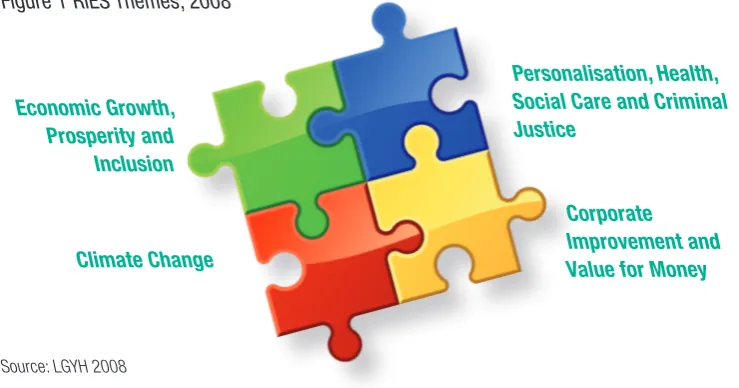
The Yorkshire and Humber RIES focuses on “three key strategic and interlocking issues” as well as concentrating on corporate improvement and value for money (RIES 2008). These are:
l Economic Growth l Climate Change
l Personalisation, Health, Social Care and Criminal Justice
Figure 1 RIES Themes, 2008
Source: LGYH 2008
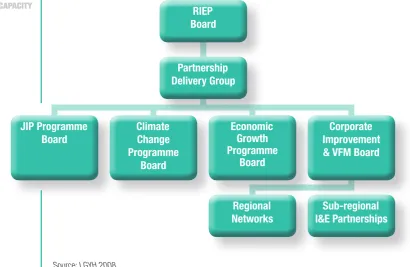
To deliver the RIES, local authorities in the region, working with LGYH, have established a RIEP Board made up of representatives from the new Regional Leaders Board and representatives from every Council, the Fire and Police Authorities and a PCT Board Chair.
Region 2008-09 £ 2009-10 £ 2010-11 £ Total £
North East 4,202,778 5,673,750 5,673,750 15,550,278
North West 5,952,778 8,036,250 8,036,250 22,025,278
Yorkshire & Humber 4,752,778 6,416,250 6,416,250 17,585,278
West Midlands 5,327,777 7,192,500 7,192,500 19,712,778
East Midlands 5,302,778 7,158,750 7,158,750 19,620,278
East of England 5,890,278 7,951,875 7,951,875 21,794,028
London 5,702,778 7,698,750 7,698,750 21,100,278
South East 7,190,278 9,706,875 9,706,875 26,604,028
South West 5,677,778 7,665,000 7,665,000 21,007,778
Economic Growth, Prosperity and Inclusion
Personalisation, Health, Social Care and Criminal Justice
Climate Change
Corporate
Improvement and Value for Money
[image:6.595.169.539.551.745.2]Figure 2 The Yorkshire RIEP Process, 2008
Source: LGYH 2008
It is proposed that the Economic Growth Programme Board should support the capacity development required to operationalise the major changes which will now follow from the Government’s Review of Sub-National Economic Development and Regeneration6, and create
synergy with the new joint working partnership between local authorities and Yorkshire Forward.
Furthermore it is proposed that RIEP resources should be applied to develop the immediate response to the economic recession and increase the capacity for local authorities to work together across the city regions and functional sub regions.
JIP Programme Board JIP Programme Board RIEP BoardRIEP Board Partnership Delivery GroupPartnership Delivery Group Climate Change Programme Board Climate Change Programme Board Economic Growth Programme Board Economic Growth Programme Board Regional NetworksRegional Networks Corporate Improvement & VFM Board
Corporate Improvement & VFM Board
Sub-regional I&E PartnershipsSub-regional I&E Partnerships
6 See: www.berr.gov.uk/whatwedo/regional/sub-national-review/page40430.html
EVOLUTIONARY
BUILDING STRATEGIC CAPACITY
5
The Changing Regional Architecture 2009
Since 2007, there has been an on-going debate about the best way to accelerate economic growth and the way economic development and regeneration policy is conceived and delivered at all levels. The Leitch Review of Skills (World Class Skills, 2007)7, the Sub National Review
of Economic Development and Regeneration, the Regional Spatial Strategy (2008)8 and the
Freud report on welfare reform (2007)9 are all key national and regional strategic policy reports
which, together, are bringing about a significant change in the way regional and local economic development is to be delivered from 2010.
The emerging regional landscape has seen the demise of the Regional Assembly which since 1999 provided regional leadership by agreeing regional strategic priorities, directing the development of the Integrated Regional Framework and endorsing key regional strategies. Membership of the Yorkshire and Humber Assembly comprised all 22 local authorities in the Yorkshire region, plus 15 Social, Economic and Environmental partners, and the National Park Authorities for planning purposes.
As part of new central government proposals and following general agreement from all local authorities in the region, the Yorkshire and Humber Assembly ceased to exist from 1st April 2009. Local Government Yorkshire and Humber has since then assumed the role of supporting the new Local Authorities Leaders’ Board and will, together with Yorkshire Forward, provide support for the emerging regional governance structures including the new Joint Regional Board (made up of the members of the Leaders’ Board and Yorkshire Forward’s Board). The Government’s response to the SNR consultation stated clearly that:
“….. the key regional planning functions of the regional assembly will pass to the RDA and Local Authority Leaders’ Board. Other residual functions will also pass to successor bodies as required and the need for regional assemblies will end” (BERR & CLG 2008).
The role of LGYH will thus need to be strengthened and widened in the period ahead. LGYH must provide strong leadership as well as play an enabling role in assisting functional sub-regions and local authorities to discharge their growing regional, city regional and local responsibilities.
First, there is the need for an adequate supporting capacity – administrative and executive - to enable local authority Leaders and Chief Executives to work effectively with Yorkshire Forward on the new agenda. The new Leaders’ Board is expected to work alongside Yorkshire Forward to produce and guide the implementation of the proposed Integrated Regional Strategy (IRS). This will require some review and re-organisation of the existing Regional Assembly functions and staffing (see Chapter 5).
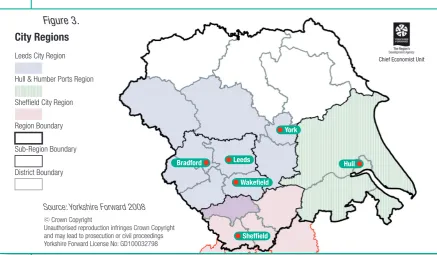
Secondly, the LGYH Leaders’ Board needs to provide direction across all the themes to be covered by the IRS to enable the four functional sub regions (Leeds, Sheffield and Hull and Humber Ports city regions and York and North Yorkshire sub region) and the individual local authorities to meet and adapt to the crucial challenges ahead. This includes working to ensure that adequate capacity is available at the right level, that synergy is achieved and duplication and inefficiencies are minimised (see Chapter 5). There has already been agreement on the proposed Regional Thematic Advisory Boards, as outlined in Table 2.
7 See: www.dcsf.gov.uk/skillsstrategy/uploads/documents/World%20Class%20Skills%20FINAL.pdf 8 See: http://www.communities.gov.uk/planningandbuilding/planning/regionallocal/regionalspatialstrategies/ 9 See: http://www.dwp.gov.uk/welfarereform/freud_report.asp
Table 2
Regional Thematic Advisory Boards
The Regional Skills Partnership will be the new Work and Skills Thematic Board and will have a direct role in advising the LSC and co-ordinating its successor agencies with the new powers to be given to Local Authorities on skills. In addition to the four thematic regional boards, there will be an Independent Board to ensure that the principles of sustainable development and economic opportunity for all are fully ingrained in the development and delivery of the IRS. This Board will be chaired by an independent/expert chair to work with the Joint Regional Board and the thematic advisory boards and provide expert input and to test IRS development and delivery against the principles of sustainable development, diversity and leadership and ambition.
Theme Chair Deputy Chair
Spatial Planning Local Government Yorkshire Forward Board
Regeneration and Housing Local Government Yorkshire Forward Board
Work and Skills Yorkshire Forward Board Local Government
Transport Yorkshire Forward Board Local Government
Sustainable Development Independent Experts
EVOLUTIONARY
BUILDING STRATEGIC CAPACITY
7
Key Issues in Economic Development in Yorkshire & Humber
At national level the significant policy driver was the July 2007 HM Treasury review of Sub-National Economic Development and Regeneration. The review was set up in March 2006 to examine ways of reducing regional economic inequalities; its report was published in July 2007. The report argues that the diversity of the UK economy means regions and localities will be affected in different ways as globalisation and technological innovations change the economic base.
The SNR, in 2008, is the start of a process to better co-ordinate a multitude of economic development and regeneration structures and initiatives that have been created during the past decade with little real attempt at coordination. Moreover, it also means that economic development is a key theme for regeneration, influencing the outcome of the Comprehensive Spending Review and developments for the 2008-2011 period.
In December 2007 the Department for Communities and Local Government (CLG), together with the Department for Business, Enterprise and Regulatory Reform (BERR), published a paper setting out progress to date, Taking Forward the Review of Sub-National Economic Development and Regeneration (CLG and BERR 2007)10 , in advance of the full consultation document which was
published in March 2008.
Prosperous Places: Conclusions of the SNR
In March 2008 the Government published the final consultation document on the SNR, Prosperous Places: Taking Forward the Review of Sub-National Economic Development and Regeneration (CLG and BERR 2008). The consultation on this document ended in June 2008 and in November 2008 the Government published its final response (Prosperous Places: taking forward the review of sub-national economic development and regeneration, 2008).
In 2009 with the passing of the Local Democracy, Economic Development and Construction Bill (LDEDC), there will be:
l Legislation to place a new statutory duty on local authorities to assess the economic
conditions in their area. This new duty will be placed on unitary and upper tier authorities and underpinned by statutory guidance. It is, however, the Government’s intention to place a duty on upper tier authorities to work closely with district councils in their area in completing their assessment. There will be a corresponding duty on district councils to co-operate with the upper tier.
l Economic Prosperity Boards at sub-regional level. Clauses 65-82 of the LDEDC bill – Policy
Document on Regional Strategies11, currently before Parliament, details the new
regional strategy process which replaces the existing Regional Economic Strategy (RES) and Regional Spatial Strategy (RSS). The LDEDC Bill provides for three new options for sub-regional co-operation:
l Economic Prosperity Boards (EPB)
l the combination of the functions of an EPB with the functions of an Integrated Transport
Authority (ITA)
l Multi Area Agreements with stakeholder duties
In 2009, City Regions are being asked to respond to a consultation process on these options. The Government admits that “existing boundaries rarely capture cohesive functional economic areas, with housing and labour markets, for example, often cutting across multiple jurisdictions” (PBR 2007). As such, the need for effective collaboration between local authorities is clear. In this regard there will be legislation to allow for the creation of statutory sub regional authorities for economic development, known as ‘Economic Prosperity Boards’ (EPBs). It is expected that these EPBs will largely follow the boundaries of existing city regions and functional sub regions.
These new boards will adhere to the original principles set out within Prosperous Places, in that:
l they will be based on collaboration between elected members of existing local authorities;
l they will not include any council tax precept;
l they will not impose additional net costs on local authorities; and
l they will provide transparent accountability for residents.
The creation of Economic Prosperity Boards will be voluntary in nature, allowing local authorities to ‘opt-in’ if they so wish. Following the enactment of the Local Transport Act 2008, the Government has also decided to allow for the functions of EPBs to be combined with the functions of Integrated Transport Authorities to create a consistent approach to economic development and transport. The Government has also decided to legislate to allow for the creation of MAAs with statutory duties. The Government’s expectation is that Economic Prosperity Boards will evolve out of existing sub-regional partnerships, such as MAAs. For example, where an EPB is established across an area with an existing MAA, it would be appropriate for the agreed MAA targets to be adopted by the EPB.
The Government announced in the Pre-Budget Report (2008) that nationally, at least two new city regions will be chosen to proceed on a statutory basis in the April 2009 budget and this raises the question of ensuring that the Yorkshire plans are well advanced so that at least one of the four functional sub-regions stands a chance to be chosen to proceed on a statutory basis.
A joint duty on Regional Development Agencies (RDAs) and local authority Leaders’ Boards to prepare and agree an Integrated Regional Strategy for each region outside London. The Government has decided to give the RDA and the local authority Leaders’ Board joint responsibility for the regional strategy, including its drafting, implementation plan and monitoring of its delivery. The key regional planning functions of the regional assembly will pass to the new Joint Regional Board. In Yorkshire and Humber the LGYH Leaders’ Board has already been constituted in line with the criteria set earlier by the Government. These were that the Board should be:
l streamlined and manageable, able to make strategic, long-term decisions, and able to engage
effectively with their region’s RDA;
l representative of local authorities across the whole of their region – including representing
key sub-regions, upper and lower tier authorities and the political balance of leaders; and
l comprised of local authority leaders and with sufficient authority to act on behalf of all the
local authorities in the region.
EVOLUTIONARY
BUILDING STRATEGIC CAPACITY
9
With regard to the new Integrated Regional Strategy (IRS), the Government believes that the form and format should be for each region to decide, but the aim should be to produce a concise and succinct document, which broadly covers:l an overview of the key regional challenges over the strategy period;
l how sustainable economic growth can best be delivered, having regard to employment and the key drivers of productivity (skills, innovation, enterprise, competition and investment), as well as regeneration;
l a distribution of housing supply figures consistent with addressing the Government’s long term housing supply targets as well as targets for affordable housing and achieving quality homes for all, including vulnerable and socially excluded people;
l how the region will tackle climate change, including managing the impacts of unavoidable climate change and achieving development in a way which is consistent with national targets for cutting carbon emissions;
l those areas within the region identified as priorities for regeneration, investment and intervention;
l strategic requirements and provision for transport, waste, water, minerals, culture, energy and environmental infrastructure, insofar as these are not already specified in national policy; and
l additional policy areas that the Leaders’ Board and RDA in each region decide and which fit with the objectives of the strategy.
In order to implement these changes the Government will:
l legislate to require each region in England, except London, to produce a regional strategy that delivers sustainable economic growth and contributes to sustainable development;
l issue further guidance on what the regional strategy would be expected to cover and on the strategy-making process;
l provide greater clarity on national policy expectations, including reaffirming commitments to providing for long term housing needs;
l and legislate to require regions to produce an implementation plan to accompany the regional strategy, as well as undertake annual monitoring.
The Implications of these Changes in Yorkshire
The SNR, coinciding with the downturn and deepening recession, provides an opportunity for the region and local authorities to assess how it wishes to develop the new joint approach to regional development for the period ahead - 2009-2012.
There is a need for a Change Management Programme, to address the resources required at functional sub regional level for the new agenda. This needs to focus on the following key tasks:
l facilitating the new IRS (between Yorkshire Forward and local authorities);
l co-ordinating the city region strategies (and the York and North Yorkshire Investment Plan) and
their role in the IRS process and to strengthen capacity and capability for co-ordination at city region level;
l co-ordination of local economic assessments at FSR level;
l marshall the capacity to establish the Economic Prosperity Boards, where suitable, and clarify
their key tasks beginning with agreement on MAAs where none currently exists;
l examining and boosting local authority economic development capability especially in relation
to skills for 14-19 year olds, strategies on employment and worklessness, targeting of the new Working Neighbourhood Fund, and the capacity to articulate and advocate adult skills, business support and social policies relevant to their areas.
l co-ordinating the response to the Local Transport Act 2008 and the development of new
Integrated Transport Authorities.
l being clearer on regional, sub-regional and local priorities for the 2010-2020 period ahead. l strengthening the existing MAA process and ensure that up-to-date city region economic
plans dovetail with the new IRS and with the local authority economic assessments.
The reforms announced by the SNR emerged as the current recession gathered pace. The economic challenges the region now face place an increased emphasis on embedding the new structures and reaching agreement on new strategies which can lead the region out of recession. Regional Development Agencies and local authorities need to work closer together in the period ahead to ensure that these new structures can capture and implement the new strategies which are required.
EVOLUTIONARY
BUILDING STRATEGIC CAPACITY
Working Together at Functional Sub-Regional and Local
Level to Achieve Improvement and Eficency
The SNR provides an opportunity to strengthen functional sub-regional arrangements as a key part of the evolving regional partnership between Yorkshire Forward and Local Government Yorkshire and Humber. If the new Integrated Regional Strategy is to be successfully agreed and delivered through a City Region/FSR Prosperity Board based on:
l Sheffield City Region l Leeds City Region
l Hull and Humber Ports City Region l York and North Yorkshire FSR
then there is a need to ensure that the FSRs have the appropriate resources and capacity to undertake the policy and co-ordination roles which are being required of them and to achieve clarity on projects for delivery. Only once this is realised can the FSRs address the longer-term improvement and efficiency objectives.
A review of FSR resources and their key priorities shows that they need to:
l strengthen their governance and policy development capabilities;
l harness the agenda for economic growth based on the new local economic assessments; l recognise that they are pivotal to the work of the new Leaders’ Board;
l liaise closely, regularly and effectively with the new thematic boards;
l liaise with local authorities and Yorkshire Forward to bring forward (recession) projects,
innovations and efficiency-saving activities;
l integrate sub-regional structures at political and technical levels; l ensure sub-regional participation in IRS decision-making;
l ensure FSR involvement in planning, employment and skills, housing, transport, regeneration
and sustainable development, with effective links to Yorkshire Forward;
l harness the potential of the proposed Economic Prosperity Boards and statutory MAAs and
their capacity to promote economic growth;
l Expand the potential for combining the economic development and regeneration functions of
an EPB with the transport function of an Integrated Transport Authority (ITA).
[image:14.595.126.564.110.365.2]11
4.
Figure 3. lWakefield lYork lLeeds lSheffieldHull l
Bradford l
City Regions
Leeds City Region
Hull & Humber Ports Region
Sheffield City Region
Region Boundary
Sub-Region Boundary
District Boundary
Chief Economist Unit
Source: Yorkshire Forward 2008
O Crown Copyright
Unauthorised reproduction infringes Crown Copyright and may lead to prosecution or civil proceedings Yorkshire Forward License No: GD100032798
In particular, although FSRs have access to planning and regeneration skills, they still need to strengthen their capabilities on: economic and financial analysis; housing; transport; employment, skills and worklessness; and sustainable development and climate change. Proposed new ways of working in the emerging regional architecture could include formalising the co-ordination and interaction between Yorkshire Forward (especially the Strategy Team), LGYH and the FSRs in this regard in order to minimise duplication of resources efficiently utilise existing capacity.
The Yorkshire Cities network also has a key role to play in ensuring that the key cities and towns in the region strike the right balance between urban and rural policy and pool their resources in new and innovative ways to develop their respctive functional sub-regions. The Yorkshire Cities network is a collaboration between nine local authorities (Bradford, Calderdale, Doncaster, Hull, Kirklees, Leeds, Sheffield, Wakefield and York) in the Yorkshire and Humber region. It is supported by Yorkshire Forward and hosted within Leeds City Council and looks at research and policy development on urban and economic issues. It could be useful to review and strengthen the resources of Yorkshire Cities to enable it work closer with LGYH and the city regions and to contribute effectively to shaping the emerging IRS process. This is particularly important in terms of achieving better coordination across functional sub regions for the research and evidence base, improved research capacity across urban authorities and improved economic development activities and strategy through work on economic resilience.
The future role for the Yorkshire Cities network needs to be clarified by the Joint Regional Board to ensure that resources are allocated effectively and efficiently in the period ahead.
If effective sub-regional strategies are to be developed they need to be brought forward to nest inside the IRS and developed in partnership with Yorkshire Forward. This suggests that for each functional sub-region, an adequate but small team should be established to direct and lead the Change Management Programme and co-ordinate with both Yorkshire Forward and Local Government Yorkshire and Humber. Each team would address both the upwards and downwards co-ordinates required to ensure more effective collaboration takes place and brings forward a new generation of city region plans to the relevant Thematic Advisory Boards for the 2010-2013 period. This is not necessarily about recruiting new officers – though that might be needed in some cases. Instead there is a need to form a view about the current level of resources residing at different spatial levels and within various organisations and re-alligning these with a view to achieving greater efficiencies and new ways of working. Over time certain functions and resouces have developed in an adhoc way and this is an opprtunity to move forward and create a more dynamic capability at FSR level. Hull and Humber Ports city region has already embarked ona strategic review of its capabilities prior to drawing down the RIEP funding.
EVOLUTIONARY
BUILDING STRATEGIC CAPACITY
13
The Regional Capacity Challenge
Regional Capacity
The import of the changes proposed by the SNR is about greater collaboration, changing mindsets and providing a stronger mechanism for sub-regional devolution. It challenges local authority Leaders to move from being gatekeepers – scrutinising the RDA – to having joint ownership of and responsibility for the economic destiny of the region and its component parts. Thus in the new arrangements, the Leader’s Board will be jointly responsible - with Yorkshire Forward Board members - for the successful drafting, consulting and delivery of the IRS. This raises the obvious question of how to ensure that the highest level of capacity is assembled to support to the Leaders’ Board. LGYH has a key role to play here. The existing resources residing at the Regional Assembly need to be fully assessed and re-allocated at the right levels. The challenge is to avoid spreading this pool of resources too thin whiles retaining enough of a geographical spread to benefit the development of FSRs. The Regional Assembly’s key strengths lie in spatial planning, transport, housing and scrutiny. These are certainly key skills which will be needed at regional and FSR level in the period ahead and it is imperative that these resources are re-deployed effectively at both levels.
The Joint Regional Board needs to work with the Yorkshire Forward Board to agree the process whereby Yorkshire Forward resources fully complements LGYH and FSR capacity in the new context. This will ensure the Joint Regional Board itself as well as the key tiers and functions underneath are well resourced and enabled to make the best decisions.
Capacity at Functional Sub-Region Level
Assembling the capacity and resources at sub-regional level is critically important. There is a need for discussions between LGYH and Yorkshire Forward about how to use all of the region’s resources and capacity more effectively and efficiently. This includes existing Regional Assembly resources, as already discussed, as well as re-examining Yorkshire Forward capacity at regional and sub regional level. The four FSRs are at varying stages of development and they each face different challenges and a wide range of issues.
The Sheffield city region faces a complex set of challenges. This City Region straddles two Government Office regions thus involving two RDAs (Yorkshire Forward and East Midlands Development Agency). It includes four local authorities within South Yorkshire as well as five local authorities, two county councils and a national park authority covering the northen part of the East Midlands region. A great deal of political and executive will is required to secure the resources and impetus needed. Currently an MAA covering housing issues has been signed although this only pertains to the four South Yorkshire local authorities. The Sheffield City Region is now conducting a two-part transport review, as encouraged by the Local Transport Act, due to report in early summer, and is submitting a pan-SCR housing strategy to its Leaders’ Forum in January 2009. The building blocks for a coherent economic and spatial plan are now being assembled. The city region is in a good position to express an interest in being considered for a fore-runner city region Economic Prosperity Board status. The area is ideally formed to attract interest in practicing devolution at a place-specific level because the complexity of administrative boundaries, duplicated strategies and plethora of policies and programmes render the challenge of making sense of activity at city region level to businesses and local residents, real. The strength of the partnership in aspiring to do this is significant, with a tightly formed structure encompassing cross-party representation and involvement of all key local government players in the SCR.
In the Hull and Humber Ports city region, an MAA covering worklessness and skill is expected to be signed off by April 2009. The Humber Economic Partnership is recognised to be the appropriate body to represent this city region and the Partnership is currently preparing to produce an Integrated City Region strategy which will review its current CRDP and contribute to the IRS. Economic development capacity varies significantly across the city region. it is perceived that capacity is more limited in the south bank local authorites of North Lincolnshire and North East Lincolnshire as compared to Hull and East Riding Councils. The RIEP process provides an opportunity to begin to bridge this gap in capacity. A statutory MAA is certainly feasible in the short to medium term.
The York and North Yorkshire Partnership Unit represents the economic development interests of all the local authorities and other partners within the North Yorkshire County Council area as well as the city of York and co-ordinates external funding across the sub-region. Four of the districts in this sub-region are also participating in the Leeds City Region (Selby, Craven, Harrogate and York). It is geographically the biggest sub-region in Yorkshire and Humber and covers coastal and rural areas as well as market towns and urban areas. There is currently no MAA process underway in this sub-region but an investment plan has been agreed with Yorkshire Forward. There is good evidence of joint working with Leeds City Region and given the geopraphical overlap this needs to be formalised and strengthened further in the period ahead.
The Leeds city region is at the heart of Yorkshire and Humber in commercial and economic terms. Leeds, together with Sheffield City Region, was among the first group of MAAs to be agreed and signed off. The Leeds City Region MAA covers transport and skills issues. The city region has also been very proactive in terms of housing and is in negotiations with CLG to designate new “growth points” and “eco settlements”. The Leeds City Region is well placed in the immediate future, among the four in Yorkshire and Humber, to explore the possibility of establishing an Economic Prosperity Board with statutory powers that will formalise and strengthen its strategic and delivery capacity. Discussions on the new Integrated Transport Authority could be developed alongside the new Leeds City Region EPB. This could be a unique opportunity for the city region to take the lead and show the way in England as an exemplar FSR. The current team would need to be strengthened and better resourced and a great deal of political will is required to make this a reality.
EVOLUTIONARY
BUILDING STRATEGIC CAPACITY
15
Resources currently residing within local authorities and at Yorkshire Cities should be assessed together with resources at LGYH and Yorkshire Forward. It is in the spirit of such an assessment, conducted jointly between Yorkshire Forward, LGYH and the FSRs, that new and innovative ways of working in the region should also be considered. The bids for enhanced capacity submitted to the RIEP as part of this report should also be considered within this context. It is aimed at assessing capacity needs which could then be filled by existing resources elsewhere within the region/sub-region. It is vital that the FSRs are fully resourced given the key role they have to play in co-ordinating economic assessments, influencing and implementing the IRS and taking forward MAAs, EPBs and ITAs.At local authority level, evidence again points to a varying level of capacity with some district authorities having very limited capacity in economic development. This suggests that a co-ordinated effort will be required to successfully fulfil the new statutory requirement of conducting economic assessments in each area. The impact of the recession paves the way for new thinking and clarity on regional, sub-regional and local authority roles. This needs to be addressed urgently by all stakeholders led by LGYH and the Leaders Board.
The economic, financial and political cycles all suggest that with the next three year, a great deal of fresh thinking will be required on the response to the recession, and the economic strategies required to lead Yorkshire and Humber into a new phase of economic growth. Planning during the next year will be vital and new progress will be required for economic development to deal with rapidly rising unemployment. Local, regional and national stakeholders need to ensure that whilst they respond to the urgency of the current economic climate, we also address the longer-term need to build the capacity at sub-regional and local levels, which will be needed to transform local areas and reshape the region for the decade ahead.
The legislation which is being brought forward in 2009 is deliberately flexible with regard to function and constitutional arrangements. Local authorities in each sub-region need to debate the opportunities available and discuss with their respective city region teams how they wish to respond to the LDEDC bill.
Conclusions
The latest National Improvement and Efficiency Strategy has coincided with the SNR to create a unique opportunity for regional and local development. The regional institutional architecture is evolving again after a decade of relative stability, at a time when local authorities and the RDA need to respond to the deepening recession and ensure a new economic growth agenda is placed at the highest level for the immediate future.
Regional and local stakeholders must however act swiftly and decisively to ensure that the RIEP process backs up the SNR process. In the emerging new “regional world”, local authorities are to inherit greater powers and influence in the development of their regions and how it affects their localities. However, with this new influence comes a joint responsibility with Yorkshire Forward to improve delivery and the opportunity to boost economic growth at city region level.
So far the Leaders and Chief Executives in Yorkshire and Humber working with LGYH have been pro-active, and shown a readiness and an encouraging capacity to take crucial decisions. The Leaders’ Board now needs to deal with the following questions:
l What level of resources is best marshalled at regional, sub-regional and local levels to support
the work of the Leaders’ Board?
l What resources from the Assembly can be redeployed to strengthen functional sub-regions
(FSRs)?
l How to strengthen the capacity of LGYH to perform their role more effectively?
l What are the most immediate and critical tasks to be addressed in the establishment of sub-
regional Economic Prosperity Boards?
At FSR level there is an opportunity to build on the work of the existing city regions and sub-regions by assembling support teams that will derive their powers and responsibilities from the elected local authority Leaders. They will be responsible for the implementation of MAAs and need to have policy responsibility for housing, transport, skills and sustainable development at FSR level, in order to effectively integrate and link economic, spatial planning and environmental policy into new and integrated ways of working.
The four FSRs in Yorkshire and Humber need to be adequately resourced to carry out the functions expected of them. There are “buy-in” and boundary issues and areas of overlap which need to be clarified for the sake of efficiency and practicality and this is a task for the LGYH Leaders’ Board and individual local authorities. It will be advantageous for at least one of the FSRs in this region to enter negotiations for EPB status in 2009. This will ensure that the region is at the vanguard of economic development policy and practise and also position the FSRs to play an enhanced role through the recession in readiness for the upturn.
A key issue for the Joint Regional Board is how to sufficiently resource the FSR infrastructure to help deliver the new IRS. The SNR clearly spells out the intentions of Government to move the RDAs from a project delivery role to a more policy-making and programme management and strategic delivery role. At present Yorkshire Forward, as well having its regional base in Leeds, also has four sub regional operations across the region working to geographical sub-regional boundaries. For the sake or efficiency and coherence, these will now need to be re-considered
EVOLUTIONARY
BUILDING STRATEGIC CAPACITY
17
with a view to reflecting the new FSR boundaries. There is also the issue of how Yorkshire Forward and LGYH operations could be better aligned with the emerging FSR resources. The potential is there to create synergy and a well-resourced FSR infrastructure capable of delivering on the complex array of responsibilities under the new arrangements. Resources currently residing within local authorities and Yorkshire Cities should also be assessed together with resources at LGYH and Yorkshire Forward as the region explores new and innovative ways of working in the region. The bids for enhanced capacity submitted to the RIEP as part of this report should thus be considered within this context. It is aimed at assessing capacity needs which could then be filled by existing resources elsewhere within the region and sub-region.The SNR guidance confirms that all unitary and upper tier authorities will have a statutory duty to asses the economic conditions of their area. This is intended to inform the IRS process among others. The FSRs should be tasked, by the Joint Regional Board, with using this opportunity to rewrite their CRDPs and co-ordinate existing strategies to reflect their new roles and
responsibilities. The new FSR economic assessments can then provide the overarching framework for individual local authorities to fulfil their new statutory duties in this regard.
At the local level, unitary, upper tier and district councils now have an enhanced remit. In addition to their existing roles in social, economic and environmental management roles, the new devolution agenda means that local authorities will now also have further responsibilities for skills, worklessness and economic development and for implementing the Geographic Programmes promoted through Yorkshire Forward. A capacity audit performed as part of this project revealed a varied level of resources to adequately prosecute this new agenda across the region. Local authority Leaders, Chief Executives and other partners will need to address this to ensure that resources are not wrongly skewed and “top heavy” (in favour of the regional and sub-regional development infrastructure) but that local and neighbourhood needs are also sufficiently supported and assessed. RIEP funds need to be utilised to focus on the key neighbourhoods and skills agendas and the priorities at locality level.
The funds made available through the RIEP process to build capacity are certainly needed and timely, but on their own will not be enough to deliver this new and swiftly evolving agenda. There is an obvious need for funds to be disbursed courageously and innovatively in concert with resources that currently reside with other regional actors.
Throughout 2009, the task is to move forward with
l Local Economic Assessments
l Joint working with Yorkshire Forward on the IRS
l Further MAA and EPB development possibly combined with ITAs l New City Region Development Plans
l Leadership and Elected Members Change Management and Strategic Leadership l Partnership and Commissioning Development
l Sector Growth strategies and key recession project priorities
l Governance and policy support, e.g. transport, skills, housing, sustainable development and
Recommendations
For LGYH/RIEP
l Work with Yorkshire Forward and other partners to establish capacity at regional and FSR level
for economic development and regeneration.
l Decide the best use of existing Regional Assembly resources. Wherever possible such regional
resources should be matched with FSR responsibilities as well.
l Update and inform local authorities on the emerging national and regional landscape,
responsibilities and new roles and how this affects local authorities by organising four sub- regional partnership meetings.
l Assemble a small team from LGYH/Yorkshire Forward to support the Joint Regional Board and
the four FSRs
l Formalise arrangements with Yorkshire Forward with regard to the process of drafting,
consulting and agreeing the new IRS for 2009/10
l Work with other (inter)regional and local partners to secure adequate resources for FSRs and
prioritise sub-regional delivery of key projects and finalise RIEP funding resources.
l ensure adequate mechanisms exist for integrating new CRDP into the IRS process.
For Yorkshire Forward
l Work in partnership with LGYH and the FSRs in designing and agreeing the new institutional
architecture and formalising the role of the new CRDPs and local economic assessments.
l Review resources prior to 1st April 2009 with a view to deploying existing sub regional teams
to work closely with the new functional sub regional structures in the immediate year ahead.
l Work with FSRs to determine efficient resource allocation for co-ordinating and supporting
local authorities in conducting effective and coherent economic assessment using common frameworks and baselines wherever possible. Economic assessment need to be linked and co-ordinated at FSR level.
l Determine, in partnership with the Leader’s Board and the FSRs, clear, longer-term funding
agreements for the 2009-2012.
l Establish clearly, with LGYH how the emerging regional arrangements will support local
authority and FSR structures to deliver the new IRS.
EVOLUTIONARY
BUILDING STRATEGIC CAPACITY
19
For FSRs
l Work with LGYH and Yorkshire Forward to map and assess the existing level of infrastructure
and support at sub-regional level and, together with local authorities, develop plans for the new local economic assessments.
l Agree sub-regional priorities with local authorities and key partners and linked to MAA
priorities
l Agree the process for buy-in to the FSRs and the new CRDPs.
l Agree thematic focus and key priorities and assemble the staff teams required.
l Decide on progress on applying for statutory powers. The FSRs are at various stages in
development but our view is that North Yorkshire and Hull and Humber Ports could aim for statutory MAAs status whilst Leeds and Sheffield city regions may wish to explore the possibility of establishing a full scale Economic Prosperity Board linked to the development of an Integrated Transport Authority and city region Employment and Skills Boards..
l Explore with Yorkshire Forward, LGYH and other partners the possibility of further pooling of
resources with Yorkshire Forward’s sub-regional teams
l Work with partners to develop a common framework to co-ordinate the local economic
assessments
l Work with partners to refresh the sub-regional evidence base and produce integrated city
regional strategies which will transform existing CRDPs and address short-medium term and long-term priorities.
For Local Authorities
l Assess their existing capacity, working with the FSRs, LGYH and Yorkshire Forward, with
regards to fulfilling their new statutory duty of economic assessments.
l Establish clear processes to ensure that local input is sought and provided as part of the IRS
process.
l Establish clear processes to ensure that local input is a key part of FSR output and that the
regional Leaders Board is accountable at local level
l Examine the scope for improvement and efficiency savings with the FSRs on local and sub-
Postscript
Comment from Yorkshire Forward
A Partnership Approach to the Development of an Integrated Regional Strategy
In response to SNR the Yorkshire and Humber region moved to new partnership arrangements from April 2009. The region has already made strong progress having established a Joint Regional Board comprising representatives from Yorkshire Forward’s Board and a Strategic Leaders Board made up of Local Authority Leaders.
Yorkshire Forward working with Local Government, has a central role in the development of the new IRS. We need to ensure a joint approach to the establishment of a strong evidence-gathering process during 2009/10, built on an inclusive partnership between LGYH, the Functional Sub-Regions and Yorkshire Forward.
The principle of building from the local upwards is a core principle of our approach. Yorkshire Forward is keen to work closely with Local Authorities, Functional Sub-Regions and Yorkshire Futures to share capacity, promote good practice and work to support consistency and quality in developing the local, functional sub-regional and regional evidence base. Indeed we should build on our track record of joint working with Local Authorities in local economic masterplans and strategies and our work in supporting the economic evidence underpinning City Regional Development Plans.
Our support is primarily in the form of capacity, we have strengths in economic analysis, forecasting and intelligence, strategy development, sustainable development and policy advice. A key strength is our ability in building indicators, analysis and policy implication that work across the region but can offer strong local insights. We can also provide some financial support to capacity and research, primarily at the Functional Sub-regional level.
Simon Foy
Yorkshire Forward
EVOLUTIONARY
BUILDING STRATEGIC CAPACITY
ERBEDU Leeds Business School, Leeds Metropolitan University 22-25 Queen Square Leeds LS2 8AF Tel: 0113 812 3223 Fax: 0113 812 3224 E-mail: [email protected] www.leedsmet.ac.uk/lbs/erbedu