PII. S016117120320418X http://ijmms.hindawi.com © Hindawi Publishing Corp.
ON A THIN SET OF INTEGERS INVOLVING
THE LARGEST PRIME FACTOR
FUNCTION
JEAN-MARIE DE KONINCK and NICOLAS DOYON
Received 22 April 2002
For each integer n ≥ 2, let P (n) denote its largest prime factor. Let S := {n≥2 :ndoes not divideP (n)!}andS(x):=#{n≤x:n∈S}. Erd˝os (1991) con-jectured thatSis a set of zero density. This was proved by Kastanas (1994) who established thatS(x)=O(x/logx). Recently, Akbik (1999) proved thatS(x)=
O(xexp{−(1/4)logx}). In this paper, we show thatS(x)=xexp{−(2+o(1))×
logxlog logx}. We also investigate small and large gaps among the elements of Sand state some conjectures.
2000 Mathematics Subject Classification: 11B05, 11N25.
1. Introduction. For each integern≥2, letP (n)denote its largest prime factor and let
S:=n≥2 :ndoes not divideP (n)!, S(x):=#{n≤x:n∈S}. (1.1)
Thus, the first 25 elements ofS are
4,8,9,12,16,18,24,25,27,32,36,45,48,49,
50,54,64,72,75,80,81,90,96,98,100, (1.2)
while using a computer, we easily obtain thatS(10)=3,S(100)=25,S(1000)=
127,S(104)=593,S(105)=2806,S(106)=13567,S(107)=67252, andS(108) =342022.
In 1991, Erd˝os [2] challenged his readers to prove thatSis a set of zero den-sity. In 1994, Kastanas [4] proved that result, while K. Ford (see [4]) observed thatS(x)=O(x/logx). In 1999, Akbik [1] proved thatS(x)=O(xexp{−(1/4) ×logx}).
Our main goal here is to prove that
In order to prove (1.3), we establish the following two bounds valid for each fixedδ >0:
S(x)xexp−2(1+δ)logxlog logx, (1.4)
S(x)xexp−2(1−δ)logxlog logx. (1.5)
Finally, we investigate small and large gaps among the elements ofS and state some conjectures.
2. The lower bound forS(x). Letδ > 0 be small and fixed. Since every integern≥2 divisible by the square of its largest prime factor must belong to
S, we have that
S(x)≥
p≤√xmp2≤x P (m)≤p
1=
p≤√xm≤x/p2
P (m)≤p
1=
p≤√x
Ψ x
p2,p
, (2.1)
whereΨ(x,y):=#{n≤x:P (n)≤y}.
Settingu=logx/logy, we recall Hildebrand’s estimate [3]
Ψ(x,y)=xρ(u)
1+O
log
(u+1)
logy
(2.2)
which holds for
exp(log logx)5/3+ε≤y≤x, (2.3)
whereε >0 is any fixed real number, and whereρstands for Dickman’s func-tion whose asymptotic behaviour is given by
ρ(u)=exp
−u
logu+log logu−1+O
log log
u
logu
(u→ ∞). (2.4)
It follows from this last estimate that ifuis sufficiently large, then
logρ(u)≥ −(1+δ)ulogu. (2.5)
Hence, if we choosersufficiently large, sayr≥r0≥2, then for eachy≤x1/r,
...
Therefore, it follows from (2.4) and (2.5) that, withu=log(x/p2)/logp=
logx/logp−2,
logρ(u)≥ −(1+δ)loglogx
plog logx
u≥r0 (2.6)
and hence (2.1) and (2.2) yield
S(x)x
e(log logx)5/3+ε≤p≤x1/r
1
p2e(1+δ)(logx/logp)log logx
=x
x1/r
e(log logx)5/3+ε
dπ(t)
t2·e(1+δ)(logx/logt)log logx,
(2.7)
whereπ(t)stands for the number of primes not exceedingt. Now, set
Lδ(x):=
(1+δ)logxlog logx (x≥3) (2.8)
so that, for anyδ1>0, we have, forxsufficiently large,
Lδ(x),
1+δ1Lδ(x)
⊂
(log logx)5/3+ε,1 rlogx
. (2.9)
Using this, it follows from (2.7) that settingJ(x):=[eLδ(x),e(1+δ1)Lδ(x)],
S(x)x
t∈J(x)
dπ(t)
t2·e(1+δ)(logx/logt)log logx
> x min
t∈J(x)
1
t2·e(1+δ)(logx/logt)log logx
t∈J(x)dπ(t).
(2.10)
Now, observe that sincet/logt < π(t) <2(t/logt)fort≥11, we have that
t∈J(x)dπ(t)=π
e(1+δ1)Lδ(x)−πeLδ(x)
> e
(1+δ1)Lδ(x)
1+δ1Lδ(x)− eLδ(x)
Lδ(x)
e(1+δ1)Lδ(x)
1+δ1Lδ(x).
On the other hand, settingv=logtand afterwardsw=v/Lδ(x), we have
min
t∈J(x)
1
t2·e(1+δ)(logx/logt)log logx
= min
Lδ(x)≤v≤(1+δ1)Lδ(x)
1
e2v+(1+δ)(logx/v)log logx
= min
1≤w≤1+δ1
1
e2wLδ(x)+(1+δ)(logx/wLδ(x))log logx
= min
1≤w≤1+δ1
1
e(2w+1/w)Lδ(x)
1
e(3+2δ1)Lδ(x)
(2.12)
since 2w+1/w≤2+2δ1+1=3+2δ1for eachw∈[1,1+δ1]. Hence, using (2.11) and (2.12), it follows from (2.10) that
S(x)x e
(1+δ1)Lδ(x)
1+δ1Lδ(x)·
1
e(3+2δ1)Lδ(x)
=x e−(
2+δ1)Lδ(x)
1+δ1Lδ(x)
xe−2(1+δ1)Lδ(x),
(2.13)
which establishes (1.4) by takingδ1sufficiently small.
3. The upper bound forS(x). First, we establish that
S(x) <
2≤r <logx/log 2p<x1/r Ψ
x pr,pr
. (3.1)
Actually, this inequality is based on a very simple observation; namely, the fact that ifn∈S, then there exist a primepand an integerr≥2 such thatpr
dividesnbut does not divideP (n)!, in which caseP (n) < pr. Hence, writing
n=prm, we have thatP (m)≤P (n) < pr. These conditions imply that ifn∈S
andn≤x, then we haver <logx/log 2,p < x1/r,m < x/pr, andP (m) < pr,
thus proving (3.1).
We now move to find an upper bound for the inner sum on the right-hand side of (3.1); namely, p<x1/rΨ(x/pr,pr ), uniformly for all r ≥2. For this purpose, we fixr≥2 and separate this sum onpinto three distinct sums as follows:
p<x1/r Ψ
x pr,pr
...
where the sums S1(x), S2(x), andS3(x)run, respectively, in the following ranges:
p≤exp(log logx)2,
exp(log logx)2< p≤exp2
logxlog logx,
exp2
logxlog logx< p < x1/r.
(3.3)
The first sum is negligible since it is clear that, using the well-known estimate,
Ψ(X,Y )Xe−(1/2)logX/logY (X≥Y≥2) (3.4)
(see, e.g., Tenenbaum [5, Chapter III.5, Theorem 1]), we get that
S1(x) <exp(log logx)2Ψx,logx
log 2exp
(log logx)2
xe(−1/2+o(1))(logx/(log logx)2).
(3.5)
The third one is also easily bounded since
S3(x) <
exp{2√logxlog logx}<p<x1/r
x pr
x
p>exp{2√logxlog logx}
1
p2
xexp−2logxlog logx.
(3.6)
To estimateS2(x), we use essentially the same technique as in the proof of (1.4).
First, it follows from (2.4) that
logρ(u)≤ −ulog(u) (3.7)
provideduis sufficiently large. Then, with the same approach as in the proof of (1.4), we get that, for each fixed integerr≥2,
S2(x)x
2√logxlog logx
1
dv
Now, setf (v)=v+logxlog logx/v. Sincef(v)=1−logxlog logx/v2and f(v)=0 whenv=v0=logxlog logx, it is easy to see thatv0is indeed a minimum forf. From this, it follows that
v+logxlog logx v
≥fv0=2logxlog logx for eachv∈1,2logxlog logx.
(3.9)
Using this in (3.8), we conclude that
S2(x)xexp−2logxlog logx
2√logxlog logx
1
dv vr−1
xlog2
logxlog logxexp−2
logxlog logx.
(3.10)
Combining (3.1), (3.2), (3.5), (3.6), and (3.10), we get (1.5).
4. Small and large gaps among elements of S. We can easily show that there are infinitely manyn∈S such thatn+1∈S. This follows from the fact that the Pell equation
x2−2y2=1 (4.1)
has infinitely many solutions. Indeed, if(x,y)is a solution of (4.1), then by settingn=2y2andn+1=x2, we have thatP (n)2|nandP (n+1)2|(n+1), in
which casendoes not divideP (n)! andn+1 does not divideP (n+1)!, which guarantees thatn,n+1∈S. In fact, ifT2stands for the set of thosen∈Ssuch thatn+1∈S and ifT2(x)=#{n≤x:n∈T2}, then it follows easily from
the above thatT2(x)logx. In fact, most certainly, the true order ofT2(x)
is much larger than logx, but we could not prove it.
It seems strange that suchtwin elementsofS, that is, pairs of numbersnand
n+1 both inS, are more difficult to count than pairs of numbersnandn+4 both inS. Indeed, ifF4stands for the set of thosen∈S such thatn+4∈S
and ifF4(x)=#{n≤x:n∈F4}, then we can show that
F4(x)logx1/4
x. (4.2)
Indeed, observe that given any primep, then both numbersn=p4−4p2= p2(p2−4)=p2(p−2)(p+2)andn+4=p4−4p2+4=(p2−2)2belong toS.
...
Chebychev’s inequality π(y)y/logy. Finally, note thatT2(108)=1175,
whileF4(108)=1261.
More generally, we conjecture that given any positivek≥3, the set Tk:=
{n∈S :n+1, n+2,...,n+k−1∈S}is also an infinite set. We could not prove this to be true, even in the case wherek=3. Note that the only numbers less than 108belonging toT3are 48, 118579, 629693, 1294298, 9841094, and
40692424.
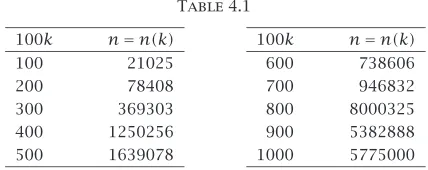
[image:7.468.125.339.255.340.2]As for large gaps among consecutive elements ofS, it follows from the fact thatSis a set of zero density that given any positive integerk, there are infin-itely many integersnsuch that the intervals[n,n+k]contain no element ofS. Table 4.1gives, for each positive integerk, the smallest integern=n(k)∈S
such that bothnandn+100kbelong toS, while the open interval(n,n+100k)
contains no element ofS.
Table4.1
100k n=n(k)
100 21025
200 78408
300 369303
400 1250256
500 1639078
100k n=n(k)
600 738606
700 946832
800 8000325
900 5382888
1000 5775000
It is quite easy to show that
n(k)≥2500k2−100k+1. (4.3)
Indeed, since all perfect squares belong toS and since(m+1)2−m2=2m+
1, it follows that the interval(n,n+2m+1)contains no element ofS and, therefore, thatn≥m2. Hence, given a positive integerk, choosemso that
100k=2m+2, that is,m=50k−1. Then, clearly, we have thatn(k)≥m2= (50k−1)2, which proves (4.3).
It would also be interesting to obtain a decent upper bound forn(k).
Acknowledgment. This research was supported in part by a grant from
the Natural Sciences and Engineering Research Council (NSERC).
References
[1] S. Akbik,On a density problem of Erd˝os, Int. J. Math. Math. Sci.22(1999), no. 3, 655–658.
[2] P. Erd˝os,Problem 6674, Amer. Math. Monthly98(1991), no. 10, 965.
[3] A. Hildebrand,On the number of positive integers≤xand free of prime factors > y, J. Number Theory22(1986), no. 3, 289–307.
[5] G. Tenenbaum,Introduction to Analytic and Probabilistic Number Theory, Cam-bridge Studies in Advanced Mathematics, vol. 46, CamCam-bridge University Press, Cambridge, 1995.
Jean-Marie De Koninck: Département de Mathématiques et de Statistique, Université Laval, Québec, Québec, Canada G1K 7P4
E-mail address:[email protected]
Nicolas Doyon: Département de Mathématiques et de Statistique, Université de Mon-tréal, MonMon-tréal, Québec, Canada H3C 3J7