Art and Design Theses Ernest G. Welch School of Art and Design
5-11-2018
FOLDED MYSTERY
maryam palizgir
Follow this and additional works at:https://scholarworks.gsu.edu/art_design_theses
This Thesis is brought to you for free and open access by the Ernest G. Welch School of Art and Design at ScholarWorks @ Georgia State University. It has been accepted for inclusion in Art and Design Theses by an authorized administrator of ScholarWorks @ Georgia State University. For more information, please [email protected].
Recommended Citation
FOLDED MYSTERY
by
MARYAM PALIZGIR
Under the Direction of Jess Jones, MFA
ABSTRACT
The body of work in my thesis project titled Folded Mystery are the metaphors for how
we exchange knowledge, how perception widens our perspective, and how observation deepens
our understanding of the reality in which we live. I seek works of art that activate once the
viewer is involved. Folded Mystery is about challenging viewers' perception with
multi-perception embodiment through 2D and 3D drawings, sculptural paintings, and installations that
focus on the interaction of geometric abstract forms, colors, reflective objects and layering
grid-like materials in space.
FOLDED MYSTERY
by
MARYAM PALIZGIR
A Thesis Submitted in Partial Fulfillment of the Requirements for the Degree of
Master of Arts
in the College of the Arts
Georgia State University
Copyright by
Maryam Palizgir
FOLDED MYSTERY
By
Maryam Palizgir
Committee Chair: Jess Jones
Committee: Pam Longobardi
Ruth Stanford
Ryan Crooks
Electronic Version Approved:
Office of Academic Assistance
College of the Arts
Georgia State University
DEDICATION
To my parents who taught me to be a good person in the world. To my dearest brother, Payam,
his friendship made sure that I never felt alone. To Mona, for being a great sister- in- law and a
friend. My beloved nieces, Dorita and Menta. I am so lucky to have you in my life, and being
your aunt brings me so much happiness into my life.
Finally, I have to express the greatest gratitude to my love, Mohammadjavad Jahangir, for his
understanding and encouragement in my many moments of crisis, even as he pursues his MFA
ACKNOWLEDGEMENTS
Thank you Jess Jones, Pam Longobardi, Ruth Stanford, and Ryan Crooks for being in my thesis
committee. You all have been a strong influence on my art practice, particularly by giving me the
freedom and fearless approach to a huge variety of scales, material studies. I feel lucky to have
been in this program and benefitted from your knowledge and experience.
I would like to acknowledge some other faculty as well Craig Drennen, Adrienne Gonzalez,
Adam Wagner, Susan Richmond, Tim Flowers, Stephanie Dawn Haynie, Christina West,
Michael A. White, Hope Cohn, Fahamu Pecou, and all my fellow artists who were right beside
me during my past three-year of art journey. Thank you for supporting me, pushing me, and
TABLE OF CONTENTS
ACKNOWLEDGEMENTS ... v
LIST OF FIGURES ...vii
1 INTRODUCTION ... 1
1.1 Colorful Memories and Architectural Influence ... 2
1.2 Fading Memories ... 5
1.3 Vision Loss ... 7
2 MATERIAL STUDY AND SPACE COGNITION ... 9
3 INTERACTION BETWEEN SPACE AND FORM ... 14
4 THE LANGUAGE OF VISION ... 19
4.1 Unfold the Mystery ... 32
5 THE VALUE OF LIGHT ... 39
5.1 Light in Mosques ... 39
6 CONCLUSION... 42
LIST OF FIGURES
Figure 1.1 Amin Abedini, The interior of Nasir Al-Mulk, mosque (built 1888),2017, Shiraz, Iran
... 3
Figure 1.2 Abdollah Heidari,Abedini, The interior of Golestan palace,2017, Tehran, Iran ... 4
Figure 1.3 Abdollah Heidari,Abedini, The interior of Golestan palace,2017, Tehran, Iran ... 4
Figure 1.4 Martin White, The interior of Shah Cheragh Mosque,2016, Shiraz, Iran ... 5
Figure 2.1Maryam Palizgir, Earth Vessels installation, 2017, hand cut out fiberglass screen, projected animation, 48x80 in ... 10
Figure 2.2 Maryam Palizgir, Floating Home Installation view#1, 2017, 2000 yarns thread, nail, light, 10 x 12 sq ft... 11
Figure 2.3 Maryam Palizgir, Floating Home Installation view#2, 2017, 2000 yarns thread, nail, light, 10 x 12 sq ft... 11
Figure 2.4 Barbara Kasten, Unique, Photogenic Painting, Untitled 74/1, 1974, Cyanotype Photogram, 22x30in ... 13
Figure 3.1 Maryam Palizgir, Hinged Space#2, 2018, Holographic foil, Fiberglass screen, reflective sheet, sweing needle, thread, 80x108x 3 in ... 14
Figure 3.2 Luisa Lambri, Untitled (The Met Breuer, #06), 2016, color photograph, 35 3/8 x 31 1/2" ... 16
Figure 3.3 Josef Albers, M-5, 1954, Machine engraving on black laminated plastic, 17 221/2 in.(43.2x57.2 cm), 1976.8.1890 ... 17
Figure 3.4 Josef Albers, Structural Constellation, n.d.ink and pencil on paper, 18 × 23 in. ... 18
Figure 4.2 Maryam Palizgir, Visual Dynamic #5, 2018, Holographic foil, Fiberglass screen on
Canson paper, Holographic foil,13x17x 1 1/2 in ... 21
Figure 4.3 Maryam Palizgir, Visual Dynamic #6, 2018, Holographic foil, Fiberglass screen on
Canson paper, Holographic foil,13x17x 1 1/2 in ... 22
Figure 4.4 Maryam Palizgir, Visual Dynamic #7, 2018, Holographic foil, Fiberglass screen on
Canson paper, Holographic foil,13x17x 1 1/2 in ... 23
Figure 4.5 Maryam Palizgir, Visual Dynamic #8, 2018, Holographic foil, Fiberglass screen on
Canson paper, Holographic foil,13x17x 1 1/2 in ... 24
Figure 4.6 Maryam Palizgir, Visual Dynamic #9, 2018, Holographic foil, Fiberglass screen on
Canson paper, Holographic foil,13x17x 1 1/2 in ... 25
Figure 4.7 Maryam Palizgir, Visual Dynamic #10, 2018, Holographic foil, Light Fiberglass
screen on Canson paper, Holographic foil,13x17x 1 1/2 in ... 26
Figure 4.8 Maryam Palizgir, Visual Dynamic #11, 2018, Holographic foil, Light, Fiberglass
screen on Canson paper, Holographic foil,13x17x 1 1/2 in ... 27
Figure 4.9 Maryam Palizgir, Visual Dynamic #12, 2018, Holographic foil, Light, Fiberglass
screen on Canson paper, Holographic foil,13x17x 1 1/2 in ... 28
Figure 4.10 Maryam Palizgir, Visual Dynamic #13, 2018, Holographic foil, Light, Fiberglass
screen on Canson paper, Holographic foil,13x17x 1 1/2 in ... 29
Figure 4.11 Maryam Palizgir, Visual Dynamic #14, 2018, Holographic foil, Light, Fiberglass
screen on Canson paper, Holographic foil,13x17x 1 1/2 in ... 30
Figure 4.12 Maryam Palizgir, Visual Dynamic #15, 2018, Holographic foil, Light, Fiberglass
Figure 4.13 Monir Shahroudy Farmanfarmaian, Infinite Possibility. Mirror Works and Drawings,
1974–2014, Installation view, Image courtesy of SOLOMON R. GUGGENHEIM
MUSEUM ... 33
Figure 4.14 Maryam Palizgir, Spatial VSs Visual, 2018, Fiberglass screen, holographic foil, inkjet print on archival paper, 55x 40x 14 in ... 34
Figure 4.15 Maryam Palizgir, Spatial Abstraction, 2018, Adjustable aluminium window screen,spray paint, inkjet print on archival paper, 23.5x 38.5 x 8 in ... 35
Figure 4.16 Maryam Palizgir, Hinged Space#2 detail shot, 2018, Holographic foil, Fiberglass screen, reflective sheet, Light, sewing needle, thread, 80x108x 3 in ... 36
Figure 4.17 Maryam Palizgir, Simultaneous Variation, 2017, Holographic foil, Fiberglass screen, plexiglass mirrored box, 8 1/2x 13x 4 in ... 37
Figure 4.18 Maryam Palizgir, Constant Ripple, 2018, Holographic foil, Fiberglass screen, Acrylic paint, 25x16x 13.5in ... 38
Figure 5.1 Maryam Palizgir, Glimpsed Moments, 2018, Holographic foil, Oak wood structure, 25 16x 13.5 in... 41
Figure 6.1 Maryam Palizgir, Folded Mystery, Installation view #1, 2018 ... 43
Figure 6.2 Maryam Palizgir, Folded Mystery, Installation view #2, 2018 ... 44
Figure 6.3 Maryam Palizgir, Folded Mystery, Installation view #3, 2018 ... 45
Figure 6.4 Maryam Palizgir, Folded Mystery, Installation view #4, 2018 ... 46
1 INTRODUCTION
“The relation between what we see and what we know is never settled. Each evening we see the
sun set. We know that the earth is turning away from it. Yet the knowledge, the explanation,
never quite fits the sight.” 1
― John Berger, Ways of Seeing
The body of work in my thesis project titled Folded Mystery is the metaphors for how we
exchange knowledge, how perception widens our perspective, and how observation deepens our
understanding of the reality in which we live. I seek to create works of art that are
perception-dependent, and activating depends on being perceived.. Folded Mystery is about challenging
viewers’ perception and multi-perception embodiment through 2D and 3D drawings, sculptural
paintings, and installations focusing on the interaction of geometric abstract forms, colors,
reflective objects and layering grid-like materials in space.
I first became interested in applying geometric forms and patterns as the visual elements,
through my graphic design profession. I made hundreds of posters, book designs, corporate
identities based just on geometric forms, repeated patterns, and solid colors instead of using
images and photographs.
To me, the “process” of making an artwork is as important as the final piece. I work in a
variety of different mediums and my process involves deconstructing and reconstructing an
image, object or matter through mixed media and material manipulation. Through my process, I
discover the potential of the material possibilities through making.
I intend to focus on the complexity of space by making sculptural installations that allow
me to look into and through things. I also bring photography into this exchange. I am
preoccupied with finding new ways of seeing through the experimental cross-fertilization of
drawing, sculpture, and photography, which stimulated a philosophically oriented questioning of
vision and perception.
1.1 Colorful Memories and Architectural Influence
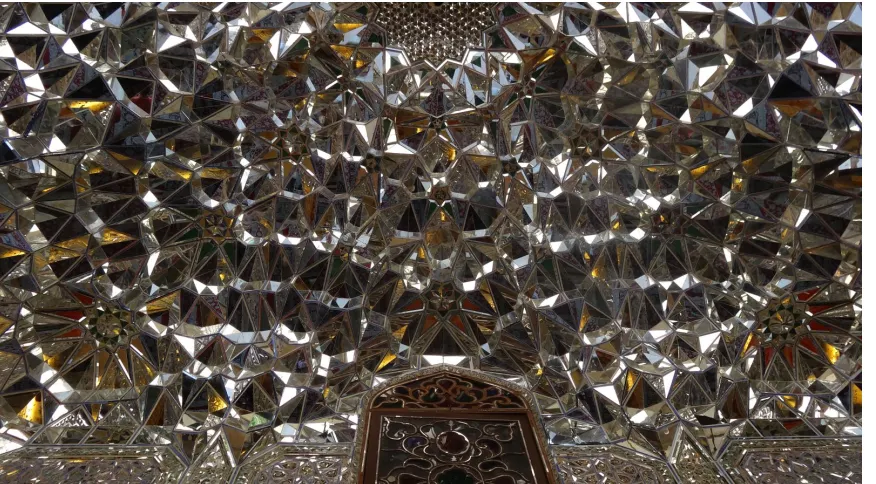
I grew up in a culture deeply rooted in rich colors, a culture that creates textile art such as
rugs and hand -woven fabrics, tile works, and abstract forms of mirror work designed for
mosques, palaces, and traditional houses. Iranian architecture makes use of abundant symbolic
geometry, using pure forms such as circles and squares. The plans are often based on
symmetrical layouts featuring rectangular courtyards and halls. The abstract geometric forms
allude to the spiritual attributes of architecture. Traditionally, the guiding formative motif of
Iranian architecture has been its cosmic symbolism "by which man is brought into
communication and participation with the powers of heaven".2 This theme has given unity and
continuity to the architecture of Persia.
2 Laleh Bakhtiar , and Ardalan Nader, Sense of Unity; The Sufi Tradition in Persian
Accumulating unforgettable childhood memories, consisting of several family trips to these
architectural sites, combined with the moments that I went to the textile factory in which my
mom used to work, I swung between yardage of colorful, well-designed fabrics, and this shaped
my visual perceptions. I believe my visual memory has been overloaded by colors, patterns,
[image:14.612.76.533.234.479.2]forms and architecture. (Figure1.1 - 1.4)
Figure 1.2 Abdollah Heidari,Abedini, The interior of Golestan palace,2017, Tehran, Iran
[image:15.612.73.504.375.664.2]1.2 Fading Memories
Many years ago, I came upon a pile of colorful broken window glasses from a demolished
old house in Tehran. Why did I stop to take this photo? Perhaps it was the mad pile of ecstatic
colors, maybe it was how the angles of the glasses slept on each other, or it could have been the
fact that the reflective objects offered a moment of light perception, angle, and color superior to
everything around it. I subconsciously started to create a visual diary of all my wanderings.
Having a smart phone brings me the opportunity of capturing the moments that patterns, objects
or subject catch my eye.
In recent years, I’ve done it several times a day: whipped out my smartphone to snap a
picturesque landscape that is too beautiful to forget or photographed a particularly impressive
artwork in an art gallery. The ubiquitous presence of technology has its pros and cons. It's
obvious that I document my moments to keep my memories from fading, but with such
[image:16.612.73.511.71.313.2]mostly forgetting to see them again. There is a "photo-taking impairment effect" as psychologists
argued. That means if we take a photo of something we're less likely to remember it than if we'd
looked at it with our eyes. "When people rely on technology to remember for them," argued
psychologist Linda Henkel of Fairfield University in Connecticut, "counting on the camera to
record the event and thus not needing to attend to it fully themselves – it can have a negative
impact on how well they remember their experiences." In her study from 2014, students were led
on a museum tour and asked to take photos of certain works of art – and only observe others.
When they were tested the next day, they were less able to remember details of objects that they
had photographed. This is what Henkel calls a “photo-taking impairment effect”.3
The Folded Mystery is a challenge to spend much more time for elevating our perceptions in
today’s life with the ubiquitous presence of technology and lesser presence of physical body and
individual experiences. I realized that, the more I observe with care, the more associations,
patterns, and stories I create for myself that ultimately become an artwork. Close observation is
like any exercise, physical or intellectual or spiritual. The more I see, the more I get.
As Homo sapiens, we generally walk upright and primarily view the world at eye level, looking
forward. In this manner we can see the farthest distances and take in the most visual information.
But the world becomes a lot more interesting if we try to see it from another point of view.
Looking up from the ground, looking down from a tower, turning object over, focusing closely
on details, all these shifts in perspective unlock visual doors, open vistas, and allow us to see
3 Tiffanie Wen, “Are you taking too many pictures?,” The British Broadcasting Corporation ,10 September
more. Fresh perspectives help us see things more broadly and appreciate how things operate in
the world.4
In Folded Mystery series, I consider how the act of seeing is neither simple nor
straightforward, and it can challenge the viewer's vision through multi-perception in a way to be
able to see the surroundings differently. I am really fascinated by both seeing and attentiveness. I
feel like we live in an age where attentiveness is maybe less valued than it has been in the past,
but also where the way that we look has changed by the development of the technologies. We are
always looking at our own images or images of other people on our social media feeds. I think
people are often very dismissive of the kind of looking. Of always looking into your phone or
taking a picture of the artwork in the gallery instead of actually looking at the work. But there is
something happening in that image that doesn't happen when you are just looking and vice versa.
There are things that your eyes can do that that images cannot.
1.3 Vision Loss
I used to wear glasses for many years. Six years ago, I had a hard time deciding to do Lasik
eye surgery due to the process, and a its side effects. I recall clearly the days before it that I tried
to see as much as I could, and kept thinking about to what extent my life will change if I were to
lose my sight. Vision loss seems like the death knell for everyone, especially visual artists. And
indeed, it is one of my greatest professional fears. During the surgery, staying awake and being
aware of someone or something touching the most sensitive part of your body is unnerving. You
experience seconds of temporary blindness and darkness. Thankfully, I survived with my vision
4 Rob Forbes, See for Yourself: A Visual Guide to Everyday Beauty. (San Francisco: Chronicle
intact, but I don’t feel comfortable without my inseparable eye drops. I can’t sleep and I
constantly have dry eyes. This personal experience was a motivation for me to make work
2 MATERIAL STUDY AND SPACE COGNITION
I experiment with process and textile techniques differently than people trained in textile did.
My material study teaches me to think about the flexibility of materials. I work in
interdisciplinary areas and my curiosity about materials has been constant. I choose materials
best suited to my subject matter. For instance, I have been working with moirés, the patterns
made by grid-like materials layered together since second year of graduate school. The initial
attraction to moiré was a phenomenon that I saw happening and the idea of using layers of
screens is to create a transition between 2D and 3D, depicting the state of ephemerality and
constant change, combined with the possibility of the viewers’ displacement. The Earth Vessels
is an artistic response to water scarcity. Hand-cut fiberglass screens were used to portray the
shrinking size of Lake Urmia- the sixth-largest saltwater Lake on Earth- in the past few decades.
Adding the layer of light by projecting an animation video makes the installation both impressive
and ambiguous. Additionally, there is an interactive part that is performed by viewers who walk
on a salt surface with blood capsules underneath that pop and splash blood red liquid on clean
white salt to emulate the “bloody shame” associated with human-caused environmental
Floating home is a piece in which I draw in space. The initial theory behind using thread was to
deliberately transform 2D shapes into 3-D forms. Employing thread allows me to draw in space,
offering the ability to create floating linear structures to blur boundaries and make more
connections. I play with the certain set of tools like, simple outlines, spotlights, shadow effects,
and the importance of the physical body to investigate the space through lines, perspective, and
[image:21.612.72.541.71.382.2]perception. (Figure 2.2-2.3)
Figure 2.2 Maryam Palizgir, Floating Home Installation view#1, 2017, 2000 yarns thread, nail, light, 10 x 12 sq ft
[image:22.612.71.463.400.661.2]Barbara Kasten is one the most important artists that has a deep impact on material studies
for Folded Mystery project. Trained as a sculptor, Kasten began to investigate photography
through cyanotypes of fabrics and photograms of objects placed directly on the paper. On a
grander scale, Kasten also pictures architectural spaces and landscapes, manipulating the
environment through carefully placed mirrors and dramatic gemlike tones. Kasten’s video
projections of rotating objects and planes of drifting color, cast onto building exteriors and
interiors, destabilize the architecture through the optical fragmentation of forms.5
During the mid-1970s, Kasten began to gravitate toward the fringes of photographic
processes, experimenting with painterly techniques that resulted in an array of tactile effects:
coating, tracing, layering, building thin coats of liquid emulsion as washes and stains, a way of
injecting the medium with the delicacy of color and the spontaneity she had previously found in
textile sculpture. Fiberglass also became a transition material between the mediums, its fiber-like
pliability allowing it to be molded into abstract shapes. In 1974, Kasten showed a new series of
screen wall pieces, in elliptical, geometric, and U-shaped, interspersed with photographic work at
the Brand Library and Art Center in Glendale, California.6 (Figure 2.4)
5 Art in the Twenty-First Century, Directed by Stanley Nelson, Performed by Barbara Kasten,
2016,
https://art21.org/watch/art-in-the-twenty-first-century/s8/barbara-kasten-in-chicago-segment/.
6 Alex Klein, Liz Deschenes, Jenni Sorkin, and Jenni Sorkin, Barbara Kasten: Stages,
3 INTERACTION BETWEEN SPACE AND FORM
My post-minimal visual vocabulary is not only informed by minimalists like Donald Judd
and Sol LeWitt, but also by colorful Islamic art and architecture. I create works, which are
crystalline, reflective, pure, and sharp-edged. My work is minimal in its formal language,
introducing an abstract moment of visual wonder. The multi-perspective quality of the pieces
invites the viewer to walk around, choosing where to pause in front of the work, instead of being
a passive observer. I am looking into built environments to find my desire geometric forms. I
also combined the geometric forms with holographic foils and sheets to play with the perception
of dimensionality and movement.( Figure 3.1)
[image:25.612.74.515.345.658.2]The creation of holograms that displayed three-dimensional images on a two-dimensional
surface goes back to the development of laser technology in 1962. “Pictures from the Moon”—
is an exhibition held in new museum in New York on 2012 curated by Jenny Moor which
featured a focused selection of holograms from the 1960s to the present by several leading,
contemporary artists. “Artists were drawn to holography, hailed as a medium of the future that
turned space inside out, for its spatial, volumetric, and sequential qualities, and to the creative
possibilities it offered in contrast to photography, film, and early video.”7
I visited the exhibition held at the Met Breuer museum, New York in 2017 by
internationally renowned photographers Luisa Lambri and Bas Princen who documented Marcel
Breuer’s architectural practice. The exhibition represented photographs that will highlight the
role of modern architecture in today’s built environment. Evoking minimalism and abstraction,
Lambri creates images that examine the dialogue between interior and exterior, and the
interaction between surface and light.(Figure 3.2)
7 Jenny Moore, "Pictures from the moon," New Museum, 5 July 2015,
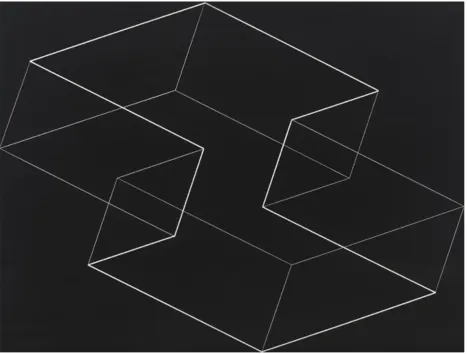
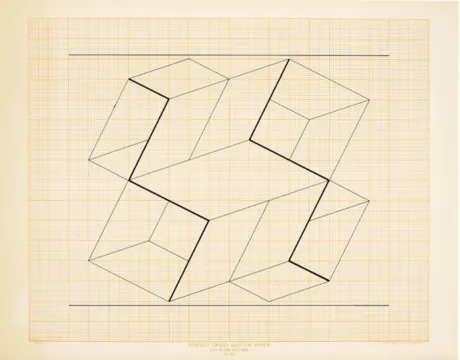
I would also like the radically simplified forms commonly associated with the Bauhaus art
and architecture. The Bauhaus teaching philosophy centered on the study and use of color, light,
texture and materials. Josef Albers (March 19, 1888 – March 25, 1976) a German-born
American artist, Bauhaus teacher, and educator whose work, both in Europe and in the United
States, formed the basis of some of the most influential and far-reaching art education programs
of the twentieth century is one of my inspirations for making my low relief drawings. After
[image:27.612.71.508.70.451.2]moving to the United States, Albers concentrated on several series of works that systematically Figure 3.2 Luisa Lambri, Untitled (The Met Breuer, #06), 2016, color photograph, 35 3/8 x 31
explored the effects of perception. In his series of drawings Structural Constellations (1953–58),
he created complex linear designs, each one subject to many possible spatial interpretations.
[image:28.612.72.539.181.535.2](Figure 3.3 -3.4)
4 THE LANGUAGE OF VISION
The Folded Mystery can be divided mainly into two categories: geometric drawing in space
and sculptural painting and photography installation. Geometric abstraction bears boundless
potential as inspiration for contemporary art practice. My art has been continuously lodging
between 2D and 3D visualization of space utilizing the geometric concepts called line, plane, and
space.
These recent artworks are the study of vision, illusion, multi- perception, and the presence of
the physical body to create dialogue between artwork, viewer and space. Although most of the
artworks are static, they are activated by the mobility of the viewer, using perspective and
illusion to present the moving eye with shifting patterns of colors and forms that ripple, break
and re-form. These series will allow the viewers to have moments of contemplation of
multi-perception through displacement effects.
My dominant materials in the Folded Mystery series are fiberglass screen, reflective sheets,
and holographic foils, and light. I draw geometric forms with utilizing folded fiberglass screen
strips and cut shapes formed with heat press technique. Then I use the fragment of holographic
foils between layers of screens to conjoin into a jaunty form that implies constant changing
The other six sculptural drawings utilizing spray paint on Arche paper, sewing needles and
color threads are the variation of the drawing, in which, I render another view of
[image:37.612.75.431.181.622.2]three-dimensional work by casting the shadow lines. (Figure 4.7- 4.12)
4.1 Unfold the Mystery
My work fuses the heritage of traditional Iranian architectural decoration, and its spiritual
aspects, with the western philosophies of minimalism and abstraction that informed
contemporary artists like Frank Stella and Robert Morris and many non-Western artists as well.
Geometric, pattern-based abstraction has appeared in Islamic art for thousands of years, and a
similar aesthetic boomed in Western art during the 1960s, as geometric minimalism became a
popular art movement.
Monir Shahroudy Farmanfarmaian is a contemporary Iranian artist that my art practice has been
affected by her mesmerizing geometric sculptural works. She is known for transforming Persian
pictorial language into Modernist forms. Through her studies abroad, she began work combining
traditional Iranian techniques with Western geometric abstraction to create unique and culturally
ambiguous paintings and objects. Born in Qazvin, Iran in 1924, Farmanfarmaian studied Iranian
art early in her life until moving to New York in the late 1940s, further studying at Cornell
University, and Parsons School of Design, and the Art Students League. She became an
important fixture of the New York art scene, befriending important painters such as Andy
Warhol, Jackson Pollock, and Joan Mitchell. After a 20-year exile following the Islamic
Revolution, Farmanfarmaian moved back to Iran in 1992, where she currently lives and
continues to produce work. She mostly works with glass, mirror, wood, and metal tessellated
compositions.8 (Figure 4.13)
In both Islamic and Western art, geometric art retains a connection with scientific and
mathematic thought. In Folded Mystery, I applied a Minimalism’s use of prefabricated industrial
materials like fiberglass screen , and repeated geometric forms with the emphasis placed on the
physical space occupied by the artwork. The viewer's presence in the space is also important to
perceive and explore dimensionality and fluidity of the pieces. One of the challenges in my
pieces was scale. In feedbacks from my professors, the common point raised was to play with the
scale of the work. In doing so, there are range of vary scales from small to large scales pieces in
this project. Audiences can explore in terms of having more viewing point access with sculptural
[image:45.612.74.513.317.672.2]painting installation and photo-based installation. (Figure 4.14-4.15)
Viewers also are lead to experience vision and illusion, and even the appearance of light as
a material presence. They are often faced with artworks that are light and space sensitive and
also demanded a physical as well as a visual response. The overlapping geometric forms in my
pieces allow them to inset into the infinite possibilities of geometric forms that I contemplate.
[image:47.612.73.381.183.676.2](Figure 4.16)
For me, it is essential to keep the three elements of space, artwork, and viewer in a shared-
dialogue. I want the work to be seen from different angles, a quite complete vision rather than a
flat surface. (Figure 4.17- 4.18)
5 THE VALUE OF LIGHT
“Light is a very important symbol in spiritual spaces and hidden. God is the light of skies and
earth. Reflection and expression is the essence of God on this earth. Iranian traditional
architecture represents a world of infinite light and divine wisdom and spiritual space.”9
Part of my visual memory shaped in deep, dark spaces of Islamic mosques which are decorated
with light or designed with colorful window glasses which gives me the ability to convey a sense
of spirituality. The result creates some pieces exploring the value of light and shadow based on
the basic elements of architecture and lighting aspects.
5.1 Light in Mosques
“The mosque is looking for inspiration from the general concepts of God, to the spiritual
world and the material world be closer together to create a spiritual space. Since light is a symbol
of the unity of God, the Muslim artist is trying to convey the sense of vibration and interest. In
addition to the spiritual and mystical symbol of light in a mosque, decoration also is considered.
Sometimes the thought is required. Lighting and decoration of mosques, the mind and the
imaginary world and the human leads are brought into the light of the world that is the right
expression. The depth and breadth of vision to understand the meaning and existence finds
meaning to become intuitive. Translucent wall and skylight while deprivation and intimacy
mosque reserves caused by light passing through the colored glass, broken and other raw and not
the outside world which is embedded and eternal bliss. At the same time, the color glass cord to
9 Mohammad Shokrpour, , Ghorban Mahboubi , and Parizad Fakhrian. 2015. "The importance
become light or daylight shining through the transparent colored glass, the richness of your inner
sun throws, as the divine light reflection and refraction when the mirror is smooth, being
appreciated to the discount has resulted. Analysis of the light through the colored glass is a
reminder of the existence of the divine light. The dominant color is the blue stained glass
down and relax sky. There are scenes in the geometric network and are crystallized light
sentence.”10
Glimpsed moments ( Figure 5.1) inspired by Islamic architecture is an attempt to represent
the value of light and the illusion of solid forms dissolving through reflected light resulted from
an interaction between the ambient light and the objects themselves. In other words, the piece
incorporates the light and space of the place.
“The Iranian architectures in the far past paid attention to importance of light in architecture and
had innovation on using clever methods in building. Light has not been used as monotonic, but
using this natural element was very variable. Architecture is a detailed artistic play of a
collection of built material under the light. Our eyes created to see forms under light; these are
shadows and lights that uncover the forms in front of us.”11
10 Ibid, page:1628
6 CONCLUSION
In Folded Mystery, I consider how the act of seeing is neither simple nor straightforward,
can play with viewer's vision disorder through multi-perception in a way to be able to see the
surroundings differently. Taking its cue from John Berger’s 1972 groundbreaking text on visual
culture, Folded Mystery explores the various visualization that aims to reconfigure viewer's
perception of the world. I invite visitors to investigate the manifold ways of seeing by which I
accord forms that are otherwise familiar with renewed appearances. I intend to remind viewers
that the connection between what we see and what we think we know is never that simple and
has multiple layers and sides that needs exploration and cognition. Through this series, I aim to
slow down the process of seeing and at every single moment of displacement viewers examine
what is revealed and what is obscured by the lenses of their own eyes instead of camera lenses
and discover things about the piece, things that they did not see at first glance. It is interesting
that our eyes look like a camera, we look at the things for some seconds and then we are off to
the next one. Bridging a variety of medium from painting, sculpture, textile, photography, and
installation combined with moiré pattern, layered fiberglass screen meshes, and holographic foils
BIBLIOGRAPHY
Bakhtiar, Laleh , and Ardalan Nader. 1973. Sense of Unity; The Sufi Tradition in Persian Architecture. Chicago: University of Chicago Press.
Berger, John. 1990. Ways of Seeing. London: Penguin Books.
Forbes, Rob . 2015. See for Yourself: A Visual Guide to Everyday Beauty. San Francisco: Chronicle Books.
2016. Art in the Twenty-First Century. Directed by Stanley Nelson. Produced by Art21. Performed by Barbara Kasten.
Klein, Alex , Liz Deschenes, Jenni Sorkin, and Jenni Sorkin. 2015. Barbara Kasten: Stages. Pennsylvania: Institute of Contemporary Art University of Pennsylvania.
2010. "Monir Shahroudy Farmanfarmaian." Artnet . June 3. http://www.artnet.com/artists/monir-shahroudy-farmanfarmaian/.
Moore, Jenny . 2012. "Pictures from the moon." New Museum. July 5.
https://www.newmuseum.org/exhibitions/view/pictures-from-the-moon.
shokrpour, Mohammad, Ghorban Mahboubi, and Parizad Fakhrian. 2015. "The importance and beauty of light in mosques," ." Science Journal (CSJ) 36 (4): 26.
Wen , Tiffanie . 2015. "Are you taking too many pictures?" The British Broadcasting