Georgia State University
ScholarWorks @ Georgia State University
Marketing Dissertations Department of Marketing
Summer 7-11-2016
A Road to Engagement
Anita PansariFollow this and additional works at:https://scholarworks.gsu.edu/marketing_diss
This Thesis is brought to you for free and open access by the Department of Marketing at ScholarWorks @ Georgia State University. It has been accepted for inclusion in Marketing Dissertations by an authorized administrator of ScholarWorks @ Georgia State University. For more information, please [email protected].
Recommended Citation
A
A ROAD TO ENGAGEMENT
BY
Anita Pansari
A Dissertation Submitted in Partial Fulfillment of the Requirements for the Degree
Of
Doctor of Philosophy
In the Robinson College of Business
Of
Georgia State University
GEORGIA STATE UNIVERSITY ROBINSON COLLEGE OF BUSINESS
B Copyright by Anita Pansari
C
ACCEPTANCE
This dissertation was prepared under the direction of the Anita Pansari Dissertation Committee. It has been approved and accepted by all members of that committee, and it has been accepted in partial fulfillment of the requirements for the degree of Doctor of Philosophy in Business Administration in the J. Mack Robinson College of Business of Georgia State University.
Richard Phillips, Dean
DISSERTATION COMMITTEE Dr. V. Kumar
D ABSTRACT
A ROAD TO ENGAGEMENT BY
Anita Pansari July 11, 2016
Committee Chair: Dr. V. Kumar Major Academic Unit: Marketing
In Essay 1,we highlight the need and develop a framework for customer engagement (CE). We develop the theory of engagement, arguing that when a relationship is satisfying and has emotional connectedness, the partners become engaged in their concern for each other. Based on the theoretical support, our proposed framework elaborates on the components of CE as well as the antecedents and consequences of CE. We also discuss how convenience, nature of the firm (B2B vs. B2C), type of industry (service vs. product), value of the brand (high vs. low), and level of involvement (high vs. low) moderate the link between satisfaction and direct contribution, and between
emotions and indirect contribution of CE, respectively. We also show how CE can be gained and how firm performance can be maximized by discussing relevant strategies. In Essay 2, we highlight the need and develop a framework for Engagement. We capture the multidimensionality of CE and Employee Engagement (EE), develop and refine items for measuring CE and EE, respectively. Next, we validate the proposed framework with data from 120 companies over two time periods. We develop strategies for firms to improve their levels of CE and EE to improve performance based on the first period measurement. Using the second-period time measurement, we observe that the influence of EE on CE is
E
ACKNOWLEDGEMENTS
I would like to dedicate my dissertation to my father (Late. Sri Muralidhar Pansari), who believed in educating daughters, and in equal opportunities for both his son and
daughters. A man who is instrumental in me being the person I am. He was and will always remain my source of strength and inspiration.
My name appears on the cover of this work, but it is the cumulative work of many people who have contributed to my life and my PhD journey to make this dissertation possible. I owe my gratitude to all who have become a part of my journey.
I would not be able to accomplish this task, without the unwavering support of my family, committee members, advisers, fellow PhD students and friends. I greatly
appreciate their belief and confidence in me. I would like to express my deepest gratitude to my advisor Dr. V. Kumar (VK) who has been influential in molding me as a researcher from the day I met him. I will be forever grateful to VK for taking me under his wing, mentoring and believing in me through my years as a PhD student. He guided me with patience and encouraged me to dive into research problems with no fear. He also
provided me with an excellent atmosphere for doing research and always believed in me. He has truly changed the path of my life by helping me discover my passion for research. I will always look up to him for advice and a source for inspiration as I build my career in this discipline.
I have been very lucky to meet so many fantastic teachers who have helped shape my thinking and eventually, my career path while I was in the program. I thank all the professors who have provided guidance professionally and personally. I would like to extend my appreciation to Dr. Densih Shah and Dr. Jeff Parker for giving me
encouragement and helpful career advice. I also thank my dissertation committee of Dr. Nita Umashankar, Dr. Alok Saboo and Dr. Constantine Katsikeas for their valuable advice and insightful suggestions.
A good support system is really important to survive in the doctoral program. I have met great friends at the Center for Excellence in Brand and Customer Management
(CEBCM), who have become my second family. I have shared both my joys and sorrows so many beautiful and fun moments with my friends: Sarang, Yash, Alan, Amalesh, Hannah, Angie, Brianna, Insu, Kate, Ashley, Hyunseok Song, Ankit, Avi, Baha, Jia, Rachel, Bharath, Jeff, Ericka, Gayatri, and Amber to name a few. Thank you for being a great family. I will miss the time at CEBCM and all of you.
Adenike Brewington and Karen Galanski deserve a special mention for their continuous administrative and technical support. They have been prompt and have always ensured my journey was smooth.
F
believed in me, encouraged me to dream big and always provided unconditional love. Making you proud will always be one of the main drivers in my life. I thank my brothers and sisters, Anil, Jyoti, Aruna, Dinesh, Archana, Tanay, Bhavana and Amit who
supported me and pushed me to do well at every step. I also want to thank my nieces and nephews Poorvi, Jaanvi, Mrinank, Gatik, Tanvi, Aarav, Vansh and Arjun who motivate me to be a better version of myself and a role model for them. I also thank my amazing new parents Prem Gakhar and Nirmal Gakhar for giving me constant love and
encouragement. Finally, I sincerely thank my loving partner, Sudhanshu for encouraging me to pursue my dreams, listen to my ideas, keeping me sane and giving me nothing but support and great food.
G
Table of Contents
List of Figures ... i
List of Tables ... i
Essay 1 Customer Engagement: The Construct, Antecedents, and Consequences ...1
1.1 Introduction ...1
1.2 Motivation ...6
1.2.1 Business Perspective ...6
1.2.2 Academic Perspective ...7
1.3 Tenets of Engagement Theory ...10
1.4 Conceptual Framework ...12
1.4.1 Direct Contribution ...14
1.4.2 Indirect Contribution ...14
1.4.3 Effect of Customer Satisfaction on Direct Contribution...15
1.4.4 Impact of Moderators on the Relationship between Satisfactions and Direct Contribution ...17
1.4.5. Effect Of Emotion On Indirect Contribution ...21
1.4.6. Impact of Moderators on the Relationship between Emotions and Indirect Contribution ...22
1.4.7 Consequences of Customer Engagement ...26
1.5 Managerial Implications ...29
1.6 Conclusion ...34
References ...37
Essay 2- Engagement: A New Source of Competitive Advantage ...51
2.1 Introduction ...51
2.2 Defining Engagement ...52
2.3 Motivation ...54
2.3.1 Literature Review ...54
2.4. Conceptual Framework and Hypothesis Development ...56
2.4.1. Customer Engagement ...56
2.4.2. Employee Engagement ...58
2.5. Effect of Employee Engagement on Consumer Engagement ...59
2.6. Moderators ...60
2.7. Consequences of Engagement ...62
2.7.1. Customer Engagement and Firm Performance ...62
2.7.2. Employee Engagement and Performance ...64
2.7.3. Customer Engagement vs. Employee Engagement ...66
2.8. Research Methodology ...67
2.8.1. Study 1- Customer Engagement ...67
2.8.2. Study 2- Employee Engagement ...69
2.9. Employee Empowerment ...70
2.10. Analysis and Results ...71
2.11. Implementing the Engagement Framework ...72
2.12. Discussion ...80
2.13. Scope for Future Research ...84
i List of Figures
Essay 1 Figures
Figure 1: The Evolution of Customer Management ...49
Figure 2 : Antecedents and Consequences of Customer Engagement ...49
Figure 3: Customer Engagement Matrix ...50
Essay 2 Figures Figure 1: Process of Developing and Implementing the Engagement Framework ...94
Figure 2: Engagement Framework with Moderators ...94
Figure 3 – Linking Engagement to Performance ...95
Figure 4 – Engagement Strategy Matrix ...95
List of Tables Essay 1 Tables Table 1: Constructs Related to Customer Engagement ...45
Table 2: Select Literature Review on Customer Engagement ...46
Table 3: Variables Used In the Conceptual Framework ...47
Essay 2 Tables Table 1: Results of CFA for Customer Engagement ...96
Table 2: Results of CFA for Employee Engagement...98
Table 3: Implementing Engagement Descriptive Measures ...100
1
ESSAY 1- CUSTOMER ENGAGEMENT: THE CONSTRUCT, ANTECEDENTS, AND CONSEQUENCES
1.1 Introduction
Managing customers has evolved over the years, and this is evident from the
metrics used in the different phases of marketing focus (see Figure 1). Until the 1990s,
marketing was focused on customer transactions. The yardsticks used to measure the
impact of these transactions on firm profitability were past customer value,
share-of-wallet, and recency, frequency, and monetary value. The goals of organizations evolved
with time, and this transaction-based perspective slowly evolved into relationship
marketing (Morgan and Hunt 1994; Berry 1995) in the late 1990s and the early 2000s,
where the core objective of firms was to establish positive relationships with customers
and ensure customer satisfaction and loyalty via better products and services. Further,
there is a detailed discussion in the literature of that era (Homburg and Geirging 2001;
Shankar, Smith, and Rangaswamy 2003) on the link between customer satisfaction,
loyalty, and profitability. There have also been discussions on understanding how long a
customer will stay with a firm in a profitable manner by understanding the lifetime value
of the customer (Kumar 2008). However, both managers and academicians understand
that over the course of time, it is not enough to simply satisfy the customer to make
him/her loyal and profitable. Profitable loyalty and satisfaction need to be evolved to a
higher level, a level of desired differentiation and of sustainable competitive advantage.
Therefore, the goal of organizations evolved from relationship marketing to engaging
customers in all possible ways. This led to the rise of the term “engagement” among
marketing academia and practitioners, as shown in Figure 1.
2
Engagement has been discussed with different meanings in various contexts. In
the business world, engagement has been termed as a contract. In management literature,
it has been discussed as an organizational activity with the internal stakeholders. In
marketing, engagement has been discussed as an activity of the customer toward the firm
and is termed as customer engagement (CE) (Kumar et al. 2010; Brodie et al. 2011;
Vivek, Beatty, and Morgan 2012). We suggest that when a relationship is satisfied and has emotional bonding, it then progresses to the stage of “engagement.”
Companies continuously attempt to engage their customers in various ways. Some
companies that have been successful are Dove and Coca-Cola. As of this writing, Dove’s “real beauty sketches” is the most viral advertisement with 114 million total views
(Kolowich 2015). Experts note that the video has reached the status of the most shared
because of the “contents of the video, which elicited the intense emotional responses of
‘warmth, ‘happiness’ and ‘knowledge’ from its target demographic — one of the key
factors behind a video’s sharing success.” Similarly, Coca-Cola’s campaigns across the
world have always been aimed at striking an emotional chord among customers and have
been the center of many conversations among customers for their creative and emotional
content. Coca-Cola’s “Hello Happiness” campaign in Dubai ensured that the customers
were buying their product (to get the cap) and also becoming emotionally connected with
the brand.
Brands like Dove and Coca-Cola have gone the extra mile to create brand-related
conversations and engage their customers in every possible manner. Firms have been
slowly shifting their focus from the objective of “selling” to “emotionally connecting”
3
of profitable loyalty. In other words, a firm’s focus is shifting to personalizing
interactions, delighting its audience, and understanding customers' unique challenges to
make their lives better and involving them as spokespersons of the firm. These examples
highlight how firms are engaging their customers across the world.
Customer engagement (CE) has been discussed in marketing in the recent past
(Brodie et al. 2011; Vivek, Beatty, and Morgan 2012; Kumar et al. 2010) as an outcome measure of the firm’s activities. Similarly, academicians and practitioners have been
discussing a few other customer-centric measures such as customer satisfaction, customer
involvement, customer loyalty, customer trust, customer satisfaction, customer commitment, and customer brand value to evaluate the effectiveness of the firm’s
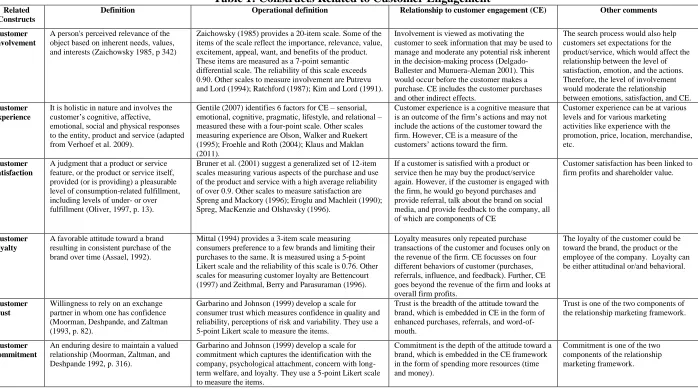
marketing activities. We provide a clear distinction of these variables with CE and also
highlight their relationship with CE in Table 1.
--- Insert Table 1 ---
Table 1 provides the definition of the constructs, the measurements used, and how
each is different from customer engagement. For example, customer involvement is a metric that evaluates “the level of relevance, excitement, value, appeal, wants and
benefits” (Zaichowsky 1985). It has been used to categorize products based on the
customer’s level of involvement. It indicates the customer’s level of motivation to seek
information that may be used to manage and moderate any potential risk inherent in the
decision-making process (Delgado-Ballester and Munuera-Aleman 2001), while CE has
been conceptualized as the different activities of the customer that affect a firm’s
performance (Kumar et al. 2010). These activities include customer purchases,
4
conversations about the brand, and the feedback/suggestions of the customer to the firm
for better performance.
In the literature on CE, Kumar et al.’s (2010) definition and conceptualization
differs from Vivek, Beatty, and Morgan (2012), who look at the intensity of customer
participation with the firm, and that of Brodie et al. (2011), who note that customer
engagement is a psychological state that occurs under a specific context. However, all of
these studies show that CE is a multidimensional concept. A few studies argue that CE is
influenced by various marketing activities and CE itself can influence firm performance.
All the various definitions help us understand that there is a difference in defining and
conceptualizing CE. Therefore, in this paper, we attempt to provide a holistic definition
that encompasses all customer activities. We define CE as the mechanics of a customer’s value addition to the firm, either through direct or/and indirect contribution. This is consistent with the definition of Kumar et al. (2010), where direct contributions consist of
customer purchases, and indirect contributions consist of incentivized referrals that the
customer provides, the social media conversations customers have about the brand, and
the customer feedback/suggestions to the firm.
Recently, Kumar and Pansari (2016) not only provided a conceptual framework
for engagement but also offered an empirical test of the effect of engagement on
performance. Their engagement construct included both customer engagement and
employee engagement. Although their study highlighted linking engagement to
performance, it did not discuss how engagement can be formed or initiated by the firm
5
of customer engagement to enable firms to improve their strategies by focusing on the
complete process of engaging customers.
The psychology literature suggests that engaged partners experience a more
satisfied relationship and a strong emotional connectedness (Kitayama, Markus and
Kurokawa 2000). We adapt this concept to understand how firms can engage their
customers. Therefore, in this study, we develop a conceptual framework of customer
engagement with the help of the academic literature and popular press. Our framework
focusses on the process of customer engagement, by first showing how customer
engagement can be gained, and then linking the direct and indirect contributions of CE on
both tangible and intangible firm performance outcomes. In the framework, we also study
the various factors moderating the link between satisfaction and the direct contribution of
customers as well as between emotions and the indirect contribution of customers. The
moderators are convenience, nature of the firm (B2B vs. B2C), type of industry (service
vs. product), value of the brand (high vs. low), and the level of involvement (high vs.
low).
In the next section, we discuss the motivation for our study, which provides a
review of the relevant academic literature in marketing and the popular press. Then, we
discuss the tenets of the engagement theory and focus on the conceptual framework,
which comprises the components of CE, the moderators, and the consequences of
customer engagement. Next, we discuss the managerial implications and provide
strategies to manage customer engagement. Finally, we highlight the limitations of the
6
1.2 Motivation
1.2.1Business perspective
Customer engagement is the primary focus of many firms. In a study comprising
438 marketing managers,1 63% of marketers defined engagement in terms of sales and
repeat sales, 15% defined it as an impact on revenue by customers, and 22% as love for a
brand. Although there are differences in the definition, more than 80% of marketers
wanted to engage customers in a conversation to build advocacy and trust over the next
three to five years. A study by Gallup highlights the benefits of engaging customers,
noting that customers who are fully engaged represent an average 23% premium in terms of share-of-wallet, profitability, revenue, and relationship growth when compared with
the average customer; an actively disengaged customer represents a 13% discount in those same measures. This highlights the importance of engagement in the marketplace.
This finding is not restricted to any industry but can be generalized across industries, as
seen in the following statistics from various studies by Gallup in 2013.
In the consumer electronics industry, fully-engaged shoppers make 44% more
visits per year to their preferred retailer than the actively disengaged shoppers. On
average, the engaged consumer spends $373 per shopping trip, while actively
disengaged customers spend $289 per trip.
In casual restaurants fully engaged customers make 56% more visits per month
than actively disengaged customers and in fast food restaurants fully engaged
customers make 28% more visits per month than actively disengaged customers.
1
7
In the hospitality sector fully engaged hotel guests spend 46% more per year than
actively disengaged guests.
In the insurance sector fully engaged policy owners purchase 22% more types of
insurance products than actively disengaged policy owners do.
In the retail banking industry, customers who are fully engaged bring 37% more
annual revenue to their primary bank than customers who are actively
disengaged.
1.2.2 Academic perspective
Engaging customers has been discussed extensively in marketing in the last
decade by both academicians and practitioners, although from different perspectives.
Academicians have gone beyond the benefits of relationship marketing such as lower
marketing cost, higher revenue, higher marketing efficiency, and higher marketing
efficiencies (Kumar, Venkatesan and Reinartz 2008). They focus on the activities of the
customer toward the firm.
Vivek, Beatty, and Morgan (2012) state that customer engagement encompasses
all the activities of the customer with the firm, initiated either by the customer or the firm. They define it as “the intensity of an individual’s participation in and connection with an
organization’s offerings or organizational activities, which either the customer or the
organization initiates” (p. 127). Their conceptual framework of CE involves participation
and involvement of current or potential customers as antecedents of CE, while value,
trust, affective commitment, word-of-mouth, loyalty, and brand community involvement
8
elements in their conceptual framework. These authors treat all these components of CE
as consequences of CE and not a part of the CE construct.
Van Doorn et al. (2010) note that CE is a “customer’s behavioral manifestation
towards a brand or firm, beyond purchases, resulting from motivational drivers” (p. 253).
They believe that if a customer’s goals are aligned with the firm’s goals, then CE should have a positive overall impact on the firm; however, if the customer’s and the firm’s
goals are misaligned, CE may have more negative consequences. In other words, a
customer would be engaged with the firm if he/she gets a lower price and derives
maximum benefit, even if the firm is not realizing its potential profit. Hence, their
conceptualization of CE seems to be restricted as they do not consider all the activities in
which customers would participate if they are engaged with the firm. The activities of the
customer can demonstrate the level of engagement with the firm. These activities include
customer purchases, the incentivized referrals of the customer, social media
conversations about the brand, and the customer feedback/suggestions to the firm for
better performance (Kumar 2013).
Table 2 highlights the existing academic literature on customer engagement, the
type of firm where the study was conducted (whether it is a conceptual or empirical
study), and if it was an attitudinal or behavioral study. Although past studies discuss the
concept of CE, none of them highlight the antecedents and consequences of customer
engagement. Thus, from both the business and the academic perspective, studying the
value of engaging customers is powerful for the firm.
9
Reinartz and Kumar (2002) echo the importance of engaging customers by noting that “to identify the true apostles, companies need to judge customers by more than just
their actions” (p. 4). In the last 15 years, marketing academicians have discussed
customer engagement extensively. The focus has been on different aspects like behaviors,
attitudes, and metrics for measuring customer engagement. For example, CE has been
discussed from the perspective of relationship marketing (Bowden 2009),
service-dominant logic (Brodie et al. 2011), customer attitudes toward the brand (Vivek, Beatty,
and Morgan2012), and a customer’s contribution toward the firm (Kumar 2013).
These various conceptualizations highlight the fact that customer engagement is a
multidimensional concept. Academicians also note that customers may be valued
incorrectly (overvalued or undervalued) when all activities of customer engagement are
not taken into account (Kumar et al. 2010), which may result in an inappropriate
allocation of resources (Verhoef, Reinartz, and Krafft 2010). Additionally, firms may
calculate wrong returns on marketing actions (Rust, Lemon, and Zeithaml 2004) if they
do not consider customer engagement, as it affects marketing metrics, which would
subsequently affect firm value (Gupta, Lehmann, and Stuart 2004). Further, practitioners
look at CE through a different lens. They define it as activities that facilitate “repeated
interactions that strengthen the emotional, psychological or physical investment a customer has in a brand” (Sedley 2010, p. 7).
All these discussions confirm that customer engagement affects firm performance
and is therefore important for valuing customers. We believe it is important to understand
10
focusing on the theory of engagement, which forms the basis for building customer
engagement. In the next section, we discuss the tenets of engagement theory.
1.3 Tenets of Engagement Theory
Customer management has evolved from a transaction perspective to relationship
marketing over time, as shown in Figure 1. Firms focused on customer transactions until
the 1990s. The impact of these transactions was measured by the firm’s profitability
through past customer value, share-of-wallet, and recency, frequency, and monetary
value.
The commitment trust theory (Morgan and Hunt 1994) paved the way for
relationship marketing. According to this theory, the core objective of firms is to
establish positive relationships with customers through developing commitment and trust
with the customers. The objective of relationship marketing has been to establish
long-term relationships with the customer (Jackson 1985; Berry and Parasuraman 1991). These
long-term relationships should promote efficiency, productivity, and effectiveness
(Morgan and Hunt 1994) and also be cooperative. The definitions of trust and
commitment have been established in the literature by Morgan and Hunt (1994),
Moorman, Zaltman and Deshpande (1992), and Moorman, Zaltman and Deshpande
(1993). Trust has been defined as “a willingness to rely on an exchange partner in whom
one has confidence" (Moorman, Deshpande, and Zaltman 1993, p. 82), and commitment
has been defined as “an enduring desire to maintain a valued relationship" (Moorman,
Zaltman, and Deshpande 1992, p. 316). Both these constructs focus on the intrinsic
11
Firms in the mid-1990s and early 2000s worked toward earning customers’ trust
and displaying their commitment to the firm. The relationship with the customer had first
been limited to customer purchases. However, the relationship has progressed with
evolving technology, customer needs, and the capabilities of the firm. Now, consumers
have easier access to the firm and a larger platform to voice opinions because of social
media. Firms also have started segmenting and focusing on the needs of consumers by
carefully evaluating their transaction data and improved CRM methods.
Firms now are focusing on the quality of the relationship that they establish with
the customer and also the maximum output beyond purchases, which the customer can
provide to the firm. Customers are also contributing to the firm when they feel connected
to the firm (Kumar 2013). This is one of the components of the interdependence theory
(Thibaut and Kelly 1959), which focusses on the interaction between partners as the
essence of close relationships. The theory notes that during interaction, partners create
products for each other or they communicate with each other (Thibaut and Kelly 1959).
This is becoming evident in the marketplace, where consumers are providing feedback to
the company for the development of new products or improving existing products.
The quality of the relationship between the firm and the customer depends on the
level of satisfaction derived from the relationship and the level of emotional
connectedness of the customer toward this relationship. When a firm achieves trust,
commitment, and a satisfied and emotional relationship with the customer, we can say
that the firm and the customer are engaged with each other. In an engaged partnership
12
other, partners interact more often with each other and also speak highly of their partner
to indicate the level of emotional connectedness.
It is important to understand the theory of engaging customers, as engaging
customers has direct and indirect benefits (Kumar and Pansari 2016, Kumar 2013). We
propose that the two tenets of the engagement theory would be satisfaction and emotion,
since engagement occurs only after a relationship is formed based on trust and
commitment. In other words, the tenets of relationship marketing are subsumed in
engagement theory, as we believe that the process of engaging a customer is logically the
next step after the relationship formation. Further, the theory of engagement need not be
restricted to the relationship between the firm and the customer, as it could be applied to
all the stakeholders of the firm. The objective of every engaged partner is to establish a
long-term association.
We now develop the conceptual framework for CE, using these tenets.
1.4 Conceptual framework
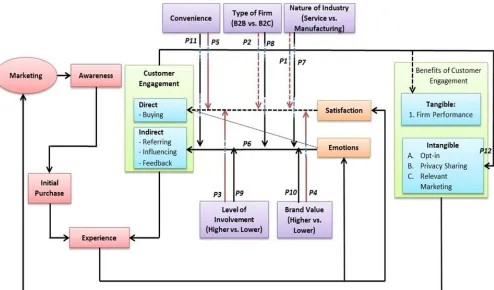
Our proposed conceptual framework, as shown in Figure 2, is organized in the
following manner. First, we discuss the concept of CE and identify the components of CE
(direct and indirect contributions). We then discuss the antecedents (satisfaction and
emotion) of CE and the variables moderating the relationship between satisfaction and
CE, and between emotion and CE. Finally, we discuss the consequences of customer
engagement.
Insert Figure 2
Our framework is applicable to goods and services, which are frequently
13
activities initiated by the firm. These marketing activities could be advertising,
promotional offers, social media campaigns, etc. These activities lead to creating
awareness among customers about the products and services of the company. This
awareness helps customers understand the offerings of the firm and if the firm can fulfill
any of their needs. The customer then makes a purchase from the firm, which creates an
experience. As stated by Carù and Cova (2003), customer experience is not sold by
companies; rather, companies provide artifacts and contexts that are conducive to
experiences, which are used by consumers to co-create their own unique experiences. A
positive/ negative experience would affect the level of satisfaction the customer has
toward the firm and the emotions that he/she has for the company. The expectation is that
satisfaction should lead to repeat purchase. Similarly, a customer who exhibits positive emotions would assist with indirect contribution, such as being an advocate for the firm’s
product and services. The relationship between satisfaction and direct purchases has been
established at the aggregate level in the literature (Anderson 1994).
It is possible that not all customers will exhibit similar associations. Therefore, if
individual-level data is available, accounting for customer heterogeneity is important. In
our framework we study the individual-level relationships between satisfaction and direct
contribution, and between emotions and indirect contribution. Table 3 provides the
definitions and the suggested ways to measure the constructs in our framework.
--- Insert Table 3 ---
Next, we discuss in detail the CE construct, which is the direct and the indirect
contribution of the customers. Our definition of customer engagement focusses on the
14
The direct contribution is in the form of customer purchases and the indirect contribution
is in the form of customer referrals, customer influence, and customer knowledge.
1.4.1 Direct contribution
Customer purchases Customer purchases of products /services contribute directly to firm value (Gupta, Lehmann, and Stuart 2004). Customer purchases help firms allocate
resources efficiently. Firms have gained revenue increases of about $20 million by
reallocating their resources based on customer purchases while maintaining the level of
marketing as is (Kumar 2008). The focus of the firm here is to maximize the profitability
from each customer over a longer term. The metric relevant to this measure is known as
Customer Lifetime Value (CLV).
1.4.2 Indirect contribution
Customer referrals Incentivized referrals are a form of engaging with the customers for both B2C and B2B firms (in the case of B2B, it is denoted as “reference”). Referrals help
in attracting customers who would otherwise not be attracted through traditional
marketing channels (Kumar et al., 2010; Kumar 2013), thus contributing indirectly to
firm performance. Further, referred customers are more profitable than non-referred
customers (Schmitt, Skiera and Bulte 2011). Even in the B2B context, references have
been impactful where selected clients are more beneficial to convert prospects to
profitable customers (Kumar et al. 2013).
Customer influence Social media platforms are being used extensively by customers to exchange brand and product related information in both B2B (Chakravarty et al. 2014)
and B2C firms (Kumar 2013). These platforms have a more direct impact on brand
15
(Trusov et al. 2009). Users can affect others’ activities within their social network; this
effect is termed as “influence” (Trusov et al. 2009). These social media influences create
a ripple effect and extend beyond the close social network of the customer, which in turn
creates a chain reaction across a wide group of customers (Hogan, Lemon, and Libai
2003) and indirectly impacts the firm’s profits (Kumar 2013; Lee and Grewal 2004). Not
every customer can influence others. Therefore, identifying the drivers of influential
behavior in a social network (Kumar et al. 2013) is important for firms to maximize the
benefits of their social media strategy.
Customer knowledge Customer knowledge/feedback is derived when a current customer is actively involved in improving a company’s products/services by providing feedback
or suggestions. Customers add value to the company by helping firms understand
customer preferences and by participating in the knowledge development process (Joshi
and Sharma 2004). Firms could use this knowledge to improve their products and
services and/or create new products (Kumar and Bhagwat 2010) and impact firm
performance indirectly.
1.4.3 Effect of customer satisfaction on direct contribution
Customer satisfaction is an essential indicator of a company’s past, current, and
future performance and has therefore been the focus among marketing practitioners and
scholars (Oliver 1999). The key concept of customer satisfaction is based on expectancy–
disconfirmation theory (Lewin 1938). The expectancy–disconfirmation model asserts that
if the perceived performance exceeds consumer expectations (a positive disconfirmation),
16
a customer’s expectations, (a negative disconfirmation) then he/she will be dissatisfied
(Churchill & Surprenant 1982).
Both practitioners and academics have accepted the premise that customer
satisfaction results in customer behavior patterns that positively affect business results
(Vavra 1997). It has been regarded as a fundamental determinant of long-term consumer
behavior (Oliver 1980; Yi 1990). Research has found that customer satisfaction has a
measurable impact on purchase intentions (Bolton and Drew 1991), on customer
retention (Mittal and Kamakura 2001), and on financial performance (Anderson, Fornell
and Lehmann 1994; Keiningham et al. 1999). All the studies that have established the
relationship between satisfaction and firm performance have done the same at the
aggregate level. This relationship should be positive even at the individual level. This is
because if a customer is satisfied, this would reflect in his/her behavior toward the firm
(Kumar et al. 2014). One manifestation of a positive behavior would be customer
repurchase. Hence, we propose that:
P1: There is a positive relationship between customer satisfaction and that customer’s
direct contribution.
The relationship between satisfaction and performance would be enhanced in various
contexts depending on the nature of industry (service vs product), kind of firm (B2B vs.
B2C), level of product involvement (high vs. low), brand value of the firm (high vs. low),
and level of convenience. Therefore, we study the moderating impact of all these
variables on the relationship between satisfaction and direct contribution (purchases) and
17
1.4.4 Impact of moderators on the relationship between satisfaction and direct contribution
Service vs. product Customer satisfaction affects firm performance in all industries.
Products have higher perceived quality, expectations, and customer satisfaction, but
lower repurchase likelihood, relative to services (Anderson 1994). However, we propose
the opposite and note that the effect between satisfaction and purchases would be
enhanced in the service industry. In this study, we consider products and service in the same continuum, as two different industries. While availing a service, if the customer’s
expectations are not met, the customer can complain to a service personnel and the issue
can be dealt with immediately. The process of service recovery is faster. However, when a customer’s expectations are not met for a product, the chance of recovery is low, as
most products are standardized. The customer’s complaint or feedback can be used to
improve the existing product, but the customer can access the new product only in the
next production cycle. Further, sometimes the product cannot be altered/fixed according to the customer’s needs. This may lead to disconfirmation of expectation of the
consumer, if it concerns the features of the product. This would also impact the repeat
buying behavior of the consumer. Therefore we propose that:
P2:The impact of satisfaction on direct contribution will be enhanced in the service (vs.
products) industry.
B2B vs. B2C firms In a B2B setting, firms focus more on the functional aspect of the product/service being sold as compared to a B2C setting. In a B2B setting, decisions are
generally made by a team, and the decision-making team may not be the same team that
18
distinct individuals/teams. Therefore, it is necessary that both the user and the buyer are
satisfied with the product or service, which is offered. If all the units in a B2B firm are
satisfied, the consequence of a satisfied client can go a long way. In other words, the
decisions in a B2B sector are made based on the combined satisfaction of many groups as
well as the quality of the product, which may not hold true in a B2C setting. Therefore,
we propose:
P3: The impact of satisfaction on direct contribution of the consumer will be enhanced
for a
B2B firm (vs. B2C firm)
Level of involvement Low involvement products tend to be products bought more often, as a routinized response behavior or as a habit (Kumar, Ghosh and Tellis 1992). Research
shows that a higher frequency of usage and accumulated experience influences customer
satisfaction (Anderson 1994). This indicates that customers have relatively accurate
priors and understand the products that match their preferences. Consequently, their level
of disconfirmation would be lower (Anderson and Sullivan 1993). However, when
consumers buy products with high level of involvement, their expectations increase and
repurchase intentions are lower and more sensitive to satisfaction (Anderson 1994).
Further, in high involvement products, since the customer invests time and resources in
understanding all the details about the product, he/she is more likely to notice "things
gone right or wrong" (Anderson 1994). Additionally, low involvement products are
repeatedly purchased, like CPG goods (e.g., salt, sugar, shampoo), and high involvement
products (e.g., durables, cars, homes, education) are infrequently purchased. Therefore
19
P4: The impact of satisfaction on direct contribution of the customer will be enhanced for
products with low involvement.
Level of brand value Consumers use brands for creating individual identity, a sense of achievement and individuality for consumers (O’cass and Frost 2002). Brands create
value for the consumer by creating positive feelings, aiding self-expression, and
providing an overall feeling of having personal “good taste” in brand choice (Langer
1997). These expressions are more evident for brands with high value or for status
brands. The value of the brand can be defined in terms of brand equity. Brand equity is
the value that accrues to a product with its brand name compared to the value that would
accrue if the same product did not have the brand name (Keller 2003). The higher the
brand equity, the more value the brand possesses and the more positive beliefs consumers
have about the brand (Pitta and Katsanis 1995).
Many consumers buy high value brands as a status symbol or because of social
pressure. The expectation of quality for products of a high value brand is high; hence, the
chances of disconfirmation are also high. Further, satisfaction is relatively more sensitive
to perceived quality with ease of evaluating quality (Anderson 1994). Therefore, when
consumers buy products with lower brand equity, their level of expectations from the
brand is low, and hence the chances of disconfirmation are also low. Therefore, their
level of satisfaction will be high, which will induce repurchase behavior. Hence, we
propose that:
P5: The impact of satisfaction on direct contribution of the customer will be enhanced for
a firm with low brand value.
20
product, rather than being a characteristic or attribute of a product (Brown 1990). When
consumers think of convenience, they focus on resources such as time, opportunity, and
energy that they use to buy goods and services. Convenience in manufactured goods
includes product size, preservability, packaging, and design, which can reduce
consumers' time and effort in purchasing, storage, and use (Anderson and Shugan 1991).
In the service industry, convenience is associated with reduced time or effort in shopping
and could be presented in the form of extended operating hours or credit availability.
Location is both a service and product convenience.
Convenience reduces the nonmonetary price of a product (Etgar 1978). There is a
demand for convenience in the current market scenario, which could be attributed to
socioeconomic changes, technological progress, more competitive business
environments, and opportunity costs that have risen with rise in consumer incomes
(Seiders, Berry, and Gresham 2000). Many firms are devoting more resources to
providing convenience as part of a strategic shift to more effective customer
management. Offering online shopping with in-store pick-up and/or returns through
expedited shipping, saving customer details in online databases, and providing
personalized buying suggestions are some of the actions firms take to ensure increased
customer convenience. The level of satisfaction to direct contribution will be enhanced if
the level of convenience for both ease of use and the availability of the product is high, as
this will ensure that the consumer may repurchase the product. For example, if you are
trying to buy a product that is never available in your local grocery store and if you have
21
Similarly, you would also find a replacement for products that are difficult to use because
of the type of packaging. Therefore, we propose that:
P6: The impact of satisfaction on direct contributions of the customer is enhanced by the
level of convenience that the firm provides to its customers.
1.4.5 Effect of emotion on indirect contribution
Emotions have been classified as positive or negative (Watson, Clark, and
Tellegen 1988). Positive emotion is an “energized and alert state of mind," and negative
emotion is a state of "distress or aversive moods" (Watson, Clark, and Tellegen 1988).
Some positive emotions are enthusiasm, laughter, empathy, action, and curiosity;
negative emotions include grief, fear, hatred, shame, blame, regret, resentment, anger,
and hostility. Understanding the emotions of consumers is important as emotions affect
decision making, and the positive or negative outcome of a decision can profoundly
affect the decision maker’s feelings (Schwarz 2000).
Emotions, a key affect component, are known to be associated with intense states
of arousal that lead to focused attention on specific targets and may therefore impact
ongoing behavior. Allen et al. (1992) have demonstrated that emotions act as a better
predictor of behavior than do cognitive evaluations. While behavior can include
purchases, it is more often word-of-mouth and feedback that is influenced by emotions
since the customer feels part of the firm. Purchase behavior is predominantly influenced
by satisfaction and only to a small extent by emotions given the utility derived from
consumption has to be maximized. Thus, the dotted line in Figure 2 shows a weak
22
Both the Theory of Reasoned Action (Engel, Blackwell, and Miniard 1995) and
the “hierarchy of effects” models of consumer behavior (Lavidge and Steiner 1961) note
that consumer emotions are a precursor to action. If brand managers win the hearts and
minds of customers, then it is easier to retain and acquire customers. As mentioned
earlier, customer contributions are not restricted only to customer repurchases as they
also comprise referrals, social media interactions, and feedback to the company (Kumar
2013). Individuals who have positive emotions evaluate products more positively than
individuals who have neutral or negative emotions (Isen and Means 1982); hence, their
actions towards the brand would also be positive. Customers who are emotionally
attached to the brand will treat the brand as their own and discuss the brand in online and
offline conversations (Fedorikhin, Park, Thomson, 2008), may provide feedback about
the brand (Nyer 1997 and Ladhari, 2007), and may even refer the brand to their friends
and relatives (Baumeister et al., 2007). Therefore, we propose that:
P7: The higher the level of positive emotions of the customer towards the brand, the
higher will be the indirect contribution of the customer.
1.4.6 Impact of moderators on the relationship between emotions and indirect contribution
Service vs. product: The effect of emotions on customer contributions may be evident in all customer transactions across industries. However, the magnitude of this relationship is
higher in some scenarios. In the service sector where customers contribute to service
quality through their roles as co-producers of the firm's service and knowledge
23
the customer. Bettencourt and Brown (1997) note that in the service industry the contact
employees can induce positive emotional responses by spontaneous exceptional service
during the service encounter.
Firms in the service industry are also aware of the same and hence focus not only
on offering the best deals but also on building relationships with the customer. Wells
Fargo is an example, given its focus on relationship banking. Further, in the service
industry there is heterogeneity in every transaction based on the customer’s emotions, as
the service provider interacts with the customer based on his/her needs, attitudes, and
emotions. Additionally, customers more often discuss their service experiences than their
product usage experiences (Perry and Hamm 1969). A positive service interaction will
make the consumer refer the brand to his friends and relatives and also provide feedback
to the company. Therefore, we propose that:
P8: The impact of emotions on indirect contributions of the customer will be enhanced in
the service industry.
B2B vs. B2C firms Brands use emotional advertisements to connect with customers in the B2C environment (Morrison and Crane 2007). Consumers primarily use emotions
(personal feelings and experiences) rather than information (brand attributes, features,
and facts) to evaluate brands (Murray 2013). In a B2B firm, the user and the decision
maker may be two different individuals. The user may not have all the details (price,
delivery, etc.) about the product to recommend or refer the product, and the decision
maker may not be able to comment on the functionality of the product. Moreover, in a
B2B environment, even if the user is emotionally connected with the brand, the level of
24
Further, in a B2B setting, it is difficult to exhibit and communicate emotions.
However, this is not the case in the B2C sector. In the B2C sector, emotions play an
important role, as consumer actions are based on emotions. If a consumer is emotionally
attached to the product, then there is a likelihood that he/she will recommend the product
to his/her friends and family, provide feedback as he/she would want the product to be
the best, and participate in the discussions about the product on social media. Hence, we
propose that:
P9: The impact of emotions on indirect contribution of the customer will be enhanced for
a B2C firm (vs. B2B firm).
Level of involvement: High involvement products/services require more information because of the importance of the products/services and the thought process related to it
(Zaichkowsky 1987). Involvement leads to higher motivation, heightened arousal, and
increased cognitive elaborations (Mano and Oliver 1993). This indicates that high levels
of involvement strengthen the experience of emotions, in general. However, lower
involvement products require minimal thought, and there is a tendency among customers
to form a buying habit (Shah, Kumar and Kim 2014) with these products (Vaughn 1980).
Studies in the psychology literature note that repeated actions have reduced emotional
intensity (Wood, Quinn, and Kashy 2002). The Theory of Mind and Emotion
(Mandler1975) discusses that emotions arise when there is an interruption of one’s
organized behavior sequence, which generates emotions. Since infrequently performed
behaviors (e.g., high involvement products) and behaviors in unstable contexts are
25
encounter difficulties and interference, no habitual behaviors are more likely to be
associated with emotions. Further, when consumers buy high involvement products they
like sharing their experience and inform their network about their purchase. They would
also like to provide feedback to the company, as they extensively research the product.
Since they have gathered extensive knowledge about the product, (Suh and Yi 2006) they
may refer the product to their friends and relatives. Therefore, we propose that:
P10: The impact of emotions on indirect contributions of customers will be enhanced for
a higher involvement product/service.
Level of brand value: Great brands establish a lasting emotional connection with the target audience. They reach beyond the purely rational and economic level to arouse
feelings of closeness, affection, and trust (Berry 2000). Since emotions influence
customer decisions, brands have to transcend specific product features and benefits and penetrate people’s emotions (Webber 1997). Brands that make the customer “happy”,
“joyful” or “affectionate” cause a stronger attitudinal commitment and purchase loyalty
(Matzler et al. 2006).
Further, many high brand value products are bought by consumers as they have a
status and prestige attached to them and customers like displaying these products
(Ordabayeva and Chandon, 2011).Therefore, the higher the brand equity/value of the
firm, the higher will be the indirect contribution (referrals, feedback to the company, and
discussion on social media) of the consumers. Further, consumers have higher
expectations of brands that have higher brand equity (Pitta and Katsanis 1995).
26
disappoint, the magnitude of the negative effect would be higher as compared to brands
with lower brand equity. Therefore, we propose that:
P11: The impact of emotions on indirect contribution of the consumer will be enhanced
for a firm with higher brand value.
Convenience influences customer evaluation and purchase behavior (Seiders et al. 2005). Ensuring customer loyalty is not sufficient; however, it is necessary for maintaining
positive customer relationships (Keaveney 1995). Since convenience conserves time and
effort, it provides consumers more opportunities to fulfill their intent. The intent of a
customer with the firm goes beyond purchases as discussed in the customer engagement
concept (Kumar 2013). Only if it is convenient for the customers to interact with the firm
across all possible touch points would they be willing to provide any references and/or
feedback and to promote the firm on various social media platforms. Therefore, we
propose that:
P12: The impact of emotions on indirect contributions of the customer is enhanced by the
higher level of convenience that the firm provides to its customers.
1.4.7 Consequences of customer engagement
The contributions (both direct and indirect) of customers can have tangible
(direct) and intangible (indirect) benefits to the firm. The tangible benefits can be seen in
the form of firm performance (higher profits, revenue, or market share). Customer
repurchases directly impact firm performance (Kumar 2013). However, customer
discussions about the brand on social media create a ripple effect to a wide group of
27
experience the company’s product/services. This would indirectly impact firm
performance, as has been demonstrated in the literature by Kumar (2013). The feedback
that consumers provide may help firms either improve their product/service and/or
generate new ideas for new product development (Kumar and Bhagwat 2010). Both of
these activities would help firms improve their performance, as they would have a better
product/service or a more developed new product. The relationship between customer
engagement and tangible firm performance has been established by Kumar and Pansari
(2016). Further, the link between Customer Lifetime Value (CLV) and firm valuation has
also been well established in the literature (Kumar and Shah 2009). Therefore, we are not
offering a proposition on the relationship between CLV (purchases) and firm
performance.
Some of the intangible benefits of customer engagement are in the form of
permission marketing, privacy sharing, and the ability to make marketing messages more
relevant.When companies seek their customers’ permission to send them marketing
messages, it is known as permission marketing (Godin 1999). Permission marketing
creates a channel for two-way interaction and customer engagement, which is considered
crucial for firm value creation. Permission marketing can be in the form of customers signing up to receive the firm’s marketing contents (opt in); opt out is when the firm
sends the customer marketing contents and the customer has the ability to decline this
interaction. If the customer is emotionally connected to the company, the customer may
enthusiastically interact with firms by joining their e-mail programs voluntarily,
proactively downloading their mobile applications, and following their social media
28
and his/her chances of opting out will be lower. This will also result in increased actions
by the customer (Kumar, Zhang, and Luo 2014).
Another intangible benefit that the firm gets from highly engaged customers is the
heightened trust that they have in the firms, and hence a willingness to provide the firm
with more information about themselves. This could be in the form of allowing access to
their social media pages, or by giving firms permission to use their information. This
information can then be used by firms to better understand its customers and engage with
them accordingly.
It is a challenge to determine what the customer wants. Many firms tend to offer
all customers every product/service that they have, irrespective of the customers’ actual
specific wants, needs, and preferences. However, this may annoy some customers, and
the firm could lose potential customers and the ROI from the marketing investment to
these customers (Kumar, Venkatesan, and Reinartz 2006). Therefore, it is important for
firms to understand the specific needs of each of their customer segments. By examining
privacy preferences and the number of marketing communications that the customer has
opted in/out, the firm can gauge whether the consumer prefers little or regular marketing
communication. Such individual-level assessments would help a firm personalize its
marketing program and send selective but highly targeted and relevant communication to
customers who prefer them. This would help the firm in maximizing its ROI. But the firm
would have easy access to such individual-level information only if the customer is
engaged with the firm (emotionally and behaviorally). Therefore, we propose:
P13: The higher the customer’s engagement (direct and indirect contribution), the higher
29
firm access to his/her personal information, and (c) enable the firm to provide relevant
marketing communication.
1.5 Managerial implications
Given that satisfaction positively influences direct contribution, and emotions influence
the indirect contributions of customers, companies have to find ways to manage both
satisfaction and emotion in a positive way to maximize both the direct and indirect
contribution. This section focuses on the managerial implications derived from our
conceptualization of the components of customer engagement and its antecedents and
consequences.
Customer engagement matrix
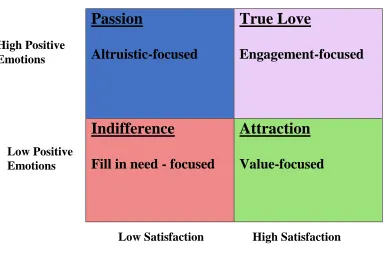
We suggest a set of strategies in the form of a 2X2 matrix as shown in Figure 3
for managing both satisfaction and emotion. The intensity of emotions can be low or
high, and the level of satisfaction can also be low or high. We name each of the four cells
as follows: True Love (high emotion–high satisfaction), Attraction (low emotion–high
satisfaction), Passion (high emotion–low satisfaction) and Indifference (low emotion–low
satisfaction). Next, we discuss the specific strategies to effectively manage each of these
four cells.
--- Insert Figure 3 here ---
Indifference: When customers exhibit a lower state of emotions and satisfaction, which suggests an overall neutral disposition toward a firm, we categorize these customers as
indifferent. In this stage, the consumer has low positive emotions and low levels of
satisfaction. The customer interacts with the firm only if the firm can fulfill a current
30
“fill in need” customers. This indifference could be the result of various factors. First, the
need for the product/service could be low. Second, the size of the wallet could be low,
resulting in the customer not being able to afford the product/service. Third, the
product/service could be used due to convenience, and therefore no emotion and/or
satisfaction is realized. Once the firm understands why the customer is indifferent, it can
create strategies to find a way to be relevant to indifferent customers and convert them.
However, the long-term strategy is to convert these customers to transact more, form a
strong relationship, and become more engaged.
Passion: For certain product categories, customers have high positive emotions toward the firm, but low levels of satisfaction, for example, with a sports franchise. Attending
only one game in a season for a sports team is enough to exhibit the emotion, but it may
not result in a satisfied outcome. However, the yearning to go to more games may keep the fan’s satisfaction checked. We call such customers “altruistic focused,” since they
are not satisfied but still have high positive emotions toward the firm. The low levels of
satisfaction could also be due to the disconfirmation in expectations of the customer. If
the level of satisfaction is low due to poor service, low quality of product, or unmet
expectations of the customer, then a good strategy is to use the emotional connection of
the customer to attract other fans to the sports game. The objective here is to maintain the
high emotional attachment and hope to improve the level of satisfaction by providing
better experience. Among the customers in the passion segment, the customers who are
most likely to be responsive to a better customer experience can be profiled and recruited
31
Attraction: In some product categories, customers buy products/services from the firm and are satisfied with the firm, but have low positive emotions toward the firm. These customers are “value focused.” Examples of such behavior include a customer choosing
an airline solely owing to the presence of a hub, or transacting with a bank’s ATM due to
the convenience of its location. A firm could be content with realizing higher revenues
from this group of satisfied customers, as they would contribute directly to the firm’s
profit through purchases. However, for a long-term relationship and accruing the benefits of the customer’s indirect contribution, the firm should try to create a deeper and more
emotional connection with such customers by duly identifying/recognizing the high
fliers, surprising them with gifts/coupons, and/or inviting them for special events such as
sports games or movie openings from time to time. The objective of the firm’s strategy is
to provide maximum value to the customer, such that he/she displays a high positive
emotion toward the brand. This would help the firm to move the customer from the
attraction segment to the true love segment.
True love: In these cases, customers have already been won over by the firm. They are highly satisfied and have high positive emotions with the firm. This is the ideal stage in
which a firm would want all of its customers to be. The goal of the firm in this stage
should be to keep increasing the emotional connection and sustain the high level of
satisfaction of these customers. Hence the customers are “engagement focused.” The
strategy in this stage focusses on ensuring maximum levels of engagement. Firms
typically try to increase the size of this segment over time as it enables profit
maximization through both direct and indirect contribution. These customers are also
32
the customers experience/perceive. Only an innovation that is purely disruptive in nature
can be a significant force in luring such customers. For example, the presence of Uber
has successfully dethroned local cab companies given the large value difference. For
Uber customers, periodic communication and interactions to let them know how much
they are valued and also rewarding them with surprise gifts or invitations will go a long
way in retaining them.
Influencing direct contribution
Once the firm manages the level of satisfaction and emotions of its customers, it can have
a positive impact on the direct and indirect contributions of its customers. The question
that still remains is in what ways a firm can extract more value from a satisfied and an
emotionally connected customer.
Buying: Direct contribution is measured in the form of purchases. Past studies have identified over a dozen ways of influencing buying behavior due to being satisfied. These
strategies are termed as the “Wheel of Fortune strategies” by Kumar (2008). Each of
these strategies has been implemented in various firms generating an ROI of over 8 to 10
times. Examples of these strategies include optimizing the marketing resource allocation,
pitching the right product to the right customer at the right time, and inducing
multichannel shopping.
Influencing indirect contribution
An emotionally connected customer can be a significant force in generating
33
Referring: Referrals can be influenced by targeting the medium CLV customers and providing them with incentives that are both transaction based and milestone based in a
B2C setting (Kumar et al. 2010). In a B2B context, Kumar et al. (2013) illustrate the need
for creating client references that have a longer tenure of buying, higher revenues, and a
larger number of employees. They suggest that a reference will be most effective when it
is presented as a video, has product, role, and industry congruence. Firms implementing
the suggested strategies have shown profit gains of 30% to 50%. In a B2C context,
customers who have longer tenure and medium profits are more effective in bringing
profitable prospects.
Social media influencing: In order to identify the influencers in social media, many metrics have been proposed. One of the metrics is the Klout score, which ranges from 1
to 100 and provides a general score of how many other people an individual can
influence on social media. It is not based on a particular product category or service but is
based on the complete social media usage of the individual. Kumar et al. (2013) further
build upon the Klout score metric to offer a dollar metric by identifying influencers in
social media for each category using eight drivers such as activeness, generosity,
reciprocity, and like-mindedness. They term this dollar metric as Customer Influence
Value (CIV). One of the biggest benefits of identifying influencers using CIV is that for
firms implementing a social media marketing campaign, not only is awareness created
but there also is a conversion to sales. For instance, when Kumar et al. (2013)
implemented this CIV-based influence marketing strategy for an ice cream retailer,
34
ROI by 83%. Thus, the use of the eight critical drivers to influence the message spread
and conversion to sales is a fruitful strategy.
Feedback: Customers should be encouraged to provide feedback by almost all service providers and in many situations by product manufacturers also. For example, in the
introduction of Hover boards during the 2015 holiday season there was a furor over the
explosion of some Hover boards as well as users falling over due to not being able to
balance. The transportation of this toy has also been banned by many airlines. Therefore,
it is expected that the Hover board manufacturer will recall the product and release it
after addressing the issues that have been raised by customers who have had first-hand
experiences with the product.
Many companies have idea forums for customer feedback. For instance, Delta has
created Ideas in Flight, Dell has created Idea Storm, BMW has created Innovation Lab, and Best Buy has created the Blue Label Strategy to collect new product/service ideas from the customer base in the form of feedback. Taking this a step further, companies are
now incentivizing such feedback in tangible ways. Microsoft, for instance, shares
revenues with the provider of the ideas, and IBM provides customers royalty when
using/implementing software created by them.
1.6 Conclusion
Overall, firms have to learn the art and the science of managing customers to engage
them in a profitable and sustainable manner if they have a satisfied and emotionally
connected set of customers. The objective of this study is to offer a conceptual
framework for customer engagement. To do so, we not only review the relevant academic