Differential Biomass Allocation to Above-Ground Plant
Components by Two Invasive
Sida
Congeners in a Dry
Tropical Peri-Urban Vegetation in India
Shilpy Singhal and Rup Narayan
Department of Botany, I. P. (Post-Graduate) College, Bulandshahr-203001, UP, INDIA
Abstract- Differing biomass allocation strategy could be a
necessary plant-trait associated with invasive weeds in an alien environment. The present study focused on exploring differential biomass allocation pattern as an invasive plant-trait in the two pantropical invasive malvaceous weeds Sida acuta Burm f. and Sida cordifolia L. in an anthropic peri-urban vegetation in Indian dry tropics. Eighty plant individuals from each of these two congeners across their varying developmental stages were clipped off from their dominantly growing study site at the polluted bank of Kali river in Bulandshahr (28º04’ & 28º43’ N lat. and 77º08’ & 78º28’ E long.) in the national capital region of India. The plant individuals were separated into different above-ground plant components (leaf, stem-axis, branch and reproductive parts that included flowers/capsules/seeds). They were oven-dried, weighed and the mass fractions of each component estimated as its dry weight relative to total above-ground plant biomass. In the weedy and ruderal vegetation here, these two congeners with > 47 g m-2 above-ground biomass and about 25% importance value index, showed striking difference in their biomass allocation strategy. S. acuta had significantly higher leaf and branch mass fractions, reflective of its profuse branching habit and differentially higher biomass investment for photosynthetic function. In contrast, S. cordifolia had significantly larger reproductive mass fraction (for increased colonizability) and stem-axis biomass. The overall stem biomass was comparable, indicative of common perennial tendency for firm establishment in the alien environment. With increasing plant size, both the congeners showed a similar trend of decreasing leaf mass fraction and increasing mass fractions of support and reproductive structures. Biomass allocation was significantly influenced by species, growth phase (reproductive/vegetative) and ontogeny. Thus, the present study indicated a strategic differing pattern of biomass allocation to different plant components by the congeners S. acuta and S. cordifolia which could be attributed to their invasibility in dry tropical environments.
Index Terms- Sida acuta, Sida cordifolia, invasiveness,
plant-traits, species diversity
I. INTRODUCTION
lien plant invasions have become a serious environmental problem and have posed a grave threat to native biodiversity all over the earth ecosystem [1]. The anthropogenic interventions in tropics, as a result of increasing human
population and improved trans-continental transport, can be considered to have significantly contributed to the increasing pressure of the invasive species here. The peri-urban vegetation in Indian dry tropics has been reported to be infested with a considerable number of alien plant species [2, 3]. Commonly, these invasive alien plants grew aggressively and formed monocultures e.g. Parthenium hysterophorus, Ageratun conyzoides [4, 5] by outcompeting native plants. Such invasive alien species are well known for their ability to alter species composition, structure and function of invaded ecosystems, and have caused huge environmental damage and economic loss worldwide [6]. Identifying the factors and plant traits that contributes to the success of invasive plants is very important for predicting and controlling potentially invasive plants, and it becomes further important in the light of the fact that the mechanisms underlying invasiveness are still not well elucidated [7-9].
The ability to differentially allocate biomass to its different organs has been attributed to the considerable success of invasive plants in dry tropics [10]. Some workers have reported that successful invasive species allocated more biomass to leaves and less to roots than native species [11, 12]. This pattern of biomass allocation may promote irradiance capture, which may not be a growth deterrent under dry tropical conditions, but, it may impair water and nutrient absorptions, indicating that invasions may be environment dependent. Thus, environmental conditions must be taken into consideration while identifying the traits contributing to invasiveness. It has been suggested that successful invasive species must either use limiting resources more efficiently than native species or use them selectively at times when they are unavailable to the latter, provided life history traits are similar between invasive and native species [13]. In addition, phylogenetic relatedness of invasive and similarity of ecological conditions should also be taken into account and the comparisons of traits across these could be a powerful approach to evaluate the invasiveness of alien plants [7, 8, 14].
ISSN 2250-3153
America but has spread throughout the tropics and subtropics [17]. Sida cordifolia L. is commonly known as Indian ephedra because of the presence of alkaloid ephedrine. This plant is native of tropical and subtropical part of Africa, Australia, China, Nepal, Sri Lanka, Bhutan and Pakistan [18]. While S. acuta is considered as an exotic invasive weed in India [19-21], S. cordifolia is a naturalized/invasive weed here [19].
The major objective of this work was to investigate: (i) the structure of Sida-infested vegetation in a dry tropical peri-urban anthropo-ecosystem, and (ii) variation of morphological traits and allocation of biomass to different above-ground components in the congeners Sida acuta and Sida cordifolia at a site.
II. MATERIAL AND METHODS Study area
The present study area was Bulandshahr (28º04’ & 28º43’ N lat. and 77º08’ & 78º28’ E long.) located at distance of 72 km from Delhi in the western part of Uttar Pradesh, 237.44 m above sea level. The district of Bulandshahr lies between Ganga and Yamuna rivers. It is about 84 km in length and 62 km in breadth. The district is known as ‘milk belt’ of UP. The soil of the district includes broad belt of excellent alluvial soils formed from depositions by the Ganga and Yammuna river. The Bulandshahr city shares common boundaries with Meerut, Ghaziabad, Gautam Budh Nagar (Noida) and Aligarh city on its various sides. The Ganga separates it from Moradabad and Badaun city and Yamuna separates the city from Haryana state and Delhi. The vegetation here mainly comprised of mosaic of annual weeds and ruderals. Several exotic weeds intruded in this area included Sida and its congeners. Bank of polluted Kali (black) river (KRB) was selected that witnessed abundant growth of Sida acuta and Sida cordifolia. This river originates in Muzaffarnagar and after a long journey merges with Ganga in Farukhabad district. This KRB site witnessed the intensive dumping of urban and sewage wastes. Agricultural fields, however, lay along its banks in the adjoining areas. A stretch of 2 km along the bank of the Kali river was selected for intensive sampling in this study. The climate of the study area has three major seasons: rainy (Jul-Oct), winter (Nov-Feb) and summer (Mar-Jun). The mean maximum and minimum temperature was in the month of June (41.5 ºC) and January (8.0 ºC) respectively. Annual mean rainfall was 642.3 mm received mostly during monsoon (Jul-Oct).
Plant sampling
The phytosociological data analysis of the study site was done through a total of 50 randomly laid quadrats (each 25 × 25 cm) across the bank of Kali river. For density estimation of grasses, every emergent tiller was considered as one individual. Above-ground biomass ( B) was estimated through ground le el har esting. The abo eground tissues were considered to be within the uadrat if their roots lay in the uadrat. n the laboratory the plant samples were washed dried at 0-80 for 36-48 hrs and weighed. The above-ground biomass of species was used as a dominance measure. Importance value index (IVI) of each species was calculated according to Curtis and McIntosh [22] and relative importance value index (RIVI) as IVI/3 according to Risser and Rice [23].
Species diversity
Species IVI was plotted against species rank (highest to lowest) [24] for the study of the dominance diversity structure of the vegetation under study.
α di ersity of the egetation (species count Shannon-index, Simpson index) was estimated according to Magurran [25] and Gupta and Narayan [26]. β di ersity was estimated by di iding the total number of species at the site by the average number per sample [27].
Biomass sampling of Sida congeners
Eighty individuals of each of the two species Sida acuta and Sida cordifolia were randomly selected from the study site (KRB). The plant individuals were picked at varying stages of their growth. The selected individuals were cautiously clipped off from the plant base. Shoot length (SL) of the fresh individuals was measured from the top to bottom of the plant at the study site. Basal diameter of all plant individuals was also measured. All plant individuals were taken to lab, separated into different above-ground components viz. stem (stem-axis and branch), lea es and reproducti e parts (flowers and capsules) o en-dried at 80 for 48 hrs and weighed. Biomass allocation to different components was characterized by fractions (stem-axis mass fraction, SAMF; branch mass fraction, BMF; stem (stem-axis + branches) mass fraction, SMF; leaf mass fraction, LMF and reproductive part (flowers + capsules) mass fraction, RPMF), expressing the biomass of each organ relative to that of the total above-ground biomass.
One hundred fresh leaves of matured plant individuals were randomly collected from study site. Leaf area of all leaves was measured by digital leaf area meter (Systronics).
Statistical analysis
The relation of plant’s abo e-ground component mass fractions (stem mass fraction; SMF, leaf mass fraction; LMF and reproductive part mass fraction; RPMF) to total above-ground biomass (log scale) was studied. A linear regression model was used to evaluate the biomass allometric relationships between each component mass fraction and total above-ground biomass [28]. To determine the biomass allocation changes with increasing plant size, all aboveground component mass fractions (SAMF, BMF, SMF, LMF and RPMF) were regressed against shoot length. For this, a second order polynomial regression model was used. The difference in the morphological traits of plants was statistically (SPSS 17.0) examined by t-tests (two tailed).
All plant individuals were separated over two developmental phases (reproductive and vegetative). Contribution of biomass to different above-ground components by S. acuta and S. cordifolia was compared at both developmental stages. With the help of two-way ANOVA (SPSS 17.0), effect of phase, species and their interaction on dependent variables (SAMF, BMF, SMF, LMF and RPMF) was measured keeping phase and species as fixed factors.
III. RESULTS
Vegetation structure
Table 1. Plant species, their density (D, individuals m-2), frequency (F, %), above-ground biomass (AGB, g m-2) and relative importance value index (RIVI) at Kali river bank site in a dry tropical peri-urban region.
Leguminosae were the dominant families which contributed to 56% of the recorded flora. Sida acuta was the most dominant annual forb in this vegetation that showed highest plant biomass occupancy (39.1 g m-2 AGB) (Table 1). Both congeners S. acuta and S. cordifolia showed presence across all randomly sampled quadrats (Frequency 100%), AGB > 47 g m-2 and contributed to about 25% of total RIVI of the vegetation. The second most frequently encountered flora was Parthenium hysterophorus (> 90%). The third congener Sida ovata occupied 17th rank in terms of RIVI. However, the most dominant species in terms of RIVI was the grass flora Cynodon dactylon (RIVI 17.0).
Species diversity in terms of Shannon index was 1.16, Simpson index 0.09 and β di ersity was 2.31. The dominance-diversity curve indicated a major share of resource between Cynodon dactylon, Sida acuta accounting for > 32% of RIVI followed by Digitaria adscendens and Parthenium hysterophorus that accounted for about 20% of RIVI (Figure 1). A meagre share of resource was equitably distributed among the majority of tail-ending species.
Figure 1. The dominance-diversity structure of vegetation at Kali river bank site in a dry tropical peri-urban region
Plant level traits
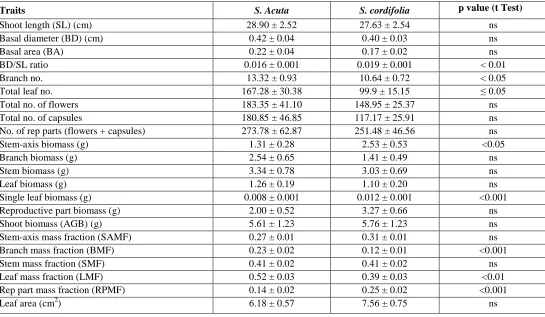
The mean stem-axis biomass of S. Cordifolia was significantly higher than that of S. acuta (p < 0.05) (Table 2). In contrast, the number of branches and branch mass fraction (BMF) was higher in S. acuta. The number of leaves as well as leaf mass fraction (LMF) was also higher in S. acuta. However, the leaf biomass per leaf was higher for S. cordifolia. In contrast to BMF and LMF that were higher in S. acuta, RPMF was recorded higher for S. cordifolia (p < 0.001).
The biomass partitioning to leaves (LMF) and reproductive parts (RPMF) differed significantly with the change of species of Sida in the present study (Table 3). The variation in SAMF, SMF and LMF appeared significantly influenced by growth phase (vegetative and reproductive). The SMF was also influenced by species-phase interaction (p < 0.001).
Allocation pattern
Biomass investment to different plant components in both S. acuta and S. cordifolia varied with vegetative/ reproductive phase of development (Fig. 2). In vegetative phase of S. cordifolia, SAMF and BMF together accounted for over 50% of its total AGB. On the other hand, in S. acuta the leaf component alone accounted for over 60% of its total AGB. In reproductive phase S. acuta contributed more to branches (22%) and leaves (32%) while S. cordifolia invested more to reproductive parts (30%).
Species Family D F AGB RIVI
Cynodon dactylon (L.) Persoon Poaceae 248 84 28.9 17.0
Sida acuta Burm F. Malvaceae 151 100 39.1 15.6
Digitaria adscendens (Kunth) Henrard Poaceae 121 84 18.6 10.3
Parthenium hysterophorus L. Asteraceae 51 92 27.8 9.5
Sida cordifolia L. Malvaceae 67 100 8.4 6.9
Malvastrum tricuspidatum (R. Br.) A. gray Malvaceae 67 74 11.2 6.7
Peristrophe bicalyculata (Retz.) Nees Acanthaceae 34 84 5.7 4.7
Cassia obtusifolia L. Leguminosae 14 66 12.1 4.6
Dactyloctenium aegypticum (L.) P. Beauv. Poaceae 44 58 7.0 4.6
Cassia occidentalis L. Leguminosae 5 58 8.9 3.4
Abutilon indicum (L.) Sweet Malvaceae 8 66 4.3 3.0
Croton bonplandianum Baillon Euphorbiaceae 5 66 1.9 2.4
Poa annua L. Poaceae 10 34 3.5 1.9
Acrachne racemosa (Roemer & Schultes) Ohwi Poaceae 9 34 1.5 1.6
[image:3.612.48.219.590.709.2]ISSN 2250-3153
[image:4.612.34.579.87.404.2]Table 2. Plant-level traits (mean ± SE) of Sida acuta and Sida cordifolia in a dry tropical peri-urban region.
Table 3. Results of the ANOVA of the different above-ground biomass components of Sida acuta and Sida cordifolia in response to their vegetative and reproductive phases.
Traits S. Acuta S. cordifolia p value (t Test)
Shoot length (SL) (cm) 28.90 ± 2.52 27.63 ± 2.54 ns
Basal diameter (BD) (cm) 0.42 ± 0.04 0.40 ± 0.03 ns
Basal area (BA) 0.22 ± 0.04 0.17 ± 0.02 ns
BD/SL ratio 0.016 ± 0.001 0.019 ± 0.001 < 0.01
Branch no. 13.32 ± 0.93 10.64 ± 0.72 < 0.05
Total leaf no. 167.28 ± 30.38 99.9 ± 15.15 ≤ 0.05
Total no. of flowers 183.35 ± 41.10 148.95 ± 25.37 ns
Total no. of capsules 180.85 ± 46.85 117.17 ± 25.91 ns
No. of rep parts (flowers + capsules) 273.78 ± 62.87 251.48 ± 46.56 ns
Stem-axis biomass (g) 1.31 ± 0.28 2.53 ± 0.53 <0.05
Branch biomass (g) 2.54 ± 0.65 1.41 ± 0.49 ns
Stem biomass (g) 3.34 ± 0.78 3.03 ± 0.69 ns
Leaf biomass (g) 1.26 ± 0.19 1.10 ± 0.20 ns
Single leaf biomass (g) 0.008 ± 0.001 0.012 ± 0.001 <0.001
Reproductive part biomass (g) 2.00 ± 0.52 3.27 ± 0.66 ns
Shoot biomass (AGB) (g) 5.61 ± 1.23 5.76 ± 1.23 ns
Stem-axis mass fraction (SAMF) 0.27 ± 0.01 0.31 ± 0.01 ns
Branch mass fraction (BMF) 0.23 ± 0.02 0.12 ± 0.01 <0.001
Stem mass fraction (SMF) 0.41 ± 0.02 0.41 ± 0.02 ns
Leaf mass fraction (LMF) 0.52 ± 0.03 0.39 ± 0.03 <0.01
Rep part mass fraction (RPMF) 0.14 ± 0.02 0.25 ± 0.02 <0.001
Leaf area (cm2) 6.18 ± 0.57 7.56 ± 0.75 ns
Variable Source df Sum of sq F P
SAMF
Species 1 0.056 2.455 0.119
Phase 1 0.096 4.188 0.042
Interaction (species × phase) 1 0.021 0.931 0.336
BMF
Species 1 0.007 0.503 0.48
Phase 1 0.005 0.368 0.545
Interaction (species × phase) 1 0.133 9.694 0.002
SMF
Species 1 0.011 0.827 0.364
Phase 1 1.093 85.123 <0.001
Interaction (species × phase) 1 0.184 14.326 <0.001
LMF
Species 1 0.101 5.726 0.018
Phase 1 5.287 300.416 <0.001
Interaction (species × phase) 1 0.0001 0.004 0.949
RPMF
Species 1 0.353 32.94 <0.001
Phase 1 - - -
Figure 2. Biomass alloaction to different above-ground components by Sida acuta and Sida cordifolia at two different developmental phases (reproductive and vegetative). Codes: SAMF, stem-axis mass fraction; BMF, branch mass fraction; LMF, leaf mass fraction; RPMF, reproductive part mass fraction; SA, Sida acuta; SC, Sida cordifolia.
[image:5.612.84.252.94.228.2]The LMF declined significantly with increasing plant size of both the Sida congeners (Fig. 3), albeit it was higher for S. acuta, particularly at higher plant sizes. In contrast to decreasing pattern of LMF, SMF and RPMF increased significantly with above-ground biomass. However, at lower plant size, SMF was higher for S. cordifolia while at higher plant sizes, it was higher for S. acuta. Compared to the SMF and LMF, RPMF was significantly greater (p < 0.001) for S. cordifolia.
Figure 3. Allometric relationships between plant component mass fractions (stem mass fraction, SMF; leaf mass fraction, LMF and reproductive part mass fraction, RPMF) and total above-ground biomass (log scale) of Sida acuta (filled squares and solid line) and Sida cordifolia (open circles and dotted line) at Kali river bank site in a dry tropical peri-urban region.
The allometric relationship among the different above-ground plant components were studied by regression equation of second order polynomial (figure 4). Despite LMF being higher in S. acuta compared to S. cordifolia, both the weed species showed
a comparable declining trend with ontogeny. The SMF increased with plant size in both the species although the increase was recorded to be higher for S. acuta in the mid of the growth stages. However, the reproductive allocation (RPMF) was significantly higher in S. cordifolia compared to S. acuta.
Figure 4. Variation of stem-axis mass fraction (SAMF), branch mass fraction (BMF), stem mass fraction (SMF), leaf mass fraction (LMF) and reproductive part mass fraction (RPMF) in relation to shoot length of (a) Sida acuta and (b) Sida cordifolia at Kali river bank (KRB) site in a dry tropical peri-urban region. Curves represent best-fit second-order polynomial regression.Regression equations and R2 values are presented in table 4.
IV. DISCUSSION
A discerning difference in biomass allocation strategy in the congeners S. acuta and S. cordifolia with strong perennial tendency was evident from this study in the weedy and ruderal vegetation along the bank of polluted Kali river in the Indian dry tropical region. The mosaic of vegetation in the presently studied peri-urban region [26] indicated occurrence of variously dominated weeds in different patches of vegetation, some of which are turning invasive and some naturalized/invasive. This increasing dominance of Sida congeners, particularly S. acuta in the studied peri-urban vegetation indicated its growing influence across the various anthropo-ecosystems in the peri-urban region here.
[image:5.612.351.516.177.396.2] [image:5.612.38.301.455.664.2]ISSN 2250-3153
Table 4. Regression equations and R2 values of stem -axis mass fraction (SAMF), branch mass fraction (BMF), stem mass fraction (SMF), leaf mass fraction (LMF) and reproductive part mass fraction (RPMF) with shoot length of Sida acuta and Sida cordifolia at Kali river bank (KRB) site in a dry tropical peri-urban region, as presented in figure 4.
photosynthetic ability [7, 29, 30]. The remarkably higher biomass allocation to photosynthetic tissues is intelligible from the mean LMF of 0.46 reported for herbaceous species by Poorter and Nagel [31], 0.26-0.41 for herbaceous weeds in dry tropics by Gupta [2], 0.27-0.38 for invasive weeds Chenopodium murale [10] and Ageratum conyzoides [4]. Its LMF, however, declined with ontogeny although it remained higher than S. cordifolia, as evinced at higher plant sizes, in particular (fig. 3). The biomass allocation to support structure was comparable in both the Sida congeners. However, the trend of biomass investment to main axis and branches varied significantly in these two congeners. In S. acuta the number of branches and differential biomass investment to branches (BMF) (reflective of its profuse branching) was significantly higher. In contrast, the biomass allocation to stem-axis was higher for S. cordifolia. This characteristic difference in allocation indicated a perennial tendency [10] of these two alien invasive congeners for successful establishment and naturalization in this dry tropical region. The overall stem allocation (SAMF + BMF) was not significantly different. Thus, the growth strategy of greater biomass investment to stem component for firm establishment in the newly invaded area can be attributed to the perennial tendency of this herbaceous weed to shrubby life-form, as reported by some taxonomic workers in the neighbouring regions [32, 33]. The SMF of these two congeners compared well with the range reported for the herbaceous weeds in the region [10], but higher than that reported for herbaceous species [31].
Besides higher stem-axis allocation in S. cordifolia, single leaf biomass and reproductive allocation (RPMF) were also significantly higher. Thus, pronounced invasive character of S. cordifolia could be attributed to higher biomass investment to reproductive structures [34, 35]. This alien weed is reported to have higher number of seeds (~10 /capsule) compared to S. acuta (5-8 /capsule) [36] and seed size as observed in this study.
Reproductive allocation to the scale of 30% of its total AGB corroborates its strategic invasive and expansionist capacity [10]. The study reflected shift in allocation strategy varying with the growth phase, species type and ontogeny. This indicates a high plastic response of the congeners of Sida that facilitated its adaptation and establishment under alien environments. With increasing plant size, while LMF declined on one hand SMF and RPMF increased with the other. Across different plant sizes over varying developmental stages, the higher RPMF for S. cordifolia at all ontogenetic points and higher LMF for S. acuta reflected a distinguishable difference in their invasive growth strategy. Different plant-traits are often suggested to promote invasiveness of different species, as a universal syndrome of traits to characterize all invasive species appears too simplistic [37-40]. In conclusion, the study reflected a strategic alteration in biomass allocation to different plant components by the congeners S. acuta and S. cordifolia. While S. acuta allocated differentially higher biomass to photosynthesizing leaf component, S. cordifolia allocated relatively higher biomass to reproductive structural components. Biomass allocation varied with ontogeny, growth phase (vegetative/reproductive) and plant species.
ACKNOWLEDGEMENTS
We are thankful to the University Grants Commission, New Delhi, for financial support. We are also grateful to the contribution of late Dr. L. K. Sharma for his assistance in identifying plant species. Anonymous reviewers are also thanked for their comments and fruitful suggestions.
REFERENCES
[1] Sharma, G.P., J.S. Singh, and A.S. Raghubanshi, Plant invasions: Emerging trends and future implications. Current Science, 2005. 88(5): p. 726-734. [2] Gupta, S., An ecological investigation on biomass production and allocation
pattern of some weed flora at Bulandshahr. 2008, CCS University, Meerut. [3] Gupta, S. and R. Narayan, Plant diversity and dry-matter dynamics of
peri-urban plant communities in an Indian dry tropical region. Ecological Research, 2011. 26(1): p. 67-78.
[4] Chaudhary, N. and R. Narayan, Exotic invasive Ageratum conyzoides L. in Indian dry tropics: A preliminary investigation of its biomass allocation pattern and plant traits. Journal of Plant Developmental Science, 2013. 5(3): p. 249-254.
[5] Chaudhary, N. and R. Narayan, The Advancing Dominance of Ageratum conyzoides L. and Lantana camara L. in a dry Tropical Peri-urban Vegetation in India. International Research Journal of Environmental Science, 2013. 2(11): p. 88-95.
[6] D'Antonio, C.M. and S. Kark, Impacts and extent of biotic invasions in terrestrial ecosystems. Trends in Ecology & Evolution, 2002. 17(5): p. 202-204.
[7] McDowell, S.C., Photosynthetic characteristics of invasive and noninvasive species of Rubus (Rosaceae). American Journal of Botany, 2002. 89(9): p. 1431-1438.
[8] Feng, Y.-L. and G.-L. Fu, Nitrogen allocation, partitioning and use efficiency in three invasive plant species in comparison with their native congeners. Biological Invasions, 2008. 10: p. 891–902.
[9] Feng, Y.-L., H. Auge, and S.K. Ebeling, Invasive Buddleja davidii allocates more nitrogen to its photosynthetic machinery than five native woody species. Oecologia, 2007. 153: p. 501–510.
[10] Gupta, S. and R. Narayan, Phenotypic plasticity of Chenopodium murale across contrasting habitat conditions in peri-urban areas in Indian dry tropics: Is it indicative of its invasiveness? Plant Ecology, 2012. 213(3): p. 493-503.
Species Regression equation R2 value
S. acuta
SAMF = -2E-05x2 + 0.002x + 0.232 0.778
BMF = -8E-05x2 + 0.010x - 0.027 0.920
SMF = -0.000x2 + 0.014x + 0.153 0.992
LMF = 0.000x2 - 0.017x + 0.862 0.996 RPMF = 1E-05x2 + 0.001x + 0.061 0.931
S. cordifolia
SAMF = 1E-04x2 - 0.005x + 0.357 0.639
BMF = -2E-05x2 + 0.001x + 0.171 0.012
SMF = 8E-06x2 + 0.003x + 0.317 0.942
LMF = 9E-05x2 - 0.015x + 0.772 0.996
[11] Williams, D. and R. Black, Drought response of a native and introduced Hawaiian grass. Oecologia, 1994. 97(4): p. 512-519.
[12] Wilsey, B.J. and H.W. Polley, Aboveground productivity and root–shoot allocation differ between native and introduced grass species. Oecologia, 2006. 150(2): p. 300-309.
[13] Vitousek, P.M., Biological invasions and ecosystem properties: can species make a difference? Ecology of biological invasions of North America and Hawaii, 1986. 58: p. 163-176.
[14] Feng, Y.-L., G.-L. Fu, and Y.-L. Zheng, Specific leaf area relates to the differences in leaf construction cost, photosynthesis, nitrogen allocation, and use efficiencies between invasive and noninvasive alien congeners. Planta, 2008. 228: p. 383–390.
[15] Zheng, Y.-L., et al., Growth, biomass allocation, morphology, and photosynthesis of invasive Eupatorium adenophorum and its native congeners grown at four irradiances. Plant Ecology, 2009. 203: p. 263–271. [16] Mann, A., M. Gbate, and A. Umar, Sida acuta subspecie acuta. Medicinal
and economic palnt of Nupeland. 2003, Jube Evans Books and Publication. [17] Karou, S.D., et al., Sida acuta Burm. f.: a medicinal plant with numerous
potencies. African Journal of Biotechnology, 2007. 6(25).
[18] Singh, D.K., et al., Pollen Fertility and Scanning Electron Microscopic Studies of Sida Cordifolia L. Indian Res. J. Genet. & Biotech, 2013. 5(2): p. 98-104.
[19] Khuroo, A.A., et al., Alien flora of India: taxonomic composition, invasion status and biogeographic affiliation. Biological Invasions, 2012. 14: p. 99– 113.
[20] Singh, K.P., A.N. Shukla, and J.S. Singh, State-level inventory of invasive alien plants, their source regions and use potential. Current Science, 2010. 99(1): p. 107-114.
[21] Reddy, C.S., Catalogue of invasive alien flora of India. Life Science Journal, 2008. 5(2): p. 84-89.
[22] Curtis, J.T. and R.P. McIntosh, An upland forest continuum in the prairie-forest border region of Wisconsin. Ecology, 1951. 32(3): p. 476-496. [23] Risser, P.G. and E.L. Rice, Phytosociological analysis of Oklahoma upland
forest species. Ecology, 1971: p. 940-945.
[24] Whittaker, R., Communities and ecosystems, 2nd edn Macmillan. New York, 1975: p. 385.
[25] Magurran, A., Ecological diversity and its assessment. London. Croom Helm, 1988.
[26] Gupta, S. and R. Narayan, Species diversity in four contrasting sites in a peri-urban area in Indian dry tropics. Tropical Ecology, 2006. 47(2), 229-241(2): p. 229-241.
[27] Whittaker, R.H., Evolution and measurement of species diversity. Taxon, 1972: p. 213-251.
[28] Mead, R. and Curnow R. N., Statistical methods in agriculture and experimental biology. 1983, Chapman and Hall, London
[29] Durand, L.Z. and G. Goldstein, Photosynthesis, photoinhibition, and nitrogen use efficiency in native and invasive tree ferns in Hawaii. Oecologia, 2001. 126(3): p. 345-354.
[30] Feng, Y.-L., Photosynthesis, nitrogen allocation and specific leaf area in invasive Eupatorium adenophorum and native Eupatorium japonicum grown at different irradiances. Physiologia Plantarum, 2008. 133: p. 318– 326.
[31] Poorter, H. and O. Nagel, The role of biomass allocation in the growth response of plants to different levels of light, CO2, nutrients and water: a quantitative review. Australian Journal Plant Physiollgy, 2000. 27: p. 595– 607.
[32] Gaur, R.D., Flora of the District Garhwal North West Himalaya. 1999: TransMedia Srinagar (Garhwal), U.P. India.
[33] Sharma, L.K., Floristic Studies of District Bulandshahr and Morphological Studies of Desmodium Desv. and Alysicarpus Neek. with Special Reference to Fruit Structure. 1980, Meerut University, Meerut, India.
[34] Baker, H.G., Characteristics and modes of origin of weeds. , in The genetics of colonizing species., H.G.S. Baker, G. L., Editor. 1965: Academic press, New York. p. 147-172.
[35] Mehrotra, P., G. Kharakwl, and Y. Pangety, Ecological implication of plant traits, strategies and competitive abilities of herbs. Applied Ecology and Environmental Research, 2004. 2(2): p. 1-13.
[36] Heard, T. and M. Day, Sida acuta Burm. f-spinyhead sida Sida rhombifolia L.-paddy's lucerne Sida cordifolia L.-flannel weed, in Biological Control of Weeds in Australia M. Julien and R.C. Mcfadyen, J, Editors. 2012, CSIRO Publishing Melbourne, Vic. . p. 544-550
[37] Goodwin, B.J., A.J. McAllister, and L. Fahrig, Predicting invasiveness of plant species based on biological information. Conservation Biology, 1999. 13(2): p. 422-426.
[38] Daehler, C.C., Performance comparisons of co-occurringnative and alien invasive plants: Implications for conservation and restoration. Annu. Rev. Ecol. Evol. Syst., 2003. 34: p. 183–211.
[39] Feng, Y., J. Wang, and W. Sang, Biomass allocation, morphology and photosynthesis of invasive and noninvasive exotic species grown at four irradiance levels. a cta oe col o g i c a, 2007. 31: p. 40-47.
[40] Feng, Y.-L., J.-F. Wang, and W.-G. Sang, Irradiance acclimation, capture ability, and efficiency in invasive and non-invasive alien plant species. Photosynthetica, 2007. 45(2): p. 245-253.
AUTHORS
First Author- Shilpy Singhal, Research Scholar Department of Botany, I. P. (Post-Graduate) College, Bulandshahr, Email- [email protected]
Second Author- Dr. Rup Narayan, Associated Professor Department of Botany, I. P. (Post-Graduate) College, Bulandshahr, Email- [email protected]