“A Comparative Evaluation of Palatal Adaptation in
Denture Bases Processed With Compression Molding and
Injection Molding In Two Different Palatal
Configuration”-An In Vitro Study
Dr Vigneswaran Sekar* MDS, Dr Sendhilnathan D** MDS, Dr Lakshmi S,**MDS, Dr Abby Abraham*** MDS, Dr Annapoorni. H***MDS.
*
Department of Prosthodontics & Implantology, Meenakshi Ammal Dental College & Hospitals,
Chennai, Tamilnadu.
**
Department of Prosthodontics & Implantology, SRM Kattankalathur Dental College & Hospitals,
Chennai, Tamilnadu
Abstract- The success and draw backs of the compression molding are well studied and reported but there is no enough studies or reports on injection molding. This study is on a comparison and evaluation of palatal adaptation of two different denture bases fabricated in two different palatal forms namely Shallow palate and Deep palate were used. Orientation notches (OrN) were made in the Master Model and were duplicated. 20 Shallow and 20 Deep palate cast were made. Denture bases were processed by Compression molding and Injection molding technique. The casts were trimmed in the PPS area and midline and the palatal adaptation was evaluated using vision measuring system. The results revealed that the mean palatal adaptation of injection molding denture bases was statistically significant when compared to compression molding denture bases in both the shallow palate and deep palate (p≤0.05). But there was no statistical difference within the injection molding and compression molding denture bases in both palates (p≥0.05). The Injection molding denture bases had better palatal adaptation. The material of choice and the technique of processing plays a major role than the shape of the vault in deciding the palatal adaptation of the denture.
Index Terms- Compression Molding, Injection Molding, Orientation Notches, Posterior Palatal Seal, Midline
I. INTRODUCTION
The success of the removable complete denture depends upon its retention, stability, and support. The retention of the complete denture is directly related to the adaptation of the base to the supporting oral tissues and is maximised when there is
more intimate adaptation with the oral tissues. PMMA based acrylic resin have been used popularly for the denture bases.
In a clinical situation, decreased gap between the denture base and the tissue surface contributes to improved denture retention. Previous studies reported that variations in measurements from less than 0.25 to 0.27 mm in the fit of the record bases to the master cast would appear to have little clinical significance in the serviceability of dentures, because tissue displacement of only 0.25mm would be required to allow almost complete seating of a maxillary denture on the oral tissues4.
Palatal adaptation of the denture is influenced by the material, the processing technique and the anatomic morphology of the vault also plays a role.
Two recognised changes are unavoidable in PMMA based acrylic resin which is Shrinkage and expansion2. However, newer denture materials and processing techniques are being introduced to reduce the shrinkage and expansion3. Volumetric shrinkage occurs during polymerisation process is due to the differences in densities of the monomer and the polymer, this results in a lifting of the denture base away from the posterior palate area after the polymerisation of PMMA.The conventional processing technique causes polymerization shrinkage, thermal contraction during flask cooling, and strain accompanying stress release during de-flasking may cause diminished adaptation of the denture to the tissues4.
shaped palatal forms usually seen in the deep vault have openings only in the midline.
The aim of the study was to compare the palatal adaptation of two different denture bases fabricated by compression molding and injection molding in two different palatal forms namely shallow and deep vault along the Midline, Posterior Palatal Area and the Entire arch.
I. Materials and Methods:
The impression of the stone cast was made with irreversible hydrocolloid material (Zelgan Plus, DENTSPLY) and it was poured with base plate wax (Hindustan Modelling Wax, Hindustan Dental Products).
The waxed cast was processed with Heat cure acrylic resin- Pink (Acrylin-H, Asian Acrylates) according to the manufacturers recommendations. Two master casts made of PMMA acrylic resin, one with the Shallow vault and the other with Deep vault were obtained (Fig 1 & Fig 2).
[image:2.612.371.518.140.231.2]Fig 1 Master model – Shallow palate Fig2 Master Model – Deep palate
[image:2.612.398.489.393.548.2]‘V’ shaped orientation grooves were made on the Master Model for both the Shallow palate cast and Deep palate cast. The Orientation Notches (OrN) were marked on 5 specific points namely in the Left Vestibule (LV), Left Ridge (LR), middle of the Posterior Palatal Seal (MPPS), Right Ridge(RR), Right Vestibule (RV) with a indelgible marker along the posterior palatal seal area. Three specific points namely Labial Frenum (LF), Anterior Ridge (AR) and in Mid Palatine Raphe (MPR) were marked along the midline. The Orientation notches of 2 mm were drilled using a stable surveyor with a handpiece (Fig 3).
Fig 3 Drilling OrN in the cast
II.AFabrication of special tray:
A single base plate wax (Hindustan Modelling Wax, Hindustan Dental Products) was adapted all around the master model as a single wax spacer5. The wax in the area of the retaining grooves was removed to maintain the orientation of the cast after the fabrication of the special tray. After the making of the spacer, the self-cure resin (Pyrax Rapid Repair, PyraxPolymers) was mixed and well adapted over the cast along with the spacer with uniform thickness.
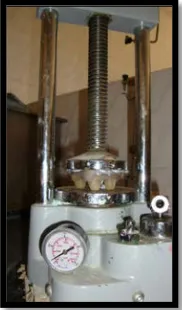
Five pillars were made on the tray to orient the cast parallel to the floor. The parallelism was achieved by placing tray along with the pillars and the cast in the hydraulic pressure machine before the resin in the pillars was completely polymerised. Pressure was applied until the cast was parallel to the floor. The whole assembly was maintained until the pillars were completely polymerised (Fig 4).
Fig 4 special tray with Pillars
II.B Impression Procedure:
The spacer was completely removed and one relief hole was given in the centre of the palate which was greater than 1.0 mm5. After the spacer was removed, tray adhesive (Ivoclar Vivadent) was applied and then impression material was loaded uniformly on to the special tray (Aquasil Ultra Monophase Fast Set, Smart Wetting® Impression Material) and then the cast was placed within the tray and taken to the hydraulic bench press where a pressure of 5 KgF6 (72 psi) was applied and the pressure was maintained until the material was completely set (Fig 5). When the pressure was applied , the excess material flowed through the relief hole and the borders of the tray.
Fig 5. 72 psi pressure for impression making
II. C Pouring the cast:
20 casts were fabricated for both the shallow vault and deep vault palatal forms using dental stone (Gyproc, Prevest Dentpro Limted).
II.D Grouping
They were subdivided into two Sub Groups namely A and B for both the group of 10 casts each for fabrication of denture bases by Compression Molding and Injection Molding. (Table 1)
[image:2.612.74.208.483.592.2]Sub Group A (SC)
Sub Group B (SI)
Sub Group A (DC)
Sub Group B (DI)
10 cast : Compression molding (C)
10 cast: Injection
molding (I)
10 cast : Compression molding (C)
10 cast: Injection
[image:3.612.30.261.57.154.2]molding (I)
Table 1: Grouping the casts
II.E Wax Up For Denture Base Fabrication:
A single shellac base plate (Rolex base plate, Ashoo Sons Company) was well adapted. The base plate was well fused to the cast with a thin roll of wax around the borders of the cast completely. The base was carefully removed and checked for its thickness with a Vernier calliper (Baker SD 10 Vernier Calliper). The thickness was evenly maintained within 3 mm (Fig 6) for all the 40 casts .
Fig 6 Thickness is measured with caliper II. FProcessing
II.F.1Compression Molding:
[image:3.612.369.517.84.176.2]The denture bases were processed by Compression molding Technique using Heat cure denture base resin (Lucitone, DENTSPLY) in a thermal acryliser unit (Acryliser C-73, Confident Dental Equipments) . A bench press pressure of 3000 psi (Fig 7) was applied during the trial closure overnight.
Fig 7 Bench curing at 3000 psi in Bench press
The curing temperature of 740celsius was maintained for 2 hour and 1000celsius was maintained for 1 hour1.
II.F.2 Injection Molding:
The denture bases were processed using Hydraulic Bench Press and a pressure of 6 Pa (Fig 8) was maintained. The Heat cure resin (SR-IVOCAP, IVOCLAR VIVADENT) was injected through an injector at a constant pressure of 6 Pa. during
the whole process. The curing temperature was maintained at 98 degree Celsius for 35 minutes.
Fig 8 Curing under constant pressure (6 pa)
II.G. Making of the matrix:
After the dentures were retrieved from the flask, the flash was trimmed off. The cast was covered with a cellaphon sheet and then held with the cast with the help of a rubber band and yellow type II dental stone (Gyproc, PrevestDentpro Limited) was poured to form a matrix over the denture base (Fig 9). Matrix helped in preventing the dislodgement of the denture base from the cast during the trimming and measurement6.
Fig 9 Matrix in cross section
II.H. Trimming the Cast:
[image:3.612.316.476.298.406.2]After the matrix was set, the cast was trimmed of up to the OrN in the cast were visible along the posterior palatal seal area (Fig 10 & 11). The readings were taken along the PPS area for palatal opening, after which the cast were trimmed along the sides to see the OrN along the midline (Fig 12 & 13) to study for the palatal opening.
Fig 10 Trimming of cast to see OrN in Shallow palate
[image:3.612.345.541.517.602.2] [image:3.612.349.535.636.723.2]Independent Samples Test
13.054 .002 15.388 18 .000 .1848200 .0120108 .1595863 .2100537 15.388 9.833 .000 .1848200 .0120108 .1579968 .2116432 Equal variances
assumed Equal variances not assumed PPS
F Sig. Levene's Test for Equality of Variances
t df Sig. (2-tailed) Mean Dif ference
Std. Error
Dif ference Lower Upper 95% Confidence
Interval of the Dif ference t-test for Equality of Means
Fig 12 OrN along the Midline for Shallow palate
Fig 13 OrN along the midline for Deep palate
II.IData Collection:
Vision Measuring System (VMS) were used for recording the width of palatal opening. The VMS had an optical scanner which measured at 5x optical zoom. The readings were processed with the help of software (Msu25D Vision Measuring Software, 3 axis, Version 75.0 k) and produced on the computer screen (Fig 14 & 15).
Fig 14 Processed image on the Screen for Compression molding denture base
Fig 15 Processed image on the screen for Injection molding denture base
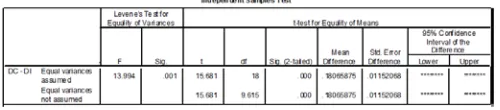
The results were subjected to statistical analysis with Independent Students‘t’ test. Significance value (p) was found out using the Test of Significance.
III. RESULTS:
The results were tabulated in different tables for the PPS area, midline area and combined PPS and midline.
Between the groups of compression molding and injection molding in shallow and deep palate:
Along the posterior palatal seal:
(i) The mean palatal adaptation in shallow palate between compression molding and injection molding showed a high statistical significance. (Tables II).
[image:4.612.326.559.59.235.2](ii) The mean palatal adaptation in deep palate between compression molding and injection molding showed a high statistical significance. (Tables III).
Table II: Test of significance for palatal adaptation along the PPS in shallow palate for compression molding and injection molding denture bases.
Table III: Test of significance for palatal adaptation along the PPS in deep palate for compression molding and injection molding denture bases
[image:4.612.49.288.406.582.2]Independent Samples Test
9.645 .006 8.917 18 .000 .15237500 .01708881 .11647274 .18827726 8.917 9.228 .000 .15237500 .01708881 .11386262 .19088738 Equal variances
assumed Equal variances not assumed SC - SI
F Sig. Levene's Test for Equality of Variances
t df Sig. (2-tailed) Mean Dif ference
Std. Error
Dif ference Lower Upper 95% Confidence
Interval of the Dif ference t-test for Equality of Means
Independent Samples Test
.702 .413 -1.591 18 .129 -.03247500 .02041346 -.075362 .01041209 -1.591 15.686 .132 -.03247500 .02041346 -.075820 .01087001 Equal variances
assumed Equal variances not assumed SC - DC
F Sig. Levene's Test for Equality of Variances
t df Sig. (2-tailed) Mean Dif ference
Std. Error
Dif ference Lower Upper 95% Confidence
Interval of the Dif ference t-test for Equality of Means
(i) The mean palatal adaptation in shallow palate between compression molding and injection molding showed a high statistical significance. (Tables IV).
(ii) The mean palatal adaptation in deep palate between compression molding and injection molding
[image:5.612.321.559.249.305.2]showed a high statistical significance. (Tables V).
Table IV: Test of significance for palatal adaptation along the MIDLINE in shallow palate for compression molding and injection molding denture bases
Table V: Test of significance for palatal adaptation along the MIDLINE in deep palate for compression molding and injection molding denture bases
Entire arch:
(i) The mean palatal adaptation in shallow palate between compression molding and injection molding showed a high statistical significance. (Tables VI).
(ii) The mean palatal adaptation in deep palate between compression molding and injection molding showed a high statistical significance. (Tables VII).
Table VI: Test of significance for mean palatal adaptation in shallow palate for compression molding and injection molding denture bases throughout the arch
Table VII: Test of significance for mean palatal adaptation in deep palate for compression molding and injection molding denture bases throughout the arch
Results within the groups:
(i) The mean palatal adaptation between shallow and deep palate throughout the arch in compression
molding showed no statistical significance. (Tables VIII).
[image:5.612.38.278.268.327.2](ii) The mean palatal adaptation between shallow and deep palate throughout the arch in impression molding showed no statistical significance. (Tables IX).
Table VIII: Test of significance for a compression molding denture base in shallow and deep palate
Table IX: Test of significance for an injection molding denture base in shallow and deep palate
IV. DISCUSSION
The current study compared the palatal adaptation between shallow and deep. Earlier studies suggested a statistical difference in palatal adaptation in dentures between the shallow palate and deep palate where the adaptation for the deep palate is significantly more than the shallow palate7.
The results of one study showed that palatal adaptation along the posterior palatal seal and midline was of high statistical difference. The mean palatal adaptation for Injection molding denture base was statistically higher, when compared to the compression molding denture base8. Two main reasons were the Pressure and in Injection molding technique the resin was pushed through the flask continuously for the complete polymerization cycle.
In Compression molding technique after the material was packed in the flask, the flask was placed under the bench press overnight at 3000 psi. After the flask was retrieved from the bench press, transferred to the clamp, where the amount of pressure built up within the flask in the clamp was unknown. But in Injection molding the material slowly pushed in to the flask at constant pressure (6 Pa) until the polymerization was completed. Difference in this pressure increased the palatal adaptation between the two denture bases.
[image:5.612.45.292.490.546.2] [image:5.612.36.286.591.646.2]The results of this study differed to results of previous studies9, 10, 11, and 12.
Turck reported that there was no statistical difference in adaptation between compression molding, microwave and light activated techniques13.
Previous studies have reported that there was difference in adaptation in a compression molding denture in shallow palate and deep palate, in which the adaptation was better in deep palate compared to the shallow palate. The palatal adaptation between the compression molding and injection molding dentures in a shallow palate and deep palate along the PPS and midline, the results observed to be higher with no statistical difference. The adaptation of a compression molding denture was better in shallow palate than the deep palate but was not statistically significant. There was no difference in adaptation between the injection molding denture bases in shallow and deep palate because of the continuous application of pressure.
In compression molding, in deep palate when pressure was applied, the excess pressure tends to escape along when pressure was stopped, whereas in shallow palate since there was no deep undercut (steep palate) the pressure tends to escape all throughout the palate.
Comparing the adaptation of the denture bases in shallow and deep palate between the compression molding and injection molding the results were highly statistically significant. However there was no statistical significant difference in adaptation in shallow or deep palates in both compression and injection molding technique.
McCartney reported that additional distortion of the denture base and associated effects on the occlusion stabilize within 24 hours after removal of the denture from the master cast. Beyond this time there will be further distortion caused by water sorption and continued stress release, but it is of a statistically insignificant magnitude and does not warrant delay in delivery of the denture14.
This difference in adaptation is not attributed to the material composition between these two materials used in different fabrication technique15. O'toole studied whether the processing technique of acrylic resins affected their dimensional stability. Several curing methods were suggested to improve the quality of acrylic resin restoration. The methods include (1) bench curing (2) curing under a Coat of petroleum jelly, (3) curing in a monomer atmosphere and (4) curing under pressure in air and/ or under water16. But he found out that there was no difference after using all these methods.
Gap formation between the denture base and cast are generally attributed to polymerization shrinkage of the resin material and a tendency of cooling shrinkage toward the central area of the denture base, as well as to subsequent distortion caused by confinement of the surface topography of the alveolar ridge. Hence the greatest gap was always seen in the centre of the PPS area or the Vestibule area17.These findings are also predictable with the results reported by Consani et al18, who compared the posterior border gap of the denture base-cast sets sectioned transversally at each area of the canine, molar and posterior ends.
Latta in his study has reported that there was shrinkage in compression molding dentures before and after polymerization19. Lee in his study examined the adaptation
accuracy of acrylic denture base processed using fluid-resin (PERform), injection-moldings (SRIvocap, Success, Mak Press), and two compression-molding techniques. The PERform and Mak Press produced significantly smaller maximum palatal gap dimensions than the other groups (p<0.05)20.
CONCLUSION:
Injection molding is better compared to compression molding and the following conclusion can be derived.
1. In both the Palatal forms the Palatal adaptation of the Injection molding denture bases is much better compared to the Conventional Compression molding denture bases.
2. Individually both Injection molding and Compression molding performs in the same way in both the Shallow palate and Deep palate.
3. The Material of choice and the technique of fabrication play a bigger role than the shape of the vault in deciding the palatal adaptation of the denture.
Acknowledgements:
I would like to acknowledge Dr Ranzani Rajasekar for help and support to conduct my study.
References:
1. Anusavice KJ Phillips 10th edition.
2. Wong DM, Cheng LY, Chow TW, Clark RK. Effect of processing method on the dimensional accuracy and water sorption of acrylic resin dentures. J Prosthet Dent. 1999; 81: 300-304
3. McCord JF. Contemporary techniques for denture fabrication. J Prosthodont 2009; 18: 106-111.
4. Consani RL, Domitti SS, Consani S. Effect of a new tension system, used in acrylic resin flasking, on the dimensional stability of denture bases. J Prosthet Dent. 2002; 88:285-289.
5. Osamu Komiyama, Saeki, Kawar, Kobayashi, Otake. Effects of relief space holes on pressure characteristics of maxillary edentulous impressions. J Prosthet Dent 2004; 91: 570-576.
6. Frank RP. Analysis of pressures produced during maxillary
edentulous impression procedures. J Prosthet Dent 1969; 22:400-413. 7. Laughlin. A comparison of palatal adaptation in acrylic resin denture
bases using conventional and anchored polymerization techniques. J Prosthodont 2001; 10: 204-211.
8. Teraoka, Takahashi. Controlled Polymerization System for
fabricating precise dentures. J Prosthet Dent 2000; 83: 514-20.
9. Baemmert RJ, Lang BR, Barco MT, Jr., Billy EJ. Effects of denture teeth on the dimensional accuracy of acrylic resin denture bases. Int J Prosthodont 1990; 3: 528-537.
10. Johnson DL, Duncanson MG Jr. The plastic postpalatal denture seal. Quintessence Int 1987; 18: 457-462.
12. Freeman Hardy. Comparison of fluid resin and compression molding methods in processing dimensional changes. J Prosthet Dent 1978; 39:375-377.
13. Turck, Lang, Wilcox, Meiers. Direct measurement of Dimensional accuracy with three denture Processing Techniques. Int J Prosthodont 1992; 5: 367-372.
14. John .W.McCartney. Flange adaptation discrepancy, palatal base distortion, and induced malocclusion caused by processing acrylic resin maxillary complete dentures. J Prosthet Dent 1984; 52: 545-553. 15. Eystein Ruyter. Flexural properties of denture base polymers. J
Prosthet Dent 1980; 43: 95-103.
16. O'Toole TJ, Furnish GM, von Fraunhofer JA. Linear distortion of acrylic resins. J Prosthet Dent. 1985; 53: 53-55.
17. Takamata T, Setcos JC Resin denture bases: review of accuracy and methods of polymerization. Int J Prosthodont. 1989; 2:555-62. 18. Consani, Mesquita, Nobilo, Henriques. Influence of simulated
microwave disinfection on complete denture base adaptation using different flask closure methods. J Prosthet Dent 2007; 97: 173-8.
19. G.H.Latta, Jr., W.F.Bowles, and J.E.Conkin. Three dimensional Stability of new denture base resin systems. J Prosthet Dent 1990; 63: 654-661.
20. Chung-Jae LEE, Sung-Bem BOK, Ji-Young BAE and Hae-Hyoung LEE. Comparative adaptation accuracy of acrylic denture bases evaluated by two different methods. Dental Materials Journal 2010; 29 : 411–417.
AUTHORS
First Author – Dr Vigneswaran Sekar
Senior Lecturer,
Department of Prosthodontics & Implantology, Meenakshi Ammal Dental College & Hospitals, Chennai, Tamilnadu.
Second Author – Dr Sendhilnathan D.
Professor,
Department of Prosthodontics & Implantology, SRM Kattankalathur Dental College
Chennai, Tamilnadu
Third Author – Dr Lakshmi S.
Professor,
Department of Prosthodontics & Implantology, Meenakshi Ammal Dental College & Hospitals, Dr Abby Abraham.
Reader,
Department of Prosthodontics & Implantology, Meenakshi Ammal Dental College & Hospitals,
Dr Annapoorni H. Professor & Head,
Department of Prosthodontics & Implantology, Meenakshi Ammal Dental College & Hospitals,
Correspondence Author – Dr Vi gn eswa r an Sek ar .
Senior Lecturer, Department of Prosthodontics & Implantology, Meenakshi Ammal Dental College & Hospitals, Chennai, Tamilnadu.
Email id: [email protected]