Copyright © 2017, Scholarly Research Journal for Interdisciplinary Studies
OPEN ACCESS RESOURCES FOR LEARNING TEACHING AND RESEARCH IN
EDUCATIONAL INSTITUTIONS: A STUDY
Ms. Ch. Ratna Kumari
Head, Dept. of Library & Inf. Sc, St. Ann’s College for Women, Mehdipatnam, Hyderabad, E-mail: [email protected]
This paper examines to study what type of information required, contributions to the Open Access Resources and preferred open access resources among the teachers, research scholars and PG students. It is found that 63.8% of the respondents were required review of literature from the Open Access resources. The study recommends that the authors have contribute their research content in the open access resources to make visibility at national and international level.
Keywords: Open Access Resources, DOAJ, NPTEL, Open J-Gate, Shodhaganga
Introduction:
Information resources are published in the form of journal articles research reports, electronic
books and conference papers etc .resources are very much useful for the learning, teaching
and research in higher educational systems. Open access is a new trend in scholarly
communication which aims at providing free access to scholarly literature over the internet
and has gained enormous momentum in the recent years. Although OA started and has grown
from the pockets of regional initiatives in the developing countries. It is appealing to
developing countries and is spreading throughout the world quickly facilitated by common
technical standards and open source software. OA endeavours to reduce the price and
permission barriers to scholarly communication and the scholarly literature are freely
accessible now without any hindrance.
Harnad described the characteristics of Open Access "Information which is free, immediate
permanent, full text on-line and accessible. Harnard suggests three main justifications of
OA."To Maximize the uptake, usage, applications and impact of their search output of your
university. To measure and reward to uptake, usage application and impact of the research
output of your university. To Collect, manage and showcase a permanent record o the
research output and impact of your University.
Copyright © 2017, Scholarly Research Journal for Interdisciplinary Studies Review of Literature:
Ivwighreghweta and Onoide (2012) found in the study that most students were not aware of
open access journals, and could not use them. It is further observed that the user communities
have a positive attitude towards the use of open access. It is recommended that efforts should
be made by information providers especially librarians towards making users aware them and
benefit of OAJ use"
Okoye & Ejkeme (2010) indicated that "with open access articles can be accessed online free
of charge. Further it is identified that inadequate skills to navigate the internet unstable power
supply, unavailability of internet facilities. Permanence of open Access movement due to
unstable financial support, lack of knowledge of the existence of open access journals in the
internet constraints to the use of open access journals by researchers".
Objectives of the Study:
To analysis type of information required from the open Access Resources
To Find out the contribution made by the respondents to the Open Access Resources
To Know the preferred Open Access Resources
Hypothesis :
There is a significant difference in the contribution to the Open Access Resources and
Teachers and the Research Scholars and the students.
There is a significant difference in the preferred Open Access Resources Among the
respondents.
Methodology:
The Study was carried to analysis the various types of Open Access Resources available for
learning, teaching and research. It was conducted among the teachers, to research scholar and
PG students.
Data Analysis and Findings :
The demographic information of the respondent is given in
Table 1: Demogrphic Information Of Rspondents:
S.No Description No. Of Respondents Percentage %
1 Designation
Teachers 23 18.1
Research Scholars 61 48
PG Students 43 33.9
It can be seen from the Table 1 that 61(48%) of the respondents are Research Scholars,
Copyright © 2017, Scholarly Research Journal for Interdisciplinary Studies
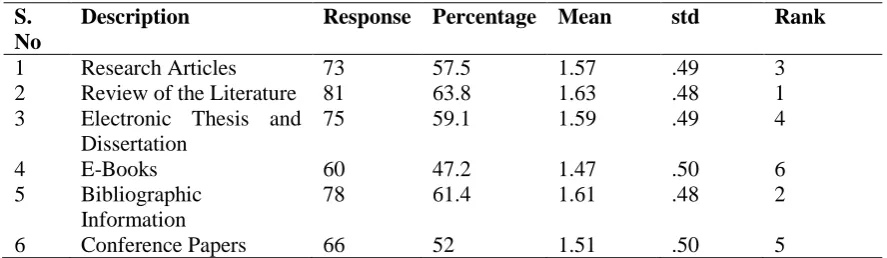
Information is available in a variety of forms such as articles, E-books, Reviews. Electronic
Thesis and Dissertation etc in Open Access Resources(OAR), It helps for teaching learning
and research in higher educational institutions. The study analyzed the specific type of
information required among the Teachers, Research Scholars and students on nominal scales
[image:3.595.76.520.215.344.2]and described in Table 2
Table 2 : Types Of Information Requred
S. No
Description Response Percentage Mean std Rank
1 Research Articles 73 57.5 1.57 .49 3
2 Review of the Literature 81 63.8 1.63 .48 1 3 Electronic Thesis and
Dissertation
75 59.1 1.59 .49 4
4 E-Books 60 47.2 1.47 .50 6
5 Bibliographic Information
78 61.4 1.61 .48 2
6 Conference Papers 66 52 1.51 .50 5
It is found from Table 2 that 63.8% of the respondents are used to collect review of literature
from Open Access Resources. It followed by Bibliographic Information(61.4%). Electronic
Thesis and Dissertation(59.1%). Research Articles(57.5%) and Conference Papers. It is also
found that least priority is given for E-Books(47.2%).
The Study is also intended to ascertain the various contributions made by the teachers,
research scholars and PG Students as authors, reviewers and editors to the open access
resources and explained in Table 3
Table 3 : Contribution Of Respondents To The Open Access Resources
S.No Description Response Percentage Mean std Rank
1 Authors for the Articles
48 37.8 1.37 .48 1
2 Editors and Editorial Members
19 15 1.14 .35 3
3 Reviewer 37 29.1 1.29 .45 2
4 Publisher 7 5.5 1.05 .22 4
It is found from the Table 3 that majority of the respondents(37.8%) were published research
articles/papers in the Open Access Resources. It is also analyzed that 29.1% of the
respondents were reviewers to review the research articles submitted by the contributors.
Further, it is found that 15% of the respondents are the publishers.
One way ANOVA was applied to find out that there is a significant difference in contribution
Copyright © 2017, Scholarly Research Journal for Interdisciplinary Studies
Table 4: One-Way Anova Test Results for Contributions of Respondents to Oar
Description
Designation N Mean std F
Value P Value
Contribution to the Open Access Resource
Teachers 23 5.00 .852
.279 .797 Research Scholars 61 4.86 .804
PG Students 43 4.86 .741
Total 127 4.88 .778
Table 5: Summary of Anova Results
Description
Source Variation
Sum of
Squares Degree of freedom Mean Square F Value P Value
Contribution to the Open Access Resource
Between Groups
.343 2 .172
.279 .797 Within
Groups
76.114 124 .614
Total 76.457 126
From Table 4 and 5 One-way ANOVA test can be seen. It is found that mean score of the
contribution of respondents to Open Access resources is high among the Research
Scholars(4.86) and the PG Students(4.86).
The F value is 2.79 and the P Value is 0.797(p>0.05) which denotes it is not significant.
Therefore it is inferred that there is no significant difference in the contribution to the Open
Access Resources, Where F-=0.797 and p>0.05 as the p value is greater than 0.05.Hence the
hypothesis 1 is not proved.
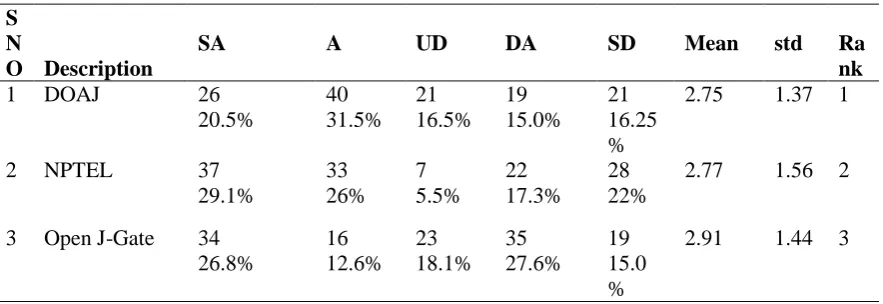
Open Access Resource are available in various platforms such as DOAJ, NPTEL and Open
J-Gate etc. These resources are contained a variety of resources like journal, articles , research
reports, conference papers and case studies. The resources help for learning, teaching and
research. The study is analyzed to find out the preferred Open Access Resource platforms
[image:4.595.79.521.602.754.2]among the respondents on Likert's five point scales and the same is given n Table 6
Table 6: Preferred Open Acess Resources
S N O
Description
SA A UD DA SD Mean std Ra
nk
1 DOAJ 26
20.5% 40 31.5% 21 16.5% 19 15.0% 21 16.25 %
2.75 1.37 1
2 NPTEL 37
29.1% 33 26% 7 5.5% 22 17.3% 28 22%
2.77 1.56 2
3 Open J-Gate 34 26.8% 16 12.6% 23 18.1% 35 27.6% 19 15.0 %
Copyright © 2017, Scholarly Research Journal for Interdisciplinary Studies 4 Indian
Academy of Sciences
24 18.9%
14 11%
31 24.4%
42 33.1%
16 12.6 %
3.09 1.30 4
5 Shodhganaga 16 12.6%
14 11%
31 24.4%
43 33.9%
23 18.1 %
3.33 1.25 5
It is found that 55.1% of the respondents are highly preferred NPTEL to get information for
learning teaching and research data freely available. DOAJ (51.5%) is second highly
preferred resources by the respondents which is followed by Open J-Gate(39.4%).Indian
Academy of Sciences(29%). Shodhaganga is the least preferred(23.6%) resources by the
respondents.
Conclusion and Recommendations:
The Growth in publishing has increased in all disciplines. Many educational institutions in
India have introduced research programmes in all disciplines. It becomes a mandatory for the
research scholar to publish research articles in the National and International Journals.
Open Access Resources Provide a good platform for the authors to publish their scholarly
content in the journals e.g.DOAJ (Directory of Open Access Journals) there are 11791Open
Access Journals. Based on the present study the following are recommended.
All Universities/colleges should make it mandatory to deposit their research content
in the project Shodhaganga introduced by the INFLIBNET. It helps other research
scholars to consult the various thesis on different disciplines
The Library and information science schools have to provide a publishing avenue for
the teachers, tee research scholar and the students in the institution
The teachers /research scholars have to contribute their works to the Open Access
Journals.
References:
Harnad, S (2008) : Mandates and metrics: How Open Repositories enable Universities t manage,
measure and maximise their research assets available
.http:users.ecs.solon.ac.uk/harnad/Temp/openacess.pdf
Ivwighreghweta, O Onoriode, OK(2012) Awareness and use of Open Access Journals by LIS Students
at the University of Ibadan, Nigeria Library Philosophy and Practice , April 2012.
Sivakumaren K S Swaminathan Sand Ravichandran K M Library and Information Professionals
opinion on Open Access Resources(OAR) A Study SALIS Journal of Library and
Information,4(1-4),51-57