A Study on the Pseudo-Second-Order Kinetic
Equation for the Adsorption of Methylene Blue onto
Nitric Acid-Treated Rice Husk: Comparison of Linear
Methods
Yu-Ting Huang1,Li-Chiun Lee1,Ming-Cheng Shih2*
1. Department of Nutrition, I-Shou University. No.8, Yida Rd., Jiaosu Village, Yanchao District, Kaohsiung City 82445, Taiwan, R.O.C.
2. Department of Biological Science & Technology, I-Shou University. No.8, Yida Rd., Jiaosu Village, Yanchao District, Kaohsiung City 82445,
Taiwan, R.O.C.
*Corresponding author.
E-mail address: [email protected]
Tel: +886-7-6151100 ext.7321.
Fax: +886-7-6577056.
Present address: Department of Biological Science & Technology, I-Shou University. No.8, Yida Rd., Jiaosu Village, Yanchao District,
Kaohsiung City 82445, Taiwan, R.O.C.
DOI: 10.29322/IJSRP.8.6.2018.p7865
http://dx.doi.org/10.29322/IJSRP.8.6.2018.p7865
Abstract:
Adsorption is a feasible and environment friendly dye remediation method. The pseudo-second-order kinetic models is
commonly applied to experimental data in many adsorption kinetic studies to express the adsorption mechanism of adsorbate onto
the adsorbent. Six varied linear expression of pseudo-second-order kinetic equation have been examined in this research. The
results showed that the R2 values can be used to select the best-fit linear forms of the pseudo-second-order kinetic equation.In this
study, the results also indicated that the linearized expression of type 6 can be used to calculate the pseudo-second-order rate
constants and to predict qt more appropriate than the other 5 expressions of pseudo-second-order equation for this studied system. .
Keywords: Linear regression; Pseudo-second-order; Nitric acid-treated rice husk; Adsorption; Methylene blue; Kinetics
1.Introduction
The chemical industries always cuased a lot of environmental pollution, such as air pollution, water pollution and soil
pollution. Many researchers tried to solve these environmental pollution. Wastewater is one of the most import subject. Wastewater
can found in the discharge of many industries. Synthetic dyes wastewater always can cause more attention than the other wastewater
wastewter. Most of the used processes for the color removal are developed based on the biological theory, physical theory and
chemical theory. Some of them were not environmentfriendly method. In the recent years, environment friendly method caused a lot
of attention. Therefore, recent efforts have been made to discover new environment friendly and economically feasible treatment
alternatives (Hamdaoui, Saoudi et al. 2008). Among several effective methods, adsorption with natural material receive great
attention due to the easy availability, ease of operation, simplicity of design and comparable low cost of application. (Karadag, Koc
et al. 2007, Chowdhury and Das Saha 2011, Shih 2012). In order to investigate the adsorption mechanism to obtain a better
removal efficiency, several adsorption kinetic models have been proposed to express the adsorption mechanism of adsorbate onto
the adsorbent. In these adsorption kinetic models, the pseudo-second-order kinetic models is the most popular model and have been
commonly applied in many adsorption kinetic studies. Numerous altered equation expression of the pseudo-second-order model
were derived to simplify the calculation diffcultyduring the past few decades. Among these equation expressions, the formual
derivation of Ho’s equation is frequently used to investigate the correlation of the adsorption data for pseudo-second-order kinetic
model due to its simplicity and its good fitting of many adsorption researchs over the past decade (Ho and McKay 1998, Ho, Ng et
al. 2000, Shahwan 2014).
Among these literatures, the linear regression technique has been the most frequently used analysis method to find the best-fit
kinetic models for dye removal, but linear regression is criticized since it leads to varied linearized forms. In order to find the best-fit
kinetic models, six linearized types of pseudo-second-order kinetic models were used to calculatee the kinetic parameters by using
the least squares method (Karadag, Koc et al. 2007). Also, the comparison of the the theoretical qt calculated by these six inearized
types of pseudo-second-order kinetic model and the experimental qt data were used to find the best-fit kinetic model.
2. Materials and methods
The experimental data employed in this study was gained from the literature (Shih 2012). In the study of Shih (Shih 2012),
many acid-treated rice husk was used as the adsorbent. The experimental data applied in this research mainly obtained from the
results of the nitric acid-treated rice husk (NRH) used as the adsorbent.
The pseudo-second-order equation is generally written as below (Ho, McKay et al. 2000, Demirbas, Kobya et al. 2004,
Ofomaja 2007, Sari, Tuzen et al. 2007, Neşe and T. Ennil 2008):
2
2
(
e t)
t
q
q
K
dt
dq
−
=
(1)where qt (mg/g) is the sorption capacity at time t (min); qe is the sorption capacity at equilibrium (mg/g) and K2, is the rate constant
of the pseudo-second-order sorption (min-1) (Djeribi and Hamdaoui 2008, Ncibi 2008, Huang and Shih 2014). Integration and
rearrangment of Eq. [1] with applying border conditions t = 0 to t = t and qt = 0 to qt = qt gives the non-linear form of
pseudo-second-order equation as follows (Ho 2006, Huang and Shih 2014):
+
=
t
q
K
t
q
K
q
e e t 2 2 21
(2)Eq (2) can be rearranged to obtain a linearity forms as follows:
Type 1 pseudo second-order:
K
t
q
q
q
e t e 21
)
(
1
=
+
Eq (3) is the first linearized type of pseudo-second-order equation. Eq (3) can be converted to another 5 alternative linearity forms as
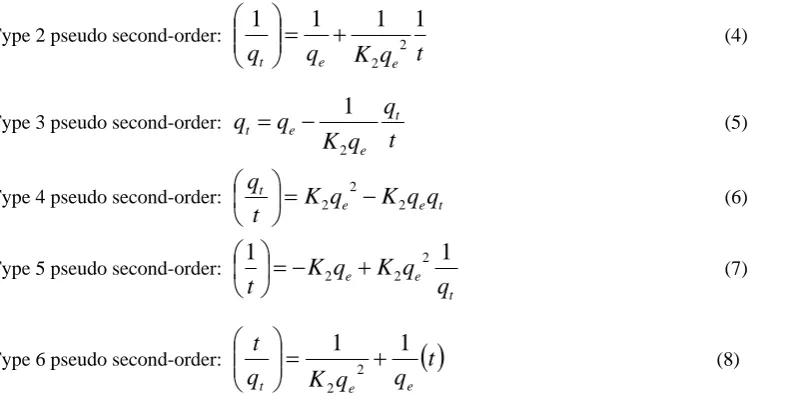
follows(Kumar 2006, Hamdaoui, Saoudi et al. 2008, Chowdhury and Das Saha 2011, Huang and Shih 2015, Huang and Shih 2017):
Type 2 pseudo second-order:
t
q
K
q
q
t e e1
1
1
1
2 2+
=
(4)Type 3 pseudo second-order:
t
q
q
K
q
q
t e e t 21
−
=
(5)Type 4 pseudo second-order: t
K
q
eK
q
eq
tt
q
2 2 2−
=
(6)Type 5 pseudo second-order:
t e e
q
q
K
q
K
t
1
1
2 2 2+
−
=
(7)Type 6 pseudo second-order:
( )
t
q
q
K
q
t
e e t1
1
2 2+
=
(8)3. Results and discussion
In this study, the experimental data for dye adsorbed onto the surface of NRH were fitted to the six different linearized
[image:3.595.42.441.114.323.2]versions of pseudo-second-order equation. The fig. 1 has 1/(qe-qt) on the Y axis and t on the X axis for the linearized type 1. The
fig. 2 has 1/qt on the Y axis and 1/t on the X axis for the linearized type 2. The fig. 3 has qt on the Y axis and qt/t on the X axis for
the linearized type 3. The fig. 4 has qt/t on the Y axis and qt on the X axis for the linearized type 4. The fig. 5 has 1/t on the Y axis
and 1/ qt on the X axis for the linearized type 5. The fig. 6 has t/ qt on the Y axis and t on the X axis for the linearized type 6. The
rate constant K2 and the theoretical qe for these various linearized versions of pseudo-second-order equations can be calculated from
the plot of these six figures, (Kumar 2006, Hamdaoui, Saoudi et al. 2008, El-Khaiary, Malash et al. 2010, Huang and Shih 2017).
All parameters for these six linearized versions of pseudo-second-order kinetic equations included theoretical qe and the rate
constant K2 and the correlation coefficient, R2 are shown in Table 1. From the values of parameters, it was observed that the qe
values, K2 values and R2 values calculated from these six linearized versionss of pseudo-second-order equations were diverse.
In the results of comparion of the qe values predicted by these six linearized versions with the experimental value , the
difference between the experimental value of qe and the value of qe obtained using linearized versions 6 is the smallest. The low
difference between the experimental value of qe and the value of qe obtained using linearized versions 6 can not use to prove the
linearized versions 6 is the bet-fit linear form of kinetic equation. From the literatures, the researchers define the best-fit linear form
of kinetic equations is generally selected based on the R2values. In the table 1, values of R2 for types 3 and 4 were lower than
0.87, these low values of R2 for types 3 and 4 suggested that these two linearized versions applied in the prediction of the MB
adsorption onto NRH particles can not obtain a favourable results. R2 values for types 1, 2, 5 and 6 were higher than 0.95. The
high values of these 4 linear expression indicated that the calculated results will be closer to the experimental data than the types 3
and 4. We also can find the R2 value of linearized version 6 was the highest for the MB adsorption on NRH, this high R2 value
implied that linearized version 6 of pseudo-second-order equatuion should be the best fitted kinetic exoression to represent the
MB adsorption on NRH. In order to prove the correctness of the high values of R2 can be use to find the best fitted kinetic
exoression, the comparison between the plot of experimental qt vs time with the plot of theoretical qt calculated from these six
linear pseudo-second-order kinetic kinetic models vs time were made (figure 7-12.).
The theoretical qt valuses of these six linear types of pseudo-second-order equations in fig 7-12 were calculated by bringing the
qe valuesand k2 valuesof each linear types of pseudo-second-order equations into the nonlinear form of pseudo-second-order
equation.
From these figures, the result of figure 12 clearly indicated that the linearized version 6 is closer to the experimental data
than the other 5 linearized versions.
Linear Type
Type 1
Type 2
Type 3
Type 4
Type 5
Type 6
4. Conclusion
In this research, thes adsorption kinetics of experimental outcome were analyzed by using 6 different linearized expressions of
pseudo-secondorder kinetic equation. The linearized transformation of the pseudo-secondorder kinetic equatuion cause the real
problems and complexities in calculating the parameters of the pseudo-secondorder kinetic equatuion. The various results obtained
from the various linearized expressions of pseudo-secondorder kinetic equatuion probably as a result of the variation in the error
structure got varied in the linearized process of the non-linear pseudo-secondorder kinetic equatuion. Also, the different axial
settings of linearized expression could affect the determination process (Khambhaty, Mody et al. 2008). In this study, six different
linear expressions of pseudo-second-order equation were used for linear regression and compared using the correlation coefficient,
R2. Also, these varied linear expressions of pseudo-second-order equation were used to determine the kinetic parameters. These
kinetic parameters were used to calculate the theoretical qt and compared to evaluate the experimental qt data. The calculated results
of thses linear expressions were different. The difference of of thses linear expressions probably due to the change of the error
distribution caused by the linearization technique. These results implied that it is a important issue to choose a suitable linear type to
obtain the best-fitted data. In the results, it is found that the R2 values can be used to select the best-fit linear forms of the
References:
Chowdhury, S. and P. Das Saha (2011). "Comparative analysis of linear and nonlinear methods of estimating the
pseudo-second-order kinetic parameters for sorption of Malachite green onto pretreated rice husk." Bioremediation Journal 15(4):
181-188.
Demirbas, E., M. Kobya, E. Senturk and T. Ozkan (2004). "Adsorption kinetics for the removal of chromium(VI) from aqueous
solutions on the activated carbons prepared from agricultural wastes." Water S. A. 30(4): 533-540.
Djeribi, R. and O. Hamdaoui (2008). "Sorption of copper (II) from aqueous solutions by cedar sawdust and crushed brick."
Desalination 225(1-3): 95-112.
El-Khaiary, M. I., G. F. Malash and Y.-S. Ho (2010). "On the use of linearized pseudo-second-order kinetic equations for modeling
adsorption systems." Desalination 257(1-3): 93-101.
Hamdaoui, O., F. Saoudi, M. Chiha and E. Naffrechoux (2008). "Sorption of malachite green by a novel sorbent, dead leaves of
plane tree: Equilibrium and kinetic modeling." Chemical engineering journal 143(1-3): 73-84.
Hamdaoui, O., F. Saoudi, M. Chiha and E. Naffrechoux (2008). "Sorption of malachite green by a novel sorbent, dead leaves of
plane tree: Equilibrium and kinetic modeling." Chemical Engineering Journal 143: 73-84.
Ho, Y.-S. (2006). "Second-order kinetic model for the sorption of cadmium onto tree fern: a comparison of linear and non-linear
methods." Water research 40(1): 119-125.
Ho, Y. and G. McKay (1998). "A comparison of chemisorption kinetic models applied to pollutant removal on various sorbents."
Process Safety and Environmental Protection 76(4): 332-340.
Ho, Y., J. Ng and G. McKay (2000). "Kinetics of pollutant sorption by biosorbents: review." Separation & Purification Reviews
29(2): 189-232.
Ho, Y. S., G. McKay, D. A. J. Wase and C. F. Forster (2000). "Study of the Sorption of Divalent Metal Ions on to Peat." Adsorption
Science and Technology 18(7): 639-650.
Huang, Y.-T. and M.-C. Shih (2014). "Linear regression analysis for the adsorption kinetics of methylene blue onto acid treated rice
husk."
Huang, Y.-T. and M.-C. Shih (2015). "Effect of linearized expressions of pseudo-second-order kinetic equations on the prediction
of the adsorption of methylene blue on rice husk." source: International Journal of Science Commerce and Humanities: 138-145.
Huang, Y.-T. and M.-C. Shih (2017). "Comparative Analysis of Different Linearized Expressions of Estimating the
Pseudo-Second-Order Kinetic Parameters for the Adsorption of Methylene Blue on Hydrochloric Acid-Treated Rice Husk." source:
International Journal of Scientific and Research Publications 7(6): 255-260.
Karadag, D., Y. Koc, M. Turan and M. Ozturk (2007). "A comparative study of linear and non-linear regression analysis for
ammonium exchange by clinoptilolite zeolite." Journal of Hazardous Materials 144(1-2): 432-437.
Khambhaty, Y., K. Mody, S. Basha and B. Jha (2008). "Pseudo-second-order kinetic models for the sorption of Hg (II) onto dead
biomass of marine Aspergillus niger: comparison of linear and non-linear methods." Colloids and Surfaces A: Physicochemical and
Engineering Aspects 328(1): 40-43.
Kumar, K. V. (2006). "Linear and non-linear regression analysis for the sorption kinetics of methylene blue onto activated carbon."
Journal of hazardous materials 137(3): 1538-1544.
Ncibi, M. C. (2008). "Applicability of some statistical tools to predict optimum adsorption isotherm after linear and non-linear
regression analysis." Journal of Hazardous Materials 153(1-2): 207-212.
Neşe, O. and K. T. Ennil (2008). "A kinetic study of nitrite adsorption onto sepiolite and powdered activated carbon." Desalination
Ofomaja, A. E. (2007). "Kinetics and mechanism of methylene blue sorption onto palm kernel fibre." Process Biochemistry 42(1):
16-24.
Sari, A., M. Tuzen, D. Citak and M. Soylak (2007). "Equilibrium, kinetic and thermodynamic studies of adsorption of Pb (II) from
aqueous solution onto Turkish kaolinite clay." Journal of Hazardous Materials 149(2): 283-291.
Shahwan, T. (2014). "Sorption kinetics: Obtaining a pseudo-second order rate equation based on a mass balance approach." Journal
of Environmental Chemical Engineering 2(2): 1001-1006.
Shih, M.-C. (2012). "Kinetics of the batch adsorption of methylene blue from aqueous solutions onto rice husk: effect of
acid-modified process and dye concentration." Desalination and Water Treatment 37(1-3): 200-214.
ACKNOWLEDGEMENT
The authors acknowledge the effort of all students and graduates of Bioprocess Engineering and Fermentation Lab in Department of
Biological Science and Technology, I-Shou University for their experiment operation.
AUTHORS
First Author –Yu-Ting Huang, assistant professor, Department of Nutrition, I-Shou University. N o . 8 , Y i d a R d . , J i a o s u
V i l l a g e , Y a n c h a o D i s t r i c t , K a o h s i u n g C i t y 8 2 4 4 5 , T a i w a n , R . O . C ., email address: [email protected].
Second Author–Li-Chiun Lee, assistant professor, Department of Nutrition, I-Shou University. N o . 8 , Y i d a R d . , J i a o s u
V i l l a g e , Y a n c h a o D i s t r i c t , K a o h s i u n g C i t y 8 2 4 4 5 , T a i w a n , R . O . C ..
Third Author–Ming-Cheng Shih, assistant professor, Department of Biological Science & Technology, I-Shou University.
N o . 8 , Y i d a R d . , J i a o s u V i l l a g e , Y a n c h a o D i s t r i c t , K a o h s i u n g C i t y 8 2 4 4 5 , T a i w a n , R . O . C . , email address:
Correspondence Author –Ming-Cheng Shih, email address: [email protected], alternate email address: [email protected],
Tel: +886-7-6151100 ext.7321, Fax: +886-7-6577056, Present address: Department of Biological Science & Technology, I-Shou